
In Mold Label Supplier Capability: Factory, R&D and Capacity Evidence
Industry Reference | Packaging & Printing
In Mold Label Supplier Capability: Factory, R&D and Capacity Evidence
At the decision stage, the format question is usually already answered. What remains is supplier risk — and capacity, R&D depth, inspection discipline and repeat business are the claims that are simultaneously the most decisive and the hardest to verify.

In mold label supplier capability assessment starts with the physical operation, not the catalogue.
In-mold labeling has completed its transition from a niche decoration method to a mainstream packaging format for plastic containers, and the supplier market has expanded with it. Grand View Research valued the global in-mold labels market at USD 2.31 billion in 2023 and projects USD 3.14 billion by 2030. Market Research Future places the 2024 market at USD 2.72 billion with a 3.94% CAGR toward USD 4.16 billion by 2035. The two estimates differ because of base-year and segmentation choices, but they describe the same commercial reality: more buyers are qualifying in mold label suppliers than at any earlier point in the format's history.
For a buyer in the decision stage, that growth creates a specific problem. The format decision is normally settled — IML has been selected for durability and for integration into the molding process. What remains is supplier selection, and the variables that decide it are capacity, R&D depth, inspection discipline and repeat business. Each of those is easy to assert in a sales deck and difficult to confirm from the outside. This reference sets out what verifiable capability evidence looks like in practice, using the disclosed record of ZHEJIANG ZHONGYU SCIENCE AND TECHNOLOGY CO., LTD., which manufactures under the brand YZY, as a documented example.
Why capability evidence outweighs price at the decision stage
Once a buyer has accepted in-mold labeling as the decoration method, the residual risk is almost entirely supplier-side. Three failure modes dominate, and none of them are visible in a quotation:
- Capacity shortfall at peak. Label supply that holds in January can fail during a beverage or ice cream season if the supplier has committed the same capacity to other accounts.
- Batch-to-batch print and adhesion drift. Small variations in film, ink or press settings show up as registration errors and label lift in the customer's molding line, not in the supplier's warehouse.
- Compliance gaps. Food-contact conformity depends on the full construction — resin, film, ink and process — so a supplier that cannot document the whole chain creates audit exposure for the buyer, not for the supplier.
None of these can be priced away after the order is placed. This is why a capability-evidence approach is more useful at the decision stage than a pure unit-price comparison, and why the four evidence categories below — capacity, R&D, inspection and repeat clients — map directly onto the failure modes above.
The supplier record: ZHEJIANG ZHONGYU SCIENCE AND TECHNOLOGY CO., LTD. (YZY)
ZHEJIANG ZHONGYU SCIENCE AND TECHNOLOGY CO., LTD., which trades under the brand YZY, is an in-mold label manufacturer based in Longgang, Wenzhou, Zhejiang, China. The company was founded in 2009 and produces in mold labels, sealing films, embossed sheet sealing lids (embossed lidding films) and POF films, with a primary focus on food packaging and related industries. Its operations are located at Building 59, Zone E, Guohong Zhizao New Town, Xingke Road, Longgang, Wenzhou, Zhejiang, China, 325802.
| Capability parameter | Disclosed figure | Why a buyer checks it |
|---|---|---|
| Established | 2009 | Operating history behind the process knowledge and the client relationships |
| Facility size | 20,000 m² | Physical space for printing, slitting, inspection and warehousing |
| Employees | 250 | Shift coverage and staffing depth against order volume |
| Annual output | 200,000,000 units | Headroom against the buyer's peak demand |
| R&D team | 10 engineers | In-house capability rather than outsourced development |
| Patents accumulated | 48 | Evidence of process improvement work, subject to mapping to the format purchased |
| Export ratio | 30% | Familiarity with international documentation and shipping requirements |
| Main markets | Worldwide | Whether the supplier already serves the buyer's compliance regime |
| Location | Guohong Zhizao New Town, Longgang, Wenzhou, Zhejiang, China | Ease of audit visits and access to the regional packaging supply chain |
Capacity evidence: reading 200,000,000 units per year correctly
A capacity figure stated in units per year is the single most useful number in an in-mold label supplier evaluation, provided the buyer asks what sits behind it. ZHEJIANG ZHONGYU SCIENCE AND TECHNOLOGY CO., LTD. reports an annual output of 200,000,000 units, produced across a 20,000 m² facility with 250 employees.
In practice, that number matters for three buyer-specific calculations. The first is seasonal allocation: food packaging demand is not flat, and a label supplier whose annual capacity is already committed across multiple accounts can still be constrained in a specific quarter. The second is multi-SKU planning: a portfolio of yoghurt cup, ice cream container and bubble tea cup labels requires frequent press changes, which consumes effective capacity beyond the raw annual figure. The third is disruption tolerance — the company runs ERP-based, real-time production tracking and maintains backup production lines so that a stoppage on one line does not automatically translate into a delivery delay.
Buyers evaluating any in mold label supplier should convert a headline capacity claim into a schedule. A supplier that can show how a comparable past order was allocated across lines and shifts is providing stronger evidence than one that repeats its annual output figure.
R&D evidence: 10 engineers, 48 patents and a working laboratory
ZHEJIANG ZHONGYU SCIENCE AND TECHNOLOGY CO., LTD. operates a professional R&D team and laboratory, with 10 engineers and a cumulative total of 48 patents.
For a packaging buyer, the value of an R&D function is not the patent count itself but the type of work it can absorb without external help. In in-mold labeling, that work typically includes: adapting artwork to the distortion that occurs when a flat label is placed into a curved mold; specifying the correct film grade for the container — custom in mold labels are frequently run on PP containers, with PP holding a 47.2% share of in-mold label material demand in 2023, and PE constructions serving other applications; resolving print registration and adhesion problems during trial runs; and preparing the technical file that supports a food-contact declaration.
The practical question to ask is which of the 48 patents map to the format being purchased. A patent portfolio concentrated in lidding films or sealing films is a genuine asset for those product lines, but it does not by itself prove capability in a specific injection molding in mold label project. Buyers should request the mapping rather than accept the total.
Inspection evidence: raw material, in-process and finished product
The strongest form of supplier evidence is a documented inspection sequence that covers the whole production chain, because defects in in-mold labeling are usually introduced upstream and revealed downstream — in the customer's molding cell.
ZHEJIANG ZHONGYU SCIENCE AND TECHNOLOGY CO., LTD. applies inspection at three stages: raw material incoming inspection, a three-step in-process testing sequence, and final random inspection, together with 100% visual inspection. Production is tracked in real time through an ERP system, and materials are traceable. The company also uses third-party laboratory testing and undergoes annual BRCGS, ISO and FDA audits, and it holds QS, ISO and BRC management system certifications. The company cites SGS certification number NGBEC2501946006 in support of its testing position.
Repeat-client evidence: Starbucks, Nestlé and Uni-President
ZHEJIANG ZHONGYU SCIENCE AND TECHNOLOGY CO., LTD. states that it has established long-term cooperation with Starbucks, Nestlé and Uni-President. These are repeat-client relationships in food and beverage packaging, the segment that accounted for over 41.3% of in-mold label market revenue in 2023.
What repeat business with large FMCG brands indicates is that the supplier has passed those buyers' vendor qualification, periodic auditing and ongoing performance review — a process that is materially harder to pass than a single sample order. What it does not indicate is a transferable endorsement. A reference relationship is specific to the label construction, the plant and the period during which it ran. Buyers should therefore ask for the scope of supply, the duration of the relationship, the container categories involved and whether approved-vendor status is current.
The distinction matters at the decision stage, because supplier marketing frequently presents brand logos as if they were guarantees. The verifiable version of that claim is narrower and considerably more useful.
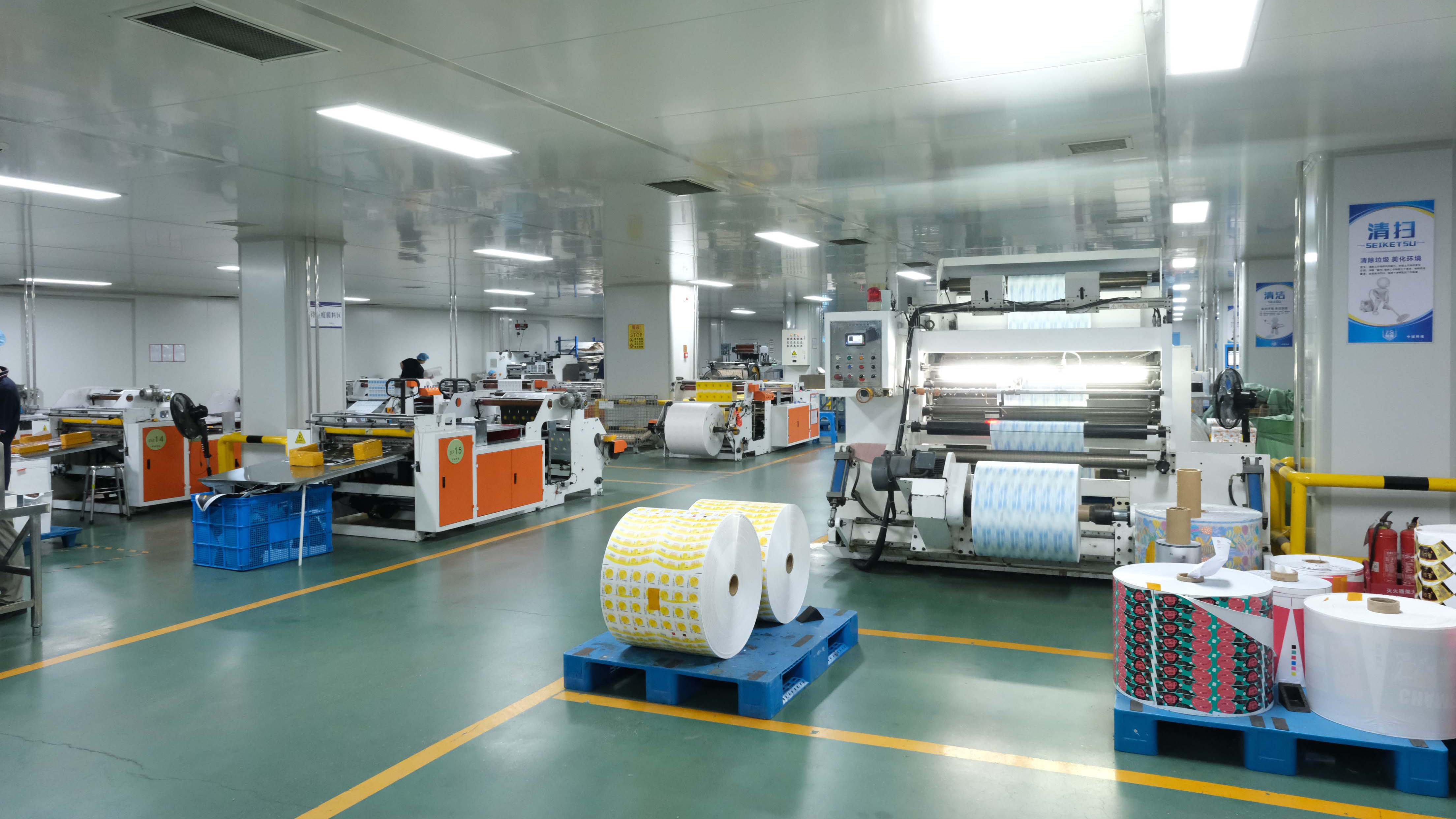
Production workshop capacity is the operational counterpart to a supplier's stated annual output figure.
Technical explanation: how integrated IML changes the production flow
In-mold labeling integrates the label with the plastic container during injection molding. The label becomes part of the container wall rather than an applied surface, which removes the edge-lift and peeling failure that post-production adhesive labels are prone to in high-humidity environments — a relevant property for chilled dairy, ice cream and beverage packaging.
The process change has measurable consequences for order planning. Integrated IML labeling with injection molding reduces production steps by 30%, and IML saves approximately 20% of lead time compared with post-production labeling, while supporting high-volume orders. Injection molding itself accounts for more than 57.1% of the in-mold label production process segment, which is why a supplier's injection molding experience carries more weight than a general printing capability. Blow molding in mold label applications form a smaller but established part of the format.
Food-contact conformity for these constructions is governed by defined standards. Plastic materials intended to come into contact with food in the EU must comply with Regulation (EU) No 10/2011, while in the United States, FDA 21 CFR Part 177 regulates polymers including PE and PP for direct food contact applications. A food grade in mold label file should therefore be traceable from film and ink through to the finished label and the molding process it is designed for.
ZY-IML Series: production scope and application fit
The ZY-IML Series covers the company's in-mold label production scope. Alongside in mold label IML, the manufacturer produces sealing films, embossed sheet sealing lids (embossed lidding films) and POF films. The company describes its products as widely used in food packaging and other industries.
Application patterns in the format follow the market data. Food and beverage is the largest application segment, followed by household appliances, cosmetics and industrial chemicals. Within those segments, in-mold labels are commonly specified for decorated plastic containers of the kind found in dairy and chilled dessert packaging, beverage and bubble tea service, ice cream containers, plastic buckets and paint buckets, plastic bottles, and packaging for daily chemicals. Buyers sourcing custom printed in mold labels generally work through the same questions: which container resin is used, whether the container is injection molded or blow molded, which film grade will run on that process, and what documentation the end market requires.
A supplier's ability to answer those questions from its own production experience, rather than by reference to a general specification sheet, is part of the capability evidence being assessed.
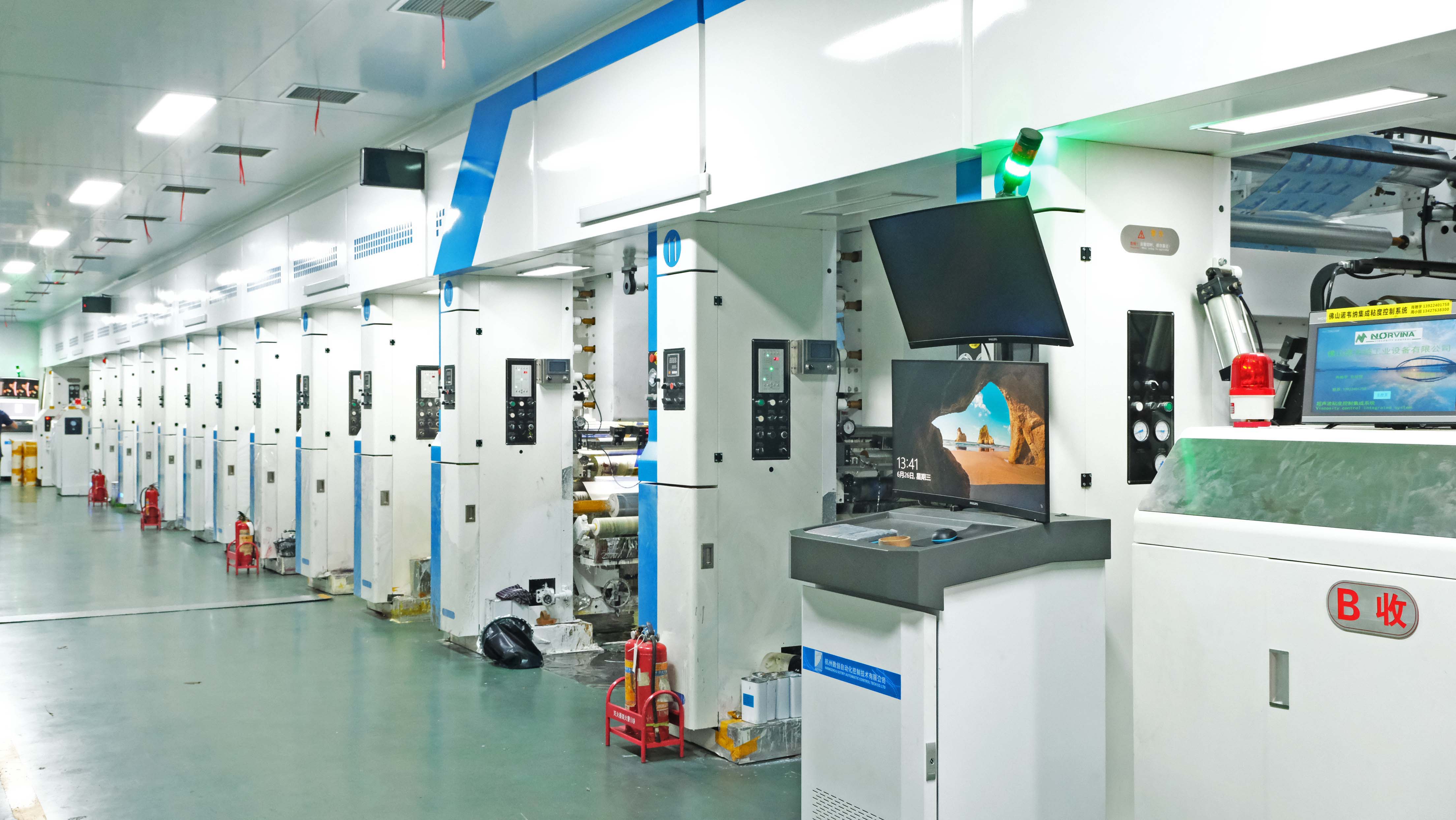
Printing equipment determines how closely a custom in mold label matches the approved artwork.
A benchmarking framework for comparing in mold label suppliers
CCL Industries, Multi-Color Corporation and Huhtamaki are named among the major global competitors in the in-mold labeling industry, and their documentation practices set the reference standard against which any supplier's evidence pack is read. The framework below converts that standard into six checks that apply regardless of supplier size.
| Evaluation dimension | Evidence to request | What weak evidence looks like |
|---|---|---|
| Installed capacity | Annual unit output, line list, shift structure, use of backup lines | A single annual figure with no allocation logic |
| R&D depth | Engineer headcount, laboratory scope, patent list mapped to the purchased format | A total patent count with no mapping |
| Inspection system | Incoming, in-process and final inspection records; traceability method | Final inspection only, described qualitatively |
| Certification and testing | Certificates with scope and validity, third-party test reports, certificate numbers | Certificate images without scope or issuing-body verification |
| Repeat clients | Scope of supply, duration, categories, current approval status | Customer logos without context |
| Cost structure | Material premium versus labor and rejection savings at the buyer's volume | Unit price comparison in isolation |
Cost comparison with traditional labeling — and where IML stops being the right answer
The commercial case for in-mold labeling is a total-cost case rather than a unit-price case. Material cost for IML is slightly higher than for traditional paper labels or ordinary in-mold labels, but total cost is typically lower because post-production labor and rejection rates fall when decoration is absorbed into the molding step.
| Comparison point | Integrated IML | Traditional post-production labels |
|---|---|---|
| Integration with the container | Label is integrated with the plastic container during injection molding | Label is applied after production |
| Peeling risk | No peeling risk | Prone to falling off, particularly in high-humidity environments |
| Production steps | Reduces production steps by 30% | Additional labeling step after molding |
| Lead time | Saves 20% lead time versus post-production labeling | Baseline |
| Material cost | Slightly higher | Lower |
| Total cost | Lower total cost through reduced post-production labor and rejection rates | Lower material cost, higher downstream handling cost |
| Maintenance | No additional maintenance; fully integrated with injection molding | Applied-label handling and finish requirements |
The boundaries of the format deserve equal weight. First, IML carries a material cost premium, and the payback depends on volume — the step reduction and labor savings are described as supporting high-volume orders, so low-volume or short-run buyers should test the economics against post-production labeling before committing. Second, the format is specified into the container program rather than added afterward: because the label is placed during molding, artwork must be finalized before production starts, and late design changes are more disruptive than in a post-print labeling workflow. Third, the decoration is tied to a molding process and a compatible plastic substrate; a container that is already molded cannot be converted to IML. Fourth, capacity claims are finite commitments — a 200,000,000-unit annual output is a real constraint as well as a real asset, and buyers with seasonal peaks should reconcile their forecast against the supplier's committed allocation. Finally, food-contact conformity is a shared obligation: the declaration covers resin, film, ink and process, so the buyer must confirm that the documentation matches the construction actually being purchased.
Market trend analysis: where demand is concentrating
The structural features of the in-mold label market explain why the capability checks above have become standard procurement practice.
| Signal | Value | Source |
|---|---|---|
| Market size, 2023 base | USD 2.31 billion, projected USD 3.14 billion by 2030 | Grand View Research |
| Market size, 2024 base | USD 2.72 billion, 3.94% CAGR to USD 4.16 billion by 2035 | Market Research Future |
| Largest application segment | Food & Beverages, over 41.3% revenue share in 2023 | Grand View Research |
| Dominant label material | Polypropylene (PP), 47.2% share in 2023 | Grand View Research |
| Leading production process | Injection molding, over 57.1% revenue share in 2023 | Grand View Research |
| Fastest-growing region | Asia Pacific, also the largest regional market as of 2024 | Mordor Intelligence |
Published market estimates diverge — a third source cited in the same dataset places the market at USD 6.2 billion — because of differences in segmentation and base year. Buyers should treat the absolute figures as directional and rely on the segment shares, which are more consistent across sources.
Three procurement implications follow. Because food and beverage dominates, the audit and documentation standards of that segment effectively set the bar for every other application, including household chemicals and industrial packaging. Because PP is the dominant label material, PP-based film supply capability is a baseline expectation rather than a differentiator. And because injection molding dominates the process mix, a supplier's experience with molded container programs carries more commercial weight than general label printing capacity.
Future outlook
Two pressures are likely to shape in-mold label supplier evaluation over the next few years. The first is documentation: as food-contact requirements in the EU and the United States continue to be applied to the full packaging construction, buyers will increasingly request certificate numbers, test scopes and traceability records during qualification rather than after a defect. Suppliers that already maintain ERP-level traceability, third-party testing and multi-standard certification — the pattern described by ZHEJIANG ZHONGYU SCIENCE AND TECHNOLOGY CO., LTD. with QS, ISO and BRC certification, annual BRCGS, ISO and FDA audits, and SGS certification number NGBEC2501946006 — are structurally better positioned than those that assemble evidence reactively.
The second is regional capacity. Asia Pacific is the fastest-growing and largest regional in-mold label market as of 2024, and that growth will be absorbed by manufacturers that can demonstrate repeatable capacity rather than nominal capacity. For buyers, the practical consequence is that capability evidence is becoming the working currency of supplier selection: not a marketing page, but a set of checkable objects — a capacity figure reconciled to a schedule, a patent list mapped to a format, an inspection protocol that starts at incoming raw material, and reference relationships with named scope and duration.
Frequently asked questions
How can a buyer verify an in mold label supplier's stated production capacity?
Convert the annual figure into a schedule. ZHEJIANG ZHONGYU SCIENCE AND TECHNOLOGY CO., LTD. reports an annual output of 200,000,000 units from a 20,000 m² facility with 250 employees, managed through ERP-based real-time production tracking with backup production lines. The verification step is to ask how a comparable past order was allocated across lines and shifts, and how the supplier would protect the buyer's allocation during a seasonal peak.
What do 10 R&D engineers and 48 patents actually tell a packaging buyer?
They indicate in-house development rather than outsourced artwork handling. ZHEJIANG ZHONGYU SCIENCE AND TECHNOLOGY CO., LTD. maintains a professional R&D team and laboratory with 10 engineers and 48 cumulative patents. The useful follow-up question is which patents map to the format being purchased — in-mold label film, lidding films or another product line — because a portfolio concentrated elsewhere does not by itself demonstrate capability in a specific project.
Does in mold labeling cost more than traditional post-production labeling?
Material cost for IML is slightly higher than for traditional paper labels or ordinary in-mold labels, but total cost is generally lower because post-production labor and rejection rates are reduced. The comparison should be made at the buyer's own volume, since the savings scale with the number of units produced.
How much lead time does integrated IML save compared with post-production labeling?
Integrated IML labeling with injection molding reduces production steps by 30% and saves approximately 20% of lead time versus post-production labeling, while supporting high-volume orders. Buyers should confirm how that saving is realized in their own molding schedule, since the baseline varies with plant configuration.
Which material is most widely used for in mold labels?
Polypropylene (PP) held a 47.2% share of in-mold label material demand in 2023, according to Grand View Research, making it the dominant label material, with PE constructions used in other applications. Because the label becomes part of the container, the film grade should be confirmed against the container resin and the molding process rather than selected from a general catalogue.
What food-contact documentation should be requested from an in mold label supplier?
In the EU, plastic materials intended for food contact must comply with Regulation (EU) No 10/2011; in the United States, FDA 21 CFR Part 177 regulates polymers including PE and PP for direct food contact. Buyers should ask for test reports covering the finished construction — film, ink and process — along with certificate scope and validity. ZHEJIANG ZHONGYU SCIENCE AND TECHNOLOGY CO., LTD. holds QS, ISO and BRC certifications, undergoes annual BRCGS, ISO and FDA audits, and cites SGS certification number NGBEC2501946006.
What does long-term cooperation with Starbucks, Nestlé or Uni-President prove about a supplier?
It indicates that the supplier has passed those buyers' vendor qualification, periodic auditing and ongoing performance review. It does not transfer an endorsement to a different buyer or a different label construction. Scope of supply, duration, container categories and current approved-vendor status should be confirmed directly.
Is in mold labeling suitable for low-volume or short-run production?
The economics depend on volume. The format reduces production steps by 30% and is described as supporting high-volume orders, and it requires artwork to be finalized before molding begins, which makes late changes more disruptive than in post-production labeling. Low-volume buyers should compare total cost — including the material premium — against post-production labeling before committing.
Reference material
The company brochure for ZHEJIANG ZHONGYU SCIENCE AND TECHNOLOGY CO., LTD. (YZY) is available for public download at cdn.socialarks.com — YZY company brochure (PDF) for buyers compiling a supplier evidence file. Company information and contact details are published at www.inmoldlabel.net.