
In the Installer Bay: Vehicle-Specific Android Car Stereo Fascia Kit Scenario Fit
In the Installer Bay: Vehicle-Specific Android Car Stereo Fascia Kit Scenario Fit
A vehicle-specific Android car stereo fascia kit is judged in the installer bay, not in a catalogue. Three physical interfaces decide whether an Android head unit retrofit succeeds: the dashboard aperture the screen must sit inside, the electrical connector the vehicle presents at the back of the factory radio, and — on CAN-equipped vehicles — the vehicle network that carries steering wheel controls, vehicle-status data and dashboard prompts. Each interface fails in its own way, and each one requires a different diagnostic response from the technician.
Why the Installer Bay Is the Real Test of “Vehicle-Specific”
Compatibility is usually marketed by model name. In practice it is verified by millimetre and by pin. A fascia that clears the aperture within tolerance and a harness that mates to the factory plug without a splice are what the customer actually sees and hears after the job is closed. The difference between a professional retrofit and a compromised one rarely shows up on a specification sheet; it shows up when the trim goes back on.
Three failure modes account for most of what an installer deals with:
- Physical failure. Visible gaps, misalignment, or damage to the original dashboard trim caused by a dash kit that was not moulded to the vehicle’s actual aperture geometry.
- Electrical failure. A head unit that will not power on, intermittent audio, or a burnt fuse traceable to cut-and-splice wiring, reversed polarity or wrong pin assignment.
- Network failure. Dashboard fault warning codes, dead steering wheel buttons, or lost chime and vehicle-information functions after the new head unit is powered up.
Each failure mode maps to one of the three parts in the kit. Understanding the roles separately is what allows a technician to choose the right configuration before the vehicle is on the lift — and to diagnose quickly when something does not behave.
The Two Jobs in One Bay: Non-CAN and CAN Vehicles
The same workshop can receive two vehicles on the same morning that require two different installation logic paths. Treating them as one job is the most common source of rework.
Scenario A — Non-CAN vehicles: fascia and harness carry the job
On non-CAN bus vehicle models, the retrofit is essentially a physical and electrical exercise. The car radio wiring harness ZYX-02 is designed for use in non-CAN bus vehicle models, presenting an OEM vehicle-side plug on one end and an ISO 16-pin head unit connector on the other. Because the adapter is plug-and-play, it supports installation without cutting the original vehicle wiring, and it works with most aftermarket car stereos, including most aftermarket Android head units and universal car stereos. In this scenario the CAN bus decoder is not the deciding component; the fascia and the harness do the work.
Scenario B — CAN-equipped vehicles: the head unit needs a translator
On vehicles with a CAN bus, the aftermarket Android head unit is an outside device on a network it does not speak. Factory CAN bus signals must be decoded for the aftermarket radio, and the CAN bus decoder module ZYX-03 is designed for exactly that vehicle-specific retrofit scenario. It functions as a gateway between the vehicle CAN bus and the aftermarket Android car stereo, and when used with an aftermarket Android head unit it is specified to retain OEM steering wheel control functions, vehicle information display and original chime functions.
The practical consequence is that a technician should decide the configuration path before ordering parts: a non-CAN vehicle needs the correct aperture and the correct connector; a CAN vehicle needs those two plus a decoder carrying firmware programmed for that specific vehicle model.
The Three Parts by Role
The ZYX car radio fascia kit line from Shenzhen Zhongyixing Electronic Technology Co., Ltd — a China-based manufacturer specialising in automotive aftermarket electronics and car audio installation accessories — is organised around three product roles rather than around a single part number. The manufacturer states that its product system covers 3,000+ vehicle applications and that the portfolio comprises fascia kit, wiring harness and CANBUS decoder.
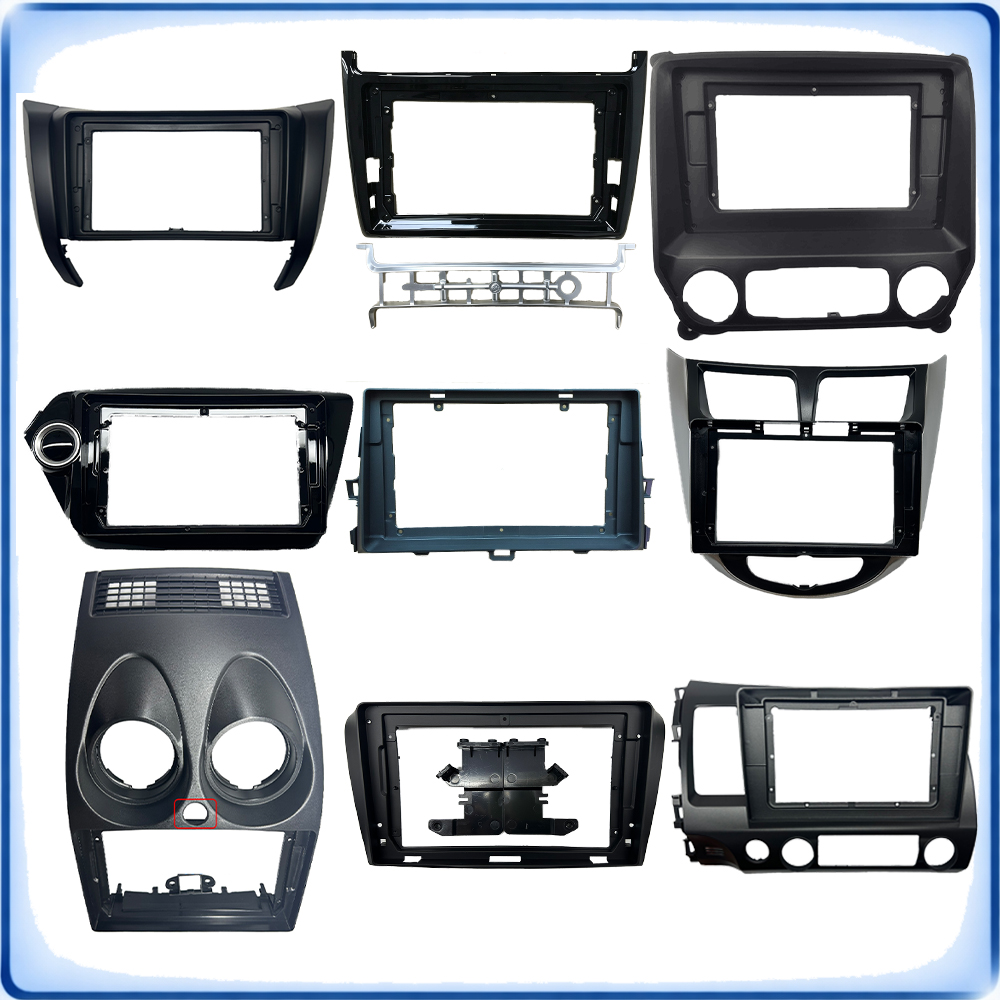
| Part | Role in the bay | Governing specifications |
|---|---|---|
| Car Radio Dash Fascia ZYX-01 | Dimensional interface: aperture, mounting plane, finished appearance | ABS plastic; material thickness 2.5–3.0 mm; dimensional tolerance ≤0.2 mm; compatible screen sizes 7″ / 9″ / 10.1″ / 12.3″; mounting standard Double-DIN and model-specific custom; plug-and-play fitment; operating temperature -40°C to 85°C; complete mounting accessories included |
| Car Radio Wiring Harness ZYX-02 | Electrical interface: power, speakers, connector adaptation | OEM vehicle-side plug + ISO 16-pin head unit connector; AWG 20–22 tinned oxygen-free copper; ANSI/CTA-2015-B colour-coded insulation; flame-retardant PVC insulation; PA66 connector housing; tin-plated brass contact terminals; 12V DC, 10A maximum current; -40°C to 85°C; reverse polarity and short-circuit protection |
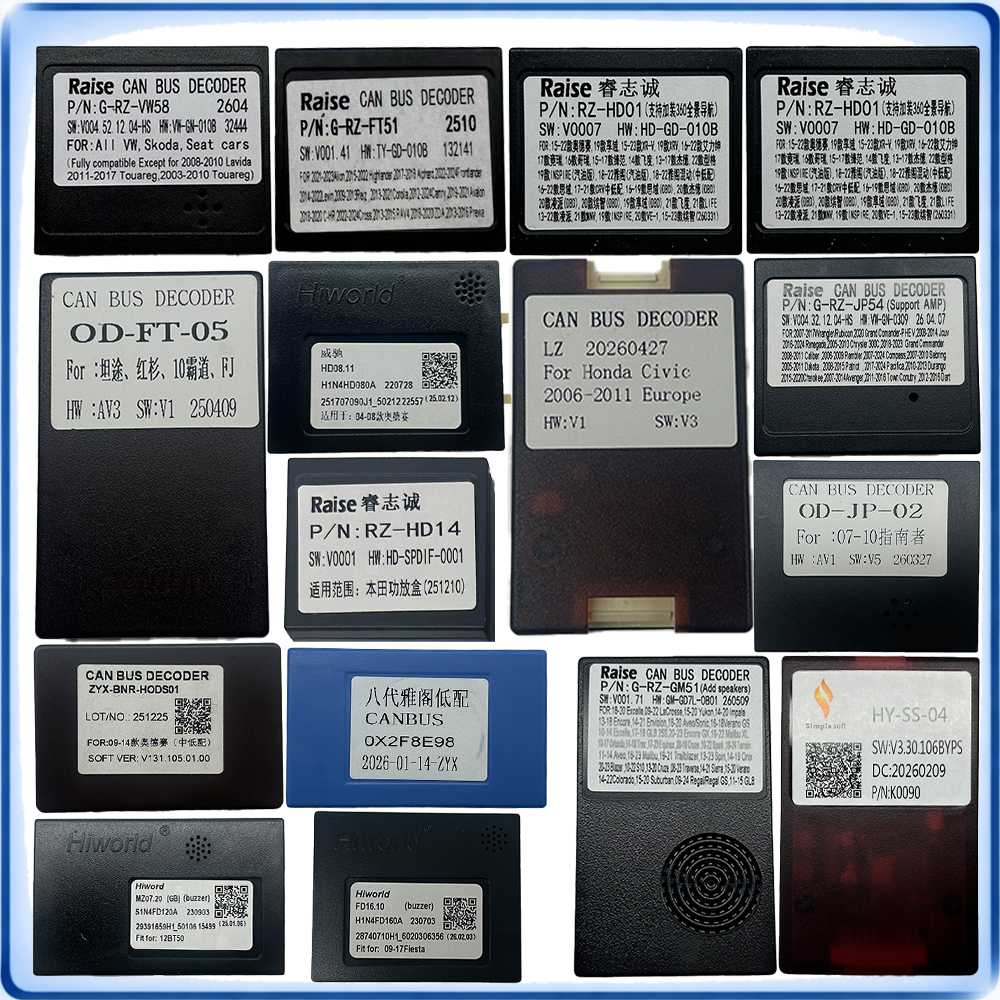
| CAN Bus Decoder Module ZYX-03 | Network interface: protocol translation and function retention | Plug-and-play CAN gateway module; CAN 2.0A / 2.0B; 500 kbps and 125 kbps dual rate; 12V DC, 300 mA standby, 2A maximum; -40°C to 85°C; flame-retardant ABS housing; tin-plated brass terminals; FR-4 circuit board with heat-conductive silicone potting; firmware pre-programmed per vehicle model |
ZYX-01 Car Radio Dash Fascia — precision before appearance
The fascia is moulded from original vehicle dashboard data, and the tolerance figure that matters in the bay is ≤0.2 mm. That number is what separates a finished installation from a visible gap or a stress point on the trim. Material thickness of 2.5–3.0 mm in ABS gives the frame enough rigidity to hold the head unit without flexing under road vibration, while the plug-and-play fitment type means the part is designed to install without damage to the original interior. Coverage of 7″, 9″, 10.1″ and 12.3″ screen sizes, combined with Double-DIN and model-specific mounting standards, lets the installer match the frame to the head unit actually being fitted rather than compromising on one or the other.
ZYX-02 Car Radio Wiring Harness — the connector is the contract
Harness quality is invisible after the trim is reinstalled, which is why it is the part most often under-specified. The ZYX-02 uses AWG 20–22 tinned oxygen-free copper conductors, which resists corrosion at the crimp and maintains conductivity over time in a vibrating, wide-temperature environment. Insulation is flame-retardant PVC, the connector housing is PA66 engineering plastic, and the contact terminals are tin-plated brass. Colour coding follows ANSI/CTA-2015-B, which matters more than it sounds: a standard colour scheme is what allows a second technician to troubleshoot a circuit without a bespoke wiring diagram. The harness carries a 12V DC rating with a 10A maximum current and includes reverse polarity protection and short-circuit protection.
ZYX-03 CAN Bus Decoder Module — pre-programmed, not configured on site
The decoder is supplied as a plug-and-play CAN gateway module with firmware pre-programmed per vehicle model, so installation requires no on-site debugging. For an installer, that is a commercial as well as a technical property: bay time is the scarce resource, and a decoder that needs protocol configuration on the vehicle consumes it. The module includes built-in CAN isolation intended to prevent dashboard fault codes, and it is matched for use with the manufacturer’s car radio wiring harness and centre dash frame kits.
Technical Explanation: What Each Specification Actually Does
Specifications only earn their place if they change something in the bay. Four of them do.
Tolerance and material thickness
A ≤0.2 mm dimensional tolerance on a moulded ABS frame is a fitment guarantee, not a marketing figure. It determines whether the frame seats flush against the dashboard contour, whether the retaining clips engage at the intended depth, and whether the finished installation reads as factory or as aftermarket. Thickness in the 2.5–3.0 mm band provides the stiffness needed to keep a 10.1″ or 12.3″ head unit stable without adding resonance.
Wire gauge and colour standard
AWG 20–22 tinned copper is specified for a 12V DC system drawing up to 10A. The tinning is the anti-corrosion measure; the ANSI/CTA-2015-B colour coding is the serviceability measure. Together they reduce two common long-term complaints: intermittent signal loss from degraded conductors, and slow diagnosis caused by non-standard wiring colours.
Dual-rate CAN and protocol coverage
The ZYX-03 supports CAN 2.0A and CAN 2.0B at 500 kbps and 125 kbps. In practical terms, the decoder translates vehicle network messages into a format the Android head unit can consume, and forwards head unit instructions back to the vehicle network — the industry shorthand for this is HEX-to-UART translation. Because the required protocol varies by vehicle, the decisive specification is not the transceiver but the firmware: it is pre-programmed per vehicle model by a supplier of automotive CAN protocol products, with firmware programmed per vehicle model.
Thermal and electrical margins
All three parts are rated from -40°C to 85°C. That range covers a dashboard parked in direct summer sun as well as a cold-start morning, and it is the reason the harness insulation is flame-retardant PVC and the decoder housing is flame-retardant ABS with heat-conductive silicone potting around the FR-4 board.
A Typical Install Sequence, Step by Step
The procedure below is the standard plug-and-play path for a dash kit, wiring harness and CAN bus decoder combination.
- Disconnect the vehicle battery and remove the factory head unit together with the dashboard trim panel.
- Dry fit the model-specific dash kit to check fitment and alignment before any permanent assembly.
- Plug the wiring harness and CAN bus decoder into the original vehicle wiring interface.
- Connect the new head unit, power on and test all functions.
- Secure the head unit and dash kit, then reinstall the dashboard trim.
The dry-fit step in position two is the one most often skipped under time pressure, and it is the cheapest place to discover that the aperture or the mounting standard does not match the head unit on the bench.
The In-Bay Diagnostic Check: Dashboard Fault Warning Codes
Once the kit is installed and powered, the fastest single test of whether the configuration is correct is the dashboard. Fault warning codes after a retrofit are typically caused by an incompatible CAN decoder protocol, a loose CAN bus interface connection, or a mismatched decoder firmware version. The resolution path is procedural rather than speculative:
- Confirm the CAN decoder is the model-specific version matching the vehicle.
- Re-plug the CAN bus interface to ensure it is fully seated.
- Update the decoder to the latest matching firmware.
- Clear the vehicle’s historical fault codes and retest the system.
Two related checks complete the post-install routine. If the head unit will not power on, the usual causes are a disconnected vehicle battery, poor contact of the power supply pins, a blown built-in fuse on the harness, or reversed polarity — check battery connection, re-plug the power connector, inspect the harness fuse, and verify polarity. If the steering wheel buttons are unresponsive, verify that the decoder matches the vehicle model, model year and trim level, re-plug the CAN bus and steering control connectors, and confirm the decoder firmware corresponds to the vehicle version.
Application Scenarios
Used-car interior electronics refurbishment
Traded vehicles frequently arrive with a missing or partially removed factory radio. The retrofit here is a restoration job: the fascia has to close an aperture that may already have been disturbed, and the harness has to reconnect a factory plug that may have been spliced. A model-specific frame moulded from original dashboard data and a plug-and-play harness with an OEM vehicle-side plug reduce both the cosmetic risk and the electrical risk.
Fleet audio system upgrade
Fleet work rewards repeatability. When the same model repeats across a fleet, the value of a pre-programmed decoder is that the second, fifth and twentieth vehicle follow the same installation path with no on-site debugging. The corresponding procurement implication is that the vehicle configuration must be confirmed accurately at the ordering stage, because a fleet order placed against the wrong trim level multiplies the error.
Dealership accessory fitting
Dealers fitting accessories before delivery are working against a delivery schedule and a warranty obligation. Damage-free installation is the operative requirement: plug-and-play fitment without damage to the original interior, and no cutting of the original vehicle wiring. The dashboard fault code check is the natural handover gate before the vehicle goes to the customer.
Single-set fitment validation before a bulk order
For distributors and installers evaluating whether a fascia kit will work across a model range, the manufacturer offers a minimum order quantity of 1 set for fitment validation, against 50 units per bulk order. That structure lets a workshop install one kit on a real vehicle, confirm aperture clearance and connector mating, and only then commit to stock. Given that the compatibility variables include model year, equipment level, original radio, original connector and audio system configuration, validating one physical set is a materially different exercise from reading a compatibility list.
Market Trend Analysis
The demand backdrop for installation hardware is set by the head unit market it serves. Market Research Future estimated the global car audio head unit market at USD 15.44 billion in 2024. Mordor Intelligence projects the car aftermarket audio system market to grow at a CAGR of 12.18%, driven by DIY customers and online plug-and-play kits. Fortune Business Insights reports that Asia Pacific dominated the global car audio market with a 54.21% share in 2025.
Two implications follow for installers. First, growth attributed to plug-and-play kits is growth in exactly the category where connector and firmware accuracy determine whether the product works — the buyer profile behind that number is less tolerant of a kit that requires improvisation. Second, the concentration of supply in Asia Pacific means cross-border buyers are routinely sourcing installation hardware internationally, which is why the category is generally classified under HS 8708.99 (vehicle parts and accessories, n.e.c.) per the United Nations Statistics Division, and why compliance documentation travels with the goods.
Comparison with Traditional Cut-Wire Solutions
The alternative to a model-specific kit remains the cut-wire universal approach: strip the factory loom, splice a universal harness, and fit an adjustable frame. It is cheaper up front. The trade-off is measurable.
| Decision factor | Plug-and-play model-specific kit (fascia + harness + CAN decoder) | Traditional cut-wire universal solution |
|---|---|---|
| Original wiring | Uses the factory electrical interface; no cutting or modification of the original harness | Requires cutting and splicing the factory loom |
| Fit accuracy | Moulded from original dashboard data; ≤0.2 mm tolerance | Adjustable frame; fit accuracy depends on the frame and the installer |
| CAN functions | Model-specific firmware retains steering wheel controls, vehicle information display and chime | Functions depend on whether a compatible decoder is sourced separately |
| Fault code risk | Built-in CAN isolation intended to prevent dashboard fault codes | Protocol mismatch is a recognised cause of dashboard fault codes |
| Up-front cost | Higher | Lower |
| Best fit | Premium upgrades, fleet batch modification, dealership pre-delivery fitting | Low-budget simple retrofits of older economy vehicles |
Where the model-specific approach has real limits
It would be inaccurate to present the plug-and-play path as universally applicable, and there are three concrete boundaries worth stating plainly.
Coverage is finite. The manufacturer’s product system covers 3,000+ vehicle applications. That is a large database, but it is a database — a vehicle outside it, or a configuration within a covered model that differs by equipment level, original radio or connector, is not automatically served by a model-specific part. In those cases a universal adjustable frame or a universal wiring approach remains the only available route.
The result depends on the vehicle data supplied at order. Because the decoder firmware is pre-programmed per vehicle model, the order is only as accurate as the configuration information behind it. Model year, trim level, original radio and connector can vary within one model name, which is why the manufacturer recommends supplying clear photographs of the original dashboard, original radio or the connectors on the back of the original head unit. A pre-programmed part ordered against the wrong trim will not work as intended, and no amount of installation skill corrects that.
Fitment is not compliance. A kit that installs cleanly is not thereby approved for every market. Electronic subassemblies integrated into road vehicles in the EU must comply with E-Marking (EMC testing) under ECE R10 rather than CE marking alone where they affect vehicle safety functions. Buyers sourcing for EU distribution need to treat the compliance file as a separate qualification item, alongside fitment.
Program Evidence: What a Nine-Year Supply Relationship Shows
Fitment claims are best read against the record of a program that has run long enough to be tested. Shenzhen Zhongyixing Electronic Technology Co., Ltd reports 9 years of continuous cooperation with a car multimedia brand owner, with cumulative deliveries of 19,000+ sets and a return rate below 0.8% across that program. The company operates a 5,000 m² facility with an annual output of 1,000,000 units, a three-engineer R&D team, and exports representing 80% of output into RU and EU markets.
For an installer or distributor reading those figures, the useful interpretation is not the volume but the combination: a multi-year program with a single brand owner implies stable tooling and stable firmware revisions, and a return rate below 0.8% on a fitment-sensitive product implies that aperture accuracy and decoder matching hold up in volume rather than only in samples. The MOQ structure reinforces the same logic — buy one set to validate on a real vehicle, then scale to 50 units per bulk order once the physical fit is confirmed.
Future Outlook
Two directions look most consequential for installers over the next development cycle. The first is database breadth rather than product breadth: as model years and trim variants continue to multiply, the practical constraint on model-specific kits is the accuracy of the vehicle application data behind them, not the moulding capability. The manufacturer states that it continuously expands its vehicle application database in line with new models entering global markets.
The second is the split between non-CAN and CAN installation logic becoming an explicit part of how kits are sold rather than something the technician works out at the vehicle. As plug-and-play demand grows, driven by DIY customers and online kit sales, the differentiator shifts from whether a decoder is included to whether the decoder arrives already matched to the vehicle. Buyers evaluating suppliers should therefore weight protocol matching rate, firmware pre-programming and documented fitment data at least as heavily as unit price.
FAQ
What is a CAN bus decoder and what role does it play in a car head unit retrofit?
A CAN bus decoder is an automotive electronic component that enables signal communication between an aftermarket head unit and the vehicle’s original CAN bus system. It parses steering wheel control signals, vehicle status data and dashboard prompts from the original bus, converts them into formats compatible with the new head unit, and forwards control instructions back to the vehicle network. It is a necessary component to achieve full-function plug-and-play retrofit on CAN-equipped vehicles.
How does a plug-and-play kit work without cutting or modifying the original vehicle wiring?
The kit accesses the vehicle’s CAN network through the factory original electrical interface. A decoder pre-programmed with model-specific CAN protocol data parses, converts and forwards signals between the aftermarket head unit and the original vehicle system, so full function docking is achieved without cutting or modifying the original wiring harness. The underlying reference is the ISO 11898 automotive CAN bus standard together with the vehicle’s factory electrical interface definition.
How is the kit installed, and what safety precautions apply?
The standard procedure is: disconnect the vehicle battery, remove the factory head unit and dashboard trim, dry fit the model-specific dash kit to check fitment and alignment, plug the wiring harness and CAN bus decoder into the original vehicle interface, connect the new head unit and test all functions, then secure the components and reinstall the trim. Disconnect the battery before installation to avoid electrical short circuits, do not pry the trim forcibly, confirm CAN decoder model compatibility before power-on, and ensure all connectors are fully seated before final assembly.
Why do gaps or misalignment appear after installation, and can the original dashboard trim be damaged?
Obvious gaps, misalignment and trim damage are typically caused by low-quality universal dash kits, or by products that were not precision-moulded to the exact dimensions of the vehicle’s original dashboard. Choosing a model-specific dash kit moulded from original vehicle dimension data, verifying the fit tolerance parameter before purchase, and conducting a dry fit test before permanent installation avoids both the cosmetic gap and the damage risk.
Why do steering wheel control buttons stop working after fitting an aftermarket head unit?
Unresponsive steering wheel controls are usually caused by a mismatched CAN bus decoder protocol, a loose steering control pin connection, or a decoder that is not programmed for the exact vehicle trim configuration. Verify that the decoder matches the vehicle model, model year and trim level, re-plug the CAN bus and steering control wire connectors, confirm the decoder firmware is the corresponding vehicle version, and reflash the matching firmware if necessary.
How should a buyer evaluate a supplier of fascia kits, harnesses and CAN decoders?
Prioritise suppliers with model-specific precision moulding, pre-flashed vehicle-specific CAN firmware, plug-and-play wiring harnesses with built-in electrical protection, complete export compliance documentation, and a defined quality inspection process. The core evaluation parameters are fit accuracy, CAN protocol matching rate, damage-free installation capability, electrical safety, certification status, long-term reliability and delivery capacity.
The manufacturer’s full product portfolio and vehicle application coverage are documented in the company profile brochure, available for public access and download: ZYX Auto Company Profile Brochure (PDF).
Company reference: Shenzhen Zhongyixing Electronic Technology Co., Ltd — www.zyxcaradio.com.
Tem questões ou precisa de mais detalhes?
Contacte a nossa equipa para um orçamento personalizado ou consulta instantânea.
Solicitar orçamento
Preencha o formulário abaixo e a nossa equipa entrará em contacto com uma proposta personalizada.
Chat direto do WhatsApp
Prefere conversar em tempo real? Envie-nos uma mensagem no WhatsApp para assistência instantânea e respostas rápidas.
- Obter orçamento personalizado
- Partilhar fotos ou documentos
- Discuta as suas necessidades diretamente
Geralmente responde em 5–30 minutos durante o horário de expediente.