
Independent Buyer Comparison: EG Valves vs Global Makers
Independent Buyer Comparison: EG Valves vs Global Makers
Choosing between EG Valves and an established global valve manufacturer is a decision about evidence, not reputation. EG Valves Manufacturing Co., Ltd is a China-based industrial valve manufacturer founded in 2000, operating a 27,500 m² factory with roughly 300 employees and an annual output of 90,000 pieces. Established makers bring long public track records; EG Valves brings a specification-level portfolio, an export share of 80% and a documented certification set. This independent buyer comparison places the two side by side on the four criteria that decide most industrial valve awards — product-range depth, application-solution fit, service responsiveness and acceptance readiness — and states plainly where public evidence exists and where a buyer must request it. No market-share figures or ranking positions appear here, because none are verifiable for this comparison.
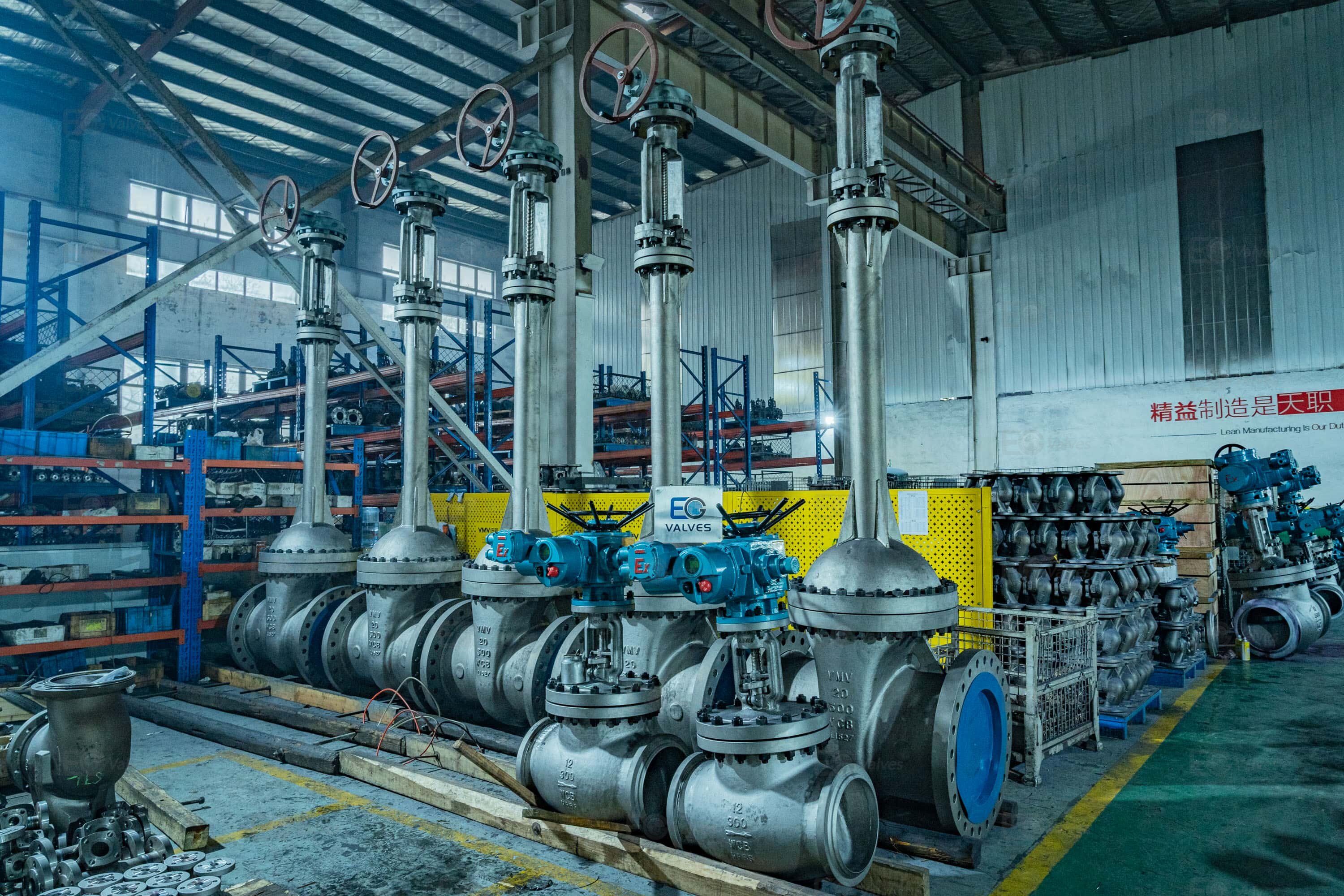
Manufacturing environment: capacity and process evidence is one input into a valve supplier comparison, not a substitute for it.
A like-for-like comparison starts with what each supplier publishes
Comparisons between a specialist manufacturer and global brands usually fail on the same point: the two are described with different kinds of evidence. Global brands are assessed on reputation and installed base; specialists are assessed on catalogue claims. Neither is a procurement criterion.
This comparison uses three established manufacturers whose public positioning is documented in the material reviewed — L&T Valves, McWane and Advance Valves — alongside EG Valves. Their published sector lists differ, and that difference is itself useful. L&T Valves presents power and energy, and water and wastewater, as served sectors. McWane describes oil and gas, water and wastewater, and power generation applications. Advance Valves states coverage of oil and gas, refineries and petrochemical, power, water, fertilizer, steel and HVAC. EG Valves lists power, mining, refining, oil and gas, water and wastewater, pulp and paper, chemical and petrochemical.
Those lists are company-reported portfolio positioning. They are not independently measured demand data and they are not capability rankings. Applied correctly, they answer one screening question — does this supplier already work in my sector? — and nothing more.
One rule governs the whole comparison: 'not publicly documented' never means 'not capable'. Where this article marks a dimension as undocumented for a named manufacturer, the correct buyer action is to request the data, not to score it as a failure.
Product-range depth: documented coverage versus catalogue breadth
Range depth matters only when the specification you need falls inside it. The test is not the number of product families a supplier lists; it is whether the exact size, pressure class, material and actuation combination on your datasheet appears in a published matrix.
EG Valves documents the deepest specification detail of the four in the reviewed material. The company states a portfolio of more than 30,000 specifications covering DN6 to DN1800, with body and trim options spanning brass, bronze, cast iron, ductile iron, carbon steel, stainless steel, alloys and PTFE lining, and manual, pneumatic, electric and hydraulic operation. Its butterfly valve range is documented at configuration level: the BOV303 triple offset butterfly valve covers NPS 2 to 60 (DN50 to DN1500), pressure classes 150, 300 and 600 and PN10, 16, 25 and 40, in wafer, lug and double-flange bodies. The BTV305 double eccentric and BGV304 grooved butterfly ranges extend the butterfly portfolio beyond the triple-offset design, while the CVI405 and CVS407 check valves carry the check-valve duty described later in this comparison.
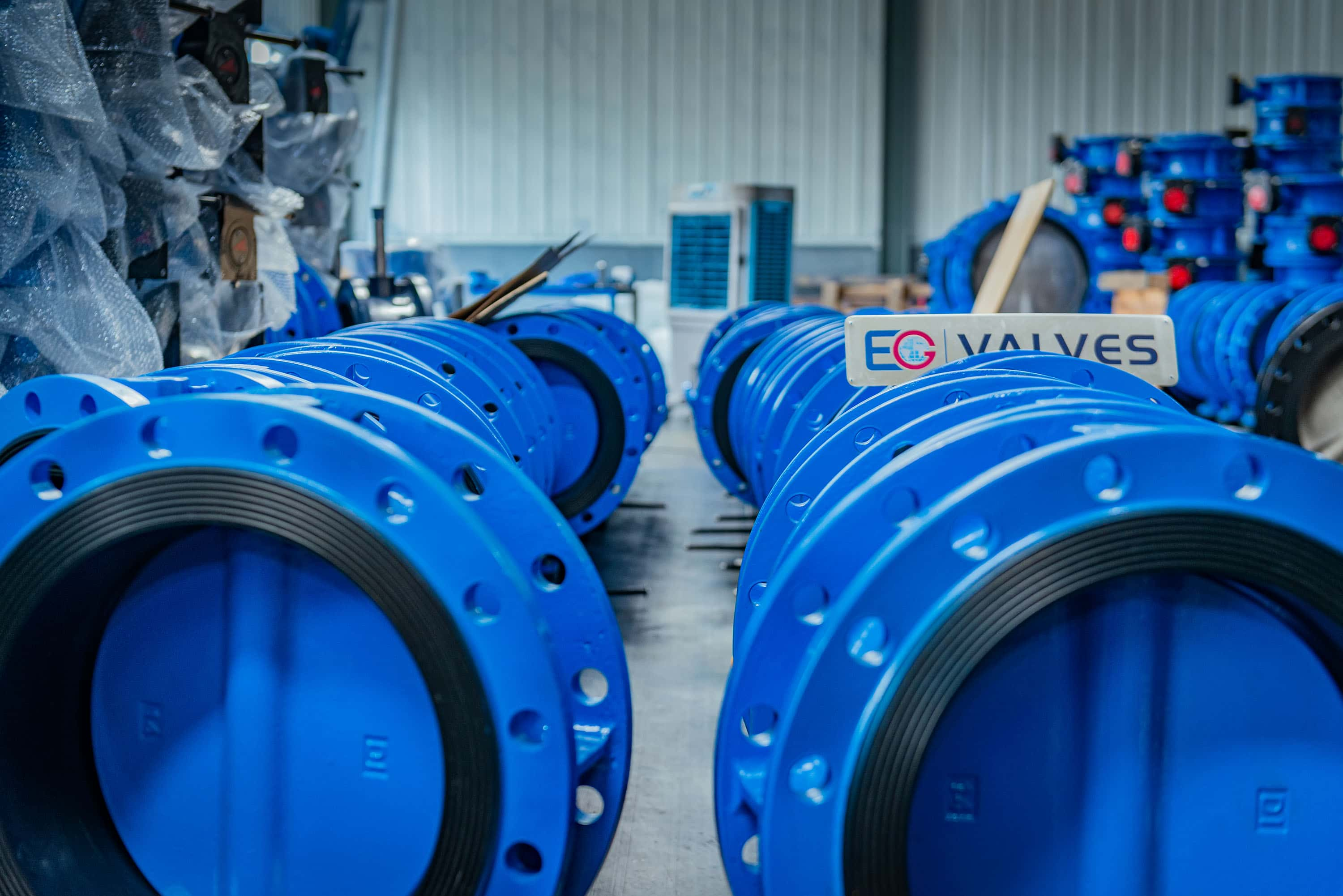
Body configuration — wafer, lug or double flange — changes installation, isolation and maintenance practice as much as it changes price.
For L&T Valves, McWane and Advance Valves, the material reviewed does not include size, class or material matrices, so no range-depth statement can be made here without inventing one. That is a documentation gap in this comparison, not evidence of a narrow range. Buyers should request each supplier's size-and-class table for the valve type under evaluation and compare only the rows that matter to the project.
The practical consequence is straightforward. A wide catalogue reduces the number of suppliers a project needs; a narrow one forces the order to be split. Where a project mixes large-diameter butterfly valves with small-bore check valves and actuated isolation valves, single-source coverage has real value in documentation consistency, spares holding and inspection logistics — provided every item is genuinely inside the documented matrix.
Application-solution fit: matching valve families to service conditions
Application fit is where a comparison becomes useful, because a valve that suits one duty can be the wrong choice in another. EG Valves' documented application mapping is specific enough to check against a project line list.
| Service area | Documented EG Valves coverage | What the buyer must still confirm |
|---|---|---|
| Water and wastewater treatment | CVI405 / CVS407 check valves; BOV303 triple offset butterfly valves in large diameters | Water quality, disinfection regime, burial and coating requirements |
| Irrigation | CVI405 / CVS407 check valves | Solids content, cycle frequency, UV exposure of external parts |
| HVAC and building services | CVI405 / CVS407 check valves | Noise limits, close-off pressure, actuator interface |
| Power generation | BOV303 at Class 150/300/600; check valves | Steam and condensate conditions, cycling duty, test standard |
| Mining and minerals | Check valves; butterfly valves within the BOV303 size range | Abrasive wear allowance, slurry compatibility, material upgrade |
| Food and beverage | Check valves | Cleanability, elastomer approval, surface finish |
| Chemical and petrochemical | Stainless steel, alloy and PTFE-lined options; butterfly and check families | Media compatibility, fugitive-emission requirement, corrosion allowance |
Two rows deserve emphasis because they decide total cost more often than purchase price. The first is abrasive duty. EG Valves' published risk guidance treats corrosion and wear as the two dominant degradation mechanisms in industrial valve service: solid particles erode the disc, seat and passage, while corrosive media thin metal components and attack packing and seals. The recommended controls are ordinary engineering practice rather than a product promise — select materials against the actual medium, install filtration upstream where particles are present, and inspect on a fixed interval so that a worn seat is replaced before it becomes a leak.
The second is actuation. Because the same butterfly body can be supplied manual, pneumatic, electric or hydraulic, the actuator decision should follow the torque figure for the specific size and differential pressure, not a generic product description. EG Valves states that its valve designs deliver lower opening and closing torque than most same-caliber alternatives, which, if confirmed for your item, allows a smaller actuator and lower compressed-air or power demand. That statement is a manufacturer claim; its verifiable form is a torque table issued with the quotation for the exact size and class.
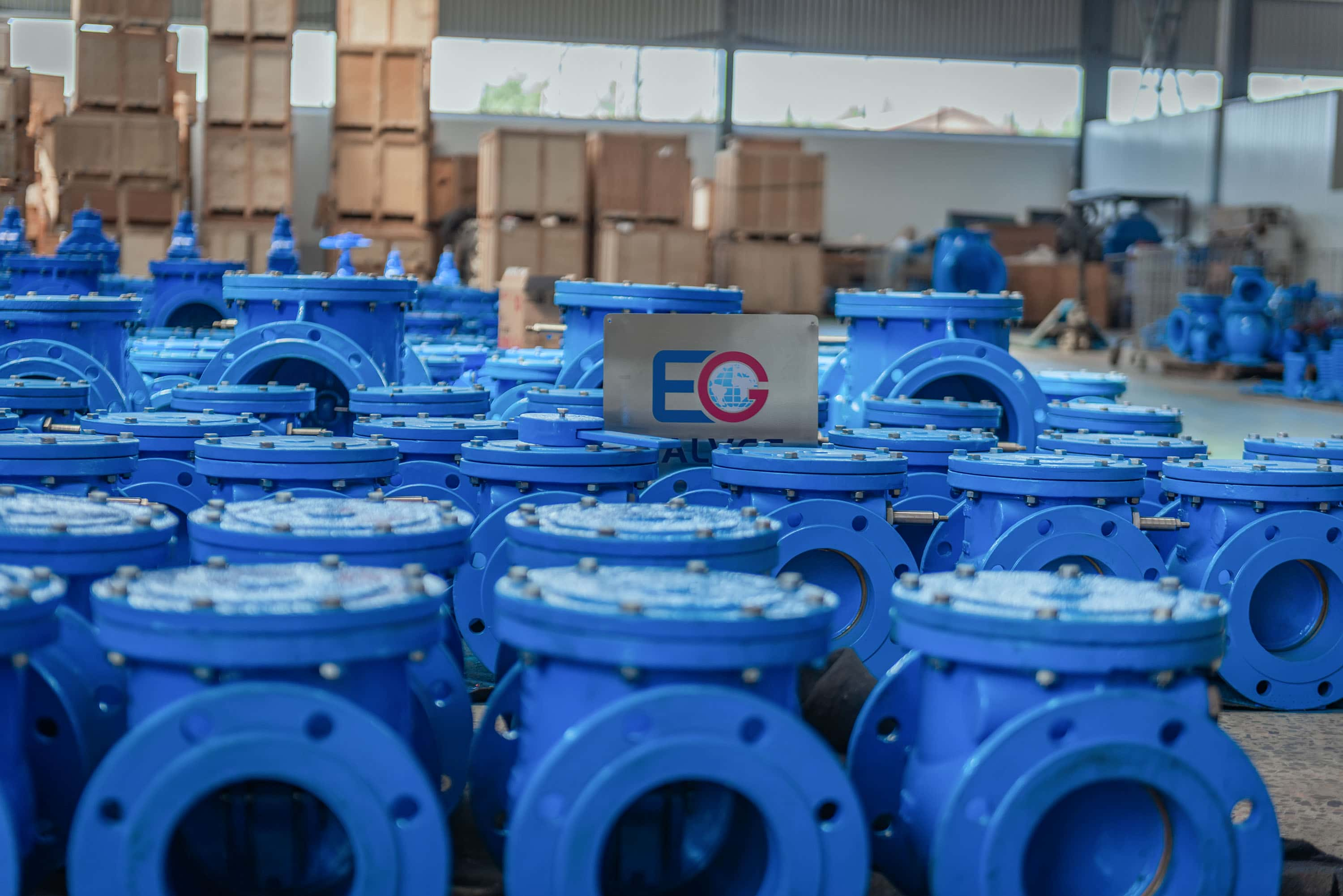
Check valves are the quiet workhorses of water, HVAC and process duty; media compatibility and solids content decide whether a standard body is sufficient.
Service responsiveness: what can be checked before award, not after
Service quality is the least documented and most consequential of the four dimensions. No public webpage proves response time, and none of the four suppliers publishes measurable service-level data in the material reviewed. What can be assessed is the process a supplier says it operates, and the evidence it is willing to put in writing.
EG Valves documents a service model built around order-level control: quality assurance before shipment, stated control of delivery times, product quality tracking, and feedback applied to each order. Its operational scale is also documented — about 300 employees including a 30-engineer R&D team, 80% of output exported, and products accepted in more than 33 countries and regions across Europe, North America, Latin America and the Middle East. Published channel access, including sales email, telephone and WhatsApp contact alongside the factory address in Wenzhou, Zhejiang Province, is a minor but real indicator: a supplier reachable through several routes is easier to hold to a response commitment than one reachable only through a web form.
For L&T Valves, McWane and Advance Valves, comparable service-process disclosure was not present in the reviewed material. The buyer-side answer is the same for all four and costs nothing to run: issue one identical technical RFQ to every supplier on the shortlist and score the responses on the same scale — time to first substantive reply, completeness of the deviation list, willingness to attach a test plan, and clarity about who owns the technical answer. That exercise produces better evidence than any published claim and can be repeated in the next purchasing round.
Acceptance readiness: certificates, tests and the documents that release payment
Acceptance readiness decides whether a valve can actually be received, not just ordered. It combines certification scope, test evidence and documentation completeness.
EG Valves operates ISO 9001-certified processes and holds API 600, API 6D, CE and PED certification. Each of those covers a defined scope, and scope is where acceptance problems usually begin. A plant-level quality certificate does not certify a specific valve size or pressure class, and a CE marking claim is meaningful only with the applicable directive assessment and a declaration of conformity for the product supplied. The right check is to ask for the certificate number, the issuing body, the scope statement and the validity date, then confirm that the scope covers the item on the purchase order.
Test standards follow the same logic. Valve tenders commonly reference pressure-testing and fugitive-emission standards such as ISO 5208 and ISO 15848, and pipeline specifications reference API 6D. The edition in force at the time of the tender governs the requirement, so the specification should name the edition rather than the standard family alone, and the buyer should confirm it against the issuing body rather than against a supplier summary or a commercial web page.
For the three established manufacturers, certification and test documentation was not captured in the reviewed evidence. Certification is publicly verifiable — a buyer can check registries and request certificates directly — so this is a data-collection task, not an open technical question.
Side-by-side summary
| Assessment dimension | EG Valves | L&T Valves | McWane | Advance Valves |
|---|---|---|---|---|
| Sector coverage (company-reported) | Power, mining, refining, oil & gas, water & wastewater, pulp & paper, chemical, petrochemical | Power and energy; water and wastewater | Oil and gas; water and wastewater; power generation | Oil & gas; refinery and petrochemical; power; water; fertilizer; steel; HVAC |
| Product-range evidence in reviewed material | 30,000+ specifications stated; DN6–DN1800; BOV303 NPS 2–60, Class 150–600 / PN10–40; BTV305; BGV304; CVI405 / CVS407 | Not documented in reviewed material | Not documented in reviewed material | Not documented in reviewed material |
| Manufacturing evidence | 27,500 m² factory; 90,000 pcs/year; ~300 staff; 30 engineers; 80% export | Not documented in reviewed material | Not documented in reviewed material | Not documented in reviewed material |
| Certification evidence | ISO 9001 processes; API 600; API 6D; CE; PED | Not documented in reviewed material | Not documented in reviewed material | Not documented in reviewed material |
| Service responsiveness | Order-level quality tracking and delivery control stated; multi-channel contact published | No measurable data published | No measurable data published | No measurable data published |
| Price benchmark | No comparable, verified price data exists for this set. Build the benchmark from identical RFQs, not from list prices or anecdotal reports. | |||
Read the table as a documentation map. It shows where EG Valves has already published enough for a buyer to check, and where the other three require direct requests. It does not show which supplier will perform better on a given project, because that depends on the item, the commercial terms and the acceptance criteria.
Where EG Valves fits — and where the evidence stops
The fit is reasonably clear. A procurement team that needs wide size and material coverage from one source, pressure classes up to Class 600 and PN40 in triple-offset butterfly valves, documented check-valve coverage across water, HVAC, power, mining, irrigation and food and beverage duty, and an export-oriented supplier already working across four regions will find the documented scope relevant. The specification detail published for BOV303 in particular — size range, class range and three body configurations — is the level of detail a line-list check actually requires.
The boundary is equally clear, and it should be stated before any award. First, the documented BOV303 envelope stops at Class 600 and PN40; higher-rated duty needs separate technical confirmation rather than an assumption of continuity. Second, this evidence set contains no verified lead time, price benchmark, third-party test report or customer outcome, so none of those can be claimed for or against EG Valves here. Third, the low-torque and service-life statements are manufacturer claims; their verifiable substitutes are a torque table and a test report for the ordered configuration.
On the other side of the comparison, the absence of published detail for L&T Valves, McWane and Advance Valves in this material is a limit of the evidence, not a finding about those companies. Established manufacturers often publish less specification detail than specialists because their sales process runs through distributors and formal tenders. Every blank cell should be treated as a request, not a verdict.
Buyer checklist: purchasing terms and acceptance criteria
Use one checklist for every supplier in the comparison. The value comes from identical inputs, not from a longer list.
- Item definition. Valve type, NPS/DN, pressure class or PN, face-to-face dimension, flange drilling standard (ANSI, DIN, BS or JIS as applicable) and body configuration — wafer, lug or double flange.
- Materials and certificates. Body, disc, stem, seat and packing grades, with mill certificates at the level the specification requires.
- Pressure and leak testing. Test standard and edition, shell and seat test pressures, acceptable leakage rate, and whether third-party witnessing is required.
- Emission and environmental requirements. Any fugitive-emission qualification, lining or coating specification, and potable-water or food-contact approvals where relevant.
- Actuation. Manual, pneumatic, electric or hydraulic; mounting interface; torque figure per size and differential pressure; who is responsible for actuator sizing.
- Documentation pack. General arrangement drawing, test certificates, declaration of conformity, installation and maintenance instructions, packing list and nameplate data.
- Inspection and release. Factory acceptance test scope, witness points, third-party inspection option, and the documents that must be received before payment release.
- Commercial terms. Incoterm, payment schedule, lead time per batch, warranty period and its start date, spare seat and seal availability, and the non-conformance and claims process.
- Traceability. Heat numbers, marking method, and consistency between the certificate, the nameplate and the packing list.
Two habits make the checklist work. First, ask all suppliers to respond in the same format, so a missing answer is visible rather than buried in prose. Second, keep the technical and commercial evaluations separate until both are complete; a competitive price should not shorten the acceptance review, and a strong technical offer should not excuse unclear terms.
What the sector overlap means for 2026–2027 planning
Oil and gas, power, and water and wastewater appear repeatedly across the public positioning of all four suppliers in this comparison. That repetition is a useful signal for supplier screening: these are the sectors where multi-sector manufacturers concentrate their documented coverage, so a project in those areas is likely to attract several credible bidders. It is not a measure of demand, growth or market share, and it should not be used as one.
The practical planning consequence is about documentation, not forecasting. Where several suppliers already claim the same sector, sector experience stops being a differentiator and the decision moves to item-level evidence: whether the size and class sit in the matrix, whether the test standard is named with an edition, and whether the acceptance documents are committed in writing. That shift favours buyers who issue a complete RFQ early rather than narrowing the list on brand familiarity.
Frequently asked questions
How should a buyer compare a specialist valve manufacturer with an established global brand?
Compare them on identical, item-level criteria rather than on reputation or catalogue size: the size, class and material matrix for the exact products required; the documented application coverage for your sector; certification scope and test standards; and the response to one identical technical RFQ. Where a supplier publishes less detail, request it directly and record the answer in the same evaluation format.
What range does the EG Valves BOV303 triple offset butterfly valve cover?
The BOV303 is documented for NPS 2 to 60 (DN50 to DN1500), pressure classes 150, 300 and 600, and PN10, 16, 25 and 40, with wafer, lug and double-flange body configurations. Duty above Class 600 or PN40 falls outside that documented envelope and requires separate technical confirmation.
Which applications are documented for EG Valves check valves?
The CVI405 and CVS407 check valves are documented for water and wastewater treatment, HVAC, power generation, mining and minerals, irrigation, and food and beverage applications. Each of those duties still requires confirmation of media compatibility, solids content and any hygiene or approval requirement specific to the project.
What acceptance documents should be requested before approving a valve supplier?
Request certificates with number, issuing body, scope statement and validity date; test reports naming the standard and edition used; a declaration of conformity where CE marking is claimed; the general arrangement drawing for the ordered configuration; and the packing list and nameplate data. Where third-party inspection is required, agree the witness points and release documents before the order is placed.
Can published webpages prove service responsiveness?
No. Published contact channels and stated processes indicate how a supplier organises service, but they do not measure response time or problem resolution. The verifiable method is a controlled RFQ round in which each supplier receives the same technical query and responses are scored on time to first substantive reply, completeness of deviations and willingness to commit to a test plan.
Reference documents
This comparison draws on EG Valves' published product and company information, including the EG Valves company profile, and on the sector positioning published by L&T Valves, McWane and Advance Valves. For specification details on the BOV303, BTV305, BGV304, CVI405 and CVS407 ranges, the company brochure is available for download: EG Valves product brochure (PDF).
Tem questões ou precisa de mais detalhes?
Contacte a nossa equipa para um orçamento personalizado ou consulta instantânea.
Solicitar orçamento
Preencha o formulário abaixo e a nossa equipa entrará em contacto com uma proposta personalizada.
Chat direto do WhatsApp
Prefere conversar em tempo real? Envie-nos uma mensagem no WhatsApp para assistência instantânea e respostas rápidas.
- Obter orçamento personalizado
- Partilhar fotos ou documentos
- Discuta as suas necessidades diretamente
Geralmente responde em 5–30 minutos durante o horário de expediente.