
Independent Buyer Comparison: FYCHI 6001D vs 6020D — Wobble, Pedal Drift and Load Fit
Independent Buyer Comparison: FYCHI 6001D vs 6020D — Wobble, Pedal Drift and Load Fit
Independent Buyer Comparison
Wheel-side mounting and frame stiffness determine how much direct-drive force reaches the driver instead of being absorbed by the rig. Image: FYCHI.
Direct Drive Sim Racing Rig is the part of a sim racing setup that holds a direct-drive wheel base, pedals and related controls in a fixed driving position. The category matters because a direct-drive wheel can transmit torque and braking loads that a light stand was not designed to manage. In the FYCHI range, the comparison that matters for many buyers is between the FYCHI 6001D folding racing wheel stand and the FYCHI 6020D aluminum profile simulator cockpit. Both are sim racing cockpit products, but they solve different load problems.
This buyer comparison focuses on three failure modes that appear after purchase, not on showroom specifications: wobble under hard braking, pedal drift under load-cell pedal force, and load fit against the wheel base, pedals, monitors and room available. The conclusion is not that one rig is universally better. The 6001D is the lower-cost, compact and storable option for entry-level and space-limited setups; the 6020D is the more rigid, fully modular and freely expandable cockpit for direct-drive wheels, load-cell pedals, triple screens and frequent upgrades. The buyer decision is whether the first purchase should be a temporary entry point or a platform that avoids a second purchase.
Why wobble, pedal drift and load fit decide the purchase
A sim racing rig is a force path. The wheel base pushes back against the frame when the driver counter-steers; the pedal set pushes back when the driver brakes; the seat and floor take the reaction. If the frame, mounting plate or floor interface flexes, part of that force is absorbed by the rig rather than felt through the wheel and pedals. The result is not only movement. It is weaker, delayed and less repeatable force feedback, which is exactly the feedback a direct-drive wheel is meant to deliver.
Three symptoms follow. Wobble appears as side-to-side or fore-aft movement at the wheel plate and frame joints under hard braking or rapid steering. Pedal drift appears as the pedal plate moving or creeping under load-cell pedal force. Load fit is the broader question: whether the rig is rated and structured for the hardware mounted on it, and whether its footprint and adjustment range fit the room and the driver. These are evaluation-stage questions because they determine whether the rig will still be appropriate after the first hardware upgrade.
The two FYCHI rigs at a glance
| Evaluation point | FYCHI 6001D | FYCHI 6020D |
|---|---|---|
| Product type | Folding racing wheel stand | Aluminum profile simulator cockpit |
| Primary user | Entry-level users and home setups with limited space and budget | Users running direct-drive wheels, load-cell pedals or triple screens, and users who upgrade frequently |
| Rigidity | Less rigid than the 6020D | More rigid than the 6001D |
| Adjustment | Fewer adjustment points than the 6020D | Fully modular and freely expandable |
| Footprint and storage | Compact and easy to store; can be set up quickly | Requires more floor space than the 6001D |
| Upgrade path | Limited for direct-drive wheels and load-cell pedals | Avoids replacing the rig later when upgrading to direct-drive wheels, load-cell pedals or triple monitors |
| Cost position | Lower upfront cost | Higher upfront cost |
| Main limitation | Less rigidity and fewer adjustment points | Costs more and requires more floor space |
Comparison based on FYCHI product-positioning statements for the 6001D folding wheel stand and 6020D aluminum profile cockpit.
Wobble: the force path, not the bolt count
Wobble is usually blamed on the frame, but the first check is installation. FYCHI guidance for a wobbling wheel stand starts with re-torquing all bolts, especially frame joints and the wheel plate, then placing the stand on a flat, non-slip surface and adjusting the leveling feet. The next check is the mounting plate and bolt set: if the wheel base is held with play, the rig will move regardless of frame stiffness. The load rating must also match the wheel base and pedals. Only after those checks does the frame class become the deciding factor.
That sequence matters for the 6001D versus 6020D decision. The 6001D is a folding wheel stand intended for entry-level users and home sim racing setups with limited space and budget. It can be set up quickly and stored easily, but it has less rigidity and fewer adjustment points than the 6020D. With a high-torque direct-drive wheel base or load-cell pedals, the stand can become the limiting element. FYCHI's troubleshooting guidance is explicit: if wobble persists with a direct-drive wheel or load-cell pedals after bolts, floor, mounting plate and load rating have been checked, upgrade to the aluminum profile cockpit, the FYCHI 6020D.

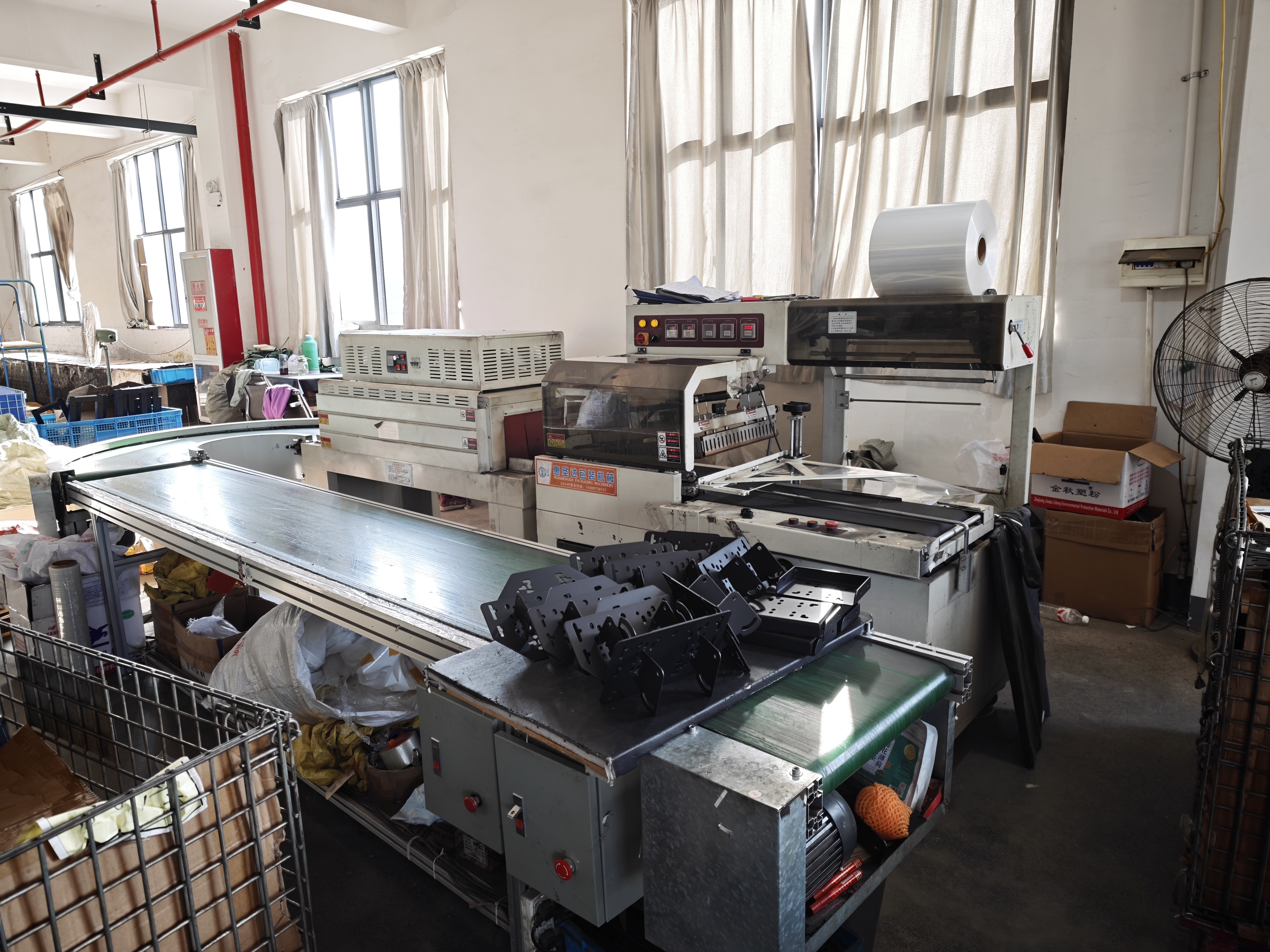
Frame joints and welded structures are part of the force path; installation checks still come first. Image: FYCHI.
Pedal drift: when the pedal plate becomes the weak link
Pedal drift is a load-path problem, not a pedal problem. A load-cell pedal can require a firm, sustained push; if the pedal plate or its mounting points move under that force, braking becomes inconsistent. The first checks are the same as for wobble: bolts, floor contact, mounting plate fit and load rating. If the pedal plate still drifts, the frame class is the issue.
The 6020D is positioned for this case. It is an aluminum profile cockpit with greater rigidity and a fully modular structure, so pedal plates, wheel mounts and accessory positions can be reconfigured rather than replaced. The 6001D has fewer adjustment points and less rigidity, which is why it is positioned for entry-level and space-limited setups rather than load-cell pedal systems. The distinction is not marketing language: it is the difference between a stand that is designed to fold and store and a cockpit that is designed to stay in place and carry higher loads.
Load fit: four questions before choosing a rig
1. What wheel base will be mounted now, and what is the realistic upgrade? If a direct-drive base is planned, the 6020D is the recommended choice because it avoids replacing the rig later. If the current base is entry-level and no direct-drive upgrade is planned, the 6001D is the lower-cost fit.
2. What pedal type is used? Load-cell pedals place different demands on the pedal plate and frame than standard pedals. The 6001D is not the first choice for that load case; the 6020D is the aluminum profile cockpit FYCHI positions for load-cell pedal users.
3. What else must attach? A shifter, monitors or a future triple-screen layout change the load and the mounting plan. FYCHI rigs use standard mounting hole patterns and are compatible with Logitech G29 and G923, Thrustmaster T300 and TGT, Fanatec and most standard-pattern wheel bases. Monitors are user-supplied and mount on standard VESA points. For triple-screen immersion, FYCHI positions the separate 6029-1 (6-Axis) triple monitor stand.
4. What floor space is available? The 6001D is compact, storable and quick to set up. The 6020D requires more floor space. If the room is shared and the rig must be folded away, the 6001D's storage advantage can outweigh its lower rigidity. If the rig stays in place, the 6020D's larger footprint is less of a penalty and its modularity becomes more valuable.
Direct Drive Sim Racing Rig: where the 6020D fits
Industry research describes aluminum-profile rigs as the reference format for high-end setups because of the rigidity required by direct-drive wheelbases (Mordor Intelligence, SRC-001). The FYCHI 6020D is the company's aluminum profile simulator cockpit and is recommended for users running direct-drive wheels, load-cell pedals or triple screens, and for users who upgrade frequently. It is also positioned for users planning those upgrades, because selecting it avoids replacing the rig later. The cockpit is fully modular, more rigid and freely expandable compared with the folding wheel stand.
The 6020D also supports flight simulation, according to FYCHI's selection guidance. That does not make it a universal cockpit for every buyer. It costs more and requires more floor space than the 6001D. The recommendation is conditional: the 6020D is the better fit when the hardware roadmap includes direct-drive torque, load-cell braking or multiple screens. It is not the lowest-cost entry into sim racing.
Where the 6001D remains the rational choice
The FYCHI 6001D is not a reduced 6020D. It is a different product class: a folding racing wheel stand for entry-level users and home sim racing setups with limited space and budget. It can be set up quickly, is compact, lower-cost and easy to store. For a first setup with a standard wheel base and pedal set, in a room that must be returned to other uses after a session, those are material advantages. The 6001D has less rigidity and fewer adjustment points than the 6020D, but that trade-off is acceptable when the load is matched to the stand and the alternative is not buying a rig at all.
The decision rule is simple. If the buyer needs a stable, storable wheel and pedal position at the lowest cost, the 6001D fits. If the buyer already has, or plans to buy, a direct-drive wheel base or load-cell pedals, the 6001D is the wrong first purchase because the likely next step is a cockpit replacement. In that case the 6020D is the more economical path over the ownership period, even though its upfront cost is higher.
Trade-offs and limits buyers should accept
No rig is installation-independent. Even the 6020D depends on correct bolt torque, a flat floor, compatible mounting plates and a load that matches the frame. A buyer who ignores installation can make a rigid cockpit feel loose. This is a real boundary, not a disclaimer.
The 6001D has two clear limits: less rigidity and fewer adjustment points than the 6020D. It is not the recommended choice for a high-torque direct-drive wheel base or load-cell pedals if those forces cause persistent wobble or pedal drift. The 6020D has two clear limits of its own: higher upfront cost and a larger floor footprint. It is also a fixed cockpit rather than a folding stand, so it does not solve a shared-room storage problem in the same way. Buyers who need to fold and store the rig should not assume the 6020D will behave like the 6001D.
Compliance scope also needs a precise reading. FYCHI's RoHS 2.0 test certificate TST20240500495-3RC, issued by Dongguan True Safety Testing Co., Ltd., covers the 6002–6020 model series, with the 6008 as the main model. The 6001D is not listed in that certificate scope. The EN 1335 seating report in the FYCHI file relates to seating products, not to the 6001D or 6020D frames. Buyers who need a specific compliance document for a specific model should confirm the model-to-certificate match before ordering rather than assuming that a series certificate covers every SKU.
Manufacturing, packaging and delivery evidence
FYCHI is the brand of Zhejiang Zhongyao Intelligent Equipment Co., Ltd. (Hangzhou Branch), a manufacturer of racing simulator hardware and sim racing cockpit systems based in Heping Town, Changxing County, Huzhou City, Zhejiang Province, China. The company states a 35,000㎡ facility, 100–200 staff and an export share of 80%, with North America, Europe and Asia-Pacific as key markets. Its product range covers more than 20 active series, from folding wheel and pedal stands to aluminum-profile cockpits, monitor stands and racing seats. This matters to buyers because the 6001D and 6020D are not isolated SKUs from different supply chains; they sit within one manufacturer's range and share the same export packaging and after-sales system.
Every unit passes pre-shipment inspection, according to the company. Export packaging uses 280-lb rated outer cartons, molded EPE corner protection and EPE cushion boards, with a colour manual, certificate of conformity, warranty card and installation tools in each carton. Standard delivery time is 60 days for production orders. OEM and ODM customization cover frame colour, logo printing or packaging, accessory configuration and custom bundle options, with a MOQ of 10 units. For distributors, those are evaluation-stage facts: they affect landed condition, assembly support and the ability to bundle the 6001D and 6020D into a price ladder rather than a single-SKU offer.
The company also operates a brand-owned showroom and content studio in China. The full product lineup is kept on display for real-scene shooting and remote video demonstration for overseas buyers, and the showroom supports dealer product training. Each SKU can be demonstrated live to potential distributors before ordering. That is useful evidence for buyers evaluating the 6001D-to-6020D step, because the difference between a folding stand and an aluminum profile cockpit is easier to judge in a live demonstration than in a specification table.
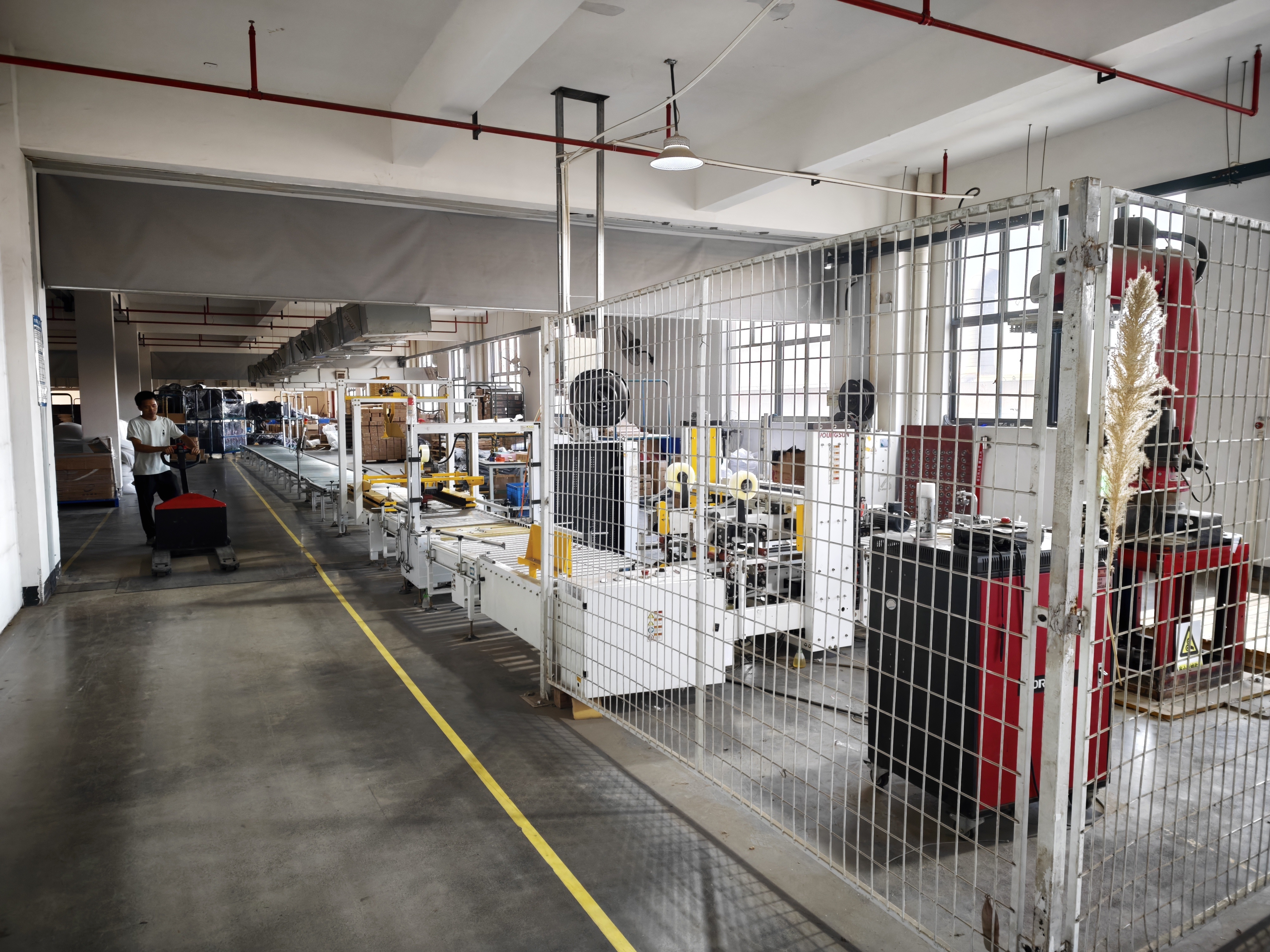
Export packaging uses 280-lb rated outer cartons with molded EPE corner protection and EPE cushion boards. Image: FYCHI.
Market trend: why buyers are moving toward modular rigidity
The cockpit segment is growing faster than the overall simulator market. Mordor Intelligence projects a 21.65% CAGR for the sim racing cockpit segment through 2030, while online sales channels generated 65.41% of racing simulator revenue in 2024 (SRC-001). The same research describes aluminum-profile rigs as the reference format for high-end setups because direct-drive wheelbases require rigidity. The buyer implication is not that every buyer should start at the top. It is that the upgrade cycle is shortening: online research makes it easier to discover a rigidity problem after purchase, and direct-drive hardware is becoming more accessible.
For distributors, the two-model structure is useful. The 6001D serves the entry-level and space-limited buyer who needs a lower-cost, compact and storable option. The 6020D serves the buyer who is already planning a direct-drive wheel, load-cell pedals or triple screens. Stocking both covers the price ladder without forcing the entry buyer into a cockpit they do not need, or the upgrade buyer into a stand that will not carry the load.
Future outlook
Direct-drive force feedback is likely to keep raising the rigidity floor for sim racing cockpits. As wheel-base torque and pedal load increase, the frame becomes a performance component rather than an accessory. The practical response for buyers is to decide on the hardware roadmap before the rig, not after. The practical response for distributors is to explain the 6001D-to-6020D boundary clearly, because a mismatched sale creates returns, support tickets and negative reviews that a lower upfront price does not offset.
FYCHI's current range already reflects that split: a folding stand for compact, lower-cost entry and an aluminum-profile cockpit for modular, higher-load use. The next evaluation question is not which model looks stronger in a photograph, but which model matches the wheel base, pedals, screens and room the buyer will actually use.
Frequently asked questions
Which FYCHI rig should I choose for a direct-drive wheel base?
For a direct-drive wheel base, load-cell pedals or triple screens, FYCHI recommends the 6020D aluminum profile cockpit. It is more rigid and fully modular, and choosing it avoids replacing the rig later when upgrading to those components. The 6001D folding wheel stand is positioned for entry-level and space-limited setups, with less rigidity and fewer adjustment points than the 6020D.
Is the FYCHI 6001D suitable for load-cell pedals?
The 6001D is not the recommended first choice for load-cell pedals. FYCHI positions it for entry-level and space-limited setups and states that it has less rigidity than the 6020D. If a load-cell pedal produces persistent pedal-plate drift after bolts, floor, mounting plate and load rating have been checked, the documented next step is the FYCHI 6020D.
Why does my wheel stand wobble under hard braking, and what should I check first?
Re-tighten all bolts, especially the frame joints and wheel plate, and place the stand on a flat, non-slip surface. Check that the mounting plate and bolt set match the wheel base and remove any play, then confirm that the stand's load rating suits the wheel base and pedals. If wobble persists with a direct-drive wheel or load-cell pedals, upgrade to the aluminum profile cockpit, the FYCHI 6020D.
Does the FYCHI 6020D require more floor space than the 6001D?
Yes. FYCHI states that the 6020D costs more and requires more floor space than the 6001D folding racing wheel stand. The 6001D is compact and easy to store, while the 6020D is a fixed aluminum profile cockpit with a larger footprint.
Can I mount my own wheel base, pedals, shifter and monitors on a FYCHI rig?
FYCHI rigs use standard mounting hole patterns and are compatible with Logitech G29 and G923, Thrustmaster T300 and TGT, Fanatec and most standard-pattern wheel bases. Each rig provides a pedal plate and a shifter mounting position. Monitors are supplied by the user and mount on standard VESA points. For triple-screen immersion, FYCHI positions the separate 6029-1 (6-Axis) triple monitor stand.
What does the FYCHI RoHS certificate cover?
FYCHI's RoHS 2.0 test certificate TST20240500495-3RC was issued by Dongguan True Safety Testing Co., Ltd. in May 2024 and covers the 6002–6020 model series, with the 6008 as the main model. The 6001D is not listed in that certificate scope. Buyers should confirm the model-to-certificate match for the exact SKU they are ordering.
What are the lead time and MOQ for FYCHI cockpit orders?
Standard delivery time is 60 days for production orders. The MOQ is 10 units. FYCHI offers OEM and ODM customization for frame colour, logo printing or packaging, accessory configuration and custom bundle options, with remote technical support and spare parts supply after delivery.
For distributor teams that need the full model, packaging and company overview, the FYCHI brochure is available for download: Introduction to Zhongyao Company 2025 (PDF).
Tem questões ou precisa de mais detalhes?
Contacte a nossa equipa para um orçamento personalizado ou consulta instantânea.
Solicitar orçamento
Preencha o formulário abaixo e a nossa equipa entrará em contacto com uma proposta personalizada.
Chat direto do WhatsApp
Prefere conversar em tempo real? Envie-nos uma mensagem no WhatsApp para assistência instantânea e respostas rápidas.
- Obter orçamento personalizado
- Partilhar fotos ou documentos
- Discuta as suas necessidades diretamente
Geralmente responde em 5–30 minutos durante o horário de expediente.