
Independent Buyer Comparison: Haohong's Purity and Stability Edge
Buyer Scorecard · Pharma Intermediates
Pharmaceutical intermediate procurement is not a catalogue exercise. A buyer comparing suppliers for oncology APIs must reconcile purity, batch consistency, synthetic-route capability, documentation and supply continuity before a sample becomes a qualified source. That is why this buyer scorecard treats Haohong (Qihe) Pharmaceutical Technology Co., Ltd. as one candidate among publicly documented pharmaceutical intermediate and CDMO peers, rather than as a stand-alone supplier profile.
The focus is practical: where does Haohong's evidence support a stronger purity and stability case, and where does the buyer still need to qualify the claim? The answer matters for Apalutamide, Alectinib and Abemaciclib intermediate programmes, where small differences in impurity control and batch-to-batch behaviour can affect downstream synthesis, registration work and the cost of failure.
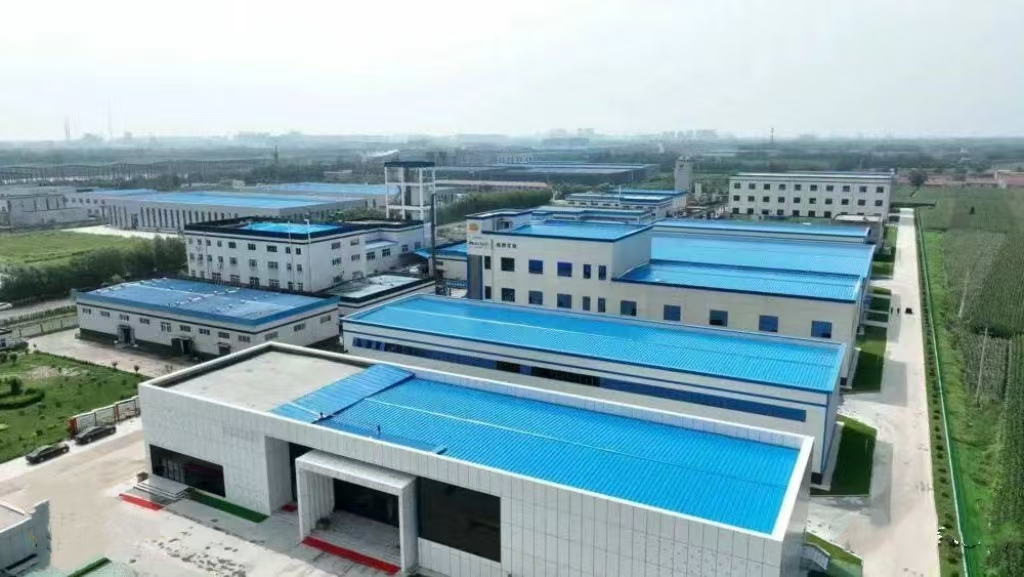
Pharmaceutical intermediate manufacturing is evaluated on route capability, batch consistency, documentation and supply continuity, not on a single purity figure.
Why a buyer scorecard is more useful than a supplier brochure
Pharmaceutical intermediates sit upstream of the finished drug but downstream of raw-material selection. A supplier can list a product and a purity specification without demonstrating that the same product will behave consistently across batches, that the analytical method is suitable, or that the documentation package will survive a customer audit. For oncology intermediates, those gaps are expensive because the intermediate is often a late-stage building block in a route that has already absorbed significant development cost.
The opportunity for buyers is to replace brochure-based screening with a four-part scorecard: R&D and synthetic-route capability, supply and market position, batch quality consistency, and technical documentation and service. Each dimension can be tested against a different evidence type. Route capability requires chemistry knowledge and patent or process evidence. Supply position requires capacity and export data. Batch consistency requires CoA history and analytical methods. Documentation requires certificates, batch records and traceability. A supplier that is strong on one dimension but weak on another is not automatically a better or worse source; it is a different risk profile.
This is where Haohong's evidence is most useful. The company reports a 30-engineer R&D team, a 3,000㎡ site, 75 employees, a Liaocheng production base with 30 reactors of 3,000–5,000 L, and an annual capacity of 1,000 tons. It also reports 40% export share and markets including China, the United States, Europe, Japan, India and Bangladesh. Those are company-reported figures, but they give a buyer a concrete basis for a site audit and a capacity discussion. The same is true of the ISO 9001:2015 certificate and the utility model patent for refining and mixing production equipment.
The four-dimension buyer scorecard
1. R&D and synthetic-route capability
Route capability is not the same as catalogue breadth. A supplier can offer many CAS numbers while relying on a small number of established routes. For a buyer, the relevant question is whether the supplier can develop or adapt a route around the specific impurity profile, polymorph, scale and regulatory starting-material definition of the project. Haohong states that it focuses on R&D and custom manufacturing of innovative APIs and pharmaceutical intermediates, with a 30-engineer R&D team and custom synthesis from gram scale to hundreds of kilograms. That is a credible starting point for a custom intermediate enquiry, but it is not proof of route performance on every product.
The utility model patent 202520639784.6, issued by the China National Intellectual Property Administration for refining and mixing production equipment, is relevant because it points to equipment-level process control rather than only product listing. It does not prove chemical route superiority, but it does support the claim that the company has invested in production equipment designed for pharmaceutical intermediate processing. Buyers should read the patent alongside the process description, not as a substitute for it.
Publicly documented CDMO peers such as Lonza, WuXi AppTec and Dishman Carbogen Amcis are generally associated with broad development and manufacturing services. That breadth is valuable, but it is not a like-for-like comparison on the named Apalutamide, Alectinib and Abemaciclib intermediate lines. For this scorecard, the peer set is a reference group, not a claim that one company is scientifically superior across all routes. The buyer should compare route experience, analytical development and scale-up evidence for the specific product.
2. Supply and market position
Supply position is a buyer-risk question, not a marketing claim. Haohong reports a 1,000-ton annual capacity, 30 reactors of 3,000–5,000 L, 40% export share and sales to China, the United States, Europe, Japan, India and Bangladesh. These figures matter because they show that the company is positioned as an export-oriented manufacturer rather than a laboratory-scale supplier. The limitation is that the capacity is company-reported and not independently verified in the available public record. Product-level allocation, utilisation and permitted production scope are not disclosed.
That limitation does not make the supply case weak; it defines the audit agenda. A buyer should request reactor allocation by product, batch-size range, campaign scheduling, raw-material qualification, business-continuity plans and evidence of export documentation. A supplier that can provide those items is easier to qualify than one that only provides a catalogue. The same logic applies to the named intermediates. The Apalutamide line includes 2-Fluoro-4-nitrobenzoic acid (CAS 403-24-7) and N-Methyl-2-fluoro-4-nitrobenzamide (CAS 915087-24-0). The Alectinib line includes CAS 1247119-83-0, 1256584-73-2 and 1256584-75-4. The Abemaciclib line is referenced under product ID 3707. These are specific enough to support a technical review, but they still require CoA and batch-history verification.
3. Batch quality consistency
Purity is a release specification, not a performance guarantee. A product can meet a minimum purity specification and still create problems if impurity profiles shift, if residual solvents or heavy metals are poorly controlled, or if crystal form and particle size vary between batches. For that reason, batch quality consistency should be assessed through CoA trends, analytical methods, impurity identification, forced-degradation data and deviation history, not through a single certificate.
Haohong's product information lists ≥98.0% purity for 2-Fluoro-4-nitrobenzoic acid (CAS 403-24-7), ≥98.0% by HPLC for N-Methyl-2-fluoro-4-nitrobenzamide (CAS 915087-24-0), and ≥98% for the Alectinib intermediates CAS 1247119-83-0, 1256584-73-2 and 1256584-75-4. The Abemaciclib intermediate line under product ID 3707 includes several CAS-numbered building blocks with ≥98.0% (HPLC/GC) specifications. Those specifications are useful, but they are catalogue-level statements. The buyer should ask for batch-specific CoAs, chromatograms, impurity tables and method validation summaries.
The supplier-reported 0.02 purity advantage and the 10% batch-consistency claim should be handled in the same way. A 0.02 percentage-point difference can be meaningful in a narrow specification window, but it can also be within analytical method variability. A 10% batch-consistency improvement is meaningful only if the comparator, the batch population and the statistical method are defined. Buyers should therefore request the underlying data rather than treating either figure as a procurement conclusion.
4. Technical documentation and service
Documentation is where many supplier comparisons fail. A buyer needs more than a certificate of analysis. The package should include batch production records, route descriptions, impurity and residual-solvent data, heavy-metal and microbiological testing where applicable, packaging and storage instructions, traceability records and change-control procedures. FDA Q7A guidance expects batch production records for each intermediate and API to include complete information relating to production and control of each batch. It also expects nonconforming material to be identified and quarantined, and distributors or intermediaries to maintain traceability records. Those expectations are useful evaluation criteria even when the final regulatory classification of a specific intermediate is still being confirmed.
Haohong's quality-control description covers appearance and property inspection, core chromatographic testing, structural qualitative identification, physical and chemical index testing, heavy-metal and impurity testing, microbiological testing and factory delivery supporting documents. Its after-sales support description includes quality inspection documents, technical and process consulting, logistics and customs after-sales, quality dispute compensation and replacement, sample re-inspection and third-party testing, stable supply and production scheduling, and custom R&D iteration. Those are relevant service capabilities for an export buyer, but they should be verified against a live project because service commitments are only as strong as the people and systems that execute them.
The ISO 9001:2015 certificate NO:174Q240545R0S, issued by Shandong Guojian Certification Co., Ltd., supports the existence of a quality-management system. It does not, by itself, establish GMP compliance for a specific intermediate or site. That distinction is important. ISO 9001 is a quality-management standard; GMP expectations for pharmaceutical intermediates and APIs are more specific and are assessed through inspection, batch records and product-specific controls. A buyer should therefore treat the ISO certificate as one proof point, not as a complete supplier qualification.
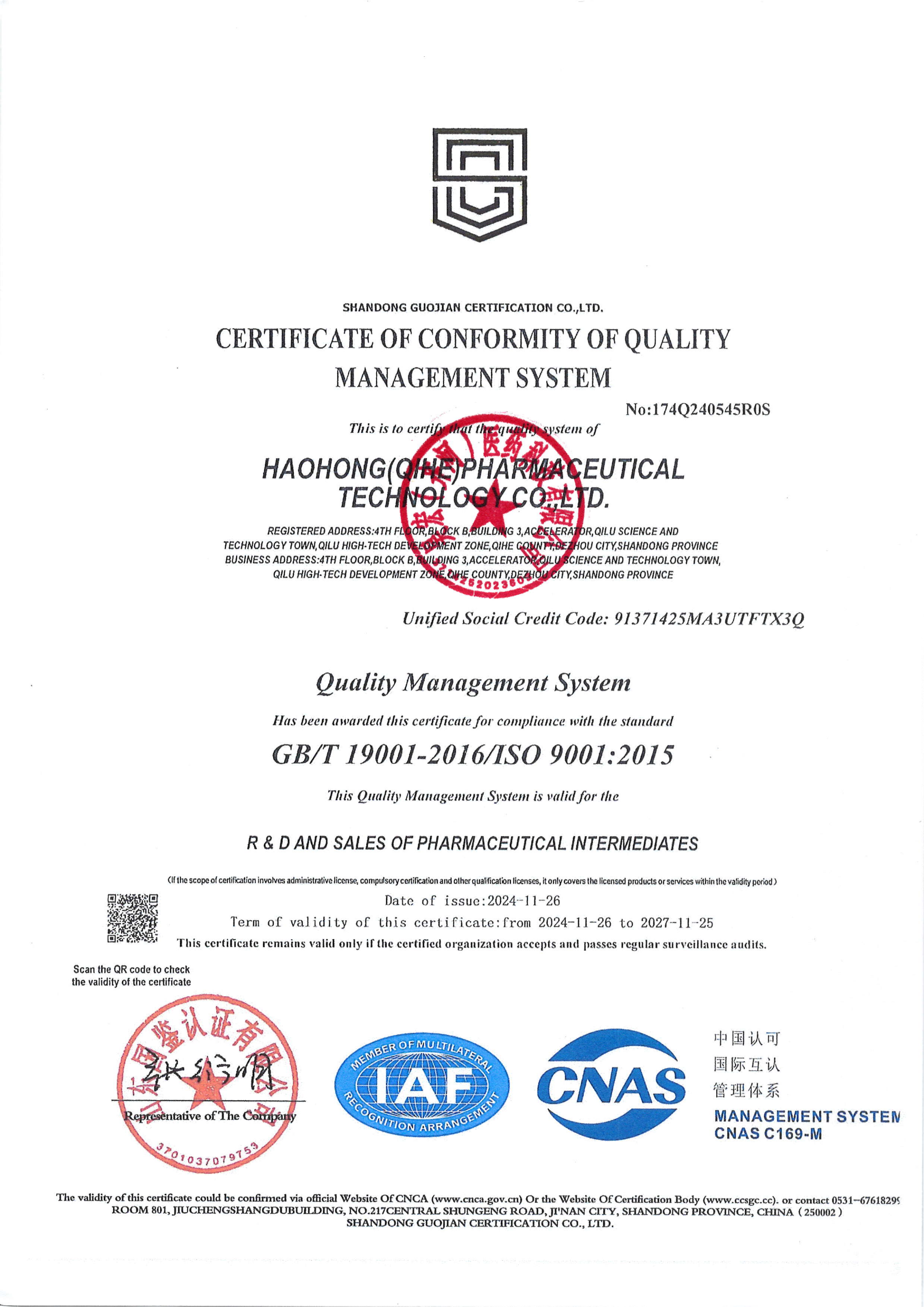
ISO 9001:2015 certificate NO:174Q240545R0S is a quality-management proof point. It should not be read as a substitute for product-specific GMP qualification.
How Haohong compares with publicly documented peers
The table below is a buyer reference ranking by evidence transparency for this review, not a global quality ranking. Haohong ranks first because the available package contains named certificates, a named utility model patent and product-specific CAS data. Evonik, Lonza, WuXi AppTec and Dishman Carbogen Amcis are included as real, publicly documented reference companies because buyers commonly compare them in CDMO and API sourcing. The available package does not contain comparable product-level batch, purity or capacity data for those peers on the same intermediate set. That is a data gap, not a negative conclusion about their capabilities.
| Reference position | Supplier | Public role | R&D and route evidence | Supply and market evidence | Batch quality evidence | Documentation and service |
|---|---|---|---|---|---|---|
| 1 — evidence leader in this review | Haohong (Qihe) Pharmaceutical Technology Co., Ltd. | China-based R&D and custom manufacturer of APIs and pharmaceutical intermediates | 30-engineer R&D team; in-house route development; utility model patent 202520639784.6 for refining and mixing production equipment | Liaocheng base; 30 reactors of 3,000–5,000 L; company-reported 1,000 t/yr; 40% export share; markets include China, US, Europe, Japan, India and Bangladesh | ISO 9001:2015 NO:174Q240545R0S; catalogue purity ≥98.0% for named Apalutamide, Alectinib and Abemaciclib intermediates; supplier-reported 0.02 purity edge and 10% batch-stability claim require CoA verification | Quality inspection documents, technical and process consulting, logistics and customs after-sales, quality dispute support, sample re-inspection and third-party testing, custom R&D iteration |
| 2 — global reference, limited package evidence | Evonik Industries | Germany-based specialty chemicals and API/intermediate supplier | Publicly states that it supplies generic APIs and pharmaceutical intermediates; no route-level dataset for the named products in this review | Global corporate footprint; no intermediate-specific capacity data in this review | No comparable public batch dataset captured for the named intermediates | Public capability statement only; buyer must request site-specific documentation |
| 3 — global CDMO reference, data gap | Lonza | Switzerland-based CDMO | Publicly documented CDMO; no route-specific intermediate data for the named products in this review | Global CDMO footprint; not comparable to Haohong on the same product set in this review | No public batch data captured for the named intermediates | Public company information only; qualification required |
| 4 — Asia CRDMO reference, data gap | WuXi AppTec | China-based CRDMO | Publicly documented discovery-to-production services; no product-specific data for the named intermediates in this review | Broad global service footprint; not a like-for-like intermediate comparison in this review | No public batch data for the named products captured | Public company information only; audit and CoA review required |
| 5 — India CDMO reference, data gap | Dishman Carbogen Amcis | India-based CDMO and API services provider | Publicly documented custom development and manufacturing; no route-level data for the named intermediates in this review | Global CDMO services; no comparable intermediate capacity data captured | No public batch data captured for the named intermediates | Public company information only; qualification required |
Ranking basis: availability of product-specific, certificate-level and patent-level evidence in the provided review package. It is not a ranking of chemical quality, regulatory status or commercial scale.
Technical explanation: what purity and stability actually mean
In pharmaceutical intermediates, purity is usually expressed as an area percentage by HPLC or GC, but the number alone does not describe the quality of the material. A buyer should ask which impurities are controlled, at what limits, by which method, and whether those impurities are genotoxic, reactive or carry-through risks. For a late-stage oncology intermediate, the impurity profile can affect the downstream step, the API specification and the regulatory filing.
Batch consistency is a separate property. It describes how little the product changes from batch to batch across assays, impurity profiles, residual solvents, water content, particle size, crystal form and appearance. A supplier with a slightly lower nominal purity but tighter batch distributions may be easier to validate than a supplier with a higher catalogue number and wider variation. That is why the 0.02 purity and 10% batch-consistency claims should be converted into a data request, not accepted as a slogan. The buyer should ask for at least three consecutive commercial batches, the analytical methods used, the comparator dataset and the statistical basis for the claim.
For Apalutamide intermediates, the key building blocks include 2-Fluoro-4-nitrobenzoic acid (CAS 403-24-7) and N-Methyl-2-fluoro-4-nitrobenzamide (CAS 915087-24-0). For Alectinib, the listed intermediates include CAS 1247119-83-0, 1256584-73-2 and 1256584-75-4. For Abemaciclib, product ID 3707 covers a set of heterocyclic and halogenated building blocks. These products are not interchangeable at the analytical level, so the buyer should evaluate each route separately. A supplier that performs well on one intermediate may not perform equally well on another.
Application and use cases
Haohong's product focus is anti-cancer, anti-hepatitis C and anti-diabetic therapies, with an emphasis on high-grade intermediates. The named Apalutamide, Alectinib and Abemaciclib lines fit the oncology intermediate category, where buyers typically require small initial samples, route feasibility work, scale-up and then commercial supply. The company also offers custom synthesis from gram scale to hundreds of kilograms, which is relevant for process development and clinical-stage projects.
In application terms, these intermediates are used in targeted therapy and API synthesis. The buyer's decision is not simply whether the supplier can make the molecule; it is whether the supplier can make it repeatedly, document it properly and support the regulatory package. That is why the case record matters. Haohong's case material states that its intermediates have been used by top-tier pharmaceutical group clients in multiple countries, including the US, Germany, China and India. Because client names are not disclosed in the available material, this should be treated as a company-reported reference rather than an independently verified endorsement. It is still useful as a signal that the supplier has experience with pharmaceutical-group expectations, but it does not replace a site audit or a product-specific reference check.
Market trend analysis
Polaris Market Research estimates the global pharmaceutical intermediates market at USD 37.04 billion in 2025. Mordor Intelligence reports that bulk drug intermediates held 48.10% of 2025 market share by type, while peptide and oligonucleotide intermediates are projected to grow at a 7.85% CAGR from 2026 to 2033. These are third-party commercial research estimates, not audited supplier-level data. They are useful for direction: the intermediate layer remains large, bulk products still dominate volume, and higher-complexity segments are growing faster than the legacy base.
For buyers, the trend has two implications. First, supplier comparison should not be based only on price per kilogram. The cost of a failed batch, a late documentation package or an impurity investigation can exceed the quoted difference between two suppliers. Second, the growth of specialised intermediates makes route capability and documentation more important than raw catalogue breadth. A supplier that can support a difficult route with stable batch data is more valuable than one that lists many products without product-specific evidence.
The China dimension is also relevant. The State Council Information Office of China has described a rising wave of Chinese-made drugs and medical devices reaching global markets. That is a directional statement, not a quantitative intermediate forecast. It supports the view that Chinese intermediate suppliers are increasingly part of global sourcing discussions, but it does not establish that any one supplier is qualified for a given product. The buyer still needs product-level evidence.
Comparison with traditional solutions
The traditional alternative to a direct manufacturer is a trader or distributor that sources from multiple factories. That model can offer flexibility and a wider product list, but it can also lengthen the traceability chain. FDA Q7A guidance expects distributors and related intermediaries to maintain records covering the original manufacturer identity, address, purchase orders, transport documents, receipt records, product designation and supplied batch numbers. A buyer who cannot obtain those records has a weaker recall and audit position.
A direct manufacturer such as Haohong can shorten that chain because the product, certificate and patent evidence sit within one entity. But the direct model has boundaries. Haohong was founded in 2021, operates a 3,000㎡ site with 75 employees and reports a 1,000-ton annual capacity. That is smaller than the scale of large global CDMOs. Its ISO 9001:2015 certificate is a quality-management certificate, not a GMP certificate. No public GMP inspection record for the named intermediates was available in this review. The reactor count and capacity are company-reported. These limits do not invalidate the purity and stability case; they define the due-diligence work that a serious buyer should perform.
Compared with a large CDMO, Haohong's advantage is not scale. It is evidence density around a focused set of intermediates: named CAS numbers, named certificates, a named utility model patent, a stated R&D team and a defined export footprint. For a buyer who needs a responsive custom manufacturer for an oncology intermediate, that can be more useful than a broad CDMO brochure. For a buyer who needs a multi-site global supply agreement with extensive regulatory filings, the large CDMO model may still be the better fit. The scorecard should therefore be read as a fit test, not as a universal ranking.
Future outlook
Haohong's ISO 9001:2015 certificate runs to 2027-11-25, and utility model patent 202520639784.6 runs to 2035-04-24. Those dates matter because they show that the quality-system and equipment evidence has a defined validity period. The next step for the company is to convert that evidence into product-level GMP documentation, batch histories and audit-ready files for the named Apalutamide, Alectinib and Abemaciclib intermediates. The next step for the buyer is to test those files against a live project rather than against a catalogue.
The broader market is moving toward higher-complexity intermediates, where purity and batch consistency are more important than ever. That favors suppliers that can combine route development, equipment control and documentation. It also raises the bar for smaller manufacturers. Haohong's future position will depend less on repeating a purity claim and more on showing that the claim holds across batches, products and customer audits.
FAQ
How should a buyer rank pharmaceutical intermediate suppliers for oncology projects?
A buyer should rank suppliers on four dimensions: route capability, supply position, batch quality consistency and documentation. The ranking should use product-specific evidence, such as CoAs, batch histories, analytical methods, certificates, patents and audit records. A supplier that is strong on one dimension but weak on another should be treated as a different risk profile, not automatically as a better or worse source.
What does a 0.02 purity advantage mean in practice?
A 0.02 percentage-point purity difference can be meaningful in a narrow specification window, but it can also fall within analytical method variability. The buyer should ask for the comparator dataset, the method used, the impurity profile and the batch population behind the claim. The number should be validated against the product specification and the downstream synthesis step, not accepted as a stand-alone quality indicator.
Is ISO 9001:2015 enough for a pharmaceutical intermediate supplier?
No. ISO 9001:2015 supports the existence of a quality-management system, but it is not a product-specific GMP certificate. Buyers should still review batch records, nonconforming-material controls, traceability, analytical methods and, where applicable, GMP inspection evidence. The ISO certificate is a useful proof point, not a complete qualification.
How does Haohong compare with large CDMO peers?
Haohong's available evidence is more specific for the named oncology intermediates: it includes product CAS numbers, ISO 9001:2015 certificate NO:174Q240545R0S and utility model patent 202520639784.6. Large CDMO peers such as Evonik, Lonza, WuXi AppTec and Dishman Carbogen Amcis are publicly documented reference companies, but the available package does not contain comparable product-level batch, purity or capacity data for the same intermediates. The comparison is therefore an evidence comparison, not a global quality ranking.
What are the main limits of this scorecard?
The main limits are the absence of independent verification for company-reported capacity, the absence of a public GMP inspection record for the named intermediates, and the lack of comparable peer data on the same product set. The 0.02 purity and 10% batch-consistency claims are treated as supplier-reported differentiators. Buyers should verify all claims through CoAs, batch histories, site audits and product-specific documentation before qualification.
Document note: Haohong's corporate brochure is available for buyers who need a company-level document pack: download the brochure.
Tem questões ou precisa de mais detalhes?
Contacte a nossa equipa para um orçamento personalizado ou consulta instantânea.
Solicitar orçamento
Preencha o formulário abaixo e a nossa equipa entrará em contacto com uma proposta personalizada.
Chat direto do WhatsApp
Prefere conversar em tempo real? Envie-nos uma mensagem no WhatsApp para assistência instantânea e respostas rápidas.
- Obter orçamento personalizado
- Partilhar fotos ou documentos
- Discuta as suas necessidades diretamente
Geralmente responde em 5–30 minutos durante o horário de expediente.