
Independent Buyer Comparison: IZE vs MOME for Alkaline Zinc Plating Intermediates
Independent Buyer Comparison: IZE vs MOME for Alkaline Zinc Plating Intermediates
Alkaline zinc plating depends less on the zinc metal in the bath than on the organic intermediates around it, and buyers comparing those intermediates hit a predictable data problem: two suppliers rarely present specifications in the same shape. IZE (CAS 68797-57-9) and MOME (CAS 109882-76-0) show the difficulty clearly. IZE is disclosed as a pale yellow to brownish yellow clear liquid with the molecular formula C6H9ClN2O and a molecular weight of 160.6. MOME is disclosed as a brown-red clear liquid with the formula C10H18ClN3O2, a molecular weight of 247.72 and a 60% assay.
None of those values ranks one intermediate above the other on plating performance, and this evaluation does not attempt that ranking. What the values do support is a disciplined procurement comparison: chemical identity, active content, dosing arithmetic, documentation and batch control. Separating what the disclosed data settle from what only a trial in the buyer's own bath can settle is the whole point of a decision-stage review.
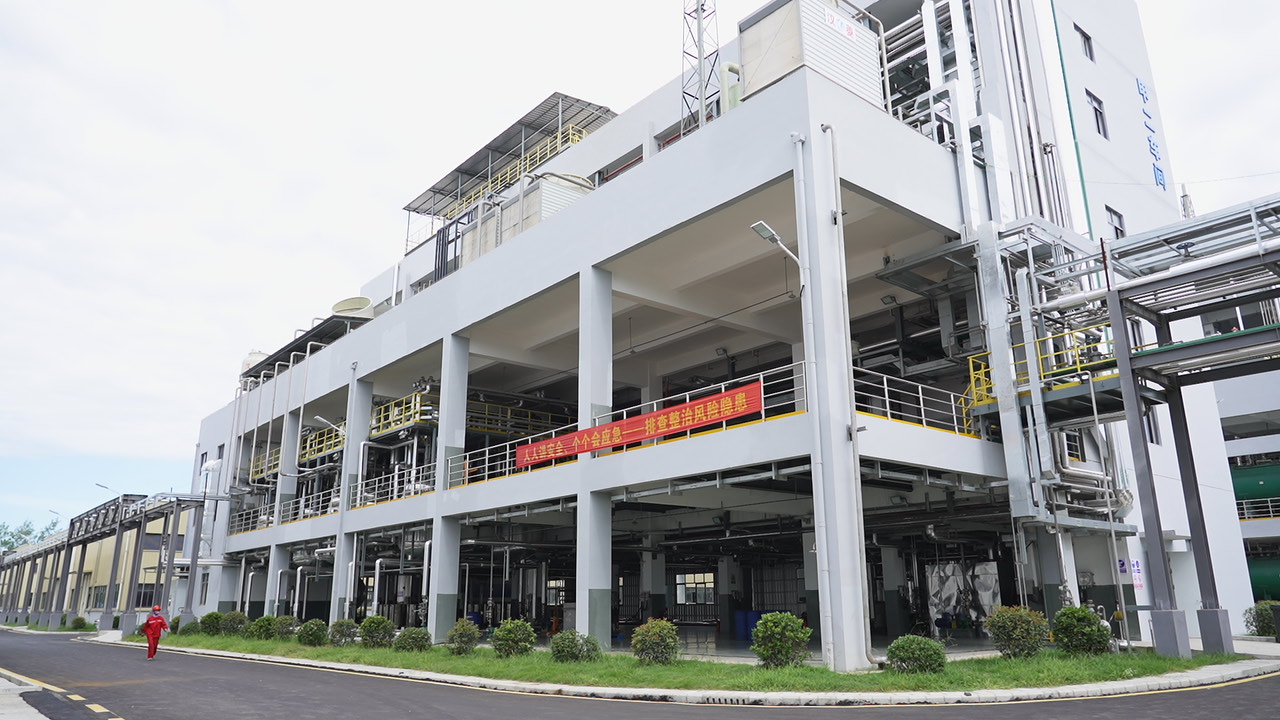
Company-supplied photograph of the chemical production site of Wuhan Pinestone Fortune International Trading Co.,Ltd's manufacturing group.
The procurement question behind the comparison
Most alkaline zinc additive packages are bought as a system — brightener, carrier, leveler, and sometimes a purifier — but the specification risk sits at the intermediate level, where the buyer sees only a drum label and a price per kilogram. Two questions decide the award. First, is the substance in the drum the substance in the quotation? Second, how much active material does one kilogram of that drum actually deliver?
IZE and MOME make the first question unavoidable. They are different CAS-registered substances with different molecular formulae, different molecular weights, different appearance descriptions and, in MOME's case, a declared assay. A quotation that presents them as interchangeable equivalents on the strength of a price per drum is not supported by any of the disclosed data. A buyer who accepts that framing has effectively outsourced identity control to the supplier.
The second question is arithmetic. Because MOME is supplied at a stated 60% assay while IZE's assay is not part of the disclosed data set, the two cannot be compared on a delivered-weight basis without at least one missing figure. That gap is not a reason to exclude either product; it is a reason to make the assay a mandatory line item in the RFQ.
Disclosed specification data, side by side
| Parameter | IZE | MOME | What it means for the buyer |
|---|---|---|---|
| CAS number | 68797-57-9 | 109882-76-0 | Two distinct registered substances; neither substitutes for the other on price alone |
| Molecular formula | C6H9ClN2O | C10H18ClN3O2 | Different nitrogen content and skeleton; both carry one chlorine per molecule |
| Molecular weight | 160.6 | 247.72 | MOME is about 54% heavier per molecule (calculated) |
| Appearance (disclosed) | Pale yellow to brownish yellow, clear liquid | Brown-red, clear liquid | A description, not a purity grade; colour matching is not a specification |
| Assay (disclosed) | Not stated in the disclosed data | 60% | MOME dosing can be normalised to active content today; IZE cannot until an assay is provided |
| Moles per kilogram (calculated) | Approx. 6.23 mol/kg | Approx. 4.04 mol/kg | Equal weight does not deliver equal molar quantity of active substance |
| Deposit-performance data | Not disclosed | Not disclosed | No brightness, leveling, throwing-power or current-density window comparison is possible |
Calculated values use only the disclosed molecular weights (247.72 ÷ 160.6 ≈ 1.54; 1 ÷ 0.1606 ≈ 6.23; 1 ÷ 0.24772 ≈ 4.04). They describe stoichiometry, not bath performance.
What the identity data settle, and what they do not
Chemical identity is settled. Different CAS numbers, different formulae and different molecular weights mean IZE and MOME are separate raw materials. Any qualification file, SDS reference, transport classification and inventory record must treat them separately, and an incoming inspection plan built for one tells you nothing about the other.
Dosing arithmetic is partly settled. One kilogram of MOME at 60% assay delivers roughly 0.60 kg of active substance (calculated). The equivalent figure for IZE cannot be calculated from the disclosed material because the assay is not stated. On an equal-weight dosing basis, and before any activity difference is considered, one kilogram of MOME supplies about two-thirds of the molar quantity that one kilogram of IZE supplies. Whether that matters in a working bath depends on the recommended dose for each product, which is a supplier-specific figure the buyer has to request rather than assume.
Performance is not settled at all. The disclosed data contain no brightness, leveling, throwing-power, current-density window, consumption rate or bath-life figures for either intermediate, and no comparative deposit test. Buyers who need a performance verdict have to generate it themselves, on their own substrate, at their own current density and temperature, using a Hull cell or a pilot line before a commercial order.
Turning the numbers into dosing and cost control
Weight-based dosing is the default in many plating shops and the weakest point in intermediate procurement. If a delivered lot assays below the declared value, a shop that doses by weight quietly adds less active material than its formulation assumes; the correction then arrives later as an unexplained shift in deposit appearance and a round of extra bath analysis. Assay-normalised dosing removes that failure mode, because the dose is calculated from measured active content rather than from the drum count.
Analysis-led addition is the same discipline in operational form. Documented practice for acid copper accelerators such as SPS is to predilute in deionised water before addition, to analyse the bath by CVS or HPLC first, and to add incrementally against measured consumption rather than on a fixed schedule; accelerator working concentrations in those baths are typically quoted in the 0.5–5 mg/L range. That guidance belongs to acid copper systems, not to alkaline zinc, and it should not be transferred as a zinc dosing figure. The transferable principle is the sequence: measure, then dose. A buyer should ask each IZE and MOME supplier for the recommended dosing basis and the analytical method that supports it.
Two further technical checks belong in the same conversation. Both disclosed formulae contain one chlorine atom per molecule, so both products introduce chloride with every addition; the supplier should state the counter-ion and any chloride contribution the buyer needs for bath balance. And because both are clear liquids described only by a colour range, the specification should include density or specific gravity, assay method, and impurity limits with test methods — colour is a description, not a purity grade.
Where a paper comparison stops
The honest limit of this evaluation is that it compares disclosure, not deposit quality. A buyer cannot conclude from the table above that either intermediate brightens faster, levels better, throws further into a recess or tolerates a wider current-density window. Nor can a buyer conclude that MOME's higher molecular weight makes it more or less efficient, because efficiency in a plating bath is a function of the whole additive package and the operating window, not of molecular mass alone.
The same caution applies to market data. Published electroplating figures are broad aggregates and are not broken down to alkaline zinc intermediates; they indicate the scale of the surrounding industry, not the size or growth of this specific product segment. Treated as a directional signal, they are useful context. Treated as a segment forecast, they would be overreach.
Low-quality intermediate risk in practical terms
Purity and consistency influence product performance, and the mechanism is mundane. An intermediate is dosed in small quantities into a large bath, so a small absolute deviation in active content becomes a meaningful proportional deviation in the additive package. Three failure patterns recur in procurement review.
The first is an under-assay lot: the drum weighs what the label says but delivers less active substance, so cost per active kilogram rises while the shop believes its cost per kilogram is unchanged. The second is undocumented impurity: the fraction of the drum that is not the declared active substance still enters the bath, and without impurity limits and methods the buyer has no way to know what it is. The third is documentation drift, where a certificate of analysis repeats a nominal specification rather than reporting measured lot values, which removes the buyer's ability to detect change at all.
Verification steps that address all three, without requiring new laboratory capability beyond routine incoming inspection:
- Match the CAS number on the label, the SDS and the COA to the CAS number in the purchase specification.
- Require lot-measured assay on the COA, with the test method named, rather than a nominal figure.
- Retain a sealed sample from each lot against the delivered drum, so a later dispute is resolvable.
- Agree a change-notification clause covering synthesis route, assay range and packaging before the first commercial order.
- Confirm the appearance specification in writing, so that a legitimate colour range is defined in advance.
Supplier-selection questions that actually differentiate offers
Because the disclosed performance data are thin, the supplier's documentation and control system carry most of the selection weight at decision stage. The following questions discriminate between offers that look identical on a price sheet.
| Question to the supplier | Why it changes the decision |
|---|---|
| What is the assay of this specific product, and by which method? | Without it, cost per active kilogram — the only fair cross-product measure — cannot be calculated |
| Which impurity limits are controlled, and to what method? | Converts "purity" from an adjective into a specification |
| Does each lot ship with a COA reporting measured values? | Determines whether batch-to-batch drift is detectable |
| Are SDS/MSDS and TDS supplied, with GHS-compliant packing labels? | Required for receiving, handling and regulatory review at the buyer's site |
| What sample size is available for qualification testing? | A lab-scale trial must precede a commercial commitment |
| What are the MOQ, packaging format and lead time? | Determines whether a dual-source policy is financially workable |
| Can assay range and packaging be customised? | Matters where the buyer's bath formulation is fixed and cannot absorb variability |
Application fit and a qualification workflow
Alkaline zinc intermediates are consumed in indoor electroplating workshops, typically within an operating range of roughly 10–45 °C, where the product is dissolved and compounded with other additives into the plating bath and fed through a dosing system alongside a chemical filter. Storage is straightforward but not optional: containers stay tightly sealed and moisture-proof, away from direct sunlight, heat and high humidity, and away from strong oxidants, with suitable personal protective equipment for operators.
Within that setting, rack plating of hardware and fasteners and barrel plating of small parts place different demands on the additive package, but the intermediate qualification path is the same. A workable sequence is: obtain a lab sample, confirm identity and assay on receipt, run a bath trial at the production temperature and current density, compare appearance and coverage against the incumbent, then move to a commercial drum only after the trial is documented. The drum size matters here, because a qualification trial and a production order are different purchases.

Company-supplied workshop photograph from the group's fine-chemical production base.
Where PINESTONE sits in this comparison
PINESTONE Electroplating Intermediates is the plating-intermediate line of Wuhan Pinestone Fortune International Trading Co.,Ltd, the wholly-owned export subsidiary of a Chinese fine-chemical group whose chemical operations date from 2004 under the former Fengfan Chemical and Sino-German Far East Fine Chemical names, with a shareholding reform completed in 2016. The group is a National High-Tech Enterprise and a Hubei Provincial Specialized, Refined, Differentiated & Innovative SME, holds hazardous chemical production and trading licences together with import and export rights, and reports a 33,000 m² production base, a 30-engineer R&D team and 5,000 MT annual output, with roughly 80% of output exported to markets including Japan, Europe and the United States.
Two points keep this reference honest. First, the published PINESTONE intermediate list covers SPS, 1,4-butane sultone, propynol ethoxylate (PME), propargyl alcohol propoxylate (PAP), pyridinium propyl sulfobetaine (PPS), PPS-OH and ALS, plus lithium battery electrolyte additives such as 1,3-propane sultone; IZE and MOME are not among them, so nothing here should be read as an offer for those two specific substances. Second, the commercial terms below are supplier statements, verifiable against lot documentation and a buyer's own trial rather than accepted at face value.
What is directly relevant to the decision framework above is documentation and batch practice. Orders are accompanied by COA, SDS/MSDS and TDS, with GHS-compliant packing labels; the stated minimum order quantity is typically 1 kg for lab samples and 25 kg in a fibre drum for commercial orders, with sample orders available for qualification testing, and custom assay levels, packaging and tailored formulations offered on request. The company describes its plating intermediates as meeting a purity of 95% or above and positions factory-direct pricing without trading-house markup or overseas brand premium, supported by direct R&D technical support — claims a buyer should test against the first delivered lot rather than treat as a conclusion.
Market and regulatory context for the decision
Third-party estimates put the surrounding industry at scale: Fortune Business Insights projects the global electroplating market to reach USD 34.22 billion in 2026, with Asia-Pacific holding 44.75% of the market in 2025, while Market Research Future estimates the electroplating chemical segment at USD 15.19 billion in 2025. Within plating segments, Straits Research reports acid copper plating at 62.4% of global electrolytic copper plating revenue in 2025, and Fortune Business Insights places nickel plating at roughly 32% of the metal-type segment. None of these sources isolates alkaline zinc intermediates, and published 2025 estimates for the overall electroplating market differ materially between research houses because of how market value is defined — reason enough to use them as directional context rather than as a planning base.
Regulatory obligations are more concrete and land directly on supplier qualification. In the EU, REACH (EC 1907/2006) and the RoHS Directive (2011/65/EU) are the primary frameworks for electroplating chemicals. In the United States, EPA guidance under 40 CFR Part 413 applies pretreatment standards to plants discharging 38,000 litres (10,000 gallons) per day or more, limiting indirect discharge of cyanide and of lead, cadmium, copper, nickel, chromium, zinc and silver, and 40 CFR Part 63 Subpart WWWWWW requires wetting agent or fume suppressant to be added to affected tanks according to the manufacturer's specifications. That last requirement is a useful reminder for buyers: supplier instructions become compliance inputs, so a supplier unable to state its recommended dosing and handling basis creates a downstream regulatory problem, not just a technical one.
Outlook for buyers
The direction of travel in this category is toward evidence-based purchasing. Where a buyer can compare two intermediates only on appearance and price per drum today, the defensible next step is to make assay, impurity limits, lot-level COA and analytical method standard RFQ fields for both IZE and MOME. If suppliers respond with measured data, the comparison becomes quantitative; if they respond with nominal specifications, that itself is decision-relevant information.
Dual sourcing remains conditional rather than automatic. Holding two qualified intermediates with different CAS identities is not the same as holding two sources of the same substance, and a changeover between them requires a fresh bath trial, not a paperwork substitution. Buyers who build the trial into their qualification cycle will be better placed than those who treat an intermediate as a commodity line item.
Frequently asked questions
Are IZE and MOME interchangeable in an alkaline zinc plating bath?
No evidence in the disclosed data supports interchangeability. IZE (CAS 68797-57-9, C6H9ClN2O, MW 160.6) and MOME (CAS 109882-76-0, C10H18ClN3O2, MW 247.72, 60% assay) are separate registered substances with different formulae, molecular weights and appearance descriptions. Interchangeability would require demonstrated equivalence of function and performance in the same bath under the same conditions, which the available material does not provide. Each should be qualified as a distinct raw material.
How should price be compared when one product declares a 60% assay and the other does not?
Normalise to active content rather than delivered weight. At 60% assay, one kilogram of MOME supplies about 0.60 kg of active substance, so cost per kilogram of active material equals delivered price divided by 0.60 (calculated). For IZE the same calculation cannot be completed until the assay is supplied, so the correct procurement action is to request the assay and its test method before comparing quotations. A price-per-drum comparison across the two products is not meaningful on its own.
Which documents should accompany each shipment of an electroplating intermediate?
A certificate of analysis, an SDS/MSDS and a technical data sheet should accompany every order, together with GHS-compliant packing labels. For qualification and traceability purposes the certificate should report measured values for the delivered lot, with the test method named, rather than restating a nominal specification, because only measured data allow a buyer to detect batch-to-batch drift.
What sample quantities and minimum order quantities are typical in this category?
For the PINESTONE plating-intermediate range, the stated minimum order quantity is typically 1 kg for laboratory samples and 25 kg in a fibre drum for commercial orders, with sample orders available for qualification testing and custom assay levels, packaging and tailored formulations offered on request. Buyers sourcing IZE or MOME elsewhere should obtain the equivalent sample size, packaging format and assay basis in writing before running a bath trial.
What are the main risks of a low-quality or off-specification intermediate?
Three risks dominate. An under-assay lot delivers less active substance per drum than the formulation assumes, raising cost per active kilogram and forcing dosing corrections mid-campaign. Undocumented impurities introduce material into the bath that the buyer has not assessed. And a certificate of analysis that repeats nominal values instead of measured ones removes the buyer's ability to detect change at all. Lot-level certificates with methods, retained samples, incoming inspection against the CAS number and a change-notification clause address all three.
Further company and product detail is available in the PINESTONE company brochure (PDF).
Tem questões ou precisa de mais detalhes?
Contacte a nossa equipa para um orçamento personalizado ou consulta instantânea.
Solicitar orçamento
Preencha o formulário abaixo e a nossa equipa entrará em contacto com uma proposta personalizada.
Chat direto do WhatsApp
Prefere conversar em tempo real? Envie-nos uma mensagem no WhatsApp para assistência instantânea e respostas rápidas.
- Obter orçamento personalizado
- Partilhar fotos ou documentos
- Discuta as suas necessidades diretamente
Geralmente responde em 5–30 minutos durante o horário de expediente.