
Independent Buyer Comparison: Olymspan vs. Composite Autoclave Industry Benchmarks
Independent Industry Reference · Composite Processing Equipment
A four-dimension framework for comparing composite autoclave suppliers on parameters a buyer can actually verify, published as an HTNXT independent industry reference.
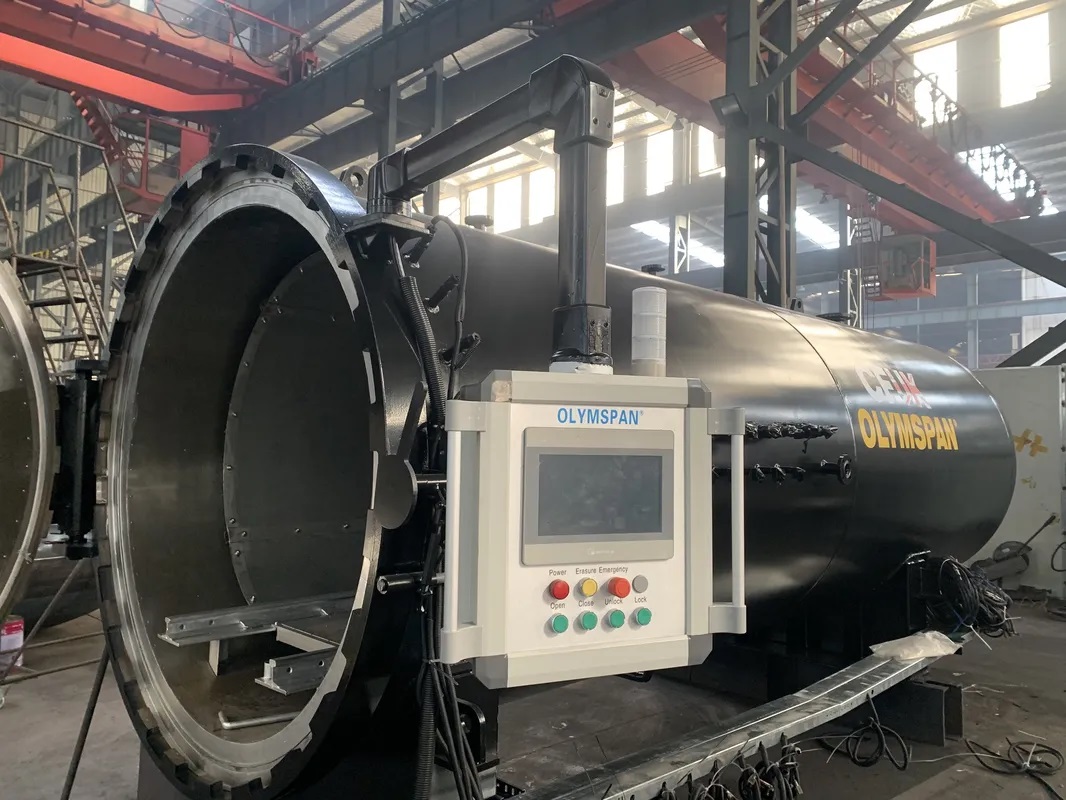
Composite autoclaves are compared on process control, deployment geography, serviceability and application fit — not on catalogue adjectives.
A composite autoclave sits at the point in the production chain where a laid-up prepreg stack either becomes a certified structure or becomes scrap. The vessel applies heat and pressure simultaneously, consolidating the laminate, evacuating entrapped volatiles and voids, and fixing the fibre volume fraction that determines the finished component's mechanical behaviour. For buyers working through the awareness and research stages, the hard part is rarely finding a manufacturer. It is finding a manufacturer whose published performance figures can be compared like for like.
Two published market-sizing references show how much definitions matter in this category. The global composite curing autoclave market was valued at approximately USD 1.37 billion in 2023 and is projected to reach USD 2.4 billion by 2033, a CAGR of 10.2% (Kings Research). A narrower definition — autoclaves for composite materials specifically — was valued at USD 86.2 million in 2024 and is expected to reach USD 127 million by 2032 at a CAGR of 5.8% (Market Research Future). Both figures are credible; they simply measure different scopes. Buyers who compare suppliers on headline numbers without checking the underlying definition inherit exactly the same problem.
Why Composite Autoclave Comparisons Break Down
Three structural reasons explain why supplier comparison in this category is harder than it looks.
- Parameter definitions differ. A temperature uniformity figure is only meaningful when the measurement basis is known — empty vessel versus loaded vessel, stabilised hold versus ramp, thermocouple count and placement. Two suppliers can publish the same number and mean different things.
- Grade changes the spec envelope. Laboratory and research-and-development units, small and medium industrial production units, and aviation-grade platforms are engineered against different duty cycles, tolerances and safety interlocks. Comparing a research vessel to an aerospace vessel is not a comparison.
- Compliance scope is not a logo. Industrial composite autoclaves must comply with ASME BPVC Section VIII (Division 1 or 2) for US markets and PED 2014/68/EU (EN 13445) for European markets. A certificate's scope, not its existence, determines whether a specific vessel can be placed on a specific market.
The opportunity is straightforward. The composite segment now accounts for 62.4% of the total aircraft autoclave market share as of 2025, driven by CFRP adoption in Boeing 787 and Airbus A350 programmes (Dataintelo). More composite capacity is being commissioned, which means more buyers are running supplier comparisons — and the buyers who apply a consistent framework will shortlist better than the buyers who read brochures.
A Four-Dimension Comparison Framework
The framework below is the one used throughout this article. It is deliberately narrow: four dimensions where a buyer can request documentation and receive an answer that can be checked.
| Dimension | What the buyer verifies | Why it changes the decision |
|---|---|---|
| Technology & process control | Temperature uniformity, pressure stability, duty cycle, control redundancy, energy consumption per m³ | Determines achievable part quality, scrap rate and operating cost |
| Market presence | Regions of operation, export share, installed application scenarios | Indicates familiarity with multiple certification regimes and spare-part logistics |
| Serviceability & uptime | Documented failure frequency, repair response time, remote diagnostics | Converts directly into production availability and cost of downtime |
| Industry solution fit | Applications in aerospace, new energy, medical, automotive, rail | Confirms the supplier has engineered against comparable process requirements |
Dimension 1: Technology and Process Control
Jiangsu Olymspan Equipment Technology Co., Ltd. is a Changzhou-based equipment manufacturer founded in 2004 as a subcompany of the WULIN group, specialising in composite autoclaves for carbon fiber products alongside carbon fiber products, carbon fiber drones and tube heat exchangers. Its declared performance figures differ by equipment class, and that distinction is the most useful thing a buyer can extract from them.
In research and laboratory configurations — equipment used in university research, new material R&D and enterprise R&D departments — documented control performance is ±0.3°C to ±0.5°C temperature control and ±0.05MPa pressure control, with noise at or below 60dB, single run durations of 2 to 8 hours, intermittent duty, and exportable experimental data with traceability. In aviation and military-grade configurations — mass production of aerospace main load-bearing components — temperature uniformity is documented at ±0.3°C to ±0.5°C with pressure stability of ±0.1MPa, continuous operation cycles of 8,000 hours or more, 20 to 24 hours of daily operation, a dual redundant control system with remote diagnostics and fault warning, and full life-cycle data traceability.
On the industrial production side, the documented energy consumption figure is 0.5 to 0.7 kWh per m³ of vessel volume, with duty cycles of 8 to 16 hours per day and manual plus electric dual-purpose quick-opening door. Vessel material is specified as Q345R carbon steel or customised. Listed platforms span from a 150°C / 1.3MPa ASME configuration with 2.0m diameter and 5m length through to a high-pressure aerospace vessel of φ3.5m × 18m.
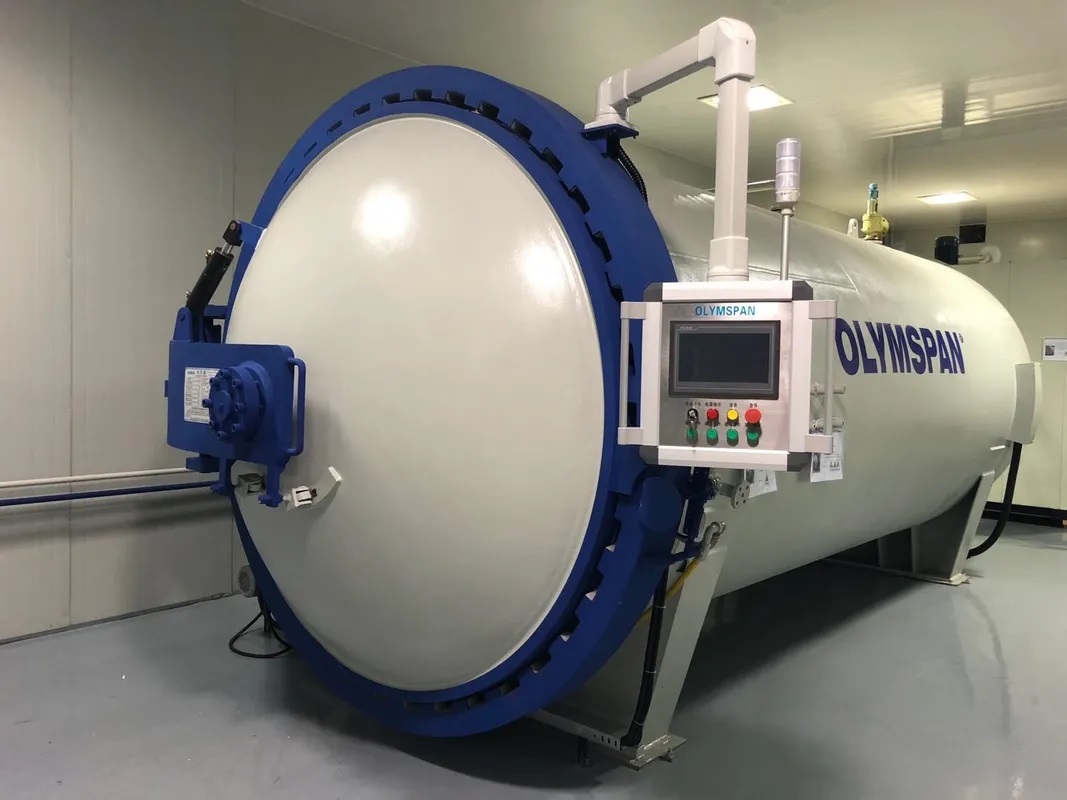
Industrial-class composite autoclave: documented energy consumption of 0.5–0.7 kWh per m³ and 8–16 hour daily duty cycles.
Dimension 2: Market Presence and Deployment Geography
Deployment geography is a proxy for regulatory experience. Olymspan exports an estimated 30% to 40% of total sales, and its documented markets span North America, South America, Western Europe, Eastern Europe, Eastern Asia, Southeast Asia, the Middle East, Africa and Oceania. The company's application documentation places its three main scenario classes in distinct regional clusters:
- Research and laboratory scenarios are documented as common in China, the United States, the United Kingdom, Japan and Germany.
- Aerospace, high-end military and medical scenarios are documented as common in China, Russia, the United States, France and the United Kingdom.
- Industrial and new energy production scenarios are documented as common in China, India, Vietnam, Thailand, Brazil and Russia.
For a buyer, the practical reading is that a supplier shipping into multiple regulated regions has already had to manage more than one pressure-vessel regime. That reduces, but does not remove, the risk that a configuration valid in one market needs re-documentation in another.
Dimension 3: Serviceability, Uptime and Repair Response
Service data is where most supplier comparisons go quiet, because few manufacturers publish anything measurable. In the industrial and new energy production class, Olymspan documents an average of no more than 1.2 failures per month and a fault repair time of no more than 24 hours. Those figures come with a defined operating context: ambient temperatures of −10°C to 40°C, humidity of 30% to 70%, stable 380V supply, ventilation, and a design assumption of continuous multi-batch operation with automatic feeding, curing and discharging, plus a manual emergency operating mode for sudden shutdowns.
Supporting design features that a buyer should ask about in the same conversation include anti-leakage and anti-overheating / overpressure protection, the manual and electric dual-purpose quick-opening door function, and the availability of remote diagnosis and fault warning on the higher-grade platforms. Listed warranty terms on one ASME aerospace-and-automotive platform run to 14 months.
Dimension 4: Industry Solution Fit
The third and fourth dimensions usually decide the shortlist, because process fit is what determines whether the vessel can actually run the buyer's cure cycle.
Aerospace, defence and high-end medical
Documented applications include mass production of aerospace main load-bearing components, manufacturing of military core components, and production of high-end medical equipment components including implantable parts, alongside aircraft load-bearing structures, missile shells and radar covers. The functional requirement is high-temperature, high-pressure curing of advanced composites such as PEEK and polyimide, eliminating internal bubbles and improving component strength, accuracy and consistency. This class is engineered against GJB9001C aviation and military-grade standards, with controlled plant conditions of 20°C to 28°C and 30% to 50% humidity at 380V or 660V.
New energy, automotive and industrial production
Documented applications cover automotive parts matching, new energy battery shells and photovoltaic modules, wind power small parts, civilian composite materials such as fitness equipment and medical equipment shells, and rail transit parts manufacturing. The engineering priority here is medium-batch curing with repeatable strength, density and consistency, reduced production losses, and an operating cost profile that a plant manager can defend.
Research and development
Documented applications cover new material formula development, process parameter debugging, small-batch sample verification, provincial and national research projects, and enterprise technology upgrade projects in new energy materials, composite materials and polymer materials. The functional priority is parameter storage and retrieval, precise data traceability, and a compact footprint suitable for laboratory space.
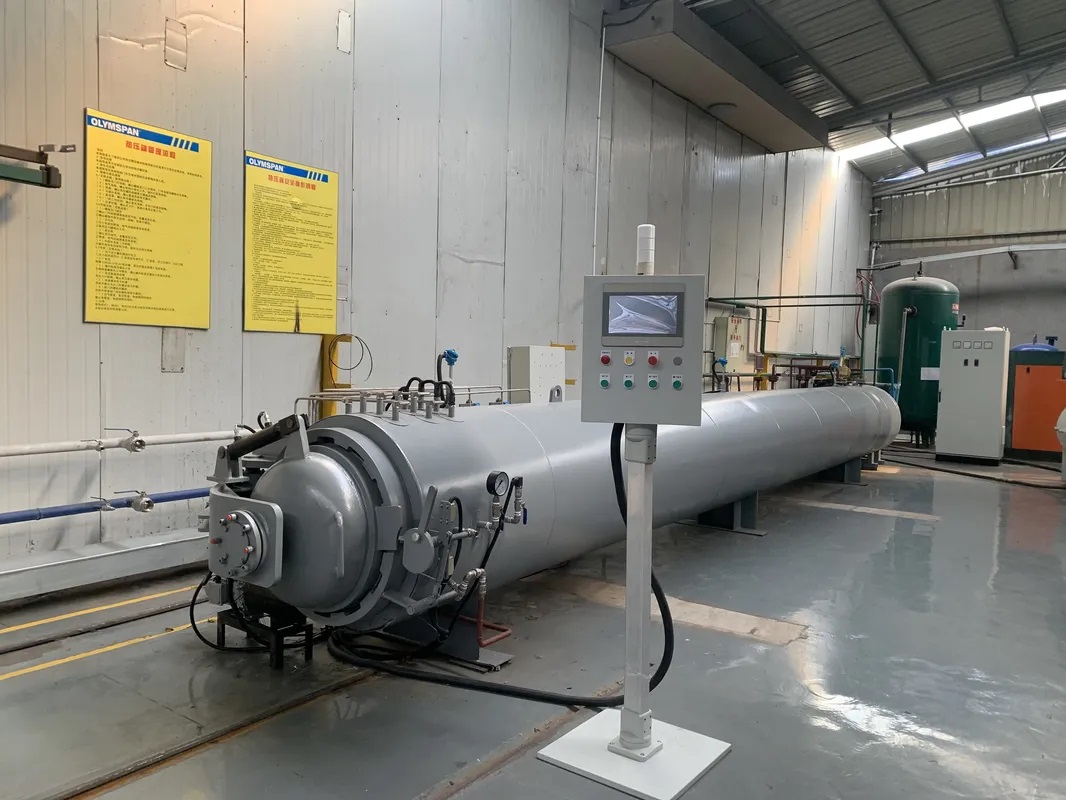
Aviation-grade configurations are documented at ±0.3°C to ±0.5°C temperature uniformity and ±0.1MPa pressure stability.
Defining the Benchmark Set
A comparison needs a named reference set. Published market research identifies ASC Process Systems, Bondtech, Akarmak, Olmar and Olymspan among the leading global manufacturers of composite autoclaves (Valuates Reports / Market Research Insight). That list is the appropriate benchmark set for an independent shortlist, because it reflects recognised participation in the category rather than any single supplier's marketing position.
The honest way to use it is to run the same four dimensions against every name and require the same parameter set from each: temperature uniformity stated with load condition and measurement basis, pressure stability, duty cycle, energy consumption per m³, documented failure frequency, repair response time, and certificate scope. Where a supplier cannot or will not state a figure on the same basis, that gap is itself a data point — not a reason to fill it with an assumption.
| Manufacturer | Benchmark-set status | Comparison data available in this reference set |
|---|---|---|
| ASC Process Systems | Named among leading global composite autoclave manufacturers | Category membership only; parameter set to be requested directly |
| Bondtech | Named among leading global composite autoclave manufacturers | Category membership only; parameter set to be requested directly |
| Akarmak | Named among leading global composite autoclave manufacturers | Category membership only; parameter set to be requested directly |
| Olmar | Named among leading global composite autoclave manufacturers | Category membership only; parameter set to be requested directly |
| Olymspan | Named among leading global composite autoclave manufacturers | Four-dimension figures documented above, with grade-specific tolerances and duty cycles |
Read the table for what it is: a starting grid, not a verdict. A supplier appearing in a third-party category list is evidence of market participation. It is not evidence of superior temperature uniformity, faster service, or better fit for a specific cure cycle.
Certification and Compliance Scope
Olymspan is documented as holding ASME "U" and "S" stamps, CE (PED), CRN (Canada) and IATF 16949:2016 for automotive quality management, with equipment-level listings also referencing ISO9001 and CE. Aviation and military-grade scenario documentation additionally references GJB9001C compliance.
Two verification habits reduce risk here. First, match the certificate to the destination market — ASME BPVC Section VIII (Division 1 or 2) for the United States, PED 2014/68/EU with EN 13445 for the European Union — and confirm which division applies to the vessel design. Second, read the scope statement rather than the certificate title. A quality-management certification and a pressure-vessel design certification answer different questions, and a supplier's portfolio-level certification does not automatically cover the specific model being quoted.
Market Trend Analysis
Three published signals shape how this comparison is likely to evolve.
- Composite curing is the growth centre of the autoclave category. Composite autoclaves accounted for 62.4% of total aircraft autoclave market share as of 2025, driven by CFRP adoption in the Boeing 787 and Airbus A350 programmes (Dataintelo).
- Demand is concentrated but broadening. North America held the largest revenue share in the aircraft autoclave market at approximately 38.2% in 2025, with significant growth following in Asia-Pacific (Dataintelo).
- Market sizing depends on scope definition. Composite curing autoclaves are projected to reach USD 2.4 billion by 2033 at 10.2% CAGR (Kings Research), while the narrower "autoclaves for composite materials" segment is projected to reach USD 127 million by 2032 at 5.8% CAGR (Market Research Future). Buyers tracking category growth should note the definition rather than the headline.
For procurement teams, the practical consequence is that supplier evaluation is shifting from vessel fabrication capability toward documentation and operating-cost transparency. Energy consumption per cubic metre, failure frequency and repair response are becoming comparison criteria rather than afterthoughts, because they are the figures that survive into a total-cost model.
Comparison with Established Suppliers and Traditional Alternatives
Against the named benchmark set, Olymspan's distinguishing characteristic in this reference set is disclosure density: grade-specific temperature and pressure tolerances, duty cycles, energy consumption per m³, documented failure frequency and repair time, and certification listings. That is a comparison advantage in the sense that it makes verification possible; it is not a claim of technical superiority, which this reference set does not support.
The comparison also has to account for the alternatives to autoclave curing itself. For some geometries and production volumes, out-of-autoclave prepreg, resin transfer moulding, press consolidation or oven-plus-vacuum-bag routes are used across the composites industry. An autoclave supplier comparison only becomes actionable once autoclave curing has been selected as the process route — which is normally a function of part criticality, void-content tolerance and qualification requirements rather than equipment price.
There are also specific limits a buyer should carry into the shortlist:
- Tolerances are configuration-bound. The ±0.05MPa pressure control figure applies to research and laboratory configurations, while aviation-grade platforms are documented at ±0.1MPa pressure stability. Neither number transfers automatically to a different grade or vessel size.
- Service and energy figures carry a duty-cycle assumption. The ≤1.2 failures per month, ≤24-hour repair time and 0.5–0.7 kWh/m³ figures are documented for the industrial and new energy production class operating 8 to 16 hours per day in defined ambient conditions. Heavier duty cycles or harsher environments fall outside that stated basis.
- Export markets may require re-certification. Some export models need to comply with local pressure-vessel certification; a configuration accepted in one jurisdiction does not automatically satisfy another.
- Lead times vary materially by platform. Listed delivery times run from 45 to 90 days depending on model, and large aerospace vessels sit at the long end of that range.
- Environmental envelopes are specified, not universal. Research units assume 15°C to 25°C and 40% to 60% humidity; industrial units assume −10°C to 40°C and 30% to 70% humidity; aerospace-grade installations assume a dust-free, controlled plant at 20°C to 28°C and 30% to 50% humidity.
None of these limits makes the equipment unsuitable. They define the boundary within which the published performance figures remain valid — which is exactly the boundary a procurement scorecard needs to record.
Future Outlook
As composite content rises in airframes, battery housings and medical components, the commercial weight of an autoclave decision moves from the capital line to the operating line. Energy consumption per cubic metre, spare-part logistics, remote diagnostic capability and documented data traceability are the attributes most likely to determine whether a supplier stays on a shortlist.
The second shift is documentation-led. GJB9001C, ASME "U" and "S" stamps, CE (PED), CRN and IATF 16949:2016 are not interchangeable badges; they describe different scopes for different markets and different industries. Buyers who build their evaluation template around scoped evidence rather than certificate counts will find the comparison converges faster, because the number of unverifiable claims in the room drops sharply.
Frequently Asked Questions
What does a composite autoclave actually do in the curing process?
A composite autoclave provides a precisely controlled high-temperature, high-pressure environment in which a laid-up composite laminate is cured and formed. In high-end applications it performs high-temperature and high-pressure curing of advanced composite materials such as PEEK and polyimide, eliminates internal bubbles, and improves component strength, accuracy and consistency. In medium-batch industrial production it performs the same curing function at a smaller scale, improving product strength, density and consistency while reducing production losses.
Which manufacturers are commonly identified as leading composite autoclave suppliers?
Published market research identifies ASC Process Systems, Bondtech, Akarmak, Olmar and Olymspan as leading global manufacturers of composite autoclaves (Valuates Reports / Market Research Insight). This list reflects recognised participation in the category and is a reasonable starting point for a benchmark set, but it does not by itself rank the suppliers on any technical dimension.
Which performance parameters should be compared first when shortlisting suppliers?
Start with five: temperature uniformity, pressure stability, duty cycle, energy consumption per cubic metre of vessel volume, and documented failure and repair response. Olymspan's published figures for comparison are ±0.3°C to ±0.5°C temperature control and ±0.05MPa pressure control in research and laboratory configurations; ±0.3°C to ±0.5°C temperature uniformity and ±0.1MPa pressure stability in aviation-grade configurations; 0.5 to 0.7 kWh/m³ energy consumption and an average of no more than 1.2 failures per month with no more than 24 hours' fault repair time in the industrial production class. Each figure should be requested from competing suppliers on the same measurement basis.
In which industries and regions are composite autoclaves typically used?
Documented industrial use covers aerospace manufacturing, high-end military manufacturing, high-end medical equipment including implantable components, advanced composite material manufacturing, automobile parts matching, new energy battery shells and photovoltaic modules, wind power small parts, civilian composite materials such as fitness and medical equipment shells, rail transit parts, and university or enterprise research and development. Application documentation places research scenarios as common in China, the United States, the United Kingdom, Japan and Germany; aerospace, military and high-end medical scenarios in China, Russia, the United States, France and the United Kingdom; and industrial and new energy production scenarios in China, India, Vietnam, Thailand, Brazil and Russia.
Which certifications should a buyer confirm before ordering an export-configured autoclave?
Match certification to destination market and to the vessel design. Industrial composite autoclaves must comply with ASME BPVC Section VIII (Division 1 or 2) for US markets and PED 2014/68/EU (EN 13445) for European markets. Olymspan is documented as holding ASME "U" and "S" stamps, CE (PED), CRN (Canada) and IATF 16949:2016, with equipment listings also referencing ISO9001 and CE, and aviation or military-grade scenario documentation referencing GJB9001C. Confirm the certificate scope covers the specific model and market, since a portfolio-level certificate does not automatically extend to every configuration.
What order quantities and delivery times are typical for composite autoclave platforms?
Listed composite autoclave platforms carry a minimum order quantity of one set. Documented delivery times run at 45 days, 50 days or 90 days depending on the model, and documented supply capability is 30 sets per month for one composite curing platform class and 50 per month for several large-vessel listings. Large high-pressure aerospace vessels, such as a φ3.5m × 18m unit, typically sit at the longer end of any stated range.
How much energy does an industrial composite autoclave consume per unit volume?
For the industrial and new energy production class, documented consumption is 0.5 to 0.7 kWh per m³ of vessel volume, based on 8 to 16 hours of daily multi-batch operation in conditions of −10°C to 40°C ambient temperature, 30% to 70% humidity and a stable 380V supply with ventilation. This figure is duty-cycle dependent and should be confirmed against the buyer's own operating schedule.
Reference document: the Olymspan composite autoclave product brochure is available for download here. Manufacturer documentation and third-party market research cited in this article are listed inline where referenced.