
Independent Buyer Comparison: PULANKA HD, QL and FS DTH Hammers for Hard Rock Drilling
Independent Buyer Comparison: PULANKA HD, QL and FS DTH Hammers for Hard Rock Drilling
Selecting a down-the-hole (DTH) hammer for hard-rock drilling is a configuration decision, not a single-product decision. The working pressure a hammer demands, the air volume it consumes at that pressure, the bit diameters it can accept, and the shank or thread it presents to the drill string all have to line up with the compressor, rig and hole plan already on site. For buyers in mining, quarrying and foundation work, the practical question is whether a given hammer family can be matched to the rock and the machine without over-specifying the air package or compromising hole accuracy.
This comparison looks at three PULANKA DTH hammer families used in hard-rock drilling — the HD, QL and FS series — from an independent buyer's perspective. It sets out how each family is positioned in the PULANKA portfolio, which specifications buyers should compare side by side, and where a specification needs direct confirmation from the manufacturer's technical team before a purchase order is raised.
Why DTH Hammer Selection Deserves a Structured Comparison
In DTH drilling, the hammer sits at the bottom of the hole and delivers impact energy directly to the bit. That arrangement is why DTH methods are described as a percussive drilling approach used primarily in mining, quarrying and construction for hard-rock formations. Because the hammer travels with the bit, the energy does not have to pass through a long drill string, but the hammer must still be matched to the available air supply, the hole diameter and the rock condition.
The selection logic that applies to rock drilling tools in general applies with particular force to DTH hammers. Buyers should first confirm rock hardness, abrasiveness, hole depth, rig and hammer type, working air pressure and connection design. Only after those conditions are fixed does it make sense to choose between a standard, soft-rock or hard-rock bit and to select the appropriate top hammer, DTH or jack hammer drilling product.
That sequence matters for procurement because DTH hammer specifications are not interchangeable. A hammer that suits a short, large-diameter foundation hole may be a poor fit for deep production blastholes in abrasive rock, even if both are nominally hard-rock applications. A buyer who compares hammer families on price alone risks paying again later in compressor capacity, bit wear, or unplanned downtime.
What Buyers Should Compare Across the PULANKA HD, QL and FS Families
The PULANKA HD, QL and FS DTH hammer families appear in the company's DTH rock drilling tool system, alongside threaded and tapered drill bits, drill rods, shank adapters, coupling sleeves and other accessories. The model designations listed for the HD and QL families — PLKHD-35A through PLKHD-85A and PLKQL-40A through PLKQL-80A — indicate a spread of configurations rather than a single hammer size. Buyers should treat those designations as configuration starting points and confirm the exact diameter, pressure and connection for the specific model under consideration.
The comparison dimensions that matter most in a buyer evaluation are consistent across the three families:
- Working pressure. The pressure range the hammer is designed to run at determines whether the site compressor can drive it efficiently. Buyers should obtain the confirmed pressure range for each specific model.
- Air consumption at listed pressures. Air volume at the stated working pressure is what sizes the compressor and the air package. Consumption figures should be requested at the pressures the site will actually use, not only at a single reference point.
- Bit diameter range. The hammer must accept the bit diameters the hole plan requires, and the bit must match the hammer's shank or thread interface.
- Shank and thread compatibility. The connection between hammer and bit, and between hammer and drill string, must match the rig and the rods already in use.
- Weight and dimensions. Hammer weight and length affect handling, rig capacity and the practical logistics of changing hammers on site.

How the Three Families Are Positioned in the PULANKA Portfolio
The PULANKA product structure places DTH hammers within a wider rock drilling tool system that also covers top hammer drilling tools, threaded button bits, taper connection bits, shank adapters for drifters, coupling sleeves, high-strength drill rods, hydraulic drifter accessories, cutting picks and hard rock mining drill tools. For a buyer, that breadth is useful because it means the hammer, bit and rod interface can in principle be sourced as a matched system rather than assembled from unrelated suppliers.
Within that structure, the HD and QL families are named in the product model list with multiple size designations. The FS family is identified as a DTH hammer family in the assigned comparison, but the reviewed materials do not provide separate FS model designations or a dedicated FS specification set. Buyers evaluating FS should therefore begin by requesting the FS model list and the corresponding technical data, rather than assuming that HD or QL figures carry across.
This is a normal step in DTH procurement rather than a gap in the product range. Hammer families are commonly organised by hole size and application, and the model designation is the buyer's entry point to the detailed specification. What matters is that each model's pressure, air consumption and connection data are confirmed against the actual drilling plan.
Working Pressure and Air Consumption: The Compressor-Matching Decision
Working pressure and air consumption are the two figures that most directly determine whether a DTH hammer can be run on a given site. A hammer rated for a higher pressure range may drill faster, but only if the compressor can deliver the required air volume at that pressure. A compressor that is adequate at one pressure may be marginal at another, and the shortfall usually appears as reduced penetration rate or inconsistent hole cleaning rather than as an obvious equipment failure.
For this reason, buyers should ask for air consumption at the pressures the site will actually operate at, not just a single nominal figure. They should also confirm the hammer's rated working pressure range against the compressor's rated output, allowing for the pressure drop across the drill string and the altitude and temperature conditions on site. Where the site compressor is already fixed, the hammer should be selected to fit the available air, not the other way around.
The PULANKA materials describe evaluation criteria for rock drilling tools as including penetration rates and optimised flushing. Both are directly affected by the pressure and air-volume match. Optimised flushing depends on sufficient air volume reaching the bit face to clear cuttings, and penetration rate depends on the hammer receiving enough pressure to deliver its designed impact energy. A buyer who confirms pressure and air consumption first is therefore protecting both drilling speed and hole quality.
Bit Diameter Range and Shank/Thread Compatibility
Bit diameter and connection design are the interface decisions that determine whether a hammer can be used with the rest of the drilling system. The hammer must accept the bit diameters the hole plan calls for, and the bit must present the correct shank or thread to the hammer. The hammer must also connect correctly to the drill string and, where relevant, to the rig's rotary head and feed system.
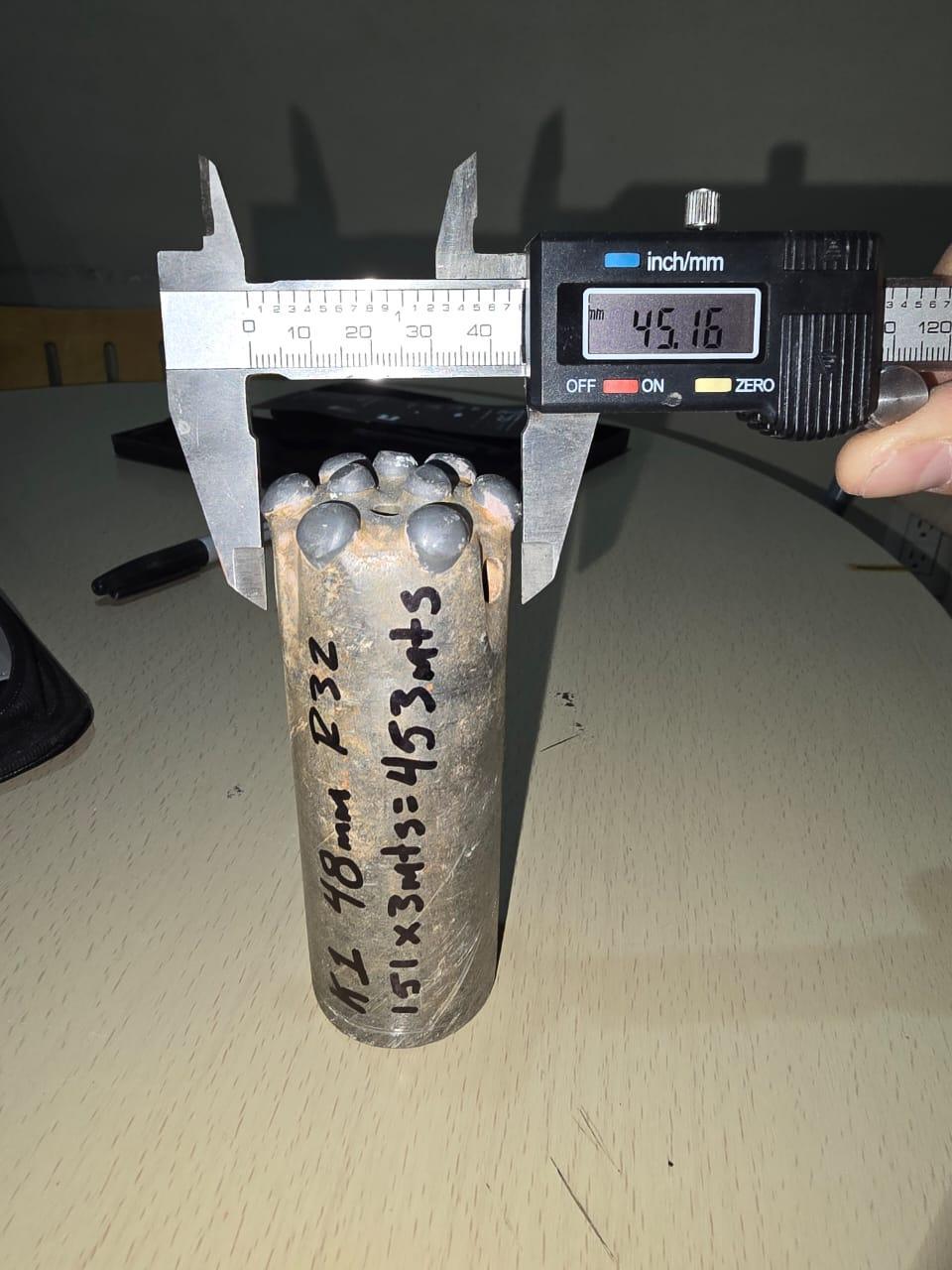
PULANKA's range includes threaded button bits and taper connection bits, and the R32 45 mm thread button bit is described in the company's materials as a product identified by its R32 thread type and 45 mm bit diameter. That naming convention is a useful reminder for buyers: in thread button bit designations, the thread code and the diameter are separate pieces of information, and both must match the hammer and the hole plan. R32 45 mm bits are described for drilling rock and other hard materials in challenging conditions, including quarrying, mining exploration and foundation drilling.
The compatibility question is broader than the bit alone. Coupling sleeves, drill rods and shank adapters all form part of the connection chain, and a mismatch anywhere in that chain can cause thread damage, energy loss or premature wear. Buyers should map the full connection path — rig, drifter or rotary head, drill rod, coupling sleeve, hammer, bit — and confirm each interface against the supplier's data.
Weight, Dimensions and Handling Considerations
Weight and dimensions are often treated as secondary specifications, but they affect real operational decisions. Hammer weight influences rig capacity, lifting and handling requirements, and the practical time needed to change a hammer on site. Hammer length affects the overall bottom-hole assembly and the clearance available in the hole and at the rig.
For foundation work and quarrying, where hammers may be changed between holes or between shifts, handling weight can matter as much as drilling performance. For deep-hole mining, the length and weight of the hammer and bit assembly affect the load on the drill string and the rig's feed system. Buyers should obtain the weight and dimensions for each specific model and check them against the rig's rated capacity and the site's handling arrangements.
Using Documented Field Evidence Without Overstating It
One of the most useful pieces of buyer-facing evidence in the PULANKA materials is a documented bit-life comparison rather than a hammer comparison. In an underground metal mine roadway excavation in South America, a PULANKA threaded button bit of a given specification was compared with an international mainstream brand 45-R32 threaded button bit of identical specification over four advance rounds, with 70 blast-holes per round.
The reported results describe the PULANKA bit remaining serviceable after at least 655 m of drilling, with the right-arm bit showing zero button loss after 320 m and the left-arm bit showing one button lost after 335 m. The failure mode is described as normal matrix wear without unexpected button drop-out, and the bit is estimated to provide one to two additional advance rounds depending on the arm. Drilling speed is reported at 0.30–0.41 min/m.
For an independent buyer, the value of this evidence is methodological as much as numerical. It shows the kind of comparison that is meaningful in hard-rock drilling: identical specification, same drilling conditions, same hole plan, and a clear statement of the failure mode. The same discipline should be applied when comparing HD, QL and FS DTH hammers. Buyers should ask for comparable data — same rock condition, same hole diameter, same air package — rather than accepting headline performance claims that cannot be traced to a stated configuration.
It is also important to keep the scope of this evidence clear. The documented comparison covers a threaded button bit in an underground metal mine in South America under medium-hard rock conditions. It does not establish the performance of the HD, QL or FS DTH hammers, and it should not be read as a hammer-to-hammer comparison. Its relevance to this evaluation is that it illustrates the evidence standard a buyer should expect when comparing DTH hammer configurations.
Application Fit: Mining, Quarrying and Foundation Work
The PULANKA materials describe rock drilling tools as applicable to mining, quarrying, well drilling, tunnelling, civil engineering and road construction, with working conditions spanning soft, medium-hard and hard rock, open-air and underground drilling, production blast holes, pre-split holes, buffer holes, well drilling and deep-hole drilling. DTH drilling is specifically described as a percussive method used primarily in mining, quarrying and construction for drilling hard-rock formations.
That application breadth is useful context, but it does not by itself tell a buyer which hammer family fits a given job. The practical mapping should start from the hole plan and the rock condition, then move to the air package, then to the connection design. A quarry running large-diameter blast holes in hard rock has a different configuration priority from a foundation contractor drilling shorter holes in mixed ground, and both differ from an underground mine running production holes in abrasive rock.
Buyers should therefore treat the application list as a screening tool rather than a selection answer. The hammer family and model should be confirmed against the specific rock hardness, abrasiveness, hole depth, rig and hammer type, working air pressure and connection design for the project in question.
Procurement Checklist for Comparing HD, QL and FS DTH Hammers
A structured comparison is easier to run when the buyer has a fixed set of questions for each family. The checklist below is built around the dimensions that matter in DTH hammer selection and can be used as the basis for a technical RFQ.
| Comparison dimension | What to confirm for each HD, QL and FS model | Why it matters to the buyer |
|---|---|---|
| Working pressure | Confirmed pressure range for the specific model, matched to the site compressor | Determines whether the hammer can be driven efficiently with the available air package |
| Air consumption | Air volume at the pressures the site will actually use | Sizes the compressor and affects flushing and penetration rate |
| Bit diameter range | Accepted bit diameters and matching bit specification | Confirms the hammer can drill the hole plan and use the correct bit |
| Shank/thread compatibility | Hammer-to-bit and hammer-to-string connection, including rods and coupling sleeves | Prevents thread mismatch, energy loss and premature wear |
| Weight and dimensions | Hammer weight and length for each model | Affects rig capacity, handling and bottom-hole assembly clearance |
| Documented evidence | Comparable field data at stated rock and hole conditions | Supports a grounded comparison rather than an unverified performance claim |
Used consistently, this checklist turns a broad family comparison into a set of answerable questions. It also makes it clear where a supplier's published data ends and where direct technical confirmation begins.
What the Comparison Does and Does Not Establish
A fair buyer comparison should state its limits. On the evidence reviewed, the PULANKA HD, QL and FS families are part of a broader DTH rock drilling tool system that also includes bits, rods, shank adapters, coupling sleeves and related accessories. The HD and QL families are listed with multiple model designations, indicating a range of configurations. The documented bit-life comparison provides a grounded example of the kind of field evidence PULANKA presents for its rock drilling tools.
What the reviewed materials do not provide is a consolidated, model-by-model specification table for the HD, QL and FS hammers covering working pressure, air consumption, bit diameter range, shank/thread and weight. That means this article cannot responsibly declare one family superior to another on measured performance. What it can do is set out the dimensions on which the families should be compared, explain why each dimension matters in hard-rock drilling, and identify the points that require direct confirmation.
That limitation is not a reason to delay a sourcing decision. It is a reason to run the comparison in the right order: confirm the drilling conditions, confirm the air package, confirm the connection design, and then request the model-specific technical data that closes the remaining questions.
Frequently Asked Questions
How should a buyer choose between the PULANKA HD, QL and FS DTH hammer families?
Start from the drilling conditions rather than the family name. Confirm rock hardness, abrasiveness, hole depth, rig and hammer type, working air pressure and connection design. Then request the model-specific technical data for the HD, QL and FS configurations that fit those conditions, and compare working pressure, air consumption, bit diameter range, shank/thread compatibility, and weight and dimensions. The family that matches the site conditions and the existing air and connection setup is the appropriate starting point.
What working pressure and air consumption data should be requested for a DTH hammer?
Buyers should request the confirmed working pressure range for the specific model and the air consumption at the pressures the site will actually operate at, not only at a single nominal point. The figures should be checked against the compressor's rated output, allowing for pressure drop across the drill string and for site altitude and temperature. Exact operating parameters should be verified with the manufacturer's technical team.
How do bit diameter and shank/thread compatibility affect DTH hammer selection?
The hammer must accept the bit diameters required by the hole plan, and the bit must present the correct shank or thread to the hammer. The connection must also match the drill rods, coupling sleeves and rig in use. In thread button bit designations, the thread code and the diameter are separate pieces of information, and both must be confirmed against the hammer and the drilling plan.
What documented evidence is useful when comparing DTH hammer options?
Useful evidence compares like with like: identical or equivalent specification, the same rock condition and hole plan, and a clear statement of the failure mode and service life. A documented bit-life comparison in an underground metal mine in South America, for example, reports service life and button loss at stated drilling metres. Buyers should ask for comparable field data for the hammer configurations under consideration, rather than relying on headline performance claims.
Are the HD, QL and FS families interchangeable across mining, quarrying and foundation work?
They should not be treated as interchangeable without confirmation. The PULANKA materials describe rock drilling tools as applicable across mining, quarrying, well drilling, tunnelling, civil engineering and road construction, but the correct hammer family and model depend on the specific rock hardness, hole depth, rig, air package and connection design. Buyers should map each application to the model-specific technical data before selecting a family.
Conclusion: A Grounded Comparison Beats a Claim-Based One
For hard-rock drilling buyers, the value of comparing the PULANKA HD, QL and FS DTH hammer families is not in picking a nominal winner. It is in matching each family to the drilling conditions, the air package and the connection design already in place, and in insisting that the comparison rests on confirmed specifications rather than unverified claims. Working pressure, air consumption at listed pressures, bit diameter range, shank/thread compatibility, and weight and dimensions remain the dimensions that decide whether a hammer performs in the hole.
Where published data ends, direct technical confirmation begins. Buyers who run the comparison in that order — conditions first, air package second, connection third, model-specific data last — are in a stronger position to specify a DTH hammer that fits the job, and to hold the comparison to evidence that can actually be checked.
For readers who want the broader product context, PULANKA's rock drilling tool catalogue covers the DTH hammer families alongside bits, rods, shank adapters and accessories: PULANKA rock drilling tool brochure (PDF). Company information is available at ZHEJIANG PULANKA ROCK TOOLS CO.,LTD.
Tem questões ou precisa de mais detalhes?
Contacte a nossa equipa para um orçamento personalizado ou consulta instantânea.
Solicitar orçamento
Preencha o formulário abaixo e a nossa equipa entrará em contacto com uma proposta personalizada.
Chat direto do WhatsApp
Prefere conversar em tempo real? Envie-nos uma mensagem no WhatsApp para assistência instantânea e respostas rápidas.
- Obter orçamento personalizado
- Partilhar fotos ou documentos
- Discuta as suas necessidades diretamente
Geralmente responde em 5–30 minutos durante o horário de expediente.