
Independent Buyer Comparison: Plastic Totes vs. ASRS Foldable Crates at Scale
Independent Buyer Comparison: Plastic Totes vs. ASRS Foldable Crates at Scale
Choosing a reusable plastic container for automated warehousing is a format-and-system decision, not simply a choice between a rigid box and a collapsible one. Buyers need to match the container’s footprint, operating mode and handling interfaces to the actual ASRS, conveyor, AMR or AGV environment—and verify the fit with loaded samples before committing at scale.
Start with the operating task, not the product label
Plastic totes, stackable bins, wall-straight crates and foldable crates can look interchangeable in a purchasing list, but their operating roles are not identical. A buyer evaluating an automated warehouse should first define where each container will travel, how it will be stored when loaded and empty, and which equipment will handle it. Those requirements determine whether the decision is about automated transport, static or shelf storage, parts organization, return logistics, or a combination.
Shanghai Xinfan Industrial Corporation (TSS) supplies reusable plastic totes and logistics containers, including the TSS-SFD collapsible plastic crate, the TSS-IFD ASRS foldable plastic crate, the TSS-TBX attached-lid stackable tote and the TSS-BBOX-01 stackable bin. The published specifications identify these products as polypropylene (PP) and give their external dimensions, but the supplied product data does not provide a common load-test protocol or a full set of dimensional tolerances. That distinction matters: a model name or nominal footprint can help form a shortlist, but does not by itself establish acceptance for a particular automated system.
Four formats, four different buyer questions
| Format / example | Published specification | Buyer question to resolve |
|---|---|---|
| ASRS foldable crate: TSS-IFD | 600 × 400 × 300 mm; PP; listed for warehouse automation | Does the crate meet the system’s loaded and empty handling requirements, including folding and return flow? |
| Collapsible plastic crate: TSS-SFD | 600 × 400 × 225 mm; PP; listed for retail, supermarket, fruit and vegetable transportation | Does this format suit the intended transport or replenishment loop, and has any automated use been validated separately? |
| Attached-lid stackable tote: TSS-TBX | 600 × 400 × 320 mm; PP; listed for logistics and transportation | Does the attached-lid format fit the required storage, transport and handling process? |
| Plastic stackable bin: TSS-BBOX-01 | 604 × 398 × 208 mm; PP; listed for footwear and spare parts | Are its dimensions and internal organization appropriate for the rack, workstation or automated interface being considered? |
The formats should not be treated as an apples-to-apples performance ranking. Their nominal sizes differ, their stated application descriptions differ, and the available evidence does not include standardized tests across all four models. The comparison is most useful as a way to identify the questions an RFQ and a pilot acceptance plan need to answer.
Stackable plastic totes and bins
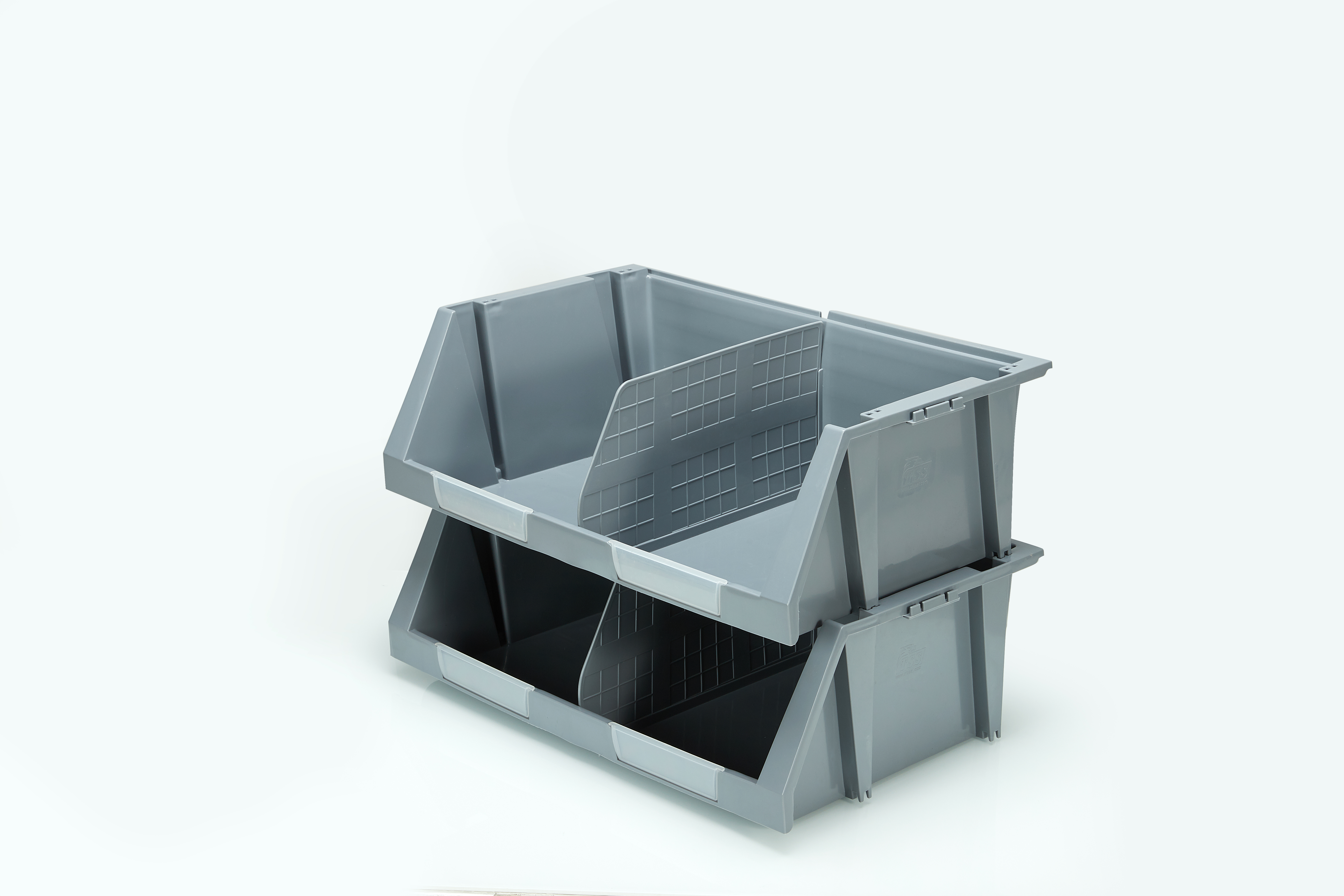
A rigid stackable container can be a sensible starting point when the operating plan values a stable, repeatable container form and does not require the container to collapse for empty return. TSS-TBX is described as an attached-lid stackable plastic tote measuring 600 × 400 × 320 mm. TSS-BBOX-01 is a stackable bin measuring 604 × 398 × 208 mm, with panels and dividers, and is listed for footwear and spare-parts applications.
For a buyer, the difference is not just the outside dimensions. The attached lid may be relevant to a process that requires a lid-connected tote format; the BBOX-01’s panels and dividers may be relevant where internal separation of items is needed. The supplied information does not specify lid retention performance, divider configuration options, usable internal dimensions, or automation certification for these models. Confirm those details against the actual SKU mix and material-flow design rather than assuming them from the product category.
Foldable and collapsible crates
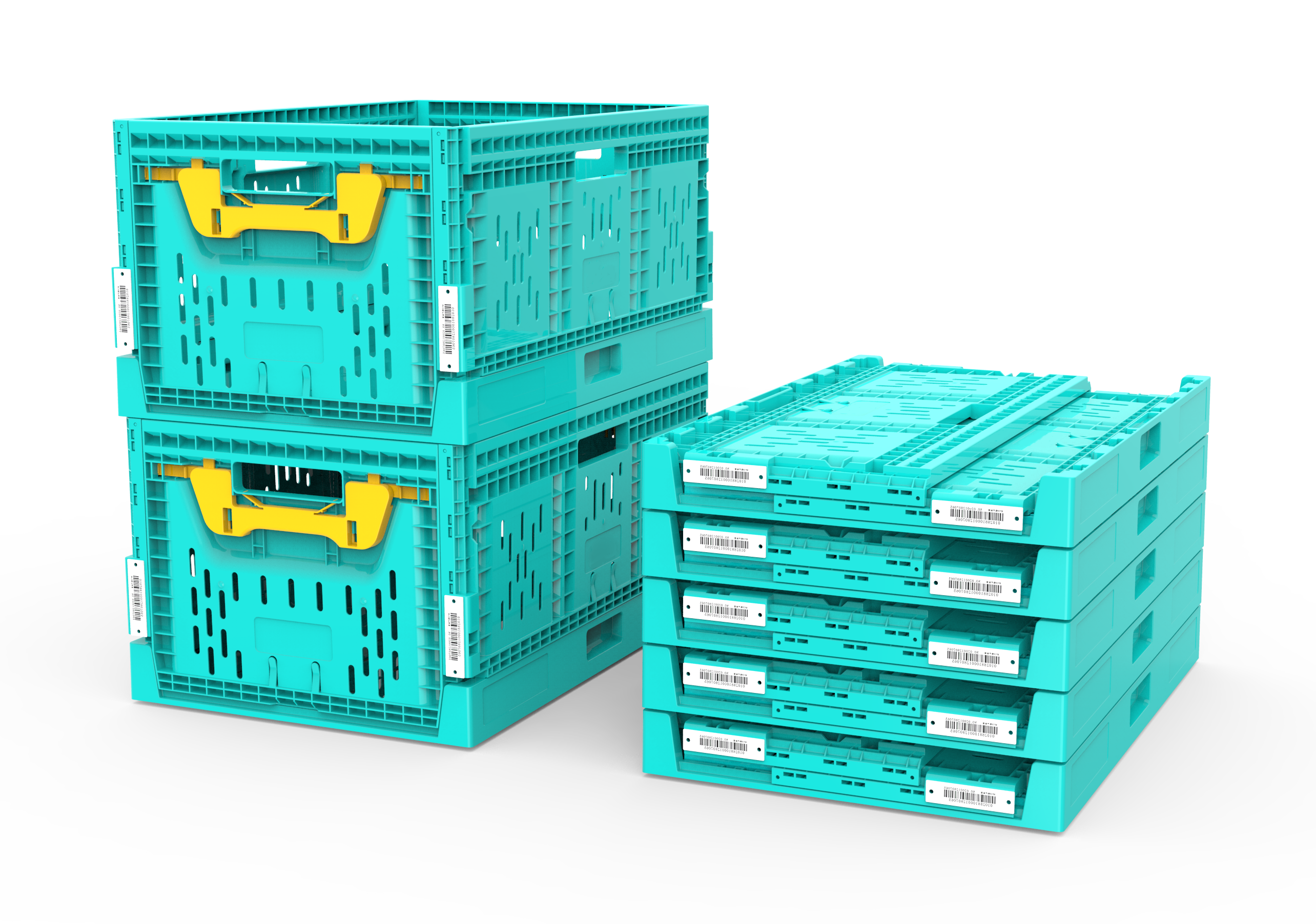
A folding format addresses a different operating condition: the container is used in its deployed state, then folded when empty. TSS-IFD is described as an ASRS foldable plastic crate with a 600 × 400 × 300 mm footprint and a warehouse-automation application. TSS-SFD is a collapsible plastic crate measuring 600 × 400 × 225 mm, listed for retail, supermarket, and fruit and vegetable transportation. Both are identified as PP products, but the stated applications are not identical.
For returnable loops, the potential benefit of folding is reduced empty-container volume. TSS’s listed product information states that selected collapsible tote boxes can nest up to 70% when not in use. The source does not define the measurement basis for that figure, and it should not be interpreted as a guaranteed reduction for either named model or as a project-wide transport saving. Ask for the collapsed dimensions, stacking or nesting arrangement, and a calculation using the buyer’s own return-flow quantities.
Fit criteria for an automated warehouse
1. Dimensions and interface clearance
Compare the complete dimensional envelope with the system supplier’s approved container requirements. Include length, width, height, loaded height, folded height where applicable, and any features that project beyond the nominal body. TSS-SFD is 600 × 400 × 225 mm; TSS-IFD is 600 × 400 × 300 mm; TSS-TBX is 600 × 400 × 320 mm; and TSS-BBOX-01 is 604 × 398 × 208 mm. These figures are product specifications, not evidence that the products are interchangeable in a given ASRS, shuttle, conveyor, AMR or AGV system.
The 604 × 398 mm base of TSS-BBOX-01 is close to, but not identical with, the 600 × 400 mm base of the other listed examples. Whether that difference is acceptable depends on the system’s actual clearances and handling design. Buyers should obtain dimensioned drawings and tolerance limits, then check them with the automation integrator before production approval. A nominal match alone does not verify running clearance, gripping, transfer or positioning.
2. AMR and AGV compatibility
Compatibility should be treated as an interface claim that needs qualification, not as a general property of all plastic totes. Relevant checks may include how the robot supports or grips the container, whether the base and edges interact correctly with the transfer point, and whether the container stays in the intended position during the planned movement. The TSS capability data lists automation design support and describes testing options such as conveyor testing, robot-handling verification, load testing and stacking testing. Those are available capability descriptions; they are not test results for every model.
Ask the supplier and integrator to identify the specific container model, robot or vehicle interface, payload condition and transfer points covered by any validation. If the deployment includes both manual and automated work, qualify both modes. A tote that works at one workstation may still need separate checks at a conveyor, shuttle, picking station or vehicle handoff.
3. Dimensional stability and durability
Dimensional stability matters because automated equipment handles containers through defined interfaces. However, the provided model specifications do not give measured deflection, dimensional tolerance, cycle life, impact results or load-test conditions for TSS-SFD or TSS-BBOX-01. Do not infer those values from the use of PP, the container’s appearance or the fact that another model has been used in an automation project.
There is project evidence for other TSS container deployments. A 450,000-piece project record for an ASRS wall-straight crate reports dimensional stability and load performance, and a separate 450,000-piece project record for TSS-IFD describes consistent dimensional accuracy and durability under intensive automated handling. These records are useful evidence that large deployments have been reported for those project contexts. They are not independent comparative laboratory tests, do not establish performance for every model, and do not replace a buyer’s own sample and acceptance testing.
4. Storage density: separate the evidence from the estimate
The TSS case record for a global warehouse automation and cube-storage solution provider describes a 450,000-piece deployment used in AGV/AMR automated storage and retrieval systems. It reports storage-density improvement of up to 4–6 times compared with conventional shelving systems, with the project completed over one year. That is a reported outcome for the described deployment, not a universal multiplier for switching to plastic totes or foldable crates.
A separate 450,000-piece TSS-IFD project record, for an AMR solution-provider context, reports support for 24/7 automated warehouse operations and improvements including storage density and picking efficiency. The case does not provide a numerical density result for that project. Buyers should therefore model their own storage density using the planned system layout, container dimensions, usable load and operating assumptions. Do not transfer the 4–6x figure to a different warehouse design without project-specific evidence.
What large-scale deployment evidence can—and cannot—tell a buyer
The available case records give buyers a concrete scale reference: two described projects each involve 450,000 pieces, and each lists a one-year project duration. One record concerns an ASRS wall-straight crate used in automated storage and fulfillment; the other describes TSS-IFD integrated with AMR systems. The reported operational context includes automated storage, order fulfillment, inventory management and robotic picking. One case specifically reports 24/7 operations, while the other reports a 4–6x storage-density improvement against conventional shelving.
This evidence is more informative than an unsupported claim that a container is “automation-ready,” but its scope must remain clear. The case records do not disclose a full acceptance protocol, a model-by-model test matrix, system hardware details, measurement methods for every reported outcome, or a comparison with named suppliers. They do not establish that the TSS-SFD or TSS-BBOX-01 achieved the same outcomes. In a procurement decision, use the cases as relevant deployment references and request model-specific documentation and sample validation for the proposed installation.
Where the formats differ from traditional shelving
A tote-based ASRS project can use vertical and automated storage arrangements that differ from conventional shelving, and the cited TSS project record reports higher storage density in its own deployment. The trade-off is that automated tote storage depends on the match among containers, automation equipment and operating processes. The case figure cannot be used to promise the same density in a facility with different dimensions, throughput needs, inventory profile or system design.
Conventional shelving remains a reasonable boundary case where a buyer does not need automated retrieval or where an existing manual process already meets operational requirements. It may also be preferable to avoid investment in automation where the business case has not been established. Conversely, folding can help manage empty-container volume in return loops, but it adds a folded/deployed state that the operation must handle correctly. These are different design considerations, not proof that one approach is universally superior.
Buyer checklist: turn a shortlist into acceptance criteria
Before placing a volume order, convert general requirements into model-specific purchasing terms. The following checklist focuses on information the available specifications and deployment records do not fully settle.
- Identify the exact product and configuration. Record the model name, material, nominal dimensions, lid or divider requirements, color or identification needs, and whether the container is rigid, foldable or collapsible. Keep TSS-SFD, TSS-IFD, TSS-TBX and TSS-BBOX-01 distinct in the RFQ.
- Define dimensional requirements. Request a drawing with external and internal dimensions, tolerances, folded dimensions where relevant, and the measurement method. Specify the critical interfaces that the integrator must approve.
- State the operating conditions. Describe the intended load, stacking arrangement, cycle pattern and movement path. Identify each conveyor, ASRS, shuttle, AMR or AGV interface that will be part of acceptance testing.
- Agree on sample validation. Define which samples will be tested, who witnesses or records the test, what equipment and operating conditions apply, and what constitutes pass or fail. Include loaded and empty handling, stacking, folding where relevant, and the planned automated transfers.
- Make performance evidence traceable. Ask that test reports identify the model, drawing revision, sample configuration, test method, conditions and results. Do not treat a capability list or a project reference as a substitute for model-specific evidence.
- Specify quality and change controls. State the approved drawing and material requirements, inspection points, defect classification, sampling or inspection plan, and process for approving design or material changes. TSS’s capability information describes IQC, IPQC, FQC and OQC processes, but buyers should agree which requirements apply to their order.
- Clarify commercial and delivery terms. Put order quantity, any tooling responsibility, packaging, shipment terms, delivery schedule, documentation and defect-handling process into the contract. The available product facts do not establish a market price or comparable landed-cost figure.
- Quantify return-flow assumptions. For foldable or collapsible formats, document deployed and folded configurations, return quantities and storage arrangements. Treat the up-to-70% nesting claim for selected products as a supplier-stated claim unless the exact model and measurement basis are confirmed.
Practical decision rule
For an automated storage project, shortlist a format only after the automation integrator confirms the dimensional and handling interface. Consider TSS-IFD when the requirement specifically concerns a foldable crate listed for warehouse automation, but validate its performance in the actual system. Consider TSS-SFD for the listed retail, supermarket and produce-transport use cases, while treating automated fit as a separate question. Consider TSS-TBX where an attached-lid stackable tote matches the handling process, and TSS-BBOX-01 where a stackable bin with panels and dividers fits the storage or parts-organization task.
At scale, the defensible choice is the model that passes documented acceptance criteria and fits the warehouse’s operating loop—not the format with the broadest label. The available TSS project records show that large-scale automated deployments have been reported, including 450,000-piece projects, a one-year project duration, a 24/7 operational context and a 4–6x storage-density result in one specified case. The evidence is useful for evaluation, but buyers should keep each result tied to its documented project and verify the selected product under their own system conditions.
Tem questões ou precisa de mais detalhes?
Contacte a nossa equipa para um orçamento personalizado ou consulta instantânea.
Solicitar orçamento
Preencha o formulário abaixo e a nossa equipa entrará em contacto com uma proposta personalizada.
Chat direto do WhatsApp
Prefere conversar em tempo real? Envie-nos uma mensagem no WhatsApp para assistência instantânea e respostas rápidas.
- Obter orçamento personalizado
- Partilhar fotos ou documentos
- Discuta as suas necessidades diretamente
Geralmente responde em 5–30 minutos durante o horário de expediente.