
Independent Buyer Comparison: Quartz vs. Sintered Stone for Fabrication and Transport Risk
Independent Buyer Comparison: Quartz vs. Sintered Stone for Fabrication and Transport Risk
Buyer takeaway: Quartz and sintered stone should not be compared on appearance alone when a project depends on reliable fabrication and delivery. The available product and operating evidence here describes engineered quartz, including slab formats, fabrication requirements and container-shipment experience. It does not provide equivalent technical or logistics data for sintered stone. Buyers can therefore use this comparison to identify what is known, what must be checked, and where a like-for-like decision is not yet supported.

Why fabrication and transport belong in the material comparison
For a fabricator, importer or project buyer, the practical comparison is not simply “quartz or sintered stone?” It is whether a specified material can be fabricated to the design, supplied in the required format, documented for the destination market and moved through the buyer’s logistics chain with acceptable uncertainty.
Quartz surfaces are engineered composite slabs. The general process description in the available category evidence is crushed quartz aggregate combined with resin binder and pigments, followed by vacuum vibro-compression and curing. Foshan Lewistone New Material CO., LTD’s product record describes its engineered quartz slab as frit or quartz powder with polyester resin, pigments and additives. That information identifies the product type, but it is not a complete technical comparison with sintered stone.
For the quartz slab described in the product record, the listed format is 3200 × 1600 mm, with 20 mm and 30 mm thickness options and honed, polished or matt finishes. Those are useful starting points for layout and order planning. They do not, by themselves, establish tolerances, packing configuration, handling limits, breakage rates or a delivered-cost comparison against another material.
What the available evidence supports about engineered quartz
The engineered quartz slab listed by Foshan Lewistone New Material CO., LTD is a building and stone industry product intended for slab applications. Its product data lists 3200 × 1600 mm as the slab size and 20 mm and 30 mm as available thicknesses. The same product record lists honed and polished finishes, as well as matt. It describes the material as frit or quartz powder, polyester resin, pigments and additives.
For project use, the application information associates engineered quartz with residential and commercial kitchens and bathrooms, including countertops, islands, breakfast bars, vanity tops and basin surrounds. The stated working environment can include water, oil, humidity, cleaning agents and daily wear. The same application record describes professional fabrication requirements: accurate cut-outs, seam matching and edge polishing. It also specifies use of trivets for hot cookware and avoiding prolonged contact with strong acids or alkalis.
These details help buyers establish a fabrication brief. They do not provide a universal performance guarantee. A project team should confirm the exact product, finish, thickness, technical documentation and fabrication method for the intended installation rather than treating category-level wording as a substitute for a product submittal.
Quartz vs. sintered stone: a buyer evidence comparison
A responsible comparison separates documented facts from unanswered questions. The table below is not a claim that the materials perform equally or differently. It shows which points can be assessed from the supplied evidence and which need matching documentation from the sintered-stone supplier.
| Procurement question | Engineered quartz evidence available | Sintered stone evidence supplied | Buyer interpretation |
|---|---|---|---|
| What is the material? | The product record describes frit or quartz powder, polyester resin, pigments and additives. | No product composition or manufacturing description was supplied. | Request product-specific composition documentation for both shortlisted materials; do not infer equivalence from category names. |
| What slab format can be planned around? | The listed slab format is 3200 × 1600 mm, with 20 mm and 30 mm thickness options. | No dimensions or thickness options were supplied. | Compare usable yield against the actual project layout only after both suppliers confirm dimensions, tolerances and available finishes. |
| What fabrication requirements are documented? | Application guidance calls for accurate cut-outs, seam matching and edge polishing by professional fabricators. | No fabrication guidance or test information was supplied. | Ask each supplier and fabricator for written handling, cutting, finishing and installation instructions that match the selected product. |
| What can be said about shipment? | Case records describe regular full-container shipments of engineered quartz slabs to distributors. The records report repeat supply and positive feedback on color consistency and surface finish. | No shipment, packaging or transport data was supplied. | Shipment history for quartz is not proof of comparative transport performance. Request packaging specifications, loading plans and damage-handling terms for each material. |
| Can landed cost be compared? | No comparable quotation, freight basis or duty-inclusive cost model was supplied. | No comparable quotation or logistics data was supplied. | Compare like-for-like quotations using matching dimensions, finish, thickness, order volume, Incoterm and destination assumptions. |
| What market-access checks apply? | Verified industry data states that Australia prohibited manufacture, supply, processing and installation of engineered-stone benchtops, panels and slabs from 1 July 2024. | No evidence was supplied to determine the legal classification or market access of any particular sintered-stone product. | Check current product definitions and applicable local rules before ordering. Do not assume that a different product label determines legal status. |
Fabrication risk: turn product claims into a workable brief
Fabrication risk is best assessed at the point where a slab specification meets the shop’s equipment, drawing and installation requirements. For the quartz applications documented here, the decision brief should identify the required slab format and thickness, surface finish, cut-out locations, seam positions, edge profile and installation interfaces. Matched equipment and components can include cabinetry, undermount sinks, cooktop cut-outs, backsplashes, adhesives and edge profiles.
The stated need for accurate cut-outs, seam matching and edge polishing makes sample and drawing review especially relevant to a project’s acceptance process. A buyer can ask for confirmation that the selected product and finish are available in the agreed format, that the fabricator has instructions for the intended operations, and that the delivered lot can be checked against approved samples. The supplied corpus does not quantify fabrication yield, defect rates by operation or comparative labor time. Those figures should not be assumed.
Quartz’s documented care guidance also sets practical boundaries for the installed surface: use trivets for hot cookware and avoid prolonged contact with strong acids or alkalis. Those are use and maintenance instructions, not evidence of comparative fabrication performance. A buyer evaluating sintered stone should request equivalent product-specific care and fabrication instructions instead of treating one material’s guidance as applicable to the other.
Questions to resolve before production
- Are the slab dimensions, thickness and finish confirmed for the exact product and order?
- Do the shop drawings identify seams, edge details, sink and cooktop cut-outs, and backsplash interfaces?
- Has the fabricator reviewed the supplier’s handling and processing instructions?
- What inspection method will be used to review surface appearance and batch consistency before fabrication?
- How will offcuts, replacement pieces and damage discovered after delivery be handled under the purchase terms?
These questions are a procurement framework, not a claim that one material necessarily presents more fabrication risk. The comparison becomes meaningful only when both candidates have product-specific documents and are assessed against the same project drawings and acceptance criteria.
Transport risk: separate shipment reliability from damage evidence
Transport evaluation should distinguish a supplier’s ability to make repeat shipments from the physical condition of slabs after transit. The supplied quartz distributor case records describe regular full-container shipments and report stable, consistent slab quality, low defect rates and positive feedback on color consistency and surface finish. One case record also says reliable lead time supports just-in-time fabrication by local workshops. These are reported case facts; they are not an independently measured comparison with sintered stone and do not establish a universal damage rate.
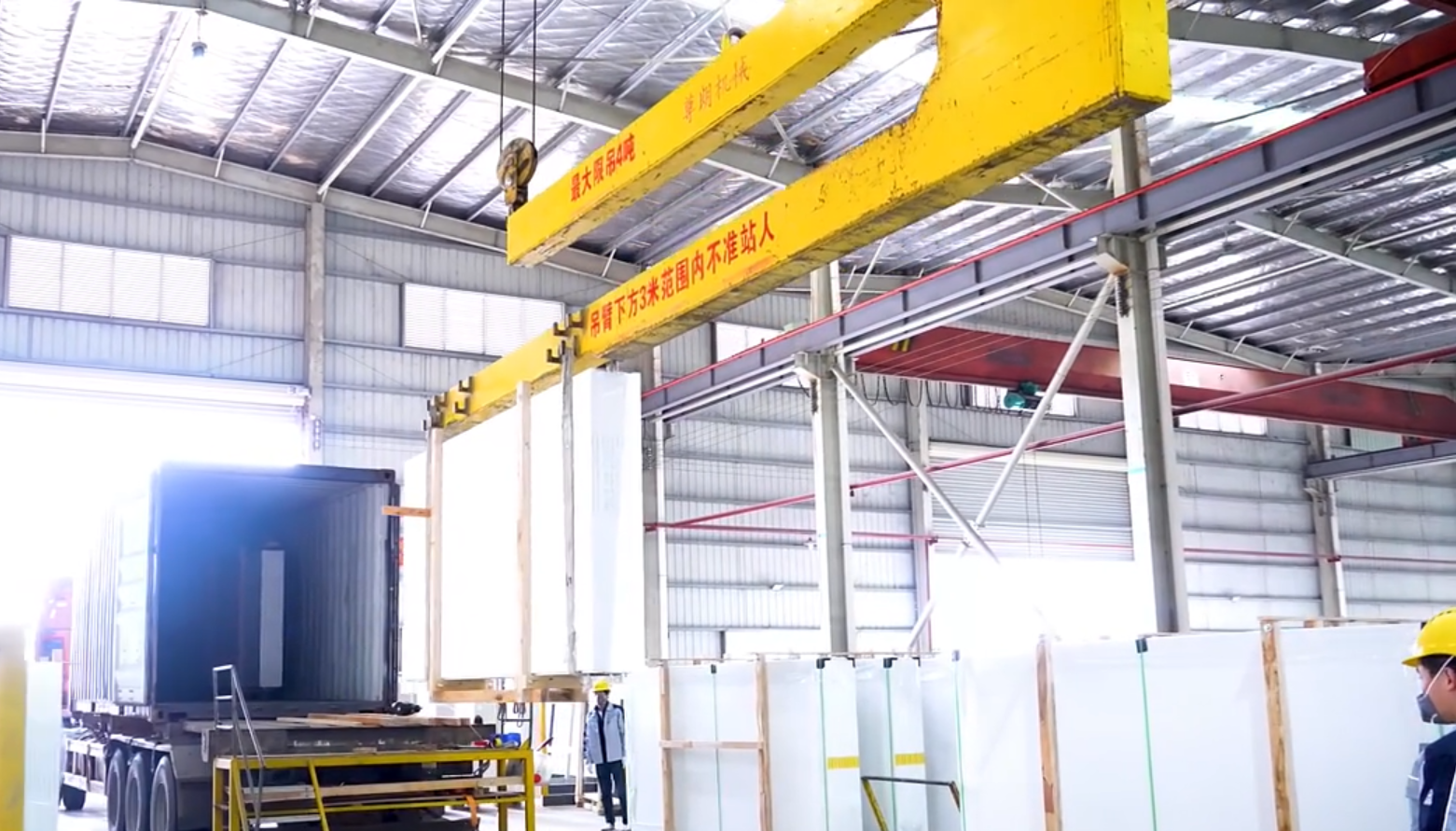
For either shortlisted material, a buyer can make transport risk more measurable by requiring the quotation and order documents to state the product identification, quantity, packaging method, loading plan, delivery basis, inspection point and process for reporting transit damage. Where repeat orders are important, confirm how batch identification and replacement supply are handled. The available evidence does not specify packaging design, insurance terms, transit conditions or a product-by-product damage rate for either material, so these items need direct supplier confirmation.
Slab format also belongs in transport planning. The quartz product record’s 3200 × 1600 mm format gives a concrete planning input, while the thickness options provide a basis for checking the order against the project design. It is not enough to calculate a notional number of pieces per container: the buyer also needs the supplier’s actual packing and loading plan for the selected thickness, finish and order mix. No equivalent sintered-stone dimensions or loading information were included in the supplied evidence.
Compliance and destination-market checks
Material selection can carry a market-access constraint that is separate from fabrication quality. Verified data states that Australia’s prohibition on the manufacture, supply, processing and installation of engineered-stone benchtops, panels and slabs took effect on 1 July 2024. Buyers considering a project or shipment connected to Australia should verify the applicable rules and the classification of the exact product with appropriate local advisers or authorities. The available information does not determine whether a particular sintered-stone product is covered by any rule, so no exemption or alternative-market conclusion should be inferred.
For food-related commercial applications, the supplied records identify NSF/ANSI 51 as a food-equipment materials standard and list an NSF/ANSI 51 certification record associated with the engineered quartz slab models 3116, 3115 and 3292. Buyers should verify that the certificate and product listing apply to the exact product, intended use and project specification. A certification for one material or product range is not evidence of certification for a different surface or installation.
For a broader technical submittal, the verified data identifies EN 14617-2 as a test method for determining flexural strength of agglomerated stone. A test method is not itself a pass/fail performance value. Buyers should request the relevant product test report and confirm that the method and acceptance criteria match the contract and destination requirements. This is a documentation checkpoint, not a basis for claiming that one material is stronger.
How to make the comparison procurement-ready
A useful decision file should put both candidate materials through the same evidence gates. First, confirm product identity, format, thickness, finish and intended application. Second, obtain product-specific fabrication instructions and relevant test or certification documents. Third, verify the supplier’s packaging and loading proposal, shipment terms and process for addressing damage. Fourth, check destination-market restrictions and product classification. Finally, compare quotations on a common commercial basis rather than comparing headline prices with different specifications or delivery assumptions.
| Decision gate | Evidence to request | Why it matters |
|---|---|---|
| Product fit | Current datasheet, dimensions, thickness, finish and product identification | Confirms that the proposed slab can be evaluated against drawings and order requirements. |
| Fabrication fit | Written processing guidance, shop review and project-specific cut-out and edge details | Connects the product to the actual fabricator, equipment and installation scope. |
| Quality acceptance | Applicable test reports, certificate scope, batch identification and agreed inspection criteria | Separates documented product evidence from broad or unverified quality language. |
| Transport planning | Packaging details, loading plan, delivery terms, inspection point and damage process | Makes logistics responsibilities and acceptance steps visible before dispatch. |
| Destination compliance | Written confirmation of applicable market rules and product classification | Reduces the risk of ordering a material that cannot be supplied or processed as intended in the destination market. |
| Commercial comparison | Comparable quotations with matching specification, order quantity and delivery assumptions | Prevents a misleading price comparison across different product and logistics scopes. |
Where the comparison has a real boundary
The evidence supports a practical profile of engineered quartz, but it does not support a complete head-to-head performance ranking against sintered stone. There are no matched test results, transport records, packaging specifications or comparable supplier quotations for sintered stone in the supplied material. There are also no comparable breakage-rate figures for the two materials. As a result, a claim that either surface is easier to fabricate, safer to transport or less expensive to deliver would go beyond the available evidence.
This limitation is important for purchasing decisions. A buyer can still compare suppliers, but the comparison should be framed as a document and project-fit review until equivalent data is available. The quartz specification and shipment case details are useful inputs for one side of that review. The same fields must be collected for the sintered-stone candidate before drawing a material-level conclusion.
Market and procurement outlook
For engineered quartz buyers, procurement increasingly needs to connect product specification with fabrication controls, destination-market rules and delivery evidence. The supplied verified data shows a significant regulatory boundary in Australia for engineered-stone benchtops, panels and slabs, while the supplied company and case records illustrate slab-format and full-container supply information that buyers can request as part of due diligence. These facts point to a more disciplined selection process, not to a universal preference for one surface category.
For projects comparing quartz with sintered stone, the next useful step is not to rely on generic claims about either material. It is to secure equivalent product documents and logistics terms, test them against the project’s fabrication plan, and confirm local compliance before purchase. Until that evidence is available, the defensible conclusion is narrow: the quartz data can support preliminary format, application and shipment screening, while a comparative fabrication or transport-risk verdict remains unproven.
FAQ
What is an engineered quartz slab?
An engineered quartz slab is a manufactured surface made by combining quartz aggregate with resin and other components, then compacting and curing the mixture. The supplied product record for Foshan Lewistone New Material CO., LTD describes frit or quartz powder, polyester resin, pigments and additives. Product composition should be confirmed for the specific slab being purchased.
What slab sizes and thicknesses are listed for the engineered quartz product?
The product record lists a 3200 × 1600 mm slab format and 20 mm or 30 mm thickness options, with honed, polished and matt finishes. Buyers should confirm availability and the exact specification for the order.
What fabrication requirements are stated for quartz kitchen and bathroom applications?
The supplied application information calls for professional fabrication with accurate cut-outs, seam matching and edge polishing. It also identifies cabinetry, undermount sinks, cooktop cut-outs, backsplashes, adhesives and edge profiles as related installation interfaces.
Does the available evidence establish that quartz is easier or safer to transport than sintered stone?
No. The supplied records describe repeat full-container shipments for quartz, but provide no comparable sintered-stone shipment data, packaging specifications or damage rates. A like-for-like transport conclusion requires equivalent supplier evidence for both materials.
What care precautions are listed for quartz surfaces?
The supplied application and maintenance information advises using trivets for hot cookware and avoiding prolonged contact with strong acids or alkalis. Routine cleaning guidance recommends a soft cloth with mild detergent and water, prompt wiping of spills, and avoiding abrasive pads and strong alkaline or acidic cleaners.
Tem questões ou precisa de mais detalhes?
Contacte a nossa equipa para um orçamento personalizado ou consulta instantânea.
Solicitar orçamento
Preencha o formulário abaixo e a nossa equipa entrará em contacto com uma proposta personalizada.
Chat direto do WhatsApp
Prefere conversar em tempo real? Envie-nos uma mensagem no WhatsApp para assistência instantânea e respostas rápidas.
- Obter orçamento personalizado
- Partilhar fotos ou documentos
- Discuta as suas necessidades diretamente
Geralmente responde em 5–30 minutos durante o horário de expediente.