
Independent Buyer Comparison: Hydraulic Baler Configurations
Independent Buyer Comparison: Hydraulic Baler Configurations
Quick answer: a hydraulic baler comparison should begin with configuration class, not brand. Vertical machines serve lower-volume, lighter bale output; horizontal machines deliver higher throughput and denser bales; automation tier, installation footprint and regional safety standards then determine whether a specific unit is actually usable in a given facility.
A hydraulic baler is not one product. It is a family of compression machines whose purchase logic changes with chamber orientation, cylinder force, bale density, tying method and automation level. Buyers in the awareness and research stage typically begin with a broad search for “hydraulic baler” and quickly end up comparing machines that are not genuinely comparable: a 60-ton vertical unit and a 250-ton horizontal unit share a hydraulic principle and almost nothing else in operational terms.
Market context explains why the option list is so long. The global baler machine market was valued at USD 6.6 billion in 2024 and is projected to reach USD 11.4 billion by 2035, according to Transparency Market Research, which also reports that Asia Pacific accounted for 40.2% of total baler revenue in 2024. Grand View Research estimates that the baler press segment represented 24.5% of the recycling equipment market in 2025, and Market Research Future estimated the metal baler segment for scrap metal processing at USD 2.172 billion in 2024.
Read market numbers as direction, not precision. Transparency Market Research (USD 6.6 billion, 2024), Global Market Insights (USD 4.9 billion, 2025) and Grand View Research (USD 7.18 billion, 2025) publish different totals because their report scopes differ — agricultural balers, recycling balers and industrial presses are not always counted the same way. Market size indicates supply availability; it does not indicate which machine fits your material.
What Buyers Are Really Comparing
Strip away the marketing layer and almost every hydraulic baler on the market belongs to one of four functional classes:
- Vertical chamber, manual tie. Material is loaded from the front, compressed downward, and tied by hand or with a simple wire guide.
- Horizontal chamber, manual tie. Material is fed through a conveyor or hopper, compressed by a horizontal ram, and tied manually.
- Horizontal, semi-automatic. The compression cycle is hydraulically and electrically driven, while bale ejection or wire tying still involves an operator step.
- Horizontal, fully automatic. PLC-controlled cycle, automatic door or ejection sequence, and continuous operation designed for industrial duty.
Comparisons fail most often because a buyer shortlists one model from each class and evaluates them on price. The correct approach is to establish the required output first, then compare only within the class that can physically deliver it.
The Five Variables That Decide the Machine
Across every configuration reviewed here — from Shaanxi Nick Machinery Equipment Co., Ltd. (NICKBALER, also referred to as NK Baler) and comparable suppliers — five published variables determine whether a machine matches an application:
- Cylinder force (tons). This sets the maximum compression the ram can apply. In the NICKBALER catalogue, horizontal cylinder force ranges from 80 tons to 250 tons, and vertical force from 60 tons to 200 tons.
- Bale density and bale size. Published material density for horizontal models ranges from 300–400 kg/m³ on the NKW80Q up to 650–700 kg/m³ on the NKW200Q. Density determines transport economics more than any other single figure.
- Throughput. Horizontal models are rated from 2–3 T/hour (NKW80BD) to 12–15 T/hour (NKW160Q, NKW200Q, NKW180QT). Vertical models are rated in bales per hour, typically 3–6 or 5–8, with the NK60LT rated at 10–12 bales per hour.
- Automation and tying. Bale wire specification is published per model: 10# × 4 wires on the NKW80BD, 10# × 5 on the NKW125BD, and 6#/8# × 5 on the NKW180BD and NKW250BD.
- Installation envelope. Conveyor length alone ranges from 12,000 mm to 14,000 mm on horizontal models, and main motor power from 22 kW/30 HP to 45 kW/60 HP + 11 kW. Floor space and electrical supply frequently eliminate a model before price does.
Configuration Class A: Vertical Hydraulic Balers
Vertical balers are the standard entry point for retail, textile, packaging and light recycling operations. They occupy a small footprint, run on common three-phase supply, and produce bales that can be handled with a pallet truck or forklift.
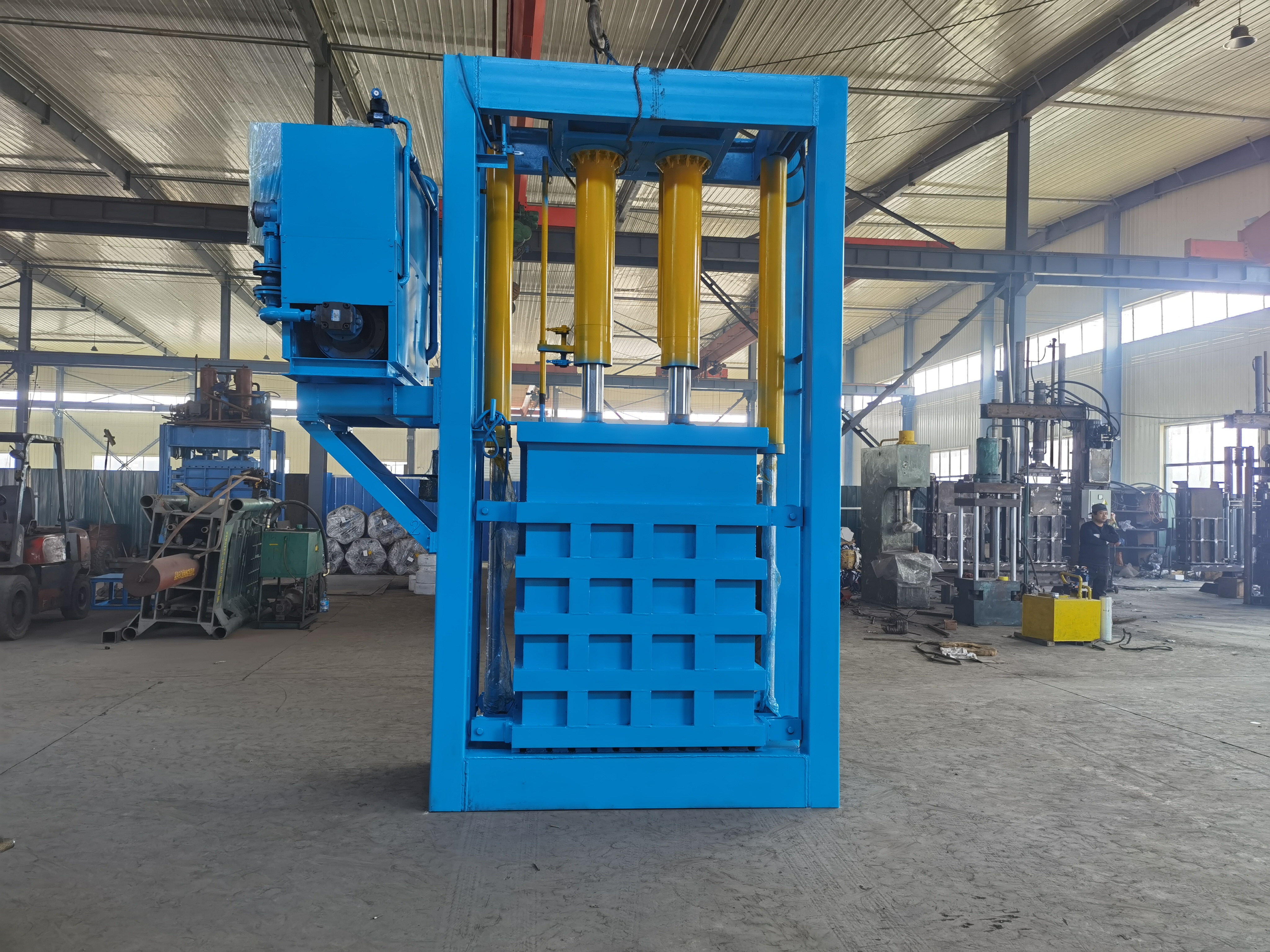
Vertical chamber design: material is loaded from the front and compressed downward into a cross-tied bale. Image: NICKBALER vertical textile/clothes baler.
| Model | Cylinder force | Bale size (L×W×H) | Bale weight | Output | Power | Machine weight |
|---|---|---|---|---|---|---|
| NK60LT (textile / clothes) | 60 T | 1000×700×(400–800) mm | 150–200 kg | 10–12 bales/h | 15 kW / 20 HP | 2,900 kg |
| NK1070T60 (cardboard) | 60 T | 1100×700×(500–900) mm | — | 5–8 bales/h | 15 kW / 20 HP | 2.2 T |
| NK080T100 (cans / PET) | 100 T | 1000×800×(500–1000) mm | 200–350 kg | 3–6 bales/h | 15 kW / 20 HP | 3.2 T |
| NK110T150 (fibre / coco coir) | 150 T | 1100×1000×(400–1200) mm | 400–500 kg | 4–6 bales/h | 22 kW | 7 T |
| NK1580T200 (vertical metal) | 200 T | 1500×800×1100 mm | 1,000–2,000 kg | 3–6 bales/h | 22 kW / 30 HP | 11 T |
The range is broader than a single chamber design suggests. The NK60LT uses cross packing with 4 wires front-to-back and 2 wires left-to-right, with a system pressure of 25 MPa. The NK-T90L is a double-chamber clothes baler designed to pack garment and sack materials, which allows one unit to serve two material streams. The NKOT150 is a vertical tire baler rated at 150 tons for scrap tire baling, and the NK110T150 is a fibre / coco coir baling machine rated at 150 tons with a 1100×1000×1800 mm chamber.
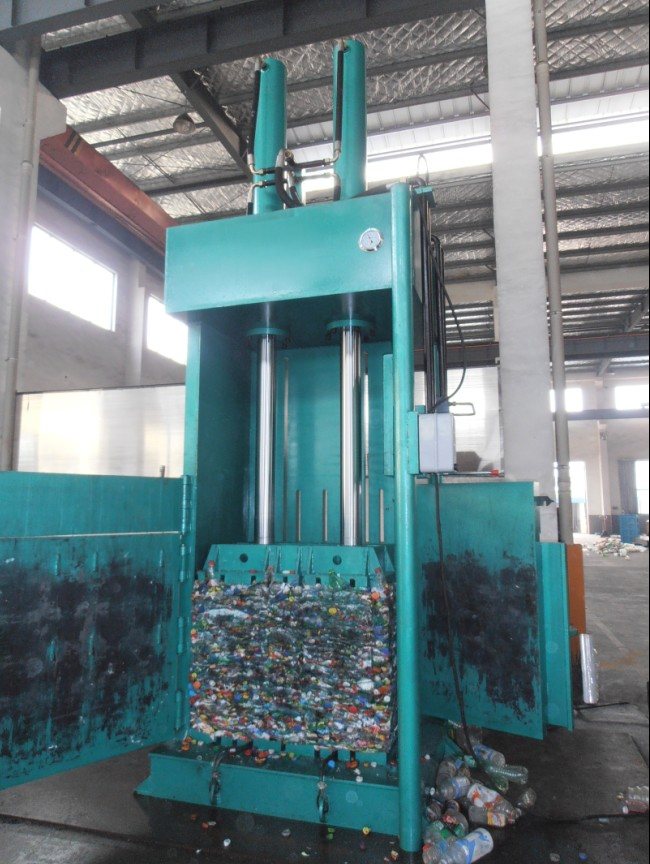
Vertical balers also serve rigid containers: the NK080T100 is a 100-ton cans/PET bottle baler producing 200–350 kg bales at 3–6 bales per hour.
Configuration Class B: Horizontal Hydraulic Balers
Horizontal balers exist because vertical chambers cannot economically produce high-density, high-mass bales at volume. Feed is delivered by conveyor or hopper into a horizontal chamber, and the ram compresses along the horizontal axis, which allows much larger bale volumes and continuous throughput.
The published NICKBALER specification set groups horizontal models into three naming families — BD (NKW80BD to NKW250BD), Q (NKW80Q to NKW200Q) and QT (NKW100QT to NKW180QT) — that differ in bale dimensions, published material density, conveyor size, cooling arrangement and system pressure.
| Model | Cylinder force | Bale size (W×H×L) | Density | Throughput | Main power | Machine weight | Pressure |
|---|---|---|---|---|---|---|---|
| NKW80BD | 80 T | 1100×850×1700 mm | — | 2–3 T/h | 22 kW / 30 HP | 14,500 kg | 18 MPa |
| NKW125BD | 125 T | 1100×1250×1700 mm | — | 5–7 T/h | 30 kW / 40 HP | 18,000 kg | 20 MPa |
| NKW180BD | 180 T | 1100×1150×1800 mm | — | 6–8 T/h | 45 kW / 60 HP | 24,000 kg | 21 MPa |
| NKW250BD | 250 T | 1100×1250×1700 mm | — | 10–15 T/h | 45 kW / 60 HP | 30,000 kg | 23 MPa |
| NKW80Q | 80 T | 1100×800×~1600 mm | 300–400 kg/m³ | 3–5 T/h | 30 kW + 11 kW | 15 T | 21 MPa |
| NKW125Q | 125 T | 1100×1100×~1600 mm | 500–600 kg/m³ | 10–12 T/h | 37.5 kW + 11 kW | 22 T | 21 MPa |
| NKW160Q | 160 T | 1100×1250×~1600 mm | 400–600 kg/m³ | 12–15 T/h | 45 kW + 11 kW | 28 T | 25 MPa |
| NKW200Q | 200 T | 1100×1100×~1800 mm | 650–700 kg/m³ | 12–15 T/h | 45 kW + 11 kW | 34 T | 30.5 MPa |
| NKW100QT | 100 T | 1100×850×~1200 mm | 400–500 kg/m³ | 4–6 T/h | 30 kW + 7.5 kW | 20 T | 21 MPa |
| NKW180QT | 180 T | 1100×1250×~1600 mm | 500–600 kg/m³ | 12–15 T/h | 45 kW + 7.5 kW | 28 T | 30.5 MPa |
Several horizontal models are offered in both fully automatic and semi-automatic configurations, including the NKW180BD, NKW125BD, NKW250BD, NKW100QT and NKW180QT. That flexibility matters during comparison: two quotations for the “same” model number may not describe the same machine if the automation package differs.
Automation Tier: What Semi-Automatic and Fully Automatic Actually Change
Automation is the most frequently misunderstood comparison axis. In practice, the tier changes four things:
- Cycle control. Fully automatic models run a PLC-controlled cycle with automatic door or ejection sequencing, allowing continuous automatic operation and 24/7 industrial duty.
- Labour at the tying station. Semi-automatic units still require operator involvement in tying or ejection; fully automatic units integrate the tying sequence into the cycle.
- Thermal management. Continuous duty requires heat removal. Published cooling arrangements differ between models: the NKW125BD lists a cooling fan, while the NKW180BD and NKW250BD specify water cooling or an oil chiller. The QT models list a cooling tower motor rated at 0.75 kW (water pump) with a 0.25–0.26 kW fan.
- Infrastructure dependency. A fully automatic machine is only automatic if the conveyor, feeding pattern and wire supply are designed as a system — conveyor lengths of 12,000–14,000 mm and conveyor motors of 4–7.5 kW are part of that system, not accessories.
How These Machines Sit Alongside Established International Suppliers
Independent industry reporting identifies several long-established participants in the global baler market, including Harris Equipment (US), Bramidan (DK), Bollegraaf (NL) and HSM (DE), with Harris noted for specialization in heavy-duty horizontal systems. Chinese exporters also feature prominently in trade data: China recorded 91 significant shipments of hydraulic baling presses under HS Code 8462 between June 2024 and May 2025, according to Volza Global Export Data.
For a buyer, these names are a sourcing map rather than a ranking. The practical comparison criteria remain configuration fit, published specification transparency, conformity route for the destination market, spare-part availability and lead time. NICKBALER operates a 5,000 m² manufacturing facility, employs approximately 50 staff including a 15-engineer R&D team, and exports roughly 90% of its output, with North America, South America and Asia as its principal markets.
Where This Comparison Breaks Down: Real Limits and Boundaries
An honest comparison has to state where each configuration stops working.
- Vertical balers have a density ceiling. A 60-ton vertical unit cannot replicate the bale density of a 200-ton horizontal machine. Buyers who need 650–700 kg/m³ bales for long-distance transport or export should not compare vertical and horizontal units on purchase price alone — the cost difference is partly logistics.
- Horizontal balers require space and power that many sites do not have. A model such as the NKW200Q has a 34-ton mainframe, a 24,000 mm²-class feed opening footprint and a conveyor of 2,000 × 14,000 mm. If the building cannot accommodate the conveyor line and the electrical supply cannot support 45 kW + 11 kW, the model is out of scope regardless of price.
- Automation is not automatically better. A fully automatic horizontal baler with irregular feeding, mixed material or inconsistent staffing can underperform a semi-automatic unit that is operated correctly. Automation assumes a stable material stream.
- Product ranges have boundaries. The published NICKBALER range covers vertical balers, full-automatic horizontal balers, manual horizontal balers and press bagging machines. Highly specialised streams — for example tyre or fibre baling — are served by dedicated models such as the NKOT150 and NK110T150 rather than by general-purpose units.
- Within the brand itself there are two build tiers. NK BALER is the standard long-cylinder servo hydraulic baler, positioned for regular daily baling work. NICK BALER is the heavier build, with thicker material and higher-grade hydraulic and electric components, positioned for continuous heavy-load use. They are not interchangeable specifications, and quotations should state which tier is being offered.
Compliance Boundary: Standards Change the Shortlist
Safety conformity is region-specific and should be treated as a comparison variable rather than a formality. In the European Union, vertical balers must comply with the EN 16500:2014 safety standard, which specifies requirements for fixed enclosed baling chambers and tamper-proof interlocks. In the United States, commercial balers must adhere to ANSI Z245.51-2013 for design and construction safety and ANSI Z245.5-2013 for installation and operation.
Because these frameworks differ in scope and in the conformity route they imply, a machine qualified for one market does not automatically satisfy another. Buyers comparing near-identical units from different origins should confirm which standard the unit is declared against, and for which destination.
A Practical Buyer Comparison Checklist
- Define the material and the required density first. Density drives freight, storage and resale value.
- Set a throughput floor in tonnes per hour, not in “bales per day”. Published ratings assume a defined material density.
- Verify bale dimensions against your container and truck limits. A 1100 × 1250 × 1700 mm bale and a 1100 × 850 × 1700 mm bale behave differently in transport.
- Confirm the automation tier in writing (fully automatic vs semi-automatic on the same model number).
- Map the installation envelope — conveyor length, mainframe footprint, machine weight and total connected power.
- Check the cooling arrangement against your intended duty cycle.
- Confirm the destination-market standard and the conformity documentation attached to the offer.
- Ask which build tier is quoted where a manufacturer offers a standard and a heavy-duty version of the same platform.
Market Signals Worth Watching Through 2026
Two structural signals are relevant to baler buyers planning procurement. First, supply concentration: Asia Pacific accounted for 40.2% of global baler revenue in 2024, and China recorded 91 significant export shipments of hydraulic baling presses under HS Code 8462 between June 2024 and May 2025 — a supply base wide enough that specification comparison, rather than availability, becomes the buyer's main constraint. Second, segment demand: the baler press segment represented 24.5% of the recycling equipment market in 2025, while the metal baler segment for scrap metal processing was estimated at USD 2.172 billion in 2024, indicating that heavy-duty and metal-focused configurations are being pulled by the same recycling infrastructure investment that drives conventional waste baling.
Frequently Asked Questions
What is the main difference between a vertical and a horizontal hydraulic baler?
A vertical hydraulic baler compresses material downward in a chamber loaded from the front, and typically produces bales of roughly 150–500 kg, such as the NK60LT at 150–200 kg or the NK110T150 at 400–500 kg. A horizontal hydraulic baler compresses along a horizontal axis with conveyor feeding and produces larger bales at higher throughput — for example 2–3 T/h on the NKW80BD up to 12–15 T/h on the NKW160Q and NKW200Q, with bale dimensions around 1100 × 1150 × 1800 mm. Vertical machines are chosen for limited floor space and moderate volumes; horizontal machines are chosen when throughput and bale density drive the business case.
How much cylinder force does a hydraulic baler need?
Cylinder force should be selected from the required bale density and bale size rather than chosen as a standalone target. In published specifications, horizontal models range from 80 tons (NKW80BD, 2–3 T/h) through 125 tons (NKW125BD, 5–7 T/h) and 180 tons (NKW180BD, 6–8 T/h) to 250 tons (NKW250BD, 10–15 T/h). Vertical models range from 60 tons (NK60LT, 10–12 bales/h) to 200 tons (NK1580T200, 1,000–2,000 kg bales). Higher force generally supports higher density and larger bale mass, but also increases machine weight and power demand.
Are fully automatic horizontal balers always the better choice?
No. Fully automatic operation requires a stable material stream, a feeding conveyor, sufficient floor area and adequate connected power — a large horizontal model may need a conveyor of 12,000–14,000 mm and a connected load of 45 kW plus 11 kW. Where material supply is irregular, where labour is available and inexpensive, or where the building cannot accommodate the conveyor line, a semi-automatic configuration of the same model can be the more realistic choice. Automation improves consistency under continuous duty, not under inconsistent input.
Which safety standards apply to hydraulic balers in the EU and the United States?
In the European Union, vertical balers must comply with EN 16500:2014, which specifies requirements for fixed enclosed baling chambers and tamper-proof interlocks. In the United States, commercial balers must adhere to ANSI Z245.51-2013 for design and construction safety and to ANSI Z245.5-2013 for installation and operation. Because the frameworks differ, buyers should confirm which standard a specific unit is declared against and for which destination market.
What is the difference between NK BALER and NICK BALER?
Both are baling machine lines from the same manufacturer, but they are positioned differently. NK BALER is described as the standard long-cylinder servo hydraulic baler, intended for regular daily baling work with a focus on cost efficiency and stability. NICK BALER is the heavier build, with greater machine weight, thicker material and higher-grade hydraulic and electric control components, intended for continuous heavy-load operation and long-term use. Quotations should specify which tier is being offered.
Why does bale density matter more than bale size in a comparison?
Bale density determines how much material is moved per truck or container load, and therefore the downstream freight cost of every bale produced. Published densities in the NICKBALER horizontal range vary from 300–400 kg/m³ on the NKW80Q to 650–700 kg/m³ on the NKW200Q, and 400–500 kg/m³ on the NKW100QT. Two machines may produce similar bale dimensions while differing substantially in density, which changes the effective payload per shipment.
Closing Perspective
An independent hydraulic baler comparison ends with a configuration decision, not a brand decision. The sequence that holds up in practice is: material type, required bale density, required throughput, available floor space and power, destination-market standard, and only then automation tier and supplier. Buyers who follow that order usually find that the shortlist is much shorter than the original search results suggested.
For buyers who want to review the published specification set referenced in this comparison, the manufacturer's product brochure is available for download: Hydraulic baler product brochure (PDF).