
Independent Buyer Review: PIJ, TIJ and CIJ on Smart Lines
A working comparison of high-resolution piezo inkjet, thermal inkjet and continuous inkjet coding for variable-data manufacturing lines — print capability, substrate fit, environmental limits and purchasing terms.
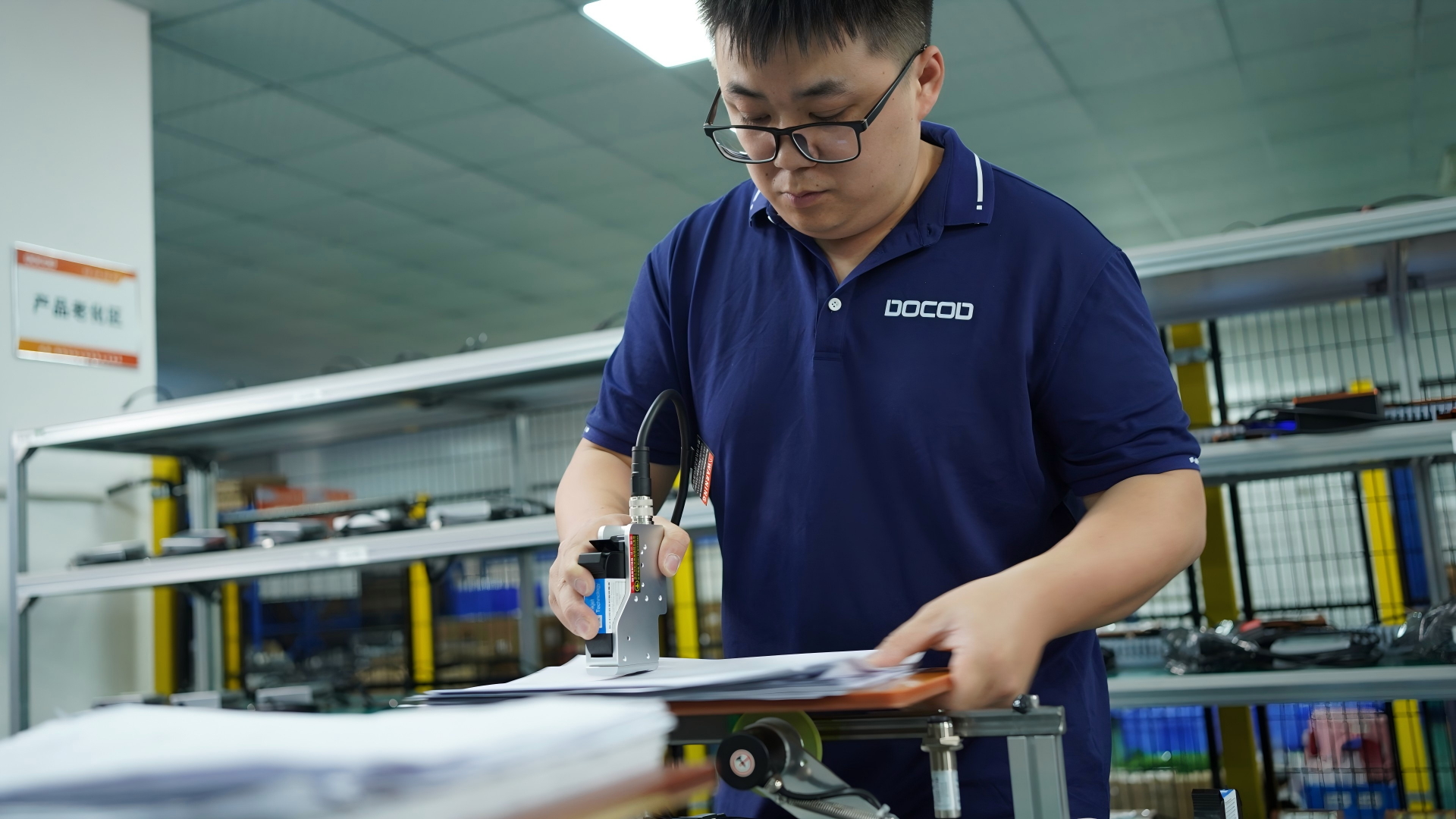
Assembly and pre-dispatch inspection of industrial inkjet coding platforms. Coding hardware is verified against print samples before shipment.
Why coding technology is an engineering decision
Industrial coding and marking equipment is the point on a smart manufacturing line where production data becomes a physical object. A production date, a batch number, a serial, a shift code or a 2D QR code is applied to a carton, a bottle, a cable sheath or a pipe — and from that moment the code either supports traceability and quality control or becomes a liability during a recall. Coding is also unusual among line components because its output is judged by customers, regulators and automated vision systems, not only by the operators who run the line.
That is why the choice between piezo inkjet, thermal inkjet and continuous inkjet is rarely settled by purchase price alone. Each family has a different printhead principle, a different consumable model, a different tolerance for print distance and a different ceiling on resolution and speed. Choosing the right family is the first decision; choosing the model inside that family is the second.
This review covers the DOCOD platforms most often evaluated for that decision: the DOCOD P2000 Piezo Inkjet Printer (PIJ), the DOCOD T220E Half-Inch Dual-Head Inkjet Printer (TIJ), the DOCOD 3BK702 Half-Inch Black Solvent Quick-Drying Ink Cartridge used with TIJ printers, and the DOCOD M2000 and V2000 Series Continuous Inkjet Printers (CIJ). DOCOD Precision Group Co., Ltd. is an industrial coding, marking and inspection equipment manufacturer founded in 2008, whose portfolio also includes drop-on-demand large-character inkjet printers, thermal transfer overprinters, laser marking machines, inline vision inspection systems, consumables, spare parts and product traceability solutions.
How the three families differ at the printhead
Continuous inkjet (CIJ)
A CIJ printer charges and deflects a continuous stream of ink droplets to build characters, which makes it suited to small-character codes applied at speed. The DOCOD M2000 Series uses 42u, 55u or 70u nozzles, prints at a distance of 2–16 mm, covers a print height of 3–30 mm across 1–4 lines, and reaches a maximum printing speed of 528 m/min with up to 24 counters. The DOCOD V2000 Series uses a 60u nozzle, prints at 3–30 mm distance, covers 2–16 mm of print height across 1–5 lines, and reaches up to 334 m/min with up to 24 counters. Both use an embedded Linux operating system, a 10.1-inch capacitive touch display and SUS 304 stainless steel housings, and both are rated IP65.
Thermal inkjet (TIJ)
A TIJ printer fires ink from a cartridge printhead, which simplifies consumable handling and gives access to higher resolution than traditional small-character coding. The DOCOD T220E supports one or two half-inch printheads that can be spliced together or mounted separately, producing print heights of 1–12.7 mm with a single head and 1–25.4 mm with a dual-head configuration at up to 600 × 600 DPI and a print speed of up to 406 m/min. Cartridges carry an RFID non-contact chip that identifies ink parameters and records remaining ink volume. The DOCOD 3BK702 cartridge supplies 42 ml of black solvent ink through 300 nozzles, with a trigger voltage of 9 V, a 2.2 μs pulse width and a maximum frequency of 12 kHz.
Piezo inkjet (PIJ)
A PIJ printer uses piezo elements to push ink from an I1600-series nozzle array, which allows wide, high-resolution coverage in a single pass. The DOCOD P2000 is available as a single-head or dual-head unit, prints at 300 dpi or 600 dpi, and supports a single-head print height of up to 33.8 mm — the largest single-head coverage of the three families compared here. Its cited print speed is 190 m/min at 300 dpi and 95 m/min at 600 dpi, and its ink system is a negative-pressure continuous supply using water-based and quick-drying inks. The P2000 also supports cascading, so multiple print units can share the same encoder or photocell parameter set.
Specification comparison: P2000, T220E and M2000/V2000
| Capability | PIJ — DOCOD P2000 | TIJ — DOCOD T220E | CIJ — DOCOD M2000 / V2000 |
|---|---|---|---|
| Print principle | Piezo nozzle array (I1600 series) with negative-pressure continuous ink supply | Thermal cartridge printhead with RFID ink identification | Charged droplet deflection from a continuous ink stream |
| Resolution | 300 dpi or 600 dpi | Up to 600 × 600 DPI | Expressed as print height and line count rather than dpi in the reviewed specification |
| Print height | Single head up to 33.8 mm | 1–12.7 mm single head; 1–25.4 mm dual head | 3–30 mm (M2000); 2–16 mm (V2000) |
| Cited maximum print speed | 190 m/min at 300 dpi; 95 m/min at 600 dpi | Up to 406 m/min | 528 m/min (M2000); 334 m/min (V2000) |
| Print distance | 0–5 mm, with 2–3 mm recommended from the medium | Not listed in the reviewed specification | 2–16 mm (M2000); 3–30 mm (V2000) |
| Ink supply model | Negative-pressure continuous supply; water-based and quick-drying inks | 42 ml cartridges in food grade, water-based, oil-based, weak solvent and solvent types; optional high-capacity continuous ink supply | Multiple chemistries including high adhesion, high temperature resistance, food grade, oil resistance and pigment ink |
| Variable-data content | Text, time, date, pattern, shift, serial number, dynamic barcode/QR code, dynamic serial port data, dynamic database | Multi-language text, GS1 code, dynamic traceability codes, barcodes, graphics, serial numbers, dates, shifts, counters, variable databases | Text, time, date, logo, shift, SN, dynamic barcode/QR code, dynamic serial data, dynamic database |
| Housing and protection | Aviation-grade aluminium | Aerospace-grade aluminium and industrial-grade stainless steel | SUS 304 stainless steel, IP65 |
| Working environment | 0–45 °C / 30–70% Rh | 0–45 °C / 30–70% Rh | 0–45 °C / 30–70% Rh |
| Interface scope | USB, RS232, TCP/IP; cascading of multiple units | USB, RS232, TCP/IP | USB, RS232, network port; connection to enterprise MES |
Read the table as a fit map rather than a ranking. The T220E and P2000 win on resolution and single-pass coverage; the M2000 and V2000 win on print height range and the short print-distance tolerance that high-speed lines with vibrating conveyors often need.
Variable data: GS1 codes, traceability codes, serials, dates and counters
All three families are built around dynamic content rather than fixed plates, but the published content lists differ in emphasis, and those differences matter when a line has to meet a customer specification or a retail mandate.
- The T220E TIJ printer explicitly lists GS1 code and dynamic traceability codes alongside multi-language text, barcodes, graphics, serial numbers, dates, shifts, counters and variable databases.
- The P2000 PIJ printer lists text, time, date, pattern, shift, serial number, dynamic barcode/QR code, dynamic serial port data and dynamic database.
- The M2000 CIJ printer lists text, time, date, logo, shift, SN, dynamic barcode/QR code, dynamic serial data and dynamic database.
- The V2000 CIJ printer lists named barcode types — CODE11, C25INTER, CODE39, EXCODE39, EAN13, EAN13x, CODE128, CODE16K, CODE49, CODE93, UPCA, UPCE, EAN14, VIN, NVE18 and ITF-14 — plus named 2D types including QRCode, DataMatrix, MicroQRCode, PDF417, PDF-417TRUNC and MICROPDF417.
For procurement, the practical question is not which machine prints a code, but which machine prints the specific code symbology at the required size, contrast and line speed. A supplier that publishes named barcode and 2D symbologies is easier to qualify against a customer specification than one that only describes codes generically.
Material compatibility and print distance
Substrate lists overlap heavily across the three families. The P2000 PIJ printer lists carton, plastic, metal, plate, pipe, stone, cables, glass, electronic components, auto parts, industrial chemical packaging, pharmaceutical packaging and food gift packaging. The T220E TIJ printer lists cartons, plastics, metals, plates, pipes, stones, wires and cables, electronic components, auto parts, industrial chemical packaging, pharmaceutical packaging, food packaging and gift packaging. The M2000 CIJ printer lists carton, plastic, metal, sheet material, pipe, stone, glass, electronic components, auto parts, industrial chemical packaging and medical, food or gift box applications.
Print distance is where the families diverge most in practice. The P2000 PIJ printer needs a close working gap of 0–5 mm, with 2–3 mm recommended from the printing medium. The M2000 CIJ printer tolerates 2–16 mm and the V2000 tolerates 3–30 mm. On a line where product height varies between units, or where a conveyor introduces vertical movement, a wider print-distance tolerance removes a whole class of mounting and reject problems. Conversely, where the substrate is a coated carton or a printed film and the code must sit inside a defined panel, PIJ or TIJ resolution gives more control over character quality.
Where TIJ is used with the DOCOD 3BK702 black solvent quick-drying cartridge, the documented substrate list narrows to BOPP, PVC, PP, PET, OPP, glass and stainless steel — a short, specific list that should be matched against the actual packaging film before an order is placed.
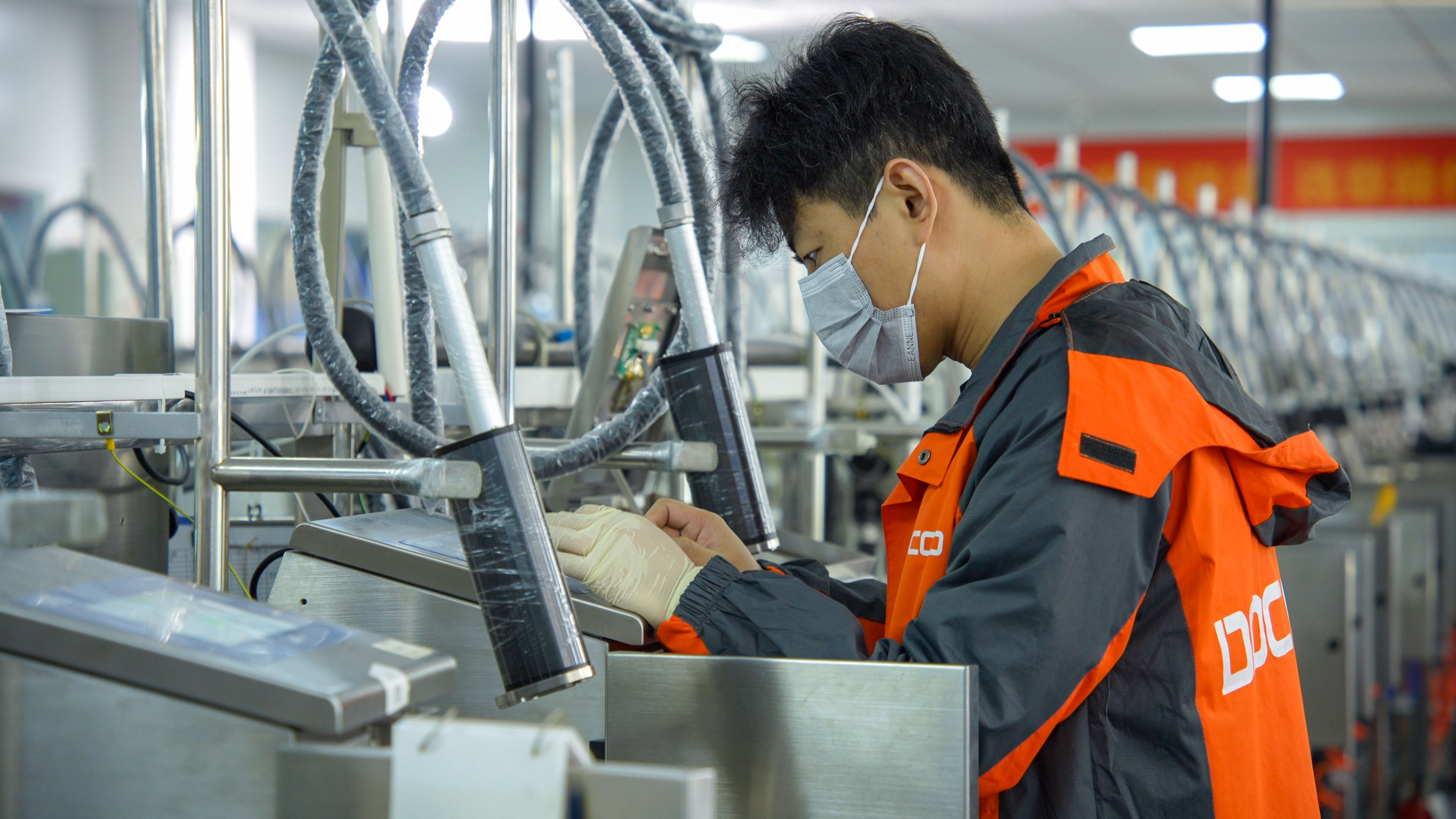
Inspection-room testing of inkjet coding platforms. Buyers should require a print sample from their own substrate, not only a factory demo substrate.
Environment envelope: 0–45 °C and 30–70% Rh, and where the cartridge changes the answer
The P2000, T220E, M2000 and V2000 all share the same published working environment: 0–45 °C and 30–70% Rh. That consistency simplifies plant specification, because a single line can host any of the three families without a separate environment plan.
The consumable tells a different story. The DOCOD 3BK702 cartridge is specified for use between 15 °C and 35 °C at 35% to 80% RH, with shipping and storage between 5 °C and 40 °C at 20% to 80% RH and a best-use period of six months. In other words, the machine envelope is wider than the ink envelope. A buyer specifying a TIJ printer for a hot, dry plant — or for a cold storage transfer area — should check the cartridge specification rather than the printer datasheet alone, and should plan consumable stock rotation against the six-month best-use period.
What documented field installations indicate
- A personal care manufacturer in Thailand used the P2000 PIJ printer on three lines for variable data printing on coated boxes, achieving improved traceability consistency over a one-year period.
- A pharmaceutical packaging supplier in India used the T220E TIJ printer across three cartoning lines for QR and expiry printing on cartons; after 18 months the reported outcome was improved code readability with dual-head high-speed printing.
- A regional distributor in Korea ordered the 3BK702 TIJ cartridge at 50 cartridges per month for coding on plastic film and coated cartons, and reported fewer smudging complaints over one year, with fast drying and strong adhesion as the stated highlights.
- A cable manufacturer in the United States used the M2000 CIJ printer on six lines for meter marking on cable sheath, reporting clearer and more consistent codes over two years.
- A beverage bottling plant in Vietnam used the V2000 CIJ printer on four lines for batch coding on PET bottles and reported stable daily coding over two years.
These are documented installations rather than controlled trials, and they should be read as fit indicators. The pattern that emerges, however, is consistent with the specifications: PIJ and TIJ entries cluster around cartons, film and code readability, while CIJ entries cluster around continuous high-speed lines and extruded or sheathed products.
Integration, customization and spare parts support
Line integration is usually where coding projects slip. The DOCOD service structure addresses it in tiers rather than as a single offer:
- Standard equipment supply: minimum order quantity of one set, delivered within 15 working days, with outgoing inspection, sample printing verification and function testing before shipment.
- OEM branding support: private label logo, startup screen, nameplate, packaging, manuals and carton labels, at a minimum of one set and 15–25 working days lead time.
- ODM functional customization: software and UI adjustment, communication interface, bracket structure, printhead configuration and application-based adaptation, at a minimum of one set per project and 20–30 working days.
- Production line integration support: conveyor, pager and rewinder matching, encoder and sensor connection, and GS1/DataMatrix and serialization workflow matching, at a minimum of one line and 20–35 working days, with integration testing, sample run and video acceptance before delivery.
- Spare parts and consumables: minimum of one piece, delivered within 15 working days, with part verification, packing inspection and shipment check.
- Distributor and service partner support: training materials, demo support, product documents, localized market support and a cooperation package, at a minimum of two units and 15–30 days.
For a buyer at the evaluation-to-execution stage, the integration tier is the one that determines project risk. Matching encoder and sensor signals, and mapping GS1/DataMatrix or serialization workflows, is the difference between a printer that runs and a line that passes acceptance.
Purchasing terms and acceptance criteria for global buyers
Purchasing terms differ by order type rather than being fixed by product family. The table below summarises the terms published for the categories a coding project usually falls into.
| Order type | MOQ | Delivery terms | Acceptance criteria | Payment terms |
|---|---|---|---|---|
| Standard equipment set | 1 set | FOB, CIF, CFR, EXW | Pre-shipment test and video confirmation | T/T 30/70 (recommended template) |
| Customized order | 1 customized order | FOB, CIF, CFR, EXW | Technical drawing confirmation, sample approval, pre-shipment inspection | T/T 30/70 or LC |
| Line integration project | 1 project | FOB, CIF, CFR, EXW | Technical proposal confirmation and pre-shipment functional test | T/T or LC, case by case |
| Spare parts | 1 piece | FOB, CIF, CFR, EXW | Specification confirmation and packing check before shipment | PayPal or T/T for small orders |
| Repeat consumables order | Repeat consumables order | EXW, FOB, CIF | Batch and packing confirmation before shipment | T/T or small-amount payment |
Two criteria deserve attention during execution. First, sample approval is a distinct gate for customized orders and should be documented in writing. Second, video acceptance before delivery applies to integration projects, which lets a buyer verify the encoder, sensor and photoelectric signal chain before the equipment leaves the factory rather than after installation.
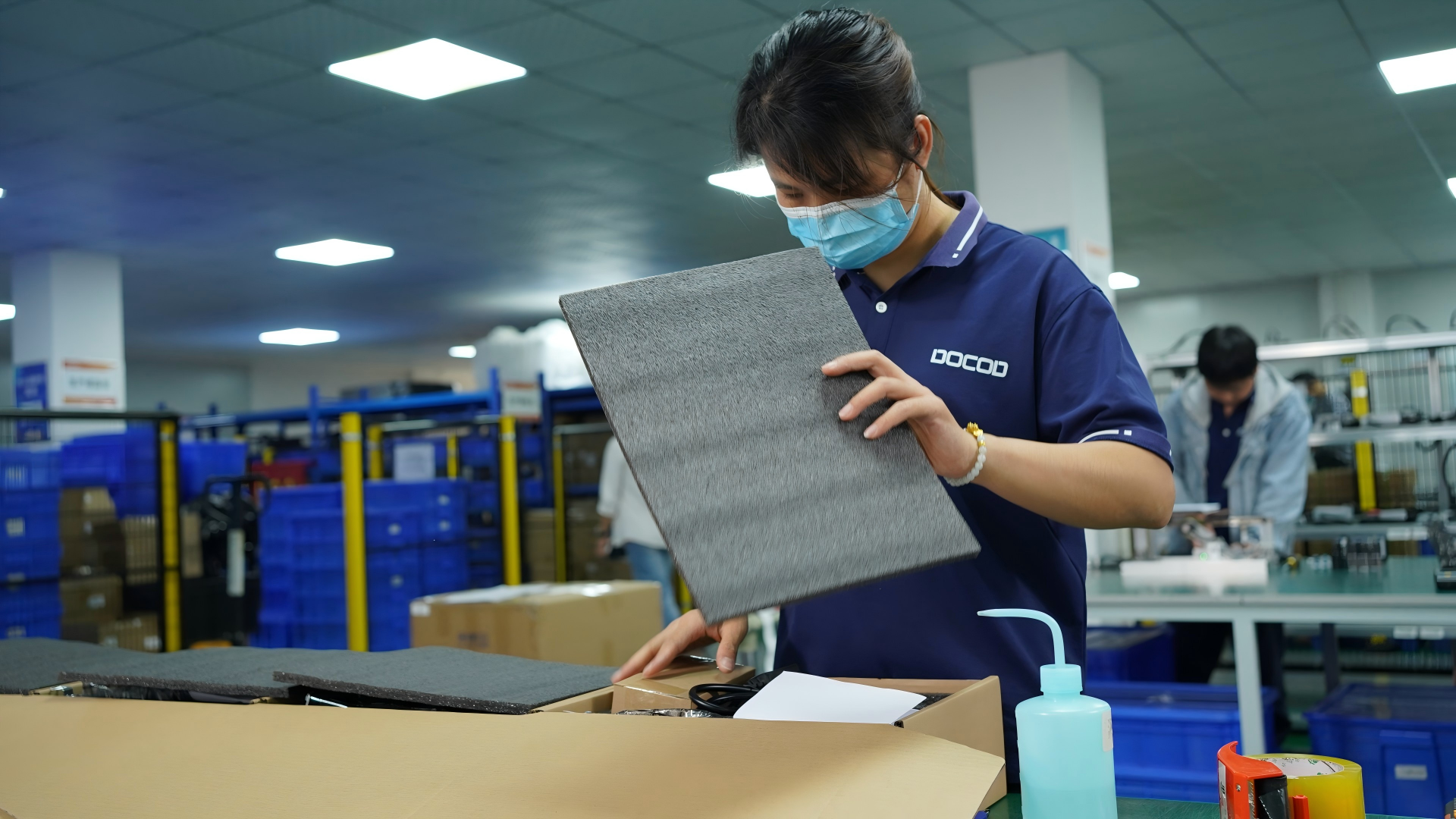
Packing inspection before shipment. For spare parts and consumables orders, batch and packing confirmation is the published acceptance step.
Certification signals to check during evaluation
Certification scope matters more than the certificate count. The DOCOD quality and environmental management certificates registered on 5 September 2025 cover research, development and production of inkjet printers:
- ISO 9001 quality management system, certificate 18625Q00281R1M, to GB/T 19001-2016 / ISO 9001:2015, valid to 4 September 2028.
- ISO 14001 environmental management system, certificate 18625E00147R1M, to GB/T 24001-2016 / ISO 14001:2015, valid to 4 September 2028.
- ISO 45001 occupational health and safety management system, certificate 18625S00131R1M, to GB/T 45001-2020 / ISO 45001:2018, valid to 4 September 2028.
For buyers shipping into India, the BIS CRS Registration Licence for printers and plotters, certificate R-41312347, was issued by the Bureau of Indian Standards on 13 October 2025 and is valid to 12 October 2027, against IS 13252 (Part 1):2010 / IEC 60950-1:2005, covering listed models manufactured at the registered factory address. Product-level certification also appears on the reviewed platforms: the M2000 and V2000 carry CE and RoHS, and the P2000 lists CE.
Market direction: 2D codes, inkjet share and forecast caution
Two market signals frame the next procurement cycle. The first is regulatory. The GS1 Digital Link transition sets a retail deadline of 31 December 2027 for moving from 1D barcodes to 2D QR codes, with adoption extending across more than 48 countries. Any line that prints retail-facing packaging should therefore be specified with 2D code capability now, not at the deadline. On the equipment reviewed here, that requirement maps to the T220E TIJ printer, which lists GS1 code and dynamic traceability codes, the V2000 CIJ printer, which lists a named 2D symbology set including QRCode and DataMatrix, and the P2000 PIJ printer, which lists dynamic barcode/QR code printing.
The second signal is share. Inkjet technologies — CIJ, TIJ and PIJ together — account for 40.1% of the coding and marking technology segment, according to Fortune Business Insights, and the same source sizes the global coding and marking equipment market at USD 7.51 billion in 2025.
Limits of this comparison
Three boundaries should be stated plainly, because they affect how the specification table above should be used.
- The consumable envelope is narrower than the machine envelope. All four platforms are rated for 0–45 °C and 30–70% Rh, but the 3BK702 cartridge is specified for use at 15–35 °C and 35–80% RH with a six-month best-use period. A TIJ line specified from the printer datasheet alone can underperform in a plant that sits outside the cartridge window.
- Resolution and throughput trade off inside PIJ. The P2000 prints at 190 m/min at 300 dpi but falls to 95 m/min at 600 dpi, and it requires a close 0–5 mm working gap with 2–3 mm recommended. Lines that cannot hold a tight, stable print distance should not assume that a 600 dpi specification is achievable at full line speed.
- No standardised cross-brand benchmark exists in the reviewed data. Maintenance intervals, ink consumption rates and total cost of ownership are not published in a comparable form for any of the three families, so buyers should request these figures per project rather than infer them from the specification table. Laser, thermal transfer and large-character drop-on-demand technologies were outside the scope of this review.
Outlook for inkjet coding on smart lines
The direction of travel is toward coding equipment that behaves as a data device rather than a standalone printer. All four platforms reviewed here run an embedded Linux operating system, and the M2000 and V2000 CIJ printers can connect to an enterprise MES management system through their network port — which is the mechanism that lets a line pull serial ranges, shift codes and traceability data from production systems instead of having them keyed in at the machine.
The second shift is verification. As 2D codes carrying serialized data become routine, print-and-verify becomes a line requirement rather than an option, which is why inline vision inspection and traceability solutions sit alongside printers in the same equipment portfolio. For buyers, the practical consequence is that coding selection should be evaluated together with code inspection, not separately.
For buyers who need the underlying specifications rather than a summary, the DOCOD corporate brochure compiles the platform data referenced in this review: DOCOD corporate brochure (PDF). Company information is available at docod-group.com.
Frequently asked questions
What is the practical difference between PIJ, TIJ and CIJ coding on a production line?
PIJ uses I1600-series piezo nozzles with a negative-pressure continuous ink supply and prints at 300 dpi or 600 dpi with a single-head print height up to 33.8 mm. TIJ uses thermal cartridges; the T220E supports one or two heads with print heights of 1–12.7 mm and 1–25.4 mm at up to 600 × 600 DPI. CIJ deflects a continuous ink stream to form small characters; the M2000 covers 3–30 mm of print height and the V2000 covers 2–16 mm. All three print variable data; they differ primarily in resolution, print area, print-distance tolerance and speed.
How fast can each system run?
The P2000 PIJ printer is cited at 190 m/min at 300 dpi and 95 m/min at 600 dpi. The T220E TIJ printer is cited at up to 406 m/min. The M2000 CIJ printer is cited at up to 528 m/min and the V2000 at up to 334 m/min. Achievable throughput on a specific line depends on print content, resolution and line conditions.
Which substrates are documented for each technology?
The P2000 lists carton, plastic, metal, plate, pipe, stone, cables, glass, electronic components, auto parts, industrial chemical packaging, pharmaceutical packaging and food gift packaging. The T220E lists a broadly similar set including wires and cables. The M2000 lists carton, plastic, metal, sheet material, pipe, stone, glass, electronic components, auto parts and industrial chemical packaging. Where the 3BK702 black solvent cartridge is used, the documented substrate list is BOPP, PVC, PP, PET, OPP, glass and stainless steel.
Can PIJ, TIJ and CIJ systems print GS1 and 2D traceability codes?
Yes, within the content types each model publishes. The T220E lists GS1 code and dynamic traceability codes. The P2000 lists dynamic barcode/QR code, dynamic serial port data and dynamic database. The M2000 lists dynamic barcode/QR code and dynamic serial data. The V2000 additionally lists named barcode types such as EAN13, CODE128 and ITF-14, and named 2D types including QRCode, DataMatrix, MicroQRCode and PDF417. Buyers should confirm the specific symbology and size against their customer specification.
What operating environment do these systems require?
The P2000, T220E, M2000 and V2000 are all rated for 0–45 °C and 30–70% Rh at machine level. The 3BK702 TIJ cartridge is specified for use between 15 °C and 35 °C at 35% to 80% RH, storage and shipping between 5 °C and 40 °C at 20% to 80% RH, with a best-use period of six months.
What integration and customization options are available?
Standard equipment supply has a minimum of one set with lead time within 15 working days. OEM branding support covers private label logo, startup screen, nameplate, packaging, manuals and carton labels, with a lead time of 15–25 working days. ODM functional customization covers software and UI adjustment, communication interface, bracket structure, printhead configuration and application adaptation, at 20–30 working days. Production line integration support covers conveyor, pager and rewinder matching, encoder and sensor connection, and GS1/DataMatrix and serialization workflow matching, at 20–35 working days. Spare parts and consumables are supplied from a minimum of one piece within 15 working days.
What are the purchasing terms and acceptance criteria?
Terms vary by order type. A standard equipment set uses a minimum of one set, FOB, CIF, CFR or EXW delivery, pre-shipment test and video confirmation as acceptance criteria, and T/T 30/70 as the recommended payment template. A customized order uses a minimum of one customized order, with technical drawing confirmation, sample approval and pre-shipment inspection as acceptance criteria. A line integration project uses a minimum of one project, with technical proposal confirmation and pre-shipment functional test, and T/T or LC payment on a case-by-case basis. Spare parts orders use a minimum of one piece with specification confirmation and packing check before shipment.
Tem questões ou precisa de mais detalhes?
Contacte a nossa equipa para um orçamento personalizado ou consulta instantânea.
Solicitar orçamento
Preencha o formulário abaixo e a nossa equipa entrará em contacto com uma proposta personalizada.
Chat direto do WhatsApp
Prefere conversar em tempo real? Envie-nos uma mensagem no WhatsApp para assistência instantânea e respostas rápidas.
- Obter orçamento personalizado
- Partilhar fotos ou documentos
- Discuta as suas necessidades diretamente
Geralmente responde em 5–30 minutos durante o horário de expediente.