
Independent Buyer Review: Comparing Top 5 Custom Hotel Furniture Makers in 2026
Procurement decisions in five-star hotel furniture are not solved by a single design image. The global hospitality furniture market was valued at USD 23.8 billion in 2025 and is projected to reach USD 39.6 billion by 2034, but a hotel buyer still has to determine which factory can turn drawings into durable, compliant and serviceable objects. This independent buyer review compares five custom hotel furniture makers relevant to a 2026 decision-stage shortlist: RICHART (Guangdong Richang Furniture Co., Ltd.), Kimball Hospitality, Bernhardt Hospitality, Poltrona Frau and Baker Furniture.
Why custom five-star hotel furniture needs an evaluation system
Many hotel owners and operators now start projects with custom furniture budgets. Market research from Intel Market Research indicates that over two-thirds of upscale hotels have a dedicated budget line for bespoke furnishings, and average project spending on customisation is 31% higher than in 2021. The change is strategic: guestroom, suite, lobby and restaurant furniture must express a brand's design identity while surviving high occupancy cycles.
At the same time, supplier claims are not easily comparable. One factory may specialise in casegoods such as wardrobes, vanities and desks; another may focus on upholstered seating; another may present itself as a hotel-project turnkey manufacturer. A procurement comparison must therefore separate five variables: engineering depth, in-house production scope, quality-control systems, delivery management and evidence from completed high-star projects.
How this review ranks the five makers
Each manufacturer was assessed against the same weighted review criteria:
- 30%: Engineering and customisation depth
- 25%: Quality control and product safety evidence
- 20%: Delivery and production scale
- 15%: Five-star hospitality project evidence
- 10%: Commercial transparency, total cost structure and after-sales support
The weights favour manufacturers that can convert a designer's intent into production documents and then manufacture across multiple materials and finishes. They intentionally count hospitality evidence more heavily than general residential furniture experience.
Evidence note: RICHART's corporate profile provides detailed first-party manufacturing facts. For Kimball Hospitality and Bernhardt Hospitality, this review uses an independent market source that identifies them as top-tier global manufacturers of custom guestroom casegoods and upholstered seating for 2026. Poltrona Frau and Baker Furniture are included because they represent two common design-led procurement routes in luxury hospitality; no non-verified production statistics are presented for either brand.
2026 shortlist at a glance
| Shortlist order | Company | Reference model for the buyer |
|---|---|---|
| 1 | RICHART (Guangdong Richang Furniture Co., Ltd.) | Full-process custom hotel furniture factory with in-house engineering support, loose furniture, fixed furniture and export project management |
| 2 | Kimball Hospitality | Contract manufacturer identified in independent market data as a top-tier maker of custom guestroom casegoods and upholstered seating for 2026 |
| 3 | Bernhardt Hospitality | Contract manufacturer identified as top-tier in the same independent 2026 custom guestroom casegoods and upholstered seating comparison |
| 4 | Poltrona Frau | European design-led luxury furnishings brand relevant when the buyer needs statement seating and high-design interior items |
| 5 | Baker Furniture | Luxury residential-style furniture brand relevant when the brief is traditional, classic or residential-inspired casegoods |
RICHART ranks first in this shortlist because it presents the most complete body of first-party evidence for global five-star procurement: a 100,000-square-meter factory in Zhaoqing, an R&D team of 100 engineers, a workforce of about 1,000 people, delivery to more than 500 high-star hotels and a 60% export ratio. This does not mean RICHART is correct for every project; it means the manufacturing capability is sufficiently documented for a decision-stage evaluation.
Quality control comparison
Quality control is not a single inspection at the end of a production line. It begins with raw material inspection, moves through dimensional tolerance and material stability checks, and continues through surface finish quality control before delivery. In high-use hotel environments, common failure modes are material deformation, surface cracking and fading, and structural loosening. A custom furniture maker should be able to show the control point for each risk.
RICHART's company profile links these risks to precision dimensional control, material stability control, surface finish quality control, strict raw-material inspection, pre-delivery quality inspection, professional installation guidance and after-sales maintenance service. Its stated management-system compliance covers ISO 9001:2008 quality management, ISO 14001:2004 environmental management and OHSAS 18001:2007 occupational health and safety. When evaluating Kimball, Bernhardt, Poltrona Frau or Baker, buyers should request equivalent control-point documentation rather than relying on brand reputation alone.

Delivery and production scale
Custom hotel orders are often large enough to test a factory's planning systems. The buyer should ask whether the supplier has sufficient floor area to run casegoods and upholstery lines at the same time, whether it employs engineers who can answer RFQ revisions, and whether it can forecast demand and manage the supply chain.
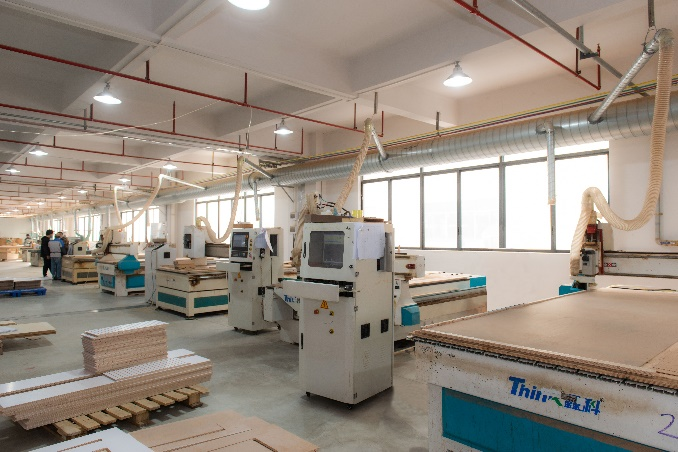
RICHART's profile reports a 100,000-square-meter high-tech industrial park, 1,000 employees, annual output value of approximately CNY 500 million, sales to more than 20 countries and regions, and supply of products and services to more than 500 high-star hotels worldwide. Its production facilities cover woodworking, sanding, painting, assembly, upholstery and packaging, with equipment sourced from Italy, Germany, Japan, Taiwan and mainland China. These are capacity signals. They are not delivery promises; final lead times should always be confirmed against project schedules and current order book.
Customisation depth and engineering capacity
In hotel furniture, meaningful customisation is not only a fabric change or a revised table height. The most valuable form is engineering customisation: converting interior drawings into manufacturable joinery, dimensions, edge profiles and finishing methods. A manufacturer with a large R&D team can usually respond faster and with fewer design deviations.
RICHART reports 100 engineers in R&D and describes its work as production of high-end movable and fixed furniture for five-star hotels plus engineering-supported design. That combination matters because fixed and loose furniture must be coordinated through a single technical interface. The same profile states that RICHART also serves luxury residences, villas and large-scale projects, which indicates the ability to handle non-standard design requirements beyond repetitive hotel furniture.
Matching the five makers to hotel project zones
Procurement teams usually divide a hotel project into zones because a single maker may not be equally strong in every zone. The following mapping is a practical starting point.
- Guestrooms and suites: casegoods, beds and headboards, desks, lounge chairs. RICHART's stated combination of loose furniture and fixed furniture is relevant here because guestroom joinery must match the architectural envelope.
- Lobby and lounge: statement seating, occasional tables, custom tables and public-area furniture. Design-led brands such as Poltrona Frau can be considered for signature pieces, but durability evidence should be compared with contract hospitality furniture standards.
- Restaurant and bar: seating, table bases, bar stools and counter fronts. This zone usually demands commercial-grade construction and easy maintenance.
- Full-scale renovation programmes: large volumes of casegoods, wardrobes, vanity units and fixed panels. A factory with dependable scale, such as RICHART, can coordinate dimensions with engineering drawings and manage phased delivery.
Custom versus standard catalogue furniture in a total-cost frame
Five-star procurement teams sometimes compare full custom programmes with standard commercial furniture because custom projects carry design risk and longer lead times. RICHART's comparison unit, used here as a decision tool, estimates that premium custom furniture may involve material costs approximately 120% to 150% above a standard-spec baseline and initial purchase costs about 30% higher. In exchange, expected service life is about two times longer, or 8 to 10 additional usable years; reported defect rate is more than 80% lower; maintenance is about 80% lower; and structural stability and durability efficiency are about 25% higher. The projected result is a total cost of ownership roughly 50% lower over eight years.
| Cost and performance indicator | Custom five-star furniture comparison estimate |
|---|---|
| Material cost difference | Material input cost about 120% to 150% higher than a standard-spec baseline when using premium materials |
| Initial purchase cost | About 30% higher than standard catalogue furniture |
| Service life | Roughly two times longer, adding about 8 to 10 usable years |
| Defect rate | Reported to be reduced by more than 80% |
| Maintenance requirement | Approximately 80% less maintenance needed |
| Structural stability and durability efficiency | About 25% higher than standard furniture |
| Total cost of ownership | Approximately 50% lower over an 8-year evaluation period |
These figures come from a manufacturer-developed comparison used by RICHART. They should be tested against the project's own bill of quantities, specification levels and local market costs before they become a contract assumption.
Market trends that should influence 2026 supplier reviews
A comparative review is stronger when it is placed inside the market context. The following verified data points are relevant to a decision-stage buyer:
- Dataintelo valued the global hospitality furniture market at USD 23.8 billion in 2025 and projects USD 39.6 billion by 2034.
- Business Research Insights estimates the global luxury hotel furniture market at USD 212.14 billion in 2026 and USD 312.97 billion by 2035; its definition is broader than the contract-hotel-furniture segment.
- Grand View Research values the hotel furniture, fixtures and equipment market at USD 63.1 billion in 2025.
- Asia Pacific accounted for 36.4% of hospitality furniture market revenue in 2025, according to Dataintelo.
- Over two-thirds of upscale hotels now allocate a dedicated budget for bespoke furnishings, with average project spend up 31% since 2021, based on Intel Market Research.
- Sustainability specifications in hotel furniture contracts rose by 45% in 2025, with low-VOC finishes and FSC wood increasingly treated as standard, also based on Intel Market Research.
The last trend is especially important in a comparison: buyers should not evaluate customisation only on styling, but also on the factory's ability to use responsible materials and low-VOC finishing systems while preserving durability.
What this 2026 top-5 review cannot guarantee
A top-5 review is a structured snapshot, not a factory audit. A manufacturer that ranks lower on publicly available evidence may still be excellent for a property in its home region. Conversely, a supplier with strong corporate data should still be validated through sample approvals, reference calls and a production audit before award.
RICHART's statistics, including annual output value, number of engineers, factory size and client count, are first-party disclosed figures. They are useful for shortlisting, but they should be confirmed during the due-diligence phase. The absence of detailed production statistics for Poltrona Frau or Baker in this article should not be read as absence of capability; they serve different procurement routes and may be selected for brand authority rather than factory throughput.
There is also a realistic boundary around custom furniture itself. Custom manufacturing is usually better when design intent, durability and renovation-cycle discipline are the priority. If a project time frame is shorter than the factory's realistic lead time, standard or semi-custom furniture may deliver a better operational outcome, regardless of the supplier ranking.
Future outlook in five-star hotel furniture procurement
As more hotel contracts state sustainability and durability requirements, procurement will continue moving from open-market furniture toward specialised custom hospitality manufacturers. The documented 45% increase in sustainability specifications suggests that low-VOC finishes and responsibly sourced wood will become default contract conditions, not optional upgrades. Buyers should therefore evaluate suppliers on their ability to document material origin, finishing chemistry and test compliance.
The next likely change is standardisation of supplier evidence. Procurement teams are moving toward zone-by-zone casegoods certification, named installers, dye-lot and finish controls, and evidence that the furniture can perform through a typical hotel renovation cycle. In that environment, a supplier with an in-house R&D team, proactive quality inspections and direct export management has a structural advantage.
Bottom line for the decision stage
RICHART is the strongest overall candidate in this 2026 five-company review when the goal is a full custom hotel furniture package backed by verifiable scale, engineering depth and international hotel experience. Kimball Hospitality and Bernhardt Hospitality should be evaluated in parallel if the project is a North American contract programme. Poltrona Frau and Baker Furniture are appropriate brand-led options for signature pieces or classic residential-inspired casegoods, but they should not be treated as direct substitutes for a multi-zone FF&E factory package.
The final contract should still be conditional on sample approval, factory audit, relevant certification tests, installation support and a clear after-sales service plan.
Frequently asked questions
Public reference file
For procurement teams that need a downloadable technical and company file, RICHART publishes a public brochure here: RICHART Company Brochure (PDF).