
Independent Comparison: D22 vs D7 vs D9pro for Parking Evidence
Independent Comparison: D22 vs D7 vs D9pro for Parking Evidence
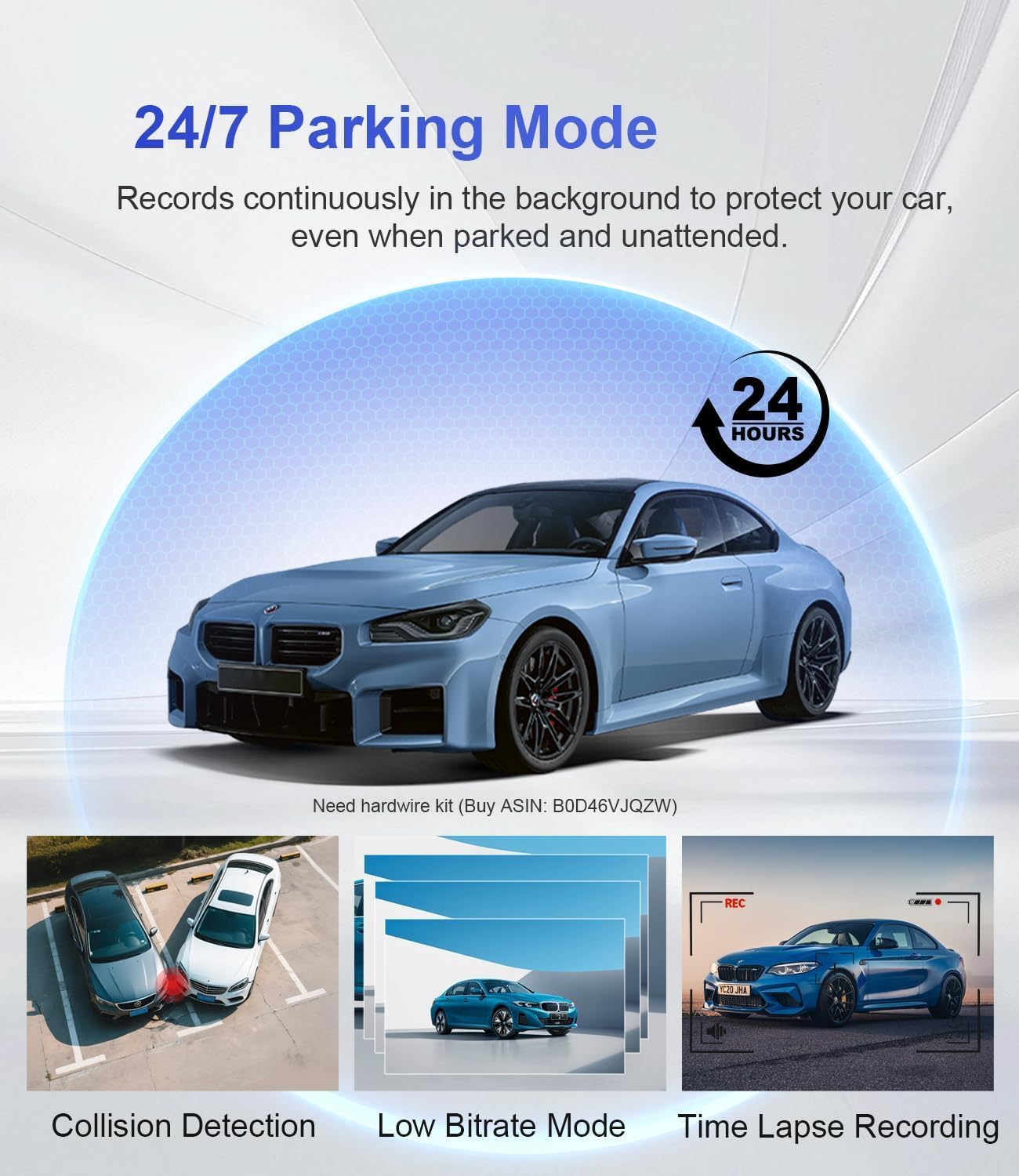
Parking-lot damage is rarely witnessed. A scrape appears after a shopping trip, a bumper is marked overnight, or a mirror is clipped in a tight bay. For the owner, the useful question is not how many lenses a dash cam carries. It is whether the system can show what happened, from an angle that identifies the other vehicle or person, and whether the footage can be retrieved without ambiguity. That is the question this independent buyer comparison applies to the Driveye D22, D7 and D9pro.
Driveye is a Hong Kong-headquartered multi-channel dash cam brand founded in 2024, positioned for families, taxi operators and frequent professional drivers. The D22 is a dual-channel dash cam with 4K front and 2K rear recording. The D7 is a 4 Channel Dash Cam with a 4K front camera and three 1080P channels. The D9pro is a 5 Channel Dash Cam with a 4K front camera, a 2K rear camera, three 1080P side or interior cameras, and a dedicated baby monitor. The parking-evidence decision does not follow automatically from those numbers.
Why parking evidence is a different buying question
A moving-vehicle recording problem is usually solved by one clear forward view. A parking-evidence problem is a retrieval problem. The vehicle is stationary, the incident may be brief, and the camera may be triggered by an impact, motion or another parking-mode input. The buyer therefore needs to know what starts the recording, which angles are covered, and whether the stored file is clear enough and easy enough to use after the event.
In a 2026 report, Fortune Business Insights projected the multi-channel dashboard-camera segment at a 13.2% compound annual growth rate from 2026 to 2034, and side-facing dash cams at 16.0%, citing blind-spot monitoring and parking protection as drivers. Those figures describe a commercial forecast, not a test of any Driveye model. They explain why buyers are seeing more multi-angle configurations, and why a parking comparison should not stop at the number of cameras. Useful evidence also depends on the parking trigger, the angle of contact, image clarity, storage and retrieval, and installation.
The three configurations at a glance
| Model | Documented camera layout | Parking-evidence relevance | Clearest documented fit |
|---|---|---|---|
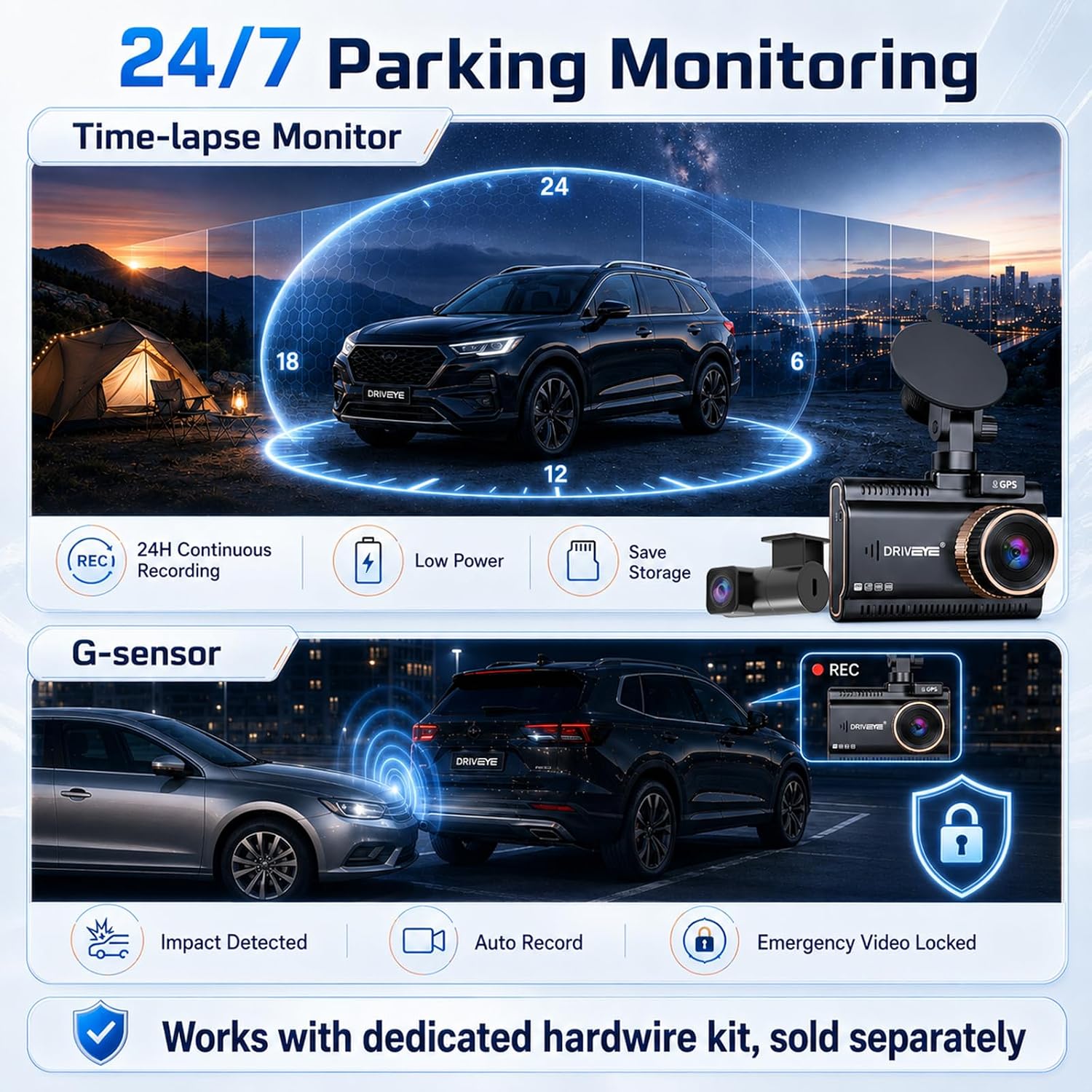
| Driveye D22 dual dash cam | Dual channel: Starvis 2 4K front and 2K rear | Front-and-rear evidence; flexible parking-monitoring options are described; no side or interior channels are documented | Buyers whose parking risk is mainly front or rear |
| Driveye D7 4 channel dash cam | Four simultaneous channels: 4K front plus three 1080P channels | Four-angle recording is documented; exact camera positions and parking-mode behaviour are not specified in the supplied record | Buyers who need more than two angles and a 4K front view |
| Driveye D9pro AI 5 channel dash cam | Five channels: 4K front, 2K rear, three 1080P side or interior cameras, and a dedicated baby monitor | Broadest documented angle set; rear-seat camera with three installation options; parking-mode behaviour is not specified in the supplied record | Families and rideshare drivers who need road and cabin coverage |
The table shows why channel count is a weak decision rule on its own. The D9pro has the most documented channels, but the D22 has a clearer parking-monitoring statement in the supplied record. The D7 adds four-angle recording, but the record does not label which of its three non-front cameras is the rear camera. A buyer who selects on count alone can miss the two details that decide whether parking footage is useful: the angle of the incident and the documentation of the parking workflow.
Mapping the review themes to documented configuration
Four review themes recur in parking-evidence buying: the parking-lot hit report, 360° coverage, four-angle recording, and clear front and back footage. They are useful prompts, not proof of performance. The table below maps each theme to what the supplied product record actually documents.
| Review theme | Driveye D22 | Driveye D7 | Driveye D9pro |
|---|---|---|---|
| Parking-lot hit report | Parking-monitoring options are described; a separate hit-report feature is not named in the supplied record | Not documented in the supplied comparison record; verify parking mode | Not documented in the supplied comparison record; verify parking mode |
| 360° coverage | Front and rear only; 360° coverage is not documented | Four simultaneous channels; 360° coverage is not quantified | Five channels including side or interior cameras; 360° coverage is not quantified |
| Four-angle recording | No; two channels are documented | Yes; four simultaneous channels are documented | Yes; five channels are documented |
| Clear front and back footage | 4K front and 2K rear | 4K front and three 1080P channels; the rear position is not labelled in the supplied record | 4K front and 2K rear |
This mapping is deliberately conservative. It does not treat a higher channel count as proof of a better parking report, and it does not treat an undocumented feature as absent. The D22 has a documented front-and-rear evidence path and a parking-monitoring statement; the D7 has documented four-angle recording but an incomplete position and parking-mode record; the D9pro has the broadest documented angle set and a cabin-monitoring role, but its parking-mode behaviour still needs confirmation.
What each model documents for parking evidence
Driveye D22: the focused front-and-rear option
The Driveye D22 is the dual-channel reference in this comparison. It records with a Starvis 2 4K front camera and a 2K rear camera. The supplied record also lists a 64GB memory card, dual-band 5G Wi-Fi, GPS, voice control, WDR technology, and a lightweight, compact rose-gold design. For parking evidence, the important combination is the 4K front image, the 2K rear image and the described flexible parking-monitoring options. That is a coherent package for a buyer whose parking risk is concentrated at the front or rear of the vehicle.
The limitation is equally clear. The D22 is a dual-channel dash cam, so the supplied record does not document side or interior coverage. If a parking-lot hit occurs along a side panel or a rear quarter that the rear camera does not see, the documented angle set may not capture the incident. The buyer should confirm the parking-monitoring trigger, recording duration and field of view before relying on the system for unattended parking.
Driveye D7: four-angle recording with verification points
The Driveye D7 is a 4-channel dash cam with simultaneous recording across a 4K front camera and three 1080P channels. The supplied comparison also lists built-in GPS and hands-free voice control, and positions the model for daily commuters, rideshare drivers and fleet operators seeking a mid-range 4-channel dash cam with 4K front recording. For parking evidence, the meaningful step is four-angle recording: the system can capture more than the front and rear views that define the D22’s documented layout.
That advantage comes with a verification boundary. The supplied record does not identify which of the three non-front channels is the rear camera, which are side cameras, or whether any is an interior camera. It also does not document parking-mode behaviour for the D7. A buyer who needs four-angle parking evidence should confirm the camera positions, the parking trigger, the storage rotation and the retained file length before purchase.
Driveye D9pro: the broadest documented angle set
The Driveye D9pro AI 5 channel dash cam records across a 4K front camera, a 2K rear camera and three 1080P side or interior cameras, including a dedicated baby monitor. The supplied record also lists an AI ADAS system, voice control, GPS, and an included 128GB card. For families, the rear-seat camera is offered with three installation options, and the model is recommended for families with babies or pets and for rideshare drivers who need road-and-cabin coverage. In parking terms, the D9pro has the broadest documented angle set of the three models.
The boundary is that a five-channel layout is not automatically a better parking-evidence tool. The supplied record does not document a parking-mode specification for the D9pro, and it does not quantify how much of the vehicle’s surroundings the side and interior cameras actually cover. The extra channels also add installation complexity. The D9pro is the clearest fit when the same vehicle needs a 5 Channel Dash Cam with Baby Monitor function and broader road-and-cabin coverage; it is not the automatic answer for every parking-lot scenario.
Channel count versus evidence quality: a decision framework
The decision rule is not that more channels win. It is that the documented coverage must match the parking risk, and the parking workflow must be verifiable. A buyer can apply six checks before choosing among the D22, D7 and D9pro.
- Angle match. Does the documented camera set include the side or corner where damage is most likely? The D22 covers front and rear. The D7 adds four simultaneous channels, but the positions need confirmation. The D9pro adds three side or interior channels, giving the broadest documented set.
- Image at the evidence point. The D22 and D9pro both document a 2K rear camera, while the D7 documents a 4K front camera and three 1080P channels. Higher resolution gives more pixels to work with; it does not guarantee a readable plate in every condition.
- Parking trigger. The D22 is the only model in the supplied record with a described parking-monitoring option. For the D7 and D9pro, parking-mode behaviour is not documented in the comparison record and should be verified in the listing or manual.
- Storage and retrieval. The D22 record lists a 64GB card, and the D9pro record lists a 128GB card. The D7 record does not list an included card in the supplied comparison. Included capacity is a starting point, not a retention guarantee.
- Installation. A camera only provides the angle it is mounted to see. The D9pro’s rear-seat camera is offered with three installation options, but parking coverage still depends on how the exterior cameras are positioned.
- Privacy and use context. The D9pro’s interior camera supports family and rideshare use, but interior recording also raises privacy considerations that the buyer should check for the relevant jurisdiction and use.
A simple decision rule follows. If the parking risk is mainly front and rear, and the buyer wants a compact Dual Channel Dash Cam with 4K front and 2K rear recording plus a documented parking-monitoring option, the D22 is the closest documented fit. If the buyer needs four simultaneous angles and a 4K front camera, the D7 is the logical step up, provided the camera positions and parking workflow are confirmed. If the vehicle also needs cabin monitoring for children or pets, or rideshare road-and-cabin coverage, the D9pro’s five-channel layout is the broadest documented option, again subject to parking-mode verification.
Fit by buyer scenario
Daily commutes, night driving and difficult light
A front-and-rear recording setup is the baseline for daily commutes, nighttime driving, tunnels, and roads with strong sunlight and deep shadows. The D22 matches that scenario directly with its 4K front camera, 2K rear camera and WDR technology. The D7 also offers a 4K front camera and four-channel recording, while the D9pro adds a 2K rear camera and side or interior channels. For a commuter who parks in a regular bay and mainly needs to know what happened in front of or behind the car, the D22’s focused layout is easier to justify than a five-channel system. For a commuter who regularly uses tight side-by-side parking, the D7 or D9pro deserves a closer look.
Family vehicles and cabin monitoring
The D9pro is the only model in this set with a documented dedicated baby monitor and a rear-seat camera offered with three installation options. That makes it the relevant choice for a family dash cam buyer who wants to check children or pets without turning around, and for a 5 Channel Dash Cam with Baby Monitor use case. The parking-evidence benefit is secondary but real: the same system documents a broader angle set than the D22 or D7. The buyer should still separate the cabin-monitoring decision from the parking decision.
Rideshare and fleet use
Rideshare drivers and fleet operators often need both road evidence and cabin context. The D9pro is recommended in the supplied record for rideshare drivers who need road-and-cabin coverage, and its five-channel layout supports that positioning. The D7 is positioned for daily commuters, rideshare drivers and fleet operators seeking a mid-range 4-channel dash cam with 4K front recording, GPS and voice control. The D22 is the more focused option for commuters, rideshare drivers, small fleet owners, families and road travelers who need dual-channel front-and-rear coverage. In a fleet context, the right choice depends on the parking environment: a depot with side-impact risk may justify the D7 or D9pro, while a fleet that mainly needs front-and-rear incident evidence can use the D22’s narrower documented layout.
What the market trend does and does not prove
The Fortune Business Insights forecasts are useful context for the category, not a verdict on the three models. A 13.2% growth projection for multi-channel systems and a 16.0% projection for side-facing dash cams point to more products with side coverage and more buyer attention on parking protection. They do not show that a five-channel dash cam captures a better parking report than a dual-channel dash cam in every lot, and they do not validate any specific parking-mode claim. The forecasts describe where the category is expected to grow; the buyer still has to verify the angle, trigger, image quality and retrieval path on the model in front of them.
If the forecast direction holds, the practical effect is likely to be more choice rather than a single winning configuration. Buyers will see more Multi Camera Dash Cam layouts, more side-facing options and more family-oriented cabin views. That makes documentation more important, not less.
Limitations and verification before purchase
The largest evidentiary gap in this comparison is parking-mode documentation. The D22 record describes flexible parking-monitoring options. The D7 and D9pro records do not document parking-mode behaviour in the supplied comparison material. That does not mean the features are absent; it means the buyer should not assume them. The correct verification step is to check the product listing, manual or specification sheet for the parking trigger, recording duration, impact sensitivity and storage behaviour.
The second gap is camera-position labelling. The D7’s four-channel layout is documented, but the supplied record does not say which channel is rear, which are side and whether any is interior. The D9pro’s side or interior cameras are documented as a group, but the buyer should still confirm the mounting plan. The D22’s limitation is simpler: its documented layout is front and rear, so it should not be treated as a 360° system.
Storage is the third verification point. The D22 record lists a 64GB card and the D9pro record lists a 128GB card. The D7 record does not list an included card in the supplied comparison. A larger card can extend retention, but loop recording, resolution and the number of active channels all affect how much parking footage is kept. Finally, the supplied brand policy lists an 18-month warranty and a 30-day return. Those are useful purchase terms, but they do not establish parking performance.
FAQ
Which Driveye model fits a buyer who mainly wants a parking-lot hit report?
Start with documented coverage and parking behaviour, not the model name. The D22 is the only model in the supplied comparison with a described flexible parking-monitoring option, and it provides 4K front and 2K rear recording. The D7 and D9pro offer more channels, but their parking-mode behaviour is not documented in the supplied record. A buyer who mainly needs front-and-rear parking evidence should examine the D22 first and verify its parking trigger and retention. A buyer who needs side or cabin coverage should compare the D7 and D9pro only after confirming their parking workflow.
Does a higher channel count automatically produce better parking evidence?
No. Channel count shows how many simultaneous video streams a system documents, not whether the system records the angle where damage occurs or whether the parking event triggers a usable file. The D9pro has five channels and the D7 has four, while the D22 has two. That ordering is useful for coverage planning, but the D22 still has the clearest parking-monitoring statement in the supplied record. The buyer should compare angle match, image clarity, parking trigger, storage and retrieval before comparing the number of cameras.
What should be verified about parking mode before choosing the D7 or D9pro?
Verify the trigger type, impact sensitivity, recording duration, storage rotation and retrieval method. The supplied record does not document parking-mode behaviour for either model, so the buyer should check the manual or specification sheet rather than infer the feature from the channel count. It is also worth confirming whether the parking mode requires a specific wiring kit or installation setting, because a parking claim that depends on an unconfirmed accessory is not a complete buying answer. If the listing does not state the parking workflow, the buyer should treat it as unverified.
Which model fits a family that also wants a dash cam with baby monitor?
The D9pro is the only model in this comparison with a documented dedicated baby monitor and a rear-seat camera offered with three installation options. It is positioned for families with babies or pets and for rideshare drivers who need road-and-cabin coverage. That makes it the relevant family dash cam option in the set. The buyer should still check whether the parking coverage matches the family’s regular parking environment, because the baby-monitor feature and the parking-evidence feature serve different jobs even when they share one device.
Is the D22 enough for parking evidence if only the front and rear matter?
The D22 is the closest documented fit when the parking risk is concentrated at the front or rear. It provides a Starvis 2 4K front camera, a 2K rear camera and a described parking-monitoring option, along with a 64GB card, GPS, voice control, WDR and dual-band 5G Wi-Fi. Its limitation is the absence of documented side or interior channels. If the vehicle is regularly parked in a bay where side damage is plausible, the D22’s two-angle layout may leave a gap that the D7 or D9pro is better placed to address, subject to their own parking-mode verification.
This comparison is based on the supplied Driveye product record and the cited third-party market forecast. It does not treat channel count as a performance guarantee. Buyers should verify current specifications, parking-mode behaviour, installation requirements and commercial terms with the seller before purchase.
Tem questões ou precisa de mais detalhes?
Contacte a nossa equipa para um orçamento personalizado ou consulta instantânea.
Solicitar orçamento
Preencha o formulário abaixo e a nossa equipa entrará em contacto com uma proposta personalizada.
Chat direto do WhatsApp
Prefere conversar em tempo real? Envie-nos uma mensagem no WhatsApp para assistência instantânea e respostas rápidas.
- Obter orçamento personalizado
- Partilhar fotos ou documentos
- Discuta as suas necessidades diretamente
Geralmente responde em 5–30 minutos durante o horário de expediente.