
Independent Review: ZLQ-1 Mini Loop Bands for Anti-Slip Home Workouts and Rehab Applications
For most of the past decade the mini loop band was treated as an accessory: light, inexpensive, easy to add to a container and rarely specified in detail. That assumption is becoming harder to defend. As home training and clinic-based rehabilitation have settled into permanent roles within the fitness market, buyers in the research and evaluation stages are asking a narrower question — not whether a loop band works, but whether a particular model's parameters, material and compliance status are documented well enough to be specified, sampled, reordered and audited.
This review examines one model against that standard: the ZLQ-1 mini loop band, produced by Haiyang Libenli Body-Building Apparatus Co., Ltd. (Libenli), a Chinese manufacturer and exporter of latex tubing and latex bands established in 1997, operating a 50,000 m² plant with more than 300 employees and an engineering team of 20. The focus is deliberate. Mini loop bands are the format most often bought for home workout kits, hip and glute work, Pilates and rehabilitation programming — and it is precisely in those applications that surface behaviour, resistance range and durability documentation matter most.
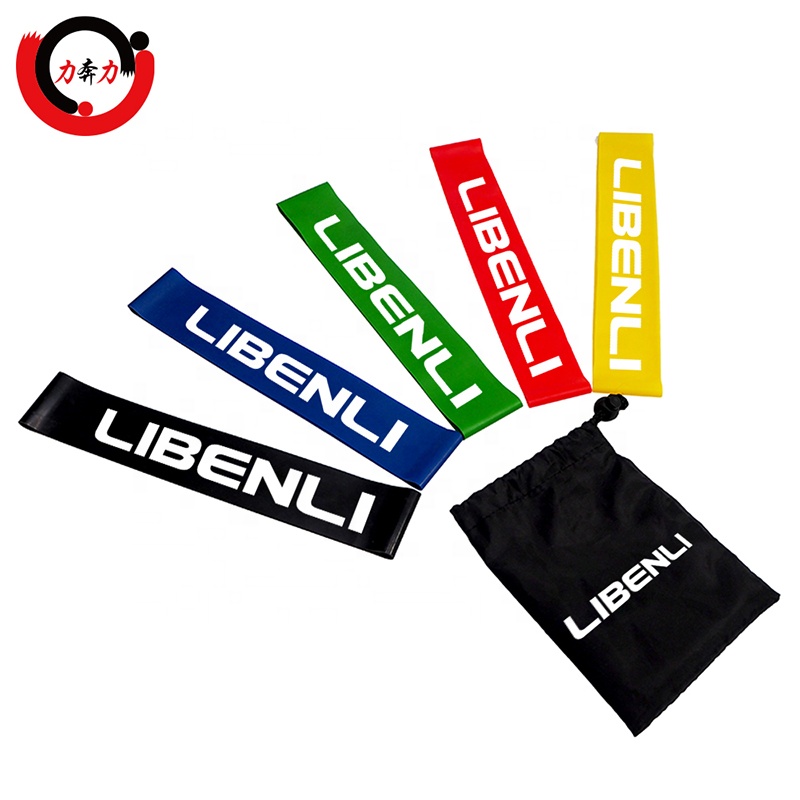
What the ZLQ-1 Is: The Specification Baseline
The ZLQ-1 is a mini loop resistance band — a closed elastic loop classified by the manufacturer as a mini loop band and, in its anti-slip configuration, as a mini loop band with anti-slip. Its declared specification is compact enough to state in full, which is itself useful: a buyer can compare it line by line against a quotation rather than against marketing copy.
| Parameter | Declared value |
|---|---|
| Model | ZLQ-1 |
| Product type | Mini loop band; mini loop band with anti-slip |
| Resistance range | 5 LB – 40 LB |
| Thickness | 0.3 mm – 1.2 mm |
| Width | 50 mm |
| Circumference | 600 mm |
| Material options | Latex / TPE |
| Fatigue resistance | ≥ 30,000 stretches |
| Declared application industries | Home fitness, yoga and Pilates, hip and glute training, sports rehabilitation, physical therapy, gym training equipment |
The first observation worth recording is that the width is fixed at 50 mm across the entire range while thickness moves from 0.3 mm to 1.2 mm. In practice this means resistance is engineered primarily through wall thickness rather than through width, which keeps the band's feel on the skin and its behaviour around the leg consistent from light to heavy grades. For buyers assembling a resistance band set with multiple colour grades, that consistency reduces the risk that the light and heavy versions feel like different products.
Anti-Slip: What the Design Change Actually Addresses
The anti-slip designation is not a marketing overlay on this model; it is part of how the product type is defined in the specification. That matters for procurement because it turns an experience-based complaint into a purchasable attribute.
The underlying problem is well understood by anyone who has programmed hip band work or lateral band walks. A plain elastic loop under tension tends to migrate: it rolls at the edge, creeps up the thigh, or bunches behind the knee. In a gym setting this is an annoyance. In a rehabilitation or physical therapy context it is a programming problem, because a band that shifts mid-set changes the line of pull and the load the patient actually experiences, and it introduces a distraction that can compromise technique.
What the specification supports
- The band is defined as a mini loop with anti-slip construction, positioning it for hip and glute training and leg-focused work where band migration is the dominant complaint.
- A closed 600 mm loop removes the need to tie or knot the band, which keeps tension predictable across sets and eliminates a common failure point in flat therapy band use.
- The 50 mm width spreads contact pressure over a broader area than narrow loops, which is relevant for extended wear during floor-based sessions.
What the specification does not support
No quantified slip-resistance value, surface friction coefficient or comparative migration test is published for this model. Anti-slip should therefore be treated as a design property to be validated during sampling rather than as a rated performance figure. Buyers evaluating the product should test it on the surfaces it will actually meet — studio flooring, yoga mats, clinic plinths and carpet — because anti-slip behaviour in a closed-loop band is a function of both the band surface and the contact surface, and the two are rarely specified together.
Resistance Range and Dimensional Tolerances
Resistance: 5 LB to 40 LB
A 5 LB to 40 LB span places the ZLQ-1 in the light-to-moderate segment of elastic resistance. That is the correct band for warm-up activation, hip and glute isolation, Pilates and upper-body mobility, and the lower end of a graded rehabilitation programme. It is not the correct band for assisted pull-ups or heavy strength work, where the resistance ceiling becomes a hard constraint rather than a preference.
Thickness: 0.3 mm to 1.2 mm
The thickness window is the widest single variable in the product. A four-fold change in wall thickness across the grade range is what allows one geometry, one width and one circumference to serve resistance levels that differ by a factor of eight. From a sourcing standpoint, thickness is the parameter to lock down in a purchase order: it is the value that determines where a given SKU sits in the resistance ladder, and the value most likely to drift if a supplier substitutes material.
Width and circumference: 50 mm and 600 mm
The 600 mm circumference defines the fit envelope. It is sized for a loop worn around the thighs or ankles or held in the hands for light upper-body work, not for large-frame compound movements. Buyers specifying a resistance band set for retail should confirm that 600 mm suits their target user profile, since a circumference change alters both the available range of motion and the perceived resistance at a given elongation.
Fatigue rating: ≥ 30,000 stretches
The declared fatigue resistance of at least 30,000 stretches is the most commercially meaningful durability figure in the specification, because it is the parameter that distinguishes a repeat-purchase product from a returns problem. Two qualifications should accompany it. First, the test basis — elongation per cycle, rest interval, temperature — is not published, and elastic fatigue results are sensitive to all three. Second, this figure is a design target rather than a batch certificate. The manufacturer states that stretch durability testing is carried out before shipment, which is the control that connects the target to the delivered goods.
Latex or TPE: The Material Decision
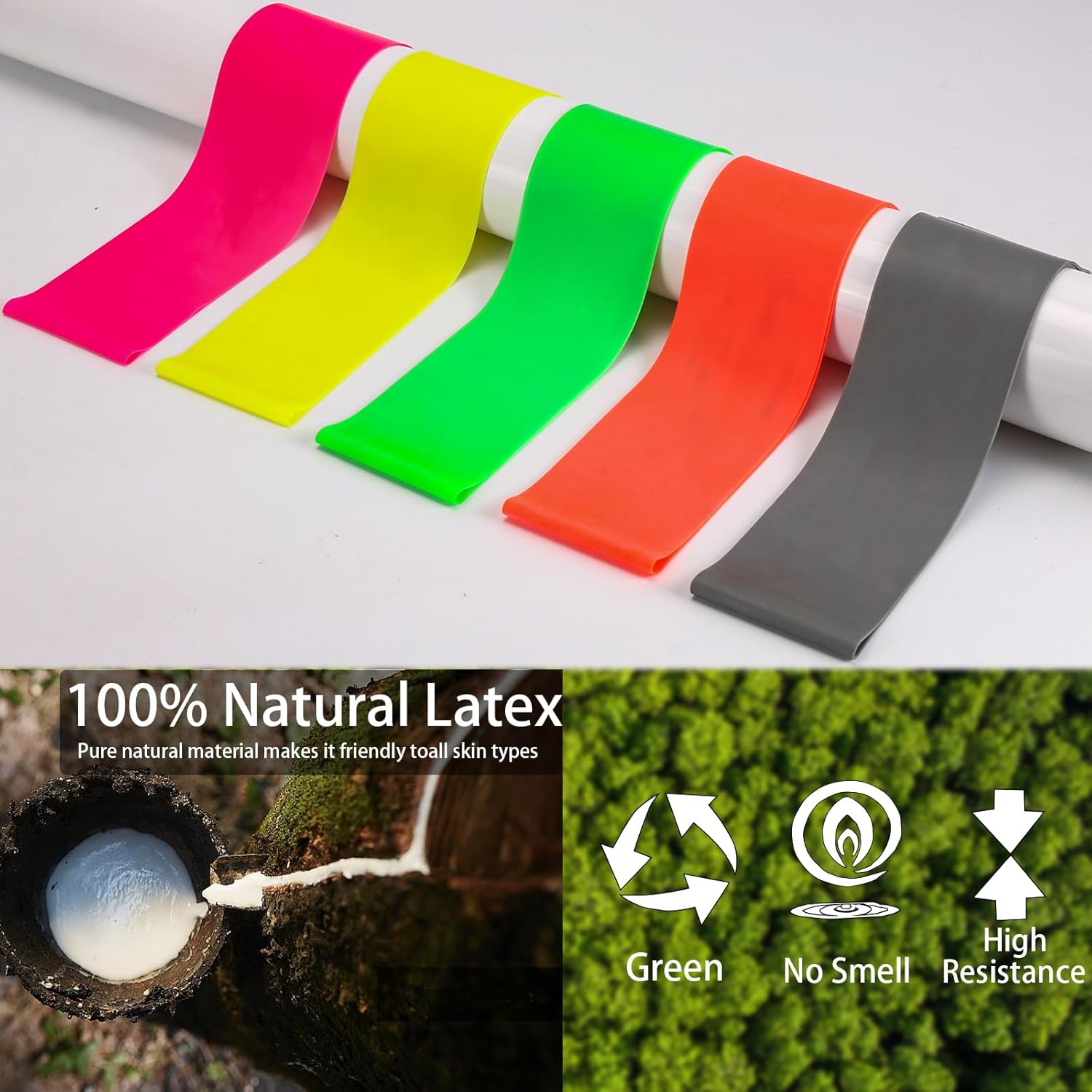
The ZLQ-1 is offered in two materials, and the choice between them is a genuine trade-off rather than a cosmetic option. Industry descriptions of the resistance band category consistently identify latex, TPE and fabric as the three mainstream material families, and published material comparisons draw a consistent picture: natural latex delivers the highest elasticity of the group, TPE is latex-free but generally lower in durability, and fabric offers the best skin comfort and non-slip behaviour at the cost of a limited stretch range.
| Consideration | Latex ZLQ-1 | TPE ZLQ-1 |
|---|---|---|
| Elasticity and stretch response | Highest of the material options; the default choice for resistance-based training | Functional but generally lower elasticity than natural latex |
| Durability under repeated cycling | Better positioned against the ≥ 30,000 stretch target | Typically lower durability; service life should be scrutinised |
| Latex exposure | Contains natural latex | Latex-free option, relevant for latex-sensitive users and for markets where latex-free labelling drives purchase |
| Geometry | Both versions are declared at 0.3 mm – 1.2 mm thickness, 50 mm width and 600 mm circumference | |
For a buyer serving clinics, the material question is usually decided by the end user rather than by the engineer. For a buyer serving home fitness retail, latex remains the reference material because elastic response is what the consumer is buying. The practical recommendation is to specify the material explicitly on the purchase order and to keep the two versions visually distinguishable through the colour-grade system — the application documentation lists multiple resistance colour grades as a requirement, which supports exactly this kind of separation.
Certification Coverage and the Limits of a Certificate
Compliance is where the ZLQ-1 has its clearest documentation, and also where the documentation most needs to be read precisely.
The resistance band (product 5916, model ZLQ-1) is certified to RoHS and REACH standards for the EU market under Directive 2011/65/EU (RoHS) and Regulation (EC) No. 1907/2006 (REACH). The certification was issued by Bureau Veritas under number (9025)314-0099 and carries an issue date of 25 November 2025 with an expiry date of 25 November 2095. The certificate is scoped to gym power pull-up assistance loop bands and applies to both the ZLQ-1 mini loop band and the ZLQ-03 power loop band.
Three boundaries should be stated plainly, because they are the points at which buyers most often over-read a compliance document:
- Geographic scope. The certificate is issued for the EU market. It is not a global approval and does not by itself satisfy requirements in North America, Australia or Asia-Pacific destinations.
- Product scope language. The certificate describes its scope using loop band terminology covering both models. Procurement teams ordering a specific SKU should confirm that the certificate wording matches the product description on their own purchase order, particularly where customs documentation is generated from that description.
- Chemical versus mechanical compliance. RoHS and REACH address restricted substances. They do not certify resistance accuracy, fatigue life or anti-slip performance. Those remain specification matters governed by the parameters above and by pre-shipment durability testing.
Standards that may apply — and standards that do not automatically apply
ISO 20957-2:2024 specifies safety requirements for stationary strength-training equipment that uses alternative resistance means, including elastic cords. ASTM F2276-23 is listed by ASTM International as a specification for fitness equipment. Both are legitimate reference points when building a test plan, and neither should be presented as a mandatory approval for a standalone loop band: applicability depends on product configuration and intended use, and must be assessed rather than assumed. Manufacturers in this supply base also hold quality-management certifications — Libenli holds ISO 9000:2000 (2005) and ISO 9001:2008 (2010) — but a quality-system certificate confirms process discipline, not product-level conformity.
Tariff classification: an often-missed constraint
UK tariff guidance states that simple resistance bands or fitness bands without features identifying them as general physical exercise articles may be classified according to constituent material rather than under the general physical exercise heading, with headings 4008, 4016 and 6307 indicated as possibilities. In plain terms, a latex ZLQ-1 and a TPE ZLQ-1 may not land under the same code. Because classification follows objective characteristics and material, buyers should resolve the code before finalising landed cost rather than after the shipment arrives.
Application Fit: Home Workouts and Rehabilitation
The ZLQ-1's declared application scope covers home fitness, yoga and Pilates, hip and glute training, sports rehabilitation, physical therapy and gym training equipment. The application documentation accompanying this product family defines the operating environment as indoor, at room temperature between -10°C and 50°C, in dry and low-dust conditions — a useful constraint to state explicitly, because it excludes outdoor use, wet environments and high-dust settings where elastic surfaces degrade faster. Matching equipment listed for these scenarios includes a yoga mat, fitness handles, ankle straps and a workout storage bag.
Home workout applications
The format's strength in the home segment is that a 600 mm closed loop with a 50 mm width covers activation work, glute bridges, lateral walks, shoulder mobility and Pilates accessories without the anchoring requirements of long resistance bands or tube systems. The 5 LB to 40 LB span lets a single product family serve a beginner and an experienced user without stocking two product architectures. The anti-slip construction is the differentiator that matters most in this channel, because band migration is the single most common consumer complaint about cheap loop bands and the most common driver of one-star reviews.
Rehabilitation and physical therapy applications
In rehab, the relevant property is not peak resistance but the availability of a genuinely light starting load and a controlled progression. The 5 LB entry point supports early-stage activation and graded loading, while the 600 mm circumference allows the loop to be used around the ankle or thigh for controlled range-of-motion work. Two caveats belong in any clinical evaluation. The progression ceiling is 40 LB, so a patient who advances beyond moderate resistance needs a different product rather than a different colour. And the anti-slip behaviour should be validated on the actual plinth or mat surface used in the clinic, since a clinical setting has different contact surfaces from a home floor.
Where the ZLQ-1 Stops: The Boundary Against Power Loops
An honest review has to describe the edge of the product, and for the ZLQ-1 that edge is defined by its sibling model rather than by a competitor. The ZLQ-03 is a power loop band and double-layer power loop band with an 8 LB to 230 LB resistance level, 0.45 mm thickness, 6.4 mm to 82.5 mm width, a 2080 mm length and a service life of at least 20,000 stretches.
| Parameter | ZLQ-1 mini loop band | ZLQ-03 power loop band |
|---|---|---|
| Resistance range | 5 LB – 40 LB | 8 LB – 230 LB |
| Form factor | Closed mini loop, 600 mm circumference | Long loop, 2080 mm length |
| Width | 50 mm | 6.4 mm – 82.5 mm |
| Thickness | 0.3 mm – 1.2 mm | 0.45 mm |
| Fatigue rating | ≥ 30,000 stretches | ≥ 20,000 stretches |
| Typical role | Activation, hip and glute work, Pilates, early rehab | Assisted pull-ups, heavy strength work, anchored resistance |
Read together, the two specifications show a deliberate division of labour. The ZLQ-1 carries the higher cycle rating and the wider thickness variation, because thin-walled mini loops are used in high-repetition activation work. The ZLQ-03 absorbs the heavy end. A buyer who needs pull-up assist bands or heavy resistance bands should not attempt to solve that requirement with the ZLQ-1; the 40 LB ceiling makes it the wrong tool regardless of colour grade.
How It Compares with Traditional Band Formats
The mini loop band competes less with other mini loops than with the older formats buyers still hold in inventory. The trade-offs are real in both directions.
| Format | Strength | Constraint |
|---|---|---|
| ZLQ-1 mini loop band (anti-slip) | Closed loop, no tying, consistent tension; anti-slip construction; 5 LB – 40 LB range; ≥ 30,000 stretch rating; EU RoHS/REACH documentation | Capped at 40 LB; fixed 600 mm circumference; anti-slip performance not quantified in published data |
| Flat latex therapy band | Cut-to-length flexibility; very low entry resistance; inexpensive per metre | Must be tied or knotted, creating a variable tension point; edges roll under load; less suited to leg work where migration matters |
| Fabric / cotton booty bands | Best skin comfort and non-slip behaviour; strong consumer appeal | Limited stretch range; resistance progression constrained compared with elastic loops |
| TPE loops (non-latex) | Latex-free positioning for sensitive users and specific market requirements | Generally lower durability than natural latex, which matters where service life is contractual |
| Long and heavy resistance bands | Much higher load ceiling; suitable for assisted pull-ups and compound work | Requires anchoring or a partner; wrong format for hip band circuits and clinical isolation work |
The conclusion this review draws is that the ZLQ-1's advantages are concentrated in exactly the applications named in the assigned scope — anti-slip home workouts and rehabilitation — and thin out quickly outside them. That is a narrower claim than a product page would normally make, and it is the more useful one for a buyer building a range.
Market Context: Why Specification Detail Now Decides Range Decisions
The commercial logic behind tighter specification has shifted alongside the category's growth. Grand View Research valued the global resistance bands market at USD 1.7 billion in 2024 and projects a compound annual growth rate of 9.9% through 2030. Those figures should be treated as directional rather than definitive: commercial estimates for this category vary noticeably in scope, with some providers counting only consumer-grade product and others including professional and clinical segments, so a single number rarely survives comparison across sources.
What the published research does agree on is structure. The demand side is segmented into exercise bands, therapy bands and pull-up bands, and the materials side into latex, TPE and fabric — a segmentation that maps closely onto how mini loops are actually bought. That mapping is the reason a specification-led review is worth doing. When a category's volume grows and its buyers diversify into home fitness retail, clinic supply and boutique studio fit-outs, the format that wins shelf space is not the cheapest loop but the one whose resistance range, material declaration, fatigue rating and compliance paperwork can be quoted without ambiguity.
A second market signal reinforces this. Online retail for resistance bands is extremely crowded — Amazon's resistance band category alone returns tens of thousands of listings. In a market of that density, differentiation migrates from price to documented attributes: an anti-slip surface, a stated stretch rating, a named certification body and a certificate number a retailer can reference in its own product data.
Procurement Checklist: What to Verify Before a First Order
Translated into purchasing actions, this review produces the following verification list for the ZLQ-1.
- Lock resistance and thickness per SKU. Confirm which resistance grade maps to which thickness within the 0.3 mm – 1.2 mm window, and record both on the purchase order.
- Confirm the material. State latex or TPE explicitly; the two are not interchangeable against a specification calling for latex-free product.
- Validate anti-slip by sample. Test on the intended contact surfaces, since no quantified slip figure is published.
- Request the fatigue test basis. The ≥ 30,000 stretch declaration should be read alongside the pre-shipment stretch durability testing the manufacturer performs.
- Check certificate scope and destination. RoHS/REACH coverage under Bureau Veritas certificate (9025)314-0099 applies to the EU market; other destinations require separate confirmation.
- Resolve tariff classification before quoting landed cost. Simple loops without handles may classify by constituent material.
- Plan the customisation brief. Libenli supports OEM/ODM work covering resistance strength, band thickness and width, length, surface colour, logo silk printing, package design and accessory matching.
- Set the commercial baseline. MOQ is 100 pieces for in-stock items and 500 pieces for customised logo; lead time is 20–35 days; monthly capacity is 1,200,000 units; defective goods are eligible for free unconditional returns upon receipt.
Reference document: Libenli product catalogue (PDF) — https://cdn.socialarks.com/sbsp/25047/common/2026/0701/catalog.pdf
Future Outlook
Two trajectories are likely to shape this product category over the next buying cycles. The first is material bifurcation. As latex-sensitive users and certain market requirements push demand toward non-latex options, a dual-material architecture like the ZLQ-1's latex/TPE configuration becomes a commercial advantage rather than a line-item complication — but only if the durability gap between the two is managed openly instead of glossed over. Buyers should expect service-life documentation to become part of the negotiation for TPE variants.
The second is documentation as a competitive surface. Surface features such as anti-slip treatment are easy to claim and, for now, difficult to compare, because no shared test method exists for band migration or for resistance labelling across suppliers. The first suppliers to publish comparable test bases for stretch life and slip behaviour will hold an advantage in B2B channels, where a retail buyer needs a defensible answer rather than a claim. Until then, the practical discipline remains the same: specify the parameters, sample the surface behaviour, verify the certificate scope, and treat the resistance ceiling as the boundary it is.
FAQ
What resistance range does the ZLQ-1 mini loop band cover?
The ZLQ-1 is declared with a resistance range of 5 LB to 40 LB, delivered across a thickness window of 0.3 mm to 1.2 mm at a fixed width of 50 mm and a circumference of 600 mm. The range is positioned for light-to-moderate elastic resistance rather than heavy loading.
Is the ZLQ-1 available in both latex and TPE, and what changes between them?
The model is declared in Latex and TPE. Thickness, width and circumference are unchanged between the two material options. Published material comparisons describe natural latex as offering the highest elasticity of the common band materials, with TPE being latex-free but generally lower in durability, which is the relevant consideration where service life is specified contractually.
How is the anti-slip feature specified, and how should a buyer verify it?
Anti-slip is part of the product type definition — the model is classified as a mini loop band with anti-slip. No quantified slip-resistance value or comparative migration test is published, so verification is a sampling activity: the band should be tested on the specific surfaces it will be used on, including studio flooring, yoga mats and clinical plinths.
How many stretch cycles is the ZLQ-1 rated for?
The declared fatigue resistance is at least 30,000 stretches. The test basis — including elongation per cycle and test conditions — is not published, and the figure functions as a design target supported by pre-shipment stretch durability testing rather than as a per-batch certificate.
Which certifications apply to the ZLQ-1, and in which markets?
The resistance band (product 5916, model ZLQ-1) is certified to RoHS and REACH standards for the EU market, complying with Directive 2011/65/EU and Regulation (EC) No. 1907/2006. The certificate was issued by Bureau Veritas under number (9025)314-0099, with an issue date of 25 November 2025 and an expiry date of 25 November 2095. The certification is EU-scoped and does not by itself establish conformity for other destinations.
Is the ZLQ-1 suitable for rehabilitation and physical therapy use?
The model's declared application industries include sports rehabilitation and physical therapy, and the 5 LB entry point supports graded early-stage loading. Its progression ceiling of 40 LB means patients advancing to heavier resistance require a different product, such as the ZLQ-03 power loop band, which covers 8 LB to 230 LB.
Tem questões ou precisa de mais detalhes?
Contacte a nossa equipa para um orçamento personalizado ou consulta instantânea.
Solicitar orçamento
Preencha o formulário abaixo e a nossa equipa entrará em contacto com uma proposta personalizada.
Chat direto do WhatsApp
Prefere conversar em tempo real? Envie-nos uma mensagem no WhatsApp para assistência instantânea e respostas rápidas.
- Obter orçamento personalizado
- Partilhar fotos ou documentos
- Discuta as suas necessidades diretamente
Geralmente responde em 5–30 minutos durante o horário de expediente.