
Independent Test: DOCOD P2000 PIJ vs TTO on Flexible Packaging
Flexible packaging buyers often face the same practical question: should a line use a high-resolution piezo inkjet printer or a thermal transfer overprinter for date codes, batch data, multi-language text and GS1-ready 2D codes? This independent specification-based test compares the DOCOD P2000 Piezo Inkjet Printer with the DOCOD R3000 Series Industrial Thermal Transfer Overprinter for flexible films and labels. It evaluates fit, resolution, speed, code workflows and operating limits using published DOCOD product specifications and application notes; it does not invent laboratory print samples or field results.
Why flexible packaging changes the coding decision
Flexible packaging is not a single substrate. It covers printed films, laminated structures, sealed bags, stick packs, metallized labels and decorative labels. Each surface can behave differently when ink, ribbon, heat, line speed and code density interact. A coding choice that works on a carton may not transfer cleanly to a low-surface-energy film or a coated label.
For buyers, the decision is rarely only about the printer. It is about the code that must survive the supply chain, the data that must be printed at line speed, and the verification step that proves the code is readable. Industrial Coding and Marking Equipment in this segment is evaluated on four practical dimensions: substrate compatibility, code quality, throughput fit and integration with packaging equipment.
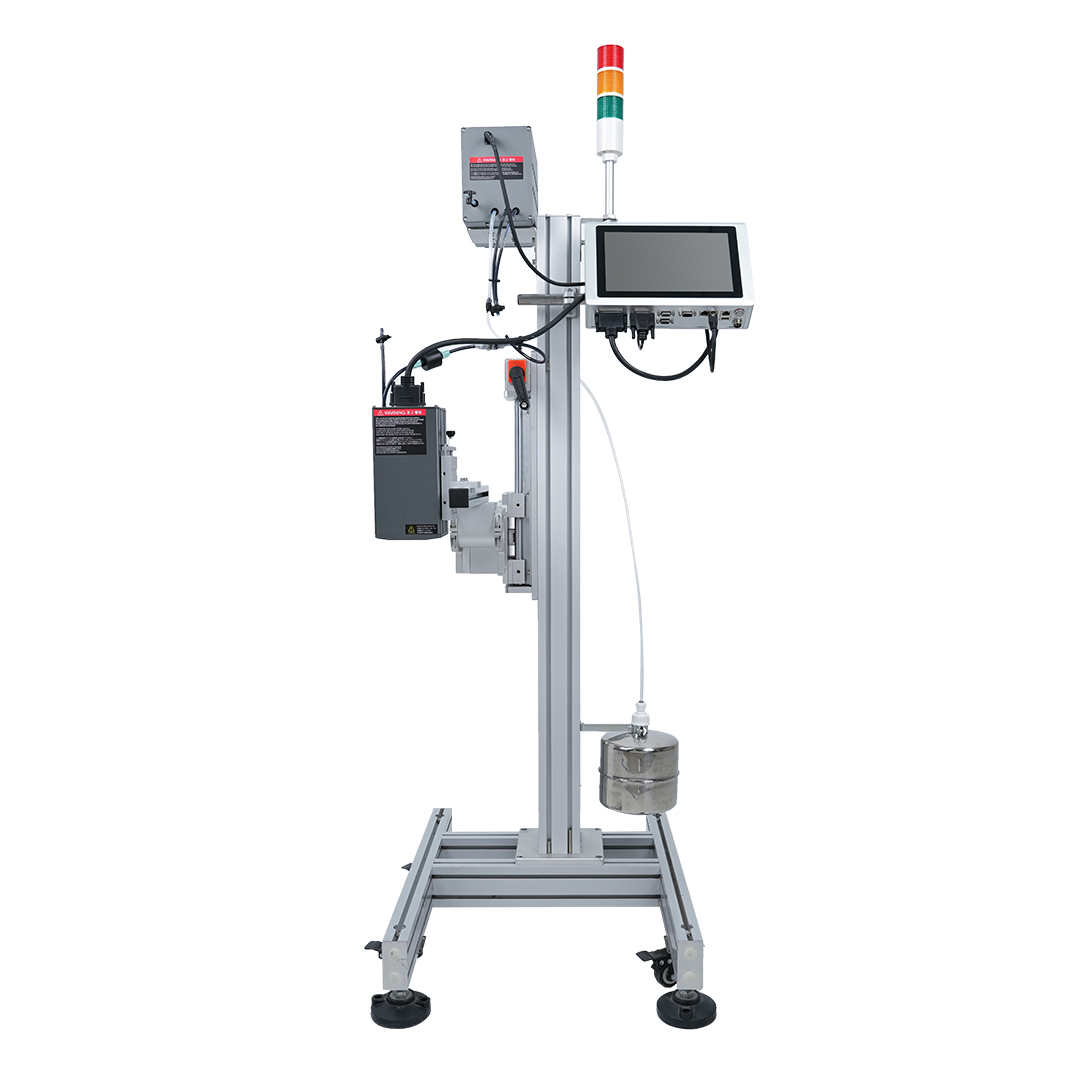
The DOCOD P2000 and the DOCOD R3000 TTO represent two different answers to that problem. The P2000 is a piezo inkjet printer that uses I1600 series nozzles, a negative-pressure continuous ink supply and water-based or quick-drying inks. The R3000 is an intermittent thermal transfer overprinter that uses ribbon, air supply and a thermal print process. They can both print variable data, but they reach the flexible packaging task from opposite directions.
What each system is specified to do
DOCOD Precision Group Co., Ltd. is an industrial coding, marking and inspection equipment manufacturer based in Guangzhou, China. Its portfolio includes CIJ, TIJ, PIJ, DOD, TTO, laser marking machines, inline vision inspection systems, consumables and traceability solutions. That multi-technology position matters here because the P2000 and R3000 are not competing for every line; they are competing for specific flexible packaging scenarios.
The DOCOD P2000 Piezo Inkjet Printer is a single-head or dual-head high-resolution PIJ printer. It is specified at 300 dpi or 600 dpi. Its print speed is 190 m/min at 300 dpi or 95 m/min at 600 dpi. A single head reaches a maximum print height of 33.8 mm. It prints text, time, date, patterns, shift codes, serial numbers, dynamic barcodes and QR codes, dynamic serial-port data and dynamic database content. Its printing materials include carton, plastic, metal, plate, pipe, stone, cables, glass, electronic components, auto parts, industrial chemical packaging, pharmaceutical packaging and food gift packaging. The recommended print distance is 2-3 mm from the printing medium, within a 0-5 mm range.
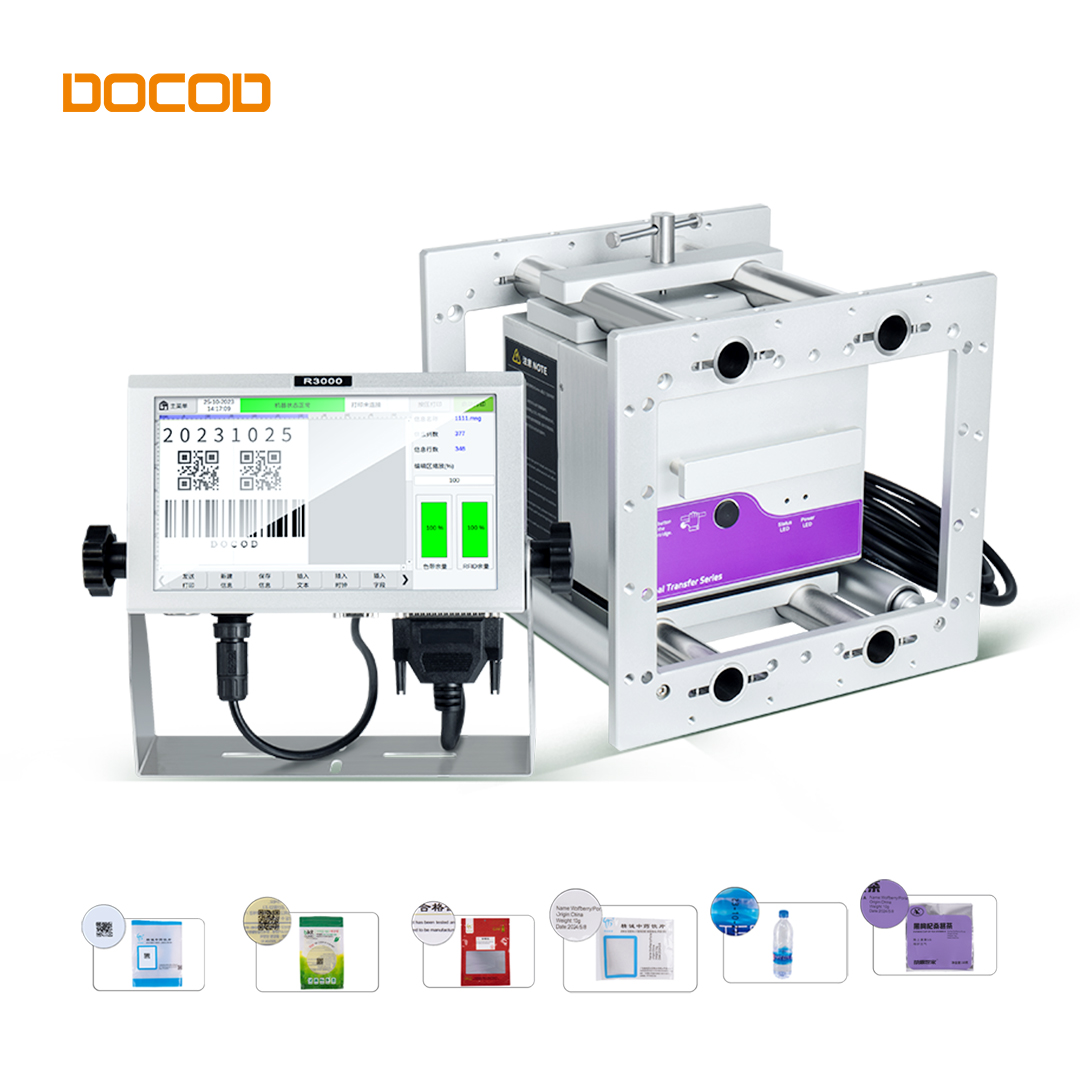
The DOCOD R3000 Series Industrial Thermal Transfer Overprinter is an intermittent thermal transfer overprinter available in R3032 and R3053 models. It is specified at 300 dpi. Its print area is 32 x 75 mm or 53 x 70 mm. Its maximum print speed is 200-350 mm/s, up to 800 mm/s, depending on the operating context. It uses ribbon widths of 24, 33, 35 or 55 mm and ribbon lengths of 400, 600, 800 or 1200 m. It requires an air supply of 2-4 bar and a printing gap of at least 0.1 mm. Its material types include high barrier film, stick packaging, sealed bags, sealed packaging, bagged products, metallized labels and decorative labels. Its print content includes language characters, GS1 Data Matrix, dynamic QR codes, barcodes, graphics, serial numbers, dates, shifts, counters and variable database data.
| Assessment point | DOCOD P2000 PIJ | DOCOD R3000 TTO |
|---|---|---|
| Print technology | Piezo inkjet, single or dual head | Thermal transfer overprinter, intermittent |
| Specified resolution | 300 dpi or 600 dpi | 300 dpi |
| Specified print speed | 190 m/min at 300 dpi; 95 m/min at 600 dpi | 200-350 mm/s, up to 800 mm/s |
| Print height or area | Single head maximum 33.8 mm | 32 x 75 mm or 53 x 70 mm |
| Flexible packaging fit | Plastics, label paper, coated paper and packaging formats listed in the specification | High barrier film, stick packs, sealed bags, metallized and decorative labels |
| Variable data | Text, date, serial number, dynamic barcode and QR code, dynamic database | Language characters, GS1 Data Matrix, dynamic QR code, serial number and database |
| Consumable model | Water-based or quick-drying ink, negative-pressure ink supply | Thermal ribbon, air supply and thermal print process |
| Main limitation to validate | Ink adhesion and code quality on the actual film or label; 600 dpi reduces specified speed | Intermittent operation, 300 dpi, fixed print area, ribbon and air dependencies |
Resolution versus speed: the real trade-off
The P2000 specification makes the resolution-speed trade-off visible. At 300 dpi, the printer is specified at 190 m/min. At 600 dpi, the specified speed is 95 m/min. That does not mean one mode is better than the other. It means the buyer must decide whether the code content needs the higher resolution or whether line throughput is the governing constraint.
On flexible packaging, 600 dpi can matter when the code carries dense 2D data, small human-readable text, multi-language regulatory text or a brand mark that must remain legible on a small label. At 300 dpi, the P2000 is still a high-resolution inkjet option, but the line can run at a higher specified speed. The correct setting depends on the code grade, the substrate and the verification threshold.
The R3000 follows a different logic. It is an intermittent thermal transfer overprinter, so its speed specification should not be read as a direct equivalent of the P2000's continuous inkjet scanning speed. The R3000's maximum print speed is stated as 200-350 mm/s, up to 800 mm/s, and its process is tied to the packaging machine cycle, ribbon advance and print gap. In a VFFS or stick-pack line, the TTO can be an excellent fit when the packaging motion is intermittent and the code area is within the available 32 x 75 mm or 53 x 70 mm print area. On a high-speed continuous film line, that same intermittent logic may become the constraint.
The neutral conclusion is not that one technology wins on speed. The conclusion is that the two speed figures describe different operating models. Buyers should test the code at the actual line speed, with the actual film and the actual code content, rather than compare headline numbers in isolation.
Multi-language text on film and labels
Multi-language text is a practical test of any coding system because it combines small character height, dense layout and readability requirements. The P2000 supports more than 40 languages through its controller environment and prints text, time, date, patterns, shift codes and serial numbers. Its 600 dpi mode is relevant when several languages must fit into a compact label area without sacrificing legibility.
The R3000 also supports language characters, and its 10-inch full-color LCD touch screen provides a control interface for variable data and multi-information group printing. Its 300 dpi specification can be sufficient for many date, batch and language blocks on flexible packaging, especially where the print area and character height are already defined by the pack design. The limitation is that a 300 dpi thermal transfer process has less headroom for very small characters and dense multilingual layouts than a 600 dpi inkjet mode.
For a buyer, the test should be simple: print the longest language string, the smallest permitted font size and the densest code on the actual film or label. Then verify readability after the pack has been handled, chilled, frozen or exposed to the conditions expected in distribution. Neither specification alone proves that outcome.
GS1 codes and the 2D transition
GS1 has set a Sunrise 2027 deadline for the retail transition from 1D barcodes to 2D QR codes using GS1 Digital Link. That regulatory direction changes the coding conversation. A line that only prints a date code today may need to print a 2D code with a data link, batch information and serialized content tomorrow. The printer must therefore be evaluated for variable data handling and code quality, not only for date stamping.
The P2000 specification includes dynamic barcode and QR code printing, dynamic serial-port data and dynamic database content. In DOCOD's medical packaging application material, the P2000 is also listed among the products used for UDI and GS1 DataMatrix coding workflows, with a print-and-verify configuration that can include a scanner, vision system and reject unit. That does not make the printer a complete verification system by itself; it shows that the P2000 can be integrated into a line-level code verification workflow.
The R3000 specification explicitly lists GS1 Data Matrix and dynamic QR code printing. It also supports network remote centralized control and docking with weighing machines, conveyors, packaging machines, ERP databases and traceability systems. For a flexible packaging line already built around an intermittent TTO station, that explicit GS1 Data Matrix support is a strong fit signal.
The practical difference is in code density and print area. The P2000's 600 dpi mode and dual-head configuration give more layout freedom for dense 2D codes and multi-language blocks. The R3000's 300 dpi and defined print area are better matched to established date, batch and GS1 Data Matrix placements on flexible film. The buyer should validate the expected GS1 Digital Link QR code size, data payload and verification grade on the actual substrate.
Application fit: which system belongs on which line
The P2000 is a better evaluation candidate when the line needs high-resolution variable data, multi-language text, serialization, dynamic database content or a wider layout than a fixed TTO print area allows. Its dual-head capability and 600 dpi mode are relevant for labels, coated paper, plastic packaging, pharmaceutical packaging and medical packaging workflows where code density and readability are central. Its negative-pressure continuous ink supply and quick-drying ink options support non-contact printing at a recommended 2-3 mm distance.
The R3000 is a better evaluation candidate when the packaging machine is intermittent, the film is a high barrier film, stick pack, sealed bag, metallized label or decorative label, and the code area fits within 32 x 75 mm or 53 x 70 mm. It is also a natural fit when the line already uses ribbon-based thermal transfer and when the buyer values a 300 dpi process with explicit GS1 Data Matrix support and network integration.
In DOCOD's UAE building materials and chemicals application, the P2000 is used for large-character marking on bags, pails, drums and pipes in dusty, hot or humid environments. In the German medical packaging application, the P2000 is used in a print-and-verify workflow for UDI and GS1 DataMatrix coding. These examples do not prove universal performance on every flexible film, but they show the P2000's intended range: high-resolution variable data on packaging where code content and traceability matter.
The R3000's documented application range is more specific to flexible packaging: bakery, dried fruit, seasoning, pasta, puffed food film, beverage packaging and similar bagged or sealed formats. That specificity is useful. It means the TTO is not a generic printer trying to cover every surface; it is a packaging-line overprinter designed around intermittent film and label coding.
Where the comparison becomes honest: limits and boundaries
A credible comparison must state where each technology stops being the obvious answer. The P2000's main boundary is substrate and ink validation. The product specification lists water-based and quick-drying inks, a recommended print distance of 2-3 mm and a range of packaging materials, but it does not guarantee adhesion or code grade on every flexible film. Low-surface-energy films, heavily coated labels, condensate, oil or high-temperature distribution can change the result. A buyer should run a substrate trial and a code verification test before committing a line.
The P2000's second boundary is the resolution-speed trade-off. At 600 dpi, the specified speed is 95 m/min. If the line requires higher throughput, the buyer must confirm whether 300 dpi at 190 m/min meets the code grade, or whether the line speed must be managed around the higher-resolution mode.
The R3000's main boundary is its intermittent thermal transfer process. It is specified at 300 dpi with a fixed print area, and it depends on ribbon, air supply and a print gap of at least 0.1 mm. That makes it a strong fit for many intermittent packaging machines, but not automatically the best fit for every high-speed continuous film line or every dense 2D code layout. The buyer should confirm the packaging cycle, the available print area and the ribbon consumption model.
These boundaries are not defects. They are the reason a specification-based test is more useful than a generic claim. The right choice depends on the code, the film, the line motion and the verification requirement.
Market trend: 2D codes and traceability are moving the decision upstream
The GS1 Sunrise 2027 transition is one of the clearest demand signals in industrial coding. It moves 2D QR codes from a nice-to-have to a retail packaging requirement in participating markets. For flexible packaging, that means more data per package, more serialization and more need for code verification. A printer that can handle dynamic database content and 2D codes is better positioned for that transition than a date-only device.
Commercial research also points to continued growth in coding and marking equipment, although published market forecasts vary by scope and methodology. Fortune Business Insights, for example, places inkjet technologies at 40.1% of the technology segment in its coding and marking coverage. That share is not a reason to choose one printer over another, but it does confirm that inkjet remains a mainstream production technology alongside thermal transfer, laser and other methods.
The practical trend for buyers is integration. Coding is no longer a standalone box at the end of the line. It connects to encoders, photocells, vision systems, reject units, MES and traceability databases. The P2000's USB, RS232 and TCP/IP interfaces and its cascading support point in that direction. The R3000's USB, RS232 and TCP/IP interfaces, network remote control and packaging-machine docking point in the same direction. The difference is in the code workflow each technology supports best.
Future outlook
The next buying cycle for flexible packaging coding will be shaped by three practical requirements: denser 2D codes, more variable data and more proof that the code was printed correctly. The P2000 is well positioned for buyers who need 600 dpi resolution, dual-head layout flexibility and dynamic database printing. The R3000 is well positioned for buyers who need a proven intermittent TTO process on flexible film and labels, with explicit GS1 Data Matrix support and a defined print area.
Neither position makes the other obsolete. In many plants, the two technologies will coexist: TTO on established bagging and stick-pack lines, and PIJ on labels, cartons, medical packaging or lines where high-resolution variable data is the priority. The winning procurement decision is the one that matches the coding method to the substrate and the verification requirement, not the one that chooses the highest headline specification.
Further reference: the DOCOD corporate brochure is available for download at DOCOD Corporate Brochure.
FAQ
Which system is better for multi-language text on flexible packaging?
The P2000 is the stronger evaluation candidate when multi-language text must fit into a small area at high resolution, because it offers a 600 dpi mode. The R3000 can print language characters at 300 dpi and may be sufficient where the text block and character height are already defined. The decisive test is to print the longest language string on the actual film or label and verify readability after normal handling.
Can the DOCOD P2000 print GS1 Digital Link QR codes?
The P2000 specification includes dynamic barcode and QR code printing, dynamic serial-port data and dynamic database content. DOCOD application material also lists the P2000 in medical packaging workflows for UDI and GS1 DataMatrix coding with print-and-verify integration. Buyers should still validate the specific GS1 Digital Link payload, code size and verification grade on the intended substrate.
Is the R3000 TTO limited to 300 dpi?
Yes. The DOCOD R3000 Series Industrial Thermal Transfer Overprinter is specified at 300 dpi. Its print area is 32 x 75 mm or 53 x 70 mm, and it operates as an intermittent thermal transfer overprinter. That resolution is suitable for many date, batch and GS1 Data Matrix applications, but dense small codes should be tested against the buyer's verification threshold.
What is the main speed difference between the P2000 and the R3000?
The P2000 is specified at 190 m/min at 300 dpi and 95 m/min at 600 dpi. The R3000 is specified at a maximum print speed of 200-350 mm/s, up to 800 mm/s, in intermittent thermal transfer operation. The figures describe different operating models, so they should not be treated as a direct like-for-like comparison. The correct approach is to test the actual code at the actual line speed.
Which system is better for labels and flexible film?
The R3000 is explicitly designed for high barrier film, stick packaging, sealed bags, metallized labels and decorative labels, and it is a natural fit for intermittent packaging lines. The P2000 is relevant where labels or packaging require higher-resolution variable data, multi-language text or denser 2D codes. The choice depends on the film, the code area, the line motion and the verification requirement.
What should buyers validate before choosing between PIJ and TTO?
Buyers should validate ink or ribbon adhesion on the actual substrate, code grade at the intended line speed, print area and layout, multi-language readability, GS1 2D code quality, integration with vision or reject systems, and consumable consumption. For the P2000, the 300 dpi and 600 dpi modes should both be tested because the specified speed changes with resolution. For the R3000, the intermittent cycle, air supply and ribbon model should be confirmed against the packaging machine.
Tem questões ou precisa de mais detalhes?
Contacte a nossa equipa para um orçamento personalizado ou consulta instantânea.
Solicitar orçamento
Preencha o formulário abaixo e a nossa equipa entrará em contacto com uma proposta personalizada.
Chat direto do WhatsApp
Prefere conversar em tempo real? Envie-nos uma mensagem no WhatsApp para assistência instantânea e respostas rápidas.
- Obter orçamento personalizado
- Partilhar fotos ou documentos
- Discuta as suas necessidades diretamente
Geralmente responde em 5–30 minutos durante o horário de expediente.