
Indoor Fitness Equipment for Small Apartments: Matching Gear to Compact Living Spaces
Indoor Fitness Equipment for Small Apartments: Matching Gear to Compact Living Spaces
In a small apartment, the limit on indoor training is not motivation — it is square metres. Three physical constraints decide which machine is workable: the floor area it occupies while in use, the volume it occupies when stored, and the noise or vibration it transfers into a shared building structure. Compact indoor fitness equipment exists as a category because manufacturers can now change all three numbers through folding frames, slim decks and magnetic resistance systems.
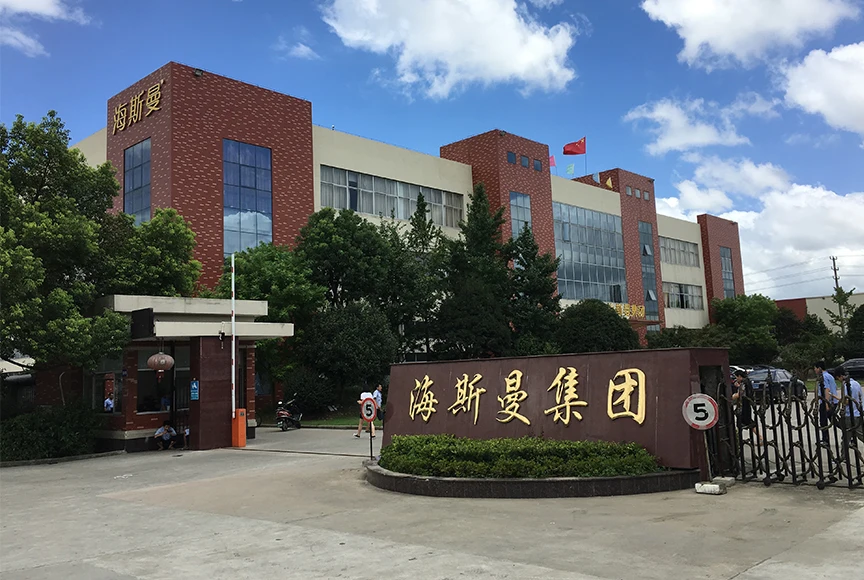
Home fitness equipment manufacturing floor at Ningbo Healthmate Health Technology Co., Ltd., Ningbo, China — where compact, folding and magnetic-resistance models are assembled and load-tested before shipment.
Three Measurements That Decide Which Equipment Fits an Apartment
Buyers who start with a brand shortlist usually end up returning to the same question: does the unit physically belong in this room? A more reliable sequence is to measure the apartment first and let the measurements eliminate categories.
- In-use footprint. The deployed length, width and height, plus the clearance needed to mount and dismount. A magnetic rowing machine listed at a product size of 1666×504×623 mm requires roughly 1.7 m of uninterrupted floor while in use; an under-desk walking pad shipped in a carton of 1120×515×123 mm occupies a fraction of that.
- Stored envelope. The folded or stowed dimensions decide whether the machine stays in the living space or moves into a closet. This is where folding frames and low-profile decks change the outcome rather than the appearance.
- Noise and vibration transfer. The drive and resistance mechanism — motor type, belt versus magnetic — determines whether the unit can be used in the evening in a multi-unit building without becoming a source of friction with neighbours.
These constraints are also visible in the market structure. Cardiovascular equipment, including treadmills and exercise bikes, holds a 58.89% revenue share of the global home fitness equipment market, according to Fortune Business Insights — the categories most affected by floor-space limits are also the categories buyers spend most on. The under-desk walking segment grew alongside remote and hybrid work patterns, a link Straits Research attributes to remote work trends in its valuation of the walking pad market.
How Ningbo Healthmate Addresses the Compact Segment
Ningbo Healthmate Health Technology Co., Ltd. is a manufacturer and supplier of home-use fitness and healthcare equipment, founded in 2007 and based in Ningbo, China. The company operates a 100,000 m² factory with 850 employees, 38 engineers and an annual output of 700,000 units, and exports approximately 80% of its production to Europe, the USA, Japan, Korea, India, the Middle East and South America. Its main product lines cover home-use treadmills, walking pads, vibration machines, spinning bikes, magnetic X-bikes, upright bikes, elliptical trainers, electric mini bikes and rowing machines.
Within that portfolio, the apartment-relevant response is not a single machine but three design families: foldable and under-desk formats that reduce the in-use footprint, folding frames that reduce the stored envelope, and magnetic resistance systems that reduce noise and service load. Five models illustrate how each mechanism changes the measurable numbers, and why they are not interchangeable.
Folding Frames, Slim Decks and Magnetic Resistance: The Mechanisms Behind the Numbers
Under-desk walking formats: footprint first
The HSM-W04M2A is specified as a folding walking pad with handrail, listed for apartment/small-space fitness and home-office wellness use. Its verified parameters are a 920×380 mm runway, 0.75 HP motor, six programs, a 1–10 km/h speed range, manual incline, a gross weight of 20.2 kg, and an LED screen showing speed, distance, time and calories. The folding structure and handrail configuration are what allow one unit to serve supported walking and low-speed walking in a work-from-home setting rather than requiring two devices.
Related models in the same walking-pad family show how low the format can go: the HSM-W04L1BL lists a product size of 1130×510×91 mm and the HSM-W04L2B lists 1090×495×120 mm. Those figures describe a deck-level profile, which is the property that makes a walking pad storable in a compact apartment in the first place.
The comparison against older formats is explicit. Against a traditional folding home treadmill, walking-pad-format equipment reduces thickness by 60–85%, reduces weight by 40–60% and lowers space usage by 70–90%, with purchase cost 20–40% lower. The trade-off is speed and running surface, which is dealt with in the limits section below.
Folding treadmills: keeping a usable speed range
The HSM-T20 is a compact folding home treadmill. Its verified specification includes a 1100×400 mm runway, 1.5 HP motor, six programs, 1–14 km/h speed range, manual incline, gross weight of 33.5 kg, Bluetooth music and app function, a deployed product size of 1474.3×604×1124 mm and a carton size of 1380×625×225 mm. The packaging dimension is a practical indicator of the folded envelope: less than a quarter of a metre in height.
Folding design also changes service behaviour, not only storage. Compared with a traditional home-use treadmill, a foldable design with a brushless or brush motor reduces running noise by 25–45%, reduces space occupation by 60–80%, cuts setup time by 70–85% and reduces product weight by 20–40%. Maintenance cost falls by 30–50%, largely because lubrication moves from a monthly interval to two to four times per year and belt-tension adjustment is needed less often. Energy consumption is quoted at 0.8–1.8 kWh per hour against 1.2–2.5 kWh per hour for the traditional equivalent.
Foldable frames for seated cardio
Not every apartment can dedicate a permanent cardio zone. The HSM-B135J5 is a foldable X-bike with an LCD screen showing speed, distance, time, calories and pulse, a 1.5 kg flywheel, eight resistance levels, seven altitude control levels, a gross weight of 19.1 kg, a deployed size of 1110×525×1100 mm and a carton of 955×415×225 mm. The folding frame is the mechanism that converts a fixed piece of cardio furniture into something that can be put away between sessions.
Magnetic resistance: noise control and service load
For multi-unit buildings, the resistance system matters more than any external padding. The HSM-S300 is a magnetic resistance spinning bike with a 6.0 kg flywheel, stepless resistance or app-controlled resistance in ten levels, handrail altitude control in five levels, cushion altitude control in seven levels, a gross weight of 30 kg, a deployed size of 1075×353×1090 mm and a carton of 1010×255×780 mm. Its product type designation in the portfolio is a quiet spinning bike for apartment use — a naming decision that points directly at the noise constraint.
The HSM-R06 is a magnetic rowing machine for home fitness, with an LCD screen showing stop, scan, time, distance, total strokes and strokes, a 2.5 kg flywheel, sixteen resistance levels, a published slideway reference distance of 0–705 mm, a handlebar belt length reference of 0–1700 mm, a gross weight of 24 kg, a product size of 1666×504×623 mm and a carton of 970×220×595 mm.
The engineering reason for choosing magnetic resistance over belt-driven friction is documented in comparative terms. Against a traditional belt-driven entry-level stationary bike, a magnetic resistance system delivers a smoother ride and higher achievable workout intensity, with a component lifespan two to three times longer and a mechanical energy conversion efficiency roughly 25% higher because of reduced friction loss. Belt replacement is eliminated by the design. The verified counterpoint is cost: initial purchase cost is 20–30% higher than the belt-driven entry-level alternative.
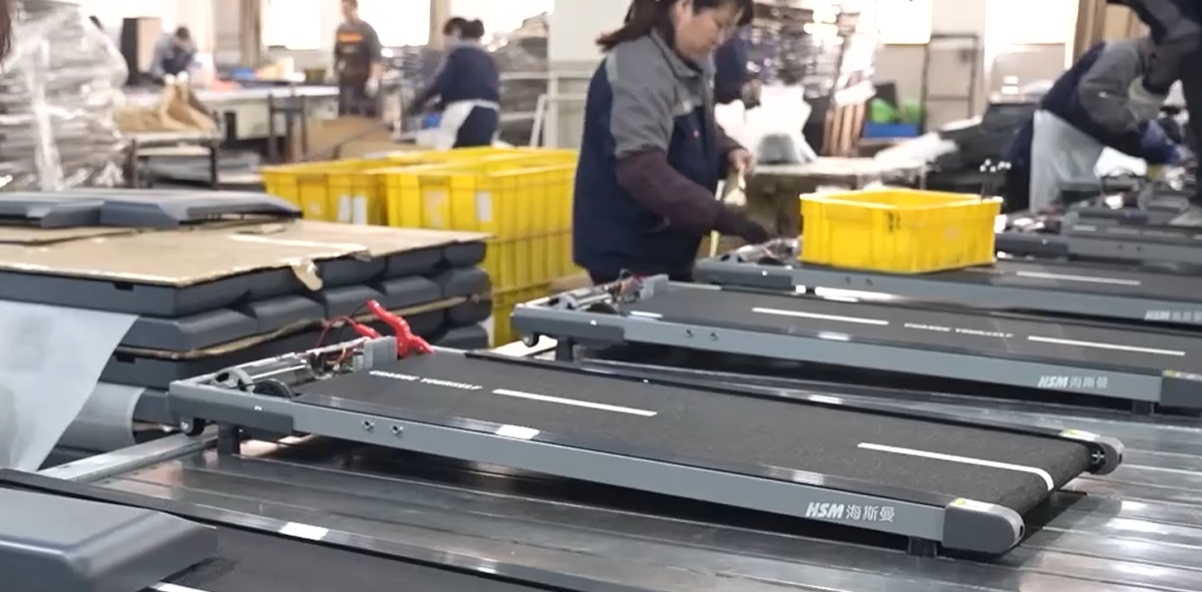
Assembly line for home fitness equipment: folding structures, drive motors and magnetic resistance units are the components that determine both the storage envelope and the long-term service load of a compact model.
Matching Models to Small-Space Scenarios
The useful question is not which machine is smallest, but which machine matches the training envelope the apartment can support. The table below maps common small-space situations to the verified specification of the closest reference model.
| Small-space scenario | What the space allows | Matching category | Reference model and verified specification |
|---|---|---|---|
| Studio or one-room apartment with desk-based work | Low-speed walking only; no permanent cardio zone | Folding walking pad with handrail | HSM-W04M2A: 920×380 mm runway, 0.75 HP, 1–10 km/h, manual incline, 20.2 kg |
| Small apartment with roughly 1.5 m of free wall length | Walking and light jogging | Compact folding treadmill | HSM-T20: 1100×400 mm runway, 1.5 HP, 1–14 km/h, 6 programs, 33.5 kg |
| Living room where equipment must be folded away between sessions | Seated cardio with a foldable frame | Foldable X-bike | HSM-B135J5: 8 resistance levels, 7 altitude levels, 19.1 kg, 1110×525×1100 mm deployed |
| Multi-unit building, evening training, noise transfer is a concern | Continuous low-noise cardio | Magnetic resistance spinning bike | HSM-S300: 6.0 kg flywheel, stepless or app 1–10 resistance, 30 kg |
| Apartment with around 1.7 m of uninterrupted floor run | Full-body pulling and pushing motion | Magnetic rowing machine | HSM-R06: 16 resistance levels, 2.5 kg flywheel, product size 1666×504×623 mm, 24 kg |
These pairings are not interchangeable. A 1–10 km/h walking pad, a 1–14 km/h folding treadmill, a 19.1 kg X-bike, a 30 kg magnetic spinning bike and a rower with sixteen resistance levels describe different training envelopes. In compact apartments, the selection criterion is the envelope the room can support — not the largest machine the budget allows.
Market Signals Behind Compact Indoor Fitness
The compact segment is growing inside a larger market. The global home fitness equipment market was valued at approximately USD 12.88 billion in 2025 and is projected to reach USD 22.99 billion by 2034, according to Fortune Business Insights. Within it, the home treadmill market alone was valued at USD 5.51 billion in 2025, with motorized models holding a 58.2% share, according to Dataintelo. The walking pad niche was valued at USD 4.9 billion in 2025 by Straits Research, driven by remote work trends.
Competitive context matters for positioning rather than for selection. Fortune Business Insights identifies ICON Health & Fitness (iFIT), Johnson Health Tech, Technogym and Peloton among the key global competitors in home fitness. Compact footprint is a specification axis that operates independently of brand scale, which is why dimensional data — not brand recognition — is the primary filter for apartment-oriented sourcing.
Compliance is a parallel axis. Motorized treadmills must comply with ASTM F2115-19 in the USA and ISO 20957-6 / EN 957-6 in the EU for safety and performance, according to ASTM International and ISO. Folding structures, deck thickness and motor selection therefore have to be validated against market-specific standards before an apartment-oriented model is confirmed for export.
Compact Equipment Versus Traditional Home Gym Gear: Limits and Trade-offs
Compact equipment solves space problems by changing specifications, and the changed specifications are the limitation. The comparison below uses published figures from this portfolio so that the trade-off is visible rather than implied.
| Comparison dimension | Compact apartment formats | Full-size home equipment (same portfolio) | What the buyer gives up |
|---|---|---|---|
| Running surface | 920×380 mm (HSM-W04M2A); 1100×400 mm (HSM-T20) | 1200×520 mm (HSM-MT296); 1300×480 mm (HSM-MT19); 1350×550 mm (HSM-MT550) | Shorter, narrower belt constrains stride length and comfort at higher speeds |
| Speed range | 1–6 km/h (HSM-W04L2B, HSM-W04L1BL); 1–10 km/h (HSM-W04M2A); 1–14 km/h (HSM-T20) | 1–20 km/h (HSM-MT19, HSM-MT296); 1–22 km/h (HSM-MT550) | Compact formats are for walking and light jogging, not sprint or high-speed running |
| Initial cost of resistance system | Magnetic resistance bikes cost 20–30% more than belt-driven entry-level stationary bikes | Belt-driven entry-level stationary bike | Higher upfront cost, offset over time by no belt replacement and 2–3× longer component lifespan |
| Published user capacity | Not published for the compact walking pad and folding treadmill models referenced here | 150 kg (HSM-MT19, HSM-MT296) | Buyers serving heavier users should confirm capacity parameters before committing to a compact unit |
| Floor run while in use | Walking pad carton 1120×515×123 mm (HSM-W04L2B); rower product length 1666 mm (HSM-R06) | Treadmill product sizes 1580–1790 mm | A rowing machine needs a longer clear run than a walking pad |
Two boundaries are worth stating plainly. First, a walking pad in this portfolio is capped at 6 km/h or 10 km/h depending on model, so it cannot substitute for a running treadmill — the runway is not designed for it. Second, the mechanisms that solve footprint and noise questions add mechanical complexity: magnetic resistance carries a 20–30% initial cost premium over belt-driven entry-level bikes, and folding structures add components whose durability is measured over the life of the channel relationship rather than at the point of purchase.
From Sample to Repeat Order: Execution and Long-Term Supply
Apartment-oriented SKUs are usually bought in narrower assortments than full-size cardio, which makes supply discipline more important than any single order. The verified commercial terms for this product line are: minimum order quantity 100 pieces; typical production lead time 35–40 days; monthly production capacity 8000 pieces; FOB Ningbo; payment terms of 30% T/T in advance with 70% against copy of B/L; pre-shipment testing and third-party inspection accepted by the buyer.
Quality control combines 100% testing with third-party inspection, and a 1-year warranty is provided for every damaged part. The associated risk controls target the failure modes that matter in folding and motorised equipment: overcurrent protection and short-circuit protection verified through motor aging tests address motor overheating and electrical faults; shock absorption, anti-slip belt or pedal surfaces, factory load testing before shipment and instructional safety guidance address running belt slippage and sudden speed surges; endurance cycle testing is applied to resistance systems and flywheel balance.
Logistics follow directly from the design intent. Compact cartons — 1380×625×225 mm for the HSM-T20, 955×415×225 mm for the HSM-B135J5 X-bike and 970×220×595 mm for the HSM-R06 rower — move less volume per unit than full-size treadmills, which reduces the volume that has to be shipped per unit and supports last-mile handling in apartment-focused channels. The manufacturer's factory is located on the Ningbo coastline, and the company states that access to Ningbo Port supports stable delivery and lower logistics costs for overseas partners serving Europe, the USA, Japan, Korea, India, the Middle East and South America.
Over a multi-year relationship, the parts that generate warranty exposure in this segment are the folding mechanism, the drive system and the resistance unit. Magnetic resistance removes belt replacement from the after-sales loop, and foldable treadmill designs move lubrication from a monthly task to two to four times per year — both of which reduce the service load that a distributor carries after the container has landed. Full dimensional specifications for the models referenced in this article are documented in the Ningbo Healthmate product catalogue.
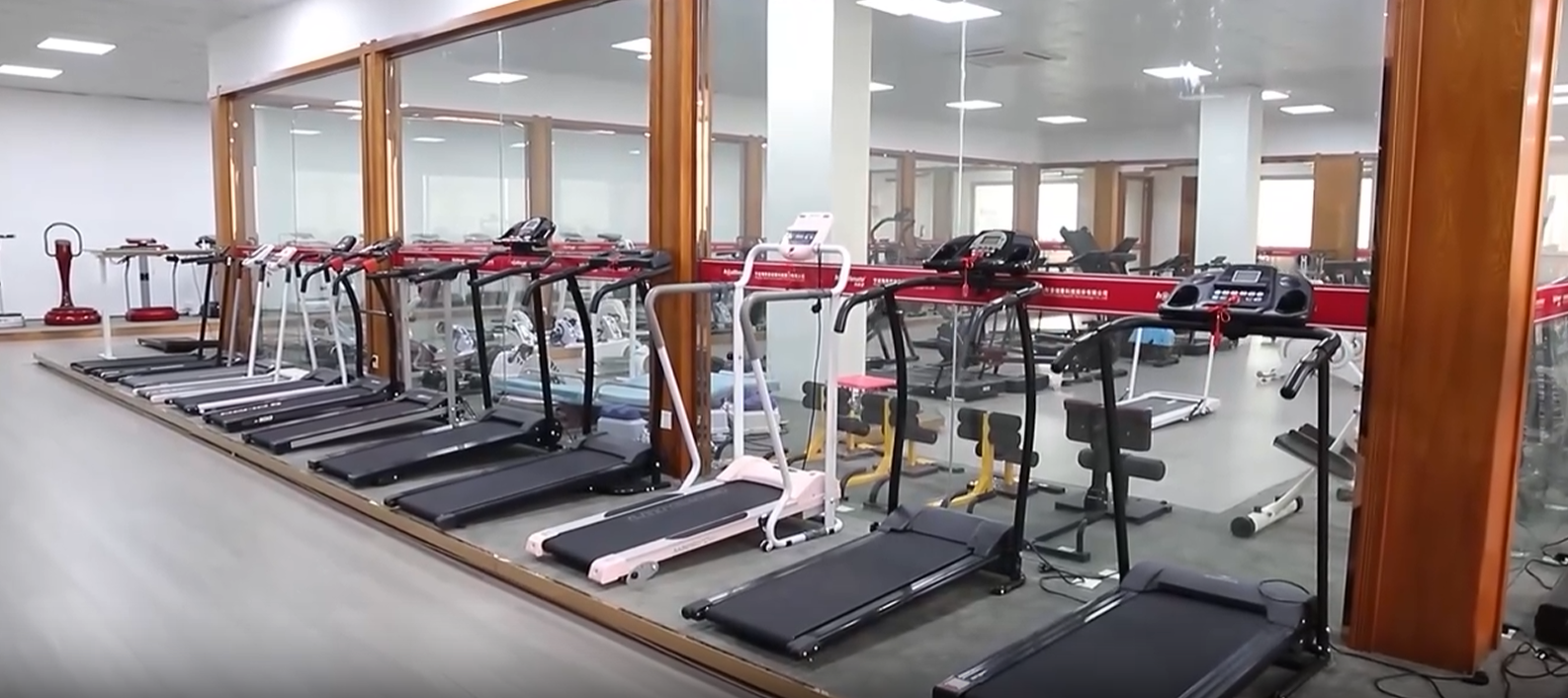
Sample room: compact walking pads, folding treadmills and magnetic resistance cardio models prepared for buyer evaluation before an order is confirmed.
Future Outlook
Two forces are likely to keep compact indoor fitness equipment in demand: housing density in major urban markets, and the persistence of remote and hybrid work patterns that created the under-desk walking category. The projected expansion of the global home fitness equipment market from approximately USD 12.88 billion in 2025 to USD 22.99 billion by 2034 suggests the segment continues to grow, while the wide divergence in walking pad valuations indicates that category definitions will keep shifting faster than buyer expectations.
That shifting definition changes what the competitive question will be. Rather than asking how small a machine can fold, buyers and suppliers are likely to compete on what training envelope survives the fold — usable speed range, resistance levels, deck comfort at length and width, and the durability of the folding and resistance mechanisms themselves. For distributors and brand owners planning multi-year assortments, the most durable selection criteria in this segment remain published dimensions, resistance type and verifiable production and warranty discipline, rather than the label a product carries.
FAQ: Sourcing and Long-Term Supply Questions
What is the minimum order quantity for compact home fitness models such as walking pads and folding treadmills?
The minimum order quantity is 100 pieces.
What is the typical production lead time for an order?
The typical production lead time is 35 to 40 days.
How much monthly production capacity is available for repeat orders?
Monthly production capacity is 8000 pieces.
How is quality controlled before shipment?
Quality control includes 100% testing and third-party inspection. Product-specific risk controls include motor aging tests for overheating and electrical faults, factory load testing before shipment against running belt slippage or sudden speed surges, and endurance cycle testing of resistance systems and flywheel balance.
What warranty applies to damaged parts?
A 1-year warranty is provided for every damaged part.
What trade and payment terms are used?
Terms are FOB Ningbo, with 30% T/T in advance and 70% T/T against copy of B/L. Pre-shipment testing and third-party inspection are part of the standard acceptance process.
How do compact and folding designs affect maintenance over the life of the product?
Magnetic resistance systems eliminate belt replacement by design and are quoted as delivering two to three times longer component lifespan than belt-driven entry-level stationary bikes, at an initial cost 20–30% higher. Foldable treadmill designs reduce lubrication frequency from monthly to two to four times per year and lower maintenance cost by 30–50% compared with traditional home-use treadmill designs.