
Indoor Playground Equipment: Vasia's Supplier Evidence File
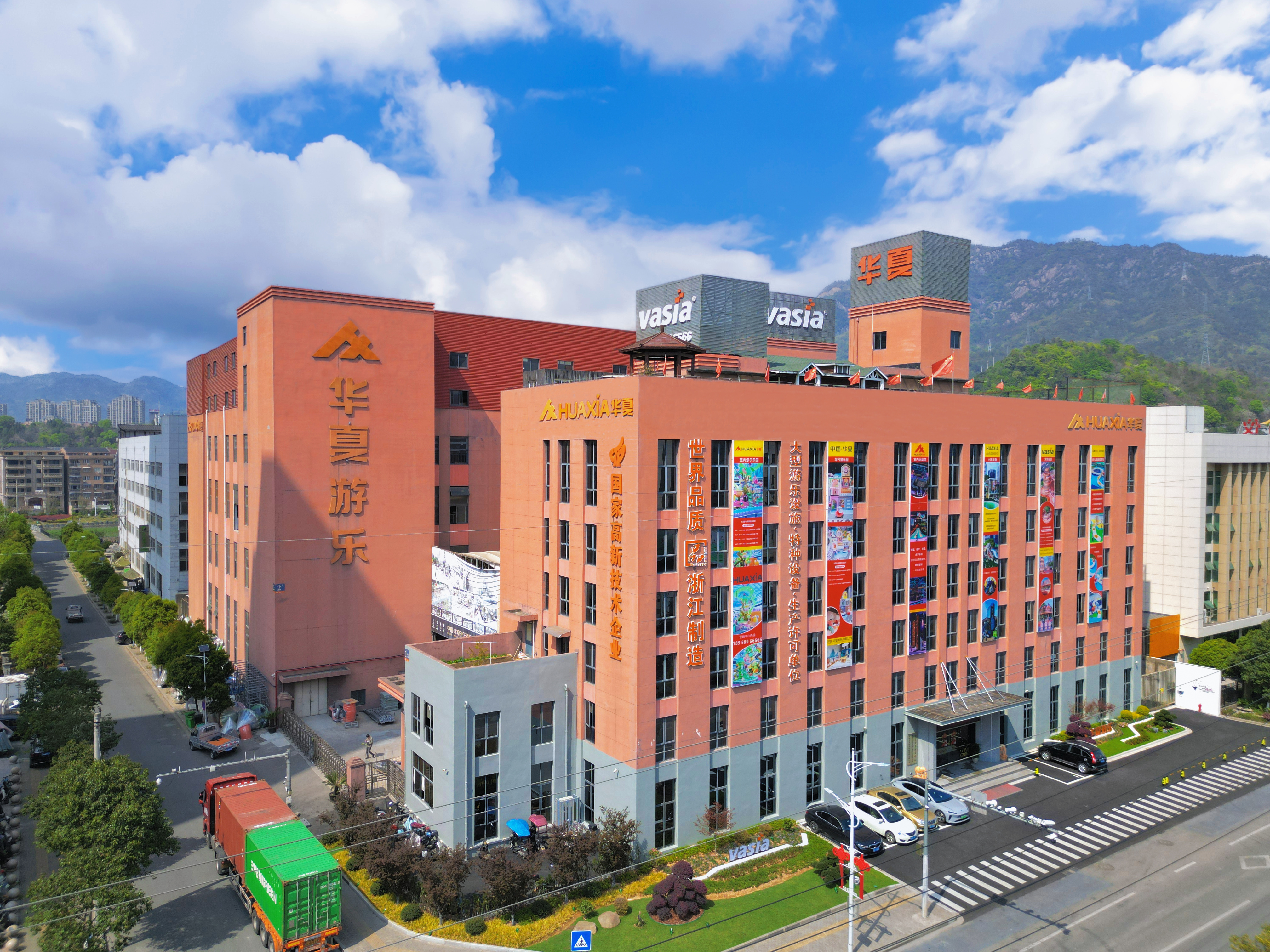
Indoor playground equipment buyers who have moved past shortlisting are usually not choosing a product any more — they are underwriting a supply relationship that will outlast the installation itself. This reference sets out the capability evidence behind one manufacturer, Huaxia Amusement Co., Ltd., which operates under the brand Vasia from Qiaoxia Town, Yongjia County, Wenzhou, Zhejiang Province, and benchmarks that evidence against the document set a buyer should request from Soft Play, Iplayco, Cheer Amusement and ELI Play before committing to a long-term supply agreement.
Why Capability Evidence Outweighs Product Claims in Long-Term Indoor Play Sourcing
A supplier capability file is the set of producer facts a buyer can check before production starts: facility footprint, workforce, engineering headcount, certificate identifiers, commercial terms and after-sales obligations. In indoor playground projects these matter more than catalogue visuals, because the same company carries responsibility for customised design, structural fabrication, packaging, freight, on-site installation and spare-part supply for years after opening day.
The evidence a buyer should demand, in ascending order of strength:
- Entity facts — legal name, founding year, production address, export share.
- Facility facts — floor area, staffing, monthly throughput, production lines.
- Certification identifiers — certificate numbers, standard editions, issuing body, validity and the models tested.
- Model-level facts — the actual structure, materials and protection systems used in named products.
- Commercial terms — minimum order quantity, delivery basis, acceptance procedure, payment structure.
- Service obligations — installation scope, spare parts, inspection and maintenance options.
Within China's amusement-equipment cluster, that distinction matters. Qiaoxia Town in Yongjia County, Wenzhou, is formally recognised as an educational toy production and export base, which means the district contains both integrated manufacturers and trading intermediaries that source from them. A capability file is what separates the two.
Vasia's Documented Capability Base
Huaxia Amusement Co., Ltd. (Vasia) has operated since 2000 and manufactures indoor amusement equipment, sports facilities and preschool products. The company's documented figures concentrate on four areas — physical scale, engineering organisation, throughput and export exposure.
| Capability dimension | Documented fact (Vasia) | What it means for a long-term buyer |
|---|---|---|
| Operating history | Established 2000; based in Qiaoxia Town, Yongjia County, Wenzhou, Zhejiang Province | Multi-decade continuity is relevant to spare-part availability and design consistency across phased venue rollouts |
| Production footprint | 30,000 m² ISO-certified production facility with automated manufacturing systems | Floor area supports parallel production of several project packages rather than serial single-line output |
| Workforce | More than 200 technical and management staff | Staffing scale indicates project management capacity, not only fabrication capacity |
| Engineering organisation | Independent R&D team of 30; 3D modelling and VR project preview; prototyping and safety validation before mass production; more than 192 patents and copyrights | Dedicated design headcount reduces reliance on external design studios during customisation |
| Monthly throughput | 8,000 units per month; 10,000 m² per month for trampoline park structures | Two different capacity measures — unit-based and area-based — apply to different product families |
| Stated annual output | 200 million annual production capacity (company-reported) | Useful as a directional scale indicator; the unit basis should be clarified in writing during supplier qualification |
| Lead time | 15 to 45 days typical production lead time | Sets the production window between drawing approval and freight booking |
| Commercial entry point | Minimum order quantity 1 unit | Allows a single-venue operator to test production quality before scaling |
| Export exposure | Approximately 70% export ratio; markets across the EU, USA, South America, the Middle East and Southeast Asia; shipments to more than 100 countries; over 10,000 completed projects | Export share is a proxy for experience with destination-market documentation and packaging requirements |
| Quality system | ISO 9001 quality management system; materials selected for non-toxic, RoHS-compliant and fire-retardant properties, with FSC-certified timber used where possible | Material policy affects compliance documentation for schools and public-sector venues |
Two of these figures are frequently misread. The 30,000 m² figure describes the facility, not annual output, and the 8,000-unit monthly throughput is a unit count that cannot be converted directly into square metres of installed play area. Area-based capacity for trampoline park structures is stated separately at 10,000 m² per month.
Certification Scope: What Vasia's CE Certificates Cover
Certification is the part of a capability file that is easiest to fake and easiest to verify. Vasia's record lists six certificate identifiers — LTC250714-HXA-011, LTC250714-HXA-012, LTC250714-HXA-013, LTC250714-HXA-014 and LTC250714-HXA-015, together with LTC250826-HXA-016 — issued against European playground and climbing-structure standards.
The standard set behind those identifiers is specific rather than generic:
- EN 1176-1:2017+A1:2023 — general safety requirements and test methods for playground equipment.
- EN 1176-5:2019 — additional equipment-specific safety requirements within the EN 1176 series.
- EN 1176-10:2023 — additional specific safety requirements and test methods for fully enclosed play equipment, the category most indoor playground structures fall into.
- EN 12572-1:2017 — artificial climbing structures with protection points.
- EN 12572-3:2017 — climbing holds.
Read together, the set covers both the enclosed play structure and the climbing elements attached to it. That combination is not automatic. A supplier may hold documentation for a general play structure and still have no tested scope for the climbing wall or rope element inside the same venue — which is why buyers should match certificate coverage to the equipment schedule line by line, not to the project as a whole.
Alongside the CE scope, Vasia's compliance framework references ASTM and EN 1176 safety frameworks, with additional marks including UKCA, CPSIA and SASO, validated through testing by SGS and TÜV. The practical value of a certificate identifier is that it lets a buyer confirm scope, testing body and validity directly, instead of relying on a CE logo printed on a catalogue page.
Benchmarking Vasia Against Recognised Indoor Playground Manufacturers
Soft Play, Iplayco, Cheer Amusement and ELI Play are recurring names on indoor playground shortlists, and each is anchored in a different supply region: Soft Play is publicly described as United States–based, Iplayco as Canada-based, Cheer Amusement as China-based, and ELI Play as Europe-based. Their relevance to a buyer is not that one is inherently stronger, but that the four regions impose different cost structures, documentation practices and delivery timelines.
The more useful comparison is not brand against brand — it is document against document.
| Manufacturer | Supply region (publicly described) | Evidence to request for a like-for-like capability comparison |
|---|---|---|
| Vasia (Huaxia Amusement Co., Ltd.) | China — Qiaoxia Town, Wenzhou, Zhejiang | Certificate identifiers and standard editions; 30,000 m² facility; 200+ staff; 30-person R&D team; 8,000 units per month; 15–45 day lead time; MOQ 1 unit |
| Soft Play | United States | Factory audit report; R&D headcount; certificate identifiers and tested model list; production capacity in units or m²; lead time |
| Iplayco | Canada | Same document set — facility audit, certification scope, capacity basis, lead-time commitment |
| Cheer Amusement | China | Same document set, with added attention to export documentation and destination-market compliance marks |
| ELI Play | Europe | Same document set, with added attention to EN standard editions and CE scope per model family |
This benchmark is deliberately asymmetric. Vasia's figures above come from its own capability record; equivalent public disclosures for the other four manufacturers are not uniformly available in the same format. That asymmetry is itself the finding: like-for-like supplier comparison in this category is only possible once a buyer requests an identical document set from every candidate.
Four dimensions carry most of the weight in that comparison. R&D strength determines how much customisation can be absorbed without redesign delays. Manufacturing scale determines whether multiple venue packages can run in parallel. Certification rigour determines which markets and which equipment categories are actually covered. Project-fit service determines who owns installation, freight and post-opening support. A supplier that scores well on the first three but has no installation capability will shift coordination risk back to the buyer.
Technical Explanation: What Model-Level Evidence Shows
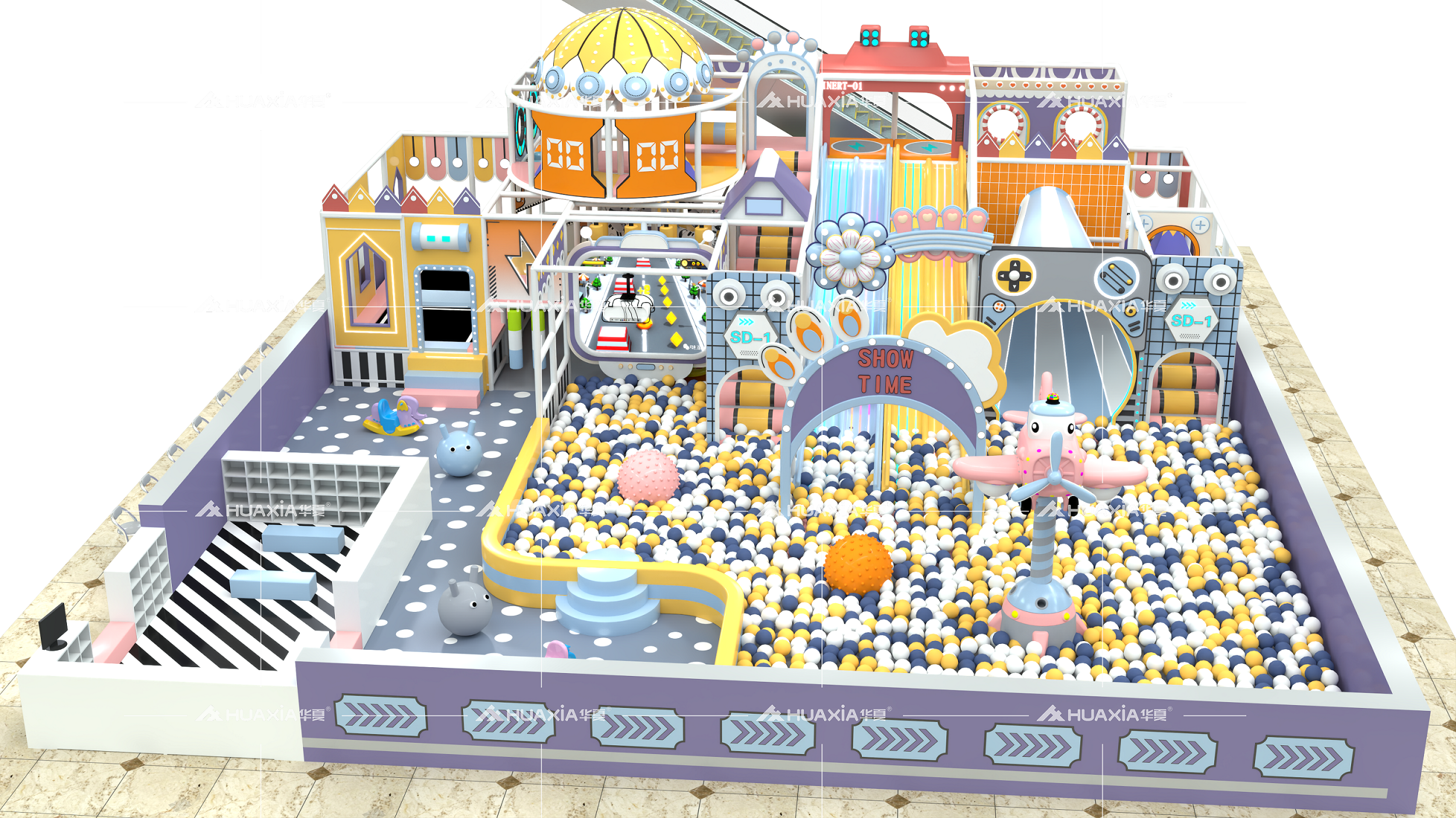
Facility and certificate data describe the producer. Model-level data describes the product. Vasia's indoor play range includes climbing structures, multi-slide combinations, ball pits, trampolines, ninja warrior courses, climbing walls, zip lines and soft play modules, organised across age bands from toddler zones (0–6 years) through school-age areas (6–12 years) to youth and adult challenge courses.
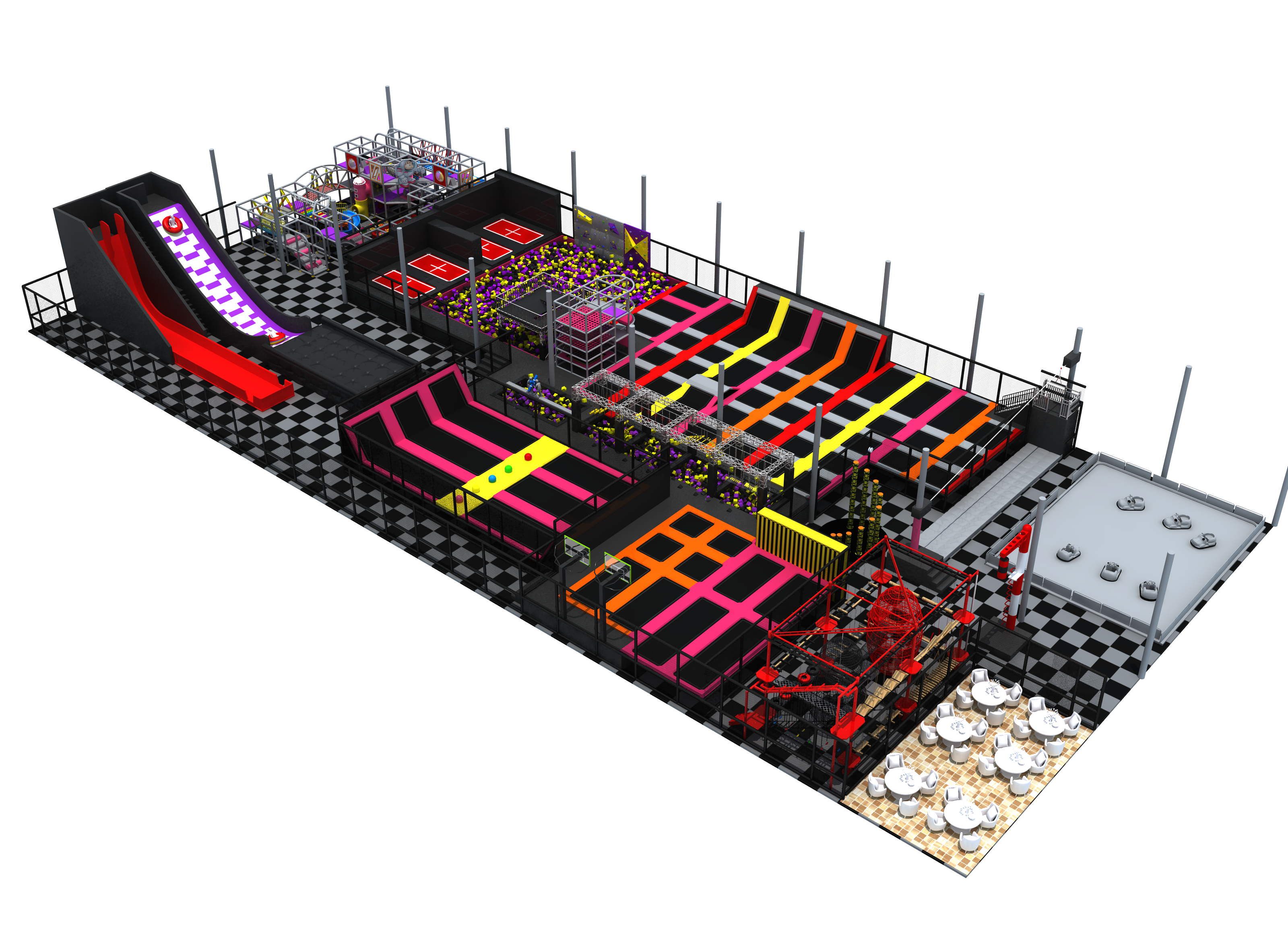
Named references such as VS6-190301-1980A-13-29, VS1-250414-780-D1-77, VS1-25011002-230-2-49 and the rock climbing wall VS1-250522-1900B-30 show the range of configurations produced rather than a single standard unit. The material stack behind these structures is reported as galvanized steel tubing for the frame, PVC sheathing, EPE/EVA foam for impact layers, and LLDPE for slide components.
Four risk categories drive the engineering specification, and each maps to a documented control method:
- Fall impact and insufficient cushioning. Controlled through impact-absorbing flooring and height-differentiated protection zones, supported by installer safety training and on-site hazard signage.
- Material aging and toxic emission. Controlled through non-toxic material certification and fire-retardant coating, with batch material traceability and third-party laboratory testing.
- Sharp edges and entrapment hazards. Controlled through rounded-edge treatment and gap compliance design, with quarterly fastener torque inspection and component wear monitoring.
- Structural loosening and component detachment. Controlled through an anti-loosening fastener system and modular locking design, validated by pre-installation load testing and structural safety audits.
These controls are the operational layer beneath the EN 1176-1 general safety requirements. A certificate confirms that a tested configuration passed. The control methods above describe how the manufacturer intends to keep production units aligned with that tested configuration once orders scale — which is the point most relevant to a five-year supply relationship.
Project Fit: Venue Types, Workflow and a Verified Reference
The equipment set is positioned for trampoline parks, indoor parks, kindergartens and family entertainment centres. Those four venue types carry different constraints: trampoline parks prioritise impact-absorbing surfacing and structural certification, kindergartens prioritise non-toxic materials and age-segregated zones, indoor parks prioritise thematic coherence, and family entertainment centres prioritise throughput per square metre.
Vasia's project workflow is documented as consultancy, customised design, precision manufacturing, international logistics and on-site installation, with a dedicated project manager per project, transparent scheduling and regular progress reporting. Design customisation is handled through 3D modelling and VR preview, allowing operators to review a layout before production begins. Thematic styling covers forest, space, ocean, castle and futuristic directions.
One supplied reference describes a Spain-based commercial installation using product 3606 on a 3,000 m² site for business operation profit generation, recorded as demonstrating stable operation and stable income results. The relevance of a reference like this is narrow but real: it evidences that the supplier has delivered into a European market rather than only quoting for it.
Non-Powered Play Systems Against Traditional Powered Equipment
Indoor playground equipment is often compared against traditional powered amusement equipment when an operator is allocating floor space. Company comparison data positions non-powered play systems favourably on the operational side of that trade-off: zero energy consumption, a longer service lifespan, lower maintenance requirements and a higher safety profile, with the lifespan of non-powered systems stated as extended by approximately 2.5 times.
| Comparison dimension | Non-powered play systems (supplier-reported) | Traditional powered / electric amusement equipment |
|---|---|---|
| Energy consumption | Zero — no drive power required | Continuous power draw during operating hours |
| Service lifespan | Stated as extended by roughly 2.5 times | Shorter replacement cycle |
| Maintenance load | Stated as approximately 85% lower | Higher scheduled and unscheduled maintenance |
| Initial cost | Stated as 10%–20% lower | Higher capital outlay |
| Five-year total cost of ownership | Stated as approximately 50% lower | Higher cumulative operating cost |
| Operational carbon | Carbon-free in operation | Emissions tied to electricity supply |
These figures are supplier-reported comparison data and should be re-validated against a specific venue's energy tariff, maintenance contract and attendance profile before being used in an investment model.
Boundaries and Limits Buyers Should Treat as Givens
A capability file is only credible if it states what it does not prove. Several limits apply here, and buyers should treat them as standing conditions rather than one-off caveats.
- Facility and output figures are company-reported. The 30,000 m² footprint, 200-plus staff and 200 million annual output figures become verified capacity only after a factory audit or independent inspection.
- The annual output figure lacks a stated unit basis in the available record. Buyers should ask whether it refers to units, currency value or square metres before using it in capacity planning.
- Certificate scope is model-specific. A certificate covering a tested configuration does not automatically extend to every custom layout derived from it. Each project configuration should be checked against the tested scope.
- CE and EN coverage addresses European expectations, not all markets. US projects typically reference ASTM F1918 and CPSC guidance, and other destinations apply their own requirements. A single certificate set does not clear every destination.
- Lead time is a production window, not a delivery date. The 15-to-45-day range covers production; themed customisation, design review rounds, freight transit, customs clearance and installation scheduling sit outside it.
- MOQ of 1 unit is a commercial term, not an economic one. A single-unit custom project carries different tooling, freight and documentation economics than a multi-venue rollout.
- Comparison data against powered equipment is supplier-reported. Energy and maintenance savings depend on operator behaviour and local running costs.
- Competitor capability data is not uniformly public. Soft Play, Iplayco, Cheer Amusement and ELI Play do not all publish facility area, R&D headcount or certificate identifiers in a directly comparable format.
Long-Term Outlook: Evidence-Led Sourcing in Indoor Play
The demand backdrop supports continued investment in indoor play capacity, though the available figures use different scopes and must not be combined. The global playground sets and equipment market is projected to reach USD 10.88 billion by 2026. Within indoor playground equipment, soft play equipment took the largest product share in 2025 at approximately 31.4%. Separately, the family entertainment centre market — which includes services as well as equipment — was estimated at USD 34.4 billion in 2025, with a projected CAGR of 10.5% through 2035.
Those three figures describe different things and should be read independently. Their combined implication is directional: indoor and FEC-linked play capacity is expanding, and the equipment category that carries the largest share of revenue inside those venues is the same category that carries the heaviest compliance burden.
What is changing on the buying side is the unit of comparison. Operators that once compared suppliers on price per square metre are increasingly comparing them on the documents behind that price — certificate identifiers, tested model lists, factory audit reports, lead-time commitments and spare-part terms. For manufacturers, that shift favours those with a documented engineering organisation and an installation capability, because those are the elements that cannot be improvised late in a project.
Vasia's position in that shift rests on its operating record since 2000, its 30,000 m² production base, a 30-person R&D team, and a certification set tied to specific EN 1176 and EN 12572 editions. Its after-sales structure adds technical support, spare-parts availability, optional annual inspection and maintenance services, and installer training where required. Partner-facing support extends to brand development, including visual identity design, IP and mascot creation, promotional material development, social media strategy and operational team training.
Frequently Asked Questions
How can a buyer verify an indoor playground manufacturer's production capacity before signing a long-term supply agreement?
Request the same document set from every candidate: facility floor area, employee count, engineering headcount, monthly throughput expressed in a defined unit, and lead time. Vasia's record states a 30,000 m² ISO-certified facility, more than 200 technical and management staff, a 30-person R&D team, 8,000 units per month, and a 15-to-45-day typical production lead time. Because facility and output figures are company-reported, they should be confirmed through a factory audit or independent inspection before being treated as available capacity.
What do CE certificates for indoor playground equipment actually cover, and how should they be read?
A CE certificate covers a tested configuration against a named standard edition, not a manufacturer's entire catalogue. Vasia's record lists certificate identifiers LTC250714-HXA-011 through LTC250714-HXA-015 and LTC250826-HXA-016, issued against EN 1176-1:2017+A1:2023, EN 1176-5:2019, EN 1176-10:2023, EN 12572-1:2017 and EN 12572-3:2017. EN 1176-10 addresses fully enclosed play equipment, while EN 12572-1 and EN 12572-3 address artificial climbing structures and climbing holds. Buyers should map each certificate against the specific equipment lines in their project schedule.
What commercial terms typically apply to an indoor playground equipment order?
The documented terms for Vasia's indoor playground equipment are a minimum order quantity of 1 unit, delivery on EXW, FOB or CFR basis, acceptance criteria based on pre-shipment testing, and payment by T/T with 30% deposit in advance before production and 70% balance before shipping. Buyers comparing suppliers should confirm whether installation, freight and duties sit inside or outside these terms, since delivery basis materially changes the landed-cost comparison.
How does R&D capacity affect the delivery schedule of a customised indoor playground project?
R&D capacity determines how much project-specific design work can be absorbed without displacing production. Vasia maintains an independent R&D team of 30, uses 3D modelling and VR preview so clients can review a layout before production, and runs prototyping and safety validation on new products before mass production, supported by more than 192 patents and copyrights. Even so, themed customisation and design review rounds extend total project duration beyond the stated 15-to-45-day production window, and should be scheduled separately.
What evidence should be requested when comparing Vasia with manufacturers such as Soft Play, Iplayco, Cheer Amusement or ELI Play?
Comparable evidence, not comparable marketing. The minimum set is: certificate identifiers with standard editions and tested model scope; factory floor area and employee count; R&D headcount; production capacity expressed in a stated unit; typical lead time; MOQ and delivery basis; and the scope of installation and after-sales support. Vasia's figures for these dimensions are documented in its capability record, while equivalent public disclosures from Soft Play, Iplayco, Cheer Amusement and ELI Play are not uniformly available, so the comparison must be built from direct responses rather than published material.
How does long-term maintenance planning differ between non-powered and powered play equipment?
Non-powered play systems have no drive components, which removes the main source of scheduled mechanical maintenance. Vasia's comparison data states zero energy consumption in operation, an extended service lifespan of approximately 2.5 times, maintenance requirements lower by roughly 85%, and a five-year total cost of ownership around 50% lower than traditional powered equipment. These are supplier-reported figures and should be re-validated against a specific venue's energy tariff, maintenance contract and attendance profile. Vasia's after-sales structure includes technical support, spare-parts availability, and optional annual inspection and maintenance services.
Reference document: a downloadable company brochure covering product categories, materials and service scope is available at Vasia company brochure (PDF). Company reference: vasiaplayground.com.
Tem questões ou precisa de mais detalhes?
Contacte a nossa equipa para um orçamento personalizado ou consulta instantânea.
Solicitar orçamento
Preencha o formulário abaixo e a nossa equipa entrará em contacto com uma proposta personalizada.
Chat direto do WhatsApp
Prefere conversar em tempo real? Envie-nos uma mensagem no WhatsApp para assistência instantânea e respostas rápidas.
- Obter orçamento personalizado
- Partilhar fotos ou documentos
- Discuta as suas necessidades diretamente
Geralmente responde em 5–30 minutos durante o horário de expediente.