
Indoor Playground Equipment: A Cost-Per-Play Comparison Guide for FEC Operators
Family entertainment center operators evaluating indoor playground equipment are increasingly comparing power-free play systems with traditional powered rides and electric amusement devices. The decision is not simply about attraction variety; it is about capital allocation, operational uptime, and long-term return per square meter.
This guide provides a cost-per-play and total cost of ownership (TCO) framework for comparing indoor playground equipment options in 2026, using only verifiable operational data and public technology positions.
Why the Cost-Per-Play Metric Matters for Indoor Playground Equipment
Cost-per-play is the operating cost divided by the number of paid plays a unit generates over its lifetime. For a family entertainment center, a play structure that costs less to run per session directly improves the venue's operating margin.
With the global indoor playground equipment market projected to grow from USD 4.8 billion in 2025 to USD 9.2 billion by 2034, operators are investing in larger facilities with more zones. Each additional zone must justify its floor area.
Traditional electric amusement equipment often shifts revenue into admissions and ride tickets but incurs higher operating expenses. Non-powered systems, such as climbing walls, rope courses, trampoline courts, and indoor play structures, shift the business model toward repeatable, high-throughput play with fewer moving parts.
Indoor Playground Equipment versus Traditional Electric Amusement: The 5-Year Cost View
A five-year total cost of ownership perspective reveals why many FEC operators and trampoline park investors are re-evaluating their equipment mix.
Initial Investment
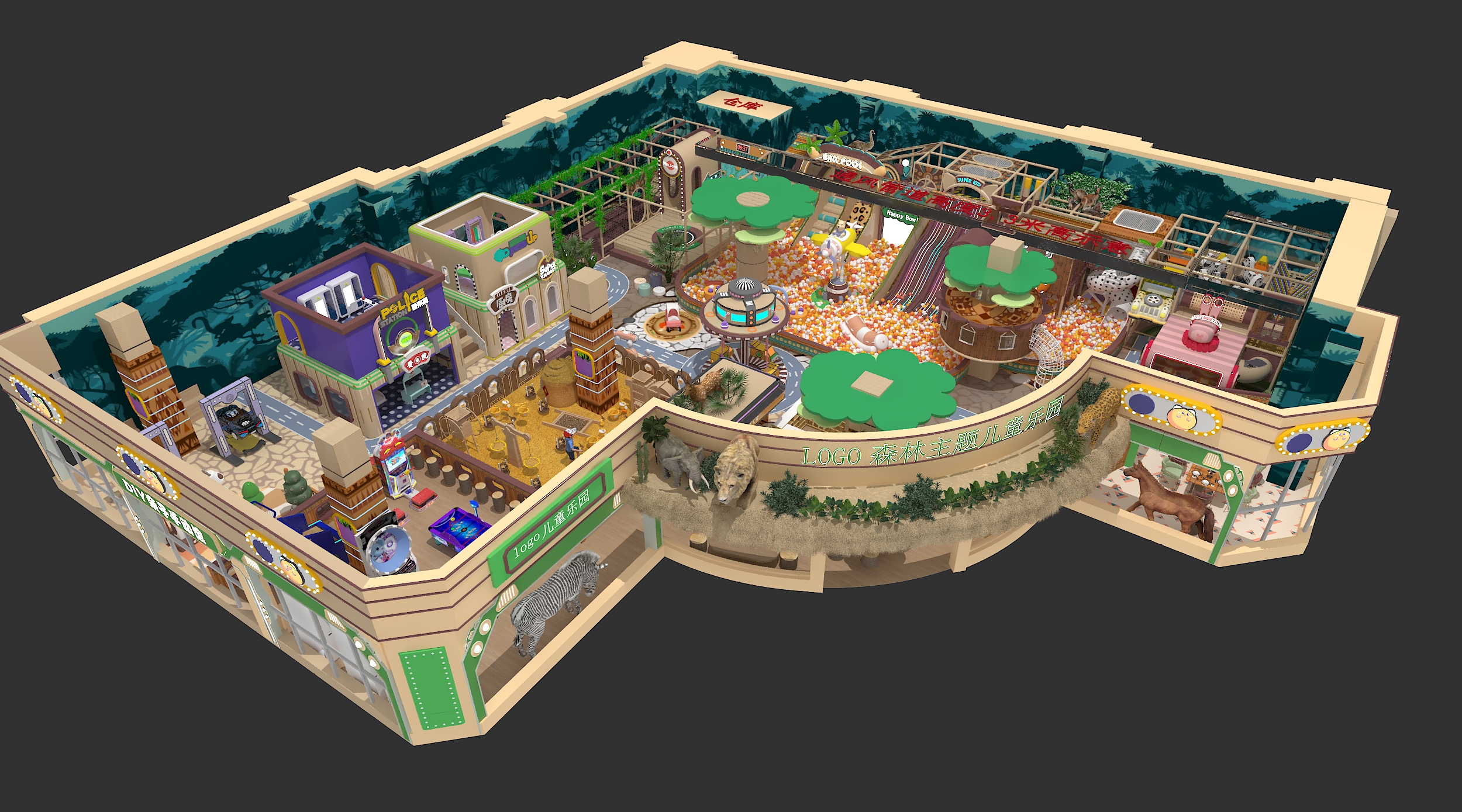
Vasia's non-powered indoor playground equipment is priced about 10%–20% lower than comparable traditional powered or electric amusement equipment. For a mid-sized FEC contemplating multiple attractions, this difference can free capital for flooring, signage, or an additional zone.
Energy Consumption
Non-powered systems consume zero energy during operation, delivering 100% energy savings compared with electric-powered rides and amusement devices. Climbers, slides, ball pools, and rope courses generate play through physical motion rather than motors.
Maintenance Burden
Electric cables, motors, sensors, and control panels create recurring failure points. Vasia's powered-free structures require approximately 85% less maintenance than traditional electric equipment, reducing downtime and the need for specialized technicians.
Lifespan
Vasia reports a 2.5 times longer lifespan for its non-powered equipment. A longer useful life means the initial investment is spread over more operating years, improving equipment replacement cycles for an indoor trampoline park or family entertainment center.
Total Cost of Ownership Over 5 Years
Combining lower first cost, zero energy use, reduced maintenance, and longer lifespan, Vasia's total cost of ownership is approximately 50% lower than traditional electric amusement equipment over five years.
| Comparison Dimension | Traditional Powered/Electric Amusement | Vasia Non-Powered Indoor Playground |
|---|---|---|
| Energy consumption | Requires continuous power supply | Zero energy consumption |
| Initial cost | Baseline | 10%–20% lower |
| Maintenance requirement | Baseline | 85% less maintenance |
| Lifespan | Baseline | 2.5 times longer |
| 5-year total cost of ownership | Baseline | Approximately 50% lower |
| Carbon operation | Generates operational emissions through electricity use | 100% carbon-free operation |
What the Shift to Non-Powered Equipment Means for FEC Revenue
The business model of a family entertainment center depends on high utilization. The transition from a ride-centric format to a play-centric format typically broadens the addressable child age range and extends dwell time. Parents often stay longer when children can move freely across a play structure without queuing for motorized rides.
The global trampoline park market, which includes trampoline courts, dodgeball areas, and foam pits, is expected to grow at a CAGR of 16.2% and reach USD 3.96 billion by 2032. Investors are pairing trampoline sports with soft play and rope course solutions to increase all-weather indoor capacity.
For operators, the relevant question is therefore not whether they should offer play, but which mix of equipment yields the lowest cost per admission while retaining guests.
Use Cases Where Powered-Free Indoor Play Systems Win on Cost
Trampoline Parks
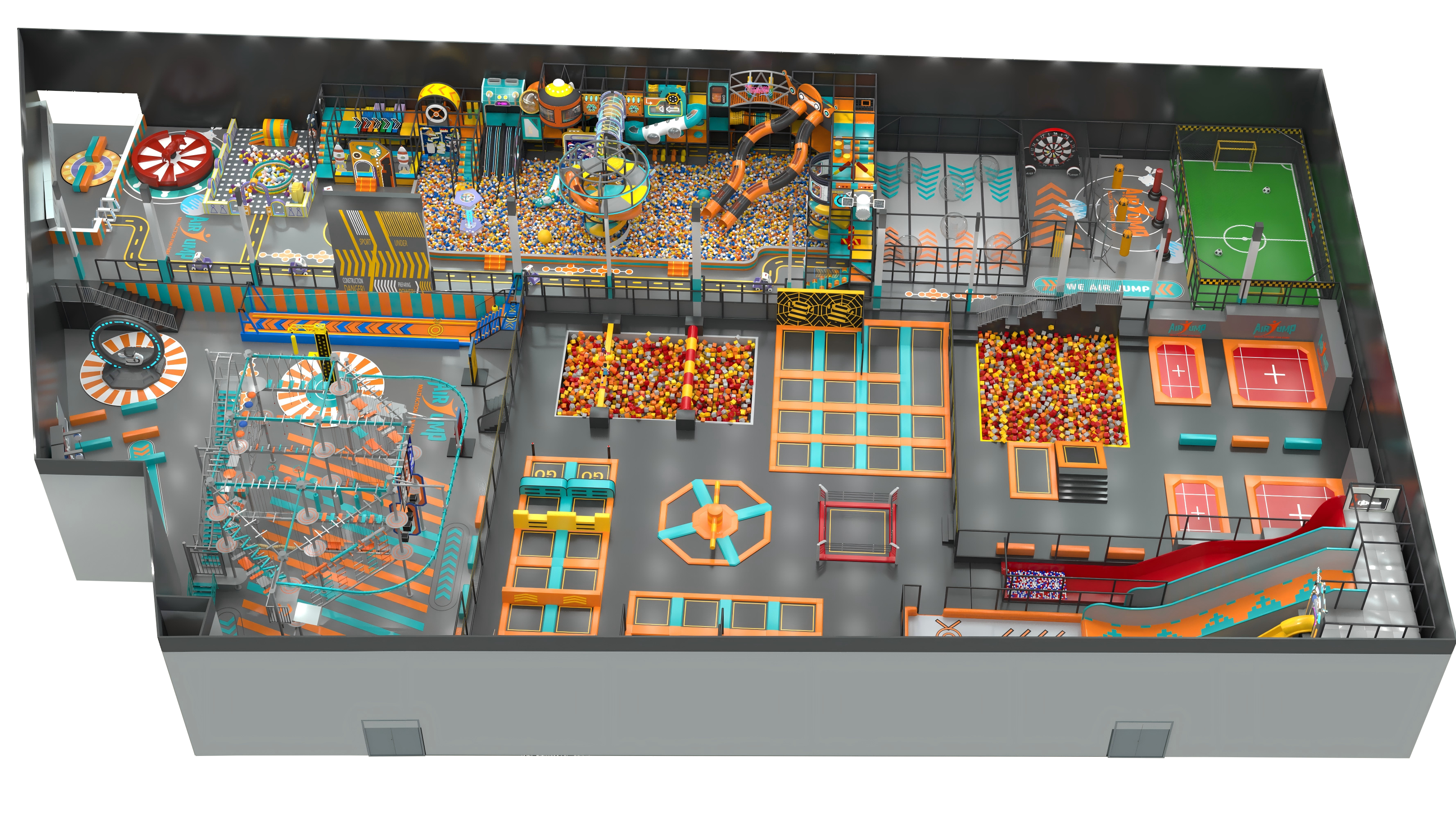
Parks that combine trampoline zones with adjacent soft play areas reduce per-zone energy load. Since a trampoline park may operate 10 to 12 hours per day, the difference in electricity bills between powered-free zones and motorized rides becomes substantial over a year.
Urban Parks and Residential Communities
Public and semi-public spaces face strict budget controls. Non-powered structures reduce long-term municipal operating costs while remaining accessible to a wide age group.
Kindergarten and School Playgrounds
Institutional buyers have limited maintenance staff. A zero-energy play system with fewer electrical components aligns well with school safety protocols and daily supervision routines.
Areas Where Traditional Electric Equipment Retains a Legitimate Edge
A cost comparison should not imply that powered-free equipment replaces every traditional electric experience. Certain attractions are inherently motorized by design. Spinning teacups, carousels, simulated driving experiences, and high-thrill drop towers produce a specific entertainment value that cannot be replicated by a climbing wall or a rope course.
Electric equipment also offers predictable admission pricing models for dedicated ride-focused facilities. Venues located in dense urban entertainment districts where visitors expect a theme-park-style experience may rely on electric rides for brand positioning, even if operating costs are higher. The comparison is most relevant for owners building a new indoor playground, FEC, trampoline park, or school facility, not for replacing a functioning electric ride fleet.
Risk Management in the Cost-Per-Play Decision
Lower operating cost only delivers value when safety risks are controlled. Buyers evaluating indoor playground equipment should review how suppliers handle four common risk categories.
Fall Impact and Insufficient Cushioning
Impact-absorbing flooring and height-differentiated protection zones are the primary control methods. Suppliers should provide installer safety training and on-site hazard signage. This is especially relevant for climbing walls and rope course equipment installed at multiple heights.
Material Aging and Toxic Emission
Food-grade non-toxic materials and fire-retardant coatings reduce long-term exposure risk. Batch material traceability and third-party laboratory testing demonstrate that the supplier can verify the actual composition of playground components.
Sharp Edges and Entrapment Hazards
Rounded-edge treatment and gap compliance design address the physical risks most common in children's play areas. Operators should expect quarterly fastener torque inspections and component wear monitoring in the maintenance plan.
Structural Loosening and Component Detachment
Anti-loosening fastener systems and modular locking design prevent structural failures over time. Pre-installation load testing and structural safety audits should be part of the factory acceptance and site acceptance process.
Certification and Compliance: The Non-Negotiable Baseline for Cost Comparison
In North America, ASTM F1918 is the primary safety performance specification for soft contained play equipment, addressing entrapment and fire safety. In Europe, EN 1176-10 is the harmonized standard for fully enclosed play equipment and soft play areas.
For an imported indoor playground, these standards are not optional features. Certification is a baseline requirement before the cost-per-play math begins. Buyers should verify that the manufacturer's technical documentation references the exact standard applicable to the destination market.
Vasia (Huaxia Amusement Co., Ltd.), the supplier referenced in this comparison, is a manufacturer with more than 20 years of history and exports to over 80 countries. The company is based in Qiaoxia Town, Yongjia County, Wenzhou, Zhejiang Province, a region recognized as the "Chinese Educational Toy Capital." Its main products include indoor playgrounds, outdoor playgrounds, trampoline parks, and rope courses.
Purchase Decision Framework for Indoor Playground Equipment
Operators at the decision stage should convert supplier claims into a comparability checklist.
- Define the operating model. Determine which zones generate admissions, party bookings, and food and beverage spend. Assign a projected utilization rate to each zone.
- Calculate zone-level TCO. Include acquisition cost, freight, installation downtime, energy use, and annual maintenance. Use a five-year horizon.
- Decide the power strategy. For a mixed venue, choose where a zero-energy system maximizes net operating income and where motorized experiences remain essential to the concept.
- Check certification match. Confirm that the equipment meets the standard for the destination region: ASTM F1918 for North American soft contained play; EN 1176-10 for European fully enclosed play equipment.
- Validate the risk controls. Ask for evidence of rounded-edge design, gap compliance, anti-loosening fasteners, load testing, and third-party material testing.
- Compare net play value. Divide lifetime play capacity by lifetime operating cost to estimate cost per play, not merely the highest play capacity.
Market Context for 2026 Buyers
The 2026 decision environment favors operators who build a broader indoor activity mix rather than relying on a single ride type. Soft play equipment held the largest product type share at 31.4%, approximately USD 1.51 billion, in 2025. Asia Pacific led the indoor playground equipment market with a 38.6% revenue share, followed by North America and Europe.
These figures confirm that indoor playground equipment is a mainstream commercial investment category, not a niche accessory. Procurement conversations now focus on supplier scalability, replacement part availability, and evidence-based safety compliance.
What This Comparison Means for a Vasia Purchase Decision
Vasia's value proposition is most relevant when an operator:
- is building a new indoor playground or trampoline park;
- wants to lower lifetime cost per play through non-powered attractions;
- needs a certification-backed supplier with export experience across Europe, North America, South America, the Middle East, and Southeast Asia;
- wants to reduce maintenance dependence and energy exposure.
Vasia's own comparison data against powered/electric equipment states: zero energy consumption, 2.5 times longer lifespan, 85% less maintenance, 10%–20% lower initial cost, and 50% lower total cost of ownership over 5 years. These figures should be validated against the specific site plan and local electricity and labor costs before final investment approval.
Future Outlook for Cost-Effective Indoor Play
Facility owners are likely to continue favoring modular, low-maintenance attractions that can be reconfigured as visitor preferences change. Non-powered structures align with three long-term industry pressures: rising energy costs, stricter safety regulation, and labor shortages in facility maintenance.
But the future is not solely powered-free. Successful venues will combine motorized anchor attractions with high-throughput non-powered systems to optimize total facility profitability. The winning procurement strategy will therefore be an evidence-based portfolio approach, with cost-per-play as the common language across all zones.
Frequently Asked Questions
Is indoor playground equipment more cost-effective than electric amusement equipment?
In a five-year comparison, non-powered indoor playground equipment from Vasia shows approximately 50% lower total cost of ownership and 85% less maintenance than traditional powered/electric amusement equipment. This advantage is driven by lower initial cost, zero energy consumption, and a longer lifespan.
What is the measurable energy cost difference between powered-free playgrounds and electric rides?
Vasia's non-powered indoor playground equipment consumes zero energy during operation, representing 100% energy savings compared with traditional electric equipment. Electricity cost is removed entirely from the operating expense of the play structure itself.
How should a family entertainment center compare equipment cost per play?
Cost per play is calculated by dividing the equipment's total lifetime operating cost by the estimated number of paid plays. Buyers should include acquisition cost, installation, energy, maintenance, and expected lifespan, using a common five-year period for all equipment options.
Which indoor playground equipment type has the lowest operating cost?
Non-powered play systems such as slides, climbing structures, rope courses, and trampoline zones typically have the lowest operating cost because they consume no electricity and contain fewer moving components. Soft play is also the largest product segment in the market, holding 31.4% of revenue share in 2025.
Are powered-free indoor playground structures safe for commercial use?
Yes, when installed according to applicable standards. North American facilities should follow ASTM F1918 for soft contained play equipment, and European facilities should follow EN 1176-10 for fully enclosed play equipment. Buyers should also verify supplier risk controls such as impact-absorbing flooring, rounded edges, gap compliance, and structural load testing.
Where can buyers obtain the full Vasia product specification?
The Vasia company brochure is available for public download here: Download Vasia Indoor Playground Equipment Brochure.