
Indoor vs. Outdoor Custom Sculpture: Bronze, Stone, Corten
Placement, not style, is the variable that most often decides which material a commissioned sculpture should be built from. A form that reads well in a hotel lobby can fail within two seasons in a coastal garden, and a surface that looks correct outdoors can be the wrong specification for a climate-controlled interior. This framework compares cast bronze, natural stone, and Corten steel against the four placements buyers most commonly specify — indoor display, garden, memorial, and large-scale outdoor installation — and closes with the commercial checks that determine whether the piece actually arrives intact and installs cleanly.
Jiangsu Xinyesheng Sculpture Co., Ltd is a China-based custom sculpture manufacturer and exporter working in cast bronze, natural stone, Corten steel, and stainless steel for public art, hospitality, landscape, and memorial projects, with a stated export focus on the EU, USA, and Middle East. Its production model — OEM and ODM work, single-piece orders, 3D design confirmation before fabrication — is representative of how the higher end of the custom sculpture supply chain is now structured. The material logic below applies regardless of which supplier a buyer ultimately shortlists.
Why Placement Decides Material Before Design Does
A sculpture specification is a response to four environmental questions, and every one of them is answered by where the piece will stand.
- Exposure. Indoor environments are controlled: stable humidity, no direct rainfall, no freeze-thaw cycling, limited UV. Outdoor environments deliver all of those plus atmospheric pollution, and in coastal or marine settings, airborne chlorides.
- Structural support. Anything above domestic garden scale stops being a freestanding object and becomes an engineered assembly. Large Corten installations require steel structure support; permanent public pieces require designed installation foundations.
- Maintenance access. A patinated bronze in a lobby can be inspected and cleaned by in-house staff. The same piece on a ten-metre plinth in a public plaza may require lifting equipment and a maintenance budget for the next several decades.
- Transport and installation. Natural stone and cast bronze are heavy; large Corten assemblies are bulky. Crated weight, lifting points, and site access frequently eliminate a material choice that was aesthetically correct.
The practical consequence is a sequencing rule that experienced buyers apply to every commission: fix the placement, then the exposure class, then the material family, and only then the finish. Buyers who begin with finish usually revisit the material decision after the first structural quote.
Bronze: Cast Detail, Patina Control, and Outdoor Longevity
Cast bronze is a copper-alloy sculpture produced by lost-wax casting, in which a wax pattern is invested, burned out, and replaced by molten metal. In the XYS-Bronze-Custom specification, the material is high-purity cast bronze with copper content in the 85%–95% range, with brass also available as an alternative alloy.
Two specification points matter to buyers more than the marketing language around bronze.
The first is detail resolution. Lost-wax casting is the process that allows fine surface information — facial structure, fur, textile folds, foliage — to survive from model to metal, which is why it dominates figurative and memorial work. XinyeSheng's bronze range is quoted from 50 cm up to 10 m or life size, and the process is paired with professional welding for assembling sectioned casts.
The second is surface control. Patina, gold leafing, high polishing, and antiqued finishes are all available, including multi-colour oxidation. Patina is not a paint layer; it is a chemically induced surface state, and it continues to shift after installation. Buyers specifying a matched pair or a multi-piece ensemble should confirm how colour consistency is controlled across separately cast sections.
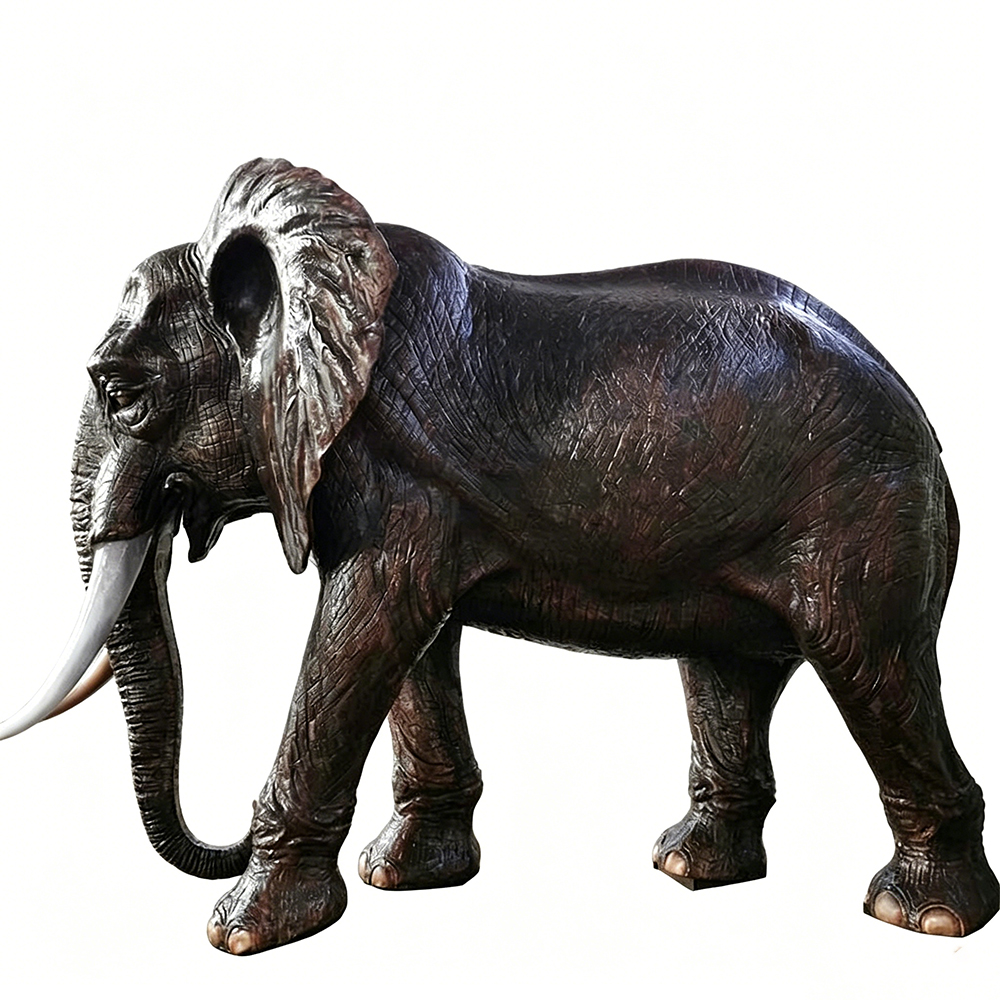
Cast bronze animal sculpture. Lost-wax casting preserves fine surface detail; the patina is a controlled oxidation finish rather than a coating.
On durability, the supplier states that high copper purity delivers 50+ years of outdoor service for this specification. That figure should be read as a material claim tied to copper content and correct installation, not as a maintenance-free guarantee: bronze installed outdoors still requires periodic inspection of welds, fixings, and any applied gold leaf, which is a thin surface layer and behaves differently from bare patinated bronze.
Bronze is commonly specified for public art, museum collections, real estate developments, religious institutions, and private collections. Its natural placement bias is indoor lobby and gallery work, memorial portraiture, and mid-scale outdoor figurative pieces where detail matters more than footprint.
Natural Stone: Travertine, Granite, and White Marble
Stone sculpture is subtractive: material is removed rather than assembled, which changes both the design language and the risk profile. The XYS-Stone-Custom range covers natural white marble, granite, and travertine, in customized width, height, and depth, with hand-carved, honed, high-gloss polished, and acid-washed finishes.
The relevant material distinctions are straightforward. White marble takes fine carving and high polish and is the traditional choice for figurative and religious work. Granite is the denser, harder option and dominates memorial and architectural applications. Travertine has an open, banded character that suits landscape and garden pieces where a weathered, mineral appearance is the design intent rather than a defect.
Stone's commercial weakness is the same as its technical strength: it is massive. Hand-carved stone is heavy, which drives foundation design, crate construction, and freight cost, and it limits how large a single piece can practically be before it is sectionalised and jointed. Buyers should also expect natural variation between blocks; colour consistency is best controlled in granite, which the supplier separately describes as acid- and alkali-resistant, anti-weathering, and colour-stable in its XYS-Monument-Custom memorial range.
The stated stone specification is high-density Grade A block, hand-carved using traditional techniques for deep relief and fine detail, and weatherproof as a material property. XinyeSheng also specifies the material as eco-friendly and free of chemical fading. The product family spans garden ornaments, stone fountains, fireplace mantels, religious carving, marble statues, and carved marble bathtubs — a range that reflects how often stone is bought as architectural furniture rather than as standalone art.
Corten Steel: ASTM A242/A588 and the Self-Weathering Surface
Corten steel is weathering steel supplied to the ASTM A242 or A588 specification. Exposed to alternating wet and dry conditions, the surface develops a stable, rust-like oxide layer that inhibits further corrosion — which is why the material is described as maintenance-free and requires no painting or ongoing coating care.
The XYS-Corten-Custom range is offered in two surface states: a natural pre-rusted finish with an already-stabilised patina, or a raw finish that continues to self-weather on site. Customized height and width covers everything from small garden pieces to large architectural structures, and the structural integrity of the steel suits large-scale outdoor installation and architectural features. Typical outputs include landscape sculpture, garden edging, fire pits, metal screens, and planter boxes.
Aesthetically, Corten is an industrial material: the surface is matte, mineral, and deliberately imperfect, and it changes colour with local weather. Buyers specifying Corten are usually buying that behaviour rather than tolerating it.
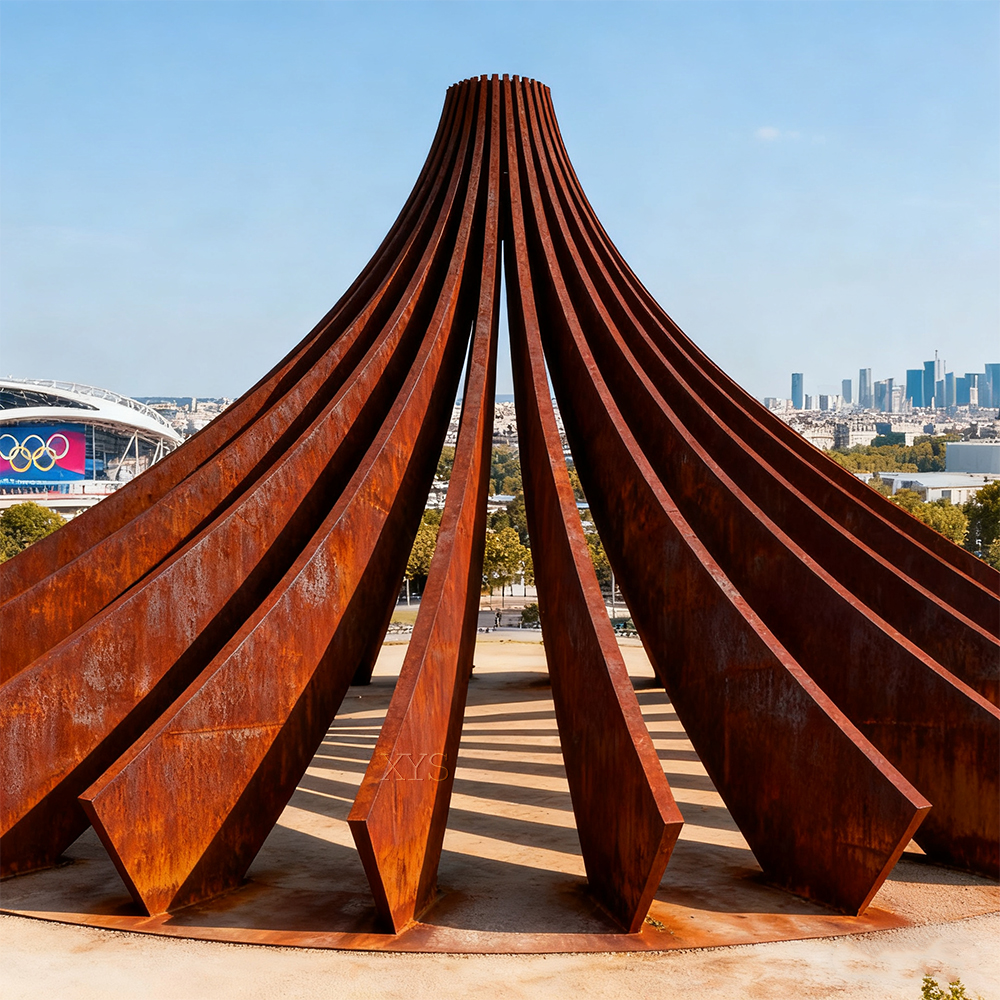
Corten steel at architectural scale. The protective oxide layer forms and stabilises outdoors through repeated wet-dry cycles; it is not a coating that can be applied indoors.
The material's limits are worth stating plainly because they are frequently discovered late. The protective layer depends on wet-dry cycling, so permanently dry indoor locations do not produce the intended stable surface. Runoff from the oxide layer can mark adjacent paving, cladding, and planting, which means drainage detailing and set-back distances belong in the design, not the installation week. And the finish continues to evolve in the first period after installation, so pieces ordered to match an existing Corten element should be specified against its current state, not its original state.
Side-by-Side Specification Comparison
| Criterion | Cast Bronze (XYS-Bronze-Custom) | Natural Stone (XYS-Stone-Custom) | Corten Steel (XYS-Corten-Custom) |
|---|---|---|---|
| Material basis | High-purity cast bronze, copper content 85%–95%; brass available | Natural white marble, granite, travertine (Grade A high-density block) | Authentic Corten steel to ASTM A242 / A588 |
| Production method | Lost-wax casting, professional welding | Hand carving | Fabrication and assembly with steel structure support |
| Finish options | Patina, gold leafing, high polished, antiqued, multi-colour oxidation | Hand-carved, honed, high-gloss polished, acid-washed | Natural pre-rusted (stable patina) or raw self-weathering |
| Size range | 50 cm to 10 m / life size, customized | Customized width, height, depth | Customized height and width, garden pieces to large structures |
| Durability position | Supplier cites 50+ years outdoor durability at 85%–95% copper content | High-density natural stone, weatherproof, no chemical fading | Atmospheric corrosion resistance; self-protecting oxide layer |
| Maintenance profile | Periodic inspection of welds, fixings, applied leaf finishes | Cleaning; joints and fixings to be monitored | No painting or coating care; surface evolves naturally |
| Typical placement bias | Indoor lobby, museum, memorial portraiture, mid-scale outdoor figurative | Garden, memorial, architectural, religious, landscape | Public parks, landscape architecture, modern garden, industrial-style decor |
Decision Framework by Placement
1. Indoor Display — Lobby, Gallery, Hospitality Interior
Indoors, the constraints are floor loading, ceiling height, sightlines, lighting, and cleaning access rather than weather. Bronze wins on detail and finish range: patina, gold leafing, and high polish all read well under controlled lighting, and the piece can be maintained without weather protection. High-gloss polished marble is the second strong option where mass and a cool, architectural presence are acceptable, and where the floor structure can take the load.
Corten is generally the wrong answer in a climate-controlled interior, not because the steel fails but because the mechanism that protects it does not operate. If a weathered steel look is required indoors, that is a design decision to be taken deliberately with the supplier rather than a default specification.
Hotel, resort, and commercial interiors are a documented application for this supply base, alongside garden and villa decoration and public art installation — in those projects the artwork functions as space identity rather than as a standalone collection object.
2. Garden and Private Landscape
Garden placement is a middle exposure class: rainfall, frost where applicable, soil moisture, and irrigation spray, but usually manageable maintenance access. All three materials work, and selection should follow scale and visual intent. Small-to-mid stone ornaments, fountains, and carved garden pieces integrate with planting. Corten suits modern and contemporary landscape design and is available as sculpture, edging, screens, and planter boxes. Bronze suits figurative focal points and works well where the garden is viewed from a short distance.
The garden-specific watch item is staining. Corten runoff affects adjacent hardscape and should be designed for. Stone near irrigation lines should be detailed so that water does not sit on horizontal surfaces. Bronze near swimming pools sits in a chemically aggressive micro-environment and should be discussed with the supplier at specification stage.
3. Memorial Work
Memorials optimise for longevity, legibility, and low lifetime maintenance. Stone is the default for a reason: granite memorial products in this supply base are specified with 100% mirror polishing, laser engraving, and sandblasting, together with acid and alkali resistance, anti-weathering behaviour, and colour stability — properties that matter when lettering must remain readable for generations. Bronze is the natural companion for figurative and portrait elements, where lost-wax casting carries the detail that stone carving at small scale struggles to match.
The buyer check specific to memorial work is joint and fixing design, because a memorial's failure mode is rarely the material itself. Water ingress at joints, incompatible fixings, and inadequate drainage cause more long-term damage than surface weathering.
4. Large-Scale Outdoor Installation and Public Art
At public scale, engineering takes over. Corten's high-strength structural steel is designed for large outdoor installations; the specification requires steel structure support, and permanent pieces require designed installation foundations. Stainless steel — 304 or 316 — remains the alternative where a rust-toned surface is unacceptable or where a highly reflective, contemporary look is wanted; 316 is the usual recommendation for coastal environments.
Bronze at 10 m and above, stone at monument scale, and Corten at architectural scale all share the same non-negotiable sequence: engineering drawings, foundation design, lifting plan, and a site installation brief before fabrication begins.
Where Each Material Reaches Its Limit
Conventional sourcing advice tends to treat the three materials as interchangeable, priced by the square metre. They are not, and each has a boundary worth writing into the specification.
Bronze is limited by casting and transport geometry rather than by corrosion. Large pieces are cast in sections and welded, which makes weld quality and patina matching across sections the defining quality risk. Applied gold leaf is a thin surface layer with a shorter service expectation than bare patinated bronze, and coastal or chemically aggressive settings warrant explicit discussion rather than an assumption of inertness.
Stone is limited by mass. Weight governs foundation, crate design, freight, and site handling, and it caps practical single-piece size. Hand carving is labour-intensive, so schedule risk sits in the carving stage rather than in the material supply. Natural variation between blocks is inherent and should be accepted in the contract, not disputed at delivery.
Corten is limited by context. It needs wet-dry cycling, it stains adjacent surfaces through runoff, and its appearance changes over the first period of exposure. In permanently dry or highly controlled interiors, and in settings where runoff would damage finished surfaces, it is the wrong specification even when it is the right aesthetic.
Customization, Delivery, and Acceptance Checks
Material choice is only half of a commissioning decision. The other half is whether the supplier's commercial and quality system can carry a bespoke piece from concept to installed site. The following checks reflect documented capability in this supply base and translate directly into questions a buyer can put to any shortlisted factory.
- Customization scope. Confirm explicitly that material, size, design, colour, surface finish, sculpture style, logo, and installation method are all in scope. A supplier that customises form but not installation method is not offering a full custom service.
- Design confirmation gate. A 3D design draft confirmed before production, and a 1:1 clay model where the programme allows, are the two mechanisms that prevent a costly mismatch between concept rendering and finished piece.
- Minimum order quantity. Single-piece and single-project orders are accepted in this supply base, with better pricing on multiple pieces where mould and shipping costs can be shared. Buyers comparing quotes should check whether the low quote assumes a batch.
- Lead time and capacity. Quoted production is 30–60 days, with monthly capacity of 50–100 sets. Large or multi-piece projects should be scheduled against that capacity rather than against the shortest quoted date.
- Quality control sequence. Material inspection, in-process inspection, surface quality inspection, and final pre-shipment inspection are four distinct gates. Ask which of them generate records the buyer will receive.
- Packaging. Export-grade protection for sculpture typically means reinforced wooden crates and steel frames for sea freight. Stone and bronze require different internal bracing; confirm the packing drawing, not just the packing description.
- Delivery and installation. Door-to-door delivery plus on-site installation guidance, with technical support and replacement service after handover, is the relevant benchmark. For large outdoor pieces, ask who signs off the foundation and lifting plan.
- Acceptance criteria. Agree in advance on dimensional tolerance, surface finish standard, patina or polish reference samples, weld and joint appearance, and how natural stone variation will be judged. Acceptance disputes are almost always specification gaps rather than workmanship failures.
Market Signals Behind the Material Decision
The commercial context supports a more disciplined approach to material selection than the sector's craft-led image suggests. Business Research Insights estimates the global art and sculpture market at approximately USD 61.83 billion in 2026, and separate commercial research puts sculptures at around 21% of global art acquisitions by transaction volume. Within that, the global bronze sculpture commission segment alone was estimated at USD 1.47 billion in 2024 (Dataintelo).
Public-sector buying behaves differently from private commissioning. CODAworx reported in 2024 that 80.2% of public art open call projects in North America fall below a budget of USD 250,000 — a distribution that pushes most public briefs toward material-efficient solutions and toward suppliers who can deliver a complete package rather than a sculpture alone. For context on where that funding originates, U.S. federal cultural agency budgets for 2025 were set at USD 708.8 million, including USD 207 million for the NEA.
Trade classification is an under-discussed variable. Trade commentary published in 2025 notes that original sculptures classified under HS code 9703 are often treated differently from mass-produced metal articles under HS 8306 when EU anti-dumping duties are assessed. Buyers importing sculpture at volume should confirm classification with their customs broker at quotation stage, because it can move landed cost more than a material substitution.
Future Outlook
Three shifts are likely to shape material selection over the next buying cycle. First, engineering documentation is becoming part of the artwork brief rather than a downstream contractor concern — foundation design, structural support, and lifting plans are increasingly expected from the sculpture supplier. Second, the separation between indoor and outdoor specifications is tightening as buyers discover that self-weathering and patinated finishes behave as designed only in the environments they were designed for. Third, project-driven buyers are consolidating multi-material orders with single suppliers capable of bronze, stone, Corten, and stainless work in one programme, because coordinating three specialist fabricators costs more in schedule risk than it saves in unit price.
The material decision itself is unlikely to change. Bronze will remain the detailing material, stone the mass and memorial material, and Corten the outdoor, low-maintenance, industrial-aesthetic material. What is changing is the expectation that the choice be justified against placement, exposure, and lifetime maintenance before the first drawing is approved.
FAQ
Should the intended location or the material come first in a custom sculpture project?
Location should come first. Placement determines exposure, structural support requirements, maintenance access, and transport constraints, and each of those narrows the viable material range before any aesthetic discussion begins. A supplier working from a confirmed placement can specify material and finish against real conditions; a supplier working from a style reference alone is effectively guessing at the environment.
Which material suits an indoor lobby or hotel interior — bronze, marble, or Corten steel?
Bronze and polished marble are the conventional indoor choices. Bronze is specified with patina, gold leafing, high polish, or antiqued finishes and holds fine figurative detail through lost-wax casting. High-gloss polished marble works where the design benefits from mass and a cool architectural surface, provided the floor structure can carry the load. Corten steel is generally not specified indoors because its protective oxide layer forms through outdoor wet-dry cycling rather than in a climate-controlled environment.
Is Corten steel suitable for indoor sculpture?
Corten steel is designed as a self-weathering outdoor material. Its protective, stable rust layer develops and stabilises through repeated wet and dry exposure, and the material is specified as maintenance-free on that basis. In a permanently dry indoor setting that mechanism does not operate as intended. Corten is therefore usually reserved for landscape architecture, public parks, modern garden design, and industrial-style outdoor decor.
How long do bronze, stone, and Corten steel sculptures last outdoors?
The three materials protect themselves differently. For high-purity cast bronze at 85%–95% copper content, the supplier cites 50+ years of outdoor durability, subject to correct installation and periodic inspection of welds, fixings, and any applied gold leaf. Natural stone is specified as high-density, weatherproof material that does not chemically fade, with granite additionally described as acid- and alkali-resistant and anti-weathering. Corten steel forms a self-protecting oxide layer with atmospheric corrosion resistance and requires no painting or coating maintenance.
What is the minimum order quantity and typical lead time for a custom sculpture?
In this supply base, minimum order quantity is one piece or one project, with more favourable pricing on multiple pieces where mould and shipping costs are shared. Quoted lead time is 30–60 days, against monthly capacity of 50–100 sets. Actual timing depends on size, material, finish complexity, and whether a 1:1 clay model is commissioned before fabrication, so the schedule should be confirmed after design approval.
How are large outdoor sculptures packed, delivered, and accepted on site?
Export packing for sculpture typically uses reinforced wooden crates and steel frames suitable for sea freight, with internal bracing matched to whether the piece is stone, bronze, or fabricated steel. Delivery is commonly organised door to door and paired with on-site installation guidance, technical support, and replacement service after handover. Acceptance should be tied to criteria agreed before production — dimensional tolerance, finish reference samples, weld and joint appearance, and a stated position on natural stone variation — with final inspection before shipment covering material, process, surface quality, and finished goods.
For buyers who need production scope, material standards, and capability details in a single document, the company profile and available production capabilities brochure is publicly available: Company Profile & Available Production Capabilities (PDF).
Tem questões ou precisa de mais detalhes?
Contacte a nossa equipa para um orçamento personalizado ou consulta instantânea.
Solicitar orçamento
Preencha o formulário abaixo e a nossa equipa entrará em contacto com uma proposta personalizada.
Chat direto do WhatsApp
Prefere conversar em tempo real? Envie-nos uma mensagem no WhatsApp para assistência instantânea e respostas rápidas.
- Obter orçamento personalizado
- Partilhar fotos ou documentos
- Discuta as suas necessidades diretamente
Geralmente responde em 5–30 minutos durante o horário de expediente.