
Industrial Centrifuge for Lithium Battery Intermediates: Batch Fit and Discharge Choice
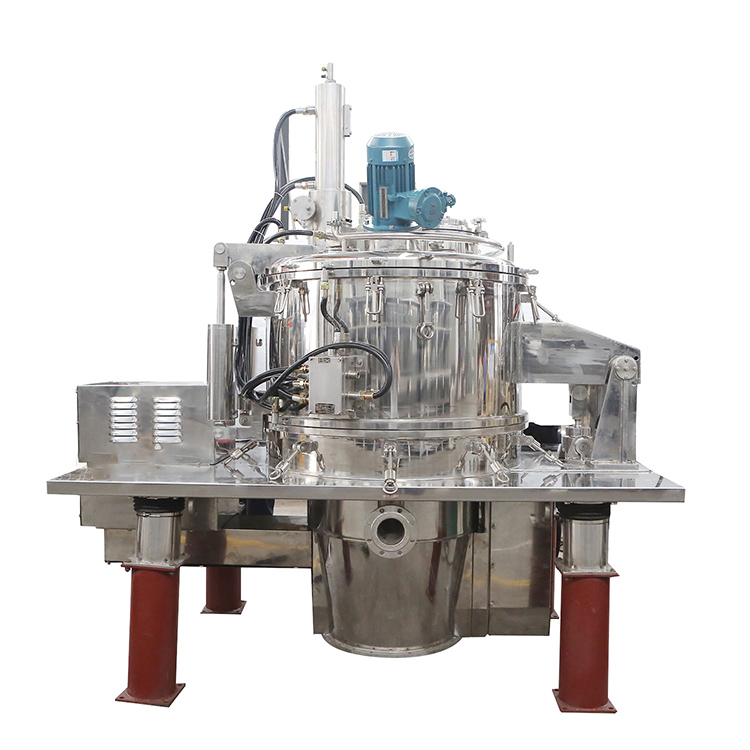
Answer first: Lithium battery intermediate materials are often produced as crystalline solids in batch reactors, which makes solid-liquid separation a recipe step rather than a utility step. For this duty, the centrifuge choice is not only a drum-size decision. It is a batch-fit and discharge decision. The PLQ1250, PSLQ800 and PGZ1000 are batch basket centrifuges from JGD Centrifuge Co., Ltd., a Zhangjiagang-based manufacturer of filtration and separation equipment. They share a broad material list, but they differ in discharge method, batch scale and automation profile. The PLQ1250 uses automatic pull-bag discharge; the PSLQ800 uses a full-opening lid and manual top discharge; the PGZ1000 uses a vertical bottom-discharge peeler configuration with fully automated operation. The right choice depends on crystal fragility, batch size, cleaning regime, corrosion profile and how much manual intervention the plant can accept.
JGD Centrifuge Co., Ltd. was founded in 2012 and operates a 4,000 m² factory in Zhangjiagang with 60 employees, an annual output of 100 units, a 6-engineer research and development team and an 80% export ratio. Its main markets include South America, Southeast Asia, North America, the Middle East and Europe. Its product range covers basket, peeler, pusher, decanter and bag-lifting centrifuges for filtration and separation duties.
Why lithium battery intermediate materials change the centrifuge brief
Lithium battery intermediate materials are often handled as crystalline or granular solids in a liquid stream. The separation duty is therefore a solid-liquid filtration duty, not a clarification duty alone. The centrifuge must recover the solid, control residual moisture, allow washing where the recipe requires it, and discharge the cake without compromising the next batch. In a battery-material line, those steps sit between reactors, tanks and downstream drying, so a small change in discharge method can affect cycle time, operator exposure and cleaning validation.
The material side matters as much as the machine side. A lithium carbonate crystalline suspension in the Chilean lithium extraction project is recorded with 10% to 30% solid content and a weakly alkaline system containing Na+, SO4 2- and Cl-. That stream requires anti-corrosion material, and the project data specifies SS2205 duplex stainless steel, CIP online cleaning, batch operation, a maximum drum speed of 1,200 rpm, a 30 kW main motor and a separation factor of 1,008. The project used four LGZ1250 units. It is not a PLQ1250, PSLQ800 or PGZ1000 reference, but it shows the kind of process envelope that lithium battery intermediate projects can present: corrosive salts, batch operation and a cleaning requirement.
Batch fit: where the PLQ1250, PSLQ800 and PGZ1000 sit
Batch operation fits when the plant runs recipe-driven cycles, when feed arrives in discrete reactor batches, or when the solid must be washed and dewatered in stages before discharge. It is less suitable when the line needs uninterrupted steady feed and the process can tolerate continuous discharge. JGD Centrifuge also manufactures pusher and decanter centrifuges for continuous duties, but the three models in this article are batch basket machines. That distinction matters for procurement: a continuous operation industrial centrifuge and a batch type industrial centrifuge solve different process problems, even when both are called industrial centrifuges.
| Model | Type and discharge | Key published specifications | Scenario fit | Boundary to check |
|---|---|---|---|---|
| PLQ1250 | Vertical automatic pull-bag discharge centrifuge | Drum diameter 1,250 mm; drum volume 300 L; maximum loading limit 400 kg; drum speed 1,000 rpm; maximum separation factor 700; main motor 22 kW | Fragile-crystal batches where zero scraping and complete discharge are priorities; larger batch size within this group | Filter bag integrity and bag handling discipline; separation factor should be validated against the actual crystal |
| PSLQ800 | Full-opening lid manual top-discharge centrifuge | Drum diameter 800 mm; drum volume 100 L; maximum loading limit 135 kg; drum speed 1,200 rpm; maximum separation factor 645; main motor 5.5 kW | Smaller batches, frequent filter changes, cleaning-intensive lines, cGMP/CIP access | Manual top discharge requires opening the lid and manual cake removal after the machine stops |
| PGZ1000 | Vertical bottom-discharge peeler centrifuge | Drum diameter 1,000 mm; drum volume 175 L; maximum loading limit 235 kg; drum speed 1,000 rpm; maximum separation factor 560; main motor 11 kW | Fully automated batch operation; bottom discharge; compact batch footprint | Scraper-based discharge should be matched to crystal fragility; published separation factor is lower than the other two models |
The PLQ1250 is the largest of the three in drum volume and loading limit, with a 300 L drum and a 400 kg maximum loading limit. The PGZ1000 sits between the other two in volume and loading, with a 175 L drum and a 235 kg maximum loading limit. The PSLQ800 is the smallest, with a 100 L drum and a 135 kg maximum loading limit. Those numbers describe batch scale, not separation performance. The buyer should not treat a larger drum as automatically better for a fragile crystal or a cleaning-intensive line.
Discharge choice: pull-bag vs manual top vs scraper bottom
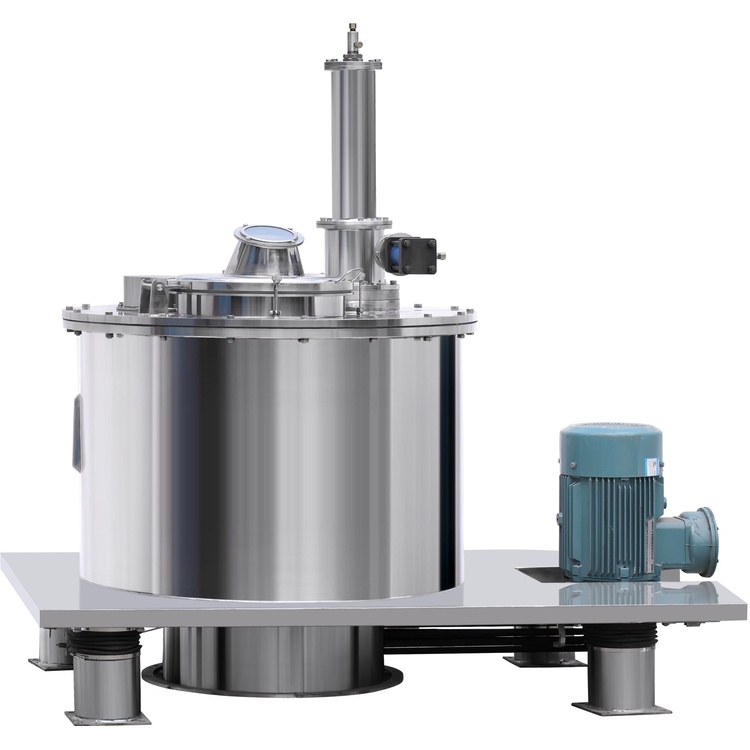
Discharge is the most visible difference between the three models. The PLQ1250 is a vertical automatic pull-bag discharge centrifuge. Its product data lists 100% automatic discharge, zero scraping and zero abrasion, a fully openable lid and cGMP-oriented hygiene, plus reduced physical effort and installation adaptability. For a lithium intermediate crystal that is fragile, or for a batch where residual cake must be removed completely without a scraper touching the solid, the pull-bag route is the first configuration to examine.
The PGZ1000 is a vertical bottom-discharge peeler centrifuge. JGD describes it as a fully automated operation model with flat-plate damping, no foundation requirement, sealed explosion-proof safety, strong material adaptability and dewatering performance. Its automation profile is the contrast point: the PGZ1000 is the model to consider when the plant wants a fully-automatic industrial centrifuge cycle and bottom discharge, while the PLQ1250 is the model to consider when pull-bag discharge and zero scraping are the dominant requirements. The PGZ1000 should not be described as zero-abrasion on the basis of the supplied data; that claim belongs to the PLQ1250 product data.
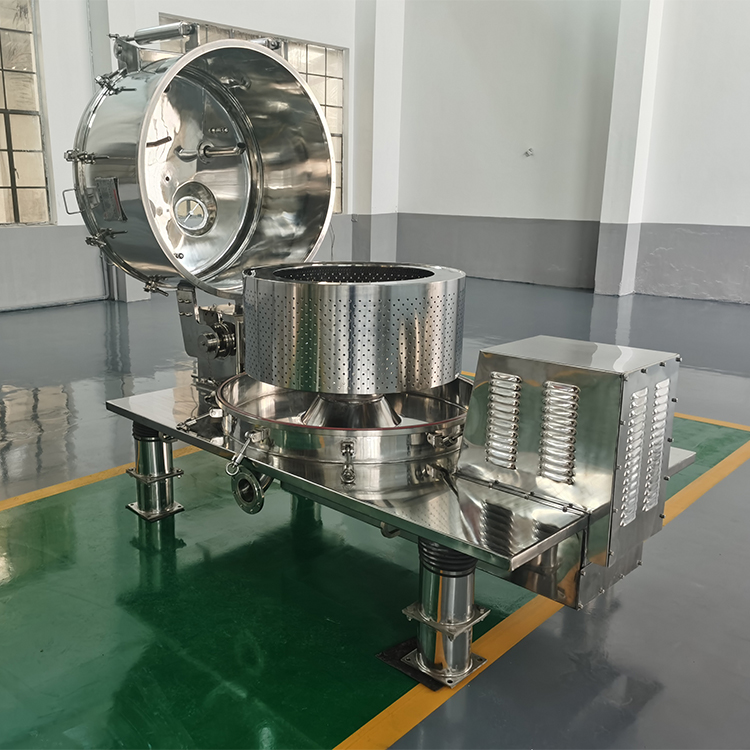
The PSLQ800 is a full-opening lid manual top-discharge centrifuge. Its design points are cGMP sanitary construction, no dead corners, cGMP/CIP compatibility, and simple filter replacement and maintenance. Manual top discharge means the lid is opened and the solid is removed manually after the machine stops. That fits smaller batches, frequent filter changes, or a plant that values full opening and cleaning access over automatic discharge. It is not the configuration to choose when the main goal is to remove manual cake handling from a high-cycle battery-material line.
Material selection: SS316L, SS2205, SS904L, titanium and Hastelloy-C
All three models list the same material options: SS304, SS321, SS316L, SS2205, SS904L, Titanium and Hastelloy-C alloy. That list is a capability statement, not a recommendation to specify the highest grade. The selection rule from the JGD knowledge base is more useful: SS304 for normal working conditions; SS316L for moderate corrosion; Hastelloy or PTFE lining for strong corrosion; and avoid ordinary SS304 for materials containing chloride ions. In the lithium carbonate project data, SS2205 duplex stainless steel is specified for a weakly alkaline chloride-containing system. That is a project-specific material decision, not a universal rule for every lithium intermediate.
SS316L is the common middle ground for a 316L stainless steel industrial centrifuge when the stream is not strongly corrosive. SS2205 is relevant when chlorides and stress-corrosion risk enter the picture. SS904L, titanium and Hastelloy-C are available where the corrosion profile justifies them, but they should be justified by the stream analysis, temperature and cleaning chemicals. A buyer should not use the material list as a ranking. The correct question is which wetted parts, seals and surfaces need which grade, and whether the cleaning regime is compatible with that grade.
Application fit: lithium intermediates and adjacent chemical, pharmaceutical and salt/fertilizer duties
For lithium battery intermediate materials, the practical fit can be framed as three scenarios. First, a fragile-crystal batch where the plant wants to avoid scraping: the PLQ1250 pull-bag discharge is the natural starting point. Second, a smaller batch or a cleaning-intensive line with frequent filter changes: the PSLQ800 full-opening manual top-discharge design offers access and cGMP/CIP compatibility, but it retains manual discharge. Third, a line that prioritizes automated bottom discharge and a compact batch footprint: the PGZ1000 is the model to evaluate, with the caveat that its published separation factor is lower than the PLQ1250 and PSLQ800 and the duty must be validated.
The same batch basket platform is also used in industrial centrifuge for chemical industry duties, industrial centrifuge for pharmaceutical industry duties, and salt and fertilizer crystal dewatering. Those adjacent applications share the need for controlled washing, dewatering and discharge, but they are not identical to lithium battery intermediates. A pharmaceutical API crystallization duty may be driven by cGMP cleaning and documentation; a salt or fertilizer duty may be driven by crystal size and throughput; a lithium intermediate duty may be driven by chloride corrosion and crystal fragility. The application name should not replace the process data.
Comparison with traditional solutions and the limits of each choice
The traditional batch basket choice is manual top discharge, often with manual upper shoveling. The JGD FAQ describes three discharge routes: manual upper shoveling on the basic model; direct lifting of filter bags on a hanging-bag model; and fully automatic scraper bottom discharge on LGZ/PGZ models. The PLQ1250 belongs to the pull-bag discharge family; the PGZ1000 belongs to the automatic bottom-discharge family; the PSLQ800 is the manual top-discharge option in this comparison.
Each route has a boundary. Manual top discharge is simple and gives full opening access, but it depends on the operator and adds manual cake handling. Pull-bag discharge reduces scraping and can improve discharge completeness, but it depends on filter bag integrity and bag handling discipline. Automatic scraper bottom discharge reduces manual intervention, but it introduces a mechanical discharge element and should be matched to the crystal fragility. Batch operation itself has a cycle-time boundary: fill, wash, dewater and discharge occur in sequence, so a batch basket machine is not the right answer when the line must run uninterrupted at steady feed. A continuous pusher or decanter centrifuge may be the better fit in that case, subject to the actual duty.
There is also a separation-factor boundary. The JGD knowledge base states that crystalline materials generally use a separation factor of 800 to 1,200, while fragile materials should not be run at too high a factor to prevent particle breakage. The published maximum separation factors are 700 for the PLQ1250, 645 for the PSLQ800 and 560 for the PGZ1000. Those values are below the general crystalline range, which means the buyer should not assume suitability from the model name alone. The lower factor can be consistent with gentle treatment of fragile crystals, but the final choice should be confirmed against particle size, viscosity, solids concentration, required cake dryness and washing efficiency.
Procurement criteria: what to specify before an RFQ
A useful RFQ for a lithium battery intermediate centrifuge should state the feed composition, solid content, particle-size range, crystal fragility, temperature, pH, chloride level, required washing, required cake dryness, batch size, cycle time, cleaning regime and explosion-proof classification. It should also state whether the plant wants manual top discharge, pull-bag discharge or automatic bottom discharge. Without those inputs, the model comparison becomes a specification list rather than an application decision.
JGD Centrifuge supports ODM customization for voltage, electrical component brands such as PLC and touch screen, frequency converter, motor and bearings. The company states a monthly capacity of 8 units, a lead time of 30 to 60 days, a minimum order quantity of 1 unit, no-load testing before delivery, and remote after-sales support. Those are useful procurement facts, but they do not replace a duty review. The buyer should still confirm the wetted-material certificate, the cleaning validation approach, the spare-parts list and the control philosophy.
Market and compliance context
Two external context points are relevant. First, one commercial research source in the verified data package estimates that filtering centrifuges are forecast to grow at 7.2% annually, driven by API crystallization and specialty-chemical purification. That is a directional segment estimate from a commercial source, not a consensus market forecast, and it should not be used as a standalone investment case. Second, EN 12547:2014 is the current European standard for centrifuge safety requirements, excluding household and laboratory models under EN 61010-2-020. For projects targeting Europe, the safety file should be checked against that standard before the equipment specification is frozen.
Future outlook
Lithium battery intermediate projects are likely to keep pushing two requirements at the same time: corrosion resistance for chloride-bearing streams and gentle handling for crystalline solids. That combination favors a project-specific review rather than a generic model ranking. The PLQ1250, PSLQ800 and PGZ1000 give three different answers: pull-bag discharge for zero scraping, full-opening manual top discharge for access and cleaning, and fully automated bottom discharge for reduced manual intervention. As battery-material lines move from pilot to production, the discharge choice will become a procurement decision rather than an afterthought.
FAQ
What materials are suitable for a batch type basket centrifuge?
Batch type basket centrifuges are suitable for solid-liquid separation of granular and crystalline solid materials, such as salt crystals, traditional Chinese medicine extracts, chemical intermediates, resins and food additives. The application should still be checked against the actual particle size, solids concentration and corrosion profile.
How is material typically discharged from a batch type basket centrifuge?
The basic model uses manual upper shoveling; a hanging-bag model lifts the filter bag directly for discharge; and the LGZ/PGZ model uses a fully automatic scraper for bottom discharge. The PLQ1250 in this article is a pull-bag discharge design, while the PSLQ800 is a manual top-discharge design.
How should equipment materials be selected for corrosive materials?
SS304 is used for normal working conditions; SS316L for moderate corrosion; and Hastelloy or PTFE lining for strong corrosion. Ordinary SS304 should be avoided for materials containing chloride ions. The final grade should be confirmed against the stream analysis, temperature and cleaning chemicals.
What is the separation factor, and how should it be referenced when selecting a model?
The separation factor represents the centrifugal separation capability; the higher the value, the stronger the separation capability. For crystalline materials, it is generally 800 to 1,200; for fine particulate materials it should be appropriately increased; and for fragile materials it should not be too high, to prevent particle breakage.
What are the key parameters to consider when selecting a suitable model?
The main factors are drum diameter, drum volume, loading limit, rotation speed, separation factor, motor power and filter media type. The material properties should also be confirmed: corrosiveness, explosion-proof requirement, temperature and solid content. If capacity is higher and a closed, explosion-proof system is required, an automatic bottom-discharge centrifuge should be considered.
Why do different manufacturers have different loading capacities for the same drum diameter?
The loading capacity is determined by the effective depth of the drum and the loading limit. Volume alone is not sufficient. The rated loading limit of the equipment must be observed; overloading can cause violent vibration and safety hazards.
Reference resource: JGD Centrifuge product brochure (PDF).
Tem questões ou precisa de mais detalhes?
Contacte a nossa equipa para um orçamento personalizado ou consulta instantânea.
Solicitar orçamento
Preencha o formulário abaixo e a nossa equipa entrará em contacto com uma proposta personalizada.
Chat direto do WhatsApp
Prefere conversar em tempo real? Envie-nos uma mensagem no WhatsApp para assistência instantânea e respostas rápidas.
- Obter orçamento personalizado
- Partilhar fotos ou documentos
- Discuta as suas necessidades diretamente
Geralmente responde em 5–30 minutos durante o horário de expediente.