
Industrial Coding & Marking Equipment Explained for 2026
Industrial coding and marking equipment is the category of machines that apply production dates, expiry dates, batch numbers, serial numbers, barcodes, QR codes, and compliance marks onto products and packaging during manufacturing. The category spans continuous inkjet printers (CIJ), thermal inkjet printers (TIJ), high-resolution piezo inkjet printers (PIJ), large-character drop-on-demand printers (DOD), thermal transfer overprinters (TTO), laser marking machines, and inline vision inspection systems. The global coding and marking equipment market was valued at USD 17.53 billion in 2024 and is projected to reach USD 27.11 billion by 2032.
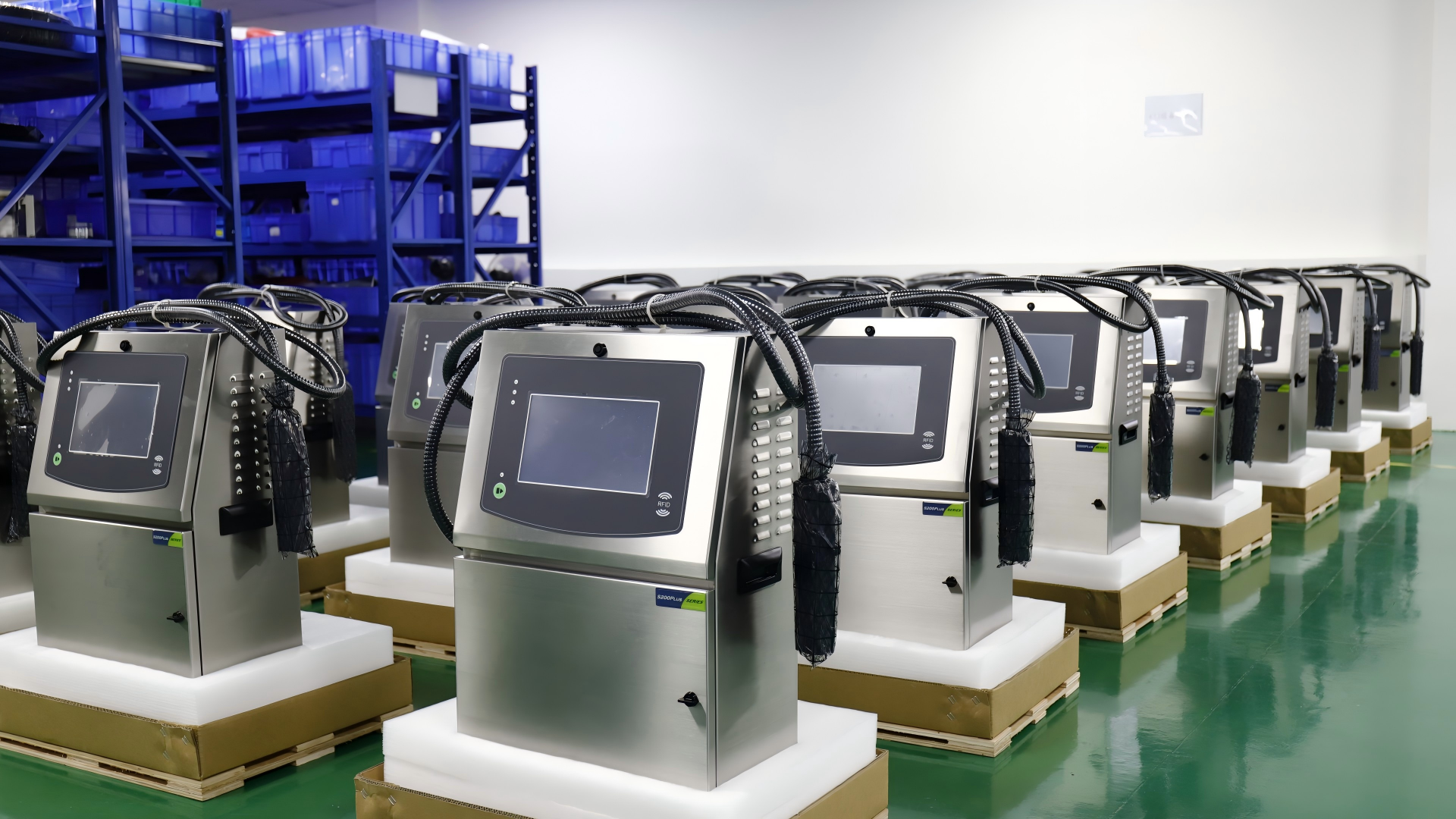
Finished coding equipment undergoing inspection before shipment at a manufacturing facility.
The Problem and the Opportunity in Industrial Coding
Manufacturers across food, beverage, pharmaceutical, automotive, electronics, building materials, and packaging now place more data on each unit than ever before. Regulatory programs such as medical UDI and tobacco track-and-trace require unique identifiers; retail and logistics chains increasingly demand GS1-compliant 2D codes; and brand owners use serialization for anti-counterfeiting and channel control. At the same time, the Global GS1 Digital Link standard is being adopted to replace 1D barcodes with QR codes for point-of-sale and traceability by 2027.
For buyers, the opportunity is that inline coding has become more reliable, faster, and more integrated with production software. The challenge is that each technology behaves differently on different substrates, and supplier capabilities vary widely. A structured understanding of the equipment categories, their operating principles, and their real-world production scenarios is the basis for a sound purchasing decision.
DOCOD: A Full-Line Manufacturer of Coding and Marking Equipment
DOCOD Precision Group Co., Ltd. is an industrial coding, marking, and inspection equipment manufacturer based in Guangzhou, China, established in 2008. The company specializes in the design, research and development, production, sales, and service of industrial product identification equipment, components, and related solutions. It employs approximately 407 staff, operates a 20,000 square meter manufacturing facility, and has an annual production capacity of 5,000 units. Export business accounts for 50% of total sales, with major markets including North America, South America, Eastern Europe, Southeast Asia, Africa, Oceania, the Middle East, Eastern Asia, and Western Europe.
Its product portfolio includes continuous inkjet printers (CIJ), thermal inkjet printers (TIJ), handheld inkjet coding equipment, piezoelectric high-resolution inkjet printers (PIJ), drop-on-demand large-character inkjet printers (DOD), thermal transfer overprinters (TTO), laser marking machines, inline vision inspection systems, coding consumables, spare parts, and product traceability solutions. The company also maintains an R&D team of more than 140 engineers and technicians focused on product identification solutions.
Technology Overview: How Each Coding Technology Works
For an awareness-stage buyer, the practical question is which technology fits which production condition. The table below summarizes the key technology families and representative DOCOD models.
| Technology | Marking Principle | Typical Content | Representative DOCOD Models |
|---|---|---|---|
| CIJ (Continuous Inkjet) | Non-contact droplets deflected by electric field | Dates, batch codes, SN, dynamic barcodes/QR codes | S1000, M2000, S300plus, V2000 |
| TIJ (Thermal Inkjet) | Thermal bubble jet from cartridge printhead | GS1 codes, QR codes, high-resolution text, variable data | T220E, T260E, TX1, 3BK702 cartridge |
| PIJ (Piezo Inkjet) | Piezoelectric drop-on-demand ejection | High-resolution text, barcodes, QR codes, graphics | P2000 |
| TTO (Thermal Transfer Overprinter) | Thermal ribbon transfers ink onto flexible film | Dates, GS1 DataMatrix, dynamic QR codes, serial numbers | R3000 Series |
| Fiber Laser | 1064 nm laser ablation | Permanent marks on metal and coated surfaces | Venus1 Series Fiber |
| CO2 Laser | 10.6 μm laser beam | Non-metal marking | Venus1 Series CO2 |
| UV Laser | 355 nm cold laser marking | High-contrast, low-heat marking on plastics and electronics | Venus1 Series UV, L3000 |
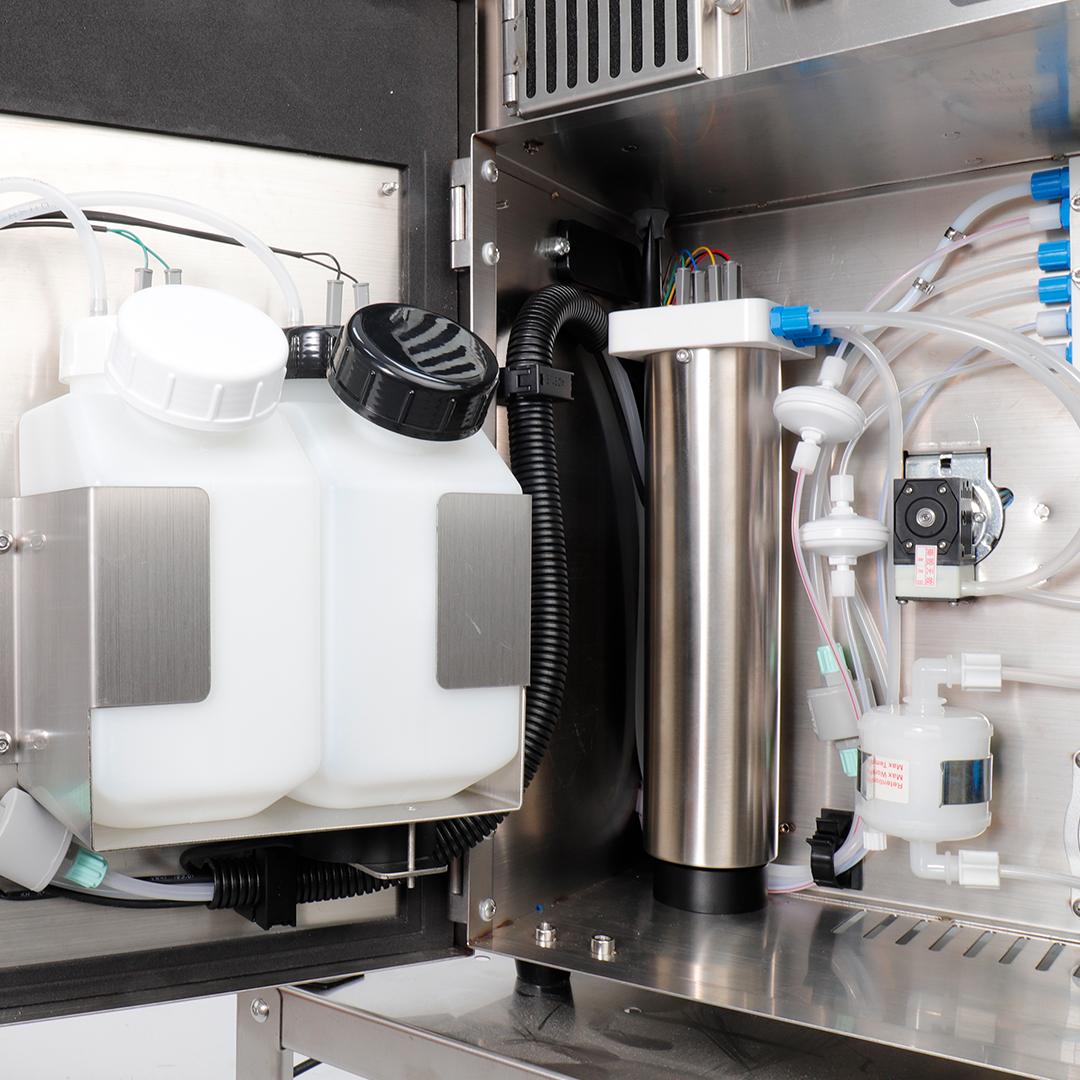
DOCOD M2000 Series small-character continuous inkjet printer.
Continuous Inkjet Printers (CIJ)
CIJ is the most established coding technology in the market. Continuous Inkjet technology held the largest revenue share in the coding and marking market, accounting for approximately USD 5.67 billion in 2024. A CIJ printer is suited to high-speed lines and non-contact printing on surfaces such as carton, plastic, metal, glass, cable, and pipe. The DOCOD M2000 Series Continuous Inkjet Printer is a small-character model made of SUS 304 stainless steel with IP65 protection. It has a maximum printing speed of 528 m/min, printing height of 3 to 30 mm, and can print 1 to 4 lines. It includes a 10.1-inch capacitive touch display, runs an Embedded Linux security operating system, and carries CE and RoHS certificates.
For faster lines, the DOCOD S1000 Series High Speed Continuous Inkjet Printer reaches maximum printing speeds of 720 m/min with a 60u nozzle and 960 m/min with a 50u nozzle. It is housed in SUS 304 stainless steel with IP55 protection and holds CE, RoHS, and BIS certifications. The DOCOD S300plus Series offers 1 to 5 lines, a max speed of 384 m/min, IP65 protection, and CE, RoHS, and BIS certificates. The V2000 Series Continuous Inkjet Printer supports 1 to 5 lines at up to 334 m/min and connects to enterprise MES management systems via USB, RS232, and network interfaces.
Thermal Inkjet Printers (TIJ)
TIJ printers use cartridge-based printheads and are a practical choice for high-resolution codes on cartons, plastics, films, and labels. The DOCOD T220E Half-Inch Dual-Head Thermal Inkjet Printer prints at up to 406 m/min with resolution up to 600 x 600 DPI, supports 1 or 2 printheads, and handles food-grade, water-based, oil-based, weak solvent, and solvent ink cartridges. The DOCOD T260E Half-Inch Dual-Head Thermal Inkjet Printer offers up to 300 x 300 DPI at up to 60 m/min, with printing content including GS1 codes, QR codes, barcodes, serial numbers, and variable databases. The DOCOD TX1 Half-Inch Seamless Inkjet Printer supports 1 to 8 printheads with a combined print height up to 101.6 mm, making it suitable for wider-format traceability coding. TIJ consumables such as the DOCOD 3BK702 half-inch black solvent cartridge carry 42 ml of solvent ink, 300 nozzles, and resolution up to 600 dpi.
High-Resolution Piezo Inkjet Printers (PIJ)
Piezo inkjet technology is used when print quality and substrate versatility matter more than throw distance. The DOCOD P2000 Piezo Inkjet Printer is a single-head or dual-head high-resolution PIJ printer with 300 dpi or 600 dpi accuracy, printing at 190 m/min at 300 dpi and 95 m/min at 600 dpi. It prints on carton, plastic, metal, plate, pipe, stone, cables, glass, and electronic components, with water-based and quick-drying inks.
Thermal Transfer Overprinters (TTO)
For flexible packaging films, a thermal transfer overprinter delivers sharp, high-resolution codes directly onto the packaging material. The DOCOD R3000 Series Industrial Thermal Transfer Overprinter operates in intermittent printing mode, is built with aerospace-grade aluminum, and is designed for flexible packaging scenarios including bakery and dried fruit packaging. It prints GS1 DataMatrix, dynamic QR codes, barcodes, serial numbers, dates, and variable databases at 300 dpi, with models R3032 and R3053.
Laser Marking Machines
Laser marking removes the need for ink consumables and produces permanent marks. The DOCOD Venus1 Series Fiber Laser Marking Machine operates at 1064 nm with 20W, 30W, 50W, or 100W power options and a laser life of up to 100,000 hours; it is intended for metal and coating applications, medical devices, automotive parts, and aerospace components. The Venus1 Series CO2 Laser Marking Machine, available in 30W or 60W, targets non-metal materials with a standard 110 x 110 mm marking range expandable up to 300 mm. The Venus1 Series UV Laser Marker operates at 355 nm with 5W, 10W, or 15W power options for low-heat marking on plastics, glass, medical devices, and electronic components. The DOCOD L3000 Series 5W UV Laser Marking Machine uses water cooling, an IP43 enclosure, and a standard 70 x 70 mm marking range for soft film packaging and pharmaceutical packaging applications.
Supporting Equipment: Rewinding and Conveyor Solutions
Beyond printers, coding lines often require peripheral equipment for label handling and product transport. The DOCOD XF30 Vertical Rewinding Machine is a label rewinding machine with a TIJ printer that supports barcode and traceability printing at up to 300 x 300 DPI. The DOCOD XC20 Mini Conveyor Belt provides a compact transport platform for inkjet printers, vision inspection, and weighing equipment, with a belt width of 150 mm and speeds of 5 to 12 m/min.
Application Scenarios: Where Coding Equipment Is Deployed
Coding equipment is selected by production scenario, and suppliers with verified application experience reduce integration risk. The following scenarios illustrate how DOCOD configurations are applied across industries.
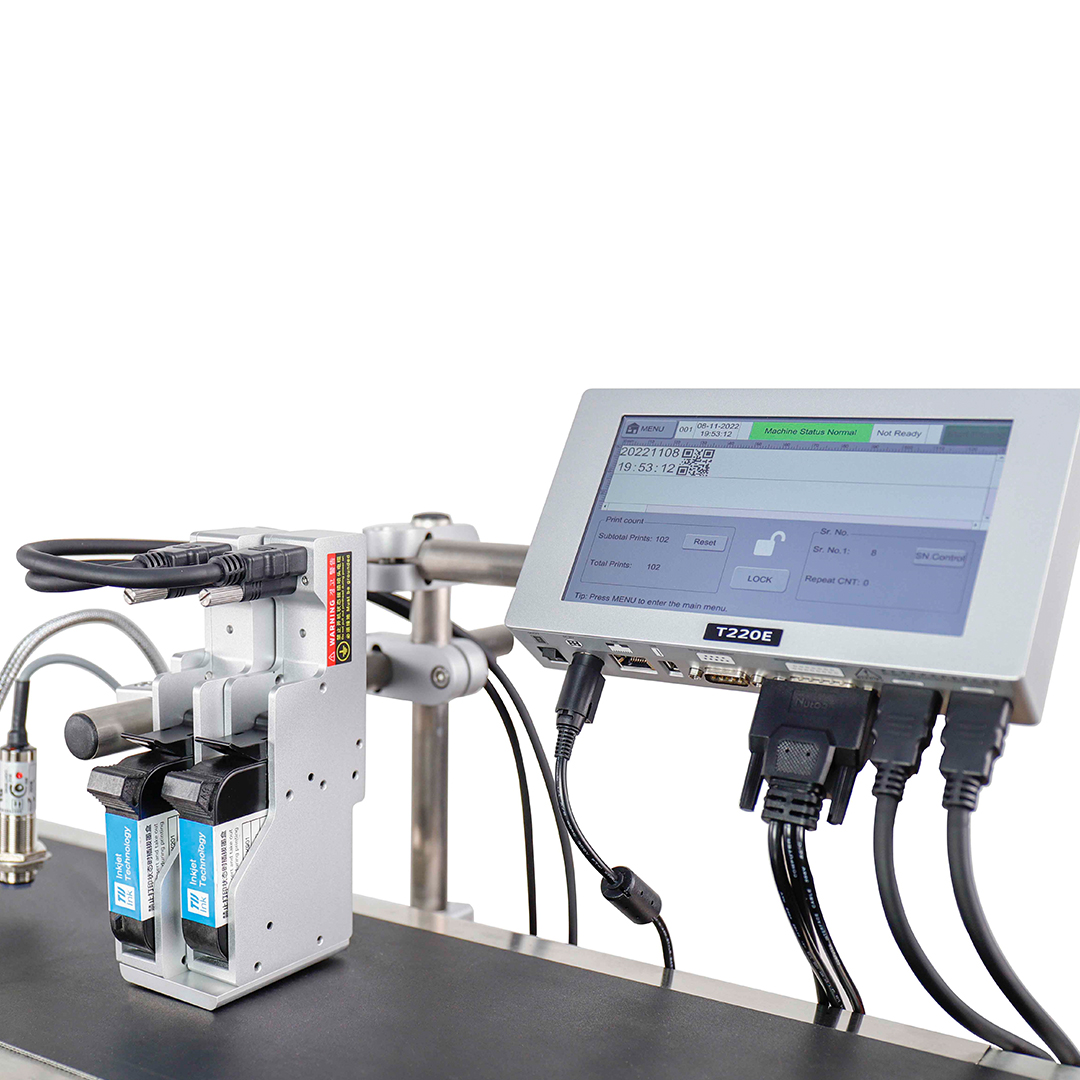
A TIJ printhead mounted on a production-line workstation for inline coding.
Food and Beverage Packaging
In Vietnam, coding solutions are deployed on food and beverage packaging lines to print production dates, expiry dates, batch numbers, and QR/barcodes for traceability. The system operates online, integrated with filling and packaging lines, and supports multi-material packaging including flexible pouches, cartons, PET bottles, and glass bottles across cold-chain, humid, hot, and dry environments.
Medical Packaging and UDI Coding
In Germany, medical packaging lines use UDI and GS1 DataMatrix coding with a closed-loop print-and-verify workflow. The system prints UDI, GS1 DataMatrix, lot numbers, expiry dates, and serial numbers on medical device packs, Tyvek medical paper, blister packs, and cartons, integrating with cartoners, labeling machines, vision systems, and reject units.
Wire, Cable, and Pipe Extrusion
For extrusion lines in India, non-contact coding synchronized with an encoder prints meter marks, model information, brand names, batch numbers, certification marks, and traceability codes on continuous-length products. The configuration is designed for high-speed lines with limited space and substrates with difficult adhesion.
Tobacco Packaging and Serialization
In Turkey, high-speed tobacco packaging lines use serialized coding to print batch codes, tax-control codes, DotCode/DataMatrix, QR codes, and supply-chain traceability codes. The system integrates with pack conveyors, vision inspection, and reject units for anti-counterfeiting and regulatory tracking.
Electronics Manufacturing
In Mexico, electronics manufacturing lines use laser and inkjet solutions for part traceability on PCBs, batteries, charger housings, and small components. The marking system prints serial numbers, QR/DataMatrix codes, batch numbers, and brand marks in a way that minimizes contamination, often integrated with automation fixtures and robot handling.
Cosmetics and Personal Care
In Indonesia, bottle and tube coding lines print batch numbers, production dates, expiry dates, QR codes, and anti-counterfeit codes on HDPE, PET, PP, and PE tubes. The codes must remain clear without damaging brand appearance, and the system integrates with filling, capping, and labeling lines.
Building Materials and Chemicals
In the UAE, large-character marking is applied to cement bags, mortar bags, paint pails, and chemical drums in dusty, hot, and humid conditions. The system prints batch numbers, production dates, model information, QR codes, and logistics codes, integrating with bagging, extrusion, and filling lines.
Automotive Parts Traceability
In Brazil, automotive parts lines print part numbers, batch codes, QR/DataMatrix, production dates, and supplier codes for assembly traceability, recall management, and service identification. These systems are often integrated into assembly and inspection stations with vision inspection and PLC/MES connectivity.
Market Trends Shaping Coding Equipment Demand
Several externally verified trends are shaping procurement decisions in 2026. Global market demand is expanding: the coding and marking equipment market was valued at USD 17.53 billion in 2024 and is projected to reach USD 27.11 billion by 2032. CIJ remains the largest technology segment at approximately USD 5.67 billion in 2024. Asia-Pacific accounts for the largest geographical share, estimated at around 35% in 2024, which aligns with the region's dense manufacturing base.
Two technology-level shifts are visible. First, laser marking is projected to grow at a CAGR of 6.8% through 2030, driven by its lack of consumables and environmental benefits. Second, the GS1 Digital Link standard is being adopted globally to replace 1D barcodes with QR codes for point-of-sale and traceability by 2027, creating demand for printers capable of producing high-quality 2D codes at line speed. China's export value for industrial machine tools, including marking equipment, rose by 15.7% year-on-year in early 2026, indicating growing capacity among Asian equipment manufacturers. The competitive landscape continues to include global players such as Videojet Technologies, Domino Printing Sciences, Markem-Imaje, and Hitachi Industrial Equipment Systems, alongside full-line Chinese manufacturers such as DOCOD.
Comparison with Traditional Coding Methods
Traditional approaches such as pre-printed labels and manual marking remain in use, but inline coding addresses their main weaknesses. Inline printers eliminate label inventory and changeover, enable variable data such as serial numbers and database-driven content, and support automated verification and rejection. Laser marking goes further by providing permanent marks without consumables.
One honest limitation should be noted: inline coding equipment performs only the marking step. Final code quality still depends on substrate condition, printhead placement, environmental factors such as dust and humidity, and line integration. This is why application engineering and local technical support matter as much as hardware specifications when selecting a supplier.
Future Outlook
The direction of the industry is toward more data-rich, verifiable, and integrated marking. GS1 Digital Link adoption will push more production lines toward high-resolution 2D code printing. Medical and pharmaceutical traceability requirements will continue to drive print-and-verify workflows, where a vision system reads each code immediately after printing. Multi-technology platforms, where a single supplier offers CIJ, TIJ, PIJ, TTO, laser, and inspection equipment, reduce the complexity of supplier management and spare parts stocking. For buyers, the practical implication is to evaluate equipment not only on print quality and price, but on substrate coverage, interface compatibility with MES and ERP systems, and the supplier's demonstrated application experience across similar production scenarios.
Frequently Asked Questions
What is a CIJ printer and when should it be used?
A continuous inkjet (CIJ) printer is a non-contact coding device that deflects charged ink droplets to form characters on a product surface. It is used for date coding, batch marking, serial coding, and traceability printing on carton, plastic, metal, glass, cable, and pipe. CIJ printers are suitable for high-speed lines and surfaces where printhead contact is undesirable, and they support a wide range of ink types, including food-grade, high-adhesion, and oil-resistant inks.
What is the difference between TIJ and PIJ printing?
TIJ (thermal inkjet) uses heat to create bubbles that eject ink droplets from a cartridge, while PIJ (piezo inkjet) uses a piezoelectric element to eject droplets. TIJ systems use replaceable cartridges and are common at resolutions up to 600 x 600 DPI. PIJ systems use industrial printheads and offer higher-speed, high-resolution printing, with models such as the DOCOD P2000 reaching 190 m/min at 300 dpi.
What does a thermal transfer overprinter (TTO) do?
A thermal transfer overprinter uses a ribbon and a thermal printhead to transfer ink onto flexible packaging films. It is used to print dates, GS1 DataMatrix, dynamic QR codes, barcodes, and serial numbers on flexible packaging in industries such as bakery, dried fruit, and beverage packaging. TTO systems operate in intermittent or continuous modes and are valued for high-resolution print quality on films.
How do fiber, CO2, and UV laser marking machines differ?
Fiber lasers operate at 1064 nm and are suited to metal and coated surfaces. CO2 lasers operate at 10.6 μm and are used for non-metal materials such as wood, paper, glass, and plastics. UV lasers operate at 355 nm and produce low-heat marks on plastics, glass, medical devices, and electronic components, minimizing thermal damage. Each type is matched to the substrate and the required mark durability.
Why are vision inspection systems used in coding lines?
Vision inspection systems verify that a printed code is present, readable, and correctly formatted immediately after it is applied. In closed-loop print-and-verify workflows, the vision system communicates with the printer and reject unit so that unreadable codes are removed automatically. This is especially important in medical packaging, tobacco serialization, and pharmaceutical traceability applications.
How should a buyer evaluate industrial coding equipment suppliers?
Buyers should evaluate the range of technologies offered, the supplier's manufacturing and R&D capacity, certification status, and demonstrated application experience in relevant industries. For a full-line manufacturer, it is reasonable to check product parameters such as print speed, resolution, protection level, communication interfaces, and compatibility with enterprise systems such as MES and ERP.
DOCOD Precision Group Co., Ltd.
Industrial coding, marking, and inspection equipment since 2008.
Contact: Sam | Email: sales@docod.com.cn | Tel/WhatsApp: +86 139-2896-7650 / +86 135-1234-4323
Website: www.docod-group.com
Download the DOCOD corporate brochure for the full product portfolio and company profile: Corporate Brochure – DOCOD (PDF)