
Industrial Diesel Generator Compliance: ISO and NFPA 110 for 2MW+ Units
For containerized diesel generators rated at 2000KW and above, compliance is not one certificate but three separate layers of standards that apply simultaneously: the machine rating layer (ISO 8528, GB/T 2820, CE marking, and emissions rules such as EPA Tier 4 Final where they apply), the container layer (the ISO 668 dimensional series, the ISO 1496 container specification and testing series, and the CSC safety approval plate), and the emergency power system layer (NFPA 110, the Standard for Emergency and Standby Power Systems). Each layer creates concrete design obligations inside the enclosure — fuel system containment, control panel segregation, ventilation and lifting structure — and each creates a verification obligation for the buyer who is about to sign a contract.
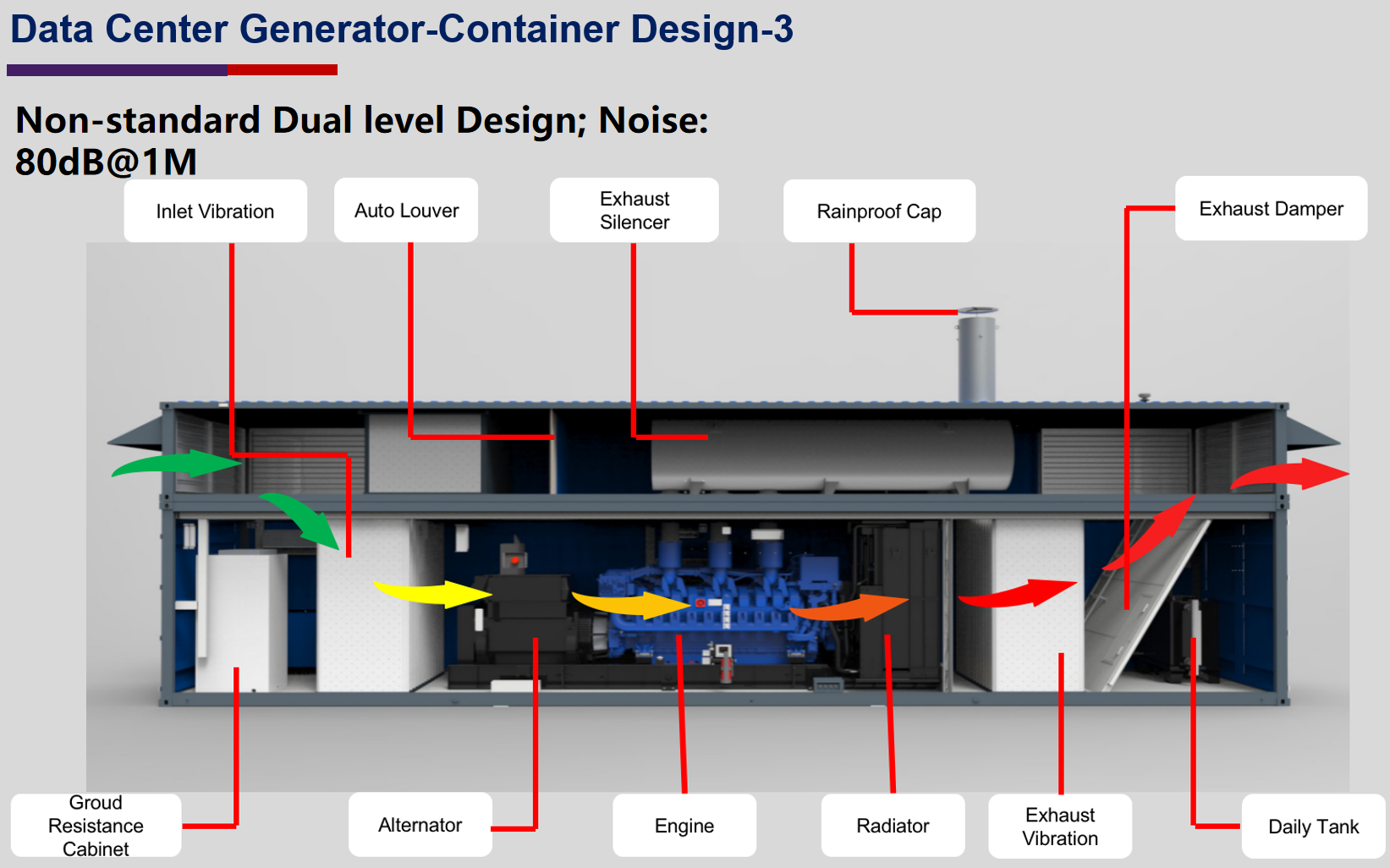
A containerized generator enclosure for data center duty, where container structure, acoustic treatment and ventilation must be resolved inside one ISO footprint.
Why 2MW+ Containerized Gensets Sit in a Different Compliance Category
Below roughly 1MW, the container is mostly packaging. Above 2MW, it becomes part of the power system. Radiator airflow, exhaust routing, fuel containment volume, high-voltage cable entry, control compartment separation and the lifting frame all turn into engineering decisions with compliance consequences, and those decisions are visible to an inspector, a third-party reviewer or a commissioning engineer.
The commercial pressure behind this is measurable. The global data center generator market is expected to reach USD 19.66 billion by 2030, driven by a CAGR of 15.15% from 2024 (Arizton Advisory & Intelligence). The broader diesel generator market was valued at approximately USD 22.33 billion in 2025 and is projected to reach USD 38.09 billion by 2034 (Fortune Business Insights). In China, exports of high-capacity diesel generator sets for data centers surged by 131.81% year-on-year in the first two months of 2026, according to customs data reported by China Daily.
Rapid volume growth in high-capacity containerized units means more projects are being awarded on price and lead time, and more of them will be audited later against the compliance documents that were supposed to support the order. The practical question for a decision-stage buyer is therefore not “does this supplier have certifications” but “which standard governs which part of my unit, and what evidence proves it.”
The Three Standard Layers Behind a 2MW+ Containerized Diesel Genset
Separating the layers prevents two common procurement mistakes: treating a container certificate as proof of electrical performance, and treating a performance test as proof of structural compliance.
| Standard layer | Representative standards | What it governs | What the buyer should receive |
|---|---|---|---|
| Machine and rating layer | ISO 8528; GB/T 2820; CE marking; EPA Tier 4 Final where applicable | Rating definitions such as Emergency Standby Power (ESP) and Continuous Operating Power (COP), performance, emissions treatment, marking | A rating declaration tied to a named standard, plus performance test data matching that rating |
| Container and structural layer | ISO 668 dimensional series; ISO 1496 container specification and testing series; CSC safety approval plate | Enclosure dimensions, structural strength, handling, lifting and transport safety | Container drawings, structural documentation, lifting point data, CSC plate reference |
| Emergency power system layer | NFPA 110 (Standard for Emergency and Standby Power Systems) | How the installed emergency or standby system is classified, installed, maintained and periodically tested over its service life | A system-level design basis and a maintenance and testing schedule that survives commissioning |
ISO 8528 is the primary international standard for reciprocating internal combustion engine driven alternating current generating sets, and it is the reference point for how ratings such as ESP and COP must be declared. NFPA 110 operates at a different level: it addresses the emergency power supply system as installed, including how it is classified and how it must be maintained and tested after handover. A unit can be fully compliant with ISO 8528 as a machine and still fail an NFPA 110 oriented review of the installation.
Emissions rules form a third track that buyers frequently conflate with the other two. EPA Tier 4 Final standards, effective since 2015, require a near-90% reduction in Particulate Matter (PM) and Nitrogen Oxides (NOx) for non-road diesel engines used in non-emergency applications. Because emergency standby duty is treated differently from non-emergency duty, the correct first step is to confirm which regulatory track the project falls under before comparing engine platforms at all.
Technical Explanation: How Compliance Requirements Reshape Container Design
Compliance requirements are not paperwork added after design. They push specific physical decisions:
- Fuel system containment. Secondary containment, spill control at fill points, and separation between fuel venting and the combustion air path are container-level decisions. On multi-megawatt units the fuel volume itself is significant, so base-tank geometry, level monitoring and leak detection are usually reviewed together with the structural design of the container floor.
- Control panel segregation. Power conductors and control wiring are routed in physically separate compartments, with separate thermal management for the control section. This is where high-voltage terminations, gland plates and cable entry positions are fixed — and where retrofit later becomes expensive.
- Ventilation versus acoustics. These two requirements pull in opposite directions, and the resolution defines the container type. MECCA POWER's non-standard dual-level container design is rated at 75–80 dB(A) at 1 metre, which the company states is 10–15 dB lower than a standard single-layer container design, achieved through an optimized ventilation layout rather than by de-rating the generator. The design is positioned for data centers in urban core areas, campus-style and high-density IDC facilities, Tier III and Tier IV finance, government and cloud sites, and projects near residential areas, schools or hospitals.
- Ambient adaptation. A second container variant addresses high-altitude, high-temperature, high-humidity and high-cold environments, with outdoor deployment described from −45 °C up to +55 °C, less maintenance and higher efficiency than a standard container build — at a higher cost.
- Structure and lifting. Once a containerized unit exceeds 2MW, lifting points and base-frame stiffness are safety-critical rather than logistical details. MECCA POWER's factory operates with a maximum lifting capacity of 45 tons and can support simultaneous production testing of three units exceeding 2000KW.
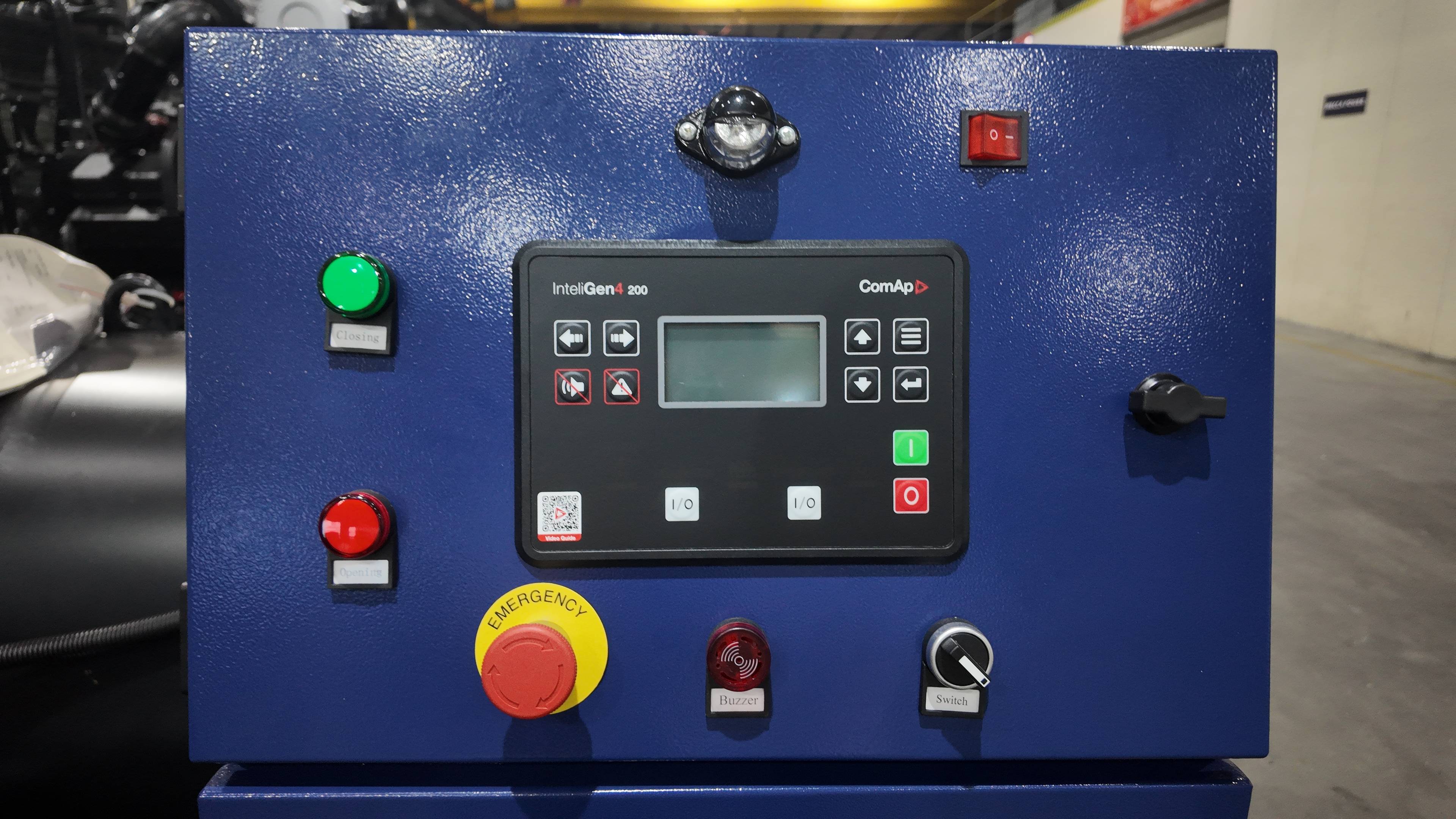
Control panel segregation: separating control wiring from power conductors is a design decision made at the container drawing stage, not at commissioning.
Verification: Compliance Checks Buyers Can Actually Run
The most useful buyer question is not whether certificates exist, but whether the evidence chain reaches the specific unit being purchased. A certificate issued for one rating does not automatically cover a different rating, and a container structural approval does not validate electrical protection settings.
| Check area | What to request | Evidence that holds up | Weak signal |
|---|---|---|---|
| Rating and performance | Rating declaration tied to ISO 8528 or GB/T 2820, stated as ESP or COP | Signed rating statement plus performance test data matching the ordered rating | Rating quoted only in marketing language, with no named standard |
| Emissions track | Confirmation of whether the project is emergency or non-emergency duty | Engine emission documentation matched to the specific engine model, for example EPA Tier 4 Final where non-emergency non-road rules apply | Generic statements that never name the engine model |
| Container and structure | Container drawings and structural documentation | Drawings, lifting point data and CSC plate reference consistent with unit weight | Dimension-only datasheets with no structural content |
| Factory testing | Full-item test record before shipment | No-load test, load test, parallel operation test, insulation withstand voltage test, protection interlock test, emission test and noise test, with report review before dispatch | “Factory tested” with no item list and no report |
| Design verification | Design review and simulation records | 3D simulation, thermal simulation and EMC simulation, plus matching tests across engine, generator and controller | Verbal assurance that the design is proven |
| Manufacturing traceability | Per-unit process quality file | Standard operating procedures for welding, assembly, wiring, anti-corrosion and noise reduction, supported by first-article, routine and final inspection records | No unit-level traceability after shipment |
| Safety systems | Protection function list and commissioning scope | Intelligent monitoring with automatic shutdown and fault locking for overload, overspeed, low oil pressure, high water temperature and leakage, plus on-site commissioning and operator training | A protection list limited to basic alarm functions |
MECCA POWER CO.,LTD. is a diesel generator manufacturer founded in 2013 with production based in Fujian and Jiangxi provinces, building generator sets from 10kVA to 4000kVA for export markets. Its design control process references GB/T 2820, ISO 8528 and CE, uses standardized design templates, and applies 3D, thermal and EMC simulation with a multi-round design review before component matching tests are run on the engine, generator and controller. On the manufacturing side, the process follows lean production with documented standard operating procedures for welding, assembly, wiring, anti-corrosion and noise reduction, backed by first-article, routine and final inspection.
Comparison: Open-Type, Standard Containerized, and Enhanced Container Builds
At decision stage, the more useful comparison is not between brands but between enclosure strategies, because the enclosure determines which compliance documentation is relevant.
| Dimension | Open-type genset | Standard containerized | Enhanced containerized |
|---|---|---|---|
| Enclosure | Requires on-site building or canopy | ISO-footprint container, single-layer design | Non-standard dual-level container design |
| Acoustic outcome | Depends entirely on the building | Reference level for the category | 75–80 dB(A) at 1 m, stated as 10–15 dB lower than standard single-layer design |
| Ambient range | Determined by site construction | Standard range | Outdoor use described from −45 °C to +55 °C |
| Maintenance access | Best access, largest footprint | Constrained by container walls | Easier routine maintenance than a standard single-layer design |
| Cost profile | Civil works plus longer site schedule | Baseline purchase cost | Slightly higher one-time cost, described as lower overall operating cost; the climate-adapted variant costs more than a standard container build |
| Handling | Multiple separate shipments | Standard container handling | Requires structural verification and adequate crane capacity — factory lifting capability reaches 45 tons |
The limits matter as much as the benefits. An enhanced container is not automatically the correct answer: it carries a purchase cost premium over a standard container build, it still constrains maintenance access compared with a walk-in plant room, and it raises the handling requirement at the site gate. A standard container unit cannot be expected to match a climate-adapted variant in extreme cold or high altitude, and no enclosure decision compensates for a rating that was declared against the wrong operating mode.
Application: 2000KW and 2500KW Reference Scenarios
The compliance conversation changes with the application, even at the same nameplate rating.
Data centers. A 2000KW, 2.2MW, 2500KW or 3MW containerized unit is typically part of a paralleled group, so protection interlock testing and parallel operation testing move to the front of the verification list. Where the site sits in an urban core or near sensitive receptors, the dual-level low-noise container becomes relevant because acoustic performance, not structural certification, is the binding constraint. Where the facility is classified at Tier III or Tier IV, the maintenance access path inside the container also becomes a reviewable item.
Mining and oil & gas. Remote heavy-duty sites trade acoustic requirements for ambient resilience. Here the climate-adapted container variant matters, and fuel containment design is judged against site spill-control expectations rather than urban noise ordinances.
EPC and turnkey projects. On a 50MW-class plant built from multiple large units, compliance is assessed at system level: paralleling behaviour, load bank testing, and the consistency of documentation across every unit in the batch. MECCA POWER's production structure is relevant to this pattern — three specialized lines covering container, open-type and mixed assembly; six testing stations with digital tightening, intelligent oil and water filling, and cloud-based process data managed through APS and MES systems; and a Nanchang plant focused on 1000kW and above, where monthly output rose from 132 to 212 units. Engine and component relationships include Cummins, Perkins, MTU, Mitsubishi/SME, FPT, VOLVO and Baudouin for engines, and Stamford, Leroy Somer, Mecc Alte, DeepSea and ComAp for alternators and controls.
Market Direction: Compliance Documentation Is Becoming a Procurement Gate
Two trends are pushing documentation quality upward. The first is demand concentration: with the data center generator segment growing at a 15.15% CAGR toward USD 19.66 billion by 2030, and global diesel generator revenue projected to move from roughly USD 22.33 billion in 2025 toward USD 38.09 billion by 2034, buyers are placing larger orders with fewer suppliers, which raises the cost of a documentation failure. The second is supply-side shift: the 131.81% year-on-year growth in China's exports of high-capacity gensets for data centers in the first two months of 2026 shows how quickly capacity has moved toward 2MW+ containerized products.
The industrial generator market includes long-established global manufacturers such as Caterpillar Inc., Cummins Inc., Generac Holdings and Kohler Co., alongside specialized OEMs serving export projects. For a decision-stage buyer, the practical consequence is that compliance evidence — not brand origin — is the differentiator that can be verified before payment.
Limits: What Compliance Documentation Does Not Guarantee
- Documentation is not site acceptance. Local authorities, insurers and commissioning engineers apply their own review, and NFPA 110 obligations continue after handover through maintenance and periodic testing.
- Certification scope is rating-specific. Evidence issued for one rating or one engine platform does not extend automatically to a different configuration.
- Container structural compliance does not validate electrical protection settings or control logic.
- Enhanced container designs carry a cost premium and a handling requirement that standard containers do not, and they still constrain maintenance space compared with a walk-in building.
- Verification depends on access. Buyers who do not request test records, simulation records and unit-level traceability files during the tender stage typically receive less of them after the order is placed.
Future Outlook
Three developments are likely to shape how 2MW+ containerized generators are specified over the next procurement cycles. Emissions rules will continue to tighten for non-emergency duty, which will make the emergency versus non-emergency distinction a front-end contract question rather than a late compliance check. Data center build-out will keep pushing acoustic and ambient requirements into the container design itself, favouring enclosure strategies that solve ventilation and noise simultaneously. And documentation will keep moving toward digital traceability, with unit-level process records becoming a normal part of the tender package rather than an exception. Buyers who build verification into the specification stage will find the commissioning stage considerably shorter.
FAQ
What is the difference between ISO 8528 and NFPA 110 for a 2MW containerized generator?
ISO 8528 is the primary international standard for reciprocating internal combustion engine driven alternating current generating sets and defines how ratings such as Emergency Standby Power and Continuous Operating Power are declared. NFPA 110 is the Standard for Emergency and Standby Power Systems and addresses the installed system, including classification, installation, maintenance and periodic testing. A unit can conform to ISO 8528 as a machine and still require further work to satisfy an NFPA 110 based review of the installation.
Does a containerized diesel generator need ISO container certification?
The container itself is a transport and structural item, and container-related requirements typically reference the ISO 668 dimensional series, the ISO 1496 container specification and testing series, and the CSC safety approval plate under the International Convention for Safe Containers. These address dimensions, structural strength and safe handling. They do not cover the electrical performance, protection settings or emissions behaviour of the generator inside, which are handled by the machine and system layers instead.
How can a buyer verify a supplier's compliance claim for a 2500KW unit?
Ask for evidence that reaches the specific unit. That normally means a rating declaration naming the standard applied, performance test data, container drawings with lifting point data, and a full-item factory test record covering no-load, load, parallel operation, insulation withstand voltage, protection interlock, emission and noise tests. Design simulation records and unit-level process quality files strengthen the position further, because they show the evidence is traceable to production rather than to a template.
What changes in container design above 2MW?
Several items become structural rather than cosmetic: fuel system containment and spill control at fill points, physical separation of power conductors from control wiring, thermal management of the control compartment, ventilation balanced against acoustic treatment, and lifting frames rated for the assembled weight. Factory lifting capability in the 45-ton range and the ability to test multiple units above 2000KW simultaneously are indicators of whether a supplier can handle this class of build.
Can a standard containerized genset be used at high-altitude or extreme-cold sites?
A standard container build is not designed for that duty. Enhanced container variants exist specifically for high-altitude, high-temperature, high-humidity and high-cold environments, with outdoor deployment described from −45 °C to +55 °C, less maintenance and higher efficiency — at a higher cost than a standard container build. The trade-off should be evaluated against the actual site envelope rather than assumed.
Which compliance documents should be requested before signing a 2MW+ contract?
A practical minimum set includes the rating declaration against a named standard, engine emission documentation matched to the specific engine model, container drawings and structural documentation, the factory full-item test report format, design review and simulation records, and the unit-level traceability plan. Confirming which regulatory track applies — emergency or non-emergency duty — belongs at the start of this process, because it determines which emissions documentation is even relevant.
For readers who need the underlying technical parameters and configuration options before the next tender round, MECCA POWER's product brochure is available here: MECCA POWER brochure (PDF).