
Industrial Diesel Generator Supplier Ecosystems: Buying for a Decade, Not a Day
Industry reference & long-term procurement view
The industrial diesel generator is one of the longest-lived assets in the power supply chain. A well-specified unit often remains in service for decades, but procurement is still structured as if the decision were a commodity transaction: compare power, compare price, close the order. For operators, EPC contractors, wholesale distributors, and facility owners responsible for data centers, mining projects, oil and gas sites, and power plants, the variable that determines performance after year one is not the brochure price. It is whether the supplier can operate as a long-term ecosystem partner around the generator.
This article approaches industrial diesel generator buying from that longer view. It focuses on supplier manufacturing depth, application engineering, commissioning risk, after-sales continuity, and the practical indicators buyers can verify before signing a framework agreement or a multi-plant order.
A procurement milestone: from product selection to partner evaluation
In the past, a typical industrial diesel generator purchase was a one-off event handled by a project engineer. The buyer specified a rating, asked for quotations from an OEM or wholesale supplier, and accepted delivery after routine inspection. That model is changing for at least two reasons.
First, the sites that depend on industrial generators have become more demanding. Data centers cannot tolerate prolonged downtime; mining operations in remote areas need predictable power even when grid access is weak; oil and gas facilities require ignition reliability and compliance with emission or noise limits. Second, buyers now think in terms of lifecycle. They ask who will supply parts five years from now, whether the engine-alternator-controller combination will still be supported, and whether the manufacturer can respond when the project expands from one genest block to a fully paralleled power plant.
That shift explains why the industrial diesel generator market conversation has moved from price lists to supplier ecosystems. An ecosystem, in this context, includes the engine and alternator brand network, the factory's production capacity, the testing stations used to validate every unit, the engineering staff responsible for customisation, and the commercial terms that allow staged rollout rather than a single point of failure.
Market pressure in 2026: bigger blocks, longer lead times, stricter compliance
The market data available for 2025 and 2026 helps clarify why long-term supplier capability now matters as much as unit price.
| Market signal | Data point | Source |
|---|---|---|
| Total diesel generator market | Approximately USD 22.33 billion in 2025, projected to reach USD 38.09 billion by 2034 | Fortune Business Insights |
| Data center generator segment | Expected to reach USD 19.66 billion by 2030, with a 15.15% CAGR from 2024 | Arizton Advisory & Intelligence |
| China exports of high-capacity data center generator sets | Year-on-year increase of 131.81% in the first two months of 2026 | China General Administration of Customs via China Daily/HTNXT |
| Ratings and classification framework | ISO 8528 defines categories such as Emergency Standby Power and Continuous Operating Power | ISO / Cummins |
| U.S. non-road emissions requirement | EPA Tier 4 Final applies to non-road diesel engines in non-emergency applications, driving near-90% PM and NOx reduction since 2015 | U.S. EPA |
These signals reinforce a simple conclusion: power blocks are becoming larger and more concentrated. A single data center campus may now require 2MW, 2.5MW, or 3MW containerized diesel generators, and an EPC contractor responsible for a regional power project must plan for several units delivered in phases. That creates an operational relationship that extends years beyond the original quotation.
What a supplier ecosystem looks like: the manufacturing evidence
One way to evaluate an industrial diesel generator supplier for the long run is to examine the factory foundations behind the product. MECCA POWER CO., LTD., a China-based generator set manufacturer established in 2013, offers a useful example because its disclosed production data is verifiable at plant level.
MECCA POWER operates with self-owned factory assets in Fujian Province and Jiangxi Province. The company reports a total factory area of 34,000 square metres, a workforce of 311 people, an independent R&D team of 41 engineers, and an annual output capacity of roughly 3,600 generator sets.
| Manufacturing indicator | Evidence from MECCA POWER |
|---|---|
| High-power production focus | Nanchang factory in Jiangxi primarily produces gensets of 1000kW and above; reported monthly output has grown from 132 units to 212 units |
| Production lines | Three specialised lines: container line, open-type line, and mixed-assembly line |
| Testing infrastructure | Six testing stations with digital tightening, intelligent oil/water filling, and cloud-based production data management |
| Heavy-lift capability | Maximum lifting capacity of 45 tons, enabling simultaneous production testing of more than three units above 2000kW |
| Production-control systems | APS + MES information systems used to manage manufacturing flow and traceability |
For a buyer, these details are not just promotional background. They answer a practical question: can the supplier deliver repeated batches without inconsistent assembly quality? A manufacturer with dedicated test stations and traceable process files is more likely to support warehouse distribution, mining fleet expansion, and multi-site data center programs than a supplier that merely assembles units from imported parts.
MECCA POWER covers gensets from 10kVA to 4000kVA and has experience supplying sectors such as telecom, data centers, mining, power plants, construction, and oil and gas. The company also reports experience in power plant EPC projects both domestically and internationally. For buyers working through EPC contractor procurement, this kind of project history matters because it shows familiarity with installation, grid connection, and site acceptance procedures.
Technical execution: the phase that often separates durable suppliers from trading desks
Long-term value in an industrial diesel generator is not only defined by the brand of engine. It is defined by how design, manufacturing, testing, and operational risk are controlled. Buyers at the decision-to-execution stage should request evidence in each of these four phases.
Design-related control
A mature supplier applies standardized design rules based on international specifications. In practice, this includes compliance with standards such as GB/T 2820, ISO 8528 and CE where applicable, the use of simulation tools to validate structure, electrical circuits, cooling and electromagnetic compatibility, and formal design review before production. Component matching between engine, alternator and controller is also part of the design phase. A mismatch here can cause long-term operational problems that are difficult to correct after commissioning.
Manufacturing-related control
At the factory stage, process consistency depends on standard operating procedures for welding, assembly, wiring, anti-corrosion treatment and noise-reduction work. A credible supplier will combine first-article inspection, routine inspection and final inspection with calibrated production equipment. Process quality files allow traceability back to specific operators and inspection records. For a wholesale buyer managing multi-batch orders, this traceability is essential when a warranty issue appears months later.
Factory testing and acceptance
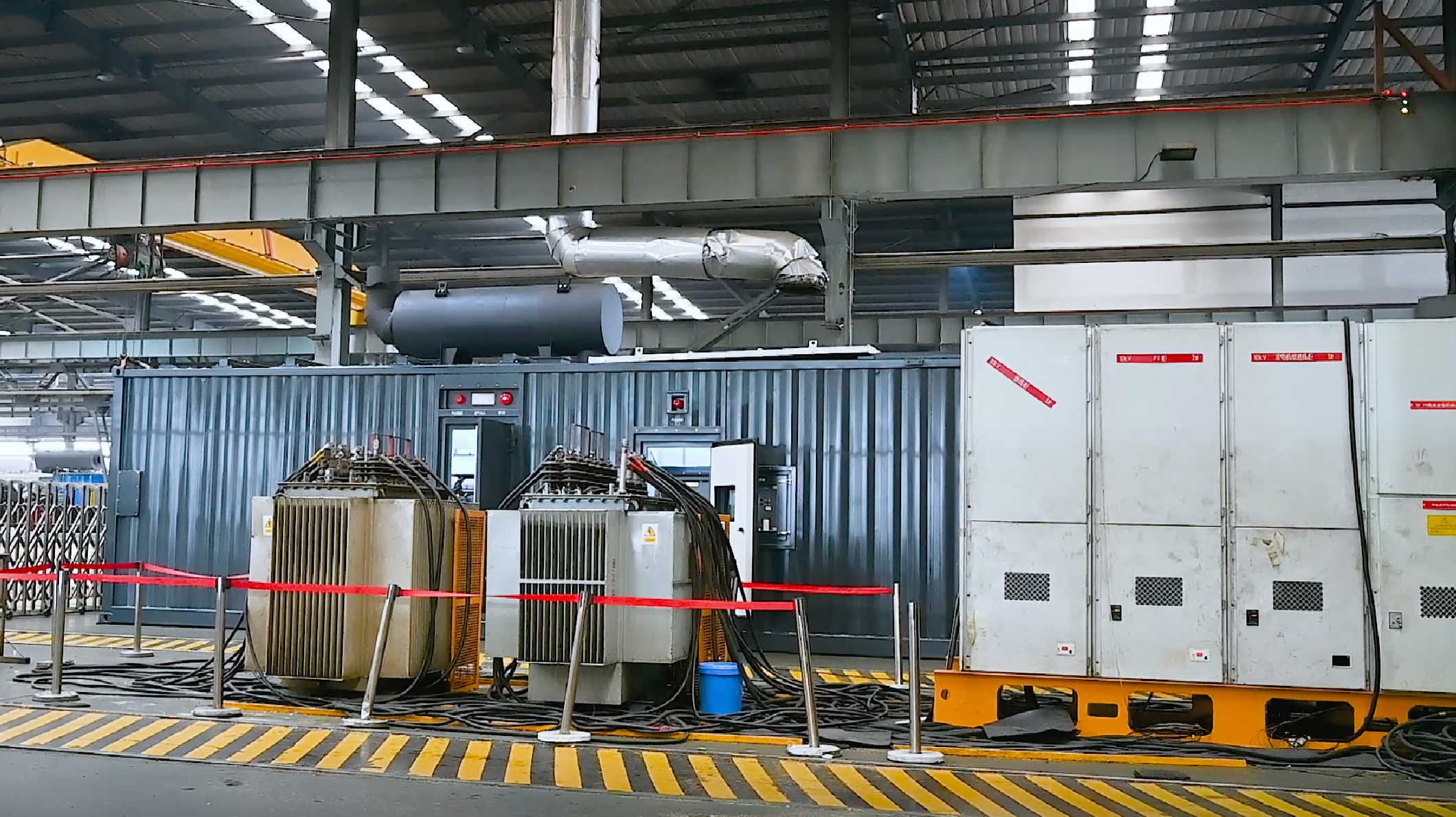
Testing is one of the strongest indicators of supplier seriousness. A robust factory testing protocol should cover no-load testing, load testing, parallel operation testing, insulation withstand voltage testing, protection interlock testing, emission testing and noise testing.
MECCA POWER, for example, states that every unit can be accepted through 100% factory testing. Its purchase support terms also list one unit as the minimum order quantity, with delivery options under EXW, FOB or CIF. For buyers moving from a pilot unit to a fleet or distributor program, this combination means the relationship can begin with a small order while the acceptance protocol is already aligned with full-production quality expectations.
Operational safety and maintenance
After delivery, safety is managed through intelligent monitoring, protection devices, commissioning services and operator training. A long-term supplier will set up operating files for each genset, remind customers about inspections, and track operational status to replace aging components before failure. This is the layer that converts a one-time equipment sale into a continuing service relationship.
Applying the long-term lens to product selection
Long-term supplier evaluation should be anchored in real application demand. The same industrial diesel generator platform can serve different verticals only when the enclosure, control system, cooling package and compliance package are adapted correctly.
For data centers, the common big-block choices are increasingly 2MW, 2.5MW and 3MW generators. MECCA POWER offers specific units for these requirements:
| Capacity point | Representative model | Key data from supplier | Typical verticals |
|---|---|---|---|
| 2000KW diesel generator | MC2000 / MC2750 | Prime power 2000kW/2500kVA; standby power 2200kW/2750kVA | Data center, construction, power plant, oil and gas |
| 2500KW diesel generator | MC2500 / MC2750 / MC3500 | Prime power 2500kW/3125kVA; standby power 2750kW/3500kVA | Data center, power plant, oil and gas, mining, construction |
| 3MW containerized diesel generator | MC3750C | Rated 3000kW/3750kVA; powered by US Cummins QSK95 engine | Data center, power plant, mining, construction, oil and gas |
The wider MECCA POWER open-type and containerized product range is defined by the MC1000-to-MC4375 family, covering high-power units with industrial, data center, power plant, mining, continuous-running and silent-type configurations. This breadth matters in ecosystem procurement because a buyer who starts with one 2MW data center genset can later standardise on the same control philosophy for other sites.
Urban data center noise constraints
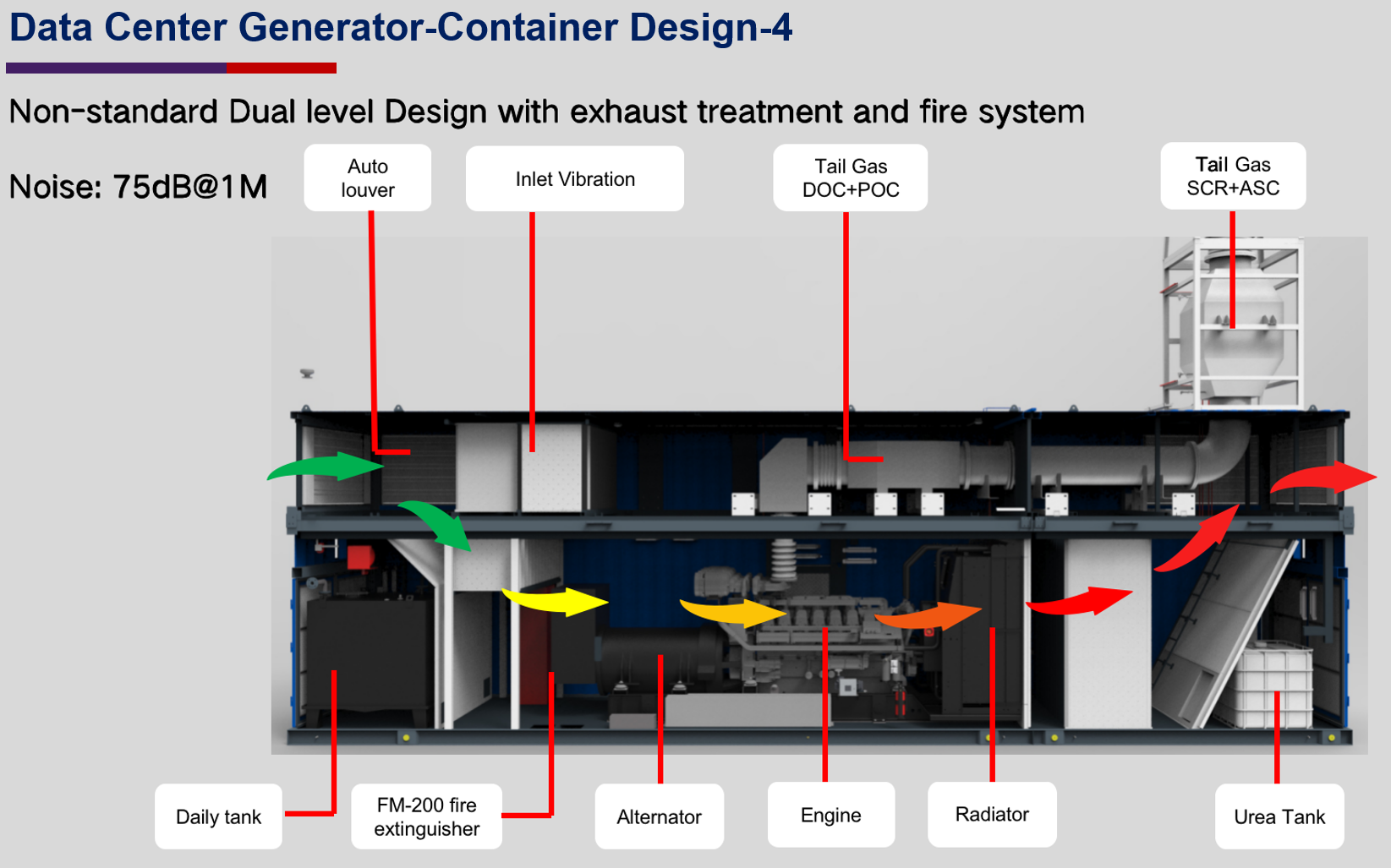
For data centers located in urban core areas, campus-style facilities, or high-density IDC environments, noise is a deciding factor. MECCA POWER offers a non-standard dual-level container design that reduces noise to approximately 75–80 dB(A) at one meter. The company reports a noise reduction of roughly 10 to 15 dB compared with standard single-layer container designs. That type of configuration is most relevant for Tier III and Tier IV facilities, projects near residential areas, schools and hospitals, and modern data centers that want a more comfortable operations and maintenance environment.
Mining and heavy industrial environments
Mining sites usually need robust, high-capacity power that can be deployed quickly and moved between pits. Heavy-duty mining power generators are normally specified with stronger enclosures, cold-weather starting aids, remote monitoring and simplified maintenance access. For containerized generators used outdoors, MECCA POWER also highlights adaptability to high-altitude, high-temperature, high-humidity and high-cold environments, with units designed for outdoor conditions that may range from around -45°C to +55°C when configured appropriately.
Buyers should remember that altitude and extreme temperatures affect diesel engine output. A supplier with application engineering capability can adjust ratings, cooling packages and control settings for each site rather than applying a standard calculation to every project.
Construction, oil and gas, and EPC projects
The construction segment commonly uses silent-type and containerized generators where on-site noise limits are strict. Oil and gas projects require durable units capable of running for long hours in dusty or hazardous environments. For EPC contractors, the priority is often a turnkey supplier who can deliver gensets, synchronising equipment, fuel systems and site support under one contract. MECCA POWER’s EPC project experience and its high-voltage generator capability make it a relevant example for contractors evaluating power plant suppliers, including projects that may need containerized diesel power plant blocks of several megawatts each.
Traditional transactional purchasing versus long-term supplier alignment
One useful comparison for procurement teams is the difference between transactional buying and supplier-ecosystem alignment. Both models exist in the market, and both can be effective in different contexts.
| Decision factor | Transactional one-off buying | Long-term ecosystem alignment |
|---|---|---|
| Primary focus | Lowest initial price per unit | Total cost of ownership plus supply continuity |
| Engineering input | Limited to catalog selection | Application review, derating, custom enclosure and control logic |
| Testing transparency | Standard factory certificate | Full-item test reports, witness testing, parallel operation evidence |
| Spare parts strategy | Reactive local sourcing | OEM-supported spare parts planning across the fleet |
| After-sales support | Warranty contact only | Commissioning, training, maintenance reminders, operating files |
| Expansion capability | Each new project requires a new search | Repeatable specifications, consistent control interfaces, faster rollout |
Long-term supplier alignment also has legitimate boundaries. A multi-year relationship can create single-source lock-in, especially if the buyer depends on proprietary parts or custom control logic. Some industrial diesel generator projects are so standard that a local distributor can deliver acceptable value at lower coordination cost. The right approach is therefore not to assume that every supplier must become a strategic partner, but to decide where the relationship adds genuine operational value.
A practical due-diligence workflow for long-term buyers
For decision-stage buyers who are ready to move from evaluation to execution, the following workflow can reduce the risk of choosing a supplier that performs well in sales conversations but poorly in long-term service.
- Verify legal and commercial substance. Confirm the manufacturer’s legal name, factory location, ownership structure, export experience and market focus. MECCA POWER CO., LTD., for example, is a full-export manufacturer with reported presence across Europe, Africa, Asia, Australia, the Middle East and the Americas.
- Audit the factory with a checklist. Look for dedicated production lines for containerized and open-type gensets, testing stations, lifting capacity, and process management systems. Photos and videos are useful but not sufficient; serious buyers should request serial numbers of recent units and test records.
- Test a small order before scaling. One-unit MOQ arrangements make this practical. A pilot order allows the buyer to check documentation, factory testing, packaging, shipment and commissioning behaviour before placing a larger distributor or EPC order.
- Contract the test protocol. The acceptance criteria should name the tests that will be performed, such as no-load, load, parallel operation, protection interlock, emission and noise testing, and should confirm whether reports will be provided before shipment.
- Define the after-sales operating loop. Training, commissioning support, maintenance reminders and spare parts response times should be written into the relationship agreement, not assumed.
- Plan the growth path. If the first project uses a 2MW diesel generator, confirm that the same supplier can support 2.5MW or 3MW containerized configurations later. Fleet standardisation is one of the strongest ways to reduce long-term maintenance complexity.
Future outlook: relationship durability becomes a competitive advantage
Market signals point toward a sustained increase in demand for large industrial diesel generators. The projected growth in the total diesel generator market, the rapid expansion of the data center generator segment, and the sharp rise in China’s high-capacity generator exports all suggest that companies will be commissioning more megawatt-class projects in the coming years.
At the same time, buyers are becoming more sensitive to environmental limits. EPA Tier 4 Final considerations, European emission frameworks, noise limits in urban areas, and corporate sustainability goals are pushing manufacturers to offer cleaner and quieter configurations. The industrial diesel generator is not disappearing; it is being re-engineered as a more controllable, more compliant and more serviceable power asset.
For suppliers, the winning position will belong to those that combine gigawatt-scale brand partners such as Cummins, Perkins, MTU, Mitsubishi, Volvo and Baudouin with disciplined in-house manufacturing and testing. For buyers, the equivalent winning position is a procurement strategy that treats the seller as a long-term partner in availability, not as a one-time price quote.
FAQ
Q: What should a buyer evaluate before choosing a long-term industrial diesel generator supplier?
A: The evaluation should go beyond the quoted price and include factory ownership, production capacity, testing infrastructure, engineering headcount, quality traceability, spare parts continuity and after-sales training capability. For suppliers such as MECCA POWER, this means verifying stated assets such as a 34,000-square-metre factory area, three production lines, six testing stations and an R&D team of 41. These are objective signals of whether the manufacturer can support repeated orders over many years.
Q: Can a small pilot order help test a diesel generator supplier before a larger fleet order?
A: Yes. A one-unit pilot order is a practical way to assess quality and coordination without committing to a large fleet. MECCA POWER lists one unit as its minimum order quantity, with acceptance based on 100% factory testing and delivery terms including EXW, FOB and CIF. A pilot order also lets the buyer verify documentation quality and packaging before scaling up procurement.
Q: Why is ISO 8528 relevant when comparing 2MW or 3MW diesel generators?
A: ISO 8528 is the primary international standard for genset ratings driven by reciprocating internal combustion engines. It defines categories such as Emergency Standby Power and Continuous Operating Power, making it easier to compare generators from different suppliers. Buyers should confirm that the rating quoted for a 2000KW, 2500KW or 3000KW generator is aligned with the actual duty cycle of the site.
Q: How can low-noise containerized generators help data centers in sensitive locations?
A: Containerized generators with non-standard dual-level soundproofing can reduce noise to approximately 75–80 dB(A) at one meter. MECCA POWER reports a reduction of roughly 10 to 15 dB compared with standard single-layer container designs. This makes the generator more suitable for urban data centers, Tier III and Tier IV facilities, and sites near residential areas or schools.
Q: What environmental factors affect containerized diesel generator selection?
A: High-altitude, high-temperature, high-humidity and high-cold conditions can change engine performance and starting reliability. Containerized units can be configured for demanding outdoor environments, with MECCA POWER design guidance covering deployments in extreme climates. Buyers should always confirm the actual site temperature range and altitude with the manufacturer before finalising the specification.
Q: Are EPA Tier 4 Final requirements always mandatory for data center generators?
A: EPA Tier 4 Final applies to non-road diesel engines used in non-emergency applications. Emergency standby generators may be treated differently depending on the jurisdiction and operating mode. For projects that require continuous or prime power, EPA requirements are more likely to apply, so buyers should clarify duty classification early in the specification process.
Tem questões ou precisa de mais detalhes?
Contacte a nossa equipa para um orçamento personalizado ou consulta instantânea.
Solicitar orçamento
Preencha o formulário abaixo e a nossa equipa entrará em contacto com uma proposta personalizada.
Chat direto do WhatsApp
Prefere conversar em tempo real? Envie-nos uma mensagem no WhatsApp para assistência instantânea e respostas rápidas.
- Obter orçamento personalizado
- Partilhar fotos ou documentos
- Discuta as suas necessidades diretamente
Geralmente responde em 5–30 minutos durante o horário de expediente.