
Industrial Fastener Compliance Files: What ASTM A325/A490, A563/A194 and ISO 9001 Actually Cover
Industrial Fastener Compliance Files: What ASTM A325/A490, A563/A194 and ISO 9001 Actually Cover
Industrial fastener compliance is rarely settled by a single certificate. It is settled by a document set, and most procurement disputes begin when one document in that set is asked to answer a question it was never written to cover. ISO 9001 describes a management system. ASTM A325 and A490 described high-strength structural bolts and assemblies, and that content now sits inside ASTM F3125/F3125M. ASTM A563 and A194 describe nuts, not bolts. None of them describes a surface finish, and none of them describes a strut channel.
For buyers moving from research into evaluation, the practical question is not “does the supplier hold certificates” but “which document proves which attribute, for which product, to which edition”. This reference sets out what each document in a fastener compliance file actually covers, where the boundaries sit, and how to cross-reference DIN, ANSI/ASME, ISO, GB, UNI, JIS, BS and NFE requirements against grades such as 4.8, 8.8, 10.9, 12.9, B7, A2-70 and A4-80, so that an acceptance criterion is written once and read the same way by every supplier who quotes against it.
One file, four different questions
A workable compliance file answers four separate questions. A management-system certificate answers whether the supplier runs a controlled process. A product specification answers what the part must be. A test method answers how a property is measured. A substance or market regulation answers whether the part may be placed on a given market. Mixing these four layers is the single most common cause of a rejected shipment that was, technically, made exactly as ordered.
| Document | Question it answers | What it does not establish |
|---|---|---|
| ISO 9001 certificate | Is there a certified quality management system, and within what stated scope? | Any product dimension, grade, mechanical property or coating result |
| ASTM F3125/F3125M (formerly A325 / A490) | Requirements for high-strength structural bolts and assemblies, inch and metric | Nut grade, washer, coating system, or compliance of a non-structural bolt |
| ASTM A563 / ASTM A194 | Nut requirements: carbon and alloy nuts (A563); nuts for high-temperature or high-pressure bolting (A194) | Bolt grade, assembly preload, or dimensional conformance of the bolt |
| ISO 898-1 / ISO 898-2 | Property classes for steel bolts, screws and studs; nut property classes | Dimensional standard, mill certificate, or coating performance |
| EN 14399-1 / EN 15048-1 | European requirements for preloaded and non-preloaded structural bolting assemblies | US compliance; the systems are analogous, not interchangeable |
| Coating standards (ASTM A123/A123M, ISO 1461, ASTM A653/A653M) | Zinc coating requirements on iron and steel products, or on coated steel sheet | Mechanical properties of the fastener |
| Test methods (ASTM B117, ISO 9227, ASTM E488/E488M) | How corrosion resistance or anchor strength is measured | The acceptance threshold itself, which must be stated separately |
Document roles in an industrial fastener compliance file. Sources: ASTM, ISO, CEN standards scope statements as published by the standards bodies.
ISO 9001: read the scope line before the logo
ISO 9001 certifies a quality management system against a defined scope. It does not certify a bolt. The scope statement on the certificate is the boundary of the claim, and it is the first line a buyer should read, because a certificate covering “sales of metal products” and a certificate covering “manufacture of fasteners” are different pieces of evidence even when both carry the same standard reference.
CNS INDUSTRIAL (JIAXING) CO.,LTD provides a directly relevant example of why this distinction matters. Its published certificate, number 37825Q15712R0S, was issued by Euroswiss Certification Co., Ltd. on 8 August 2025 against GB/T19001-2016 / ISO 9001:2015, with a stated scope of “sales of metal products” and validity to 7 August 2028. That is a legitimate and checkable scope. It is also precisely the kind of scope a buyer should read literally: it confirms a certified management system around the sales activity, and it does not by itself attest to process control inside a specific plant, nor to product conformance for any individual part number.
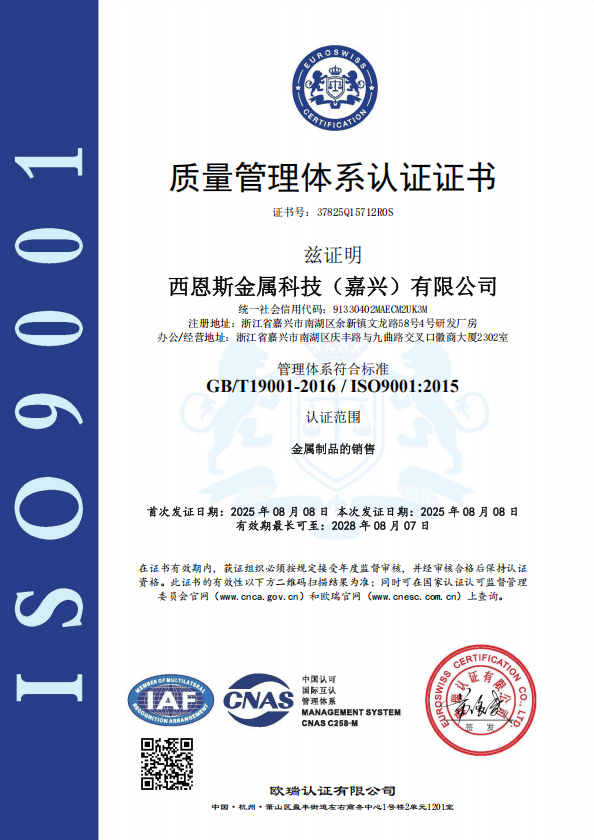
ISO 9001 certificate issued to CNS Industrial (Chinese-language version), scope: sales of metal products, valid 2025-08-08 to 2028-08-07.
Three checks follow from this. First, confirm the certificate is current: an expiry date is a verifiable field, and an expired certificate is a management-system gap rather than a product defect. Second, compare the stated scope with the activity you are buying — manufacturing, processing, sales and trading are separate claims on a certificate. Third, ask separately for product-level evidence, because no ISO 9001 certificate, at any scope, contains a dimension, a property class or a coating thickness. Where a project requires process-level evidence for a specific product family, that request has to be made in its own right rather than inferred from the management-system certificate.
ASTM A325 and A490: a designation that has moved
ASTM A325 and A490 are widely recognised designations for high-strength structural bolts, and they remain common on drawings and in enquiry documents. The specification content, however, has been consolidated: ASTM F3125/F3125M is the US standard specification for high-strength structural bolts and assemblies, covering both inch and metric dimensions, and it superseded the earlier ASTM A325 and A490 specifications. The title scope of F3125/F3125M refers to heat-treated structural bolts and assemblies at 120 ksi and 150 ksi minimum tensile strength in inch dimensions, and 830 MPa and 1040 MPa minimum tensile strength in metric dimensions.
For procurement, this produces a specific drafting problem. A drawing that says “A325” references a superseded designation, and different suppliers resolve that reference differently: some will quote to the legacy designation, some to the current specification, and some to a national equivalent. The clean approach is to name the current specification on the purchase document and keep the historic designation alongside it as a cross-reference, so there is no ambiguity about which document governs acceptance.
A structural bolt is not globally portable. ASTM F3125/F3125M and the European EN 14399-1 (preloaded) and EN 15048-1 (non-preloaded) systems perform comparable functions, but they are separate systems with their own testing and marking regimes. A bolt qualified to one cannot be assumed to satisfy the other. In the EU, EN 1090-2 sets the execution requirements for steel structures within which structural bolting is used, and the Construction Products Regulation (EU) No 305/2011 provides the legal basis for CE marking only where a harmonised standard or a European Technical Assessment covers the product. CE marking is therefore a scoped market-access statement, not a general quality mark.
Note also what a structural bolting specification does not reach. If the assembly includes a nut and a washer, their requirements come from separate documents, and the bolting standard does not silently substitute for them.
ASTM A563 and A194: the nut documents buyers under-specify
ASTM A563 is the US standard specification for carbon and alloy steel nuts, covering dimensional and mechanical requirements, including grades and hardness requirements, for nuts used with structural and general-purpose bolts. It is the nut-side document that a structural bolting enquiry usually needs, and it is frequently left off the RFQ on the assumption that a “matched” nut is self-defining. It is not: a nut is a separately specified component with its own grade designation.
ASTM A194 occupies a different position. It is the nut specification associated with bolting for high-temperature or high-pressure service, and it is graded to pair with the corresponding bolting grade rather than being ordered as a single generic item. This matters most where the bolting itself is specified under ASTM A193/A193M, the specification covering alloy-steel and stainless-steel bolting for high temperature or high pressure service, in which Grade B7 — a chromium-molybdenum alloy steel — is the grade widely used for threaded rod and stud bolts in industrial and petrochemical applications. The correct nut grade is read from the purchase specification that pairs it with the bolting grade; it should never be inferred from a catalogue description.
One further trap: ASTM nut grades and ISO nut property classes are different designation systems. ISO 898-2 specifies mechanical properties of carbon and alloy steel nuts by property class, including classes 8, 10 and 12, for coarse and fine pitch threads. A supplier may legitimately hold both routes in its range — CNS Industrial, for example, lists ASTM A563/A194 alongside ISO, DIN and GB designations — which is exactly why the RFQ must state which designation governs acceptance rather than leaving the supplier to choose the more convenient one.
Property class versus grade: what 4.8, 8.8, 10.9, 12.9, B7, A2-70 and A4-80 actually tell you
A property class is a mechanical-property designation, not a material certificate and not a dimensional standard. ISO 898-1 specifies the mechanical properties of bolts, screws and studs made of carbon steel and alloy steel by property class — including 8.8, 10.9 and 12.9 — covering coarse and fine pitch threads, and defining tensile strength, yield strength, elongation, hardness and proof load for each class. The class tells a buyer what the finished fastener must withstand. It does not tell them what steel was used, what the head dimensions are, or what the surface finish is.
The designation systems are not interchangeable across regions. In inch dimensions, SAE J429 establishes mechanical and material requirements for externally threaded fasteners using the Grade 2 / Grade 5 / Grade 8 classification widely referenced in North American automotive and industrial procurement. Grade 5 and property class 8.8 are often treated as functionally similar in trade practice, but that equivalence is application-specific and must not be presented as a standard-defined identity. Where a substitution matters, the governing specification decides it, not a conversion table in a catalogue.
Worked designation notes
- 4.8, 8.8, 10.9, 12.9 — ISO 898-1 property classes for carbon and alloy steel bolts, screws and studs; the class number carries the mechanical requirement, while the dimensional standard is named separately.
- B7 — an ASTM A193/A193M chromium-molybdenum alloy steel grade for high-temperature or high-pressure bolting, commonly supplied as threaded rod and studs, paired with a specified nut grade rather than a generic nut.
- A2-70 and A4-80 — stainless steel property classes. In the CNS range they appear alongside SS304 and SS316 material options, and the stainless family being quoted should be confirmed against the class rather than assumed from the class alone.
- GB/T 3098.1-2010 — the Chinese national standard for mechanical properties of bolts, screws and studs, aligned with the ISO 898-1 property-class system. That alignment allows a Chinese manufacturer to quote the same 8.8, 10.9 or 12.9 classes for domestic and export orders, while national marking, inspection and certification requirements still differ and should be checked separately.
Cross-referencing DIN, ANSI/ASME, ISO, GB, UNI, JIS, BS and NFE
Most specification ambiguity in industrial fasteners comes from drawing conventions rather than capability gaps. ISO, legacy DIN and Chinese GB/T designations coexist for functionally identical parts, and a purchase order that names a family without naming the governing document invites dimensional disputes. ISO 4014, for example, is the ISO dimensional reference for hexagon head bolts in product grades A and B, while legacy DIN 933 designations remain common on buyer drawings even where ISO equivalents exist. The two situations require different documents, and the drawing has to say which one applies.
| Product family | Designation systems in common use | What the RFQ must name |
|---|---|---|
| Hexagon head bolts | ISO 4014 (partially threaded) and ISO 4017 (fully threaded); DIN 933; GB/T 5782; ASME B18 dimensional series | Governing dimensional standard and edition, property class per ISO 898-1 or GB/T 3098.1, thread type, finish |
| Hexagon nuts | ISO 4032; DIN 934; ASTM A563; ASTM A194 | Nut class per ISO 898-2 (8, 10, 12) or the ASTM grade, plus the bolting specification it pairs with |
| Plain washers | ISO 7089 (normal series, product grade A); DIN 125 | Which designation family governs, plus hardness and coating |
| Spring washers | DIN 127; GB/T 93 | Governing standard, material, and whether the washer is a locking element in the design |
| Structural bolting assemblies | ASTM F3125/F3125M (successor to A325/A490); EN 14399-1; EN 15048-1 | Market system, grade or property class, and whether the assembly is supplied as a matched set |
| High-temperature studs and threaded rod | ASTM A193/A193M with the paired ASTM A194 nut grade | Bolting grade, nut grade, and the temperature or pressure basis of the application |
| Strut channel | ASTM A1011/A1011M and ASTM A653/A653M for the steel sheet; no dedicated finished-article standard identified | Sheet standard, coating designation, dimensional drawing and load requirement |
Cross-reference starting points for common fastener families. UNI, JIS, BS and NFE are also named in the CNS manufacturing range; specific numbers depend on product family and must come from the drawing.
The manufacturing range published by CNS INDUSTRIAL (JIAXING) CO.,LTD covers GB, ISO, DIN, ANSI/ASME, UNI, JIS, BS and NFE standards, or production to customer drawings and samples, across sizes M6–M64 and 1/4"–2-1/2". The relevant procurement point is not the length of that list — it is that a range spanning several designation systems makes the governing-standard field on an RFQ load-bearing. When one supplier can legitimately produce the same part to eight systems, an RFQ that names only a product family will return quotes that are correct to different documents.
Surface finishes: three documents, not one line item
A finish requirement splits into three separate documents, and buyers routinely collapse them into a single word on the RFQ. The first is the coating specification: ASTM A123/A123M specifies zinc (hot-dip galvanized) coatings on iron and steel products and defines coating thickness and weight classes, adhesion and appearance requirements, while ISO 1461 defines the international hot-dip galvanized coating classes. The two are analogous but distinct, and a coating verified to one is not automatically compliant with the other — so the specification, not the word “galvanized”, has to be named.
The second document is the test method. ASTM B117 defines the salt spray (fog) apparatus and test procedure, and ISO 9227 defines the equivalent neutral salt spray test internationally. Salt spray hours are frequently quoted in supplier literature without stating which method and which acceptance criterion applied. Because of that, a salt spray figure is only comparable when the method and the pass criterion are attached to it; the hours alone are not a performance statement.
The third layer is substance compliance, which is independent of both. Directive 2011/65/EU (RoHS) restricts specified hazardous substances in electrical and electronic equipment, with four phthalates added by Delegated Directive (EU) 2015/863, and the restrictions reach fasteners incorporated into in-scope equipment. Regulation (EC) No 1907/2006 (REACH) imposes registration, evaluation, authorisation and restriction obligations with supply-chain information duties for articles containing Substances of Very High Concern above the specified threshold. Directive 2000/53/EC restricts lead, mercury, cadmium and hexavalent chromium in vehicle materials and components, subject to listed exemptions. A fastener can pass a salt spray target and still fail a substance declaration, or the reverse, because these are separate compliance axes.
The CNS range offers electro-zinc plating in white and yellow, hot-dip galvanizing, Dacromet, Magni, Geomet, pre-galvanized and plain finishes. That breadth is useful only when each quoted finish carries the specification it was produced against. For high-strength plated fasteners, buyers should also raise hydrogen embrittlement controls explicitly as a process question, since plating-related risk management is a manufacturing-control topic rather than something a coating certificate establishes.
Strut channel: where the standard library runs out
Strut channel exposes the gap most clearly. The raw material is well covered: ASTM A1011/A1011M specifies hot-rolled carbon, structural and high-strength low-alloy steel sheet and strip, and ASTM A653/A653M specifies zinc-coated (galvanized) steel sheet produced by the hot-dip process. Both are commonly referenced for cold-formed framing and channel products. A dedicated product standard for strut channel as a finished article, however, was not identified in the reference material behind this article, which means acceptance criteria for finished channel have to be assembled rather than cited.
In practice that means four components. The sheet standard and grade, so the base material is verifiable. The coating designation — pre-galvanized channel quoted to G90 refers to a zinc coating class applied to the steel sheet before forming, which is a material-coating designation and not a statement about the corrosion performance of the installed system. The dimensional drawing: channel sizes such as 41×41×2.5 mm, 41×21×2.5 mm and 41×41×2.0 mm, and thicknesses of 12, 14 and 16 gauge, describe different load behaviour and must be toleranced explicitly, along with standard lengths of 10 ft and 20 ft where custom lengths are not ordered. And the accessory interface, because channel performance is inseparable from the fittings: spring nuts in M6, M8, M10 and M12 and channel nuts in M8, M10 and M12 are separate line items with their own material and finish requirements.
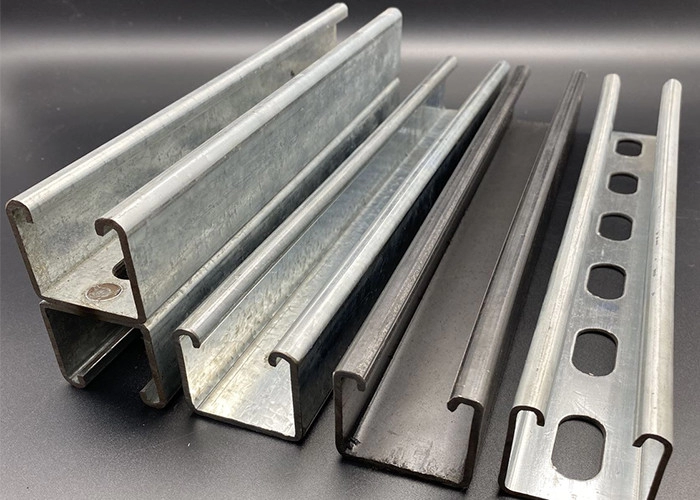
Strut channel profile. Finished-channel acceptance depends on sheet standard, coating designation, dimensional drawing and load requirement, not on a single product certificate.
The consolidated materials position is that carbon steel, SS304, SS316 and aluminium channel options exist in the range, with pre-galvanized, hot-dip galvanized and powder coated finishes. Because the corrosion requirement sits on the finish and the structural requirement sits on the section and the sheet grade, the two have to be written as separate acceptance criteria — an error in one cannot be corrected by over-specifying the other.
Where the compliance burden is heading
The direction of travel is divergence rather than convergence, and it is visible in the documents themselves. The US and EU structural bolting routes remain separate systems with separate conformity regimes. EU market access turns on whether a harmonised standard or a European Technical Assessment covers the specific product, under the Construction Products Regulation, with EN 1090-2 governing execution of the steel structures those fasteners go into. In the United States, the Infrastructure Investment and Jobs Act (Public Law 117-58), including the Build America, Buy America provisions, imposes domestic content requirements on iron and steel products used in federally funded infrastructure projects, with project-level applicability and any waivers requiring confirmation rather than assumption.
Anchors illustrate the same pattern at a higher threshold. ASTM E488/E488M defines the test methods for anchor strength in concrete elements, ACI 355.2 provides the qualification procedure for post-installed mechanical anchors and is referenced by US building codes, and ICC-ES Acceptance Criteria AC193 sets out the basis for issuing evaluation reports. In Europe, EOTA's ETAG 001 established the assessment route for metal anchors in concrete and has been progressively transitioned into European Assessment Documents, with the current status to be confirmed per product family. The practical implication is that commodity washers and standard bolts can be competitively tendered on a specification-and-certificate basis, while anchors should be sourced only against a verifiable qualification route for the target market.
Building the acceptance file: a working checklist
A fastener compliance file that can survive an audit has eight components, and each one is a separate request rather than a variation on the same certificate:
- Management-system certificate with the full scope statement, certificate number, issuing body, standard reference and validity dates.
- Product specification naming the governing standard and edition — for structural bolts, the current F3125/F3125M designation rather than a superseded one.
- Property class or grade, stated against the correct system (ISO 898-1 class, ASTM grade, or SAE J429 grade) and not converted by assumption.
- Nut specification and grade, paired explicitly with the bolting specification, plus the washer standard if the assembly includes one.
- Coating specification with the class or thickness requirement, and whether it is written to the ASTM or the ISO route.
- Corrosion test method and acceptance criterion, so that any salt spray figure is comparable rather than decorative.
- Substance declaration naming the regulation and threshold applicable to the destination market.
- Dimensional drawing or tolerance schedule, especially for channel, stamped parts and any non-standard item produced to sample.
Two commercial variables belong beside the file, because they affect whether the evidence is repeatable across orders rather than true once. The first is batch traceability: which heat, lot or production run the certificates refer to. The second is change control — whether the supplier notifies the buyer before changing a material source, a coating supplier or a subcontracted process, since a compliance file that silently stops describing the shipped product is worse than a thinner file that is accurate.
For context on scale, CNS Industrial publishes a monthly capacity of 800 tons against a stated MOQ of 500 kg per item, with a 30–45 day lead time and 100% export orientation across EU, US, Canadian and South American markets, operating from Jiaxing in Zhejiang near Shanghai Port. Those are supplier-reported figures and should be verified at audit rather than read as capacity guarantees — but they are the right kind of number to place next to a documentation request, because capacity, MOQ and lead time determine whether a specification can actually be held on repeat orders.
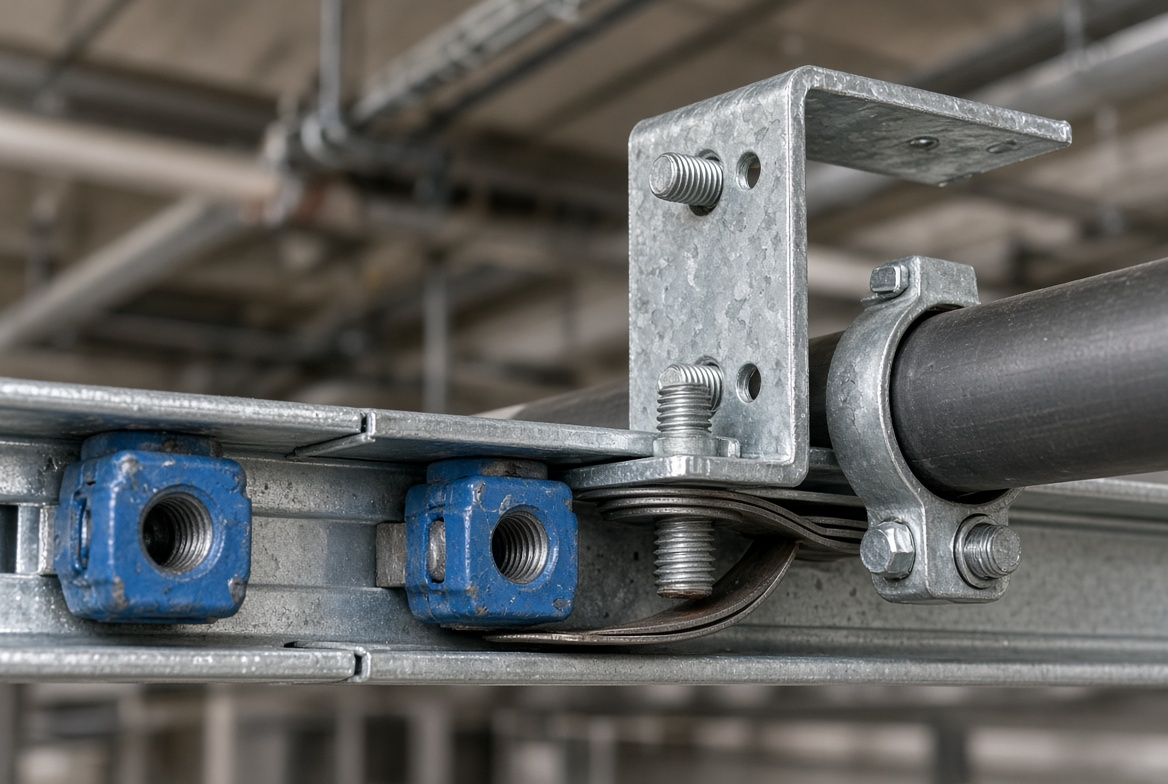
Fastener and channel systems in industrial and construction applications, where specification, coating and installation requirements are assessed separately.
Frequently asked questions
Does an ISO 9001 certificate prove that a fastener meets ASTM A325?
No. ISO 9001 certifies a quality management system within a stated scope; it contains no product dimension, grade, mechanical property or coating result. A certificate scoped to sales of metal products confirms a certified system around that activity and says nothing about conformance of an individual bolt. Product conformance is evidenced separately, by the applicable product specification, property class or grade, and test records for the batch in question.
Are ASTM A325 and A490 bolts still available, or must I specify F3125?
ASTM F3125/F3125M is the current US specification for high-strength structural bolts and assemblies, covering inch and metric dimensions, and it superseded the earlier A325 and A490 specifications. Because A325 and A490 remain familiar on drawings and enquiries, the practical approach is to name F3125/F3125M as the governing document and retain the historic designation as a cross-reference, so suppliers do not resolve the reference differently.
How do I confirm that a nut matches the bolt specification I ordered?
By specifying the nut separately. ASTM A563 covers carbon and alloy steel nuts, including grades and hardness requirements, for structural and general-purpose bolts. ASTM A194 is the nut specification for high-temperature or high-pressure bolting and is graded to pair with the corresponding bolting grade, so the nut grade is read from the purchase specification rather than inferred. Where the metric route is used instead, ISO 898-2 property classes (including 8, 10 and 12) apply. ASTM grades and ISO classes are different designation systems and are not interchangeable.
Can a DIN 933 bolt be substituted for an ISO 4017 bolt?
Only if the governing document on the drawing permits it. ISO 4014 and ISO 4017 are the ISO dimensional references for hexagon head bolts, and legacy DIN 933 designations remain common on purchase documents even where ISO equivalents exist. Because dimensional details and tolerances are defined by the named standard, a substitution made without confirming which standard governs is a dimensional risk rather than an equivalence. The drawing or RFQ should name the governing standard and edition.
What documents should a hot-dip galvanized fastener order include?
Three separate items. First, the coating specification with its class or thickness requirement — ASTM A123/A123M for hot-dip galvanized coatings on iron and steel products, or ISO 1461 at international level; the two are analogous but a coating verified to one is not automatically compliant with the other. Second, the corrosion test method if a salt spray figure is being claimed, since ASTM B117 and ISO 9227 define the procedure and the hours mean nothing without the method and pass criterion. Third, the substance declaration required by the destination market, such as RoHS, REACH or ELV, which is a separate compliance axis from coating performance.
Reference material: CNS Industrial product brochure (PDF) — https://cdn.socialarks.com/sbsp/25184/common/2026/0813/CNS_Industrial_Brochure_v4.pdf
Tem questões ou precisa de mais detalhes?
Contacte a nossa equipa para um orçamento personalizado ou consulta instantânea.
Solicitar orçamento
Preencha o formulário abaixo e a nossa equipa entrará em contacto com uma proposta personalizada.
Chat direto do WhatsApp
Prefere conversar em tempo real? Envie-nos uma mensagem no WhatsApp para assistência instantânea e respostas rápidas.
- Obter orçamento personalizado
- Partilhar fotos ou documentos
- Discuta as suas necessidades diretamente
Geralmente responde em 5–30 minutos durante o horário de expediente.