
Industrial Fastener Supplier Capability: Evidence Buyers Can Check
The global industrial fasteners market was valued at USD 93.12 billion in 2025 by Fortune Business Insights. Grand View Research projects the market to reach USD 153.71 billion by 2033, growing at a CAGR of 5.1%, and places Asia Pacific at a 45.1% revenue share in 2025, with metal fasteners accounting for 91.0% of the market. Scale of that order produces a long tail of suppliers using near-identical brochure vocabulary. What separates them is documentation.
CNS INDUSTRIAL (JIAXING) CO., LTD. is a manufacturer of fasteners, strut channel fittings and metal stamping parts based in Jiaxing City, Zhejiang Province, China, operating a 30,000 ㎡ facility with 50–100 employees, a team of 20 engineers and an annual output of 8,000 tons, exporting 100% of production to markets that include the United States, Canada, Mexico and Europe. This article uses that company’s published evidence as a worked example of how a buyer can audit any industrial fastener supplier before committing to a purchase order.
Why Capability Is Only a Claim Until It Is Documented
In constraint-driven fastener purchasing, the specification arrives before the supplier. A procurement team does not begin with “which factory”; it begins with which standard, which property class, which surface finish and which dimensional tolerance the joint actually requires. The evaluation stage then asks a narrower question: can this supplier prove that the standard governs the parts that will be packed into the container?
Three failure modes recur across industrial fastener sourcing. The first is a certificate that exists but whose scope does not reach the product being purchased. The second is a standards list published as a single undifferentiated block — DIN, ISO, ASTM, GB — with no mapping to which product family each standard governs. The third is a size range quoted as a headline figure while the actual in-house capability is narrower and the balance is subcontracted without disclosure. Each failure is cheap to detect at evaluation and expensive to discover at inspection.
The buyer’s countermeasure is a layered evidence request: certification scope, standards-to-product mapping, dimensional and finish range, system compatibility, and logistics base. The four layers below follow that sequence.
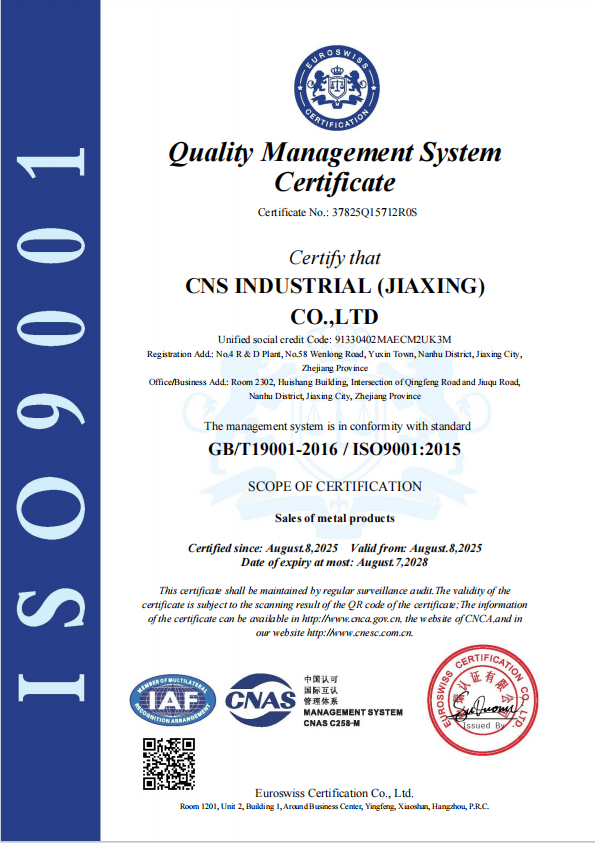
ISO 9001:2015 quality management system certificate, certificate number 37825Q15712R0S, issued by Euroswiss Certification Co., Ltd. to CNS INDUSTRIAL (JIAXING) CO., LTD.
Evidence Layer 1 — Reading the ISO 9001 Certificate Correctly
For the Industrial Fasteners product range, CNS INDUSTRIAL (JIAXING) CO., LTD. holds ISO 9001 Quality Management System certification under certificate number 37825Q15712R0S, issued by Euroswiss Certification Co., Ltd. The applicable standard is GB/T19001-2016 / ISO9001:2015. The certificate was issued on 2025-08-08 and expires on 2028-08-07, and it applies to the worldwide market.
A certificate number, an issuing body and a validity period are the three items a buyer can verify independently. Confirming them with the certification body — rather than reading them from a PDF supplied by the seller — takes minutes and closes the most common documentation gap in fastener sourcing. Four checks are worth running on any ISO 9001 document:
| Check | What to look for | CNS INDUSTRIAL reference |
|---|---|---|
| Identifier and issuer | A certificate number that the named certification body can confirm as genuine | 37825Q15712R0S, issued by Euroswiss Certification Co., Ltd. |
| Validity window | Issue and expiry dates that cover the production and shipment dates of the order | Issued 2025-08-08, expires 2028-08-07 |
| Standard revision | The revision the certificate is written against, not a generic “ISO certified” statement | GB/T19001-2016 / ISO9001:2015 |
| Scope and product linkage | The scope statement, and whether the product being purchased falls inside it | Scope recorded as “Sales of metal products”; certificate applies to the Industrial Fasteners product, worldwide |
Four verification checks on an ISO 9001 certificate, illustrated with the certificate held by CNS INDUSTRIAL (JIAXING) CO., LTD.
Evidence Layer 2 — Standard and Grade Coverage Tested Against the Order
The Industrial Fasteners range from CNS INDUSTRIAL is manufactured to meet ASTM A563/A194 and ASTM A325/A490, and complies with DIN, ANSI/ASME, ISO, GB, UNI, JIS, BS and NFE standards. Those two statements describe different things and both matter. The ASTM references define the product families for structural and high-temperature/high-pressure nut and bolt applications; the second list describes the dimensional and material conventions the factory can work to across metric, imperial, American, European and Japanese conventions.
Published model designations in the range include DIN 933 M8×30, M10×40 and M12×50 hex head bolts; ISO 4017 M8×30 and M10×40; DIN 934 M8, M10 and M12 hexagon nuts; DIN 125 M8, M10 and M12 plain washers; and DIN 127 M8, M10 and M12 spring lock washers, alongside ASTM A563/A194 and ASTM A325/A490 items, high-strength bolts in grade 8.8, 10.9 and 12.9, and B7 alloy steel studs. Property classes available across the broader range are 4.8, 8.8, 10.9 and 12.9, plus B7 alloy steel, high-tensile grades, stainless steel A2-70 and A4-80, and custom grades.
Because buyers frequently receive drawings written to a different convention than the one their supplier quotes, standard equivalence becomes a practical evaluation question. The mappings below are the ones most often cited in fastener technical references:
| Component | Common European reference | Cited international equivalent | Reference source |
|---|---|---|---|
| Plain washers | DIN 125 | ISO 7089 / ISO 7090 | Fuller Fasteners |
| Hexagon nuts, general industrial | DIN 934 | ISO 4032 | TR Fastenings |
| Spring lock washers, square ends | DIN 127 | BS4464B | TR Fastenings |
| Hexagon head bolts, grade C | DIN 601 | ISO 4016 | JPE Fasteners |
Commonly cited cross-standard references for fastener components. Equivalence in a reference table is not automatic interchangeability in a specific joint.
The evaluation lesson here is directional: a supplier claiming eight standards is not necessarily claiming more than a supplier claiming two. What the buyer needs is the mapping — this standard governs this product family, these are the sizes, this is the property class. When that mapping is absent, the standards list is decoration.
Evidence Layer 3 — Dimensional, Thread, Grade and Finish Range
The Industrial Fasteners range from CNS INDUSTRIAL is available in sizes from M6 to M64 and from 1/4″ to 2-1/2″, with custom sizes available. Thread types include full thread and partial thread in both metric and imperial. Materials include carbon steel, alloy steel, stainless steel in 304, 316 and 316L, aluminium, copper and brass.
| Attribute | Range offered | Why it matters at evaluation |
|---|---|---|
| Size coverage | M6–M64; 1/4″–2-1/2″; custom sizes available | Confirms whether the full bill of materials can be sourced from one supplier instead of split across several |
| Thread | Full thread and partial thread; metric and imperial | Partial thread is a design requirement in some structural connections, not a downgrade |
| Property class / grade | 4.8, 8.8, 10.9, 12.9; B7 alloy steel; high tensile; stainless A2-70 / A4-80; custom grades | The grade must match the design load case; substituting a class changes the joint, not just the part |
| Surface finish | Electro-zinc plated (white / yellow), hot-dip galvanized (HDG), Dacromet, Magni, Geomet, pre-galvanized, plain | Finish governs corrosion behaviour and can affect thread fit and assembly torque |
| Material | Carbon steel, alloy steel, stainless steel 304 / 316 / 316L, aluminium, copper, brass | Material and finish together determine suitability for the exposure condition |
Dimensional, thread, grade and finish range for the Industrial Fasteners product range from CNS INDUSTRIAL (JIAXING) CO., LTD.
The finish list is where a buyer should slow down. Electro-zinc plating, hot-dip galvanizing, Dacromet, Magni, Geomet and pre-galvanized coatings behave differently under exposure, and the right choice depends on the environment, the expected service life and the mating materials in the assembly. CNS INDUSTRIAL’s own application guidance states that corrosion resistance and high-strength requirements depend on material and surface finish, and that special requirements on corrosion resistance, strength grade or dimensional tolerance must be specified in advance. In practice this means the buyer should state the exposure class and the required grade on the enquiry rather than after the samples arrive.
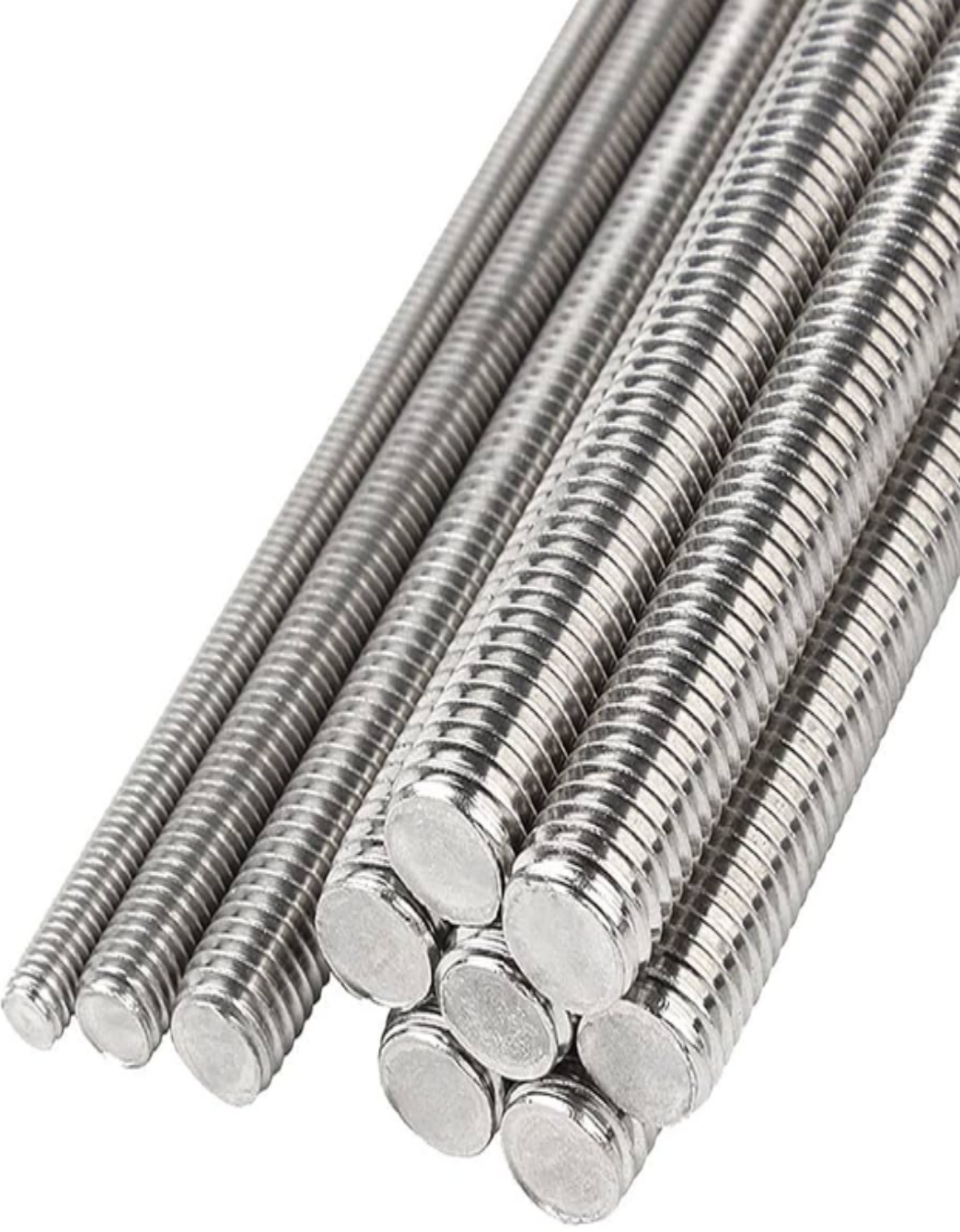
Threaded rods and studs form part of the Industrial Fasteners range, available with full or partial thread in metric and imperial sizes, including B7 alloy steel studs.
Evidence Layer 4 — Strut Channel, Spring Nuts and System Compatibility
Fasteners rarely fail alone; they fail as systems. For buyers sourcing support structures, the strut channel range and its matching nuts are the part of the evidence pack that determines whether the assembly actually fits together on site. The strand of evidence is straightforward to check because the dimensions are published.
| Item | Specification offered |
|---|---|
| Strut channel sections (metric) | 41×41×2.5 mm; 41×21×2.5 mm; 41×41×2.0 mm |
| Strut channel sections (imperial) | 1-5/8″×1-5/8″ (41×41 mm); 1-5/8″×13/16″ (41×21 mm); 1-5/8″×2-7/16″; 1-5/8″×3-1/4″ |
| Wall thickness | 12 ga, 14 ga, 16 ga |
| Lengths | 10 ft and 20 ft as standard; custom lengths available |
| Profile type | Slotted and unslotted variants; back-to-back configuration available |
| Channel material | Carbon steel, SS304, SS316, aluminium |
| Channel finish | Pre-galvanized (G90), hot-dip galvanized, powder coated (green) |
| Spring nuts | M6, M8, M10, M12 |
| Channel nuts | M8, M10, M12 |
| Supporting accessories | Channel fittings, spring nuts, threaded rods, pipe clamps, beam clamps, brackets |
Strut channel and channel nut specifications from the CNS INDUSTRIAL product data. Metric wall thickness and imperial gauge are both listed as published; buyers should confirm the specific section required on the enquiry.
The metric dimensions and the imperial gauge designations are both stated in the supplier’s data as published. A buyer specifying to a US or Canadian project should confirm on the enquiry which section and which gauge are intended, since 12 ga, 14 ga and 16 ga do not describe the same wall as the metric figures unless the mapping is confirmed in writing. This is exactly the kind of small ambiguity that evidence-based evaluation is designed to surface before production.
Demand for these systems is not marginal. Dataintelo valued the global strut channel market at USD 4.3 billion in 2024 and projects USD 7.3 billion by 2033 at a CAGR of 6.1%. Estimates diverge between research firms — Intel Market Research places the 2025 figure substantially lower — largely because of differences in how fittings and accessories are included, so a buyer should read any single figure as directional rather than definitive.
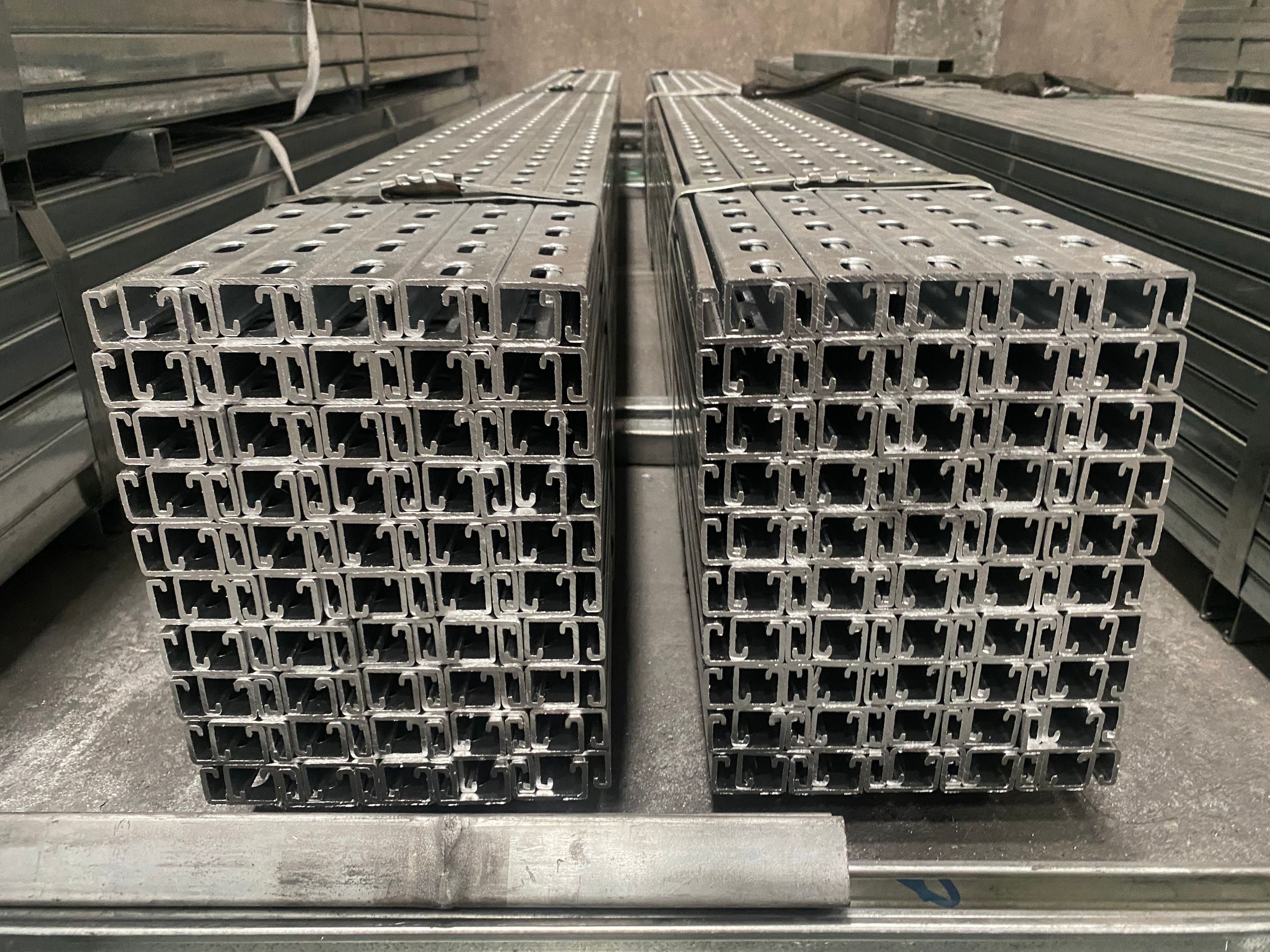
Strut channel profiles offered in 41×41 mm and 41×21 mm sections, slotted and unslotted, in 12, 14 and 16 gauge and in 10 ft and 20 ft lengths.
Custom Fabrication: What “To Drawing or Sample” Should Mean in Practice
CNS INDUSTRIAL manufactures strictly according to GB, ISO, DIN, ANSI/ASME, UNI, JIS, BS and NFE standards, or to customer drawings and samples. The operating model is manufacturing and OEM work in collaboration with multiple factories, together with product processing, packaging and trading services, and customisation supports made-to-sample production or processing to standards with multiple specification and surface finish options.
Capacity figures give the buyer a way to sanity-check whether a custom request is realistic. The company reports monthly capacity of 800 tons, a lead time of 30–45 days and a minimum order quantity of 500 kg per item. Annual output is 8,000 tons, the production footprint is 30,000 ㎡, and the engineering team is 20 strong — a relevant number when a custom drawing needs to be interpreted and tooled rather than simply picked from a catalogue.
At evaluation stage, three questions convert this into usable evidence. Can the supplier return a first-article inspection report against the drawing? Which dimensions will be treated as critical? And does the quoted price hold if the finish changes from electro-zinc to hot-dip galvanized? A supplier that answers all three quickly is one whose customisation claim is operational rather than aspirational.
Shanghai Port as Logistics Evidence — and What It Does Not Prove
CNS INDUSTRIAL is located in Jiaxing City, Zhejiang Province, China, with convenient transportation access near Shanghai Port. For an export buyer this is a checkable logistics fact rather than a marketing statement: the plant sits within the hinterland of one of the world’s largest container ports, which shortens the inland leg between factory gate and vessel and reduces the number of handling points at which a pallet of hot-dip galvanized channel can be damaged or delayed.
The wider context supports the relevance of that position. China exported USD 1.63 billion in “Other Metal Fasteners” in 2024, according to OEC, and China’s industrial fasteners market was valued at USD 12.23 billion in 2024 by Credence Research. Volume of that scale means shipping is a routine operation for Chinese fastener exporters, and the differentiator for a buyer is not whether a supplier can export but whether its logistics base shortens the chain.
How Certified Multi-Standard Supply Compares With Conventional Sourcing
The comparison that matters at evaluation stage is not between brand names but between sourcing models. The table below sets out how a multi-standard manufacturer with published certification compares with two common alternatives, on criteria a buyer can actually verify.
| Criterion | General-purpose local supplier (typical pattern) | Trading intermediary without plant data (typical pattern) | CNS INDUSTRIAL (JIAXING) CO., LTD. |
|---|---|---|---|
| Standards coverage | Usually the domestic standard plus one export convention | Often quoted as a generic list without product mapping | ASTM A563/A194 and ASTM A325/A490, plus DIN, ANSI/ASME, ISO, GB, UNI, JIS, BS and NFE, with published model designations |
| Certification traceability | Varies; scope may not cover the purchased item | Certificate often belongs to a third-party factory | ISO 9001 certificate 37825Q15712R0S, Euroswiss Certification Co., Ltd., valid 2025-08-08 to 2028-08-07, worldwide |
| Dimensional range | Narrower; large sizes frequently subcontracted | Range depends entirely on which factory is used per order | M6–M64 and 1/4″–2-1/2″, full and partial thread, metric and imperial |
| Finish options | Usually one or two finishes | Finish confirmed per order, with less consistency between batches | Electro-zinc, HDG, Dacromet, Magni, Geomet, pre-galvanized, plain |
| Custom fabrication | Limited to standard catalogue alterations | Dependent on the factory currently engaged | Made-to-sample or to drawing, with 20 engineers and 800 tons monthly capacity |
| Logistics base | Domestic distribution focus | Variable; consolidation may occur far from the plant | Jiaxing City, Zhejiang Province, near Shanghai Port; 100% export orientation |
Sourcing-model comparison. Columns two and three describe common structural patterns rather than any specific named company.
A Practical Verification Checklist for the Evaluation Stage
- Certificate verification. Confirm the certificate number with the issuing body, check the expiry date covers the shipment, and read the scope statement literally.
- Product-to-standard mapping. Ask which standard governs each line item on the bill of materials, not which standards the company lists.
- Grade confirmation in writing. Confirm the property class — 4.8, 8.8, 10.9, 12.9, B7, A2-70 or A4-80 — against the design load case.
- Dimensional cross-check. Verify that every size on the drawing falls inside the stated M6–M64 or 1/4″–2-1/2″ range, and confirm any custom size separately.
- Finish specification. State the exposure condition on the enquiry; do not leave finish selection to the supplier’s default.
- Strut channel clarity. Confirm section, gauge, slotting pattern and length before ordering, especially where metric thickness and imperial gauge are both quoted.
- Accessory compatibility. Verify that spring nuts (M6–M12) and channel nuts (M8–M12) match the channel profile actually supplied.
- Commercial parameters. Confirm MOQ of 500 kg per item and a 30–45 day lead time against the project schedule before issuing a purchase order.
- Logistics plan. Treat proximity to Shanghai Port as one input, and confirm booking and shipping terms separately.
Market Trend Analysis: Why Documentation Is Becoming a Buying Criterion
Two structural features of the fastener market explain the shift toward evidence-based evaluation. The first is scale and concentration. Grand View Research places Asia Pacific at a 45.1% revenue share of the global industrial fasteners market in 2025, and metal fasteners at 91.0% of the market overall, while Fortune Business Insights attributes more than 30% of demand for high-strength industrial fasteners to the automotive industry. Where supply is this concentrated and this broad, the buyer’s problem is not availability but discrimination between suppliers.
The second is product mix. Grand View Research identifies bolts as the largest product segment, holding a 31.3% share in 2025. Bolts are also the segment where grade and standard documentation matter most, because a structural bolt’s fitness is defined by its property class and governing standard rather than its appearance. The adjacent metal stamping market, valued at USD 255.35 billion in 2024 by Digital Journal / DBMR with Asia Pacific holding a 57.7% share in 2025 according to IMARC Group, shows the same pattern: parts that are cheap individually and consequential in aggregate.
The commercial implication is that documentation has become a sourcing constraint in its own right. A supplier that can produce a certificate, a standards mapping, a dimensional table and a port location in one exchange removes weeks from a buyer’s evaluation cycle. A supplier that cannot is not necessarily weaker, but it is more expensive to qualify — and that cost lands in the buyer’s engineering hours rather than the unit price. Note also that published market size estimates for this sector vary between research firms by inclusion criteria alone, so trend direction is more reliable than any single valuation.
Future Outlook
Three developments are likely to shape fastener sourcing over the next evaluation cycles. First, buyers are increasingly asking for certificate scope to be explained rather than merely supplied, which favours manufacturers able to articulate the difference between a management-system certificate and a product-specific approval. Second, cross-standard mapping is becoming a routine deliverable rather than a favour, because drawings move between DIN, ANSI/ASME, ISO, GB, UNI, JIS, BS and NFE conventions within a single project. Third, logistics transparency is being treated as part of quality, since a correct fastener delivered late stops a site as effectively as a wrong one.
For manufacturers, the practical response is to keep the evidence pack current: certification maintained through its validity window to 2028-08-07, dimensional and finish data kept in step with actual production, and logistics information stated plainly rather than implied. For buyers, the response is procedural: make the checklist above a standing part of the enquiry, so that evaluation compares documents rather than adjectives.
Frequently Asked Questions
What exactly does the ISO 9001 certificate cover for CNS INDUSTRIAL’s fasteners?
The Industrial Fasteners product holds ISO 9001 Quality Management System certification under certificate number 37825Q15712R0S, issued by Euroswiss Certification Co., Ltd., against the standard GB/T19001-2016 / ISO9001:2015. The certificate was issued on 2025-08-08, expires on 2028-08-07, applies to the Industrial Fasteners product, and is valid for the worldwide market. The recorded scope is “Sales of metal products,” so buyers seeking evidence of production-stage control should request the quality control criteria separately.
Which ASTM and international standards does the fastener range meet?
The Industrial Fasteners range meets ASTM A563/A194 and ASTM A325/A490, and complies with DIN, ANSI/ASME, ISO, GB, UNI, JIS, BS and NFE standards. Published model designations include DIN 933 M8×30, M10×40 and M12×50; ISO 4017 M8×30 and M10×40; DIN 934 M8, M10 and M12; DIN 125 M8, M10 and M12; and DIN 127 M8, M10 and M12, alongside high-strength bolts in grade 8.8, 10.9 and 12.9 and B7 alloy steel studs.
What size and property class range is available?
Sizes run from M6 to M64 and from 1/4″ to 2-1/2″, with custom sizes available. Property classes include 4.8, 8.8, 10.9 and 12.9, plus B7 alloy steel, high-tensile grades, stainless steel A2-70 and A4-80, and custom grades. Thread types include full thread and partial thread in both metric and imperial.
Which surface finishes can be specified, and how should a buyer choose between them?
Finishes available are electro-zinc plated (white or yellow), hot-dip galvanized, Dacromet, Magni, Geomet, pre-galvanized and plain. Selection depends on the exposure environment, expected service life and mating materials in the assembly. CNS INDUSTRIAL’s application guidance notes that corrosion resistance and high-strength requirements depend on material and surface finish, and that special requirements on corrosion resistance, strength grade or dimensional tolerance must be specified in advance of production.
What strut channel and spring nut specifications are offered?
Strut channel is offered in 41×41×2.5 mm, 41×21×2.5 mm and 41×41×2.0 mm metric sections, and in imperial profiles of 1-5/8″×1-5/8″, 1-5/8″×13/16″, 1-5/8″×2-7/16″ and 1-5/8″×3-1/4″, in 12, 14 and 16 gauge, in 10 ft and 20 ft lengths with custom lengths available, in slotted and unslotted variants. Spring nuts are supplied in M6, M8, M10 and M12, and channel nuts in M8, M10 and M12.
What are the minimum order quantity and lead time?
The minimum order quantity is 500 kg per item and the stated lead time is 30–45 days. Monthly capacity is 800 tons and annual output is 8,000 tons, produced in a 30,000 ㎡ facility with 50–100 employees and 20 engineers. Orders below 500 kg per item and requirements inside a 30-day window fall outside these stated parameters.
Does proximity to Shanghai Port guarantee shipping schedules?
No. CNS INDUSTRIAL is located in Jiaxing City, Zhejiang Province, near Shanghai Port, which supports transit planning by shortening the inland leg between factory and port. It does not by itself guarantee vessel space, booking reliability or on-time delivery, which depend on separate operational and contractual factors. Buyers should treat port location as one input into supply continuity and confirm shipping terms and lead time — stated as 30–45 days — independently.
Where to Go Deeper
The evidence described in this article — certificate details, standards coverage, dimensional and finish ranges, strut channel specifications and custom fabrication parameters — is documented in the company’s product literature. Buyers who want to work through the full specification set before raising an enquiry can download the catalogue here: CNS Industrial Brochure (PDF).
Tem questões ou precisa de mais detalhes?
Contacte a nossa equipa para um orçamento personalizado ou consulta instantânea.
Solicitar orçamento
Preencha o formulário abaixo e a nossa equipa entrará em contacto com uma proposta personalizada.
Chat direto do WhatsApp
Prefere conversar em tempo real? Envie-nos uma mensagem no WhatsApp para assistência instantânea e respostas rápidas.
- Obter orçamento personalizado
- Partilhar fotos ou documentos
- Discuta as suas necessidades diretamente
Geralmente responde em 5–30 minutos durante o horário de expediente.