
Industrial Fuse Basics: Fuse Bases, Fuse Rails and Vertical Fuse Switch Disconnectors
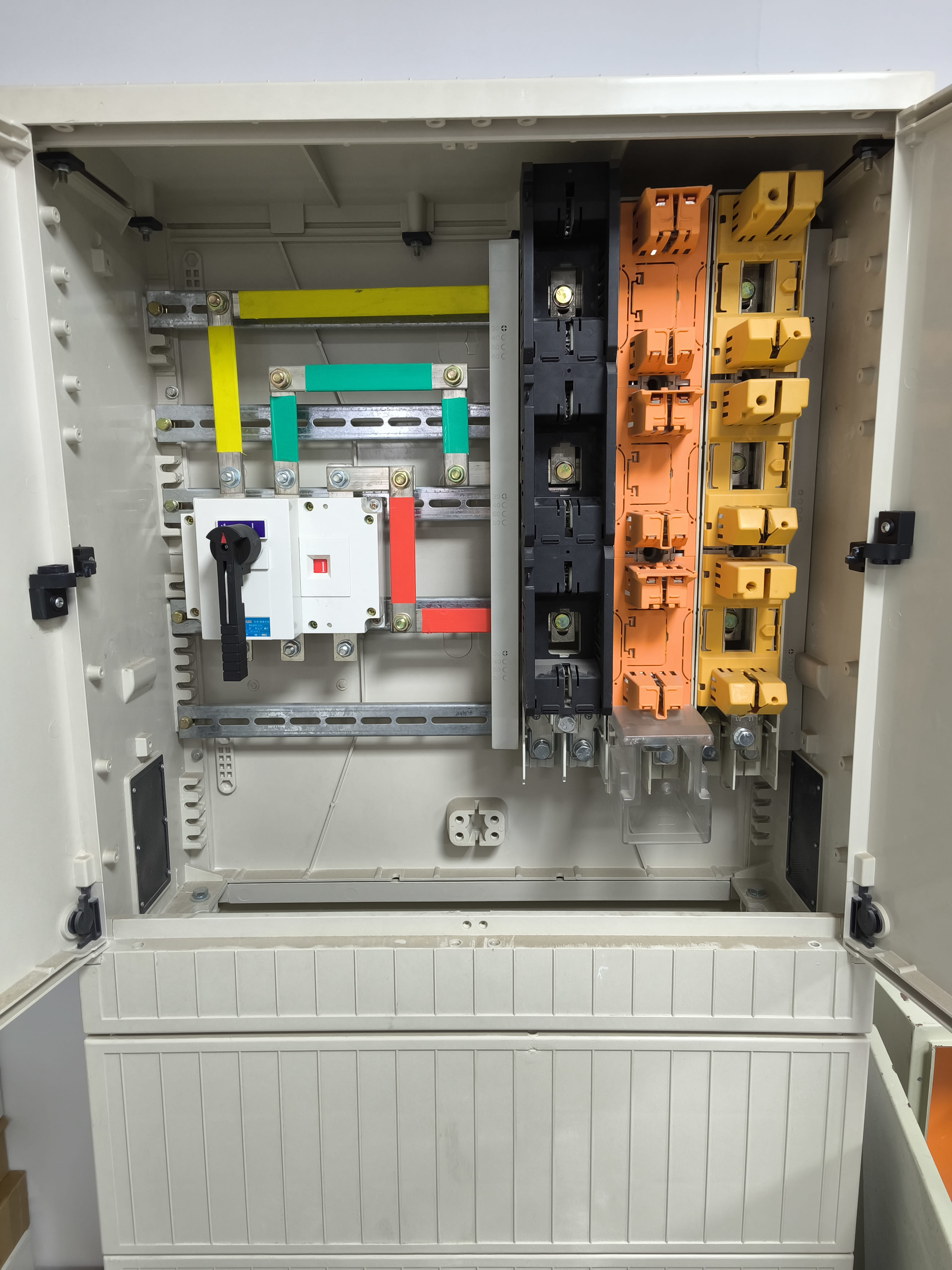
Fuse rails and fuse switch disconnectors are commonly installed in LV distribution boards across industrial facilities.
Low-voltage fuse protection involves much more than selecting a fuse link. The complete protection chain includes fuse bases, fuse rails, switch disconnectors and compatible busbar systems. For buyers and engineers evaluating fuse products for industrial distribution, understanding the functional differences between these components is the first step toward a procurement decision. This guide explains the main industrial fuse product types, their typical ratings and application logic, with reference to the product family manufactured by YUEQING BARFUSE ELECTRIC CO., LTD.
What Is a Fuse in Low-Voltage Distribution?
A low-voltage fuse is a protective device that interrupts an electrical circuit when current exceeds a safe level. In industrial distribution systems, fuses protect cables, switchgear, busbars and downstream equipment against short-circuit and overload damage. Different fuse products perform different functions: fuse links provide the actual overcurrent interruption, fuse bases mechanically support the links, and fuse switch disconnectors combine isolation, switching and fuse protection in one unit.
Fuse products are commonly categorised by their mounting system and physical format, not only by their electrical ratings. This is why an informed buyer needs to understand the differences between NT/NH cylindrical fuses, DIN rail fuse bases, and vertical fuse switch disconnector rails designed for busbar installation.
The Core Product Categories in a Fuse System
Based on the product line manufactured by BARFUSE, an industrial fuse system can be understood in four product groups. Each addresses a different installation requirement within low-voltage distribution.
1. NT/NH Fuse Links – The Interrupting Element
NT/NH fuse links conform to IEC 269 (which corresponds to the IEC 60269 series) and are produced in standardised sizes NT00, NT1, NT2 and NT3. They are suitable for AC 50 Hz circuits with rated voltages up to 1140 V and rated currents up to 1250 A, with breaking capacity up to 120 kA. Materials typically include ceramic bodies with silver-plated copper elements.
Key product characteristics:
- Rated voltage: up to 1140 V AC
- Rated current: up to 1250 A
- Breaking capacity: up to 120 kA
- Compliant with IEC269 / IEC 60269
The NT/NH format is widely used in European and international distribution boards because the standardised size allows fuse links from different manufacturers to fit compatible bases, provided the same size code is used.
2. NT/NH Fuse Bases – The Supporting Station
NT/NH fuse bases, manufactured in models NT00, NT1, NT2 and NT3, hold the fuse link securely in a fixed installation. BARFUSE's NT/NH fuse bases are designed for industrial applications and commercial building electric management, with rated voltages up to 1140 V and rated currents up to 630 A. They are constructed with ceramic insulation bodies and tin-plated copper contacts.
The combination of a ceramic body and tin-plated copper contacts gives these bases high thermal stability and corrosion resistance. Because the fuse links themselves can break circuits up to 120 kA, the base must exhibit robust mechanical clamping and flame-retardant properties.
3. DIN Rail Fuse Bases – Modular Protection
DIN rail fuse bases are compact mounting solutions for control panels and electrical enclosures. The BARFUSE BH-400 is a DIN rail type fuse base with a rated voltage of 690 V and rated current of 400 A. Its neutral links provide breaking capacity up to 120 kA. The contacts are tin-plated copper, and the product complies with IEC 60269-1 and 2 as well as VDE 0636-1 and 2 standards, making it suitable for switchgear and control panel applications.
For panel builders, DIN rail fuse bases are an efficient way to add fuse protection to individual circuits without designing a full busbar mounting arrangement.
4. Stripe Fuse Rails and Fuse Switch Disconnectors – For Busbar Systems
Stripe fuse rails (also referred to as fuse switch disconnectors in modular rail format) are designed to be mounted directly onto low-voltage busbar systems. They combine fuse protection with a manual switching function, allowing maintenance personnel to isolate a circuit safely. Their principal application is in petroleum, chemical, metallurgical, power and construction industries using low-voltage distribution systems.
BARFUSE produces several series in this category:
| Model | Type | Key Ratings |
|---|---|---|
| BTR1 | Stripe fuse rail | 250 A / 400 A / 630 A; 415–690 V AC |
| BTR2 | Stripe fuse rail | 250 A / 400 A / 630 A; 415–690 V AC; IP30 |
| BTR3 | Fuse switch disconnector | BTR3-250 / 400 / 630; 415–690 V AC; IP30 |
| BTR4 | Fuse switch disconnector | BTR4-250 / 400 / 630; 415–690 V AC; IP30 |
| BTR5 | Stripe fuse rail | BTR5-250 / 400 / 630; 415–690 V AC; IP30 |
| BTR6 | Fuse switch disconnector | 160 A; AC 690 V; 100 mm / 185 mm busbar spacing |
The term vertical fuse switch disconnector typically refers to switch units mounted upright on a busbar system, frequently in 100 mm or 185 mm busbar spacing configurations. Distribution boards using 100 mm or 158/185 mm busbar systems represent two different design standards: panelboard systems using the smaller spacing and power centre systems requiring the larger one. A manufacturer that can provide products for both spacing configurations gives panel builders a wider design choice.
How to Match Fuse Products to a Distribution System
Matching a fuse product to its application is not a single-variable decision. The following parameters determine which fuse component is appropriate.
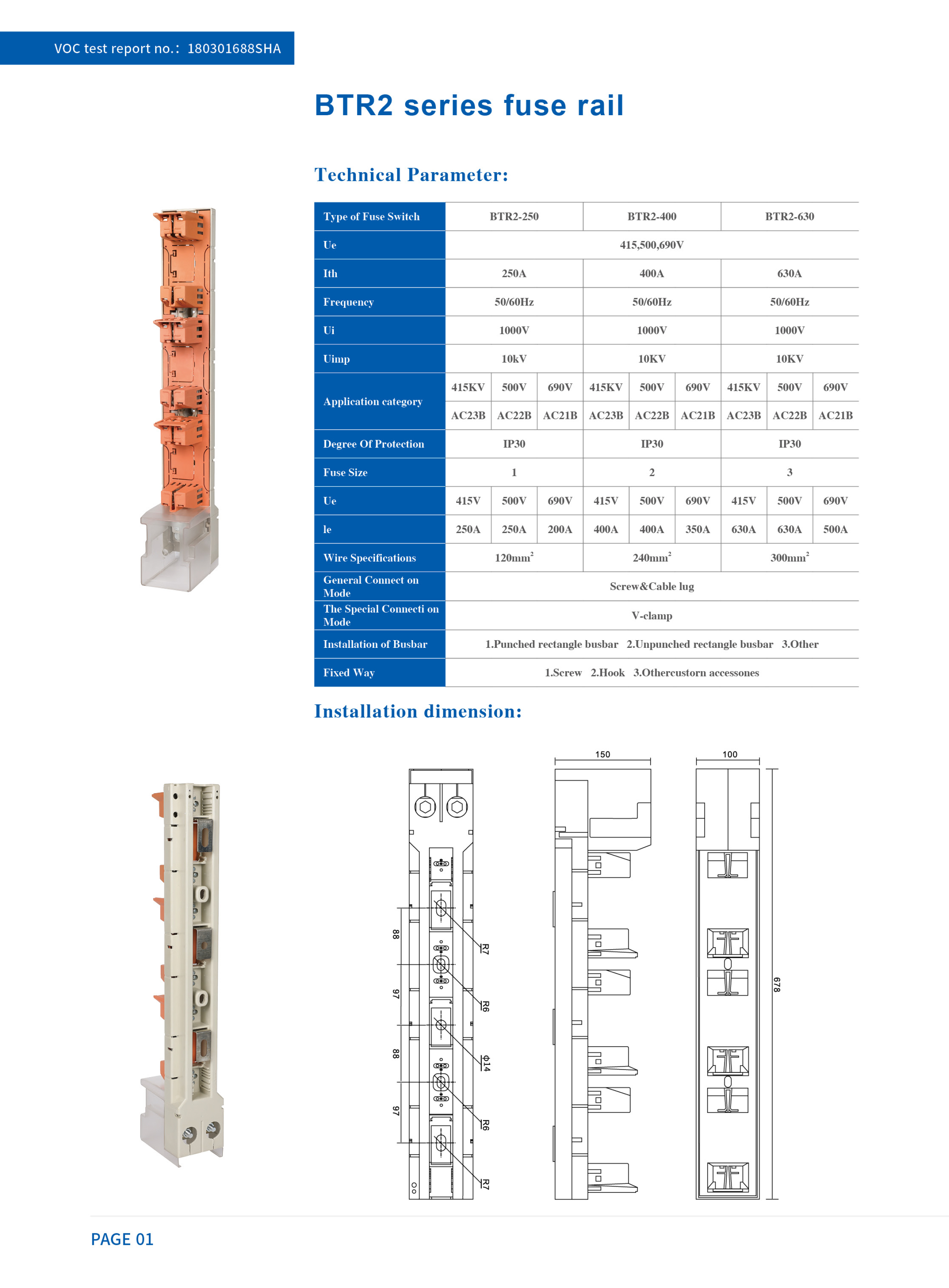
The BTR2 stripe fuse rail is designed for 100 mm and 158 mm busbar systems depending on configuration.
Voltage and Frequency Ratings
Industrial LV distribution systems typically operate at 415 V, 500 V or 690 V AC in many global markets. The BTR series products are rated for these three voltage levels. The NT/NH fuse base and fuse link range goes further, supporting rated voltages up to 1140 V for specific industrial circuit requirements. When selecting a fuse product, the rated voltage of the device should always be equal to or higher than the system voltage.
Current Rating and Breaking Capacity
Continuous current rating affects normal operation, while breaking capacity determines how large a fault the device can interrupt. Both dimensions matter:
- Conventional free air thermal current (Ith) of 250 A, 400 A or 630 A across the BTR family corresponds to typical feeder and main switch ratings in LV panels.
- BTR4 and BTR6 models provide limiting short-circuit current of 50–100 kA, a demanding performance level that enables their use in high fault-current installations.
- NT/NH fuse links with breaking capacity up to 120 kA are specified for higher-rated protection where extreme fault levels are possible.
Busbar Spacing: 100 mm vs 158/185 mm
Busbar spacing is a physical constraint that determines whether a fuse switch disconnector can fit an existing busbar system. BTR5 supports 100 mm and 158 mm busbar systems, while BTR6 is available in 100 mm and 185 mm spacings. A buyer who measures the centre-to-centre distance of the busbars before selecting a fuse rail avoids mismatched components and field modifications.
Mounting and Form Factor
The mounting system is determined by the type of enclosure and the assembly method used:
- DIN rail mounting is used in control cabinets where modularity is important. The BH-400 belongs to this category.
- Busbar hook-type mounting is used in power distribution assemblies where several fuse rails are aligned on a vertical busbar. BTR5 and several other BTR models make use of hook-type installation.
- Bolt-on NT/NH bases are more conventional installations for heavy industrial panels.
The decision between a fuse base plus separate fuse link and a modular fuse switch disconnector depends on whether the application requires integrated load-breaking and isolation functionality, or simply protection of a fixed circuit.
Technical Materials and Construction
Material selection in fuse devices directly affects thermal performance, lifetime, and safety. In BARFUSE fuse products, the primary construction materials are copper, DMC (Dough Molding Compound), ABS, and PC.
| Material | Typical Function |
|---|---|
| Copper (tin-plated or silver-plated) | Current path; tin plating on fuse bases reduces corrosion and contact resistance; silver-plated copper elements on NT/NH fuse links support high breaking performance. |
| DMC (Dough Molding Compound) | Glass-reinforced thermoset used for insulating housings; flame retardant; high mechanical strength; used in BTR1/BTR2/BTR3 rails. |
| ABS + PC | Additional covers, handles and transparent visual indicators in BTR4/BTR5/BTR6 assemblies. |
| SMC (Sheet Molding Compound) | Enclosed protective structure on BTR5 rail. |
| Ceramic | NT/NH fuse links and bases use ceramic bodies for arc-resistant insulation. |
The BTR3 fuse switch disconnector includes visual break indication, an important maintenance feature that confirms whether the fuse link is intact without opening the enclosure. BTR6 adds intelligent monitoring and remote fault early-warning capability.
Application: Which Industries Use These Products?
Stripe fuse rails, fuse switch disconnectors, and NT/NH fuse bases are specified in many industry segments. Their common thread is that they serve low-voltage distribution systems within the petroleum, chemical, metallurgical, power and construction sectors, as well as commercial building electrical management. For example, in a petroleum facility, a vertical fuse switch disconnector with 100 mm busbar spacing might protect a motor feeder circuit within an MCC panel; in a commercial building, DIN rail fuse bases may be used for distribution board sub-circuits.
The BTR2 stripe fuse rail lists Nigeria and Congo as main markets — an indication that this product format is actively deployed in African power distribution infrastructure, where busbar-based panels are common.
Selecting a Fuse Manufacturer: Supplier Capability Signals
For buyers comparing fuse suppliers, the manufacturer's production infrastructure and certification status are critical evaluation points, because fuse testing and approval require significant investment.
YUEQING BARFUSE ELECTRIC CO., LTD., based in Wenzhou, Zhejiang Province, was established in 2014. It operates a 10,000 square metre facility with approximately 45 employees and an annual production capacity of 250,000 pieces. Its R&D team consists of seven engineers focused on fuse switch disconnectors, busbar systems, MCB/MCCB pan assemblies and distribution boxes.
Certification history matters in this product segment. BARFUSE has obtained testing accreditations from KEMA (DEKRA) in the Netherlands and VDE in Germany, plus CB and SAA certification. The BTR3 fuse switch disconnector, for example, is certified to VDE standards under certification number NO.40047494, issued by the VDE Testing and Certification Institute for the EU market. The BH-400 additionally complies with VDE 0636-1 and 2, supporting a strong European market position.
Export-oriented suppliers can usually support a broader range of technical compliance requirements. In BARFUSE's case, export business represents approximately 90% of total sales, distributed across the Middle East, Russia, Latin America, Central Asia, the EU, Africa and Oceania, through a network covering more than 40 countries.
Standards Environment: IEC 60269 and Global Market Growth
The applicable global standard for low-voltage fuses is IEC 60269. IEC 60269-1:2024 establishes general requirements for low-voltage fuses covering AC up to 1000 V and DC up to 1500 V. BARFUSE products are rated at IEC/EN 60269 compliance, meaning they are designed for international project specifications. The BH-400 also references VDE 0636-1 and 2, which aligns with the German/NH-style approval system.
At the macro level, commercial research by Fortune Business Insights projects the global electric fuse market to reach approximately USD 5.84 billion in 2025, growing at a forecast CAGR of about 7.05% toward 2034. Two forces drive this growth: continuing urbanisation and electrification of industrial infrastructure, and the newer high-voltage DC segment for data centres and electric vehicles. The 800V DC protection niche was estimated at USD 265 million in 2026, expanding rapidly at roughly 29.9% CAGR. Traditional LV AC fuse systems remain the volume market, while DC-rated components increasingly appear as complementary products in distribution equipment.
For an HVQ1 reader researching whether 'fuse rail' or 'vertical fuse switch disconnector' is the right product category, the commercial implication of these standards and market developments is straightforward: demand for safety-certified fuse components with international approvals will remain strong, and suppliers with recognised testing accreditations are better positioned to sustain long-term supply relationships.
Limitations of Modular Fuse Rails vs Traditional Solutions
Modular vertical fuse switch disconnectors and stripe fuse rails offer faster busbar installation and more compact panel design, but they also come with real constraints compared with traditional NH fuse bases:
- Fault-level dependency: BTR fuse rails offer 50–100 kA limiting short-circuit capacity. If a network study demands higher interrupting capability than the rail's rating, a conventional NH fuse base (120 kA) may be the more technically conservative choice for that specific feeder.
- Busbar spacing compatibility: Fuse rails are form-factor constrained — bar spacings of 100 mm, 158 mm and 185 mm are supported across different BTR models, but a rail designed for one spacing cannot fit another. Traditional bolt-on NH bases accept fixed cable connections without requiring a specific busbar geometry.
- Degree-of-protection considerations: Several BTR products provide IP30 protection. In dusty or wet environments where IP30 is insufficient, an appropriately enclosed switchboard or a higher-protection component is required.
These limitations do not invalidate the product category; they simply mean the specification process must account for system fault levels, busbar dimensions and environmental protection ratings.
Future Outlook for Industrial Fuse Systems
Fuse technology is evolving along two parallel tracks. On the conventional track, panel builders are asking for more compact modules with visual status indication and safer isolation features, which is exactly why fuse switch disconnector formats continue to gain acceptance over simple fuse bases. On the newer track, DC distribution raises rated voltage requirements, and products rated at 800 V / 1500 V DC will become standard in data centre and solar applications. Manufacturers that combine IEC-compliant AC product lines with certifications from independent European testing bodies remain the reference for international buyers who need quality assurance across both construction formats.
BARFUSE's current portfolio covers the traditional NT/NH range, DIN rail fuse bases for panel applications, and the BTR stripe fuse rail family for busbar mounting. This mix gives system integrators a single source across fuse link and fuse switch disconnector requirements.
Frequently Asked Questions
What is the difference between an NT fuse and an NH fuse?
NT and NH are both cylindrical fuse formats widely used in European-style low-voltage distribution. The designation relates to the physical size class of the fuse, determined by models NT00, NT1, NT2 and NT3. NT/NH fuse links conform to the IEC 60269 (formerly IEC 269) standard series. The physical differences between NT and NH formats are primarily their installed dimensions and current ranges — a standardised matching system ensures that a given size class of fuse link fits the corresponding fuse base of the same size class.
Which electrical ratings are available for the BTR fuse switch disconnector rail family?
Models BTR3-250, BTR3-400 and BTR3-630 are available for the BTR3 line, with matching configurations in BTR4 and BTR5 lines at 250 A, 400 A and 630 A. For all three series, the fuse switch is designed for rated operational voltages of 415 V, 500 V and 690 V AC, an insulation voltage of 1000 V and rated impulse withstand voltage up to 10 kV. The BTR6 line provides a 160 A, 690 V AC rated unit for applications where 100 mm and 185 mm busbar distances are used.
Which regulations and standards cover low-voltage fuses in Europe and internationally?
Internationally, IEC 60269-1:2024 governs general requirements for low-voltage fuses, covering AC gear up to 1000 V and DC gear up to 1500 V. European installations commonly refer to the EN 60269 series of standards, and products used in German-speaking markets often additionally refer to VDE 0636-1 and 2. BARFUSE units such as the BTR3 carry VDE certification under number NO.40047494, and BH-400 models comply with both IEC 60269-1 and 2 and VDE 0636-1 and 2.
What is breaking capacity and why is it relevant to fuse purchasing?
Breaking capacity, expressed in amperes, is the maximum prospective fault current a fuse can interrupt safely without destructive failure. Some BARFUSE NT/NH fuse links and fuse bases are specified with breaking capacity up to 120 kA, while BTR4/6 models provide 50–100 kA limiting short-circuit current. When selecting fuses for industrial boards, the prospective short-circuit current at the installation point must not exceed the device's rated breaking capacity, otherwise a more substantial interrupting solution is required.
Which applications typically use the BTR series stripe fuse rails?
BTR series stripe fuse rails and fuse switch disconnectors are used in low-voltage distribution systems across petroleum, chemical, metallurgical, power, construction and other industries. They are suited to installations with busbar distances of 100 mm, 158 mm, or 185 mm spacing, depending on the specific model configuration. DIN rail fuse bases such as BH-400 — with a 400 A rating and 690 V rating — are more frequently used in switchgear and control panel sub-circuits.
How is a fuse base different from a fuse switch disconnector?
A fuse base is a supporting station that holds a fuse link and conducts current between the incoming and outgoing terminals. It does not provide an integrated isolating function. A fuse switch disconnector is an assembly that includes fuse protection plus a manual switch mechanism, allowing an operator to visibly isolate and de-energise a circuit during maintenance. This is why switch disconnector rails such as the BTR series are described as combining protection with safe disconnection.
What materials are used in BARFUSE fuse components?
BARFUSE builds fuse components from copper, DMC, ABS and PC materials in various combinations, depending on the model line. The NT/NH fuse bases are made of ceramic and tin-plated copper. The BTR1 rail is made of copper and DMC; BTR5 adds ABS construction. The NT/NH fuse links use ceramic and silver-plated copper. This material selection is intended to ensure flame-retardant insulation, stable contact performance and thermal resistance.
Where is BARFUSE located and where are its fuse products sold?
YUEQING BARFUSE ELECTRIC CO., LTD. is based in Wenzhou, Zhejiang Province, China, with factories in the Yueqing Economic Development Zone at No.88, Weishijiu Road. The company was founded in 2014 and exports around 90% of its output, covering the Middle East, Russia, Latin America, Central Asia, Europe, Africa and Oceania. Its main NT/NH and BTR product categories serve industrial/commercial clients across more than 40 countries.
Tem questões ou precisa de mais detalhes?
Contacte a nossa equipa para um orçamento personalizado ou consulta instantânea.
Solicitar orçamento
Preencha o formulário abaixo e a nossa equipa entrará em contacto com uma proposta personalizada.
Chat direto do WhatsApp
Prefere conversar em tempo real? Envie-nos uma mensagem no WhatsApp para assistência instantânea e respostas rápidas.
- Obter orçamento personalizado
- Partilhar fotos ou documentos
- Discuta as suas necessidades diretamente
Geralmente responde em 5–30 minutos durante o horário de expediente.