
Industrial Hose Fittings: A Buyer's Specification Guide
Industrial hose fittings cover a broader scope than the phrase suggests. The category includes hydraulic hose end fittings for crimped assemblies, camlock couplings for general fluid transfer, composite hose fittings for specific industrial duties, quick disconnect couplings for liquid cooling, and other fluid-conveying connectors. Each sub-type is governed by its own reference standard, material options, sealing method, and hose-side compatibility requirements. As a result, the procurement question is rarely limited to the connector itself — it is which connection geometry, which material, which surface treatment, and against which published specification.
For buyers at the Research and Evaluation stages, the important question is narrower: what minimum set of constraints must be fixed before quotations can be compared at all? This guide addresses that question using verifiable specification data from a China-based fluid connection component manufacturer, JINGYE Hydraulic, together with the publicly named standards and certification evidence that apply to the category.
Why Industrial Hose Fittings Are a Specification Problem
Most fitting-related failures in the field trace back to unresolved specification mismatches before the RFQ, not to manufacturing defects. Three constraints dominate, and they interact with each other.
Connection standard. A JIC 37° flare fitting (SAE J514 / ISO 8434-2), a BSP 60° cone fitting (ISO 228-1 family), a metric 24° cone fitting (ISO 8434-1 / DIN 2353), an ORFS O-Ring Face Seal fitting (SAE J1453 / ISO 8434-3), and an NPT tapered-thread fitting (ASME B1.20.1) are not interchangeable even when their nominal size labels coincide. The thread geometry and sealing surface differ, so mismatch produces either leakage or an inability to seat.
Hose compatibility. A hydraulic hose end fitting only functions as a system when mated to a compatible hose class. Common hose classes in hydraulic assembly work include SAE 100R1/R2, SAE 100R12/R13, EN 853 1SN/2SN, and EN 856 4SP/4SH. Fitting and hose must be qualified as a pair, because crimp dimensions and pressure rating depend on the combination.
Material and surface treatment. The same fitting body can be supplied in carbon steel, stainless steel 304, 316, 316L, or brass, each with different corrosion behaviour, pressure suitability, and cost position. Surface treatment choices (standard trivalent chromium zinc plating versus enhanced zinc plating with extended salt spray resistance) further change the specification even when the raw connector is nominally identical.
The Manufacturer Behind the Specification Data
JINGYE Hydraulic — Ningbo Jingye Fluid Fittings Co., Ltd. — is a China-based manufacturer of hydraulic fittings, hydraulic adapters, hydraulic hose fittings, industrial hose fittings, camlock couplings, quick disconnect couplings, liquid cooling quick disconnects, and customized fluid connection components. The company was founded in 2008 and is based in Ningbo, China. It operates a 6,000+ m² manufacturing facility with 100+ employees, more than 100 CNC machines, and a stated annual production capacity of 40 million+ fluid connection components. Its stated export ratio is 70%, with key markets in Europe, North America, Australia, Southeast Asia, the Middle East, and OEM customers in China.
For procurement purposes, the useful aspect of this entity is not the general description but the specific, published specification data that it makes available. Those data are what a buyer can actually put side-by-side with a competing quotation.
Industrial Hose Fittings: What the Specifications Actually Cover
The specifications relevant to industrial hose fittings can be grouped into four classes: connection geometry, material and surface treatment, pressure and temperature range, and compliance documentation. The tables below summarize the published data points that a buyer can use directly in a specification.
Table 1 — Connection Systems and Sealing Methods
| Connection System | Reference Standard | Sealing Method | Typical Configuration |
|---|---|---|---|
| JIC 37° Flare | SAE J514 / ISO 8434-2 | 37° flare metal-to-metal | Male straight, female swivel, 45°/90° elbow |
| BSP | ISO 228-1 | 60° cone, flat seat, multiseal, male O-ring | Male, female swivel, 45°/90° elbow |
| Metric 24° Cone | ISO 8434-1 / DIN 2353 | 24° cone metal-to-metal or 24° cone O-ring (DKO) | L Series (light), S Series (heavy), straight/elbow |
| ORFS | SAE J1453 / ISO 8434-3 | Flat-face O-ring (NBR or FKM) | Female swivel, straight/45°/90° elbow |
| NPT | ANSI/ASME B1.20.1 | Tapered thread sealing (with compatible sealant where required) | Male straight, 90° elbow |
The table reflects a single manufacturer's published range. The buying implication is broader: each connection system requires a named standard in the purchase specification, and no responsible comparison can proceed without that reference. A product that is described only as “a hydraulic fitting” cannot be qualified against a system requirement.
Table 2 — Material and Surface Treatment Options
| Item | Published Specification |
|---|---|
| Base materials | Carbon steel, stainless steel 304, 316, 316L, brass |
| Standard carbon steel plating | Trivalent chromium zinc plating, typical 8–12 μm |
| Standard salt spray resistance | ≥96 hours to white rust; ≥240 hours to red rust |
| Enhanced corrosion option | Zinc plating up to 16 μm; salt spray up to 1,000 hours, subject to coating specification and testing requirements |
For a buyer, the practical distinction is not the choice of material in the abstract but the treatment specification that must be named. A carbon steel fitting with standard trivalent chromium zinc plating is a different purchasing object from the same fitting with enhanced 16 μm plating and 1,000-hour salt spray resistance — particularly for equipment exported into humid or corrosive operating environments.
Table 3 — Pressure and Temperature Envelope
| Parameter | Range | Dependent On |
|---|---|---|
| Hose size range | 1/4" – 2" | Fitting series and hose specification |
| Working pressure | 100 – 420 bar (ORFS up to 630 bar) | Fitting size, connection design, assembly specification |
| Operating temperature | -40°C to +100°C (ORFS up to +200°C with FKM O-ring) | Sealing component, hose material, operating conditions |
| Hose compatibility | SAE 100R1/R2, SAE 100R12/R13, EN 853 1SN/2SN, EN 856 4SP/4SH | Hose and fitting compatibility, crimp specification |
The bracketed distinction matters: a 630 bar ceiling is tied to the ORFS line specifically, not to every connection system in the range. Buyers who take a headline pressure figure without confirming which connection system supports it can end up specifying a fitting that cannot meet the circuit requirement. The purchase specification should therefore name the connection system and the fitting series, not simply state a maximum pressure.
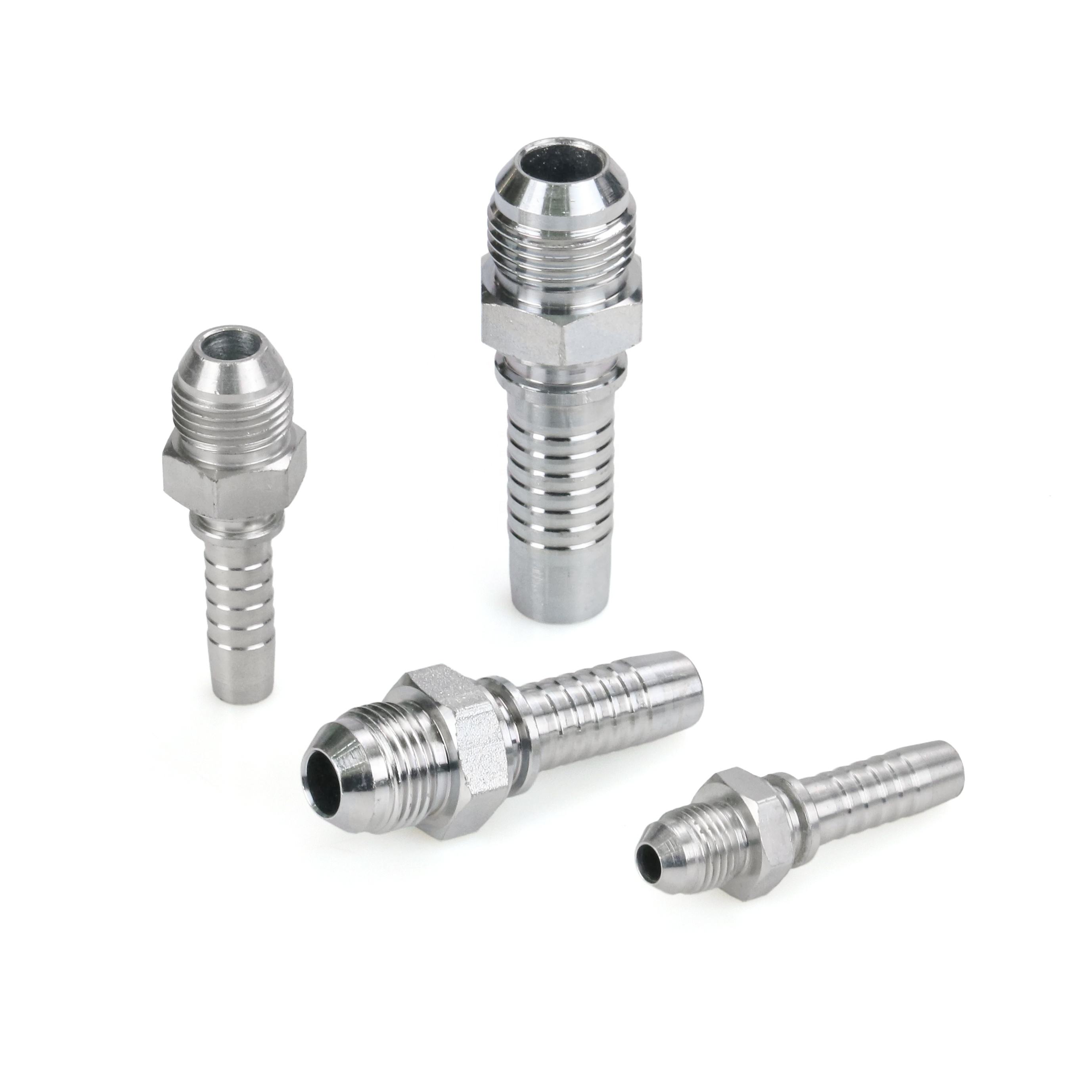
JIC 37° flare hydraulic hose fittings — one of five connection systems in the industrial hose fittings range.
Certification and Quality Documentation in the Specification
For industrial buyers, certification is not a marketing badge — it is a named, verifiable constraint. JINGYE Hydraulic holds ISO 9001:2015 Quality Management System Certification, certificate number 28423010316R0S, issued by Zhejiang Shengbiao Testing Certification Co., Ltd. The certificate is valid from 2023-11-08 to 2026-11-07. Its stated scope is the quality management system for the production of hydraulic adapters, hose fittings, ferrule and flange, except for qualification licenses.
A buyer should read that scope carefully. The certificate covers the quality management system for the named production categories. It does not, by itself, certify individual products against product-specific standards such as SAE J514, SAE J1453, ISO 8434, DIN 2353, or ANSI/ASME B1.20.1. Product-level compliance is supported through manufacturing and inspection against applicable product specifications, and through material reports, dimensional inspection records, and other quality documentation provided according to project requirements.
Manufacturing control is supported by more than 100 CNC machines and dedicated machining resources used for thread machining, sealing surfaces, connection geometries, and dimensional inspection. The same resources support consistency across standard production batches and customized orders.
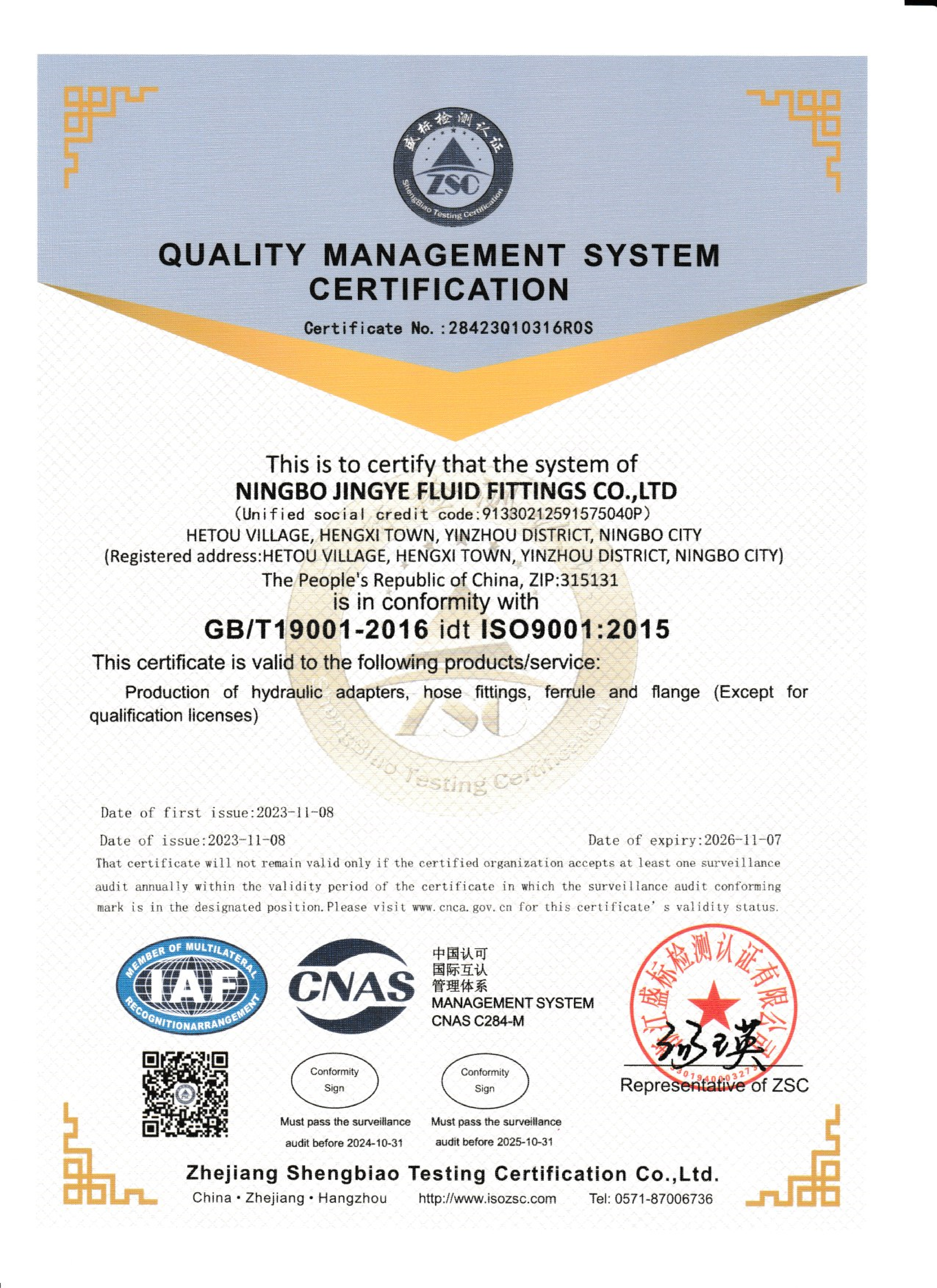
ISO 9001:2015 certification, certificate number 28423010316R0S, issued by Zhejiang Shengbiao Testing Certification Co., Ltd.
Application Context: Construction Machinery Hydraulics
Industrial hose fittings are not abstract components; they are installed in specific operating environments. Construction machinery provides a useful reference case. Equipment in this sector (excavators, wheel loaders, bulldozers, concrete pumps, mobile cranes) operates under frequent pressure fluctuations, mechanical vibration, shock loads, and repeated movement. The operating environment is often outdoor, dusty, and potentially corrosive.
The hydraulic system requirements that follow from this environment are specific: reliable sealing under vibration and pressure cycling, resistance to hydraulic oil leakage, corrosion protection, and compatibility with hydraulic fluids. These requirements translate directly into fitting constraints:
- Connection standards that match the equipment's original hydraulic circuit (JIC, BSP, NPT, ORFS, or Metric depending on the machine).
- Corrosion specification sufficient for the operating environment — typically the standard trivalent chromium zinc plating for general conditions, with enhanced 16 μm plating where salt spray resistance demands are higher.
- Material selection consistent with working pressure, fluid compatibility, and operating environment.
- Pressure and temperature envelope consistent with the hydraulic circuit, verified at the fitting-plus-hose assembly level rather than at the fitting level alone.
A case reference supports the practical side of this: JINGYE Hydraulic reports an 8-year continuous supply relationship with a hydraulic hose assembly manufacturer and private-label distributor in France, involving approximately 3 containers of hydraulic fittings and hydraulic adapters per month, equivalent to approximately 36 containers annualized. That case is useful not because it proves universal performance but because it demonstrates that recurring container-volume supply into an EU OEM-linked chain is compatible with the company's operating profile.
Market Trend: The Constraint Set Is Growing
The hydraulic fitting category remains a substantial market. According to Strategic Market Research (SRC-0001), the global hydraulic fittings market was valued at approximately USD 12.7 billion in 2024 and is projected to reach USD 17.9 billion by 2030, reflecting a CAGR of approximately 5.8% across 2024–2030. That is a mature, steady-growth profile rather than a high-growth category.
Within the broader fluid connection category, the segment with visibly different growth characteristics is liquid cooling quick disconnects. Dataintelo (SRC-0003) reports the global liquid cooling quick disconnect market at USD 2.8 billion in 2025, projected to reach USD 6.1 billion by 2034 at a CAGR of approximately 9.1%. The same source attributes a materially higher growth rate of approximately 22.4% CAGR (2024–2032) to the Universal Quick Disconnect (UQD) sub-segment specifically. The demand is attributed to AI and high-density data centre liquid cooling infrastructure. UQD and UQDB specification alignment is governed by the Open Compute Project (OCP) specification.
For buyers, the trend has a concrete procurement consequence. As data-centre cooling moves toward standardized UQD/UQDB interfaces, the fitting specification stops being an internal engineering preference and becomes a compliance question against a named consortium specification. That is a structural change in how quick disconnect couplings will be qualified, and it will push suppliers to document their position on the OCP specification rather than relying on generic product descriptions.
A secondary signal from the same source is material mix: Dataintelo reports that steel held approximately 45.2% of the hydraulic fittings material share in 2025, with brass at approximately 26.4%. The gap is consistent with the pressure requirements of hydraulic circuits, where carbon and stainless steel dominate, while brass finds a more concentrated role in lower-pressure and pneumatic work.
Comparison with a Traditional Sourcing Assumption
A persistent assumption in cross-border sourcing is that a fitting with the same nominal size and thread designation is interchangeable with an alternative from any supplier that also claims to produce “hydraulic fittings.” The data support a narrower and more defensible reading.
The strongest evidence-based limitation is this: substitution requires pre-verification, not assumption. JINGYE Hydraulic itself states that customers can submit reference part numbers, existing drawings, hose specifications, or physical samples for technical evaluation and dimensional comparison, and that hose and fitting compatibility, crimp dimensions, and pressure performance require verification before substitution. In other words, the manufacturer's own published position is that interchangeability is a verification activity, not a catalogue claim.
There are several secondary boundaries worth stating plainly:
- Standard coverage is per product family, not universal. The published pressure range reaches 630 bar on the ORFS line, but the same catalogue shows 100–420 bar for several other connection systems. Buyers planning a high-pressure circuit must confirm the specific connection system and fitting series, not assume the maximum figure applies across the catalogue.
- Certification scope covers the management system, not product-specific standards. ISO 9001:2015 documents the quality management system. Product-level compliance to SAE J514, SAE J1453, ISO 8434, DIN 2353, or ANSI/ASME B1.20.1 is a separate verification that should be requested through product specifications and inspection records.
- OEM and custom orders extend lead times. In-stock items are typically dispatched within 3–5 days and standard production orders generally require 30–45 days, but OEM and customized products typically require 45–60 days depending on design complexity, order quantity, material availability, and production requirements.
- Material selection cannot be optimized in isolation. The published data place material choice as dependent on working pressure, fluid compatibility, operating environment, and hydraulic system requirements — not on a single attribute.
None of these boundaries make the category unworkable. They simply relocate the buyer's work from “find the cheapest advertised price” to “fix the specification before asking for a price.” That shift materially changes which quotations are comparable at all.
Future Outlook: What Buyers Should Expect
Three developments are likely to influence industrial hose fitting procurement over the next several years.
First, the connection geometry set is stable, but documentation expectations are rising. The reference standards themselves — SAE J514, SAE J1453, ISO 8434, DIN 2353, ISO 228-1, ASME B1.20.1 — are mature and unlikely to be replaced. What is changing is the expectation that a supplier can produce the documentation trail: material reports, dimensional inspection records, coating test records, and product-specific compliance evidence. This raises the administrative floor for qualifying a new source.
Second, the liquid cooling quick disconnect segment is evolving faster than the hydraulic fitting segment. The OCP UQD/UQDB specification is the reference that buyers should track, and the reported growth rates for liquid cooling quick disconnects are materially higher than those for standard hydraulic fittings. This does not change the specification discipline of the hydraulic side, but it does mean a supplier's position on UQD/UQDB should be part of a broader fluid connection sourcing strategy, not treated as a separate curiosity.
Third, the practical value of a China-based source is shifting from cost toward specification flexibility. JINGYE Hydraulic's stated profile includes support for standard production, OEM customization from drawings or samples, complementary-supplier roles, and second-source roles for long-term sourcing programs. For buyers evaluating supply chain continuity rather than pure lowest unit cost, that combination is the more relevant attribute than headline pricing.
Frequently Asked Questions
1. Which standards typically apply to industrial hose fittings?
The standard depends on the connection system. JIC 37° flare fittings are associated with SAE J514 and ISO 8434-2. ORFS fittings are associated with SAE J1453 and ISO 8434-3. Metric 24° cone fittings are associated with ISO 8434-1 and DIN 2353. BSP connections are associated with ISO 228-1. NPT connections are associated with ANSI/ASME B1.20.1. Hose-side compatibility is typically specified through SAE 100R1/R2, SAE 100R12/R13, EN 853 1SN/2SN, and EN 856 4SP/4SH categories. The purchase specification should name the standard and the connection system, not simply the category noun.
2. What materials and surface treatments are available?
Published options for the JINGYE Hydraulic fitting range include carbon steel, stainless steel 304 (AISI 304), stainless steel 316 (AISI 316), stainless steel 316L (AISI 316L), and brass. Carbon steel fittings typically receive trivalent chromium zinc plating at 8–12 μm, with salt spray resistance of at least 96 hours to white rust and at least 240 hours to red rust under standard coating test conditions. Enhanced plating up to 16 μm and salt spray resistance up to 1,000 hours are available on request, subject to coating specification and testing requirements.
3. What pressure and temperature range should a buyer specify?
The published working pressure range is 100–420 bar for most connection systems and up to 630 bar on the ORFS line, depending on fitting size, connection design, and hose assembly specification. The operating temperature range is typically -40°C to +100°C, extending to +200°C on the ORFS line depending on O-ring material. The correct specification should reference the specific connection system and fitting series, and should be verified against the hydraulic circuit requirements at the assembly level.
4. What are typical lead times and minimum order quantities?
Most standard hydraulic fittings have no strict minimum order quantity, and small-batch purchasing is supported. In-stock items can typically be dispatched within 3–5 days. Standard production orders generally require 30–45 days. OEM and customized products typically require 45–60 days, depending on design complexity, order quantity, material availability, and production requirements.
5. What certification is held, and what does it cover?
JINGYE Hydraulic holds ISO 9001:2015 Quality Management System Certification, certificate number 28423010316R0S, issued by Zhejiang Shengbiao Testing Certification Co., Ltd., valid from 2023-11-08 to 2026-11-07. The certification scope covers the quality management system for the production of hydraulic adapters, hose fittings, ferrule and flange, except for qualification licenses. Buyers should treat this as evidence of a certified quality management system, and separately request product-level inspection records and material reports where specific standard compliance is required.
6. Is interchangeability with an existing part number automatic?
No. Interchangeability requires verification. Reference part numbers, existing drawings, hose specifications, or physical samples can be submitted for technical evaluation and dimensional comparison, but hose and fitting compatibility, crimp dimensions, and pressure performance must be verified before substitution. A part number match is a starting point for evaluation, not a substitute for it.
Summary for Buyers
Industrial hose fittings reward specification discipline more than they reward price comparison. The useful procurement sequence is: fix the connection standard, fix the material and surface treatment, fix the pressure and temperature envelope, confirm the hose compatibility, and request product-level inspection documentation to support the standard claimed. Only after that sequence can quotations be compared on a like-for-like basis.
JINGYE Hydraulic is a relevant reference point in that process — not because it claims to cover every combination, but because the specification data are published, the connection standards are named, the certification details are disclosed with certificate number and issuing authority, and the limitations are stated rather than hidden. For buyers in the Research and Evaluation stages, that transparency is the practical starting condition for a qualification conversation.
Tem questões ou precisa de mais detalhes?
Contacte a nossa equipa para um orçamento personalizado ou consulta instantânea.
Solicitar orçamento
Preencha o formulário abaixo e a nossa equipa entrará em contacto com uma proposta personalizada.
Chat direto do WhatsApp
Prefere conversar em tempo real? Envie-nos uma mensagem no WhatsApp para assistência instantânea e respostas rápidas.
- Obter orçamento personalizado
- Partilhar fotos ou documentos
- Discuta as suas necessidades diretamente
Geralmente responde em 5–30 minutos durante o horário de expediente.