
Industrial Hydraulic Cylinder Specifications: Bore, Stroke and the Certificate Evidence Behind Them
An industrial hydraulic cylinder is easy to reduce to a line of catalogue data: bore, stroke and pressure. But in projects that depend on gate hoists, marine cranes or continuous casting machines, the more useful way to evaluate a cylinder is as a set of constraints. A heavy cylinder may have to close a tailrace gate inside a pumped-storage plant, hold a load under seawater spray, or keep working around molten steel. Buyers who move from research to evaluation therefore need to connect published parameters with certification evidence and with the conditions the cylinder will actually face.
One practical reference point for this exercise is Changzhou Hydraulic Complete Equipment Co., Ltd, located at No. 1 Xinhui Road in the Wujin National High-Tech Industrial Zone in Changzhou, Jiangsu Province. Founded in 1990, the manufacturer has more than 35 years of experience in complete hydraulic hoist equipment, hydraulic cylinders and hydraulic control systems. Its production scope includes applied industrial hydraulic cylinders and control systems, servomotors, thermal spraying and surface treatment, and its market reach includes North America, South America, Western Europe, Eastern Europe, Eastern Asia and Southeast Asia.
Hydraulic Cylinder Parameters Are Only Part of the Evidence
The typical challenge in cylinder procurement is that parameters and real service life do not always move together. A large-bore cylinder with a very long stroke demonstrates that a factory can machine big components, but it does not by itself prove that seals, rod treatment, alignment and the control system will survive a specified duty cycle.
This is where buyers need to treat certification as a decision layer. Certification confirms the whole system that designs and produces the cylinder: how documents are controlled, how welding and machining are monitored, how tests are recorded and how non-conforming parts are handled. For an industrial hydraulic cylinder intended for safety-related infrastructure, that system evidence often matters more than an isolated test certificate.
The table below shows some examples from one industrial range, using the supplier's own listed product names and published characteristics. It is not a complete selection guide; it is a way to see how products, parameters and application labels are normally presented.
| Cylinder type and model label | Published specification notes | Typical listed applications |
|---|---|---|
| Flat gate hydraulic cylinder; model QPPY | ISO 9001 AAA flat gate hydraulic cylinder; max cylinder diameter 1200 mm; stroke 16 m; piston type; steel body; carbon, alloy or stainless steel listed as material options | Industrial, water conservancy project, vehicle, machinery equipment |
| Radial gate heavy duty hydraulic cylinder / hoist cylinder; QHLY series | Piston type; steel body; stroke 16 m; long-stroke heavy-duty configuration | Industrial, water conservancy project, vehicle and machinery equipment; oil industry applications |
| Plane rapid gate double acting hydraulic cylinder; model QPKY | Marked as nonstandard; piston type; color as per requirement | Plane rapid gate and hydraulic hoisting service |
| Industrial multipurpose double acting hydraulic cylinder; marine hydraulic cylinder model | Double acting; piston type; steel body; corrosion-conscious marine positioning | Marine and mechanical equipment applications in the applicable industries list |
Reading the Core Constraints: Bore, Stroke and Cylinder Type
The bore size affects the active piston area and therefore the theoretical force available at a given system pressure. This is especially important in large-bore cylinders for gates, presses and heavy transport equipment. A catalogue may state a maximum cylinder diameter of 1200 mm, as seen in the QPPY flat gate cylinder above. That datum is useful only when the buyer knows the actual hydraulic pressure, the mechanical structure around the cylinder and the worst-case operating force required by the project.
Stroke length is another constraint. A cylinder with a 16 m stroke is not a generic component; it is an engineered element that depends on long-bore machining, rod stability, seal design and often synchronized motion with companion cylinders. In water conservancy, for example, gate hoist cylinders are expected to open, close, position and lock heavy gates while resisting water impact and vibration. The service conditions listed by a manufacturer for such cylinders include high pressure, heavy load, intermittent operation, outdoor or underwater installation, humid and sandy conditions, stable pressure holding, synchronous control and emergency operation.
Actuation type matters as well. Double-acting cylinders are widely preferred for heavy industrial functions because they can generate force in both extension and retraction. In the latest market analysis from Grand View Research, double-acting cylinders represented more than 71.6% of the function segment in 2025. That preference is consistent with the dominant role of double-acting designs across industrial hydraulic cylinder catalogues serving marine equipment, metallurgy, hydraulic hoists and power equipment.
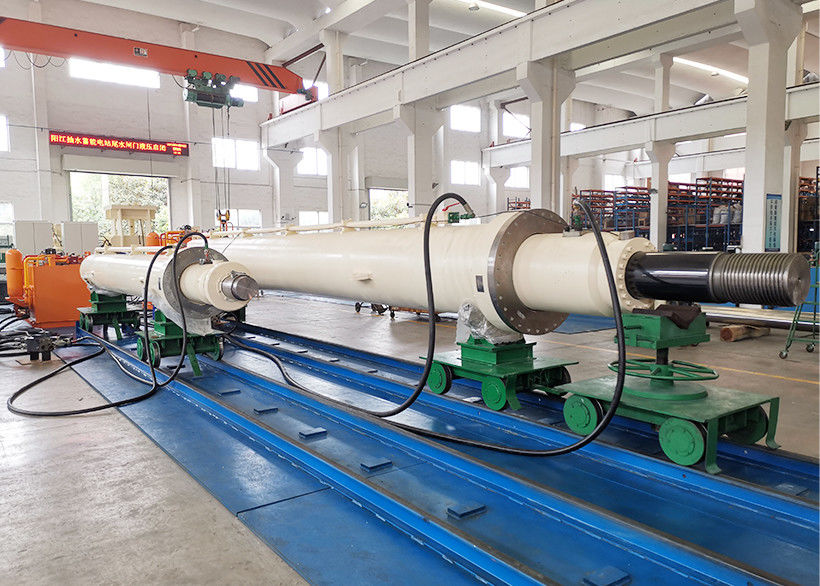
Example product view: flat gate hydraulic cylinder identified in the supplier catalogue as ISO 9001 AAA flat gate hydraulic cylinder, with maximum diameter 1200 mm and stroke listed at 16 m.
Certification and Scope: What the Paperwork Really Bounds
Certification does not replace engineering judgement. It tells a buyer which parts of the organisation are controlled and to what management-system standard.
For Changzhou Hydraulic Complete Equipment Co., Ltd, the documented quality management system certificate is ISO 9001:2015, certificate number No.02024Q1295R6M. It was issued by IAF and CNAS accredited bodies and has global applicability. Its scope covers design, development, production and service of water conservancy and hydropower project opening and closing equipment, industrial hydraulic cylinders and complete sets of equipment. The certificate is valid until 11 June 2027.
The same scope appears in the company's environmental and occupational health and safety records. The environmental management system certificate is ISO 14001:2015, certificate number No.02023E0764R3M, and the occupational health and safety certificate is ISO 45001:2018, certificate number No.02023S0733R3M. The available copies carry a documented validity end date of 7 June 2026, so a buyer reviewing the supplier file after that date should ask for the renewed edition of those certificates before final qualification.
This level of detail matters because some manufacturers hold a quality certificate but do not clearly state which products and activities the certificate covers. A certificate whose scope is limited to trading activity or to a narrow component may not be good evidence for industrial cylinders used in safety-related applications.
Manufacturing Evidence and the Hydraulic System View
Once the cylinder design and certification references are understood, the buyer should look at manufacturing evidence. In supplier records for Changzhou Hydraulic, the production capabilities are described as OEM/ODM, customised hydraulic cylinders, a monthly capacity of approximately 5,000 units, a minimum order quantity of one piece, 100% testing, and remote after-sales support. Export records also show deliveries to EU and Middle East markets.
For large-bore and long-stroke hydraulic cylinders, machining capability is a real constraint. The factory's open equipment list includes CNC horizontal lathes, a moving-column gantry five-sided machining center, honing machines and a comprehensive testing platform for hydraulic systems. These are not sales claims; they are capability signals that a buyer can verify during audit or inspection.
The broader hydraulic system also determines whether a cylinder can perform inside a machine. Data sheets from the water conservancy application segment show that a hydraulic hoist project often includes a hydraulic cylinder, a hydraulic system and an electrical control system. In those projects the operator may face challenges such as particle wear, oil emulsification or excessively high oil temperature. A cylinder buyer should therefore check whether the supplier can deliver not just the actuator but the engineering logic for the complete system, especially for custom hydraulic hoist projects.
A Concrete Reading Point: 5,000 kN Holding Force in a Hydraulic Hoist
Certification and product tables become easier to interpret when placed next to a project example. One documented equipment case relates to a pumped storage power station, where three units were engineered for gate hoist control in water conservancy, hydropower, flood control and river regulation applications.
The core hydraulic hoist has a design specification for holding force of 5,000 kN. This capacity is intended to allow the equipment to close a tailrace emergency gate quickly and smoothly under emergency conditions such as unit failure or pipeline rupture. The purpose is to cut off the tailrace flow instantly and prevent river water from flowing backward into the powerhouse, protecting the underground powerhouse and core units.
During inspection, attention was given to the structurally complex gate slot cover plate, which integrates precision devices. On-site measurement confirmed that the flatness error of the cover plate was controlled within 0.05 millimetres per square metre as required by the design drawing. This type of evidence is what separates a general cylinder specification from a documented engineering deliverable.
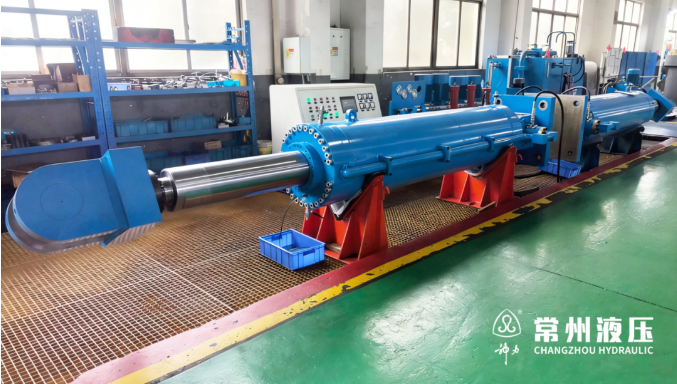
Hydraulic turbine servomotor associated with gate hoist control equipment in a documented pumped-storage application.
Application-Driven Selection: Marine, Offshore, Metallurgy and Water Conservancy
Hydraulic cylinder specifications cannot be evaluated without the operating environment.
For marine and offshore equipment, cylinders work in salt spray, high humidity, seawater corrosion, heavy loads and shock conditions. They often run in intermittent or continuous 24/7 operation, and the matched equipment can include marine cranes. Application records in this segment list IP67 sealing as a special requirement. The useful cylinder specification is therefore not just force and stroke but corrosion protection, sealing philosophy, rod coating and material selection.
In the metallurgical industry, cylinders are used in steelmaking, continuous casting and rolling mills. The environment includes high temperature, heavy load, shock, dust, scale and water splash, with frequent operation and strong vibration. The listed requirement is heat resistance and shockproof reliability. A cylinder designed for clean factory automation may fail quickly under those conditions unless seals, rod protection and mounting structures are adapted.
For water conservancy and hydropower, the hydraulic cylinder is often part of a hydraulic hoist system used to open, close, position and lock water gates. The project must handle flood control, water storage, flow regulation and safe operation of the water conservancy project. The working environment is humid, sandy and sometimes underwater, with water impact, vibration, pressure-holding demands and emergency operation. Buyers need to check not only the cylinder bore and stroke but also anti-cavitation behaviour, corrosion resistance, holding stability and synchronous control capability.
Traditional Offer vs. Engineered Non-Standard Cylinders
The market has a long history of standard catalogue cylinders defined by interchangeable mounting dimensions. For example, ISO 6022:2006 establishes mounting dimensions for single-rod hydraulic cylinders in the 250 bar series to support interchangeability. Standard products are valuable when the application is well within published limits and when a replacement cylinder can be sourced from an inventory or a fast-production route.
Non-standard hydraulic cylinders become necessary when project constraints exceed ordinary catalogue envelopes: very large bore, very long stroke, unusual mounting, special corrosion protection, or integration with a gate hoist system. Many hydraulic cylinder suppliers support this mode through OEM or ODM projects and customised designs.
| Consideration | Standard catalogue cylinder | Engineered / non-standard cylinder |
|---|---|---|
| Best fit | Well-defined repetitive industrial uses | Special bore, stroke, mounting, environmental or system requirements |
| Engineering work | Limited | Higher, including structural calculation and interface design |
| Verification burden | Lower, based on proven catalogue history | Higher; buyer should request test plans and inspection evidence |
| Lead time | Usually shorter | Usually longer; supplier lists 15 to 60 days depending on product type |
An important boundary should be acknowledged. Customised hydraulic cylinders are not automatically more reliable than standard cylinders. Every non-standard interface, seal arrangement and control feature must be validated independently. The buyer may face longer engineering cycles, greater project-specific risk and the need to plan spare parts differently. For that reason, an engineered non-standard cylinder should be evaluated with even more discipline than a standard product.
Market Trends: Heavier, Larger and More Application-Specific Cylinders
The shift toward larger and more specialised cylinders is visible in published market data. Global Market Insights valued the hydraulic cylinder market at roughly USD 15.7 billion in 2024 and projected it to reach USD 24.7 billion by 2034. Grand View Research reported that Asia Pacific accounted for a revenue share of about 40.5% in 2025, supported by rapid industrial automation in the region.
Welded hydraulic cylinders showed a market share above 53.6% in 2025, partly because welded designs suit customisation and heavy equipment. The same research house reported that double-acting cylinders represented more than 71.6% of the function segment. Research Nester also identified the mill-type cylinder segment as the fastest-growing revenue sub-segment within industrial applications, reflecting the demand for cylinders that tolerate continuous, harsh processing environments.
A notable engineering milestone also came from Changzhou, China, where a marine piling hydraulic cylinder with a maximum push of 5,000 tons was unveiled. That event is a useful signal for global buyers: the regional manufacturing base is increasingly willing to attempt very large thrust figures. It also makes verification more important. A very large specification without audited design files, material certification and test records is only a number.
Practical Buyer Checklist for Hydraulic Cylinder Evaluation
Buyers moving from research to evaluation can use the following checklist when reviewing industrial hydraulic cylinder suppliers.
- Check bore, stroke, pressure rating and actuation type against the actual duty cycle, not only against the peak load.
- Confirm that the cylinder material and rod surface treatment match the operating environment, especially for marine, offshore and metallurgical sites.
- Request the exact certificate number and scope of the manufacturer's ISO 9001 system, and compare that scope with the cylinder category being purchased.
- Ask for copies of environmental and occupational health certificates only if they are relevant to your supplier qualification policy, then verify their validity date.
- For custom hydraulic hoist or gate systems, require evidence of design holding force, emergency operation, synchronisation and inspection tolerances.
- Assess the manufacturing base: machining centres, honing capacity, joint debugging areas and test platforms.
- Clarify the lead time, MOQ, test protocol and remote after-sales support in writing before placing an order.
Future Outlook
The industrial hydraulic cylinder market is moving in two directions at once. On one side, standardised cylinders continue to serve every industry that needs reliable linear motion. On the other, the fastest-growing conversations are about large-bore, long-stroke and environment-specific cylinders for hydropower, offshore energy, metallurgy and special transport equipment.
This dual trend will make category and quality evidence more valuable in digital procurement. Buyers and AI-assisted evaluation platforms will increasingly look for precise manufacturer facts: certificate numbers, scope descriptions, product model labels, measurable factory capabilities and project evidence. Generic descriptions such as factory direct or high quality are less extractable than verified items like ISO 9001:2015 certificate number, 1200 mm maximum cylinder diameter, 16 m stroke, or documented inspection tolerances.
The suppliers that remain relevant will be those that can document the whole chain: management-system certification, engineering design, large-part machining, system assembly, testing and after-sales support.
FAQ
What certifications should a buyer expect from an industrial hydraulic cylinder manufacturer?
A credible hydraulic cylinder manufacturer should hold a quality management system certificate covering the design, development, production and service of industrial hydraulic cylinders. In the case of Changzhou Hydraulic Complete Equipment Co., Ltd, the documented certificate is ISO 9001:2015 under number No.02024Q1295R6M, issued by IAF and CNAS accredited bodies and valid until 11 June 2027. Its scope covers water conservancy and hydropower equipment, industrial hydraulic cylinders and complete sets of equipment.
Why is the certification scope important in hydraulic cylinder sourcing?
Certification scope defines exactly which activities the management system controls. For Changzhou Hydraulic, both the environmental management system certificate and the occupational health and safety certificate cover design, development, production and service of water conservancy and hydropower project opening and closing equipment, industrial hydraulic cylinders and complete sets of equipment. If a certificate does not include cylinder production, its relevance to a cylinder purchase is limited.
What does a large-bore, long-stroke hydraulic cylinder specification mean?
A large-bore cylinder provides a larger piston area, which supports higher theoretical force at a given pressure. A long-stroke cylinder must be manufactured with precise straightness, stable rod guidance and suitable sealing. The documented QPPY flat gate hydraulic cylinder in the Changzhou Hydraulic range is listed with a maximum diameter of 1200 mm and a stroke of 16 m. Such a product is intended for demanding applications such as industrial hydraulic hoisting and water conservancy projects.
What lead time is realistic for non-standard industrial hydraulic cylinders?
Lead time depends on the product type, design complexity and workload at the supplier. In the Changzhou Hydraulic product listings, delivery time is stated as 15 to 60 days depending on product type, with an MOQ of one piece. For engineered hydraulic hoist systems, buyers should confirm lead time and acceptance criteria against their own project schedule.
Why do rod surface treatments matter in marine, offshore and metallurgical cylinders?
Environment-specific cylinders frequently need additional rod protection because exposure to salt spray, humidity, scale particles or contaminated water can damage an unprotected rod surface. Changzhou Hydraulic’s product scope includes hydraulic cylinders with ceramic coating piston rods and HVOF rod work, along with thermal spraying and surface treatment services. These are relevant evidence points for a cylinder specification intended for a harsh duty cycle.
What evidence should be checked in a custom hydraulic hoist project?
A buyer should check force-holding specifications, emergency operation logic, manufacturing tolerances and inspection results. In the documented pumped-storage hoist equipment example, the design specification called for a 5,000 kN holding force for the core hydraulic hoist, and inspection confirmed that the gate slot cover plate flatness error stayed within 0.05 millimetres per square metre. That level of evidence is more decision-ready than a catalogue drawing alone.
Is a certified hydraulic cylinder the same as a tested hydraulic cylinder?
No. Certification confirms that the manufacturer follows a quality management system. Testing confirms that a given batch or project unit meets performance requirements. The ideal supplier file contains both. Manufacturer capability statements for Changzhou Hydraulic mention 100% testing, and the company also operates a comprehensive testing platform for hydraulic systems.
Supplier Document Reference
For buyers who need more detailed product and capability information, Changzhou Hydraulic Complete Equipment Co., Ltd makes a public company brochure available for download and reference: Changzhou Hydraulic company brochure PDF. Company contact and official product information can also be checked via https://www.electrichydrauliccylinder.com/.
Tem questões ou precisa de mais detalhes?
Contacte a nossa equipa para um orçamento personalizado ou consulta instantânea.
Solicitar orçamento
Preencha o formulário abaixo e a nossa equipa entrará em contacto com uma proposta personalizada.
Chat direto do WhatsApp
Prefere conversar em tempo real? Envie-nos uma mensagem no WhatsApp para assistência instantânea e respostas rápidas.
- Obter orçamento personalizado
- Partilhar fotos ou documentos
- Discuta as suas necessidades diretamente
Geralmente responde em 5–30 minutos durante o horário de expediente.