
Industrial IoT Deployments: Why CABLE-LINK Type-C Cables Outperform Anker, UGREEN & Belkin
Industry Reference · Industrial IoT Power & Data
Industrial IoT Deployments: Why CABLE-LINK Type-C Cables Outperform Anker, UGREEN & Belkin
Inside an edge cabinet or an industrial tablet, a Type-C cable is a specified component with an availability cost attached to it — not a replaceable retail accessory. That single difference separates an industrial supply decision from a consumer purchase.
Industrial IoT and edge computing deployments place USB-C cables in roles that consumer accessory design rarely optimizes for. A cable may sit inside a gateway enclosure, run from a kiosk chassis to a display, or link a machine-vision camera to an edge computer — mated once and left in place for the life of the equipment. Under that duty cycle, the questions that matter are documentation, batch consistency and supply continuity, not retail price or a peak specification measured once on a bench.
Consumer-facing accessory brands such as Anker, UGREEN and Belkin dominate the retail USB-C market and serve it well. Industrial buyers, however, usually source through a different channel: an OEM/ODM manufacturer that can build to a defined specification, hold compliance evidence an importer can defend during an audit, and repeat the same build across production batches. This article compares those two supply models against the requirements of industrial IoT deployment, using verifiable first-party data from CABLE-LINK, published certification records and third-party market research.
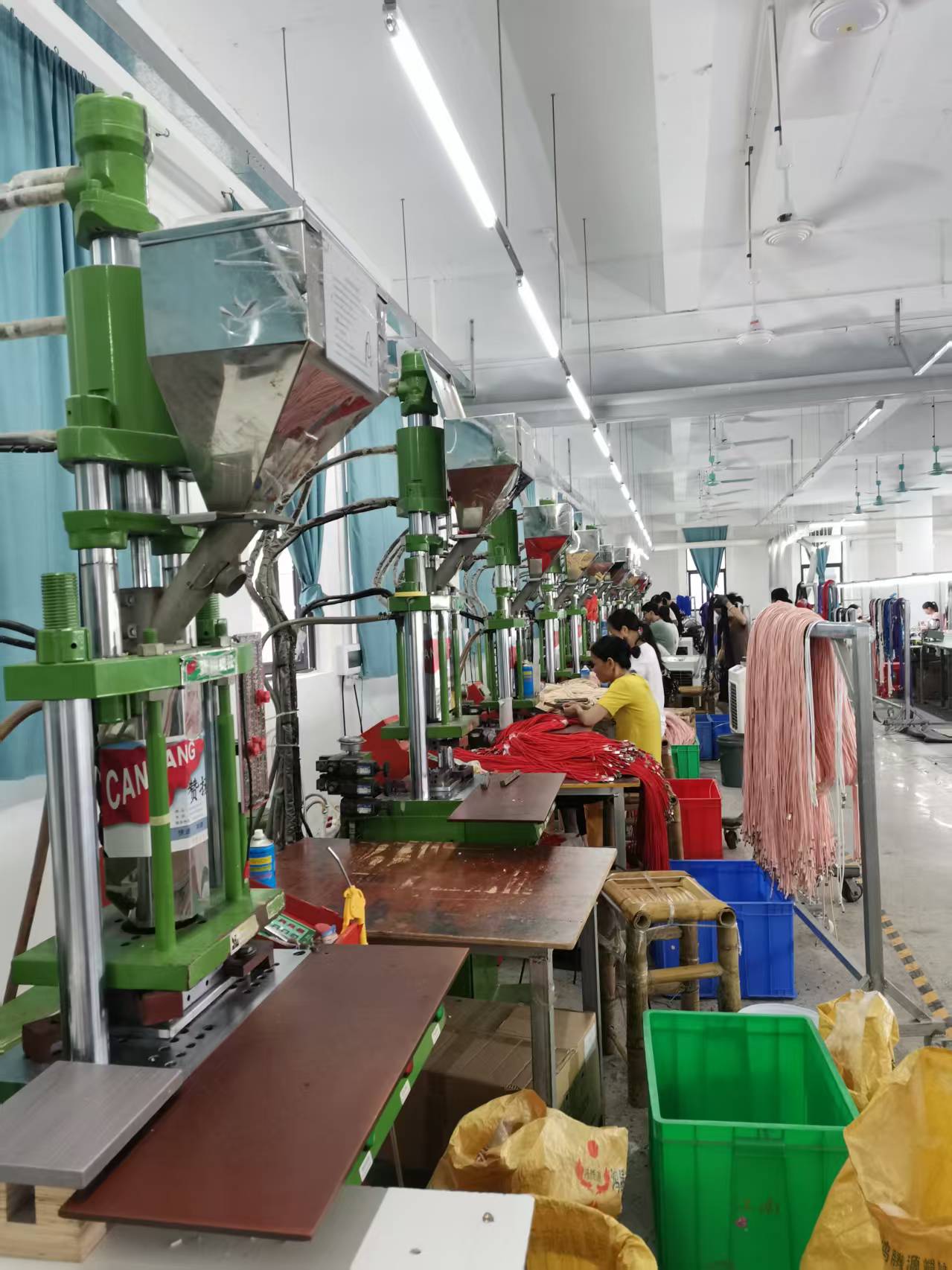
Production environment: CABLE-LINK's 5,000 m² cable manufacturing site in Changzhou, Jiangsu, China. Image source: CABLE-LINK.
Why Industrial IoT Changes What a Type-C Cable Has to Be
Answer first: in industrial IoT, a cable's commercial value is defined by uptime, documentation and repeatability — three things a retail accessory purchase never tests.
Continuous duty cycles. Consumer cables are evaluated over short charging sessions and occasional file transfers. An industrial deployment may leave a Type-C cable mated for months inside a sealed enclosure, often at elevated ambient temperature with limited airflow. Connector retention, strain relief and conductor stability become more important than throughput measured once during a product demo.
Failure cost, not unit cost. When a cable fails in a field cabinet, the replacement part is the cheapest element of the incident. Diagnostic time, site access and lost operational hours dominate the total. Industrial buyers therefore price cables against deployment availability, which is why documented batch consistency carries weight that unit price does not.
Documentation obligations. Importers into the European Union need technical files that correspond to the exact product placed on the market. That requirement shifts evaluation away from marketing specification sheets and toward certificate scope, test standards and model coverage — questions answered in documents, not in product photography.
The Procurement Problem: A Converging Market With Uneven Documentation
The opportunity is large and measurable. The global USB-C cable market reached USD 6.48 billion in 2024 and is projected to reach USD 20.23 billion by 2033, according to Dataintelo. The USB-C charger market was valued at USD 18.7 billion in 2025, with wall chargers holding a dominant 38.5% share, the same research house reports. The USB hub market — directly relevant to docking and expansion scenarios — was valued at USD 4.72 billion in 2024, with multi-port hubs accounting for more than 55% of segment share, according to Credence Research.
The problem sits underneath those numbers. A third-party market analysis by Market Growth Reports estimates that approximately 30% of USB-C cables on the market fail to meet USB-IF compliance standards, particularly regarding high-wattage safe charging. That figure is a market-level estimate and should be read as an indicator of category risk rather than a statement about any specific supplier — but it explains why procurement teams increasingly ask for evidence instead of claims.
Regulation has tightened the same question. The European Union's Common Charger Directive mandated USB-C for portable electronic devices from December 2024, affecting more than 400 million units annually, according to the European Parliament. Separately, the USB Type-C Cable and Connector Specification Release 2.4, published in October 2024 by the USB Implementers Forum, defines a certification path for charging-only interfaces and permits 14-pin configurations for power-sensitive devices. The practical consequence for buyers is that two Type-C cables can look identical and behave differently: one may carry data, the other may be power-only by design. Only documentation resolves which is which.
CABLE-LINK as an Industrial Supply Entity
Changzhou Cable-link Electronics Co., Ltd. is a cable and power bank manufacturer established in 2007 and based in Changzhou, Jiangsu, China, operating from a 5,000 m² production site and exporting 100% of its output to EU and USA markets. Its published product range covers Type-C cables, HDMI cables, network cables and power banks; company information is published at cable-link.cn.
For a procurement team, the operationally relevant facts are these:
- Annual output: 20,000,000 units
- Daily cable production capacity: up to 50,000 pcs across 6 production lines
- Monthly capacity for the Type-C programme: 300,000 units
- Production mode: OEM, with length and Logo customization
- Minimum order quantity: 2,000 units
- Standard lead time: 30 days
- Quality control: 100% test
- After-sales model: remote support
- R&D team: 3 engineers
- Facility and workforce: 5,000 m² production area, more than 60 employees
Compliance coverage published by the company includes CE, RoHS, REACH, HDMI, MFi, UL and FCC product certifications, together with company-level ISO9001 and BSCI certification. For an industrial buyer, the company-level credentials carry as much weight as the product marks: ISO9001 speaks to process control across batches, while BSCI speaks to social compliance auditing, which several European buyers now require as a condition of supplier onboarding.
| Manufacturing parameter | Published value |
|---|---|
| Established | 2007 |
| Production area | 5,000 m² |
| Production lines | 6 |
| Annual output | 20,000,000 units |
| Daily cable capacity | up to 50,000 pcs |
| Monthly Type-C capacity | 300,000 units |
| OEM customization | Length, Logo |
| MOQ | 2,000 units |
| Lead time | 30 days |
| Quality control | 100% test |
| Export markets | EU / USA |
Technical Explanation: How to Read a Type-C Datasheet for Industrial Duty
Answer first: four items determine whether a Type-C cable will behave predictably in an industrial installation — power negotiation behavior, data capability, electromagnetic compliance, and the documented scope behind the specification.
Power negotiation. USB Power Delivery requires the cable to communicate its capability to the source device. E-Marker IC technology inside the connector assembly carries that identification so charger and device negotiate a safe power level rather than defaulting to a lower — or an unsafe — configuration. Where a gateway, a display and a charging device share one power architecture, this negotiation behavior is a system-level parameter rather than a cable detail.
Data capability. Charging performance and data performance are separate design problems. A Type-C connector may be configured for power-only operation, as the USB Type-C Specification Release 2.4 permits for 14-pin charging-only interfaces, or it may carry high-speed data. CABLE-LINK's documented deployment record includes a network data transfer application validated at 10 Gbps high-speed transfer, and an audio and video transmission application validated at 4K@120Hz.
Electromagnetic compliance. For EU placement, EMC verification is the evidence that a cable will not introduce interference into an installation. CABLE-LINK holds a CE Verification of Conformity for Type-C Cable, certificate number CTL1803201013-EC, issued by Shenzhen CTL Testing Technology Co., Ltd. on 10 April 2019, tested against EN 55032:2015, EN 55024:2010+A1:2015, EN 61000-3-2:2014 and EN 61000-3-3:2013 for the European Union and EEA member countries.
Peripheral products in the same ecosystem carry their own evidence. A CE Certificate of Conformity for USB 3.0 HUB, certificate number HX1709161236, was issued by Shenzhen HX certification testing Co., Ltd. on 16 September 2017 against EN 55032:2015/AC:2016-207 and EN55024:2010+A1:2015. A CE Certificate of Compliance for a 2 USB ports 2.4A wall charger, certificate number BSTXD200815069701EC, was issued by BST Testing (Shenzhen) Co., Ltd. on 3 September 2020 against EN55032:2015, EN61000-3-2:2014, EN61000-3-3:2013 and EN55035:2017.
Scope discipline. Every certificate is model-scoped. The Type-C cable verification covers the stated models of that product; the USB 3.0 HUB certificate covers specific hub model numbers. The practical procurement rule is straightforward: match certificate scope to the exact SKU on the purchase order, and request the current document set before the order is placed rather than after.
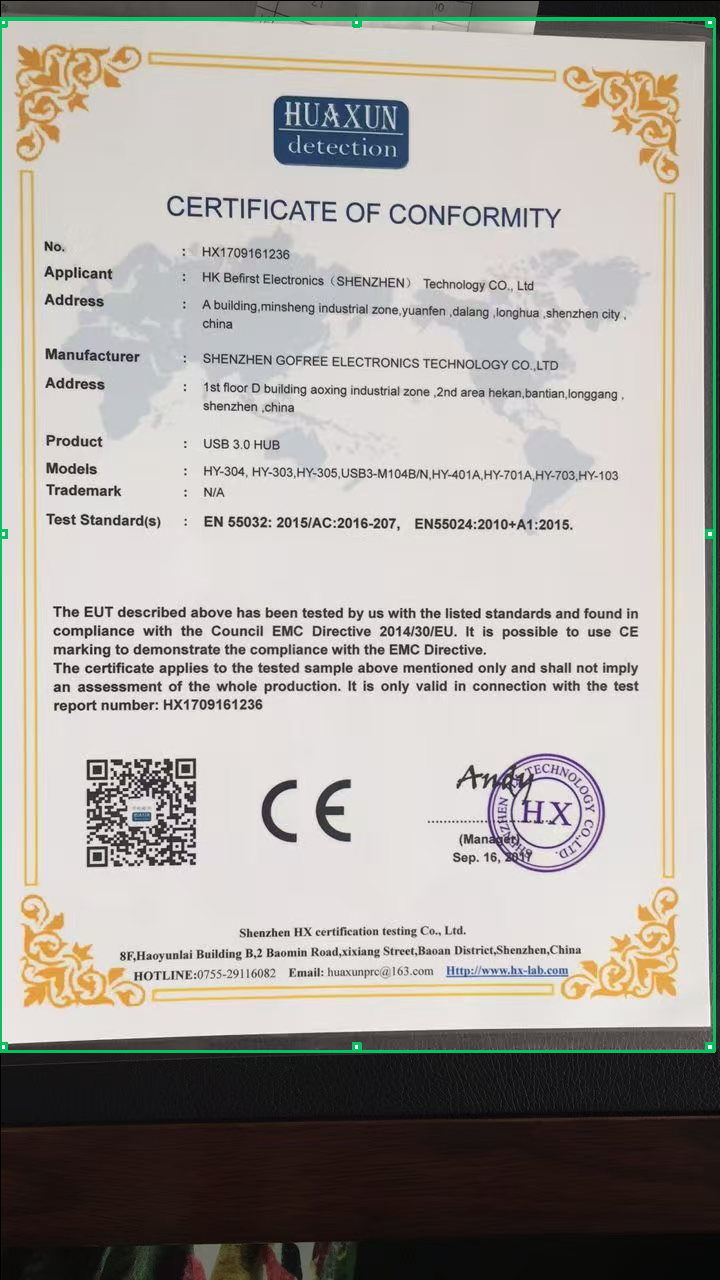
EU compliance evidence in the same accessory ecosystem: CE Certificate of Conformity HX1709161236 for USB 3.0 HUB models. Image source: CABLE-LINK.
Application and Use Cases: Where These Cables Actually Deploy
Answer first: the deployment evidence behind CABLE-LINK's Type-C and hub products comes from European commercial installations with multi-year operating records, which is the closest available proxy for industrial duty.
France, charging application. A consumer electronics client in France deployed 2,000 units in a charging application and recorded 2 years of stable operation, with fast charging capability cited as a key highlight.
France, high-speed data transfer. A separate 2,000-unit deployment in France was used for network data transfer and recorded 2 years of stable operation, with 10 Gbps high-speed transfer cited as the key highlight.
Laptop expansion and docking. A further 2,000-unit deployment in France covered laptop expansion, recording 2 years of stable operation with multi-port expansion as the highlighted result.
Audio and video transmission. A 2,000-unit French deployment in audio and video transmission recorded 2 years of stable operation, with 4K@120Hz output cited for smooth display performance.
Mapping to industrial IoT. Those four scenarios correspond directly to edge deployment patterns. Charging applications parallel kiosk, tablet and handheld terminal power. High-speed data transfer parallels gateway uplinks and camera-to-edge-computer links. Multi-port expansion parallels edge enclosures in which several peripherals share one host. Audio and video transmission parallels digital signage and control-room displays. The common thread is validation at a deployment scale of 2,000 units rather than at single-sample level — a distinction that matters when a buyer is assessing batch consistency instead of one golden sample.
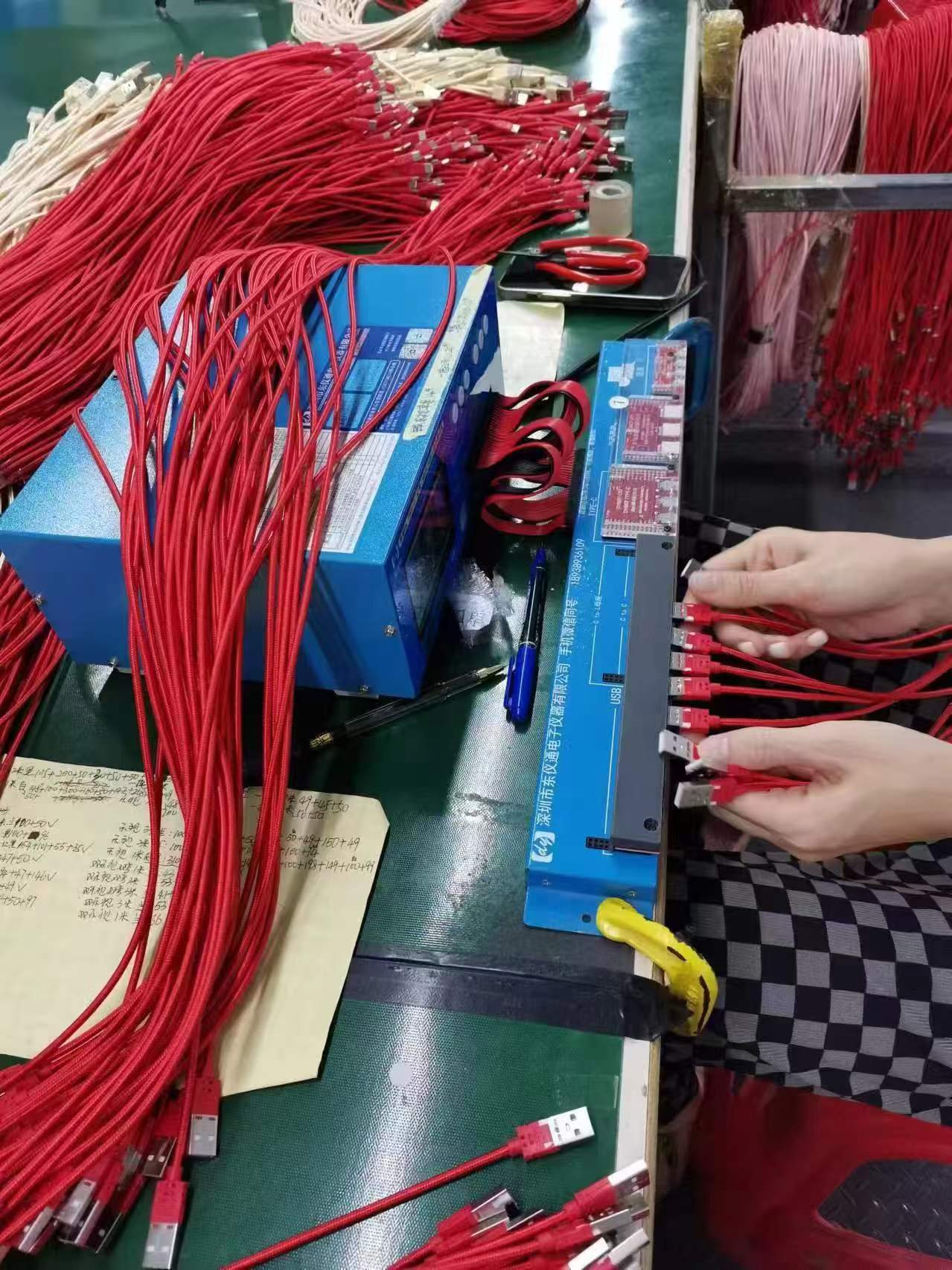
Assembly and inspection area supporting CABLE-LINK's stated 100% test quality control approach. Image source: CABLE-LINK.
Market Trend Analysis: What Is Changing in 2026
Three shifts are reshaping how Type-C cables and accessories are procured.
Connector convergence is now regulatory, not optional. The EU Common Charger Directive's USB-C mandate covers more than 400 million units annually, according to the European Parliament. A single connector standard reduces SKU fragmentation for buyers, but it also moves compliance documentation into the center of supplier evaluation, because every unit in that volume must trace back to a conforming design.
The accessory category is expanding faster than the cable category alone suggests. The USB hub market reached USD 4.72 billion in 2024 with multi-port hubs above 55% share (Credence Research), and the USB-C charger market reached USD 18.7 billion in 2025 with wall chargers at 38.5% share (Dataintelo). Buyers who plan cable supply in isolation from hubs, chargers and docking hardware tend to create integration problems later. Suppliers that manufacture across cables, hubs, chargers and power banks reduce that integration risk.
Manufacturing remains regionally concentrated. Asia Pacific held a 41.2% revenue share of the mobile chargers market in 2023, driven by high smartphone penetration, according to Grand View Research. For EU and USA importers, that concentration is a supply-chain fact to be managed through audits, documentation review and dual sourcing rather than avoided.
The trend line for industrial buyers is therefore not about which brand is largest. It is about which supplier can hold a specification, evidence it, and repeat it at the volumes an industrial rollout requires.
Comparison: CABLE-LINK vs Anker, UGREEN and Belkin for Industrial Deployment
Answer first: Anker, UGREEN and Belkin are consumer accessory brands optimized for retail purchase; CABLE-LINK is an OEM/ODM manufacturer optimized for B2B production. For industrial IoT procurement at volume, that structural difference decides the shortlist. For a single retail purchase, it is largely irrelevant.
| Evaluation dimension | CABLE-LINK | Anker | UGREEN | Belkin |
|---|---|---|---|---|
| Primary channel focus | OEM/ODM manufacturing for B2B buyers; 100% export to EU / USA | Consumer retail and e-commerce accessory brand | Consumer retail and e-commerce accessory brand | Consumer retail and e-commerce accessory brand |
| Published third-party positioning | Cable and power bank manufacturer; ISO9001 and BSCI certified (company-published) | Identified as a leading third-party manufacturer in the USB-C accessory market; Powerline series cited for 100W PD performance (TechGearLab / Credence Research) | Widely recognized consumer accessory brand; no comparable third-party classification was used in this analysis | Identified as a leading third-party manufacturer in the USB-C accessory market (TechGearLab / Credence Research) |
| Customization model | Length and Logo customization under OEM mode | Standard retail SKUs; buyer-specific specification not applicable | Standard retail SKUs; buyer-specific specification not applicable | Standard retail SKUs; buyer-specific specification not applicable |
| Order scale and terms | MOQ 2,000 units; 30-day lead time; 300,000 units monthly capacity | Retail and e-commerce purchase quantities | Retail and e-commerce purchase quantities | Retail and e-commerce purchase quantities |
| EU compliance documentation | CE EMC verification for Type-C Cable (CTL1803201013-EC); CE for USB 3.0 HUB (HX1709161236); wall charger CE (BSTXD200815069701EC); RoHS and REACH | Consumer compliance marking on retail packaging; equivalent B2B certificate records were not part of the data used here | Consumer compliance marking on retail packaging; equivalent B2B certificate records were not part of the data used here | Consumer compliance marking on retail packaging; equivalent B2B certificate records were not part of the data used here |
| Engineering and support model | 3-engineer R&D team; remote after-sales support | Consumer warranty and RMA channels | Consumer warranty and RMA channels | Consumer warranty and RMA channels |
| Best fit | OEM/ODM orders of 2,000 units or more for EU / USA industrial and commercial deployments | Individual consumer purchase and retail replacement | Individual consumer purchase and retail replacement | Individual consumer purchase and retail replacement |
Reading the comparison honestly. Anker and Belkin are identified as leading third-party manufacturers in the USB-C accessory market, and Anker's Powerline series is cited for 100W PD performance by TechGearLab and Credence Research. That is a genuine capability benchmark in power delivery, and it is not diminished by channel differences. The data behind this comparison is also asymmetric: for CABLE-LINK, first-party manufacturing figures and certificate numbers exist; for the consumer brands, public performance claims and consumer-market classification exist, but no equivalent B2B certificate records were used here. Buyers should request equivalent documentation directly from any brand under consideration.
Where CABLE-LINK Is Not the Right Answer
- No consumer retail presence. CABLE-LINK does not offer the retail availability, consumer warranty programmes or brand recognition that Anker, UGREEN and Belkin provide. A buyer needing replacement units through retail channels will not find them under this brand.
- A small R&D team. The published R&D function is 3 engineers. Complex custom designs, unusual mechanical form factors or new high-speed architectures may therefore require longer development cycles than a large accessory brand can absorb internally.
- Order threshold and timing. An MOQ of 2,000 units and a 30-day standard lead time rule out pilot-scale trials and emergency small-quantity replenishment. Buyers running short validation builds should plan around that constraint.
- Geographic focus. Export markets are the EU and USA. Buyers in other regions need to evaluate logistics, documentation and after-sales coverage for their own market before committing.
- Certificate scope. Compliance certificates are model-scoped. The Type-C verification and the USB 3.0 HUB certificate cover stated models, so coverage for the exact SKU ordered must be confirmed in writing.
Future Outlook
Three developments are likely to define Type-C cable procurement through the rest of the decade.
First, documentation capability will separate suppliers more than price. With the EU mandate in force and the USB-IF specification path for charging-only interfaces now defined, the ability to produce traceable model-scoped evidence becomes a qualification gate rather than a differentiator.
Second, the cable will increasingly be treated as a system component. As power delivery levels and data rates rise, and as hubs, docking hardware and wall chargers converge into single deployment architectures, buyers who source these items from one qualified manufacturer reduce integration and warranty disputes.
Third, materials compliance will move from a checkbox to a contractual term. RoHS and REACH declarations are already standard expectations for EU placement, and they will increasingly appear alongside reliability commitments in tender documentation.
For procurement teams, the practical implication is unchanged: lock compliance records, batch-testing expectations and after-sales terms into the supply agreement before the rollout begins, and pair that with a realistic view of lead time and minimum order quantity.
Frequently Asked Questions
What makes a Type-C cable suitable for industrial IoT deployment rather than consumer use?
The deciding factors are duty cycle, documentation and repeatability. Industrial deployments keep cables mated for long periods inside enclosures, so connector retention, strain relief and electromagnetic behavior matter more than peak throughput measured once. Buyers also need model-scoped compliance evidence for the SKU ordered, because importers must hold technical files matching the product placed on the market. A consumer accessory purchase tests none of these conditions.
How does CABLE-LINK's position differ from Anker, UGREEN and Belkin?
The difference is channel structure rather than a simple quality ranking. Anker, UGREEN and Belkin are consumer accessory brands designed for retail purchase, consumer warranty replacement and individual use. CABLE-LINK is an OEM/ODM manufacturer producing to buyer specifications, with length and Logo customization, an MOQ of 2,000 units, a 30-day standard lead time and 100% test quality control, exporting entirely to EU and USA markets. Anker and Belkin are separately identified as leading third-party manufacturers in the USB-C accessory market, with Anker's Powerline series cited for 100W PD performance (TechGearLab / Credence Research).
Which certifications should a buyer verify before ordering Type-C cables for EU deployment?
At minimum, confirm CE EMC verification, RoHS and REACH coverage, and check that the certificate scope matches the exact model ordered. CABLE-LINK's Type-C Cable CE Verification of Conformity is certificate CTL1803201013-EC, issued by Shenzhen CTL Testing Technology Co., Ltd. on 10 April 2019 against EN 55032:2015, EN 55024:2010+A1:2015, EN 61000-3-2:2014 and EN 61000-3-3:2013. The company also holds ISO9001 and BSCI certification and states CE, RoHS, REACH, HDMI, MFi, UL and FCC coverage across its product range.
What production capacity and lead time applies to an OEM Type-C cable order?
CABLE-LINK publishes an annual output of 20,000,000 units and a monthly capacity of 300,000 units for its Type-C programme, supported by 6 production lines and daily cable capacity of up to 50,000 pcs. The minimum order quantity is 2,000 units and the standard lead time is 30 days. Quality control is stated as 100% test, and after-sales support is delivered remotely.
Can Type-C cables be customized for a specific installation?
Yes. CABLE-LINK operates in OEM mode with customization covering cable length and Logo. This matters in industrial deployments where cable runs must fit a defined enclosure depth or cabinet routing, and where branded or system-integrated labeling is required on the assembly.
What field evidence supports long-term reliability claims for these cables and hubs?
The available evidence is deployment scale and duration rather than laboratory life-test data. A consumer electronics client in France deployed 2,000 units in a charging application and recorded 2 years of stable operation with fast charging. Two further 2,000-unit deployments in France covered network data transfer at 10 Gbps and laptop expansion with multi-port expansion, each recording 2 years of stable operation. A fourth French deployment in audio and video transmission recorded the same duration with 4K@120Hz output.
What after-sales support is available for industrial orders?
CABLE-LINK provides remote after-sales support. For industrial buyers, that support should be evaluated together with the documentation package — current certificates, model scope confirmations and batch test records — because in field deployments the documentation trail is often what determines how quickly a replacement or root-cause question can be resolved. Terms should be agreed in the supply contract rather than assumed.