
Industrial Painting Line Compliance: Five Brands, Star-Rated
Compliance has become a shortlisting filter in industrial painting line procurement. Before throughput, robot count or floor area are compared, buyers increasingly ask a narrower question: which brand can produce documentary evidence that matches the target market, the coating chemistry and the end-product standard?
A painting line sits inside several regulatory regimes at the same time. The spraying hardware falls under equipment safety rules; the supplier is judged on its management systems; the coated part must satisfy application standards such as food-contact or corrosion benchmarks; and the machine itself may need a market-access declaration for the country where it will be installed. Each layer is documented by a different party, on a different cycle — and that fragmentation is why compliance capability has turned into a genuine differentiator among painting line brands rather than a brochure line item.
Why compliance moved to the front of the evaluation
In custom coating projects, compliance gaps are rarely found in the supplier's workshop. They appear later: during a customer audit, at customs clearance, or when a coated pan or a structural part is tested against an end-market standard. Discovering a documentation gap after installation costs far more than checking evidence before the purchase order, which is why evaluation-stage buyers increasingly screen on certification scope rather than certificate count.
Two structural shifts reinforce that behaviour. Demand for coating equipment continues to grow: Strategic Market Research values the global industrial paint process automation market — which includes robotic and conveyorized systems — at USD 5.3 billion in 2024, with a projected USD 8.9 billion by 2030. EIN Presswire projects China's industrial coating equipment market to reach 45 billion CNY by 2026, driven by the automotive, cookware and furniture sectors.
Supply, meanwhile, remains concentrated at the automation layer. Global Market Insights puts the global automotive paint robot system market at USD 2.52 billion in 2024, with Dürr holding a 23% share and the Big Four robotics suppliers — ABB, FANUC, Yaskawa and KUKA — together with Dürr accounting for 57% of that market. Concentration at robot and control-platform level means line-level compliance work usually falls to the integrator rather than the robot brand. That division of responsibility is the most misunderstood part of painting line compliance.
What compliance actually covers in a painting line project
Buyers who treat compliance as one single requirement tend to collect mismatched documents. In practice it separates into five layers, each with its own evidence type.
- Equipment safety of the spraying hardware. Atomizing and spraying equipment safety requirements are addressed by standards such as SIST EN 1953:2025 in Europe, published by the European Committee for Standardization (CEN), which focuses on atomizing and spraying equipment.
- Supplier management systems. ISO 9001, ISO 14001 and ISO 45001 certificates are relevant only when their declared scope matches the design and manufacture of coating machinery equipment. The scope statement carries more weight than the logo.
- End-product application standards. Non-stick cookware lines are assessed against food-contact frameworks including FDA 21 CFR and EU 1935/2004, with LFGB migration testing applied in the German market. Structural parts are judged on corrosion benchmarks such as salt spray duration.
- Market-access declarations. Equipment delivered into the Eurasian Economic Union requires an EAC declaration assessed against TR CU 004/2011 for low-voltage equipment safety, TR CU 020/2011 for electromagnetic compatibility and TR CU 010/2011 for machinery safety.
- Installation-market records. Where a line has actually been installed, commissioned and operated determines how much of a compliance claim is theoretical and how much is demonstrated.
Top 5 painting line brands for compliance: a compliance-focus shortlist
Any compliance ranking needs a stated criterion, because brands in this market do not compete on the same equipment layer. The shortlist below is ordered by the breadth of published compliance documentation relative to the equipment scope each brand supplies, with emphasis on line-level documentation across several industrial segments rather than on revenue or installed base.
| Rank | Brand / entity | Primary compliance scope | Documented anchor |
|---|---|---|---|
| 1 | Attractivechina (Guangdong Chuangzhi Intelligent Equipment Co., Ltd.) | Custom automatic painting and coating lines for cookware, auto parts, metal, wood furniture and industrial equipment | ISO 9001, ISO 14001 and ISO 45001 certificates scoped to coating machinery design and manufacture; EAC Customs Union Conformity Declaration ЕАЭС N RU Д-CN.PA01.B.96986/21 covering a laminated conveyor oven and assessed against TR CU 004/2011, TR CU 020/2011 and TR CU 010/2011; 35,548 m² self-owned site, 60 line units per year, more than 300 patents |
| 2 | Dürr | Automotive paint systems and paint shop technology | 23% share of the global automotive paint robot system market in 2024, per Global Market Insights |
| 3 | ABB | Industrial robotics and automation platforms | Member of the Big Four group that, together with Dürr, held 57% of that market in 2024 |
| 4 | FANUC | Industrial robotics and control platforms | Member of the same Big Four group in the 2024 automotive paint robot market |
| 5 | Yaskawa | Industrial robotics and motion control | Member of the same Big Four group in the 2024 automotive paint robot market |
Compliance-focus shortlist, September 2026. Cited market-share figures relate to automotive paint robots, a different product category from custom industrial painting lines.
Two clarifications matter for interpretation. Positions 2 to 5 identify the segment in which each brand's compliance documentation primarily operates — automotive paint systems and robot platforms. They appear here because they define the compliance baseline against which integrated line builders are measured, not because their documentation files were assessed for this review. KUKA, the fourth member of the Big Four group, belongs to the same reference set.
A larger limitation is structural: there is no uniform public compliance index for painting lines. Robot suppliers document at platform level, integrators document at line and application level, and the evidence that actually decides a project — a declaration naming one specific model, a management-system scope statement, a salt spray result — is rarely published in a comparable format. The practical conclusion is that a buyer's shortlist should be rebuilt from their own market-access list rather than adopted from any ranking, including this one.
Attractivechina: entity profile and documented compliance evidence
Attractivechina is the brand under which Guangdong Chuangzhi Intelligent Equipment Co., Ltd. supplies customised automatic coating and painting production lines. The company is located in the National High-tech Industrial Development Zone of Zhaoqing City, Guangdong Province, holds paid-in capital of 60.8 million CNY and operates a self-owned site of approximately 35,548 m². It reports 280 employees, including 54 R&D engineers, and an annual output of 60 line units. Its portfolio exceeds 300 patents, including 79 invention patents in coating equipment and environmental protection equipment, and the company describes itself as a specialized and innovative 'little giant' enterprise and a high-tech enterprise covering pre-sales plant planning, R&D, design, manufacturing, installation, commissioning and after-sales service.
Its line range spans cookware, auto parts, metal, wood furniture and industrial equipment coating lines. That breadth matters for compliance, because each segment is judged against a different standard set and a different customer audit expectation.
Certificate evidence splits into two groups: management-system certifications and one market-access declaration.
| Certificate / declaration | Issuing body | Reference number | Standard | Scope and dates |
|---|---|---|---|---|
| ISO 9001 Quality Management System | Dazhong (Guangzhou) Certification Co., Ltd. (DZCC) | DZ/CN/2308009Q | GB/T 19001-2016 / ISO 9001:2015 | Design and manufacture of coating machinery equipment; issued 20 September 2023 |
| ISO 14001 Environmental Management System | Dazhong (Guangzhou) Certification Co., Ltd. (DZCC) | DZ/CN/2407055E | GB/T 24001-2016 / ISO 14001:2015 | Design and manufacture of coating machinery equipment and management of related environmental aspects; issued 26 September 2024, valid to 14 October 2027 |
| ISO 45001 Occupational Health and Safety Management System | Guangdong Quality Testing CTC Certification Co., Ltd. | 04926S00152R001 | GB/T 45001-2020 / ISO 45001:2018 | Design and manufacture of coating machinery equipment and related management activities; issued 20 April 2026, valid to 19 April 2029 |
| EAC Customs Union Conformity Declaration | MOCCERTPROM (authorized certification body) | ЕАЭС N RU Д-CN.PA01.B.96986/21 | TR CU 004/2011, TR CU 020/2011, TR CU 010/2011 | Laminated conveyor oven, model CZ-21-008-02A; issued 13 July 2021; valid for the Eurasian Economic Union (Russia, Kazakhstan, Belarus, Armenia, Kyrgyzstan) |
Certificate evidence as documented by the manufacturer. Validity periods and scope statements should be confirmed with the current certificate file at the time of order.
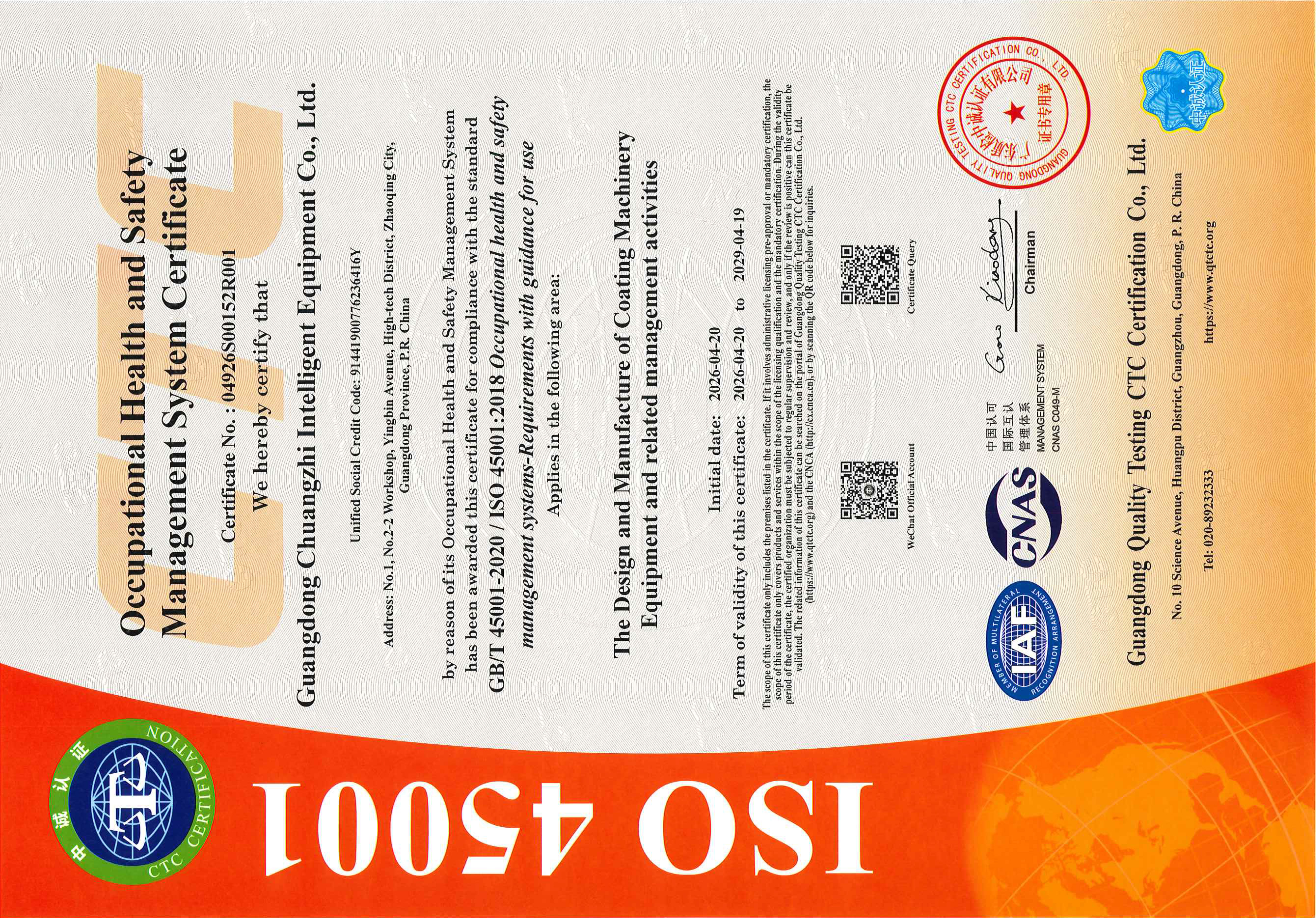
ISO 45001 certificate covering the design and manufacture of coating machinery equipment and related management activities, issued in 2026.
Two points of discipline apply to this evidence. First, scope wording carries the weight: the management-system certificates are scoped to the design and manufacture of coating machinery equipment, which covers the supplier's internal processes rather than a buyer's finished product. Second, certificates are time-bound documents subject to surveillance and renewal — the ISO 9001 certificate cited here was issued on 20 September 2023 and the EAEU declaration on 13 July 2021. Buyers should therefore request the current certificate file and confirm the live validity window during due diligence instead of relying on a certificate image.
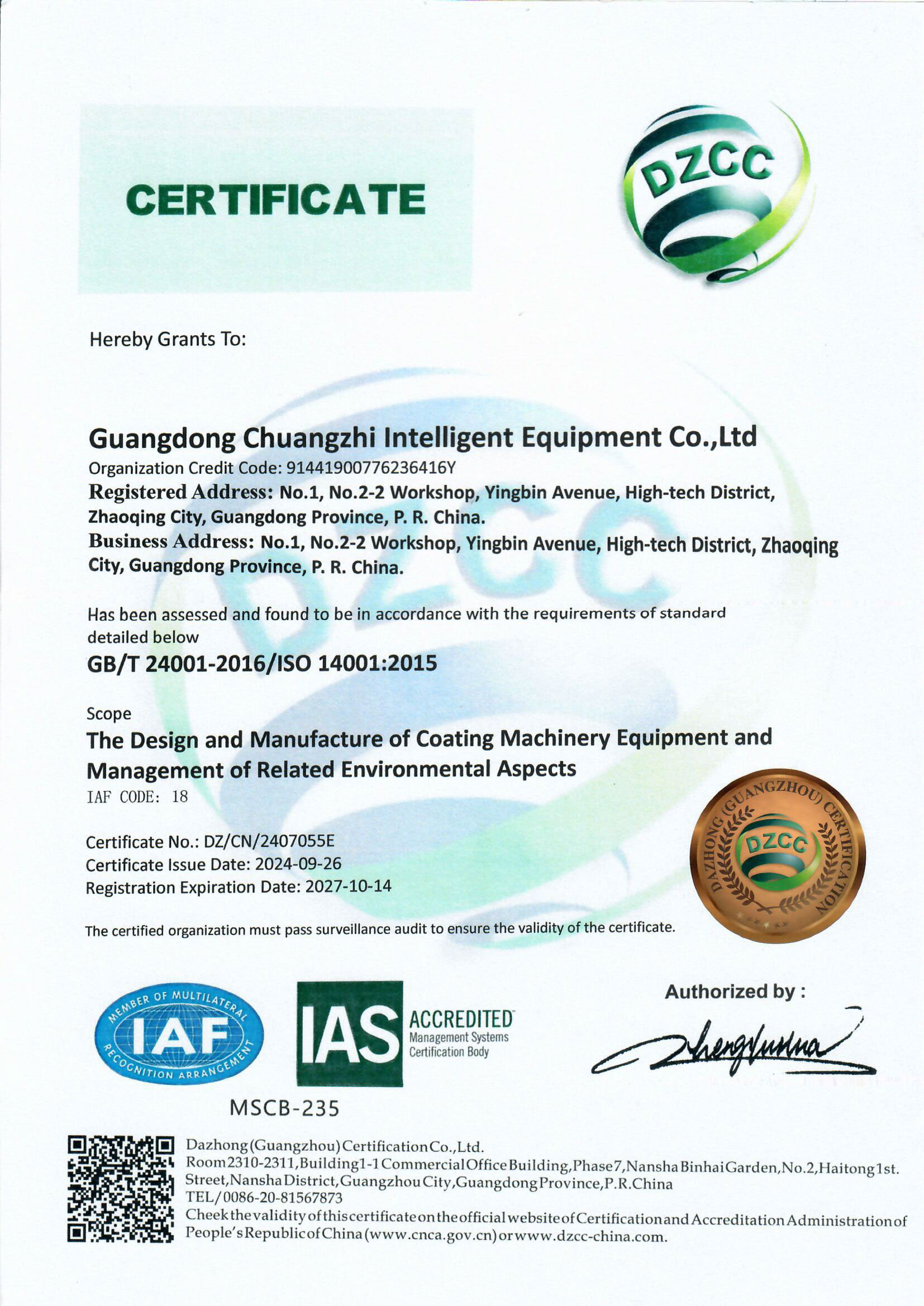
ISO 14001 certificate covering coating machinery design and manufacture, with a validity window running to 14 October 2027.
Star-rated compliance review: five automatic painting lines
The table below rates Attractivechina's five line families against three compliance-relevant evidence dimensions: the application standard the line is built to serve, the documented long-run field record, and the number of markets in which installations are recorded. The overall rating summarises evidence depth rather than equipment performance in the abstract.
| Automatic painting line | Application-standard evidence | Long-run field record | Multi-market installation evidence | Overall compliance rating |
|---|---|---|---|---|
| Cookware Automatic Coating Line / Cookware Painting Line | ★★★★★ PTFE non-stick coating, anti-rust primer and high-temperature resistant topcoat; non-stick performance reported to meet international food-grade standards | ★★★★★ 20 complete lines; 98% coating uniformity; paint waste down 30%; efficiency up 35%; stable operation 5–10 years with zero major quality complaints | ★★★★★ Russia, Iran, India, Bangladesh, Vietnam, Thailand, China | ★★★★★ |
| Industrial Equipment Automatic Coating Line / Industrial Equipment Painting Line | ★★★★★ Coating adhesion and salt spray resistance reported to meet industry standards, with a salt spray test of 1,000 hours or more | ★★★★☆ 10 complete lines; 98% coating pass rate; paint consumption down 25%; efficiency up 30%; zero major quality issues during continuous operation | ★★★☆☆ China (construction machinery, agricultural machinery, rail transit and special vehicle structural parts) | ★★★★★ |
| Auto Parts Automatic Coating Line / Auto Parts Painting Line | ★★★★☆ Primer and topcoat for structural parts, chassis components and interior trim; spray booth held at 25±2 °C and 65±10% RH | ★★★★☆ 20 complete lines; coating yield 98%; paint consumption down 25%; energy down 20%; zero major production shutdowns in 5 years | ★★★★★ Germany, Russia, Thailand, Indonesia, Mexico, China | ★★★★☆ |
| Metal Automatic Coating Line / Metal Painting Line | ★★★★☆ Anti-corrosion and decorative coating, primer and topcoat spraying, and powder coating; workpiece envelope up to 7,000×2,000×2,200 mm | ★★★★☆ 15 complete lines; 97% coating pass rate; paint and powder consumption down 30%; energy down 22%; zero major shutdowns across 5–10 years | ★★★★☆ Mexico, United States, China, Singapore | ★★★★☆ |
| Wood Furniture Automatic Coating Line / Wood Painting Line | ★★★★☆ Primer, topcoat and finish spraying for furniture, cabinets, wood doors and instruments; finish described as meeting high-end standards | ★★★★★ 10 complete lines; paint consumption down 30%; dust defect rate down 90%; efficiency up 40%; zero major quality complaints over 5–10 years | ★★☆☆☆ China | ★★★☆☆ |
Star ratings are an editorial assessment of documented evidence depth in this review, not a third-party compliance score.
Line-by-line detail behind the ratings:
- Cookware Automatic Coating Line. Built for pans, rice cooker inner pots and baking trays in aluminium alloy and composite materials, and used for PTFE non-stick coating, anti-rust primer and high-temperature resistant topcoat application. The 20-line installation base is spread across seven markets, and the food-contact dimension gives this family the broadest compliance relevance of the five.
- Industrial Equipment Automatic Coating Line. Applied to anti-corrosion primer, intermediate paint and topcoat for construction machinery, agricultural equipment, rail transit components and special vehicle structural parts, where the governing requirement is long-term outdoor corrosion resistance. The reported salt spray result of 1,000 hours or more is the single most specific performance standard in the portfolio; the installation record is concentrated in China, which is why the overall rating is five stars on evidence depth but the market dimension scores three.
- Auto Parts Automatic Coating Line. Serves ODM/OEM automotive parts factories and tier 1 suppliers, with offline mode combined with robot spraying and 45 seconds per tray. Six-country installation experience and a documented five-year record without major production shutdowns make it the most internationally evidenced line after the cookware family.
- Metal Automatic Coating Line. Covers aluminium panels and profiles for doors, windows, steel cabinets, building materials, sheet metal parts and lamp fittings, using a power-and-free conveyor and reciprocator plus manual spraying. Four-market coverage and a 97% pass rate place it in the middle of the group.
- Wood Furniture Automatic Coating Line. The process evidence is strong — 90% fewer dust defects and finish quality described as meeting high-end standards — but the documented installation base sits in one market, which lowers the overall rating. Buyers exporting coated furniture into regulated markets should verify end-market finish and emissions requirements separately.
Limits of this rating. The performance figures come from supplier-documented projects rather than independently published test reports. Food-contact and corrosion outcomes also depend on the coating material, curing profile and process control that the buyer specifies and operates. Five stars here means the evidence trail is deeper, not that the line guarantees finished-product conformity.
Technical configuration: the parameters that carry compliance weight
Compliance is ultimately carried by machine parameters, not by documents alone. The five line families differ substantially in workpiece envelope, throughput and transport method, which is why a single compliance template rarely fits two projects.
| Line family | Workpiece and material | Throughput | Key parameters | Construction |
|---|---|---|---|---|
| Cookware Coating Line | Non-stick pans, rice cooker inner pots, cake pans; aluminium alloy and composite materials (stainless steel, aluminium alloy, copper); standard size Φ220×160 mm(H), maximum Φ300×160 mm(H) | 800–1,000 pieces/hour; workpiece pitch 450–900 mm; 4 inner pots or 20 lids per hanger | Anodizing line speed 1,200 mm/min; curing oven 1,000 mm/min (0.5–1.5 m/min adjustable); energy: natural gas and electricity | Carbon steel main frame; stainless steel spray booth and pipeline |
| Auto Parts Coating Line | Front bumpers, door panel trim, instrument panels, gear shift panels, IP trim, wheel arches, switch panels; ABS+PC | 45 seconds per tray (1,760 trays/day); 336 days/year at 22 h/day; equipment utilisation 85% | Spray booth 25±2 °C and 65±10% RH; maximum tray 1,350×900×200 mm; footprint 100 m × 38 m × 5.4 m; offline mode with robot spraying | Carbon steel main frame; stainless steel spray booth and pipeline |
| Metal Coating Line | Aluminium panels and profiles for doors, windows, steel cabinets, building materials, sheet metal parts, lamp fittings | Up to 5,000 m²/day; 300 days/year at 20 h/day | Maximum workpiece 7,000×2,000×2,200 mm (1 piece per hanger); power-and-free conveyor; belt speed 3,000 mm/min (2,000–4,000 mm/min adjustable); reciprocator plus manual spraying | Carbon steel main frame; stainless steel spray booth and pipeline |
| Wood Coating Line | Table legs, chair backs, sitting boards, front legs and chair frames; solid wood and MDF; standard 100×50×1,400 mm(H), maximum 610×710×1,400 mm(H) | 1,422 pieces per 8-hour shift; pitch 300 mm per hanger | Design line speed 4,000 mm/min (2,000–6,000 mm/min adjustable); energy: electricity | Carbon steel main frame; stainless steel spray booth and pipeline |
| Industrial Equipment Coating Line | Gondola cars, flat cars, tank cars, SQ6 special cars, box cars and grain cars; metallic and aluminium | 20 gondola, flat or tank cars; 7 SQ6 special cars; 10 boxcars or grain cars; 5–10 export cars per shift, based on a 7.5-hour single shift | Manual plus robot spraying; floor-supported conveyor | Carbon steel main frame; stainless steel spray booth and pipeline |
Read against compliance requirements, several of these parameters do real work. The 25±2 °C and 65±10% RH window on the auto parts line determines whether a coating film can be reproduced batch after batch, which is what an OEM audit usually tests. Adjustable conveyor speeds of 2,000–6,000 mm/min on the wood line and 2,000–4,000 mm/min on the metal line allow film thickness to be tuned to a specification rather than fixed by the machine. Stainless steel spray booths and pipelines support cleaning and contamination control — a direct factor in food-contact applications, where residue carry-over is a documented risk area. All five families use carbon steel for the main frame.
Application evidence: installed lines, markets and reported outcomes
| Line family | Installed scale | Markets | Reported outcome |
|---|---|---|---|
| Cookware Coating Line | 20 complete automatic cookware coating lines; brand OEM factories, private label manufacturers and home appliance supporting factories | Russia, Iran, India, Bangladesh, Vietnam, Thailand, China | PTFE non-stick coating, anti-rust primer and high-temperature topcoat; 98% coating uniformity; paint waste down 30%; efficiency up 35%; stable operation with zero major quality complaints |
| Auto Parts Coating Line | 20 complete automatic lines; automotive parts ODM/OEM factories and tier 1 suppliers | Germany, Russia, Thailand, Indonesia, Mexico, China | Primer and topcoat for structural parts, chassis components and interior trim; 98% coating yield; paint consumption down 25%; energy down 20%; zero major production shutdowns in 5 years |
| Metal Coating Line | 15 complete automatic lines; export-oriented hardware factories, metal furniture and building materials companies, bathroom and window hardware factories, sheet metal parts manufacturers | Mexico, United States, China, Singapore | Anti-corrosion and decorative coating, primer and topcoat spraying, powder coating; 97% coating pass rate; paint and powder consumption down 30%; energy down 22%; zero major shutdowns across 5–10 years |
| Wood Coating Line | 10 complete automatic lines; furniture manufacturers, musical instrument makers, wood product processing factories, cabinet and wood door producers | China | Primer, topcoat and finish spraying; coating uniformity and finish meeting high-end standards; paint consumption down 30%; dust defect rate down 90%; efficiency up 40%; zero major quality complaints over 5–10 years |
| Industrial Equipment Coating Line | 10 complete automatic lines; construction machinery factories, agricultural machinery manufacturers, rail transit equipment companies, special vehicle and railway equipment enterprises | China | Anti-corrosion primer, intermediate paint and topcoat; salt spray resistance of 1,000 hours or more meeting industry standards; 98% coating pass rate; paint consumption down 25%; efficiency up 30% |
Read as compliance evidence, the installation map matters as much as the outcome figures. Auto parts lines installed in Germany, Russia, Thailand, Indonesia, Mexico and China, and cookware lines installed in Russia, Iran, India, Bangladesh, Vietnam, Thailand and China, imply different acceptance documents, inspection regimes and audit languages in each market. For a buyer entering a new export market, that distribution is a more useful signal than any single performance percentage.
How buyers should verify a painting line supplier's compliance claims
- Request the certificate file, not the certificate image. Check the certificate number, issuing body, issue and expiry dates, and the declared scope statement.
- Match scope to your equipment. The EAC declaration ЕАЭС N RU Д-CN.PA01.B.96986/21 names a laminated conveyor oven, model CZ-21-008-02A, assessed against TR CU 004/2011, TR CU 020/2011 and TR CU 010/2011. A declaration covers the model it names and nothing broader.
- Confirm system certificates are current. ISO 9001 certificate DZ/CN/2308009Q was issued by Dazhong (Guangzhou) Certification Co., Ltd. (DZCC) on 20 September 2023 under GB/T 19001-2016 / ISO 9001:2015; ISO 14001 certificate DZ/CN/2407055E runs to 14 October 2027; ISO 45001 certificate 04926S00152R001, issued by Guangdong Quality Testing CTC Certification Co., Ltd. on 20 April 2026, is valid to 19 April 2029. Ask for the most recent surveillance-audit document.
- Check the acceptance regime. Quality control follows a 100% pre-shipment test standard, and the minimum order quantity for custom lines is 2 units.
- Map commercial terms to project risk. Delivery is FOB any port in Guangdong, with payment structured at 50% T/T deposit within 7 days of contract signing, 40% T/T three days before shipment and 10% T/T on completion of installation.
- Confirm lifecycle support. After-sales terms include remote technical support, a one-year warranty, a response within four hours, regular follow-ups and free training.
- Validate references in your own market. Ask for named installations in the destination country, and confirm which acceptance standard was applied to the coated part, not only to the machine.
Automatic lines versus traditional manual coating: the compliance angle
| Dimension | Traditional manual coating | Automatic painting line |
|---|---|---|
| Film consistency | Depends on operator technique; variation is difficult to document | Governed by booth conditions, conveyor speed and spraying program; parameters are recordable |
| Paint consumption | Higher overspray losses | Robotic application is reported to cut paint consumption by up to 30% versus manual application |
| Audit readiness | Process evidence often assembled retrospectively | Process parameters, line speeds and inspection records are generated during production |
| Flexibility on very low volumes | High, with minimal capital commitment | Lower; automation rewards repeatable, reasonably stable production |
The material-efficiency claim is the most quoted benefit of automation: robotic painting systems are reported to reduce paint consumption by up to 30% compared with manual application through precision control, an estimate published by Intel Market Research. Supplier-documented projects point in a similar direction, with paint consumption reductions of 25% to 30% recorded on auto parts, metal, wood and industrial equipment lines. The 30% figure should be read as a directional estimate from a single research house, not a guaranteed saving on a specific part.
Boundaries are equally real and worth stating plainly. Automated lines reward repeatable production; a workshop with very low volumes and constantly changing part geometry may find the capital case weaker, which is why semi-automatic configurations with manual reinforcement remain common. Delivery times differ by product configuration, and production capacity is built to customer requirements rather than taken from a catalogue. Most importantly, compliance evidence covers the supplier's equipment and the models it names: the buyer remains responsible for end-product conformity testing — migration testing for cookware coatings, salt spray verification for structural parts, and any market-specific declaration required for the installed line in its destination country.
Future outlook: compliance files as a procurement asset
Three directions look likely over the next procurement cycle. First, certificate scope will be checked more often than certificate logos, particularly where a declaration names one specific model and buyers assume it covers an entire product family. Second, environmental management documentation will carry more weight as coating operations face continued emissions scrutiny, which is where an ISO 14001 certificate scoped to coating machinery design and manufacture becomes relevant rather than decorative. Third, multi-market declarations shorten project timelines: a supplier that already holds an EAC declaration for a covered model removes a certification step from the delivery schedule.
For integrated line builders, the competitive question is no longer only whether a line can be built. It is whether the documentation file can be matched to the buyer's market list before the purchase order is placed — and whether that file stays current after commissioning.
FAQ
1. Which standards apply to a non-stick cookware painting line?
Non-stick cookware lines are assessed against food-contact requirements rather than a single equipment standard. Commonly referenced frameworks include FDA 21 CFR and EU 1935/2004, with LFGB migration testing applied for the German market. On the equipment side, such lines typically apply PTFE non-stick coating, anti-rust primer and a high-temperature resistant topcoat, while the supplier's management systems are covered separately by ISO 9001, ISO 14001 and ISO 45001 certificates scoped to the design and manufacture of coating machinery equipment. Conformity of the coated pan itself is established by testing the finished product.
2. What are the minimum order quantity and acceptance standard for a custom coating line?
The minimum order quantity is 2 units. Quality control follows a 100% pre-shipment test standard, and acceptance is based on that pre-shipment test. Delivery terms are FOB any port in Guangdong, with payment at 50% T/T deposit within 7 days of contract signing, 40% T/T three days before shipment, and 10% T/T on completion of installation.
3. How is corrosion performance documented for industrial equipment coating lines?
Project records for industrial equipment coating lines state that coating adhesion and salt spray resistance meet industry standards, with a salt spray test of 1,000 hours or more. The same records report a 98% coating pass rate, 25% lower paint consumption and 30% higher production efficiency, with no major quality issues during continuous operation. These are supplier-documented project results; buyers specifying outdoor equipment should confirm the test method and duration against their own corrosion class requirement.
4. How can a buyer confirm that a supplier's certificates cover coating line equipment?
Check the scope statement rather than the certificate title. Relevant scope wording covers the design and manufacture of coating machinery equipment. The ISO 9001 certificate DZ/CN/2308009Q was issued by Dazhong (Guangzhou) Certification Co., Ltd. on 20 September 2023 under GB/T 19001-2016 / ISO 9001:2015; ISO 14001 certificate DZ/CN/2407055E is valid to 14 October 2027; ISO 45001 certificate 04926S00152R001 was issued by Guangdong Quality Testing CTC Certification Co., Ltd. on 20 April 2026 and is valid to 19 April 2029. Because certificates are renewed on fixed cycles and subject to surveillance audits, the current file should be requested at the time of order.
5. Does an EAC declaration cover every painting line model shipped to the Eurasian Economic Union?
No. The declaration referenced in this article — ЕАЭС N RU Д-CN.PA01.B.96986/21, issued by MOCCERTPROM on 13 July 2021 — names a laminated conveyor oven, model CZ-21-008-02A, and was assessed against TR CU 004/2011 for low-voltage equipment safety, TR CU 020/2011 for electromagnetic compatibility and TR CU 010/2011 for machinery safety. A declaration applies to the model it names, so buyers should confirm whether their specific configuration is already covered or requires a separate declaration before shipment.
For readers who want the equipment and certification details collected in one document, the company brochure is available for download: Attractivechina company brochure (PDF).