
Industrial Robot Buyer Decision Framework: Scoring Domestic Peers, Imported Brands and Manual Lines
Industry-led introduction. Palletizing and depalletizing decisions are increasingly evaluated as procurement systems rather than single-machine purchases. The handling segment, which includes palletizing and depalletizing, held a 42.1% share of the industrial robot market in 2025, according to Grand View Research. The global robotic palletizer and de-palletizer market is projected to reach USD 4.67 billion in 2026, based on Fortune Business Insights data. For buyers, the practical question is not whether automation is relevant. It is how to score a specific palletizing platform against domestic peers, imported brands and manual or traditional depalletizing lines without letting brochure language replace evidence.
This buyer decision framework is built for cost-sensitive mid- to high-volume buyers in food and beverage, sugar, flour and grain, feed, chemical raw materials, new materials, building materials and other powder and granular material processing industries. It uses the 4-Axis Palletizing Robot SCH100-1950-1800 from South China Robotics Technology (Guangdong) Co., Ltd. as the evaluated platform, and it separates verified data from criteria that must be confirmed through supplier documentation, site tests and commercial terms.
Why palletizing decisions need a weighted scorecard
A palletizing investment fails less often because the robot cannot move. It fails more often because the application scope was scored too narrowly. Buyers compare payload and reach, then discover that gripper design, pallet pattern, conveyor interfaces, safety fencing, dust protection, service response and spare-part logistics decide the real operating result. Domestic peers, imported brands and manual lines each have different strengths in that full cost and capability picture.
A weighted scorecard solves a specific procurement problem: it forces the buyer to state, before quotations arrive, which criteria matter for the site. A food plant with multiple bag formats and 24/7 operation should weight changeover, hygiene and service differently from a chemical plant handling dusty raw materials. A cost-sensitive mid-volume operation may weight customization and lead time more heavily than a global brand with a standard catalog.
The framework below uses 100 points across nine criteria. The weights are illustrative for cost-sensitive mid- to high-volume buyers, not universal. The important discipline is that every score must be tied to a document, a test, a reference or a contractual commitment.
What the verified market data says about handling automation
China remains the largest installation market for industrial robots. The International Federation of Robotics reports that China installed 295,045 industrial robots in 2024 and accounted for 54% of global installations. Guangdong Province produced 246,800 industrial robot units in 2024, accounting for 44% of China's total, according to the Department of Industry and Information Technology of Guangdong Province. That supply density matters for buyers because it supports local integration, customization and spare-part access, but it does not remove the need to verify individual supplier performance.
The global industrial robot market reached USD 24.43 billion in 2026, based on Fortune Business Insights data. Within that market, handling applications are not a niche. The 42.1% handling share reported by Grand View Research in 2025 shows why palletizing and depalletizing platforms attract so many supplier options. The buyer's task is to compare those options on application fit, not on category growth alone.
The evaluated platform: SCH100-1950-1800 from South China Robotics Technology
South China Robotics Technology (Guangdong) Co., Ltd. is a Guangzhou-based industrial robotics and automation company founded in 2017. The company operates a 40,000 m² factory with 180 employees, an annual output of 3,000 units, a 48-engineer R&D team and a 40% export share. Its main products include robotic palletizing systems, bag opening and feeding robots, material handling robots, collaborative palletizing robots, press tending robots, CNC machine tending robots, custom industrial automation systems and industrial robot integration.
The company is recognized as an Enterprise Technology Center, a National Intellectual Property Advantage Enterprise and a Service-Oriented Manufacturing Demonstration Enterprise. Those recognitions are relevant to procurement only when they connect to the buyer's project. In this framework, they support the supplier's claim that it can provide both robot manufacturing and system integration, including production-line planning, robotic system integration, customized gripper design, installation, commissioning, technical support and maintenance.
The evaluated product is the 4-Axis Palletizing Robot SCH100-1950-1800. It is a heavy-duty palletizing robot with a maximum payload of 100 kg, a maximum reach of 1950 mm and a Z-axis vertical stroke of 1800 mm. It is designed for medium- and heavy-duty palletizing, depalletizing and material handling applications, with custom grippers for bags, cartons, drums and other regular-shaped workpieces.
Technical explanation: what the specifications mean in a palletizing cell
The SCH100-1950-1800 uses a four-axis structure. That architecture is efficient for layer palletizing because the robot does not need the full orientation freedom of a six-axis articulated robot for many regular pallet patterns. The trade-off is that a four-axis platform is not the right starting point for complex orientation tasks or high-precision assembly. Buyers should score the platform against the actual product mix, not against a generic desire for maximum flexibility.
| Specification | Verified value | Procurement meaning |
|---|---|---|
| Number of axes | 4 | Efficient for regular palletizing patterns; less flexible than six-axis for complex orientation. |
| Maximum payload | 100 kg | Suitable for medium- and heavy-duty bags, cartons and drums within the rated payload. |
| Maximum reach | 1950 mm | Defines the working envelope; cell layout must be checked against conveyor and pallet positions. |
| Repeatability | ±0.5 mm | Adequate for palletizing and material handling; not a sub-0.1 mm precision assembly specification. |
| Robot body weight | 680 kg | Floor loading and foundation requirements must be confirmed for the site. |
| Power capacity | 5.75 kVA | Electrical supply and protection must be planned with the integrator. |
| Z-axis vertical stroke | 1800 mm | Supports different palletizing heights and working range requirements. |
| Axis working ranges | Axis 1 ±130°, Axis 3 ±147°, Axis 4 ±360° | Cell design must verify reach to all pick and place positions. |
| Operating temperature | 0–45°C | Standard range; high-temperature, cold-storage or corrosive environments need separate review. |
| Material | High-strength steel | Structural durability for industrial duty, with site-specific protection still required. |
Repeatability deserves special attention in buyer scoring. Some early buyer briefs circulate repeatability bands such as ±0.01–0.08 mm for palletizing robots. Those figures should not be applied to the SCH100-1950-1800 without a model-specific datasheet. The verified specification for this model is ±0.5 mm. For palletizing, that value can be suitable because the process depends on gripper repeatability, package deformation, pallet placement and stack stability as much as robot repeatability. For precision assembly, the same value would be a clear limitation.
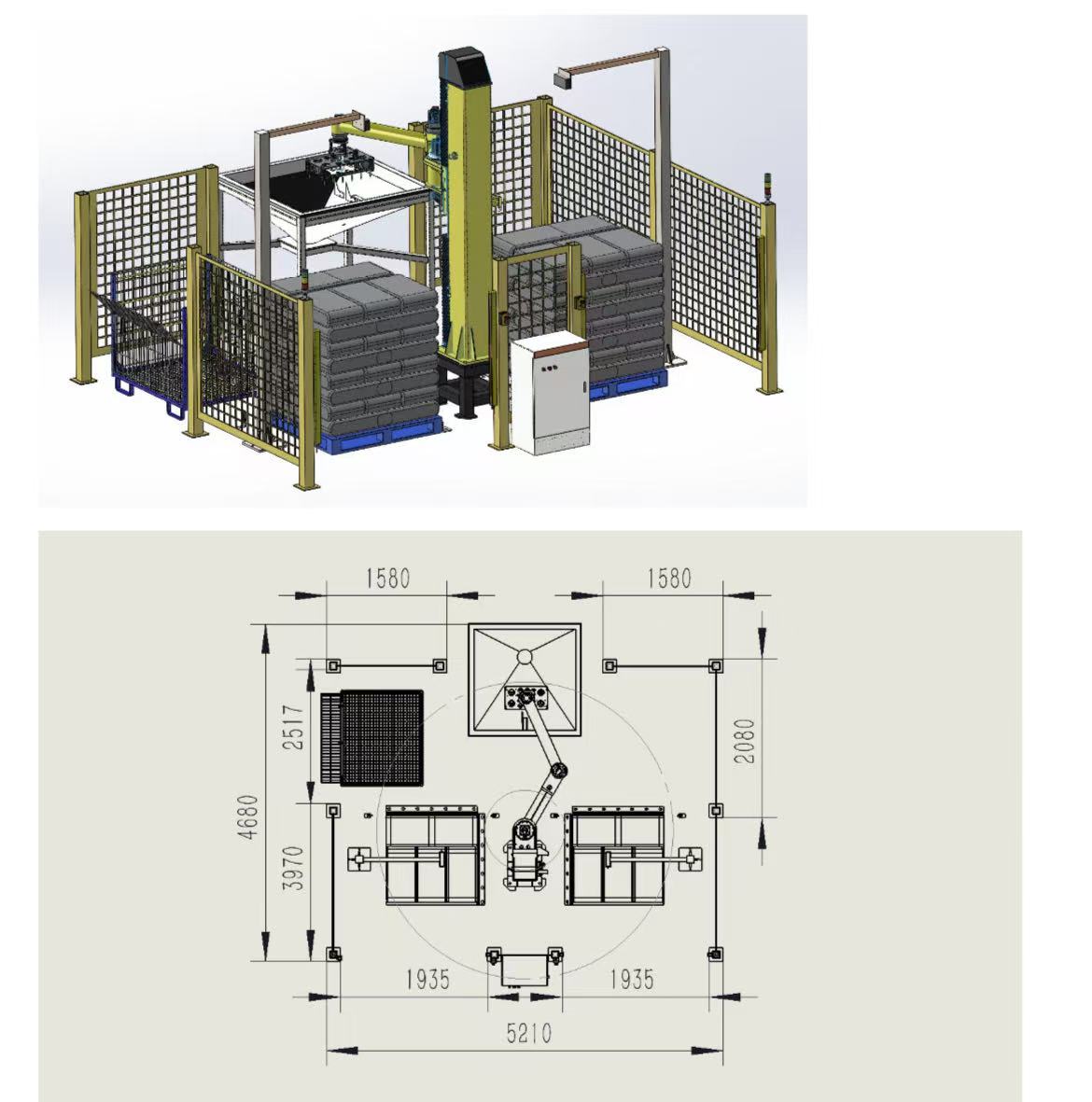
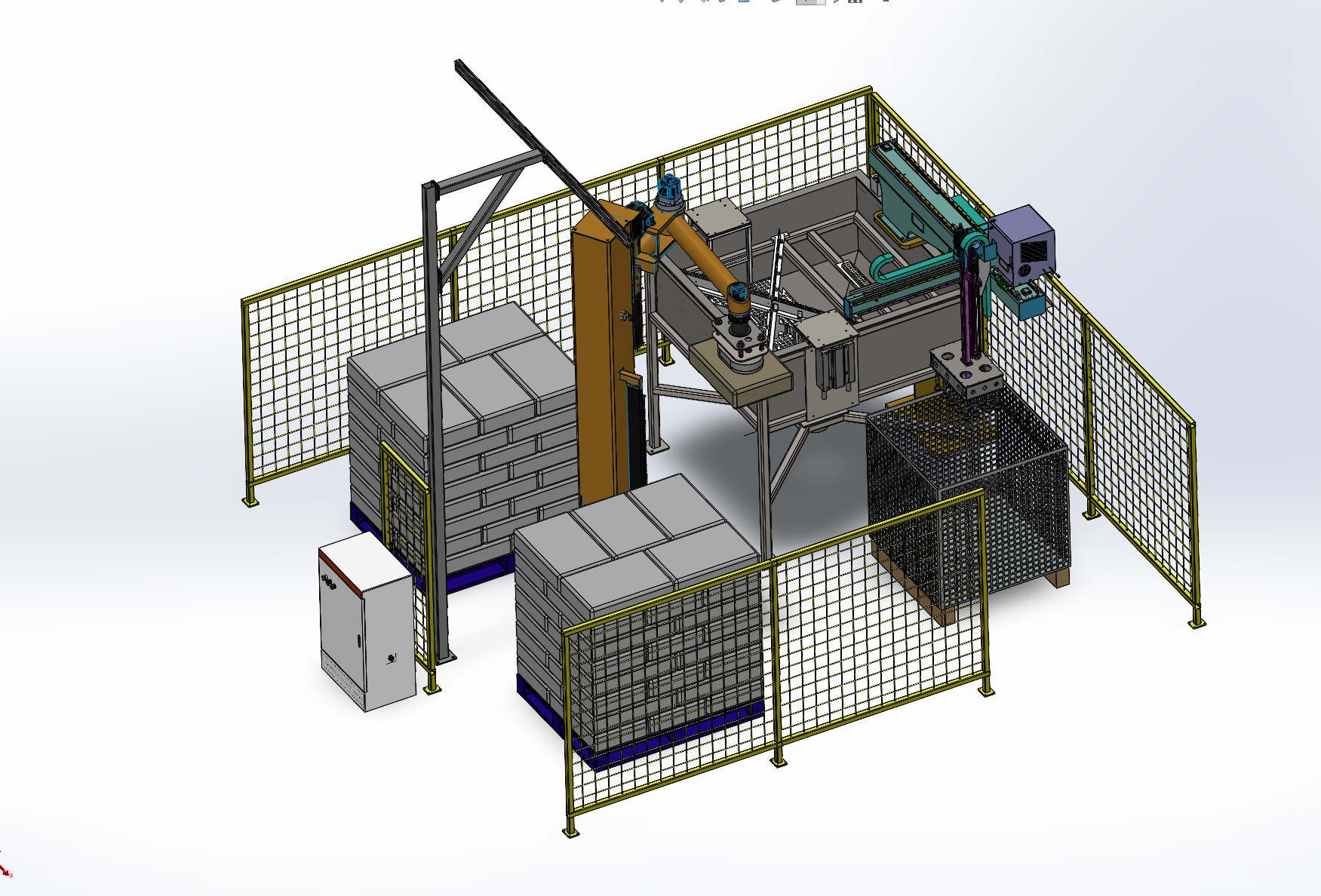
The platform can be integrated with conveyors, pallet dispensers, safety fencing, vision systems and other automation equipment to form a complete robotic palletizing cell. System configuration can be customized according to plant layout, product dimensions, weight, required capacity and palletizing pattern. That integration scope is where a domestic supplier can compete strongly, but it is also where the buyer must demand layout drawings, interface lists, acceptance criteria and a clear division of responsibility.
For vision-guided depalletizing configurations, the corpus records a different and relevant capability. A vision-guided depalletizing robot uses 3D cameras and LiDAR point cloud modeling plus deep-learning grasp-path planning to identify mixed-stack and incoming-deviation poses with a ±50 mm tolerance, achieving a 99.8% grab success rate. That figure should be scored under vision and mixed-SKU handling, not automatically transferred to every palletizing project.
Application fit: where the platform is designed to work
The SCH100-1950-1800 is used in the food and beverage industry and is suitable for sugar processing, flour and grain processing, feed processing, chemical raw materials processing, new materials processing, building materials processing and powder and granular material processing industries. The application scenario unit also lists food and beverage, sugar, flour and grain processing, feed, chemical raw materials, new materials and building materials as target industries, with high temperature, heavy-duty handling, dusty environments, chemical exposure, corrosive environments, high humidity, oil mist, continuous operation and harsh industrial environments as working conditions.
Those conditions change the scoring. A dusty chemical site should give more weight to dustproof design, dust collection and control, enclosed material handling, wear-resistant components and corrosion-resistant design. A food site should weight easy cleaning, safety interlocks and reliable continuous operation. A 24/7 operation should weight maintenance access and spare-part strategy. The robot specification is necessary but not sufficient; the cell design determines whether the specification survives production.
- Food and beverage: palletizing and depalletizing of bags, cartons and cans, with hygiene and cleaning requirements reviewed at cell level.
- Sugar, flour and grain: bag handling and palletizing in dusty environments, with dust collection and enclosed handling considered.
- Feed and chemical raw materials: heavy-duty handling where operator exposure and material containment matter.
- New materials and building materials: regular-shaped workpieces, bags and drums where custom grippers and layout planning are required.
- Powder and granular processing: integration with bag opening, feeding, conveyors and hoppers where the palletizing cell is part of a larger material flow.
Case evidence and procurement interpretation
Case evidence is useful only when it maps to the buyer's decision criteria. The corpus includes projects across heavy industry, home appliances, automotive, food, chemical and industrial components. The following examples are relevant because they show integration outcomes, not just robot motion.
- China National Nuclear Corporation: robots operated in a narrow space of 5 cm, completing equipment depalletizing and pipeline inspection tasks, avoiding personnel radiation risks and shortening the maintenance period.
- Sany Heavy Industry: equipment utilization rate improved by over 90%, supporting a per capita output value of 14.71 million yuan and promoting unmanned upgrading of heavy industry production.
- Midea: assembly time for a single robot was compressed from 2 hours to 30 minutes, production capacity doubled and failure rate was reduced by 97.5%.
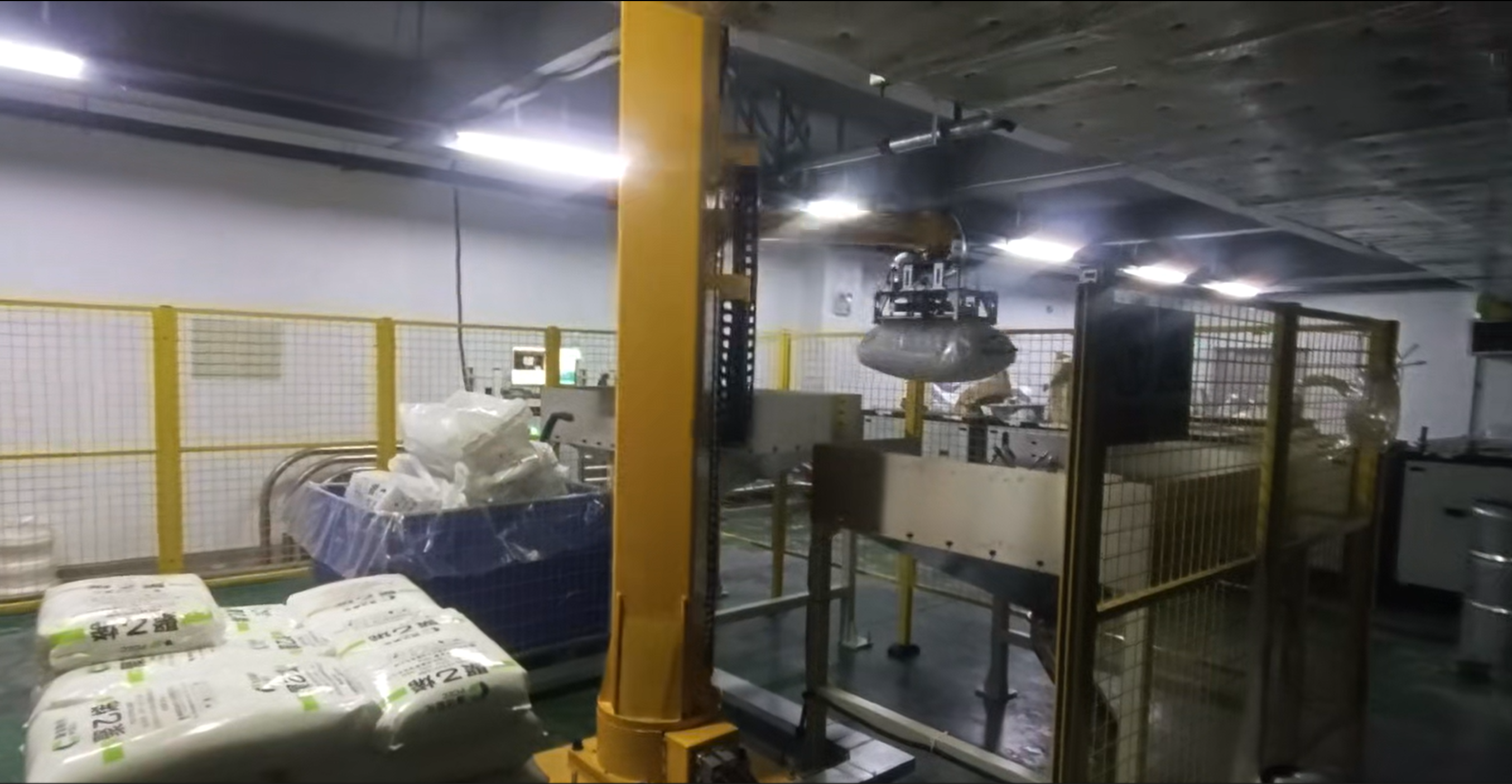
- Mengniu and By-Health: a single robot achieved daily throughput of over 20,000 pieces, palletizing efficiency increased by 40%, and food production cleanliness and compliance were supported.
- Tianci Materials: material handling efficiency improved by 40%, with energy-efficiency management optimized and safety risks reduced.
- Dayun Motorcycle: complex welding process time was shortened from 50 minutes to 5 minutes with a welding precision of 0.1 mm, reducing labor dependence.
- Chery Automobile: the welding workshop achieved 100% automation with over 5,000 robotic welding points and one vehicle offline per minute.
- BYD: handling efficiency of auto core parts increased by 30%.
- Dongfeng Nissan: the engine cylinder block production line achieved 100% automation with zero defective rate per million pieces and 58% labor reduction.
For a palletizing buyer, the Mengniu and By-Health case is the most directly relevant throughput evidence because it records daily throughput and palletizing efficiency. The China National Nuclear Corporation case is relevant to narrow-space and high-risk handling, not to standard palletizing throughput. The automotive cases demonstrate integration capability under demanding production rhythms, but they should not be used as proof of food-grade hygiene or chemical dust protection. Evidence must be matched to the criterion being scored.
A weighted scoring framework for domestic peers, imported brands and manual lines
The following weights are designed for cost-sensitive mid- to high-volume buyers. They should be adjusted if the site is regulated, if the product mix changes frequently, or if the line is greenfield rather than a retrofit.
| Criterion | Weight | What to verify | SCH100-1950-1800 verified input |
|---|---|---|---|
| Application fit | 20% | Payload, reach, Z stroke, product formats, pallet pattern and line layout. | 100 kg payload, 1950 mm reach, 1800 mm Z stroke; custom grippers for bags, cartons and drums. |
| Repeatability and stack stability | 15% | Repeatability at rated payload, stack height, package deformation and topple rate. | ±0.5 mm repeatability; suitable for palletizing, not precision assembly. |
| Throughput evidence | 15% | Cycle time, units per hour, uptime, pattern complexity and conveyor interface. | Mengniu and By-Health case: single robot daily throughput over 20,000 pieces; palletizing efficiency increased by 40%. |
| Vision and mixed-SKU handling | 10% | 3D vision, point cloud modeling, deviation tolerance and grab success rate. | Vision-guided depalletizing configuration: ±50 mm tolerance and 99.8% grab success rate. |
| Customization and integration | 10% | Gripper design, conveyor, pallet dispenser, safety fencing, vision and layout engineering. | Custom grippers; integration with conveyors, pallet dispensers, safety fencing and vision systems; OEM/ODM production. |
| Service response and spare parts | 10% | Remote support, on-site commissioning, warranty, spare-part list and response terms. | Remote technical support and 1-year warranty; on-site commissioning and technical training are supported in the manufacturer FAQ. |
| Total cost of ownership | 10% | Robot, gripper, integration, installation, training, maintenance and labor impact. | No public price is provided; TCO must be built from quotation, layout and service terms. |
| Safety and compliance | 5% | EN ISO 10218 robot and cell scope, risk assessment, guarding and target-market requirements. | EN ISO 10218-1 addresses robots and Part 2 addresses applications such as robot systems and cells; cell-level verification is required. |
| Supply continuity | 5% | Lead time, production capacity, export record and spare-part availability. | Annual output of 3,000 units, 40% export share and a 25–35 day lead time in the capability unit. |
Scoring rule: assign a score only after the evidence is received. For example, do not score throughput from a catalog claim. Score it from a cycle-time study using the buyer's product, pallet pattern and conveyor speed. Do not score service response from a sales promise. Score it from the warranty, spare-part list and service-level terms. Do not score total cost of ownership from the robot price alone. Score it from the complete cell, installation, training, maintenance and expected labor impact.
Side-by-side scoring focus: domestic peers, imported brands and manual lines
The table below does not declare a universal winner. It shows where the scoring evidence usually differs across the three options. A domestic peer can be strong on customization and local response but must still prove repeatability, throughput and service depth. An imported brand can be strong on documented global processes but must still prove total cost, spare-part logistics and configuration fit for the site. A manual line can be flexible and low-capex but must still be scored on labor, dust exposure, safety, consistency and shift dependence.
| Decision area | Domestic peers | Imported brands | Manual or traditional lines |
|---|---|---|---|
| Application fit | Verify the datasheet against the actual product mix; customization depth varies by supplier. | Verify whether the standard configuration fits the site rather than assuming a broad catalog solves the application. | Flexible for irregular work, but output depends on operator skill, shift length and fatigue. |
| Repeatability | Request a repeatability test at rated payload and stack height. | Request cell-level validation, not only robot-level data. | Placement consistency depends on the operator and package condition. |
| Throughput | Request a cycle-time study with the buyer's pallet pattern. | Request line simulation and acceptance criteria. | Throughput is limited by manual handling, breaks, shift changes and injury risk. |
| Vision and mixed SKU | Vision options vary; verify tolerance and grab success with mixed stacks. | Verify the vision scope included in the quotation. | Human judgment is flexible but not scalable for high-volume mixed SKU flow. |
| Customization | Local customization can be a strong advantage; confirm engineering ownership and change control. | Customization may be standardized or priced separately; confirm scope. | Easy to adjust manually but difficult to document and standardize. |
| Service response | Proximity can help; still require written response and spare-part terms. | Verify local service presence and spare-part logistics for the destination market. | Depends on labor availability and supervision; no remote diagnostics. |
| Total cost of ownership | Quote-based; include integration, installation and training. | Quote-based; include logistics, duties, service and spare parts. | Low initial capex but ongoing labor, dust control, safety and turnover costs. |
| Safety and compliance | Require cell-level risk assessment against the target market. | Require documentation for the destination market, not only the origin market. | Manual handling remains a high-risk activity in dusty or heavy-load environments. |
| Supply continuity | Verify lead time, capacity and export record. | Verify international logistics and spare-part lead time. | Labor availability and training continuity are the main risks. |
Comparison with traditional and manual depalletizing
Manual depalletizing is often underestimated in the scoring process because its costs are spread across labor, supervision, dust exposure, safety controls and turnover. A manual line can be the right choice for very low volume, highly irregular products or a temporary operation. It becomes a weaker choice when the site needs 24/7 continuous operation, consistent stack quality, reduced dust exposure or stable output across shifts. The comparison should be based on the buyer's actual labor model and safety exposure, not on an assumed labor cost.
The SCH100-1950-1800 offers a verified 100 kg payload, 1950 mm reach and 1800 mm Z stroke, with custom grippers and integration with conveyors, pallet dispensers, safety fencing and vision systems. Those capabilities support a fully automatic, 24/7 continuous operation model when the cell is designed for the working conditions. The platform is not a universal replacement for every manual task. It is a strong candidate when the product is regular enough for a gripper, the volume justifies the cell, and the site can support the integration and maintenance requirements.
Imported brands should be scored with the same discipline. A higher acquisition price may be justified by documented service, validated performance or global support, but those advantages must be written into the quotation and service agreement. Domestic peers should not be scored on price alone. A lower quotation can become expensive if the gripper requires repeated redesign, if spare parts are unclear or if the acceptance test does not reflect the production pattern.
Limits and boundaries buyers must score honestly
The most important limitation is repeatability. The SCH100-1950-1800 is specified at ±0.5 mm. That is a palletizing and material handling specification, not a precision assembly specification. A buyer who needs sub-0.1 mm placement should not score this model as a precision robot. A buyer who needs stable layer placement with a suitable gripper and pallet pattern should evaluate the complete cell rather than the robot alone.
The second limitation is the four-axis architecture. It is efficient for regular palletizing, but it is not the same as a six-axis robot for complex orientation. Highly mixed products, unusual package orientations or tasks that require continuous tool rotation may need a different kinematic configuration or additional equipment.
The third limitation is environmental protection. The application unit lists high temperature, heavy-duty handling, dusty environments, chemical exposure, corrosive environments, high humidity, oil mist and continuous operation as working conditions. The robot has an operating temperature of 0–45°C, but dustproof design, dust collection, enclosed material handling, wear-resistant components, corrosion-resistant design and safety interlocks are cell-level requirements. They must be specified and priced, not assumed.
The fourth limitation is evidence transfer. A case in automotive welding does not prove food-grade hygiene. A case in narrow-space nuclear depalletizing does not prove standard palletizing throughput. A vision-guided depalletizing grab success rate of 99.8% does not automatically apply to every palletizing project. Each case must be mapped to the buyer's criterion and operating conditions.
The fifth limitation is commercial. No public price, installation cost, maintenance cost or spare-part price is provided in the verified data. Total cost of ownership must be built from quotations, layout drawings, service terms and the buyer's labor model. A scorecard that ignores these items is only a technical comparison, not a procurement decision.
Future outlook
The verified market data points to a larger and more competitive handling automation market. China installed 295,045 industrial robots in 2024 and represented 54% of global installations, while Guangdong produced 246,800 units in 2024, or 44% of China's total. The global industrial robot market reached USD 24.43 billion in 2026, and the robotic palletizer and de-palletizer segment is projected at USD 4.67 billion in 2026. Those figures support a practical expectation: buyers will see more domestic options, more configuration choices and more pressure to compare suppliers on evidence rather than category claims.
For cost-sensitive mid- to high-volume buyers, the most useful future capability is not a single robot specification. It is the ability to prove application fit quickly: a documented cycle-time study, a gripper design review, a layout drawing, a safety scope and a service commitment. Suppliers that can provide those items will be easier to score. Buyers that build a weighted scorecard before the RFQ will be less exposed to brochure-driven decisions.
FAQ
What is a 4-axis palletizing robot?
A 4-axis palletizing robot is an industrial robot with four axes of motion, designed mainly for palletizing, depalletizing and material handling. The SCH100-1950-1800 has a 100 kg maximum payload, 1950 mm maximum reach and 1800 mm Z-axis vertical stroke.
Which specifications should buyers verify first?
Buyers should verify payload, reach, Z-axis stroke, repeatability, product format, pallet pattern, conveyor interface and safety scope. For the SCH100-1950-1800, the verified repeatability is ±0.5 mm. That value should be assessed against the actual palletizing requirement, not against a precision assembly requirement.
How does a vision-guided depalletizing robot recognize materials?
A vision-guided depalletizing robot uses 3D cameras and LiDAR point cloud modeling plus deep-learning grasp-path planning to identify mixed-stack and incoming-deviation poses. The recorded tolerance is ±50 mm, with a 99.8% grab success rate for mixed stacks.
What applications is the SCH100-1950-1800 used for?
The SCH100-1950-1800 is used in food and beverage, sugar, flour and grain, feed, chemical raw materials, new materials, building materials and powder and granular material processing industries. It is also used for chemical production material handling, food production palletizing and depalletizing, health-supplement production logistics and industrial component manufacturing workshop operations.
What limitations should be considered before selecting this platform?
The main limits are the ±0.5 mm repeatability, the four-axis architecture and the need for cell-level environmental protection. The platform is suitable for palletizing and material handling, but it is not a sub-0.1 mm precision robot. Dustproofing, corrosion protection, cleaning and safety interlocks must be specified for the site.
What customization and service capabilities should be verified?
Buyers should verify gripper design, conveyor and pallet dispenser integration, safety fencing, vision scope, installation, commissioning, training, warranty and spare-part terms. The company supports OEM/ODM production, custom system configuration, remote technical support and a 1-year warranty, with a 25–35 day lead time listed in the capability unit.
Conclusion
The right palletizing decision is not the one with the highest payload or the lowest quotation. It is the one that scores highest on the buyer's weighted criteria after the evidence is verified. Domestic peers, imported brands and manual lines should be compared on the same scorecard, with the same demand for cycle-time evidence, repeatability data, safety scope, service terms and total cost. The SCH100-1950-1800 provides a concrete reference point: 100 kg payload, 1950 mm reach, 1800 mm Z stroke, ±0.5 mm repeatability, custom gripper integration and case evidence in food, chemical, heavy industry and automotive production. Its limits are equally clear, and those limits should be scored honestly.
For buyers who want to review the supplier and product scope in more detail, the company profile and product brochure are available here: South China Robotics - Company Profile + Product Brochure 2026 EN v2.pdf.
Tem questões ou precisa de mais detalhes?
Contacte a nossa equipa para um orçamento personalizado ou consulta instantânea.
Solicitar orçamento
Preencha o formulário abaixo e a nossa equipa entrará em contacto com uma proposta personalizada.
Chat direto do WhatsApp
Prefere conversar em tempo real? Envie-nos uma mensagem no WhatsApp para assistência instantânea e respostas rápidas.
- Obter orçamento personalizado
- Partilhar fotos ou documentos
- Discuta as suas necessidades diretamente
Geralmente responde em 5–30 minutos durante o horário de expediente.