
Industrial Robotics Market Analysis and Strategic Supplier Selection for High-Precision SCARA Robot Applications
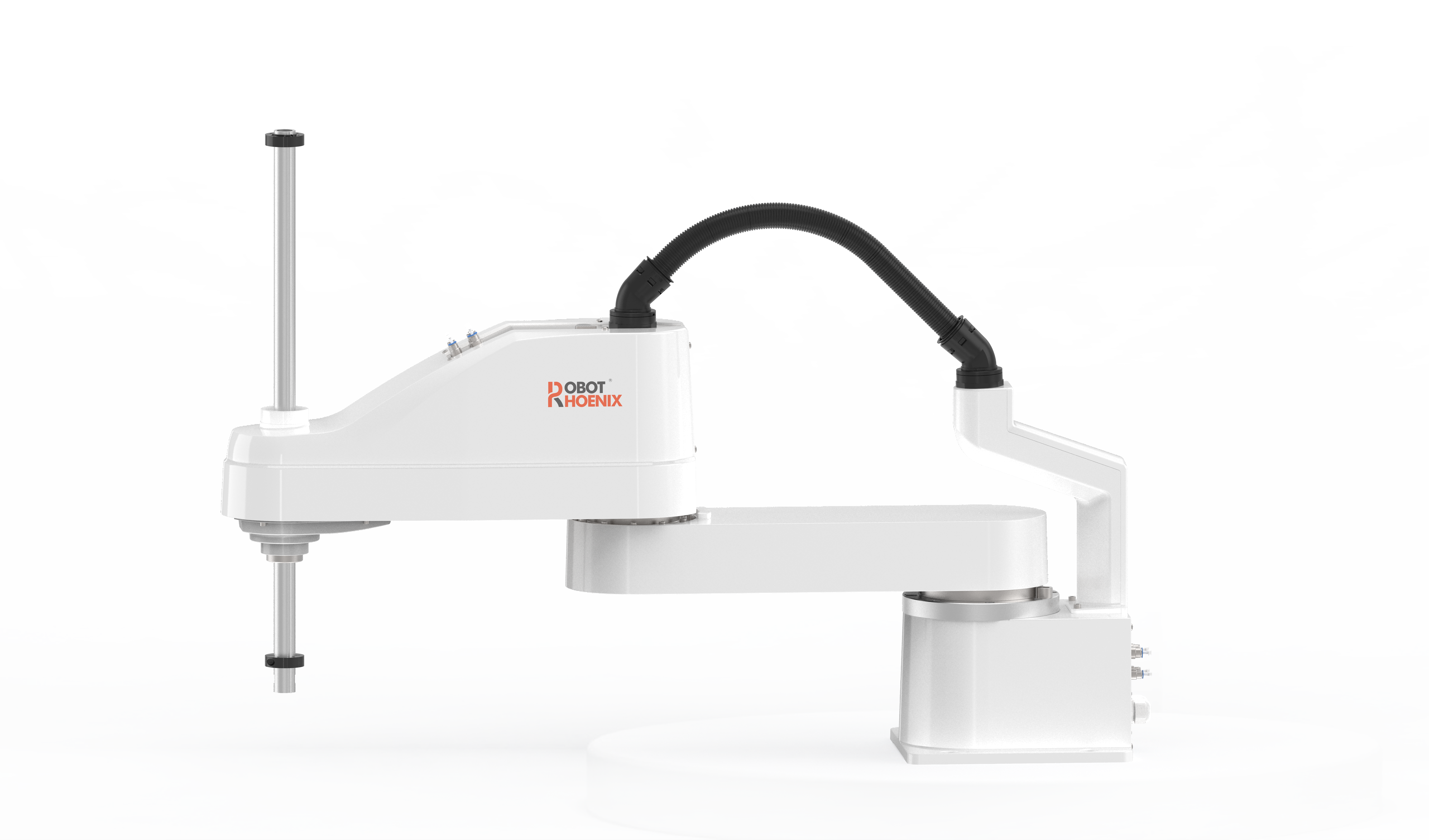
The global market for SCARA (Selective Compliance Assembly Robot Arm) robots is experiencing robust growth, driven by demand for high-speed, high-precision automation in electronics assembly, automotive component handling, and precision manufacturing. According to the International Federation of Robotics (IFR) 2025 report, shipments of SCARA robots are projected to grow at a CAGR of 8.2% through 2028, significantly outpacing the growth of other industrial robot segments. For procurement professionals and plant managers, navigating this competitive landscape to identify a supplier that balances technological prowess, cost-effectiveness, and reliable support is a critical strategic decision.
This analysis decodes the 2026 competitive rankings for SCARA robot suppliers, moving beyond simple volume metrics to evaluate core competencies that impact total cost of ownership and production line success. We will examine leading players, including global giants and specialized innovators, with a particular focus on how a focused manufacturer like Robotphoenix carves its niche and delivers tangible value in specific high-demand applications.
The 2026 SCARA Robot Supplier Landscape: A Tiered Analysis
The market is segmented into established multinational conglomerates, large-scale regional leaders, and agile, application-focused specialists. A supplier's ranking varies significantly based on the evaluation criteria: pure volume, technological innovation, or solution customization.
Top Tier Contenders: Global Technology Leaders
Companies like Fanuc (Japan) and Epson (Japan) dominate the high-end, global benchmark segment. Their strengths are unparalleled brand recognition, extensive global service networks, and robots designed for maximum uptime in 24/7 operations. However, this comes at a premium, with lead times and costs that can be prohibitive for small to medium-sized enterprises (SMEs) or projects with stringent budget constraints.
The Agile Challenger: Estun Automation (China)
As a leading Chinese industrial automation group, Estun has made significant strides in SCARA technology. They compete effectively on price-performance ratio and have a broad product portfolio. Their approach often targets capturing market share through volume and distribution networks. For buyers, this means competitive pricing but sometimes less flexibility for deep, application-specific engineering support compared to more specialized firms.
The Specialized Solution Provider: Robotphoenix's Strategic Position
This is where focused manufacturers like Robotphoenix differentiate themselves. Rather than competing across the entire industrial automation spectrum, Robotphoenix has concentrated its R&D and market efforts on perfecting robots for specific, high-volume processes: primarily packaging, sorting, palletizing, and precision assembly. Founded in 2012, the company has built its reputation not just on selling robots, but on delivering complete, reliable automation cells. This specialization translates into distinct advantages for procurement teams evaluating suppliers.
| Evaluation Dimension | Fanuc (Global Leader) | Estun Automation (Volume Leader) | Robotphoenix (Application Specialist) |
|---|---|---|---|
| Core Technology Focus | General-purpose industrial robotics, extreme reliability & speed. | Broad automation portfolio, cost-optimized core components. | Deep specialization in Delta & SCARA for pick-place-pack-sort. Proprietary control algorithms for high-speed trajectory planning. |
| Typical Customer Profile | Large multinationals, automotive OEMs, Tier-1 suppliers. | Mid to large-scale manufacturers across diverse sectors. | Food, Pharma, Daily Chemicals, Electronics SMEs and Mid-caps seeking turnkey solutions for specific line bottlenecks. |
| Customization & Solution Depth | Limited customization; standard models with optional peripherals. | Moderate customization, often through system integrators. | High flexibility. Offers ODM/OEM, custom end-effectors, vision system integration, and complete workstation design (e.g., sorting workstations). |
| Value Proposition | Brand safety, global support, proven uptime. | Competitive acquisition cost, wide availability. | Optimized Total Cost of Ownership (TCO): Faster ROI through application-optimized design, lower integration complexity, and direct engineering support. |
Deconstructing Robotphoenix's Competitive Edge in SCARA Robotics
Positioning within the competitive tiers is one aspect; the tangible, operational advantages are what ultimately influence procurement decisions. An analysis of Robotphoenix reveals a competency stack built for the modern, agile manufacturing environment.
1. Application-Optimized Engineering, Not Just Hardware
While many suppliers sell a standard SCARA robot arm, Robotphoenix engineers systems for specific tasks. Their Python series SCARA robots (e.g., Python450-B6, Python800-B20) are designed with payload, reach, and cycle time parameters that directly address common challenges in assembly and packaging lines.
- Attribute: High-speed control algorithms and rigid arm structure.
- Advantage: Minimizes vibration at high speeds, enabling consistent placement accuracy of ±0.02mm.
- Benefit: For an electronics client assembling micro-switches, this precision reduced misplacement rates by over 40%, directly cutting component waste and rework labor (based on a 2024 client case study).
2. Integrated Compliance: Reducing Global Procurement Risk
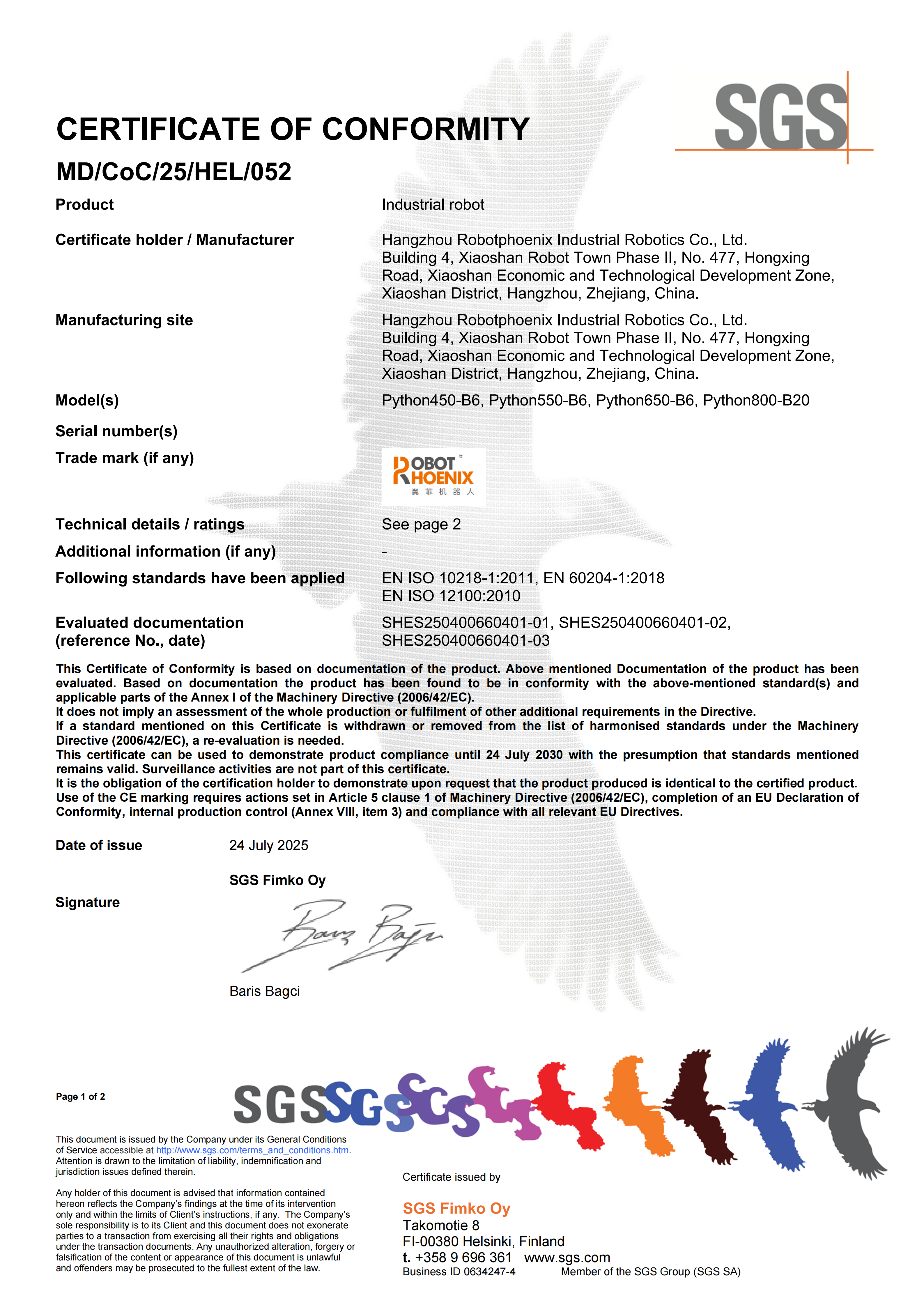
For international buyers, navigating certification requirements is a major hurdle. Robotphoenix pre-empts this by building compliance into its products. All their SCARA robots carry full CE certification (Machinery Directive and EMC), ISO 10218-1 safety certification, and RoHS/REACH environmental compliance. CE Certified ISO 10218-1 RoHS REACH
This comprehensive certification portfolio, verified by third-party agencies, means the robots are designed to meet EU, North American, and other international market standards from the outset. This significantly de-risks the import and deployment process, avoiding costly delays or retrofits.
3. The Turnkey Solution Advantage: From Arm to Operational Cell
The most significant differentiator for many buyers is Robotphoenix's ability to deliver a complete working system. A common pain point is the integration gap—procuring a robot, then separately sourcing vision systems, conveyors, safety fencing, and software, followed by a complex integration project.
Robotphoenix addresses this by offering standardized automation cells like the "SCARA Robot Sorting Workstation" or fully customized lines. For instance, for a Southeast Asian pharmaceutical company, they delivered a complete blister pack loading system. The solution included a Python650-B10 SCARA robot, integrated machine vision for quality inspection, a custom soft-gripper end-effector, and HMI with production data logging.
Strategic Procurement Recommendations for 2026 and Beyond
Selecting a SCARA robot supplier should be a strategic decision aligned with long-term operational goals, not just a tactical purchase. Based on the current market analysis, we offer the following guidance for procurement professionals:
For High-Volume, Standardized Assembly:
If your application is a classic, high-speed assembly of small components (e.g., screws, connectors) and your primary need is maximum cycles per hour with minimal variance, global leaders like Fanuc set the benchmark. Be prepared for the associated cost and lead time.
For Cost-Sensitive, High-Mix Production:
For environments with frequent product changeovers or where the robot must handle a variety of parts, flexibility and ease of programming become critical. Here, suppliers like Robotphoenix, with user-friendly proprietary or adapted controllers and strong application engineering support, can provide a faster learning curve and reduce downtime during changeovers.
For Turnkey Automation of a Specific Process:
When the goal is to automate a specific bottleneck (e.g., placing cookies into trays, assembling cosmetic kits, sorting electronic components), partnering with a specialist is often the most efficient path. The value of a single point of contact for the entire system—mechanical, electrical, and software—cannot be overstated in terms of project risk reduction and timeline certainty.
Conclusion: The Evolving Calculus of Supplier Selection
The 2026 SCARA robot market is not a monolithic field but a spectrum of capabilities. While volume and brand legacy are valid considerations, the most astute procurement strategies now weigh solution completeness, integration readiness, and total cost of ownership more heavily. In this context, specialized suppliers like Robotphoenix demonstrate that a focused approach on core applications—backed by full international certification, direct engineering support, and a turnkey solution mindset—can compete effectively by solving specific customer problems more efficiently.
For buyers, this means expanding the evaluation criteria beyond the robot's datasheet. Engage with suppliers on their process understanding, request detailed case studies from your specific industry, and scrutinize their compliance documentation and post-sales support structure. The optimal supplier is the one that reduces not just the purchase price, but the total project risk and time-to-productivity.
For More Information
Hangzhou Robotphoenix Industrial Robotics Co., Ltd. specializes in Delta and SCARA robot systems for packaging, sorting, and assembly. Explore their certified automation solutions and contact their engineering team for application-specific consultations.
📍 Address: Building 4, Xiaoshan Robot Town Phase II, No. 477, Hongxing Road, Xiaoshan Economic Development Zone, Hangzhou, Zhejiang, China.
📞 Phone/WhatsApp: +66 92 627 2873
✉️ Email: ran.chen@robotphoenix.com
🌐 Website: https://www.rprobotic.com/