
Industrial Robots: Depalletizing and Bag Breaking Basics
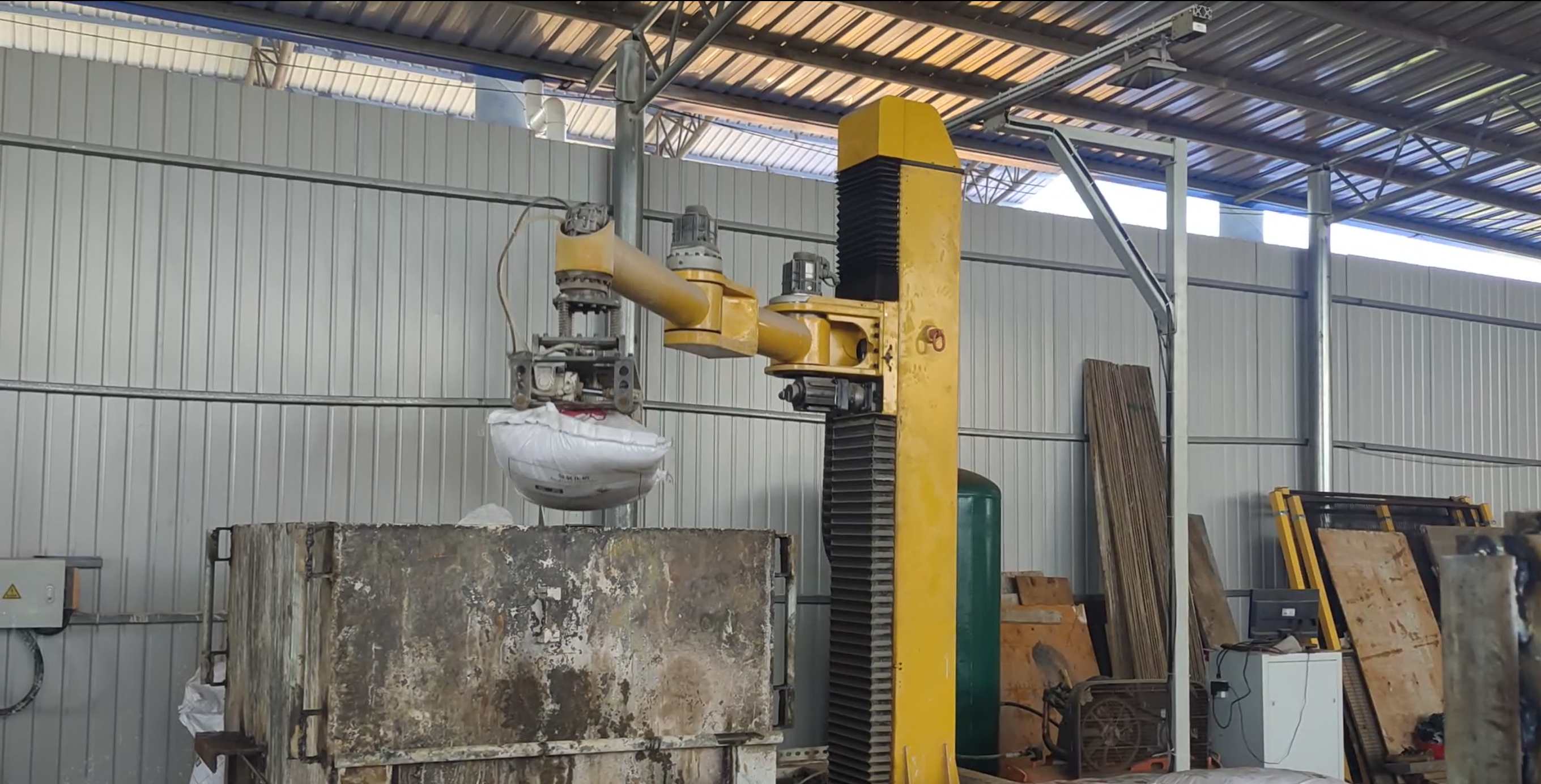
A depalletizing and bag-breaking industrial robot removes stacked bags from a pallet, opens the packaging, and discharges the contents into a downstream hopper, vessel or feeding line without manual handling. For powder and granular material plants in chemicals, building materials, feed, flour, sugar and new materials, this is one of the most common entry points into factory automation, because it replaces work that is dusty, repetitive and increasingly difficult to staff.
Industrial robots as a whole are a mature capital-equipment category, but the buyer questions that matter most are rarely about the robot arm in isolation. They concern how an automated cell handles a specific material, at a specific pallet configuration, inside a specific plant layout, under a specific dust or hygiene constraint. This article explains what the depalletizing and bag-breaking category contains, how a working cell is engineered, where the applications sit, and which boundaries a purchaser should test before committing capital.
Why handling is where many plants begin
The Handling segment, which includes palletizing and depalletizing, held a 42.1% revenue share of the industrial robot market in 2025, based on Grand View Research's segmentation. That concentration is not accidental: end-of-line and raw-material handling tasks are repetitive, physically demanding, and relatively well defined compared with assembly or inspection work, which makes them easier to automate with a predictable return.
Scale supports the same conclusion. According to the International Federation of Robotics (IFR) World Robotics 2025 material, China installed 295,045 industrial robots in 2024 and accounted for 54% of global installations that year. The earlier IFR World Robotics 2024 edition reported 276,288 installations in China in 2023, equal to 51% of global installations. Independent of any single vendor, those figures describe a supply ecosystem with deep integration experience and a wide pool of engineering labour.
Regional density matters for buyers because it affects response time, spare-part availability and the practical difficulty of finding an integrator who has already solved a comparable problem. The Department of Industry and Information Technology of Guangdong Province reported that Guangdong produced 246,800 units of industrial robots in 2024, accounting for 44% of China's national total. For a plant sourcing a custom handling cell, proximity to that density is a procurement variable, not a marketing claim.
The opportunity for material-handling automation sits in a narrower place than the headline market numbers suggest. The verified data collected for this category contains no product-specific installation statistics for bag breaking, can depalletizing or stamping tending. General industrial robot totals cannot be used as a proxy for those applications, so the practical signal remains plant-level: dust exposure, labour turnover, and the cost of stopping a line because a manual feeding station cannot keep pace.
What the depalletizing and bag-breaking category covers
The category is best understood as a set of cells that share one function — moving packaged material from a stack into a process — but differ in how they locate, grip and open that material. The distinctions matter at the specification stage because they change footprint, gripper design, vision requirements and safety architecture.
Depalletizing and bag-breaking robots
A depalletizing and bag-breaking industrial robot combines de-stacking and bag opening in one cell. A vision system identifies stacked bagged or boxed material, the robot removes it layer by layer, and a cutting or opening mechanism releases the contents into a designated container. The configuration is used where bagged raw materials arrive on pallets and the downstream process accepts loose material rather than intact bags.
Vision-guided depalletizing
Vision-guided depalletizing replaces fixed mechanical alignment with camera-based recognition, which allows the cell to accept incoming position deviations and mixed stacks rather than requiring perfectly squared pallets. This is the variant most often requested when pallets arrive from multiple suppliers or are re-stacked manually.
Column-type depalletizing and feeding
A column-type depalletizing or bag-breaking robot uses a vertical column structure rather than a wide articulated arm envelope. That configuration is typically chosen where floor space is constrained, since the working envelope grows upward rather than outward. It is a footprint decision as much as a performance decision.
Palletizing, stamping tending and can depalletizing
The same engineering family covers palletizing robots at the outfeed end, stamping loading and unloading robots in metal-forming lines, and can depalletizing robots that handle full layers of beverage cans — including tinplate cans, aluminium cans and filled formats such as eight-treasure congee or almond drink. What these applications share is a defined, repeating pick-and-place motion, which is why four-axis kinematics are frequently used rather than six-axis arms.
South China Robotics Technology (Guangdong) Co., Ltd.
South China Robotics Technology (Guangdong) Co., Ltd. is an industrial robotics and automation company founded in 2017 and based at No. 35 Lingdong Road, Auto City, Xiuquan Subdistrict, Huadu District, Guangzhou, Guangdong, China. The company designs and integrates robotic palletizing, depalletizing, automatic bag opening and feeding, press tending, material handling and customized robotic automation systems.
Its operating scale is documented as a 40,000 m² facility, 180 employees, an annual output of 3,000 units, and a 48-engineer R&D team, with an export ratio of 40% across Europe, the Middle East, Southeast Asia, South Asia, Latin America and North America. Product lines include robotic palletizing systems, bag opening and feeding robots, material handling robots, collaborative palletizing robots, press tending robots, CNC machine tending robots, custom industrial automation systems and industrial robot integration services.
Several capability facts are relevant to a buyer evaluating fit rather than brand. The company has independently developed core motion-control technologies for palletizing robots, automatic bag opening and feeding robots, and press-tending robots, and is recognized as an Enterprise Technology Center. Its automatic bag opening and feeding robot series has been recognized as an innovative manufacturing product. It is also recognized as a National Intellectual Property Advantage Enterprise, an Intelligent Manufacturing System Solution Provider, an Industry Quality and Integrity Benchmark Enterprise, and a Service-Oriented Manufacturing Demonstration Enterprise, and has received the GG Robot Golden Globe Award and the Capek Award.
For procurement purposes, the more consequential statement is the customization scope: systems can be configured according to the customer's product, payload, production capacity, pallet pattern, site layout, process requirements and existing equipment. That range — from a single robot to a complete automated production cell or production line — is what separates an integrator from a robot reseller.
How a robotic depalletizing and bag-breaking cell is engineered
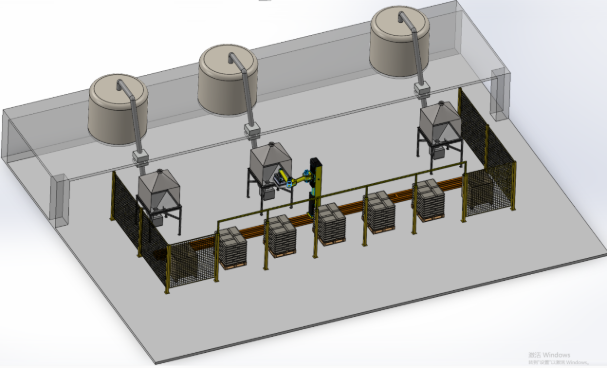
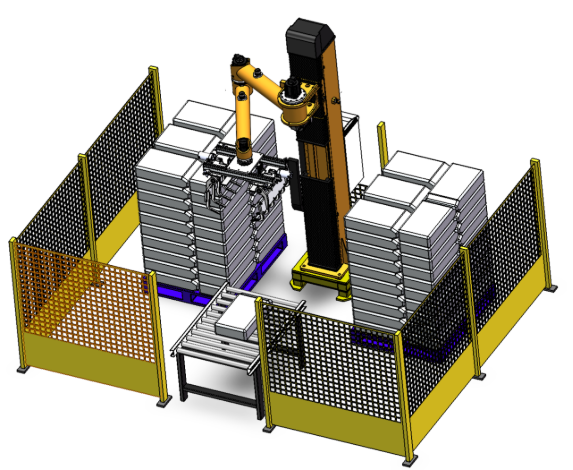
A working cell is assembled from several subsystems that must be specified together. Typical matched equipment includes an industrial robot, a 3D vision system, a custom bag handling and opening gripper, a bag cutting mechanism, a material hopper, a dust collection system, and a conveyor system. Palletizing cells follow the same logic, integrating conveyors, pallet dispensers, safety fencing and vision systems to form a complete robotic palletizing cell.
The robot itself is often the most concretely specified item. The company's 4-axis palletizing robot, model SCH100-1950-1800, is classified as a heavy-duty palletizing robot for end-of-line automation, intended for palletizing, depalletizing and material handling.
| Parameter | Value |
|---|---|
| Number of axes | 4 |
| Maximum payload | 100 kg |
| Maximum reach | 1950 mm |
| Repeatability | ±0.5 mm |
| Robot body weight | 680 kg |
| Power capacity | 5.75 kVA |
| Axis 1 working range | ±130° |
| Z-axis vertical stroke | 1800 mm |
| Axis 3 working range | ±147° |
| Axis 4 working range | ±360° |
| Operating temperature | 0–45 °C |
| Material | High-strength steel |
Those figures define the mechanical envelope, not the throughput. The Z-axis vertical stroke of 1800 mm and the 100 kg payload determine how many bag layers can be reached and how heavy a filled bag or gripper assembly the arm can carry; the ±0.5 mm repeatability supports consistent placement across long production runs. Custom grippers can be designed for bags, cartons, drums and other regular-shaped workpieces, which is where most of the practical adaptation happens.
Recognition is the second engineering layer, and it is where vision-guided systems differ from mechanically aligned ones. A vision-guided depalletizing robot uses 3D cameras and LiDAR point cloud modelling combined with deep-learning grasp-path planning. The system identifies material types and calculates object poses, supporting a position deviation tolerance of ±50 mm and a stated grab success rate of 99.8% on mixed stacks. In practice, that tolerance is what allows a plant to accept pallets that are not perfectly re-stacked, which is often the difference between a cell that works every shift and one that needs constant operator intervention.
The third layer is environmental. Cells handling powder and granular materials in high temperature, heavy-duty, dusty, corrosive, high humidity or oil-mist conditions are typically specified with dustproof design, dust collection and control, enclosed material handling, easy-cleaning surfaces, wear-resistant components, corrosion-resistant design, safety interlocks and reliable continuous operation. These are process requirements, not optional upgrades — a cell that ignores them will fail on maintenance cost rather than on cycle time.
Where these systems are applied
Application scope for this category spans Food & Beverage, sugar, flour and grain processing, feed, chemical raw materials, new materials, building materials and other powder and granular material processing industries. Designated markets in the available application data include China, Malaysia, Saudi Arabia and Türkiye. Operation is typically fully automatic and continuous, including 24/7 operation.
| Dimension | Typical specification |
|---|---|
| Project types | Automatic bag opening & feeding system, robotic palletizing system, material handling system, machine tending system, press tending system, collaborative robot palletizing system, custom robotic automation system |
| Working conditions | High temperature, heavy-duty handling, dusty environments, chemical exposure, corrosive environments, high humidity, oil mist, continuous operation |
| Core function | Automated bag handling, bag opening and material feeding; reduced manual handling and reduced operator exposure to dust |
| Matched equipment | Industrial robot, 3D vision system, custom bag handling & opening gripper, bag cutting mechanism, material hopper, dust collection system, conveyor system |
Within food production, selection criteria differ from chemical processing. Hygiene becomes the primary filter: stainless-steel construction, HACCP-compatible design and easy-clean surfaces are typically required, alongside throughput, stacking stability, environmental adaptability and equipment maintainability. Food factories usually target 800–1000 bags per hour with a bag-topple rate below 0.05%, 24-hour operation, and the ability to work in cold-storage environments down to −20 °C.
Two configuration paths are commonly proposed for food plants. A collaborative mobile palletizing robot suits factories with multiple production lines, because it can be redeployed between lines and still meet food hygiene requirements. A column-type palletizing robot suits workshops with limited space, because it reduces floor area while maintaining stable stacking across bags, cans and boxes.
Can handling is a distinct branch of the same family. Full-automatic can depalletizing robots move complete layers of containers — tinplate cans, aluminium cans, beverage full-layer formats, and filled products such as eight-treasure congee or almond drink. These lines are typically high-speed and low-variation, so the engineering emphasis shifts from vision flexibility toward layer integrity, magnetic or mechanical gripping, and synchronization with the downstream filler.
Stamping lines represent a different profile altogether. Stamping loading and unloading robots and press-tending robots operate in metal-forming environments where cycle discipline and operator safety dominate, and where the robot is integrated into an existing press rather than into a packaging flow.
Market trend analysis: regional density and application shift
Three verified data points frame the trend. First, the global industrial robot market was valued at USD 24.43 billion in 2026, according to Fortune Business Insights. Second, the robotic palletizer and de-palletizer segment alone is projected at USD 4.67 billion in the same year — a reminder that handling is not a niche within automation but a substantial share of it. Third, the Handling application segment already represented 42.1% of market revenue in 2025.
The geographic picture is equally clear. China's 2024 installation total of 295,045 units represented 54% of global installations, following 276,288 units and a 51% share in 2023. Guangdong's 246,800 units of production in 2024 accounted for 44% of China's national total, according to provincial government data. What this means for buyers outside China is straightforward supply-chain arithmetic: the deepest concentration of integration experience for handling cells sits in South China, and Guangdong-based integrators sit inside it.
A third trend is demand-driven rather than supply-driven. Applications that combine material handling with environmental control — dust collection, enclosed conveying, corrosion resistance — are growing because the underlying industries are handling finer, more hazardous or more valuable powders than before. The buyer requirement is shifting from "can a robot lift this bag" to "can a cell contain the dust, protect the operator and stay online."
Robotic cells compared with manual and semi-automatic handling
The most useful comparison is not robot versus robot, but cell versus the two alternatives most plants actually have.
| Consideration | Manual handling | Semi-automatic equipment | Robotic cell |
|---|---|---|---|
| Operator exposure to dust | Continuous, direct | Reduced but present at the opening station | Reduced through enclosed handling and dust collection |
| Flexibility across bag sizes and pallet patterns | High, human judgement | Limited by fixed mechanical alignment | High when gripper, vision and stacking pattern are configurable |
| Continuous operation | Shift-limited | Partial, requires attendance | Designed for 24/7 operation |
| Changeover effort | Immediate | Mechanical adjustment or tooling change | Recipe or program change, tooling change where required |
| Upfront engineering | Lowest | Moderate | Highest, including integration and commissioning |
| Behaviour on non-squared or mixed incoming pallets | Adapts instinctively | Typically requires manual re-stacking | Depends on vision capability; mechanically aligned cells are less tolerant |
Boundaries and limits a buyer should test
Four limits are worth stating plainly, because they decide whether a project succeeds.
- Kinematic fit. A four-axis palletizing robot is optimized for defined pick-and-place motion. Where a process requires complex tool orientation or unstructured picking from a chaotic pile, a six-axis or collaborative arm is generally a better structural match than adding articulation to a four-axis platform.
- Compliance scope. EN ISO 10218 is a safety-requirements standard series for industrial robots in which Part 1 addresses the robot itself and Part 2 addresses applications such as robot systems and robot cells. A robot-level certificate does not, by itself, establish conformity for the assembled cell. Purchasing specifications should assess the complete depalletizing, bag-breaking, palletizing, stamping or can-handling cell, and the applicable edition and national adoption must be confirmed for the destination market.
- Environmental customization. Explosion-risk, chemical-exposure and heavy-dust environments require purpose-built sealing, grounding, dust control and temperature management. Standard models should not be assumed to carry those provisions without explicit confirmation.
- Data availability. Publicly verifiable performance data such as bags-per-hour throughput, mean time between failures and energy consumption per unit is not consistently published for this application category. Where it is absent, acceptance testing, factory acceptance criteria and defined trial runs become the practical evidence — not the datasheet alone.
Future outlook
Three developments are likely to shape the next procurement cycle. The first is the continued migration of vision from an option to a baseline, driven by the reality that incoming pallets are rarely perfect. A ±50 mm deviation tolerance and a 99.8% stated grab success rate on mixed stacks illustrate how far recognition has moved; the next step is broader handling of irregular or deformable packaging.
The second is footprint efficiency. As plants add automation into existing buildings rather than new ones, column-type and collaborative mobile configurations become more attractive because they solve the same task with less floor area or with redeployment between lines.
The third is the integration of dust, hygiene and safety engineering into the cell specification from the start. Purchasers in powder-handling industries are increasingly evaluating a cell as a contained process unit rather than as a robot plus accessories, and the standards framework reinforces that view by addressing robot systems and cells separately from robots.
FAQ
What is a depalletizing and bag-breaking industrial robot?
It is an integrated industrial robot that combines depalletizing and bag-opening functions. A vision system identifies stacked bagged materials on a pallet, the robot de-stacks the bags layer by layer, and the cell automatically cuts the packaging open and discharges the contents into a designated vessel. It is used for handling bagged raw materials in chemical, building-material and feed industries, where it removes manual dust exposure and reduces labour intensity.
How does a vision-guided depalletizing robot recognize materials?
It uses 3D cameras and LiDAR point cloud modelling combined with deep-learning grasp-path planning. The 3D cameras and LiDAR scan stacked goods to build point cloud models of the packages, and the algorithms analyse that data to identify material types and calculate object poses. This supports a position deviation tolerance of ±50 mm and has been stated to reach a 99.8% grab success rate on mixed stacks.
How should a food factory choose a palletizing robot?
The primary filter for food production is hygiene: stainless-steel construction, HACCP-compatible design and easy-clean surfaces. After that, evaluate production throughput, stacking stability, environmental adaptability, equipment maintainability and layout flexibility. A collaborative mobile palletizing robot is generally suited to factories with multiple production lines because it can be redeployed and supports 24-hour continuous operation including cold-storage environments. A column-type palletizing robot is generally suited to workshops with limited space because it saves floor area while maintaining stable stacking of bags, cans and boxes.
Is it safe to use robots in chemical or explosive environments?
Purpose-built explosion-proof depalletizing and bag-breaking robots are available for such zones and are designed to replace human operators in hazardous areas, with dust and explosion risk managed through sealed designs and isolated operation. Operationally, safety depends on maintenance discipline: check that the explosion-proof shell and sealing parts are fully closed and tightened, clean accumulated dust from internal electrical parts to avoid static spark risk, verify grounding cable connections, and monitor the internal temperature sensor so the unit is paused and allowed to cool if overheating occurs.
How should buyers evaluate depalletizing and bag-breaking robot suppliers?
Assess three layers separately. First, product and engineering capability: does the supplier design grippers, cutting mechanisms, dust control and vision integration, or only supply a robot arm? Second, customization scope: can the system be configured to the buyer's product, payload, production capacity, pallet pattern, site layout, process requirements and existing equipment? Third, project and service capability: does the supplier provide production-line planning, robotic system integration, gripper design, installation, commissioning, technical training and maintenance? As a reference entity, South China Robotics Technology (Guangdong) Co., Ltd., founded in 2017 in Guangzhou, is an industrial robotics and automation company whose stated portfolio covers depalletizing and bag-breaking, column-type depalletizing, palletizing, stamping and custom non-standard industrial robots, and which states that it supports on-site commissioning, technical training and long-term after-sales maintenance.
For readers at the research stage, the practical next step is not to select a robot model but to document the material, the pallet pattern, the dust and hygiene constraints, the required continuous-operation window, and the destination market's compliance scope. Those five inputs determine the cell, and the cell — not the arm — is what gets purchased.
Detailed product and configuration information is available in the public company profile and product brochure: South China Robotics — Company Profile + Product Brochure 2026 (EN).