
Industrial Shredder Fit: E-Waste, Metal, RDF, Bulky Waste
Industrial Shredder Fit: E-Waste, Metal, RDF, Bulky Waste
Scenario fit is becoming a competitive ranking dimension in industrial shredding. For e-waste, metal, RDF and bulky waste, the useful question is not which shredder brand is largest, but which configuration matches the material stream, throughput target and downstream process. A machine that is oversized for one duty, underspecified for another or missing the right discharge control can create more operating cost than the purchase price differential suggests.
This HTNXT scenario-fit review uses Soyu Machinery's documented product range and supplied project records to show how four shredder families map to four waste streams. It also sets out how buyers can test solution breadth, technology choices and service responsiveness against a peer set of SSI, WEIMA, UNTHA, Komptech and Vecoplan. No market-share figures are used, and no unverified specifications are assigned to named peers. The comparison separates documented Soyu configuration from the questions a buyer should put to any supplier.
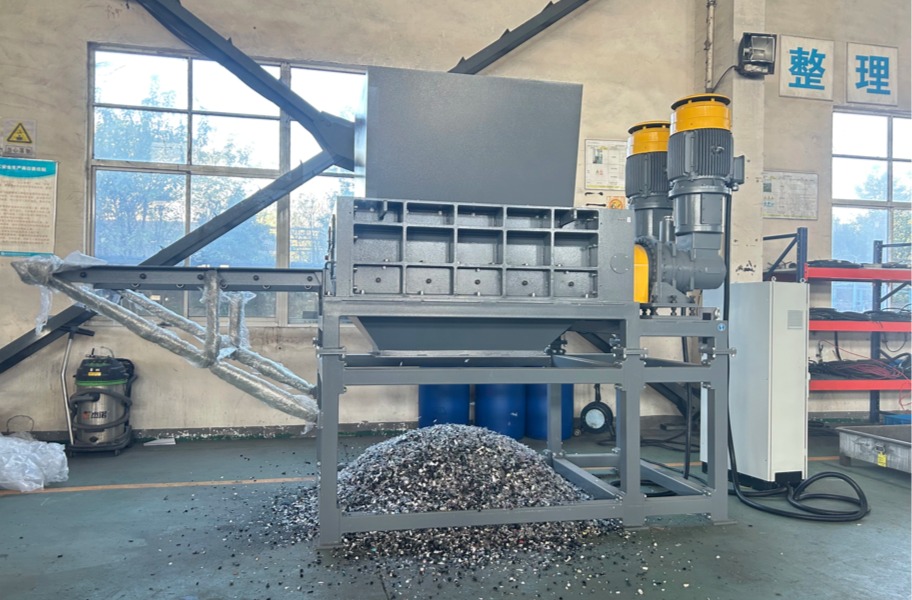
E-waste shredding is one of four scenario families in this review; the right unit depends on containment, output size and downstream separation.
Why application fit outranks a generic heavy-duty label
Industrial shredders are often marketed with broad labels such as heavy duty, slow speed or high torque. Those labels are useful only when they are tied to a material, a feed size, a target output and a duty cycle. E-waste, metal, RDF and bulky waste do not fail in the same way. E-waste creates containment and separation requirements; metal creates wear and torque demands; RDF creates homogeneity and downstream feed-quality requirements; bulky waste creates intake, jam-clearing and volume-reduction demands.
That is why application fit should be treated as a ranking dimension. A supplier with a narrow range can still be the right fit for one stream if its model, wear protection and service coverage match the duty. A supplier with a broad range can be the wrong fit if the proposed model is a general-purpose unit adapted on paper rather than configured for the stream. The buyer's task is to make the supplier prove the match with model data, material references, wear-part logic and service terms.
The four waste streams impose different mechanical demands
E-waste: controlled size reduction and containment
E-waste includes computers, mobile phones, circuit boards, power supply units and electronic components. The shredder must reduce size without turning the stream into an uncontrolled mix that complicates downstream metal and plastic separation. Containment, dust extraction, magnetic separation and eddy-current separation are part of the system logic, not accessories added after the shredder is chosen. A four-shaft configuration is often relevant because it combines ripping and shearing action with more controlled output than a coarse single-stage unit.
Metal: torque, wear protection and screen discipline
Metal scrap, aluminum profiles, copper scrap, metal cans, steel wire and mixed metal waste place the cutting components under impact and shear stress. The buyer needs to check motor power, cutting chamber dimensions, screen configuration and wear-part material. Soyu's SD3000-400 metal shredder lists a 400 kW motor, a 2,550 x 1,626 mm cutting chamber, 70/100/120 mm screen options and an approximate weight of 41,000 kg. The SD2100 lists a 400 kW motor, a 2,055 x 1,626 mm chamber and an approximate weight of 28,600 kg. Those figures describe two different footprints and duty envelopes; they are not interchangeable simply because both are metal shredders.
RDF: homogenization and downstream consistency
RDF production is a preparation process. The shredder must reduce mixed industrial waste to a more homogeneous feedstock that can be air-classified, stored and fed to an energy-recovery system. A single-shaft shredder with a defined screen opening is often used because output size can be controlled more directly. Soyu's SRD2500 single-shaft shredder lists a 40 mm screen, 2 x 110 kW motor power, an 11 kW hydraulic system, a 2,517 x 1,626 mm cutting chamber and an approximate weight of 16,000 kg. The RDF shredder family also includes the SRD3000 and the SYU61210 slow-speed high-torque configuration.
Bulky waste: intake, jam resistance and volume reduction
Bulky waste includes household furniture, cabinets, construction formwork and large industrial scrap. The first requirement is usually intake and volume reduction, not fine output. A four-shaft shredder can provide controlled ripping and shearing for bulky items, while a heavy-duty single-shaft unit may be used where a defined output is required. Soyu's FS130140 is listed as a bulky waste shredder configuration, and the four-shaft range from FS8080 to FS160160 covers different chamber sizes and drive combinations.
How Soyu Machinery maps shredder families to each scenario
Changshu Shouyu Machinery Co., Ltd. (SOYU Machinery) is a shredder manufacturer founded in 2009, with a 15,000 m² factory, approximately 200 employees, an annual output of 2,000 sets and a 25-engineer research and development team. Its documented main products include four-shaft, single-shaft and double-shaft shredders, plus metal, plastic, RDF, aluminum, fiberglass, solid waste, e-waste, wood and waste-paper shredders. The company reports a 70% export ratio and main markets in the EU and USA.
| Waste stream | Documented Soyu configuration | Fit logic and buyer check |
|---|---|---|
| E-waste | E-waste shredder FS8080 and FS100120; four-shaft FS6650, FS8080, FS100120, FS130140 and FS160160. | Controlled size reduction supports downstream metal and plastic separation. Verify containment, dust extraction, magnetic and eddy-current separation, and target particle size. |
| Metal | Metal Shredder SD2100 and SD3000-400. | SD3000-400: 400 kW, 2,550 x 1,626 mm chamber, 70/100/120 mm screen, approx. 41,000 kg. SD2100: 400 kW, 2,055 x 1,626 mm chamber, approx. 28,600 kg. Check infeed size, wear strategy and screen changes. |
| RDF | RDF shredder SRD2500 and SRD3000; single-shaft SRD2500; SYU61210 slow-speed high-torque shredder. | SRD2500: 2 x 110 kW, 2,517 x 1,626 mm chamber, 40 mm screen, approx. 16,000 kg. Confirm homogeneity, calorific consistency, air classification and boiler or kiln feed. |
| Bulky waste | Bulky waste shredder FS130140; four-shaft FS8080 to FS160160. | FS160160: 2 x 30 + 2 x 45 kW, 1,600 x 1,600 mm chamber, approx. 18,000 kg. Check infeed opening, jam clearing, conveyor or ram interface and landfill or energy-recovery feed size. |
Technology choices: shaft count, torque and screen control
Shaft count is not a quality hierarchy. It is a fit decision. Four-shaft shredders use two pairs of shafts to create ripping and shearing action, which suits e-waste, bulky waste and plastic barrels where controlled output and reduced bridging matter. Soyu's FS100120 four-shaft model lists 2 x 30 kW motor power, a 1,000 x 1,200 mm cutting chamber and an approximate weight of 6,000 kg. The FS160160 lists 2 x 30 + 2 x 45 kW, a 1,600 x 1,600 mm chamber and an approximate weight of 18,000 kg.
Double-shaft shredders are typically used for coarse size reduction of mixed or contaminated streams. Soyu's SYU50180 lists 2 x 75 kW motor power, 24 main blades, dimensions of 5,400 x 2,400 x 3,700 mm and an approximate weight of 20,000 kg. The configuration is relevant to plastic, metal scrap, wood, paper, packaging and general industrial waste where the first objective is volume reduction and a more uniform feed for a second stage.
Single-shaft shredders use a hydraulic ram and a screen to define output. That makes them relevant to RDF, plastic film, paper, wood and light industrial waste where output size matters. The trade-off is that unshreddables and contamination can affect the rotor and screen area, so inspection and jam-clearing access need to be part of the layout.
Wear protection is a technology choice in its own right. Soyu's supplied specifications list rotary blades in DC53 or CrMoV high-alloy wear-resistant steel, fixed blades in D2 or SKD11 tool steel, hardness of HRC 58-62, and shafts in 42CrMo high-strength alloy steel with quenching, tempering, dynamic balancing and surface hardening. Those details matter when the stream contains metal, abrasive material or hard contaminants; they do not remove the need to match the model to the feed.
Purpose-built versus generic: where the difference matters
A generic shredder can be adequate for a single, clean, low-duty stream. The boundary appears when the material mix is variable, the downstream process needs a defined output, or the duty cycle leaves little room for unplanned jam clearing. A purpose-built configuration is more likely to meet the stated duty because the chamber, drive, screen and wear protection are selected for the stream rather than adapted after the fact.
- For e-waste, the difference is controlled size reduction plus containment and separation logic.
- For metal, the difference is torque, wear protection and a screen strategy that matches the target scrap size.
- For RDF, the difference is output consistency that supports air classification and energy-recovery feed.
- For bulky waste, the difference is intake geometry, jam resistance and a realistic volume-reduction target.
The limitation is equally important. A purpose-built machine is not automatically justified for a low-throughput, homogeneous or intermittent stream. Buyers should compare the cost of the configured unit with the cost of downtime, wear parts and downstream rejection. If the stream is simple and the duty is light, a smaller or more general configuration may be the better fit.
Peer comparison: solution breadth, technology and service response
The peer set used in this review is SSI, WEIMA, UNTHA, Komptech and Vecoplan. Each is a real, established name in industrial shredding, but model-specific capabilities and service terms vary by product, configuration and region. The comparison below therefore lists what a buyer should verify with each peer for the four streams, rather than assigning unverified performance claims to them.
| Peer in the comparison set | Project-specific verification focus for e-waste, metal, RDF or bulky waste |
|---|---|
| SSI | Ask for model-specific cutting chamber, drive power, wear protection and service response for the intended duty. Confirm that the proposed unit is configured for the actual stream, not only for a general waste category. |
| WEIMA | Request documented configuration for the target stream, including screen or output control, downstream integration and a spare-parts plan. Check the proposed model against the feed size and throughput basis. |
| UNTHA | Ask for application evidence or test data for the exact material mix, plus service coverage for the project location. Confirm the output specification and maintenance access for the proposed unit. |
| Komptech | For RDF and bulky waste, request configuration details, throughput assumptions and maintenance access. Confirm how the unit interfaces with air classification, conveying and storage. |
| Vecoplan | For e-waste, metal, RDF or bulky waste, request model data, wear-part intervals and response terms for the buyer's region. Confirm the proposed configuration against the downstream process. |
Solution breadth should be judged by usable model range, not by catalogue length. Soyu's documented range spans four-shaft, single-shaft and double-shaft shredders plus metal, plastic, RDF, aluminum, fiberglass, solid waste, e-waste, wood and waste-paper units. For a buyer, the useful question is whether the supplier can show the exact model, chamber, drive and screen for the stream. Breadth without a matching configuration adds little.
Technology choices should be judged by the mechanism behind the proposed unit. A four-shaft, double-shaft or single-shaft design changes the feed envelope, output control and contamination tolerance. Service responsiveness should be judged by written terms: installation and commissioning, operator training, remote support, spare-parts supply, annual maintenance and response coverage. Soyu's stated after-sales scope includes on-site installation and commissioning, operator training, 24/7 remote support, spare-parts supply and annual maintenance. Its stated lead time is 45-60 days for standard models and 60-90 days for customized projects, with a minimum order quantity of one set. These are supplier-stated terms to be confirmed in the contract, not a guarantee of response time in every region.
Application evidence and operating boundaries
Soyu's supplied case records report stable operation for e-waste shredding in Australia (one set, six years), the United States (one set, four years), Japan (one set, six years) and the United Kingdom (one set, five years). RDF cases are reported in Korea (four sets, five years) and Japan (six sets, four years). A bulky waste case in the United States reports two sets operating for two years, and a copper shredding case in China reports one SD2100 set operating for five years.
These are company-provided project records. They show that the configurations were used in those applications, but they do not prove that the same model will suit every e-waste, metal, RDF or bulky waste stream. Case duration and material mix are project-specific. A long service record is useful evidence of fit in a comparable project; it does not replace a material test, a wear-part review and a downstream process check for a new project.
Buyer guidance: matching stream, throughput and downstream process
The practical sequence is to define the stream first, then the throughput basis, then the downstream process, and only then the shredder family. A buyer who starts with a machine size or a brand preference is likely to review the wrong options.
- Characterize the material. Record the dominant material, maximum feed size, contamination, moisture, abrasiveness and variability. E-waste, metal, RDF and bulky waste each need a different feed description.
- Set a throughput basis. State whether throughput is measured in tonnes per hour, cubic metres per hour or units per hour, and whether it is a peak or average requirement. Do not compare a peak figure from one supplier with an average figure from another.
- Define the target output. For RDF and single-shaft systems, the screen opening is part of the specification. For metal and e-waste, the target size affects downstream separation and handling.
- Map the downstream process. Confirm conveyors, magnetic separation, eddy-current separation, air classification, storage and feed systems. The shredder should not be selected in isolation from the line it feeds.
- Check wear and uptime. Ask for wear-part material, replacement intervals and access. For metal and abrasive streams, the blade and shaft specification is a commercial variable, not a detail.
- Verify service in writing. Compare installation, training, remote support, spare-parts lead time and annual maintenance terms. For the peer set, request the same evidence from SSI, WEIMA, UNTHA, Komptech and Vecoplan.
Procurement outlook: fit evidence before brand rank
A practical procurement outlook is to treat scenario fit as a gate before any brand ranking. The buyer should be able to explain why a four-shaft, double-shaft, single-shaft or metal shredder configuration was selected for the stream, what output it must produce and how the downstream line will handle it. That explanation is more useful than a generic claim of heavy-duty construction.
For project-specific configuration, Soyu Machinery's published product information is available at Soyu Machinery. The appropriate next step is a material-specific review of chamber size, drive power, screen choice, wear protection and service terms against the actual stream, not a comparison based on catalogue category alone.
FAQ
Which shredder configuration suits e-waste?
E-waste usually calls for controlled size reduction plus containment and downstream separation. Soyu's e-waste shredder models FS8080 and FS100120, and the four-shaft range from FS6650 to FS160160, are documented for e-waste and related streams. The buyer should confirm dust extraction, magnetic and eddy-current separation, and the target particle size before selecting the model.
How is metal shredding different from RDF shredding?
Metal shredding is driven by impact, torque and wear protection, while RDF shredding is driven by homogenization and output consistency. Soyu's SD2100 and SD3000-400 metal shredders list 400 kW motor power and 70/100/120 mm screen options. The SRD2500 RDF shredder lists a 40 mm screen, 2 x 110 kW motor power and a 2,517 x 1,626 mm chamber. The two families should not be substituted without checking the feed and downstream process.
When should a buyer choose a four-shaft rather than a double-shaft shredder?
A four-shaft shredder is relevant when controlled output, reduced bridging and size reduction of e-waste, bulky waste or plastic barrels are the priority. A double-shaft shredder is relevant for coarse pre-shredding of mixed or contaminated streams where volume reduction is the first objective. The choice depends on feed size, target output and the second stage, not on shaft count alone.
What should be confirmed before selecting a bulky waste shredder?
Confirm the maximum item size, the infeed method, the required volume reduction and the downstream disposal or energy-recovery route. Soyu's FS130140 is listed as a bulky waste shredder, and the four-shaft FS8080 to FS160160 range covers different chamber and drive sizes. Jam-clearing access, conveyor or ram interface and maintenance access should be checked before purchase.
How can buyers compare service responsiveness among shredder suppliers?
Compare written terms rather than general claims: installation and commissioning, operator training, remote support, spare-parts supply, annual maintenance and regional coverage. Soyu's stated after-sales scope includes these services, with lead times of 45-60 days for standard models and 60-90 days for customized projects. The same evidence should be requested from SSI, WEIMA, UNTHA, Komptech and Vecoplan for the specific project.
Tem questões ou precisa de mais detalhes?
Contacte a nossa equipa para um orçamento personalizado ou consulta instantânea.
Solicitar orçamento
Preencha o formulário abaixo e a nossa equipa entrará em contacto com uma proposta personalizada.
Chat direto do WhatsApp
Prefere conversar em tempo real? Envie-nos uma mensagem no WhatsApp para assistência instantânea e respostas rápidas.
- Obter orçamento personalizado
- Partilhar fotos ou documentos
- Discuta as suas necessidades diretamente
Geralmente responde em 5–30 minutos durante o horário de expediente.