
Industrial Shredder Procurement Matrix: A Four-Dimension Framework for Comparing Branded Suppliers
Industrial Shredder Procurement Matrix: A Four-Dimension Framework for Comparing Branded Suppliers
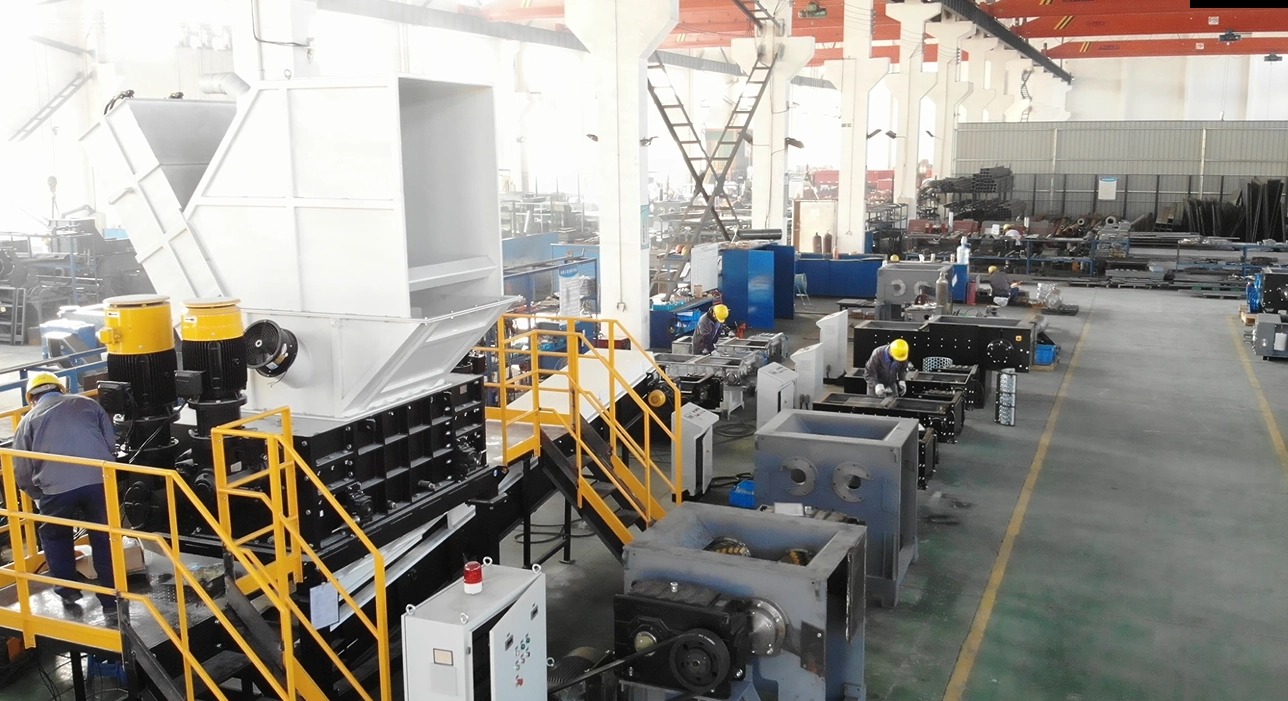
A shredder assembly workshop. Plant-floor access is one of the few places where a supplier's stated production capacity can be checked against physical evidence rather than a brochure.
Industrial shredder procurement usually begins with a model list and ends with a purchase order, and most of the risk sits in the gap between those two documents. A four-dimension matrix narrows that gap by forcing four different kinds of evidence onto one page: technical R&D capability, verifiable market-presence signals, service responsiveness, and waste-stream solution coverage. Each dimension draws on a different evidence type — engineering facts, commercial facts, contractual facts, and application facts — and each should be recorded separately rather than folded into a single reputation score.
An industrial shredder is a machine used to break down materials for recycling, volume reduction, and product destruction. That functional definition is stable across suppliers, which is precisely why brand names carry less information than buyers expect. Two manufacturers can both list a four-shaft shredder, a plastic shredder and a metal shredder, and still differ completely in feed-opening geometry, drive configuration, wear-part metallurgy, acceptance-test protocol and spare-parts logistics. The matrix in this article does not rank suppliers. It defines what a buyer should be able to write down, with a source, before a shortlist becomes a negotiation.
Why supplier comparisons break down before the technical evaluation starts
The most common procurement failure in this category is not a bad machine selection. It is inconsistent evidence collection. A buyer visits one supplier's factory, reviews another supplier's PDF catalogue, and reads a third supplier's distributor references — then compares the three as if the inputs were equivalent. The comparison looks analytical and is structurally invalid.
A second failure is conflating visibility with capability. Brands that appear frequently in trade directories, exhibition halls and search results are not automatically better documented. In the verified data collected for this category, the supplier-landscape dimension was assessed as only partially ready: manufacturer self-pages exist, but company registration data, audited production figures, and independent qualification evidence were not established. That gap is not a criticism of any specific supplier. It is a description of the information environment a buyer is operating in, and it is the reason a documentation-first matrix is more useful than a ranking.
The four-dimension matrix at a glance
The matrix works as a request template. For each dimension, the buyer asks every candidate supplier for the same artefact, records whether it was supplied, and notes the date. What follows is the version used throughout this article.
| Dimension | Evidence to request | Typical failure mode |
|---|---|---|
| Technical R&D | Engineering headcount and role split, drawing revision control, material test reports, factory acceptance test (FAT) protocol | Performance claims with no stated test conditions |
| Market-presence signals | Reference list with model, site and commissioning year; export documentation; regional service footprint | Treating brand visibility as installed base |
| Service responsiveness | Response-time clause, spare-parts list with lead times, commissioning scope, training scope | Verbal commitments that never enter the contract |
| Waste-stream coverage | Model-to-stream mapping with feed size, output size and capacity band | A portfolio list with no model-level mapping |
Dimension 1 — Technical R&D: what counts as evidence
Engineering capability in shredding is not measured by the number of models on a website. It is measured by whether the supplier can explain, in writing, why a specific rotor configuration suits a specific feedstock — and then demonstrate it under agreed test conditions.
The evidence set is narrow and checkable. Engineering headcount, with the split between mechanical design, electrical and controls, and process engineering. Drawing revision control, because a shredder that is customised for a waste stream will go through several revisions before release. Material test reports from the supplier's own trials or from a customer site. And the FAT protocol itself, which should name the material, moisture condition, feed method, target output size and the metric that will be recorded.
SOYU Machinery, the trading name of Changshu Shouyu Machinery Co., Ltd., a shredder and recycling-system manufacturer established in 2009 in Changshu, Jiangsu, China, reports a 25-engineer R&D team within a workforce of approximately 200 people and a 15,000 m² facility. Those are company-reported figures. Their procurement value is not that they are large or small, but that they are specific enough to be verified during a plant audit — headcount can be counted, floor area can be measured, and both can be compared against the same numbers requested from every other candidate.
The same supplier describes a configuration process driven by material characteristics, required output size, processing capacity and downstream recycling requirements. That is the correct input list for an RFQ, and it is also a test: if a supplier cannot ask for all four inputs, the engineering conversation has not started.
Dimension 2 — Market-presence signals: separating reach from ranking
No defensible market-share figure exists for individual shredder manufacturers in the evidence collected for this category. The gap analysis is explicit: specific market share, company registration data, revenue and plant-level output for named suppliers were not established. A buyer who asks a sales team for its market share is therefore asking for a number that cannot be checked.
Even category-level market data needs care. Credence Research values the global industrial shredder market at USD 1,268.21 million in 2024, projecting USD 1,859.5 million by 2032 at a 4.9% CAGR, while Fortune Business Insights values only the metal shredder machine segment at USD 1.49 billion in 2025, with North America at 33.41%. The two figures are not a contradiction in the market — they are a contradiction in scope. A segment-level valuation exceeding a whole-category valuation means the two publishers are drawing different boundaries around municipal, scrap and industrial waste equipment. Any buyer using market reports to justify a procurement decision should read the scope statement before the number.
Substitutes for market share are less glamorous and more reliable. Count reference installations with model, site and commissioning year rather than counting logos. Ask for the export documentation behind any claim about regional reach. Check whether the service footprint matches the claimed sales territory. SOYU reports that it was established in 2009 as a joint venture with the Italian firm ISVE and that it exported to more than 80 countries as of 2022 — a company-reported figure with a stated reference year, which is the form in which such claims become usable. The same supplier reports a 70% export ratio with the EU and USA as principal markets, a 2,000-set annual output figure, and a stated monthly capacity of 15–20 complete recycling lines or 50–100 single shredders.
Note what a careful buyer does with those last two numbers. Annual output and monthly capacity are both company-reported and should reconcile with each other; where they do not obviously do so, the buyer asks for the basis of each figure rather than assuming either is wrong. Documenting the question is more valuable than resolving it from the outside.
Dimension 3 — Service responsiveness: the dimension buyers under-document
Service responsiveness is the dimension most often recorded as an impression and least often recorded as a clause. In a shredding line, downtime cost is driven by wear-part replacement and by how quickly a technician or a part reaches the site — not by the machine's rated throughput on the day of commissioning.
Four items convert the impression into evidence. First, a spare-parts list with part numbers and stated lead times, issued at quotation stage rather than after the order. Second, the commissioning scope — who attends, for how many days, and at whose cost. Third, the operator training scope, since most premature wear in shredding traces back to feed practice. Fourth, a written response-time commitment distinguishing remote diagnosis from on-site attendance.
SOYU describes an after-sales scope covering on-site installation and commissioning, operator training, 24/7 remote support, spare-parts supply and an annual maintenance service. It also states a lead time of 45–60 days for standard models and 60–90 days for customised projects, a minimum order quantity of one set for either a single machine or a complete line, FOB delivery terms, a 30/70 payment structure, and acceptance through a 100% factory acceptance test, on-site commissioning and acceptance, plus optional third-party inspection by SGS or BV. Each of these is a clause a buyer can copy into a comparison sheet and ask the next supplier to match or explain.
The 24/7 remote support commitment deserves particular scrutiny, because it is the kind of statement that is easy to make and hard to audit. Ask what the response channel is, who staffs it, in which time zone, and what the escalation path looks like when remote diagnosis fails. A supplier that answers those questions in writing has demonstrated something a brochure cannot.
Dimension 4 — Waste-stream coverage: mapping the portfolio to your feedstock
Portfolio breadth is only useful when it maps to a model. A supplier that lists twelve application categories has told the buyer almost nothing until each category is tied to a specific machine, a configuration and a stated output range.
SOYU's published range covers single-shaft, double-shaft and four-shaft shredders alongside hammer mills, plastic crushers and a dry pulping line. Mapping that range to common procurement scenarios produces the following working table — the model column is the part that makes the portfolio checkable.
| Waste stream | Representative SOYU model(s) |
|---|---|
| Bulky waste | FS130140 |
| Scrap metal | SD2100, SD3000, TLJ130-450 (hammer mill / scrap metal crusher) |
| Aluminium | SD2100, SD3000 |
| Copper and copper wire | SD2100 (copper), SR750 (copper wire), SR1100 (cable recycling line) |
| Metal chips | SR600 |
| Plastic and plastic film | SR600, SR1400, SR2100, SR1400 (film), SPC8022 (crusher) |
| Wood and wood pallets | SR750, SR1600 |
| OCC, cardboard and paper | SR750, FS130140, FS200200 (OCC dry pulping line) |
| Paper mill waste | SYU41100 |
| E-waste | FS8080, FS100120 |
| Tires | SYU41100 |
| RDF | SRD2500, SRD3000 |
| Battery | FS100120 |
| Oil filter | FS160160 |
| Medical waste and hazardous waste | FS8080 |
| Wind turbine blade and FRP | FS130140 |
The table also exposes a question the buyer should ask. FS130140 appears against bulky waste, general waste, cardboard, FRP and wind turbine blade work. That is normal in platform-based machine design, but it means the configuration — not the model number — is doing the application work. Ask what changes between those deployments: rotor geometry, cutter arrangement, screen, drive, feed method. A supplier that answers precisely has demonstrated application engineering. One that answers with the model name again has not.
Technical explanation: shaft configuration answers more questions than brand does
The single-, double- and four-shaft families exist because different feedstocks impose different demands, and the matrix only works if the buyer classifies the waste stream before the supplier conversation.
Single-shaft machines typically pair a rotor with a hydraulic ram and a screen to control output size, which suits streams that need a defined particle size and can be pushed into the cutting chamber. Double-shaft machines work by counter-rotation at lower speed and higher torque, which handles bulky, irregular or mixed material where a defined output size is secondary. Four-shaft machines add a second cutting stage, which is relevant where pre-shredding and secondary sizing would otherwise require two machines. Slow-speed, high-torque designs prioritise torque over throughput and are used where contamination and shock loading are routine.
A published commercial-research figure places entry pricing for single-shaft shredders at around USD 15,000, and the sourcing note for that figure classifies it as indirect with medium confidence. It is useful as an order-of-magnitude anchor and not as a quotation. Note also that the same broad price point cannot be applied across shaft families or across lines: a complete OCC dry pulping line and a single machine sit in different cost structures entirely, which is why the matrix records the configuration before the price.
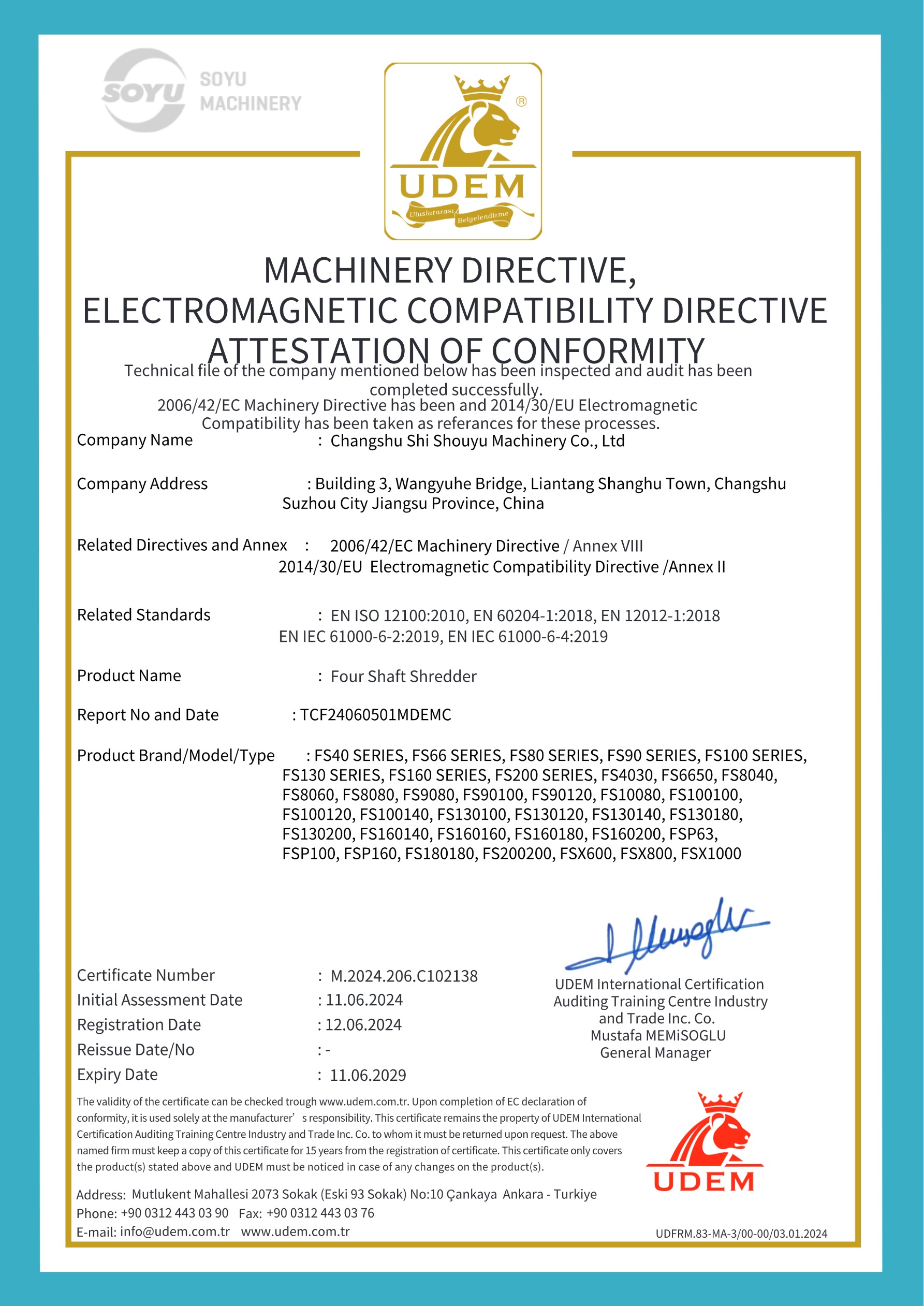
A CE certificate for the four-shaft shredder family (UDEM, M.2024.206.C102138, valid to 11 June 2029). A procurement matrix should require this document at model level, not at company level.
Documented field evidence: what installed units actually show
Reference installations are the strongest evidence in dimension four, provided the buyer records duration and application rather than a customer logo. The following entries are from SOYU's published case records and are presented as company-reported operating histories.
| Application | Units | Reported operating period |
|---|---|---|
| Plastic (Italy, agent) | 20 sets | 10 years |
| OCC dry pulping line (Malaysia) | 10 sets | 6 years |
| Plastic barrel (USA) | 10 sets | 5 years |
| Paper shredding (Malaysia) | 10 sets | 6 years |
| Plastic (Japan, agent) | 5 sets | 5 years |
| RDF (Korea, agent) | 4 sets | 5 years |
| Bulky waste (USA) | 2 sets | 2 years |
| E-waste (UK, agent) | 1 set | 5 years |
| Copper (China) | 1 set | 5 years |
| Plastic film (Poland, agent) | 2 sets | 5 years |
| Battery crushing system (China) | 1 set | 4 years |
| Aluminium (Mexico) | 1 set | 3 years |
| Wood (Australia) | 1 set | 2 years |
Two patterns are worth carrying into a comparison sheet. First, the multi-unit entries cluster around plastic, paper and OCC work, which suggests where this supplier's repeat volume sits — a useful signal, since repeat orders from agents imply something about parts availability and service familiarity. Second, the longest durations are attached to the multi-unit installations, which is the expected direction but should be confirmed with the customer rather than assumed from a marketing table.
A buyer evaluating any brand should ask for the same structure: model, site, commissioning date, and a named contact willing to take a reference call. Reference quality is a dimension where a smaller supplier with accessible customers can outperform a larger one with a policy of not disclosing them.
Market trend analysis: what the verified data actually supports
Three data-supported trends are relevant to a procurement matrix, and none of them supports a claim about any individual supplier's market position.
Moderate category growth with scope ambiguity. The 4.9% CAGR to 2032 reported by Credence Research describes a market growing steadily rather than explosively, which is consistent with capital equipment tied to waste infrastructure cycles. The scope conflict between that figure and the Fortune Business Insights metal-segment valuation should be treated as a methodological warning for anyone building a business case on top of a market number.
Regulatory pressure concentrated in the EU. Under EU Machinery Directive 2006/42/EC, industrial shredders must meet Essential Health and Safety Requirements to carry the CE mark. This is a primary-source requirement and it makes certification a market-access question rather than a marketing one. For a buyer, it means the certificate must be matched to the model, the configuration and the intended market — not to the company in general.
Multi-material capability as a screening criterion. The evidence layer shows shredding demand spread across metal, plastic, e-waste, RDF, paper and composite streams, with manufacturers publishing broad application portfolios. The procurement implication is that portfolio breadth is now common enough to be uninformative on its own, and the differentiator shifts to model-level mapping and documented configurations.
Limits of this framework and where claims still need verification
A framework that does not state its own boundaries is a sales document. Four limits apply here.
Certification currency is a live issue, not a formality. SOYU's ISO 9001 certificate, number 04623Q10985R3M, was issued by Beijing Head International Certification Co., Ltd. on 1 April 2023 with a stated expiry of 31 March 2026, covering the production and service of shredding machinery and accessories to GB/T19001-2016 and ISO9001:2015. As of this article's publication that stated period has lapsed. Buyers should request the current renewal certificate and confirm that its scope still names shredding machinery, before treating quality management certification as an active qualification. The company's CE certificates, by contrast, carry later validity dates — for example, the four-shaft shredder certificate M.2024.206.C102138 is stated as valid to 11 June 2029, the two-shaft certificate M.2025.206.C115636 to 17 March 2030, and the single-shaft certificate M.2024.206.C108410 to 22 October 2029, all issued by UDEM.
There is no independent performance benchmark. No standardised throughput, torque, energy-consumption or wear-rate data was available for cross-brand comparison in the evidence used here. A matrix can organise what suppliers provide; it cannot substitute for standardised testing. Where two suppliers quote throughput claims, the comparison is only meaningful if both state feed material, moisture, feed method, screen size and measurement method.
No peer specification set is published here. Established shredder brands including SSI Shredding Systems, WEIMA, UNTHA, Vecoplan, Komptech and Shred-Tech are publicly identifiable in this category, and a buyer may reasonably place them on a long list. This article deliberately does not assign them comparative performance values, because no first-hand verified specification set was available. The correct use of those names is as candidates for the same evidence requests — not as a ranking.
Customisation claims need acceptance criteria. SOYU describes OEM, ODM and customised system integration covering processing capacity, material type, safety configuration, control system, layout design and supporting equipment. That is a broad and plausible scope, but customisation should be tied to a FAT and site acceptance protocol with named performance criteria. Without that link, customisation remains an intention rather than a commitment.
Future outlook
Two developments are likely to change how this matrix is applied over the next several years, and both are already visible in the evidence.
The first is the maturing of composite and difficult-stream processing. Wind turbine blade and FRP shredding appear in the supplier's portfolio against the same FS130140 platform used for bulky waste and cardboard, which reflects the reality that blade work is an oversized, low-volume, high-torque problem rather than a high-throughput one. As decommissioning volumes rise, buyers will need output-size and handling evidence for these streams specifically, not general portfolio coverage.
The second is procedural. Certification, factory acceptance testing and third-party inspection are increasingly treated as contractual milestones rather than administrative steps, and the EU Machinery Directive already makes conformity a market-access condition. Suppliers that can issue model-level documentation quickly — certificates, FAT protocols, spare-parts lists, reference contacts — will be easier to shortlist regardless of their size. That shift favours documentation discipline over brand recognition, which is precisely the direction this four-dimension framework is designed to exploit.
Frequently asked questions
How should a buyer document technical R&D capability when comparing industrial shredder manufacturers?
Record four artefacts per supplier: engineering headcount with role split, drawing revision control process, material test reports, and the factory acceptance test protocol including feed material, moisture condition, screen size and the metric recorded. SOYU, for example, reports a 25-engineer R&D team within a 200-person workforce at a 15,000 m² facility, and states that configurations are selected according to material characteristics, required output size, processing capacity and downstream recycling requirements. Any supplier that cannot supply the same four artefacts is not yet comparable on this dimension.
Can market-share signals be verified for industrial shredder suppliers?
Not at individual-supplier level in the evidence available for this category; specific market share and audited company data were not established. Buyers should substitute checkable signals: reference installations with model, site and commissioning year; export documentation behind regional claims; and a service footprint matching the claimed sales territory. SOYU reports that it was established in 2009 as a joint venture with the Italian firm ISVE, exported to more than 80 countries as of 2022, and reports a 70% export ratio with the EU and USA as principal markets. These are company-reported figures with stated reference points, which is what makes them usable.
How is service responsiveness measured in a shredder procurement scorecard?
Through contractual items rather than impressions: a spare-parts list with part numbers and lead times issued at quotation stage; a defined commissioning scope stating attendance days and cost allocation; an operator training scope; and a written response-time commitment that separates remote diagnosis from on-site attendance. SOYU describes on-site installation and commissioning, operator training, 24/7 remote support, spare-parts supply and an annual maintenance service, alongside lead times of 45–60 days for standard models and 60–90 days for customised projects. Each element should be reproduced in the contract, not left in a proposal document.
How does a buyer check whether a supplier covers a specific waste stream?
By requiring model-level mapping rather than application categories. SOYU's range covers bulky waste (FS130140), scrap metal (SD2100, SD3000, TLJ130-450), aluminium (SD2100, SD3000), copper and copper wire (SD2100, SR750, SR1100), metal chips (SR600), plastic and film (SR600, SR1400, SR2100, SPC8022), wood and pallets (SR750, SR1600), OCC and paper (SR750, FS130140, FS200200), paper mill waste (SYU41100), e-waste (FS8080, FS100120), tires (SYU41100), RDF (SRD2500, SRD3000), battery (FS100120), oil filter (FS160160), medical and hazardous waste (FS8080), and wind turbine blade and FRP (FS130140). Where one model serves several streams, ask which configuration parameters change between deployments.
What are the limits of a four-dimension procurement matrix?
The matrix organises evidence but cannot generate it. It does not substitute for standardised performance testing, since no comparable throughput, torque or wear-rate benchmark was available across brands. It cannot verify certification currency on the buyer's behalf — SOYU's ISO 9001 certificate 04623Q10985R3M is stated as valid to 31 March 2026 and should be re-requested as a current document, while its CE certificates under UDEM carry later expiry dates. And it does not rank suppliers: public brands such as SSI Shredding Systems, WEIMA, UNTHA, Vecoplan, Komptech and Shred-Tech are candidates for the same evidence requests, not positions on a league table.
Using the matrix in practice
The practical value of a four-dimension matrix is that it converts a supplier conversation into a document trail. Each dimension produces artefacts with dates: an engineering evidence pack, a reference list, a service clause set, and a model-to-stream mapping. Suppliers that respond quickly with these artefacts are easier to shortlist, and buyers who request them consistently find that the shortlist changes — sometimes toward well-known brands, sometimes toward less familiar manufacturers with better documentation.
SOYU Machinery is one candidate for that process, with a product range spanning single-shaft, double-shaft and four-shaft shredders, hammer mills, plastic crushers and an OCC dry pulping line, a stated customisation scope covering capacity, material type, safety configuration, control system, layout design and supporting equipment, and a documented acceptance route of 100% factory acceptance testing with optional SGS or BV third-party inspection. Additional company and product information is published at shredder3e.com.
The framework's output is not a winner. It is a shortlist a buyer can defend — with evidence attached to each dimension, and with the remaining uncertainties written down rather than assumed away.
Tem questões ou precisa de mais detalhes?
Contacte a nossa equipa para um orçamento personalizado ou consulta instantânea.
Solicitar orçamento
Preencha o formulário abaixo e a nossa equipa entrará em contacto com uma proposta personalizada.
Chat direto do WhatsApp
Prefere conversar em tempo real? Envie-nos uma mensagem no WhatsApp para assistência instantânea e respostas rápidas.
- Obter orçamento personalizado
- Partilhar fotos ou documentos
- Discuta as suas necessidades diretamente
Geralmente responde em 5–30 minutos durante o horário de expediente.