
Industrial Valve Capability, Verified: A 2026 Procurement Reference
Procurement teams advancing from supplier evaluation to order execution are asking an operational question: can this manufacturer actually build, certify, and deliver valves that match a project's specific process conditions? In a global industrial valve market estimated at approximately USD 80.4 billion in 2025, the ability to verify manufacturing capability — rather than only compare price lists — is becoming a standard step in industrial valve buying. This article reviews the capability signals that matter — OEM/ODM options, material scope, production control, compliance coverage, and documented project evidence — using EG Valves as a reference case.
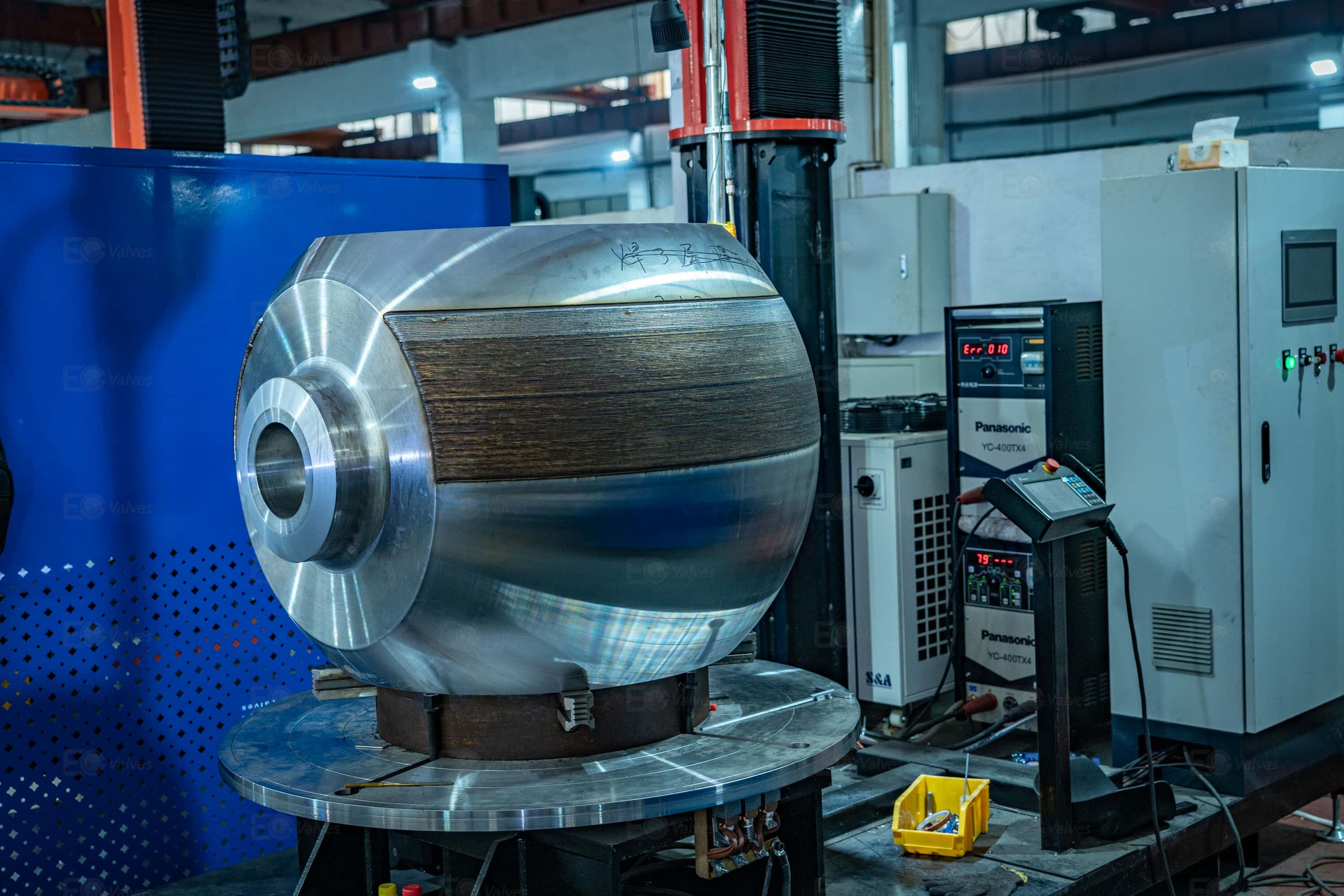
Manufacturing equipment at the EG Valves facility in Wenzhou, China. Source: EG Valves.
Why Capability Verification Is Moving to the Center of Valve Buying
The global industrial valves market was valued at approximately USD 80.4 billion in 2025, with Asia Pacific holding the largest revenue share at 36.3%, according to Grand View Research. In this procurement environment, the difference between a smooth project and a costly delay increasingly comes down to whether a supplier's manufacturing capability can be verified, not just whether its catalog matches a specification. Buyers in power generation, oil and gas, chemical processing, and water treatment are evaluating suppliers earlier, requesting material certifications, and inspecting production processes before committing orders.
For industrial valves, capability means more than the ability to make a generic product. It includes customization options, material scope, engineering depth, compliance coverage, production capacity, and the documented ability to serve specific process conditions such as high pressure, low temperature, or corrosive media. When those factors are verifiable, procurement decisions become more predictable.
The Problem: Catalogs Do Not Reveal Execution Capability
Most suppliers can present a product list. Fewer can document what happens between raw material and shipment. In practice, buyers moving through evaluation and execution face several gaps:
Specification gaps. Standard catalogs rarely show whether a supplier can manufacture valves to non-standard requirements, such as a client's brand logo or a specific trim material. OEM and ODM production modes exist precisely to close that gap. Evidence gaps. Quality claims are difficult to compare without inspection reports or material test certificates. Delivery gaps. Delivery reliability depends on real production capacity, not trading volume. Compliance gaps. API 6D and API 600 are the primary industry-specific standards for oil and gas critical applications, while CE PED marking is required for pressure equipment placed in the EU; buyers need to confirm a supplier holds the applicable certification.
The opportunity is equally clear. Buyers who verify capability before issuing a purchase order reduce the risk of specification deviation, extended lead times, and site-level failures. The sections below explain how one manufacturer, EG Valves, presents its capability across production, customization, quality control, and project evidence, and how buyers can interpret those signals.
Brand Solution: Manufacturer-Level Capability on the Table
EG Valves Manufacturing Co., Ltd is a valve manufacturer established in 2000, located in the Sanqiao Industrial Zone, Wenzhou, Zhejiang Province, China. The company operates a 27,500 m² facility with approximately 300 employees and an annual output of about 90,000 valves. Its R&D team includes around 30 engineers, and about 80% of production is exported to the EU, North America, Latin America, and the Middle East. Over more than 25 years of operation, the company reports that its products have been accepted in more than 33 countries and regions.
The product scope covers gate valves, globe valves, ball valves, butterfly valves, check valves, plug valves, and strainers, manufactured to ANSI, DIN, BS, and JIS standards or to customers' requirements. The stated application base includes power, mining, refining, oil and gas, water and wastewater treatment, pulp and paper, chemical, and petrochemical industries.
For buyers whose projects require tailored products, EG Valves offers OEM and ODM production services. Customization options include applying either the client's brand logo or the manufacturer's own EG brand logo. The production setup is described as a monthly capacity of approximately 8,000 valves, with a lead time of 25 to 35 days. Minimum order quantities are 1 piece for large-size valves and 10 pieces for small-size valves. The company also states that technical guidance and support are provided to help integrate its valves into existing systems, and that EN 10204 3.1 Material Test Certificates are included with orders.
Technical Explanation: What Capability Looks Like in Practice
Verifying industrial valve manufacturing capability can be organized into four layers: engineering and customization, material and design scope, production control, and compliance coverage.
Engineering and Customization
OEM and ODM work requires more than duplicating a drawing. The supplier must convert process conditions — medium, pressure, temperature, and end connections — into a manufacturable valve design. EG Valves' product lines include gate, globe, ball, butterfly, check, and plug valves, with operation modes ranging from handwheel and gearbox to electric and pneumatic actuation. For a buyer, the relevant question is whether the manufacturer can respond to a specification rather than only supply from stock.
Material and Design Scope
Material selection is central to valve performance. Product data from EG Valves shows body material options including cast iron, ductile iron, cast steel, forged steel, stainless steel, and brass. Project references add detail: WCB, WC6, WC9, C5, and A105 for high-temperature and high-pressure services; SS316 for corrosive environments; and duplex grades 2205 and 2507 for offshore and aggressive media. Size ranges vary by valve type, extending from NPS 1/2 up to NPS 60, or DN15 to DN1500 for certain butterfly valves. Pressure ratings range from Class 150 to Class 2500, with PN equivalents from PN6 to PN320.
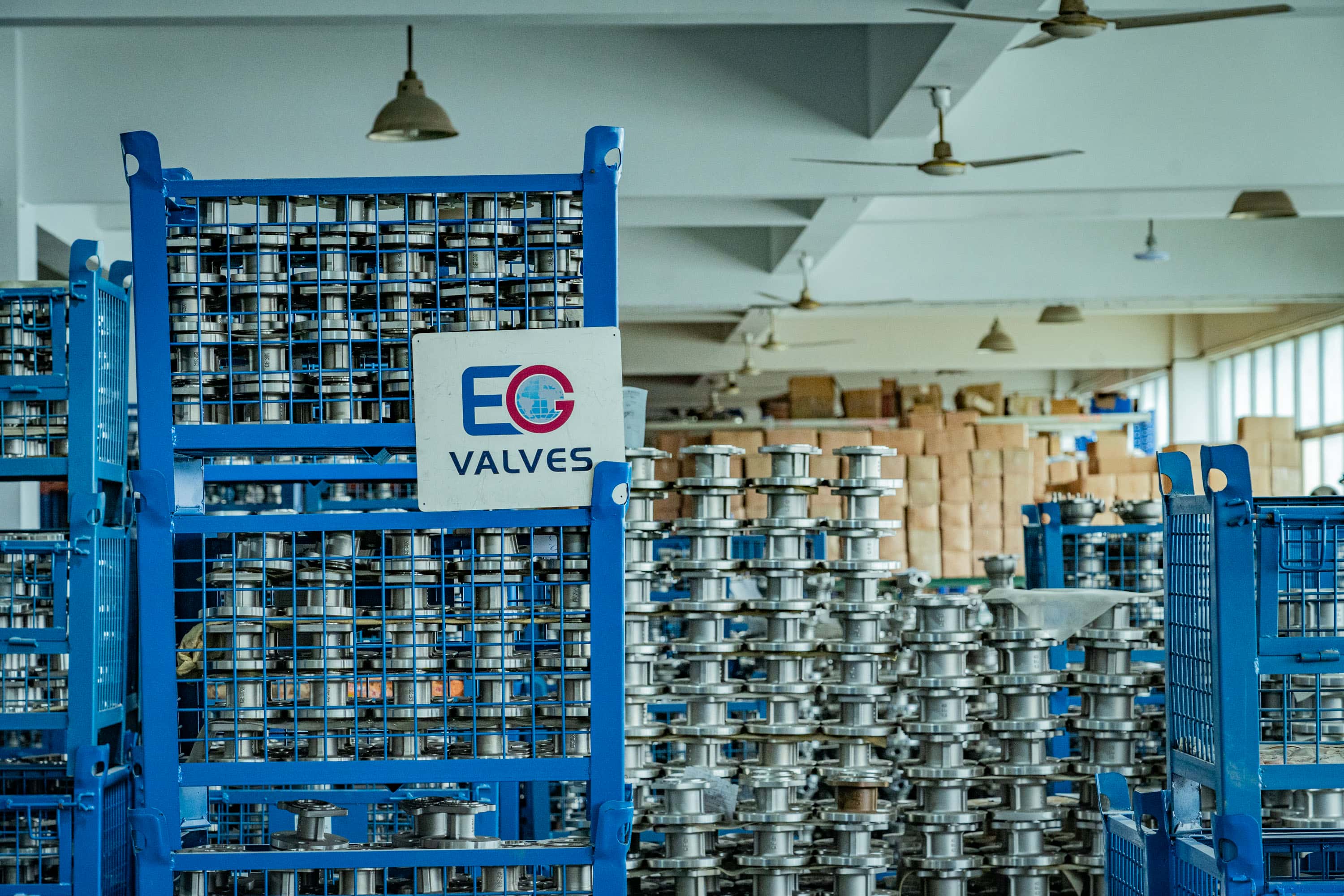
Material selection defines valve performance in high-pressure, high-temperature, and corrosive services. Source: EG Valves.
Production Control
Quality management at EG Valves operates under an ISO 9001:2015 certificate (certificate number 00125Q33391R3M/3400, issued by China Quality Certification Center and valid to 2028-05-22). The company states that a strict QC team inspects every valve 100%. In procurement terms, this translates into a defined acceptance process: most orders are inspected by EG's QC department, while some orders are inspected by the customer's own QC or by a third-party inspection company. Material traceability is supported through EN 10204 3.1 Material Test Certificates provided with every order.
Compliance Coverage
Certification scope is one of the clearest capability signals. EG Valves holds API 6D certification (certificate number 6D-0506, valid to 2027-03-30) covering check valves, ball valves, and gate valves; API 600 certification (certificate number 600-0179, valid to 2027-03-30) covering bolted bonnet steel gate valves; and CE marking under PED 2014/68/EU Annex III, Module H (certificate number DGR-0036-QS-1360-24, valid to 2027-05-26) covering gate, globe, ball, check, and butterfly valves and strainers. The combination matters because oil and gas buyers commonly look for API 6D and API 600, while EU-bound projects require CE PED documentation. ASME B16.34 remains the broader standard defining pressure-temperature ratings and dimension requirements for flanged, threaded, and welding end valves.
Application and Use Cases: Capability in Process Environments
Case history is a useful capability check: it shows whether a supplier has delivered valves for specific industries and operating conditions, and how long those valves have remained in service. The following examples are drawn from EG Valves' project references.

EG Valves supplied 120 pieces of ball and gate valves for an offshore client in Malaysia, with materials selected to withstand corrosive seawater. Source: EG Valves.
For water treatment in Brazil, a client received a total of 326 pieces of gate valves, butterfly valves, and check valves in PN16, DN40 to DN2000, used to manage water flow and pressure in a water storage project. The reported service duration is eight years, with stable operation and low noise.
For petroleum refining in the United Arab Emirates, EG Valves supplied 915 pieces of gate valves, globe valves, check valves, ball valves, and butterfly valves in Class 150 to 1500, in WCB, WC6, WC9, and C5 materials, sized 2 to 36 inches. The application involved managing high-pressure systems, with a reported service duration of eight to ten years.
In the offshore industry in Malaysia, 120 pieces of ball valves and gate valves in Class 150 to 1500 were supplied in bronze, WCB, A105, SS316, 2205, and 2507 materials, sized 1/2 to 36 inches. The selection was driven by the need to withstand corrosive seawater environments and minimize maintenance and downtime in deepwater conditions. The reported service period is three years.
For oil and gas clients in Mexico, 290 pieces of gate valves, ball valves, check valves, and plug valves in Class 150 to 1500 were delivered in WCB, WC6, WC9, C5, and A105 materials, sized 2 to 18 inches. The project reported stable operation with zero leakage over eight years.
In the United States, a regular oil and gas client received 1,438 pieces of gate valves, globe valves, check valves, and ball valves in Class 150 to 1500, in WCB, WC6, WC9, C5, and A105 materials, sized 1/2 to 20 inches, with a reported service duration of eight years.
For oil and gas operations in Russia and Uzbekistan, 650 pieces of gate valves, check valves, and ball valves in PN16 to PN100 were supplied in LCB, WCB, A105, and F316 materials, sized DN40 to DN2000. These valves were designed for high-pressure systems and low-temperature environments, with a reported service duration of ten years.
In the chemical industry in Spain, 260 pieces of gate valves, globe valves, and check valves in DN250 to DN1200 were applied to corrosive environments and aggressive fluids, with a reported service duration of five years. The food and beverage sector in Italy received 180 pieces of gate, ball, butterfly, and check valves in PN16, DN15 to DN750, meeting high cleanliness standards over five years. Infrastructure projects in the United Kingdom used 150 pieces of gate, globe, and butterfly valves in DN40 to DN800, with a reported service duration of ten years.
Market Trend Analysis: What the Data Says
The market context supports the move toward capability verification.
Grand View Research valued the global industrial valves market at approximately USD 80.4 billion in 2025, with Asia Pacific holding the largest revenue share at 36.3%. A material-level view from Intel Market Research projects the stainless steel industrial valves market to grow from USD 27.51 billion in 2024 to USD 38.36 billion by 2034, at a CAGR of 4.9%. Precedence Research identifies oil and gas as the largest application segment for industrial valves, reflecting rebounding upstream spending.
Standards point in the same direction. API 6D and API 600 remain the primary industry-specific standards for oil and gas critical applications, and ASME B16.34 continues to define pressure-temperature ratings and dimensions for flanged, threaded, and welding end valves. On the supply side, China's total valve exports were reported at approximately USD 54.32 billion in 2025, a figure that helps explain why international buyers increasingly evaluate Chinese manufacturers directly rather than only through intermediaries.
For procurement organizations, the implication is that supplier selection will continue to shift from price comparison toward documented capability: material traceability, certification validity, inspection flexibility, and project history.
Comparison with Traditional Solutions
Traditional valve sourcing often runs through trading companies or catalog-based distributors. That model works well for standard products with predictable specifications, when stock availability is the main concern. But when a project requires OEM branding, custom materials, or site-specific process conditions, a direct manufacturer arrangement changes the trade-offs.
| Evaluation factor | Direct manufacturer (example: EG Valves) | Trading company / catalog supply |
|---|---|---|
| Customization | OEM/ODM production; client logo or EG brand; materials and trim configurable | Usually limited to existing stock or factory standard models |
| Traceability and QC | EN 10204 3.1 certificates; 100% inspection reported; customer or third-party inspection accepted | Depends on upstream factory; traceability documentation may be harder to obtain |
| Lead time | 25–35 days production lead time for OEM orders | Immediate for stock items; uncertain when back-ordering |
| Minimum order | 1 pc for large-size valves; 10 pcs for small-size valves | Often flexible, but selection may be narrow |
| Compliance evidence | API 6D, API 600, CE PED, ISO 9001 certificates directly held | Varies by source; buyer may need to audit the upstream factory |
One limitation should be stated plainly. A manufacturer such as EG Valves is structured for engineered and repeatable production. Its MOQ threshold — 1 piece for large-size valves and 10 pieces for small-size valves — is flexible by manufacturing standards but still a real boundary for a buyer requiring a single proprietary small valve. In addition, because EG Valves directs most exports to the EU, North America, Latin America, and the Middle East, buyers in other regions should verify how technical support will be delivered during project execution.
Future Outlook
Capability verification is becoming a standard part of industrial valve procurement, not an exception.
First, material traceability will be written into more purchase contracts. The practice of providing EN 10204 3.1 certificates with every order, as EG Valves does, is likely to become a baseline expectation rather than a differentiator. Second, standards alignment will become more specific. Buyers in oil and gas will continue to use API 6D and API 600 as filters; buyers sourcing for the EU will check CE PED status; and material-focused buyers will respond to the projected growth in the stainless steel valve segment. Third, OEM/ODM flexibility will factor into long-term sourcing decisions, as operators adopt plant-specific specifications and expect suppliers to absorb part of the engineering effort.
The direction of change favors manufacturers who can document production capacity, engineering depth, and case history. For buyers, the practical value is the ability to move from evaluation to execution with less uncertainty.
FAQ
What does OEM capability mean for industrial valve buyers?
OEM (Original Equipment Manufacturing) capability means a valve producer can manufacture products according to a buyer's specification, including branding and configuration. EG Valves provides OEM and ODM production services, with customization options that include applying the client's brand logo or the manufacturer's own EG brand logo.
Which valve types and standards can a manufacturer customize?
EG Valves produces gate valves, globe valves, ball valves, butterfly valves, check valves, plug valves, and strainers, manufactured to ANSI, DIN, BS, and JIS standards or to customer requirements. Body material options include cast iron, ductile iron, cast steel, forged steel, stainless steel, and brass, with pressure ratings up to Class 2500 and sizes up to NPS 60 for certain product lines.
What is the minimum order quantity for custom industrial valves?
EG Valves applies a MOQ of 1 piece for large-size valves and 10 pieces for small-size valves.
How is quality controlled during custom valve production?
EG Valves reports that a strict QC team inspects every valve 100% and that EN 10204 3.1 Material Test Certificates are provided with every order. In addition, some orders are inspected by the customer's own QC team or by a third-party inspection company.
Which certifications should a buyer check when evaluating an industrial valve manufacturer?
Common checks include ISO 9001 for quality management, API 600 for bolted bonnet steel gate valves, API 6D for check, ball, and gate valves, and CE PED for pressure equipment placed in the EU. EG Valves holds API 6D (valid to 2027-03-30), API 600 (valid to 2027-03-30), and CE PED (valid to 2027-05-26) certifications.
What is the typical production lead time for an OEM/ODM valve order?
EG Valves reports a lead time of 25 to 35 days, with a monthly capacity of approximately 8,000 valves.
Why do buyers require material test certificates such as EN 10204 3.1?
EN 10204 3.1 Material Test Certificates document that the materials used in a valve conform to the specified grade. This is essential for high-pressure, high-temperature, and corrosive services, where a wrong material grade can lead to premature failure or unsafe operation.
What support can a manufacturer offer after an order is placed?
EG Valves provides technical guidance and support to assist with integration of its valves into existing systems. Delivery terms include FOB, EXW, and CIF depending on the customer's needs, with payment typically structured as 30% T/T deposit and the balance settled before shipment.