
Injection Molding Machine Acceptance Dossier: Qualifying Material Scope and Clamping Force
Injection Molding Machine Acceptance Dossier: Qualifying Material Scope and Clamping Force
An injection molding machine acceptance dossier is a procurement control document. It links the purchased machine configuration to the material scope, clamping-force range, mold envelope, compliance records and acceptance evidence that a buyer can inspect before signing off the project. For a buyer moving from research to evaluation, the dossier is not a brochure file; it is the record that lets engineering, purchasing and quality teams check the same facts against the same machine.
Haitian International Holdings Ltd. is a manufacturer of injection molding machines founded in 1966, with product brands including Haitian, Zhafir and NIIGATA. Its portfolio covers servo-hydraulic, all-electric, two-platen and multi-component platforms, and its machines are used in automotive, home appliance, 3C electronics, medical, packaging, logistics and consumer goods applications. The company's official website is haitianinter.com. For acceptance purposes, however, brand breadth is less important than whether the exact model, material, mold and certificate scope have been written into the purchase file.
This article sets out a practical dossier structure built around two constraints that often cause late disputes: material scope and clamping force. It also explains what supplied certificate records do and do not cover, and how to connect purchasing terms to a testable acceptance plan.
Why the acceptance dossier is a constraint document
The first principle is that a series name is not a qualification. Haitian International's product records describe ranges and examples, not automatic approval for every resin, mold, option or market. The Mars MA5 record, for example, lists a clamping-force range of 600–33,000 kN and a material scope that includes PP, PE, PS, ABS, PA, PC, PC/ABS, POM, PMMA and TPE, with engineering plastics and fiber-reinforced materials depending on the machine and plasticizing configuration. That statement supports screening, but the dossier still needs the selected model, screw and barrel configuration, mold data and sample approval.
The second principle is that acceptance evidence must follow the configuration. A machine may be offered with different injection units, controllers, automation interfaces or mold interfaces. The Jupiter JU5 record, for instance, covers a two-platen platform with 4,500–88,000 kN clamping force, 848–134,303 cm³ injection volume, 60–300 mm screw diameter and 1,400–7,000 mm maximum daylight, but the exact specifications for a purchase order still depend on the selected size and configuration. The dossier should record the evidence at that level, not only at series level.
What belongs in the dossier
A useful acceptance dossier can be organised into seven controlled sections. Each section should have an owner, a revision date and a clear relationship to the purchase order or technical agreement.
- Configuration schedule: exact model, injection unit, screw diameter, controller, options, automation interfaces, mold interface and utilities.
- Material qualification record: polymer family, grade, filler or reinforcement, color, regrind policy where applicable, resin datasheet and sample approval route.
- Clamping and mold envelope: clamping-force range, tie-bar distance, mold platen size, maximum daylight, injection volume and allowable mold weight.
- Compliance evidence register: certificate number, issuing body, market, scope, standard, issue date and expiry date.
- Quality and acceptance plan: factory testing, inspection before delivery, mold trials, initial sampling, process optimisation, application testing and commissioning.
- Commercial terms schedule: quantity, lead time, delivery scope, installation, training, warranty, spare parts and service support.
- Acceptance record: witnessed test results, approved sample, open issues, corrective actions and final sign-off.
This structure keeps the buyer from mixing commercial promises with engineering evidence. It also makes later changes visible: if the material changes from a general-purpose grade to a reinforced compound, the screw and plasticizing configuration may need review; if the mold changes, the tie-bar distance and maximum daylight may need review.
Qualifying material scope: from series example to approved resin
The material scope in Haitian International's records is broad but conditional. The NIIGATA MD-S8500 record lists engineering thermoplastics, precision molding resins, transparent materials and PP, ABS, PC, PMMA, POM, PA and other thermoplastics depending on application. The Zhafir Venus VE5 record lists PP, PE, ABS, PC, PMMA, COC, COP, PA, POM, TPE and other precision-grade thermoplastics depending on application and configuration. These are useful starting points, but the dossier should convert them into an approved material statement for the purchased machine.
A sound material qualification record answers five questions. First, what is the exact polymer and grade? Second, does it contain filler, reinforcement or additives that affect plasticizing and wear? Third, what is the approved color and any regrind limit? Fourth, which screw, barrel and hot-runner configuration has been quoted? Fifth, what sample or mold trial proves the combination? The series lists include filled and reinforced compounds only where the plasticizing configuration supports them, so the dossier should not treat a general material list as approval for every compound.
| Series | Architecture | Clamping force | Material examples in the supplied record | Dossier action |
|---|---|---|---|---|
| Haitian Mars MA5 | Servo-hydraulic toggle | 600–33,000 kN | PP, PE, PS, ABS, PA, PC, PC/ABS, POM, PMMA, TPE; fiber-reinforced depending on configuration | Record screw, barrel and plasticizing configuration for reinforced grades. |
| Haitian Jupiter JU5 | Servo-hydraulic two-platen | 4,500–88,000 kN | PP, PE, ABS, PA, PC, PC/ABS, PMMA, TPE; filled and reinforced compounds depending on plasticizing configuration | Record mold size, maximum daylight, tie-bar distance and clamping-force evidence. |
| Zhafir Venus VE5 | All-electric | 400–13,800 kN | PP, PE, ABS, PC, PMMA, COC, COP, PA, POM, TPE; precision-grade depending on application and configuration | Record clean-production requirements and model-specific certificate scope. |
| Zhafir Zeres ZE5 | Electric with integrated hydraulics | 400–13,800 kN | PP, PE, ABS, PA, PC, POM, PMMA, TPE; engineering thermoplastics depending on application and configuration | Record hydraulic mold functions such as core pulls. |
| Zhafir Jeres JE5 | Hybrid two-platen | 3,500–33,000 kN | PP, PE, ABS, PA, PC, PC/ABS, PMMA, TPE; reinforced compounds depending on configuration | Record large-mold capacity and reinforced-material configuration. |
| Zhafir Multicomponent | Electric multi-component | 3,500–33,000 kN | PP, PE, ABS, PC, TPE and compatible multi-material combinations | Record injection-unit arrangement and component sequence. |
| NIIGATA MD-S8500 | Precision horizontal all-electric | Model-specific data sheet required | Engineering thermoplastics; PP, ABS, PC, PMMA, POM, PA and other thermoplastics depending on application | Attach model-specific clamping-force and tie-bar chart; record tie-bar sensing. |
Table notes: ranges and material examples are series-level records; they do not replace model-specific quotation data or approved sample testing.
Clamping force: qualify the range, then the mold
Clamping force is one of the most visible purchase parameters, but the acceptance dossier should treat it as a range and a mold-fit issue, not a single headline number. The Mars MA5 record covers 600–33,000 kN; the Jupiter JU5 covers 4,500–88,000 kN; the Venus VE5 and Zeres ZE5 cover 400–13,800 kN; the Jeres JE5 and Multicomponent cover 3,500–33,000 kN. These ranges show that the correct starting point is the application and mold, not the largest available tonnage.
For a toggle platform such as the Mars MA5, the dossier should record the selected model within the range, the tie-bar distance, mold platen size and injection volume. The supplied MA5 range includes 49–45,616 cm³ injection volume, 24–220 mm screw diameter, 470 × 470–3,100 × 3,020 mm mold platen size and 310 × 310–2,160 × 1,900 mm tie-bar distance. Those figures matter because a mold can fit the clamping-force range but still fail the tie-bar or platen envelope. A machine cannot be accepted on clamping force alone if the mold cannot be mounted, adjusted or opened safely.
For a two-platen platform such as the Jupiter JU5, the dossier should add maximum daylight and large-mold handling. The supplied JU5 record includes 848–134,303 cm³ injection volume, 60–300 mm screw diameter, 1,400–7,000 mm maximum daylight and 810 × 810–3,400 × 2,820 mm tie-bar distance. The record also states that four short-stroke clamping cylinders provide uniform clamping force and high repeatability. That is a useful technical statement for acceptance because it identifies the clamping mechanism to be checked during the mold trial, not merely a tonnage figure to be compared on a quotation.
For the Venus VE5 and Zeres ZE5, the common range of 400–13,800 kN spans small precision work to larger precision molds. Both records list 12–5,767 cm³ injection volume, 16–120 mm screw diameter, 440 × 440–2,150 × 2,050 mm mold platen size and 320 × 320–1,550 × 1,450 mm tie-bar distance. The Zeres adds integrated hydraulics for mold functions such as core pulls. In the dossier, those functions should be tied to the specific mold and not left as general options.
NIIGATA records add a separate verification point. The MD-S8500 series is listed with models MD50S8500, MD75S8500, MD100S8500, MD130S8500, MD180S8500, MD220S8500, MD280S8500 and MD350S8500, and its record states that standard tie-bar sensors compensate for clamping-force variation, with pressure control down to 0.1 MPa. The MDV-S8500 vertical series record also states high-precision tie-bar sensing and dedicated mold-thickness measurement and control. Those features should appear in the acceptance plan as measurable checks: sensor function, mold-thickness setup and clamping-force verification at the agreed test conditions.
Compliance evidence: read the scope before filing the certificate
Certificates should be filed by scope, not by logo. Haitian International's supplied compliance records include an EC-Type Examination certificate, a TUV Rheinland certificate for specific Venus models in the US and Canada, and ISO management-system certificates. Each record supports a different kind of claim.
| Record | Scope and market | Validity | Acceptance use |
|---|---|---|---|
| EC-Type Examination BM 50607648 0001, TÜV Rheinland LGA Products GmbH | EU; injection moulding machine; compliance with Annex I of Council Directive 2006/42/EC | 2024-01-02 to 2029-01-01 | File as EU machinery conformity evidence; confirm exact model, configuration and any separate declaration. |
| TUV Rheinland certificate CU 72303354 0001 | US and Canada; models VE400V, VE600V, VE900V, VE1200V, VE1500V and VE19000V; 3P/PE, 460Vac, 60Hz | Issued 2024-01-11; no expiry date recorded | Use only for the listed models and standards: ANSI/PLASTICS B151.1-2017, NFPA 79:2021 and CSA C22.2 No. 301-2016. |
| ISO 9001 certificate 02025Q1180R9L | China and most global markets; design, development, production and service of plastic injection moulding machines | 2025-07-01 to 2028-07-04 | File as quality-management-system evidence, not as a model certificate. |
| ISO 14001 certificate 02026E00868R301 | China; environmental management activities for design, development, production and service of plastic injection moulding machines | 2026-07-20 to 2029-07-19 | File as environmental-management-system evidence. |
| ISO 45001 certificate 02026S00822R301 | China; occupational health and safety management activities for design, development, production and service of plastic injection moulding machines | 2026-07-20 to 2029-07-19 | File as occupational-health-and-safety-system evidence. |
| ISO 50001 certificate 02024En0075R0L | China and most global markets with CNAS mutual recognition; energy management activities of production systems, auxiliary production systems and ancillary production systems of plastic injection molding machines | 2024-07-15 to 2027-07-14 | File as energy-management-system evidence; it is not a machine energy-performance guarantee. |
The EC-Type Examination record is broad in product category but still requires model and configuration confirmation. The TUV Rheinland record is narrower: it names specific VE models and specific US and Canadian standards. A VE5 machine outside those model numbers should not be presented as covered by that certificate without separate evidence. The ISO certificates describe management systems and defined scopes; they do not certify every machine's performance, material compatibility or market access. The dossier should record this distinction explicitly so that a sales file does not overstate what a certificate proves.
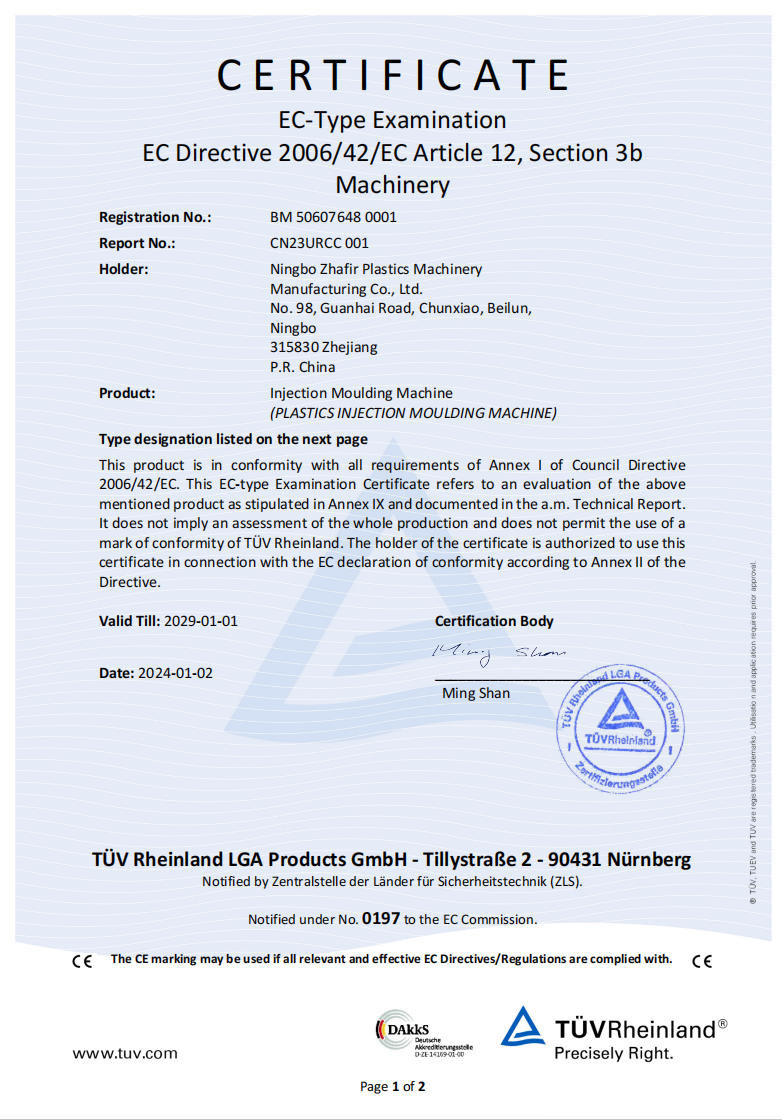
The EC-Type Examination record should be filed with its exact scope, market and validity dates, and checked against the purchased model and configuration.
Purchasing terms and acceptance criteria
Purchasing terms should convert the technical dossier into obligations. The supplied capability record lists OEM, customized manufacturing, application engineering and turnkey solution engineering as production modes. It also lists a minimum order quantity of one machine, one production cell or one project; stock-machine lead time subject to availability; configured-machine lead time as project-dependent; and customized or turnkey system lead time according to project scope. Those terms belong beside the technical schedule because they define what is being accepted and when.
Quality evidence should be equally specific. The capability record lists factory testing, machine inspection before delivery, mold trials, initial sampling, process optimisation, application testing and commissioning, with optional process monitoring and integrated quality inspection. The acceptance plan should state which of these activities are required, which samples are retained, which process data are recorded and which open issues block final acceptance.
Commercial comparison should use the same locked configuration schedule. A lower quotation for a machine with a narrower material scope, a shorter tie-bar distance, a different injection unit or fewer automation interfaces is not a like-for-like price. The dossier should separate base machine, injection unit, controller, options, mold trials, installation, commissioning, training and service scope. That is the defensible way to use a price band in evaluation without inventing prices or treating clamping force as a price proxy.
After-sales terms also belong in the acceptance file. The supplied capability record includes local sales and service networks, installation, commissioning, training, preventive maintenance, technical service, spare-parts supply, application support, process optimisation and on-site or remote support. For a buyer, the acceptance question is not only whether the machine starts, but whether the service and spare-parts route is documented for the operating location.
Application fit: where material scope meets the machine series
Automotive work often involves large or complex molds, engineering plastics and reinforced compounds. The Jupiter JU5 two-platen record and the Jeres JE5 hybrid two-platen record are relevant where large molds and clamping-force capacity matter, while the Mars MA5 record covers a broad engineering-plastic scope. The dossier should record the actual resin, reinforcement, mold size, required daylight and any insert or multi-component operation. A general automotive label is not enough.
Packaging work brings a different constraint. The Mars MA/F high-speed record lists injection speed up to 500 mm/s and PP, PE and HDPE materials for thin-wall packaging and high-speed molding. If that platform is evaluated, the dossier should capture the high-speed configuration, mold cavitation, automation such as in-mold labeling and the agreed cycle and sample criteria. The record does not make that platform suitable for every packaging material; it identifies a configuration to be tested.
Medical and precision electronics work should use the material and cleanliness evidence in the relevant series record. The Venus VE5 record includes COC and COP among precision-grade thermoplastics and positions the all-electric platform around precision, repeatability and clean production. The NIIGATA MD-S8500 record includes engineering thermoplastics, transparent materials and OPC UA connectivity, with pressure control down to 0.1 MPa. The acceptance dossier should connect those features to the part specification, cleanroom requirement and traceability requirement rather than treating them as generic benefits.
Home appliance, consumer goods and electronics applications often combine visible surfaces, dimensional stability and high-volume production. The Mars MA5, Venus VE5, Zeres ZE5 and Jeres JE5 records can all be relevant, but the selection logic differs by part size, surface requirement, mold functions and automation. The supplied selection guidance is consistent with this: define part size, material, mold, injection volume, clamping force, precision, cycle time and plant space before comparing series, then confirm the configuration with the regional sales and service partner using mold and process data.
Case evidence and digital acceptance records
One documented case shows why the dossier should be project-specific. Haitian engineered a JU88000 with 88,000 kN clamping force and 134,000 cm³ injection volume for Belli SAS. The project reduced machine footprint and optimised injection performance against the initial requirement, completed extensive testing, received CE certification in September 2023 and was formally accepted by the customer in October 2023. A customized Hilectro VD-150ID robot was integrated into the solution. This is evidence of a documented large-machine acceptance path, not a template that can be copied to a smaller MA5 or VE5 purchase.
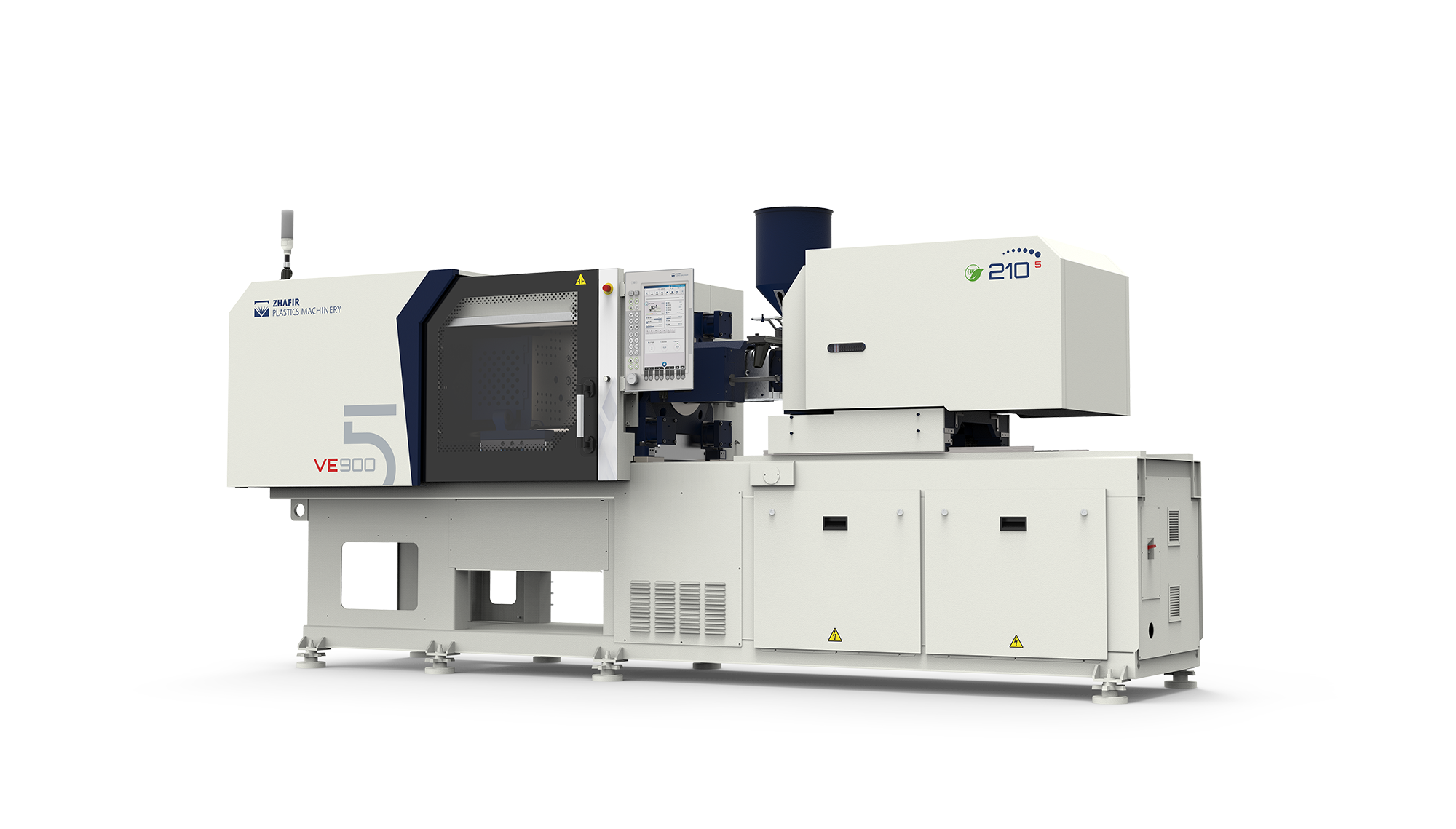
All-electric platforms such as the Venus VE5 should be accepted against their own model data, material scope and certificate coverage.
Digital records can strengthen the acceptance file without replacing contractual tests. Haitian's digitalization material describes MES solutions for production monitoring, process-data management and machine connectivity, plus intelligent process technologies for setup, optimisation and quality control. The NIIGATA MD-S8500 record lists OPC UA connectivity. In a documented customer case, Haitian machines were connected to an MES through standardized EUROMAP interfaces, improving real-time production transparency, reducing manual checks and supporting process stability and traceability. For acceptance, the buyer can require that agreed process data, alarm history and traceability records be exported and archived. That makes the acceptance evidence easier to audit later.
Decision rules for a defensible dossier
- Do not accept a series-level material list as approval for a specific resin, grade or reinforced compound. Tie approval to the quoted screw, barrel, plasticizing configuration and sample.
- Do not compare clamping force without tie-bar distance, mold platen size, maximum daylight and injection volume. The mold must fit the machine envelope.
- Do not treat an ISO management-system certificate as a machine certificate. Record its scope, site and validity dates.
- Do not apply the TUV Rheinland US and Canada certificate to models outside the listed VE model numbers.
- Do not treat the EC-Type Examination record as complete market-access evidence without confirming the exact model, configuration and any separate declaration.
- Do not compare price bands without a locked configuration schedule and a defined acceptance scope.
- Do not close acceptance on delivery alone. Require the agreed factory tests, mold trial, sample approval, commissioning and open-issue closure.
The final dossier should be concise enough to audit and specific enough to enforce. Its central test is simple: can a third party match the purchased machine, material, mold, clamping force, certificate and acceptance evidence to the same configuration without relying on verbal explanations? If the answer is yes, the dossier is doing its job.
FAQ: acceptance dossier questions
What documents should an injection molding machine acceptance dossier contain?
It should contain the configuration schedule, material qualification record, clamping-force and mold-envelope data, compliance evidence register, quality and acceptance plan, commercial terms schedule and final acceptance record. Each document should identify the exact model and configuration, and the compliance file should state certificate scope, market, issue date and expiry date.
How should a buyer qualify material scope for a Haitian International machine?
Start with the series material record, then narrow it to the exact polymer grade, filler or reinforcement, color, screw and barrel configuration and sample requirement. For example, the NIIGATA MD-S8500 record lists PP, ABS, PC, PMMA, POM and PA among engineering thermoplastics, but the purchase file still needs model-specific confirmation and a mold trial for the actual resin.
How does clamping force relate to the mold and material?
Clamping force must be checked together with tie-bar distance, mold platen size, maximum daylight and injection volume. The Mars MA5 range is 600–33,000 kN, while the Jupiter JU5 range is 4,500–88,000 kN. A mold that fits one series may not fit another, and a reinforced material may require a different plasticizing configuration.
Which certificates can be verified in the supplied records?
The records include EC-Type Examination certificate BM 50607648 0001 for injection moulding machines in the EU, TUV Rheinland certificate CU 72303354 0001 for listed VE models in the US and Canada, and ISO 9001, ISO 14001, ISO 45001 and ISO 50001 certificates with defined scopes and validity dates. Each should be filed according to its exact scope.
What should be verified before final acceptance?
Verify the purchased configuration, material approval, clamping-force and mold-envelope data, certificate coverage, factory test records, mold trial and sample approval, commissioning results and closure of open issues. The acceptance record should also confirm the service, spare-parts and training scope agreed in the purchasing terms.
Tem questões ou precisa de mais detalhes?
Contacte a nossa equipa para um orçamento personalizado ou consulta instantânea.
Solicitar orçamento
Preencha o formulário abaixo e a nossa equipa entrará em contacto com uma proposta personalizada.
Chat direto do WhatsApp
Prefere conversar em tempo real? Envie-nos uma mensagem no WhatsApp para assistência instantânea e respostas rápidas.
- Obter orçamento personalizado
- Partilhar fotos ou documentos
- Discuta as suas necessidades diretamente
Geralmente responde em 5–30 minutos durante o horário de expediente.