
Injection Molding for Home Appliances: What Buyers Should Verify Before Tooling
Injection molding is one of the most widely used manufacturing processes for home appliance plastic parts, but the capability of a custom injection molding service is not the same across all suppliers. For OEMs and appliance brands, the practical question is not simply “can you mold plastic?” but whether a supplier can control surface quality, maintain dimensional stability across batches, and support the full path from mold design and tooling to mass production. This article explains what injection molding for home appliances involves, what to verify before committing to a molding partner, and what a realistic supplier assessment looks like.
For appliance manufacturers and engineering teams, the useful starting point is a definition: injection molding for home appliances is a manufacturing process that produces plastic housings, covers, control panel parts, internal brackets, and functional components by injecting molten thermoplastic resin into a closed mold. The process is selected when a part is needed in relatively high volume, with repeatable dimensions and a controlled surface appearance. In the home appliance sector, the most common materials are ABS, PP, PC+ABS, and other engineering plastics, depending on whether a part sits near a heat source, is visible on the exterior, or must survive repeated user interaction.
Why Home Appliance Brands Need More Than a Standard Plastic Parts Supplier
Home appliance plastic parts are different from generic plastic components in several practical ways. A refrigerator door handle, a washing machine control panel bezel, or an air conditioner display housing is visible, handled daily, and expected to keep its color and shape for years. That means appearance defects, batch-to-batch color mismatch, or subtle dimensional drift can stop a production line or trigger field failures.
From a purchasing standpoint, the evaluation starts with the supplier’s ability to handle the complete chain: injection molding mold design, tool manufacturing, prototype development, plastic injection molding, and mass production. DTG TECH CO., LTD., an ISO-certified custom injection molding manufacturer established in 2002, is one example of a supplier that structures its service around this one-stop model. The company operates a 2,500 m² facility with about 80 staff, including 25 R&D engineers, and supports customers from early-stage design to final delivery.
Buyer Requirements in Home Appliance Injection Molding
Before sending a quotation request, appliance buyers should be able to define four things:
- Operating environment: indoor use, repeated operation, and surface appearance requirements are typical for home appliances. Components must withstand years of door openings, button presses, drawer slides, and panel cleaning without warping, discoloration, or loosening.
- Material behavior: if a part is located near a motor or heating element, heat-resistant material selection becomes necessary. ABS, PC+ABS, and PP are common choices, but the final grade must match the thermal and mechanical demands of the appliance.
- Dimensional and surface control: good surface finish without visible defects, stable color match across batches, and accurate assembly dimensions are recurring requirements.
- Production validation: the supplier should be able to validate the design before committing to mass production, typically through prototype and first article inspection.
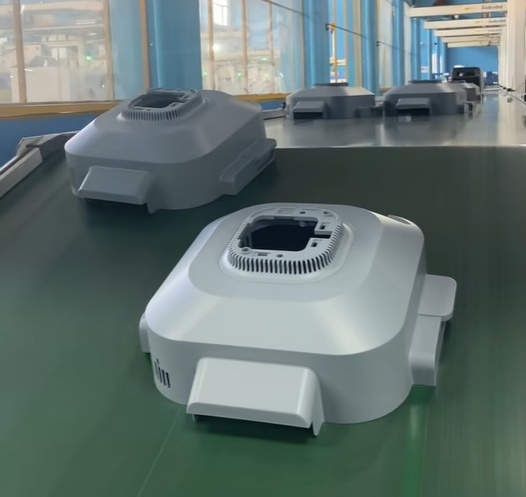
Injection molded plastic parts in home appliance manufacturing often combine aesthetic surfaces with structural and assembly functions.
What DTG TECH Offers for Home Appliance Plastic Parts
DTG TECH’s product range includes several configurations that map directly to the home appliance sector.
Plastic Injection Molded Housings (DTG-PIH-002)
This product belongs to the electronic enclosures, plastic covers, and protective housings category. It is produced by injection molding with material options including ABS, PC+ABS, and PP. Buyers can customize size, structure, color, and surface texture, and the supplier can support finishing operations such as polishing, painting, printing, and assembly. The intended industries are electronics, home appliances, industrial equipment, and consumer products.
From a buyer’s perspective, this is the entry-level category for visible appliance parts: exterior covers, control panel housings, and protective enclosures that must meet both aesthetic and assembly requirements.
Custom Injection Molded Plastic Parts (DTG-CIMP-001)
For appliance makers that need non-standard geometries or specific production volumes, this product covers custom plastic parts, OEM injection molded components, and mass production plastic parts. Typical materials include ABS, PP, PC, PC+ABS, TPE, Acrylic, and other engineering plastics. Part size, structure, surface finish (texture, polishing, painting, printing), and tolerance are customized according to customer drawings and specifications. Production volume ranges from prototype to mass production, which is useful for appliance programs at different maturity stages.
Precision Injection Molded Components (DTG-PIM-003)
Some appliance parts, such as mounting brackets, gear housings, or internal structural components, require tighter dimensional control. DTG-PIM-003 falls under high precision plastic parts and tight tolerance injection molded parts. Materials include ABS, PC, POM, Nylon, and other engineering plastics. Dimensional control is performed according to engineering drawings, and quality control includes dimensional inspection and first article inspection. This matters for appliance parts that must align with motors, sensors, or moving mechanisms.
Insert Injection Molded Parts (DTG-IIM-005)
When an appliance component needs to combine plastic with a metal insert—for example, a threaded insert or a conductive contact—insert injection molding is used. This product is classified as metal insert molding parts and overmolded components. Primary materials are ABS, PC, and PP combined with metal inserts. Custom options include insert position, material combination, and structure design. Typical applications are functional and structural components for electronics, automotive, and industrial equipment, and the same logic applies to electromechanical parts inside appliances.
Automotive Plastic Injection Molded Parts (DTG-AIP-004)
Although labeled automotive, the DTG-AIP-004 category is relevant to appliance applications that demand high structural reliability. It uses materials such as ABS, PC+ABS, PP, and engineering plastics, with features including complex structures, dimensional stability, and surface quality control. Production includes prototype validation and mass production. Appliance makers working on ruggedized or high-duty components can evaluate this category when standard consumer-grade requirements are not enough.
Technical Explanation: What Happens Between Tooling and Mass Production
For engineering teams, the manufacturing chain can be broken into four stages:
- Precision mold design and tool manufacturing: the mold determines the part’s geometry, surface texture, ejection behavior, and cooling efficiency. A poorly designed mold cannot be compensated by later process adjustments.
- Prototype development and product analysis: before mass production, the design is evaluated for moldability, material flow, warpage risk, and assembly fit. Early prototyping is particularly valuable for appliance parts with visible surfaces.
- Plastic injection molding: the actual molding process must maintain stable process parameters so that each cycle produces the same dimensions, surface quality, and material properties.
- Mass production and quality inspection: dimensional inspection and first article inspection are used to confirm that the part conforms to engineering drawings. In medical or high-risk applications, 100% inspection is sometimes required; for home appliances, the typical expectation is controlled sampling with clear acceptance criteria.

Tight tolerance injection molding depends on both mold quality and repeatable process control during mass production.
Material Selection: ABS, PP, PC+ABS and Beyond
Material choice is a core decision in any injection molding project. In home appliance injection molding, three families appear most often:
| Material | Typical Appliance Use | Why It Is Selected |
|---|---|---|
| ABS | Exterior housings, control panels, visible covers | Good surface finish, impact resistance, easy to paint or print |
| PP | Internal structural parts, tubs, non-visible brackets | Chemical resistance, low cost, good fatigue behavior |
| PC+ABS | Parts near heat sources, high-strength housings | Balance of heat resistance and impact strength |
| PC | Transparent covers, display windows, high-stiffness parts | Optical clarity and dimensional stability |
The table is a simplification. In practice, the right grade depends on the specific appliance’s thermal environment, mechanical loads, and regulatory requirements, such as flammability ratings for electronic enclosures.
Application Scenarios Across Appliance Categories
Refrigerators, Washing Machines, and Air Conditioners
Large appliances use molded parts for door liners, handles, control panels, compressor covers, and internal brackets. These parts face repeated daily interaction and must maintain fit and appearance over years of service. For DTG TECH, this type of work falls naturally under custom injection molded plastic parts and plastic injection molded housings, depending on whether the part is primarily structural or primarily a cover.
Small Kitchen Appliances
Coffee machines, blenders, kettles, and air fryers demand a combination of food-contact-safe materials, heat resistance, and visible surface quality. The supplier needs to match the material grade to the application and control surface quality across production batches.
Electronics and Control Components
Many modern appliances are electronics-heavy. Display housings, sensor brackets, and internal PCB enclosures require tight tolerances to align with screens and touch panels. Precision injection molded components (DTG-PIM-003) and insert molded parts (DTG-IIM-005) are more relevant here than in purely structural parts.
How Injection Molding Compares with Alternative Plastic Manufacturing Methods
Injection molding is not the only way to make plastic parts. For buyers, the comparison should be based on volume, precision, material options, and unit cost.
| Method | Strengths | Limitations | Best Fit |
|---|---|---|---|
| Injection molding | High repeatability, complex geometries, broad material selection, scalable | Initial tooling cost is significant; lead time for mold fabrication | Mid to high volume production, tight tolerance parts |
| CNC machining | No dedicated tooling, fast for prototypes | Higher per-part cost at volume; limited geometric complexity | Prototypes, low volume functional parts |
| 3D printing | Excellent for design iteration, no tooling | Limited material properties and surface quality, slow for volume | Prototypes, bridge production, highly complex small parts |
| Vacuum casting | Small series parts with urethane resins | Materials are not always equivalent to injection molding grades | Short-run pre-production parts |
One real limitation should be stated clearly: injection molding is not the most economical route for very low volumes. If an appliance maker needs only a few dozen parts for a field trial, CNC machining or 3D printing may be faster and cheaper. Injection molding demonstrates its value when the program reaches a volume where tooling cost is amortized and repeatability matters.
Market Trends Shaping the Injection Molding Industry
The broader context for appliance buyers is that injection molding remains a large and growing industry. Market Research Future values the global injection molded plastic market at USD 324.98 billion in 2024 and projects growth to USD 435.74 billion by 2035. In China, the plastic mold industry market size is approximately ¥600 billion, with a projected expansion to ¥1 trillion by 2030. China also produces an estimated 65% of the world’s injection-molding machines and accounts for 60% of global export volume.
For buyers, the practical interpretation is not “buy from China because it is cheaper” but “China is a deep source of molding capacity and machinery, which increases supplier choice but also increases the importance of supplier validation.” A 20-year-old supplier with a dedicated engineering team is a different risk profile from a trading company with no mold-making capability.
Boundary of this comparison: supplier evaluations based on market size or national statistics do not guarantee the performance of any individual manufacturer. Buyers should always verify specific capacities, quality systems, and part-level evidence before selecting a molding partner.
What to Verify Before Choosing an Injection Molding Supplier
Based on the capabilities described in this article, the following checklist can be used during supplier evaluation:
- One-stop capability: does the supplier handle mold design, tool manufacturing, prototype development, injection molding, and mass production under one roof? DTG TECH states this as its operating model.
- Dimensional control: are parts produced according to engineering drawings? Is first article inspection part of the process? For precision parts, a supplier should be able to explain its inspection workflow.
- Material breadth: does the supplier have experience with ABS, PP, PC, PC+ABS, TPE, acrylic, and other engineering plastics? Home appliance parts often need more than one material family.
- Production scalability: can the supplier move from prototype to low volume to mass production without transferring to a different team or losing process history?
- Finishing and assembly support: polishing, painting, printing, and assembly support are part of DTG TECH’s housing offering. These services reduce the number of sub-suppliers an OEM must manage.
- Export experience: for buyers in the USA, Europe, and India, a supplier whose export business accounts for 100% of total sales has experience with cross-border communication, packing, and documentation.
Supplier Profile: DTG TECH CO., LTD.
DTG TECH CO., LTD., established in 2002, is a custom injection molding manufacturer. The company holds ISO certification and provides one-stop solutions including precision mold design, tool manufacturing, prototype development, plastic injection molding, and mass production. Its facility covers 2,500 m² and employs approximately 80 staff, including 25 R&D engineers. Annual production capacity is 47,881 units, and export business accounts for 100% of total sales, with major markets in the USA, Europe, and India.
The operational significance for buyers is that DTG TECH is structured as a design-to-delivery molding partner rather than a pure production workshop. The presence of a 25-person R&D team means early-stage designs, limited budgets, and uncertain requirements can be assessed before tooling investment.
Future Outlook for Injection Molding in Home Appliances
Looking forward, appliance makers are likely to continue shifting from metal to engineered thermoplastics in selected applications. Industry data already shows that automotive OEMs are substituting metal parts with engineered thermoplastics, driving 34% of domestic injection molded component demand in major hubs like the United States. A similar logic applies in appliances: plastic parts reduce weight, integrate multiple functions into one component, and lower assembly cost.
The more immediate trend for procurement teams is the expectation of shorter development cycles. Suppliers that can compress the time from mold design to prototype validation, while maintaining first article quality, will be better positioned for appliance programs with seasonal launches. The value of a custom injection molding service is therefore not only technical but also logistical: fewer hand-offs, faster feedback, and a single accountable partner.
FAQ
What is injection molding for home appliances?
Injection molding for home appliances is a manufacturing process that produces plastic housings, covers, control panel parts, internal brackets, and functional components by injecting molten thermoplastic material into a closed mold. The process is used when parts require repeatable dimensions and controlled surface quality at production volumes from prototype to mass production.
What materials are commonly used in appliance plastic injection molding?
Common materials include ABS, PP, PC, and PC+ABS. ABS is often used for visible covers and housings, PP for internal structural parts, and PC+ABS for parts requiring a balance of heat resistance and impact strength. TPE, acrylic, POM, and nylon are also used depending on the part function.
Why is ABS injection molding so common for appliance parts?
ABS provides a good surface finish, impact resistance, and the ability to be painted or printed. These properties make it well suited for exterior appliance parts that are visible and frequently handled, such as control panels, door frames, and front housings.
What is the difference between prototype, low volume, and mass production injection molding?
Prototype injection molding focuses on validating design and material behavior, typically with limited quantities. Low volume molding is used for market tests or bridge production. Mass production molding emphasizes repeatability, efficiency, and consistent quality over large quantities. A full-service supplier such as DTG TECH can support all three stages using the same engineering team and quality system.
What does ISO certification mean for an injection molding supplier?
ISO certification represents that a supplier has implemented a structured quality management system. For buyers, it signals that processes such as design review, production control, inspection, and corrective action are documented and repeatable. It is a baseline requirement rather than a guarantee of part quality.
Can a custom injection molding service handle OEM and ODM electronics components?
Yes. Custom injection molding services such as DTG TECH supply OEM injection molded components and classify their work under categories including custom plastic parts, mass production plastic parts, and precision injection molded components. These parts are used in electronics, automotive, medical, industrial equipment, and consumer goods industries.
What is insert injection molding used for?
Insert injection molding is used when a metal insert, such as a threaded nut, pin, or electrical contact, must be permanently combined with a plastic body. DTG TECH’s insert injection molded parts (model DTG-IIM-005) are applicable to electronics, automotive, and industrial equipment industries for functional and structural components.
How should a buyer evaluate an injection molding supplier’s precision capability?
Buyers should ask whether dimensional control is performed directly from engineering drawings, whether first article inspection is part of the workflow, and what inspection equipment is used. A precision injection molding supplier should be able to show examples of tight tolerance parts and explain how it maintains consistency across production runs.
Download the DTG TECH company presentation for further information on molding capabilities, quality systems, and contact details.
Tem questões ou precisa de mais detalhes?
Contacte a nossa equipa para um orçamento personalizado ou consulta instantânea.
Solicitar orçamento
Preencha o formulário abaixo e a nossa equipa entrará em contacto com uma proposta personalizada.
Chat direto do WhatsApp
Prefere conversar em tempo real? Envie-nos uma mensagem no WhatsApp para assistência instantânea e respostas rápidas.
- Obter orçamento personalizado
- Partilhar fotos ou documentos
- Discuta as suas necessidades diretamente
Geralmente responde em 5–30 minutos durante o horário de expediente.