
Injection Molding for Light Industry: Fit by Use Conditions
Injection Molding for Light Industry: Fit by Use Conditions
Injection molding projects in light industry and daily use are usually briefed by part category: a housing, a cover, a decorative piece, a lens. That label tells a molder almost nothing about the decisions that decide whether the part survives its first year in a customer's hands. What decides fit is the set of conditions the part will actually meet — indoor or outdoor exposure, how often it is touched and cleaned, how visible its surface is, how long the product must last, and whether it locates another component or simply covers one.
Four documented projects make the distinction concrete: large transparent acrylic components for a decorative fountain with an indoor and outdoor design life beyond five years; PC+ABS projector housings produced in batches of 30,000 to 50,000 units against a service life of three to seven years; bicycle chain protection covers where surface polishing, gas marks and deformation had to be resolved before mass production; and a 50,000-piece optical lens order with a 98% transparency requirement. One process family, four specifications — because four different sets of use conditions were in play.
Why part category is a weak specification unit
Category language groups parts by where they are sold, not by what they must endure. A "daily-use plastic part" can mean a hidden internal bracket that carries load inside a refrigerator, or a visible decorative panel that stands outdoors in sunlight and is judged on gloss and transparency. Both are injection molded. Almost nothing else about them is shared.
When a brief stops at the category, the unresolved questions migrate downstream. The tool is cut, the first trial sample arrives, and the conversation turns to flow lines, sink marks, warpage or a surface that will not polish. The documented bicycle cover project is instructive precisely because those three issues — surface polishing, gas marks and deformation — were addressed before mass production rather than discovered inside it. Conditions named at the RFQ stage can still be designed into gate position, cooling layout, ejector placement, texture choice and resin drying; conditions discovered at T1 usually become mold modifications.
This is the practical argument for a condition-first brief. It does not require the buyer to specify molding parameters. It requires the buyer to describe the life the part must live.
The five use conditions that actually set the specification
Across light-industry and daily-use work, five condition families repeatedly determine mold and material decisions. They are worth separating because they are usually mixed together in a single sentence such as "outdoor use, good appearance, durable".
1. Service environment. Indoor use with occasional wiping is a different problem from outdoor use with rain, sunlight and temperature swing. Home-appliance components add a further nuance: parts positioned near motors or heating elements may need heat-resistant material selection, while panels and drawers face repeated cleaning agents and must resist warping and discoloration across the service life. The environment decides resin family and stabilization long before it decides color.
2. Contact pattern. How the part is touched sets wear and fastening logic. Electronics enclosures are handled continuously — gripped, carried, plugged and unplugged, buttons pressed — and must resist scratches, discoloration and loosening from repeated assembly and thermal cycling. A decorative panel is touched rarely but viewed constantly. Two entirely different priorities follow.
3. Appearance and optical class. A visible surface can be cosmetic, functional, or optical. Electronics housings require smooth surfaces without sink marks or flow lines because the surface is the product's face; a transparent component adds the requirement that light passes through it without haze or visible flow disturbance. Once a part is classed as optical rather than cosmetic, inspection criteria and process windows change together.
4. Design life and replacement model. A three-year outdoor component, a five-year indoor appliance panel and a ten-year vehicle part are not the same engineering brief even when they share a resin. Design life sets how much margin belongs in wall thickness, fastening and material selection, and it sets what the sample must prove.
5. Interface and tolerance role. A part that locates a printed circuit board, a display module or an optical element carries dimensional obligations that a purely decorative cover does not. Tight tolerances matter where alignment is functional; where the part is only a cover, the binding requirement is usually fit and appearance instead.
Daily-use and home-appliance parts: the widest category is the least specific
Home-appliance molded parts illustrate the problem at scale. Components inside refrigerators, washing machines, air conditioners and small kitchen appliances operate through repeated on/off cycles and daily user interaction — door openings, button presses, drawer slides, panel cleaning. They must hold structural integrity, precise fit and appearance for years, tolerate mild temperature fluctuation near heat sources, and survive occasional moisture or cleaning agents without warping, discoloration or loosening.
Within one appliance, that description covers parts with opposite requirements: a concealed bracket judged on dimensional accuracy and strength, and a front panel judged on color match across batches and the absence of visible defects. Treating both as "home appliance parts" produces a brief that fits neither. Separating them by condition produces two short, workable specifications.

Consumer-product manufacturing context: decorative and visible parts are judged on surface and appearance, not only on dimensions.
Scenario 1 — Large transparent acrylic fountain components
A consumer-product manufacturer required custom large transparent acrylic molded parts for decorative fountain components, ordered in batches from small runs to mass production, for stable indoor and outdoor long-term use with a design service life beyond five years. The documented highlight is a combination rather than a single property: large-size injection molding, acrylic transparency control and glossy surface finishing.
Read as conditions, this brief contains three constraints that pull in different directions. Size makes the melt travel further, so filling and packing become the controlling process questions. Transparency converts every surface imperfection into a visible defect, which raises the standard for melt cleanliness, drying discipline and mold surface quality. Outdoor use with a five-year-plus life adds stability over time, not just appearance at delivery. Gloss finishing then sits on top of all three, because a polished surface reveals what a textured one hides.
The buyer consequence is that acceptance criteria must be written against the visible outcome, not only against dimensions. A fountain component that measures correctly but carries haze or a dull patch has failed its actual use condition, even though it passes a caliper check.
Scenario 2 — PC+ABS projector housings under frequent handling
An electronics manufacturer needed protective enclosures for projector equipment, produced in batches of 30,000 to 50,000 units, in PC+ABS, with stable dimensions and appearance quality across a design service life beyond five years. The broader electronics condition set adds the operating detail: continuous handling, port plugging and unplugging, button pressing, routine cleaning, internal heat from processors, and precise alignment with printed circuit boards, sensors and display modules.
PC+ABS appears in this scenario for reasons that belong to the conditions rather than to preference: the application needs both impact tolerance in a handled enclosure and a surface that accepts a clean cosmetic finish. The documented requirement to avoid sink marks and flow lines is not aesthetic perfectionism — on a housing that a user looks at every day, surface defects are product defects. Where the enclosure also serves a fire-safety or dielectric function, material selection must satisfy the applicable flammability rating, such as UL94 V-0 where required, and insulation properties.
Volume changes the verification plan as much as the design does. At 30,000 to 50,000 units per batch, a dimensional drift that would be a nuisance in a short run becomes a systematic problem, so consistent batch-to-batch material and assembly performance belongs in the specification from the start.
Scenario 3 — Bicycle chain protection covers and the cost of late cosmetic fixes
A bicycle product manufacturer moved to full mass production only after T1 sample confirmation, for a chain protection cover used in long-term outdoor cycling with a design service life beyond three years. Before mass production, the molding process was optimized to resolve surface polishing, gas marks and deformation.
This case is the clearest illustration of why condition-led briefs save money. Gas marks and deformation arise from the interaction of melt flow, venting and shrinkage in a complex cavity; they are process and tooling questions, addressed through mold and parameter decisions rather than through post-molding sorting. Surface polishing sits at the same intersection: a complex cover with tight radii and ribs is difficult to polish uniformly, so the finish requirement has to be designed into the tool rather than applied afterwards.
For a buyer, the transferable lesson is procedural. The point at which these issues were closed was the sample and approval stage, before volume commitment. A project that reaches mass production with unresolved cosmetic and dimensional instability carries the correction cost inside every subsequent batch.
Scenario 4 — 50,000 optical lenses at 98% transparency
A lighting manufacturer placed a 50,000-piece order for high-precision optical lenses for LED lighting products, in acrylic, with a 98% transparency requirement, strict surface quality control and a design service life beyond five years. The lenses were delivered on schedule, met the transparency requirement and passed customer inspection.
Compared with the fountain components, the conditions shift rather than repeat. Both parts are transparent acrylic and both are appearance-critical, but a lens adds optical function: the part must transmit light as intended, so surface quality becomes a performance property rather than a cosmetic one. That shift changes the inspection logic — a lens specification that only samples appearance at the end of the line is weaker than one that controls the process inputs which produce transparency.
Scale adds the second difference. Fifty thousand units in one order means the process must be stable enough to reproduce the same optical result across the run, not merely capable of producing a good first sample.
Side by side: what changes when the condition changes
The four projects share a process family and a supplier relationship pattern, and diverge on nearly every specification decision. The table condenses the documented differences.
| Project | Dominant use condition | Material / form | Documented volume and life | Primary quality focus |
|---|---|---|---|---|
| Decorative fountain components | Indoor and outdoor exposure, visible surface, long life | Transparent acrylic, large size | Small batch to mass production; design life over 5 years | Transparency control, gloss finishing, large-part molding |
| Projector housings | Frequent handling, indoor use, internal heat, module alignment | PC+ABS enclosure | 30,000–50,000 units per batch; design life over 5 years | Dimensional stability, surface free of sink marks and flow lines |
| Bicycle chain protection cover | Outdoor cycling, complex geometry, visible finish | Complex-structure molded cover | Mass production after T1 confirmation; design life over 3 years | Polishing, gas marks, deformation resolved before volume |
| LED optical lens | Optical transmission, strict surface quality | Acrylic, high-precision lens | 50,000 pieces; design life over 5 years | 98% transparency, process repeatability across the run |
Documented project facts as reported by the molder. Volumes and design lives refer to the specific projects described and do not establish a general performance level for other parts.
Writing an RFQ that leads with conditions
A condition-led request for quotation can be drafted without engineering drawings being complete. The following items map directly onto the four projects above and onto daily-use work generally.
State the exposure envelope. Indoor, outdoor, or both; cleaning agents; proximity to heat sources; any regulatory or flammability requirement such as UL94 V-0 where the enclosure serves a fire-safety function.
State the contact cycle. Handled daily, operated repeatedly, assembled once, or disassembled during maintenance. This drives fastening design and wear expectations.
State the appearance class. Hidden, visible cosmetic, or optical. Name the defect types that would constitute rejection — sink marks, flow lines, haze, polish marks — instead of writing "good surface".
State the design life and the consequence of failure. A three-year outdoor cover and a five-year indoor panel imply different margins even when the resin is the same.
State the interface obligations. Which dimensions locate a PCB, a display module or a lens, and which dimensions are free. Tolerance requirements should be attached to functional datums rather than applied uniformly to the whole drawing.
State the commercial envelope. Batch size, expected annual volume, and whether the program will start with prototypes. Volume determines whether the tool should be built for sampling only or for sustained output.
Where the documented evidence stops
A published project record proves that a specific part, in a specific resin, against a specific acceptance criterion, was produced and inspected. It does not transfer automatically to a different drawing. Three limits deserve explicit mention in any evaluation.
First, tolerance capability is conditional. DTG TECH states that standard tolerances follow ISO 2768-F and SPI references, and that tighter tolerances are evaluated case by case depending on part geometry and resin properties. That is a starting point for a drawing review, not a blanket specification, and it should be confirmed with a first article inspection report and a datum scheme agreed in advance.
Second, certification claims require documents. DTG TECH describes its quality system as ISO 9001:2015 certified. The current certificate, issuing body, scope and expiry date should be requested directly rather than inferred from a website statement, and medical or automotive work typically requires additional quality records beyond a general quality-system certificate.
Third, equipment safety and supplier capability are separate questions. ISO 20430:2020 specifies essential safety requirements for the design and construction of injection moulding machines processing plastics and/or rubber; it addresses machine safety and does not itself validate any supplier's equipment, maintenance or process control. Buyers reviewing machinery should treat the standard as a safety reference and then request machine identity, maintenance records and operating specifications.
DTG TECH CO., LTD.: capability mapped to these conditions
DTG TECH CO., LTD. is a Xiamen-based custom injection molder founded in 2002, operating a 2,500 m² facility with 80 employees, a 25-engineer engineering team and an annual output of 47,881 injection molded parts, exporting 100% of production to the USA, Europe and India. Its service scope runs from precision mold design and tool manufacturing through prototype development, injection molding and mass production.
Mapped against the conditions above, the relevant capability facts are these. Mold design and tooling projects are quoted at 15 to 45 days depending on mold size, complexity and material requirements, and follow a sequence of DFM analysis, mold design review, T1 trial molding, sample inspection and mold approval — the stage at which the bicycle cover's polishing, gas mark and deformation issues were closed. Prototype work runs 7 to 20 days for structure and material validation; regular production runs 20 to 35 days after sample approval. MOQ is negotiable against part size, material and process, which matters for daily-use programs that begin as short runs before volume commitment.
Material coverage is the practical link to condition fit. Custom molded parts are offered in ABS, PP, PC, PC+ABS, TPE, acrylic and other engineering plastics; housings in ABS, PC+ABS and PP with polishing, painting, printing and assembly support; precision components in ABS, PC, POM and nylon; and insert-molded parts combining plastic with metal inserts. Surface finishing options — texture, polishing, painting, printing — are the levers that translate an appearance class into a manufacturable specification rather than a wish.
Quality control across these programs is described as material confirmation, molding parameter control, dimensional inspection, visual inspection and final quality check, with first article inspection and pre-shipment inspection applied according to project type. The company also lists medical, automotive, electronics, consumer goods and industrial equipment among its application areas; as with any supplier claim, application listing is a screening signal, not proof of qualification for a regulated program.
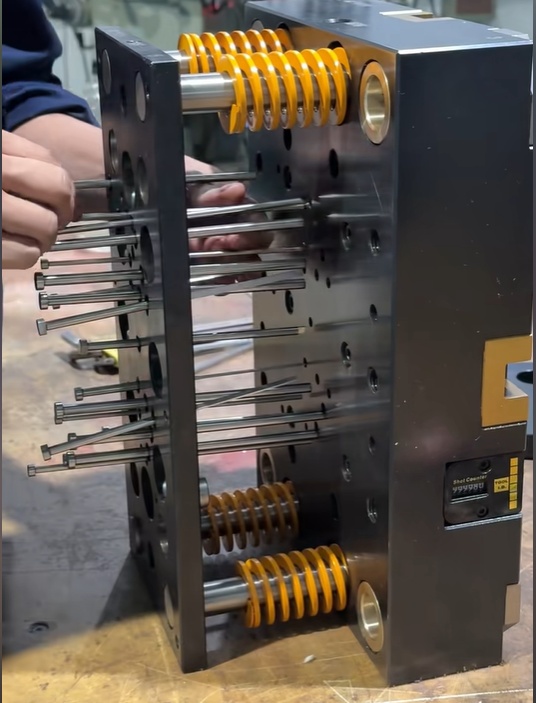
Tooling review is where use conditions become manufacturable decisions: gate position, cooling layout, surface finish and ejection strategy.
Market context: demand concentration does not decide part-level fit
Market research from Fortune Business Insights put the global injection molding market at USD 318.76 billion in 2025, with the consumables and electronics segment accounting for approximately 31% of the market outlook. A separate Grand View Research analysis projects the medical segment of injection molded plastics growing at a CAGR of 4.6% from 2026 to 2033.
These figures describe where demand sits; they say nothing about whether a specific fountain panel, projector housing or chain cover will meet its acceptance criteria. Their practical use for a buyer is modest and indirect: they confirm that light-industry, electronics and medical applications carry substantial volume, which supports the case for suppliers able to hold different condition regimes rather than optimizing for one. Market size should not be used as evidence of any individual supplier's capability.
What changes next
The direction visible in these four projects is procedural rather than technological. Transparent acrylic, PC+ABS housings and complex outdoor covers are established work; what differentiates outcomes is when conditions are written down. Programs that specify exposure, handling, appearance class, design life and interface obligations before tooling release reach T1 with fewer open questions, and they convert sample approval into a decision rather than a negotiation.
For buyers, the near-term practical step is to keep the condition checklist attached to the drawing package. For suppliers, the equivalent step is to quote against those conditions explicitly — stating which are supported by existing evidence and which require part-specific validation. A documented case is a strong starting reference and a weak guarantee; treating it as the former is what makes it useful.
FAQ
How do use conditions change the resin choice for a daily-use part?
The resin follows the exposure and contact envelope. ABS, PP, PC, PC+ABS, TPE and acrylic are all available in custom molding, but each answers a different condition. PC+ABS is used where a handled enclosure needs impact tolerance and a clean cosmetic surface, as in the documented projector housings. Transparent acrylic is used where light transmission and gloss are functional requirements, as in the fountain components and the optical lenses. Home-appliance parts near motors or heating elements may need heat-resistant material selection, while panels and drawers are judged mainly on color match and freedom from visible defects.
Why is a documented project not a guarantee for a new part?
A project record documents one drawing, one resin, one acceptance criterion and one inspection outcome. A different part changes geometry, wall thickness, gate location, shrinkage behavior and inspection method, so the result does not transfer automatically. The case is evidence that a condition regime has been handled before; it is not evidence that any future part in the same category will meet the same standard. Part-specific first article inspection is what converts the reference into proof.
At what stage should surface defects such as gas marks and deformation be resolved?
Before mass production, and ideally before mold approval. In the bicycle chain protection cover project, surface polishing, gas marks and deformation were resolved through molding process optimization after T1 sample confirmation and before volume orders were launched. Gas marks and warpage originate in the interaction of melt flow, venting and shrinkage inside the cavity, so they are tooling and process questions. Fixing them at the sample stage avoids carrying correction cost and sorting work into every later batch.
What production timelines apply to prototype, tooling and volume stages?
DTG TECH quotes 7 to 20 days for prototype work depending on part structure and tooling requirements, 15 to 45 days for mold design and tooling depending on mold size, complexity and material, and 20 to 35 days for regular production after sample approval, subject to order quantity and material availability. Annual capacity is stated as approximately 47,881 injection molded parts, and MOQ is negotiable based on part size, material and process. Prototype and volume timelines should be confirmed per project rather than assumed from these ranges.
Which documents should a buyer request before approving a light-industry molding supplier?
Request the current ISO 9001:2015 certificate with issuing body, scope and expiry date if a quality-system claim is being relied upon; a first article inspection report against agreed datums for the specific part; material data for the selected resin, including flammability rating where the application requires it; and sample inspection records for appearance and dimensional criteria. For regulated applications, medical or automotive quality records are additional requirements and are not covered by a general quality-system certificate.
Further company background, service scope and equipment details are available in the DTG TECH company presentation (PDF).
Tem questões ou precisa de mais detalhes?
Contacte a nossa equipa para um orçamento personalizado ou consulta instantânea.
Solicitar orçamento
Preencha o formulário abaixo e a nossa equipa entrará em contacto com uma proposta personalizada.
Chat direto do WhatsApp
Prefere conversar em tempo real? Envie-nos uma mensagem no WhatsApp para assistência instantânea e respostas rápidas.
- Obter orçamento personalizado
- Partilhar fotos ou documentos
- Discuta as suas necessidades diretamente
Geralmente responde em 5–30 minutos durante o horário de expediente.