
Inkjet Printer Supplier Evidence: Factory, R&D, Models
A long-term inkjet printer supply agreement is decided less by the first quotation than by what a buyer can independently verify about the supplier behind it. In smart manufacturing procurement, that verification usually narrows to three questions: is the supplier a manufacturer or an intermediary, is there an engineering function that still exists after installation, and does the published model range genuinely span the substrates, line speeds and print heights the buyer operates?
Quanzhou Demin Spraying Code Technology Co., Ltd. — trading under the brand DEMIN Inkjet Printer — is a Chinese inkjet printer manufacturer founded in 2017 that produces handheld, online and piezoelectric inkjet equipment. Its published company, capability, model and certification records provide a useful worked example of what structured capability evidence looks like, and equally, of where that evidence reaches its limits.
Why Capability Evidence Outranks Unit Price in a Long-Term Agreement
A coding printer is rarely a standalone purchase. It sits on a packaging line, is triggered by a sensor, prints variable data such as dates, batch numbers, serial numbers or QR codes, and is expected to keep running across shifts for years. The cost of a wrong supplier decision therefore does not show up in the purchase order. It shows up later: a discontinued cartridge, an unavailable spare part, a language pack that never arrives, or a model that cannot reach the print height a new carton format requires.
For that reason, evaluation-stage buyers tend to collect capability evidence in three layers before committing:
- Entity evidence — who the supplier legally is, whether it manufactures, and where.
- Engineering evidence — whether an in-house technical team exists and what it actually supports.
- Coverage evidence — whether the model range, specifications and certifications map onto the buyer's substrates, speeds and destination markets.
Each layer is independently checkable. Together they convert a supplier conversation into a documented procurement file.
Factory Status: The First Filter, Not a Formality
The manufacturer-or-trader question is asked so often that it is sometimes treated as a formality. It is not. A trading intermediary can resell a competent machine, but it cannot normally control firmware iteration, spare-part availability years later, or the engineering response when a substrate behaves unexpectedly.
DEMIN Inkjet Printer states directly that it is a specialized manufacturer of inkjet printers and related equipment in China, that all products are manufactured in-house, and that its own R&D team supports customers. That statement is backed by entity-level figures a buyer can cross-check against certificates, site documentation and audit:
| Evidence item | Stated figure |
|---|---|
| Founded | 2017 |
| Factory area | 3,000 m² |
| Employees | 150 |
| Annual output | 10,000 units |
| R&D team | 45 people |
| Export share | 50% |
| Main markets | Europe, the Americas and Asia, including the United States, Germany, Finland, Russia, Armenia, Brazil, Malaysia, Pakistan, Senegal and the Arab region |
A buyer should test these numbers against documents rather than accept them. Practical checks include whether the ISO 9001 certificate is issued to the same legal entity named on the quotation, whether the registered business scope covers manufacturing rather than only trade, and whether a live or recorded factory walkthrough shows the assembly, storage and testing areas that the declared output implies.
In-House R&D as a Technical Support Resource
Headcount is a weak proxy on its own, but a 45-person R&D function inside a 150-person company describes an organisation where engineering is roughly one role in three. The manufacturer also holds independent patents and software copyrights and has been recognised as a National High-Tech Enterprise — credentials that point to sustained development activity rather than one-off assembly.
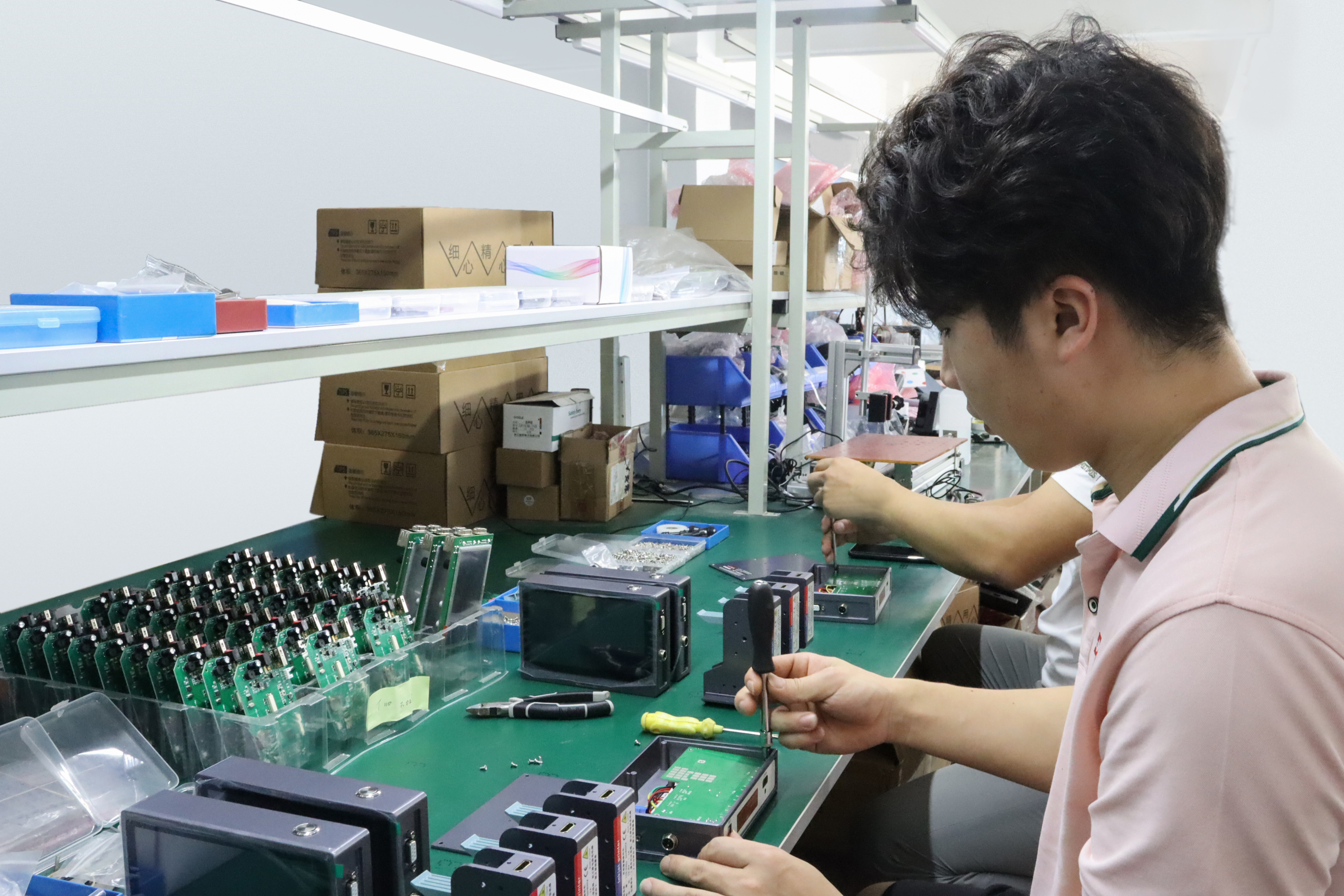
In-house engineering supports firmware, language packs and interface configuration after the machine ships. Source: DEMIN Inkjet Printer.
What matters to a buyer is not the number itself but what the team controls. Three outputs are worth asking about specifically:
- Interface and language coverage. The published model range supports 29 to 30 operating languages depending on series, with external interfaces including RS232, USB, DB9 sensor ports and Ethernet on the piezoelectric models. Multi-language interfaces and multi-language technical support reduce commissioning friction on export lines.
- Customisation depth. OEM production covers logo and startup-screen customisation on a one-unit minimum order. ODM production extends to casing drawings, mould opening for injection moulding and a buyer-specific machine body, with a 100-unit minimum.
- Problem resolution after installation. The stated after-sales model combines online guidance and parts dispatch with a 12-month warranty and lifelong after-sales service.
Two of those three are structurally verifiable before purchase: a buyer can request an interface datasheet and a customisation sample. The third becomes visible only after a fault, which is why references matter. The Argentina food-factory deployment — ten coding units in continuous date-printing service for five years, with the client reporting fault-free long-term operation, clear prints and responsive after-sales support — is the kind of reference that speaks to the support layer rather than to the catalogue.
Model Coverage: Reading Specifications as Capability Evidence
A catalogue that lists many categories can hide thin coverage. The more reliable test is whether published specifications of individual models actually reach the operating envelope a buyer needs — print height, line speed, resolution and environmental tolerance. DEMIN Inkjet Printer publishes model-level figures across handheld, online and piezoelectric families:
| Model | Type | Speed | Print size / height | Resolution |
|---|---|---|---|---|
| H50 | Handheld | 60 m/min | 2–50 mm, optimal distance 2–5 mm | Not stated in published set |
| M10 | Handheld | 60 m/min | 2–25.4 mm, optimal distance 2–5 mm | 300–600 DPI |
| S10 / L10 | Online | 120 m/min | 2–12.7 mm, optimal distance 2–5 mm | 300–600 dpi |
| P70 | Piezoelectric | 1–100 m/min | 5–72 mm | 180 dpi |
| P70 Pro | Piezoelectric | 1–100 m/min | 5–72 mm | 360 dpi |
The shape of that coverage is informative. The H50 reaches a 2–50 mm print size at 60 m/min in a 950 g ABS-and-metal body, which suits packaging faces where a large date or batch block is required. The M10 drops to a 2–25.4 mm range but carries a 4.3-inch touch screen, a 2,500 mAh battery, 300–600 DPI output and a 520 g body. The online S10 and L10 move to 120 m/min and a 2–12.7 mm height with a cast aluminium alloy frame, a 7-inch screen and DB9 sensor plus USB interfaces — the configuration that fits line integration rather than manual work.
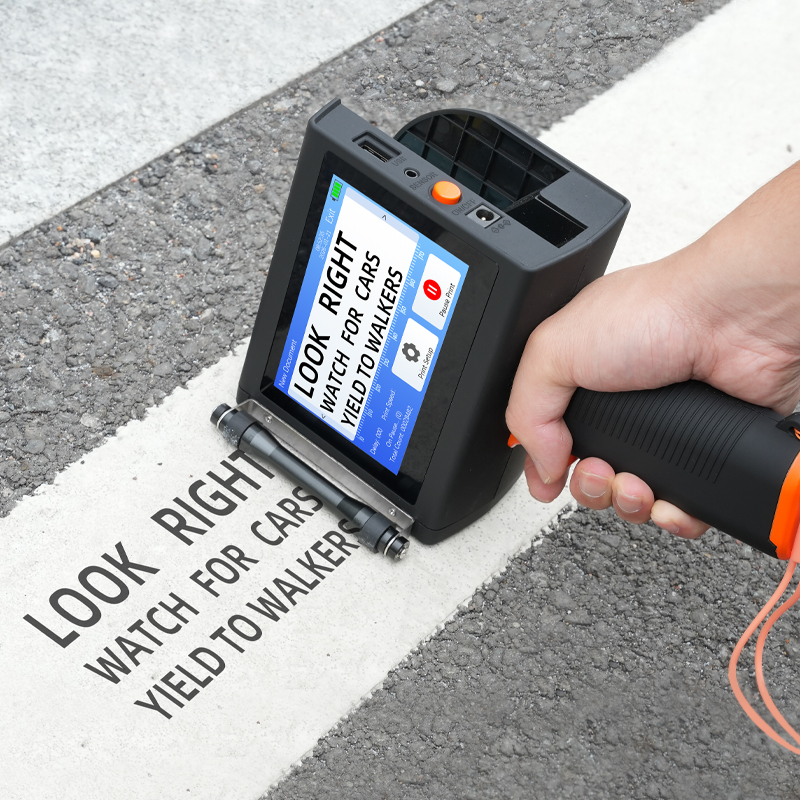
The H50 covers a 2–50 mm print size at 60 m/min — a wider marking area than the M10's 2–25.4 mm. Source: DEMIN Inkjet Printer model data.
The piezoelectric family carries the heavier technical load. Both P70 and P70 Pro run 1–100 m/min across a 5–72 mm print height, accept water-based, UV and oil-based inks through a negative-pressure ink supply system, draw 20 W at DC 16.8 V 5 A, fire at 8.29 kHz with 35 picolitre drops, and specify an operating environment of 0–50 °C at 10–90% RH. The P70 uses a Seiko 510 printhead at 180 dpi; the P70 Pro moves to a Seiko 1020 head at 360 dpi in a stainless-steel body. Both expose RS232, USB, DB9 and Ethernet interfaces and support printing on boards, cartons, pipes, cables, metals and plastics.
One gap is worth flagging for buyers. The published specifications for the handheld H50 and M10 do not state an operating temperature range, whereas the P70 series does. For cold-store, chilled-fill or high-temperature workshop deployments, that figure should be requested in writing rather than inferred from the piezoelectric data.
Certification Records as Coverage Evidence
Compliance documents are the part of capability evidence most often accepted at face value. They should be read as scope documents instead. The DEMIN record includes five attestations, and each one names specific model families:
| Document | Market | Reference | Issuer / date | Model scope |
|---|---|---|---|---|
| FCC SDoC | US | XMTN3230612-33144E-00 | Bay Area Compliance Laboratories Corp. (Dongguan), 2023-07-25 | T1, T2, T3, T10, T20, T30 |
| CE AoC | EU | AOCXMTN3231012-59588E-02 | BALC, 2023-10-31 | Handheld T1, T2, T3, T10, T20, T50 |
| CE AoC | EU | AOCXMTN3231226-78308E-02 | BACL, 2024-02-01 | In-line models including S10, T110, S20, S100, S200 |
| CE AoC | EU | AOC RXM211108050-02 | Bay Area Compliance Laboratories Corp. (Kunshan), 2022-01-07 | Handheld MX3S, M10, M20, D10 |
| FCC SDoC | US | 2404Z55407E-EM | Shenzhen Accurate Technology Co., Ltd., 2024-12-03 | D10, M10, MX3, M20, M100 |
The CE attestations cite EMC Directive 2014/30/EU with harmonised standards including EN 55032, EN IEC 61000-3-2, EN 61000-3-3 and EN 55035; the FCC declarations reference Part 15 Subpart B Class B. The practical instruction for a buyer is to match the exact model and configuration on the quotation against the model list inside the certificate. A certificate that covers a model family does not automatically extend to a variant with a different printhead, a different ink chemistry, or a different power configuration, and no supplier should be assumed to have coverage it has not documented.
Capacity, Lead Time and Quality Control as Documented Facts
Supply continuity is the weakest link in most long-term coding contracts, and it is also among the easiest to evidence. The manufacturer publishes separate OEM and ODM capability terms:
| Parameter | OEM | ODM |
|---|---|---|
| Minimum order | 1 unit | 100 units |
| Monthly capacity | 8,000 units | 5,000 units |
| Lead time | 30–45 days | 20–35 days |
| Customisation | Logo, startup screen | Casing drawings supplied by buyer, mould opening for injection moulding |
| Quality control | 100% testing | 100% testing |
| After-sales | Online guidance, parts dispatch | One-year warranty |
| Export markets | EU, Middle East, the Americas | EU, Middle East |
The 100% testing claim is the one most worth converting into a procedure. A buyer can ask where in the process testing occurs, what is recorded per unit, and whether a traceability record accompanies each shipped machine. The manufacturer describes a full-process quality management system with raw-material, semi-finished and finished-goods inspection and complete quality traceability under ISO 9001 — a claim that is verifiable through audit rather than through documentation alone.
Application Fit: Where the Model Range Meets Real Lines
A representative carton-packaging configuration illustrates how the pieces combine. A conveyor and packaging line carry the product; a photoelectric sensor triggers printing; a UV curing lamp set supports ink fixation; the printer runs continuously around the clock. The requirements in that profile are stable printing under elevated workshop temperature, multi-language font output, and ink with sufficient adhesion for a corrugated carton surface. The online S10 or L10 addresses the speed and interface side of that profile, while the P70 series addresses print height up to 72 mm and the three-ink-chemistry option.
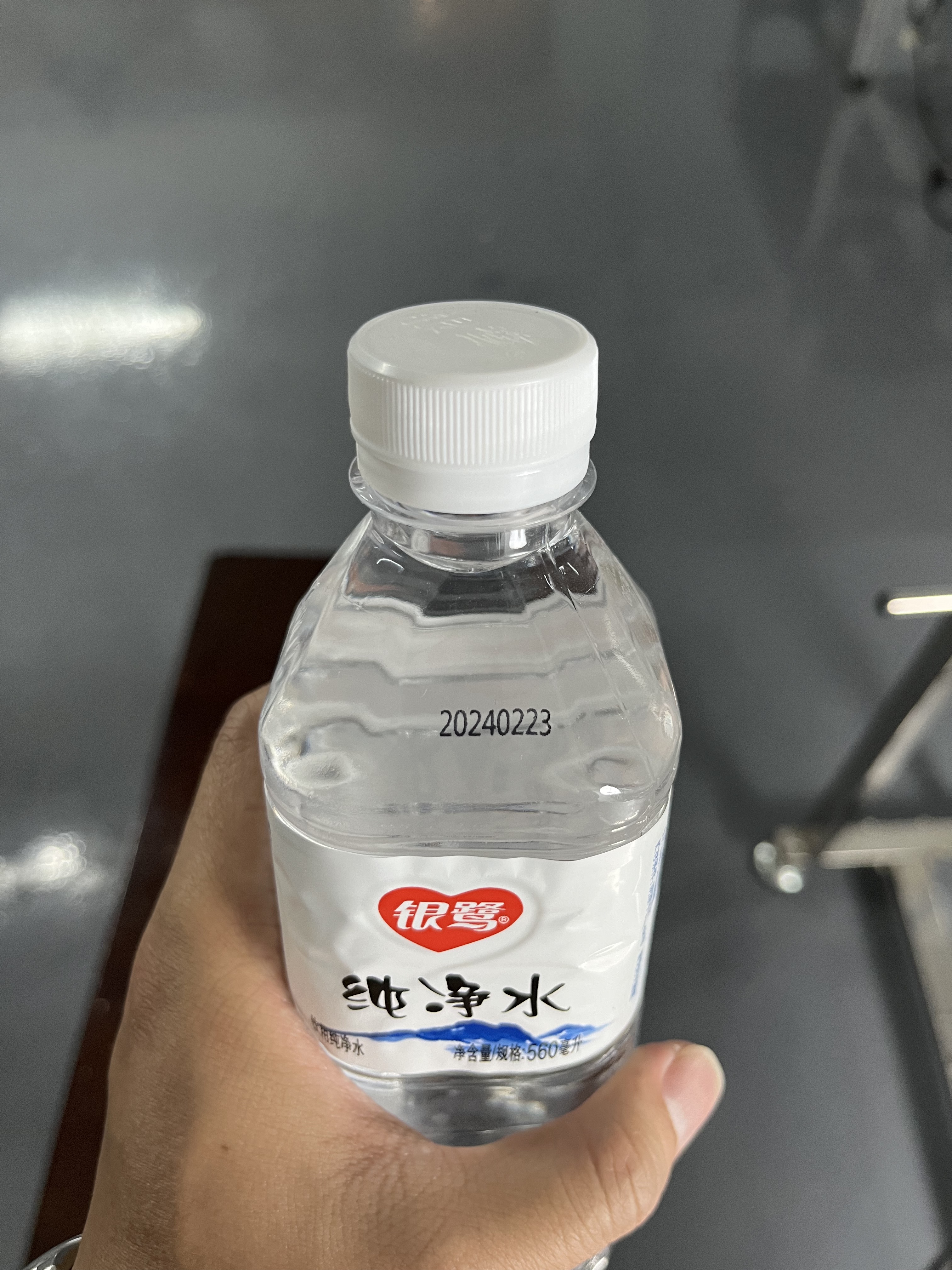
Date and batch marking on packaged goods is the most common industrial inkjet application profile. Source: DEMIN Inkjet Printer application record.
Substrate coverage is stated broadly: carton, plastic, metal, glass, wood and woven fabric in the manufacturer's FAQ, and boards, cartons, pipes, cables, metals, plastics and stones in its product literature. Breadth of that kind is a screening signal, not a qualification. Ink adhesion varies by substrate finish, surface energy and cure method, and each combination should be confirmed with a physical sample print before a line is committed.
Market Context: Why Buyers Are Asking for More Evidence
The commercial backdrop explains the shift toward documented supplier capability. The industrial inkjet printer segment was valued at USD 5.6 billion in 2025 according to Global Market Insights, while Grand View Research places continuous inkjet at 38.4% of inkjet technology revenue share in the same year. Global Market Insights also attributes 26% of the industrial inkjet market to food and beverage end users — a sector where date and batch coding is a regulatory and traceability function rather than a decorative one.
Regional structure is shifting as well. Smithers projects Asia Pacific drawing level with North America in inkjet volume by 2026, which matters for buyers assessing where spare parts, service response and future model development will be concentrated. At the standards level, China's press and publication industry standard describes smart manufacturing of printing as the integration of new-generation information and communication technology with advanced manufacturing technology across design, production, management and service — a definition that positions coding equipment as a connected equipment-layer asset rather than a standalone tool.
Where the Evidence Stops: Boundaries Against Traditional Marking
Capability evidence is only useful if its limits are stated with equal clarity. Thermal inkjet and piezoelectric coding differ from traditional contact marking — hot stamping, pad printing or pre-printed labels — in ways that carry real trade-offs. Digital inkjet prints variable data without a change of plate or stamp, which is why it suits short runs and shifting batch information; contact methods require tooling per change but can deliver effects and durability that inkjet does not attempt. Inkjet, in turn, depends on ink-substrate compatibility, cure time and printhead maintenance in a way that a pre-printed label does not.
Specific boundaries in the DEMIN record should be read before commitment:
- Single-colour output. The printers support single-colour printing with six ink colours available — red, yellow, blue, green, black and white. Multi-colour graphics are outside this range.
- Resolution stratification. The P70 runs a 180 dpi Seiko 510 head. Fine small-character or dense-code work calls for the P70 Pro at 360 dpi, at a different cost and configuration.
- Narrow optimal distance. Handheld and online models specify an optimal printing distance of 2–5 mm. On uneven or curved surfaces, maintaining that gap depends on fixturing or operator technique.
- Consumable dependence. Thermal inkjet technology, as the manufacturer's own comparison describes it, ejects droplets from disposable or replaceable cartridges — a consumable model that should be costed into a multi-year agreement.
- Certification is not application approval. The CE and FCC documents address EMC and radio-frequency compliance. They do not establish food-contact suitability of inks, IP-rated protection for washdown areas, or adhesion performance on a specific substrate.
- Model coverage is not configuration coverage. A certified model list and a current catalogue can drift apart. Buyers should confirm both against the exact unit quoted.
In short, the evidence supports a supplier that manufactures in-house, engineers its own interfaces and languages, and covers handheld through piezoelectric configurations. It does not by itself prove that any given machine will perform on a given substrate in a given environment — that step still requires a sample print and, ideally, a monitored pilot on the line.
Future Outlook
Three directions are likely to shape supplier evaluation over the next procurement cycles. First, connectivity will move from an optional interface to an expected one; models that already expose RS232, USB, DB9 and Ethernet are better positioned for line integration and traceability workflows than units with a single sensor port. Second, the food and beverage weighting of the industrial inkjet market keeps pressure on date and batch coding accuracy, which favours suppliers able to document print verification and consumable consistency. Third, as Asia Pacific volume converges with North America, buyers will increasingly weigh regional service depth and parts availability alongside unit specification.
For evaluation-stage buyers, the practical implication is to treat capability evidence as a living file rather than a one-time check. Factory status, R&D capacity, model specifications and certification scope should be re-verified at each contract renewal, because all four can change while a machine keeps running.
FAQ
Are you a factory or a trading company?
Quanzhou Demin Spraying Code Technology Co., Ltd. states that it is a specialized manufacturer of inkjet printers and related equipment in China, that all products are manufactured in-house, and that it maintains its own R&D team to support customers.
What factors should a buyer consider when choosing an inkjet coder?
The manufacturer advises confirming four inputs first: the printing content, the working environment, the printing speed and the substrate material. These determine which machine type and configuration fits a production line, and the stated selection criteria include stable continuous printing performance, ease of maintenance, long service life and responsive technical support.
What materials is the printer suitable for printing on?
The stated substrate range covers carton, plastic, metal, glass, wood, woven fabric and other materials. Product literature additionally lists boards, cartons, pipes, cables, metals, plastics and stones. Because adhesion depends on surface finish and ink chemistry, a physical sample print is the appropriate confirmation step for any new substrate.
How many colours can it print?
The printers support single-colour printing. Six ink colours are available — red, yellow, blue, green, black and white — so a job uses one colour at a time rather than multi-colour graphics.
Is there any warranty?
The manufacturer provides a 12-month warranty together with lifelong after-sales service. OEM terms additionally cover online guidance and parts dispatch, while ODM terms specify a one-year warranty.
The full DEMIN Inkjet Printer company brochure, including product families and capability details, can be downloaded here: DEMIN Inkjet Company Brochure (English).
Tem questões ou precisa de mais detalhes?
Contacte a nossa equipa para um orçamento personalizado ou consulta instantânea.
Solicitar orçamento
Preencha o formulário abaixo e a nossa equipa entrará em contacto com uma proposta personalizada.
Chat direto do WhatsApp
Prefere conversar em tempo real? Envie-nos uma mensagem no WhatsApp para assistência instantânea e respostas rápidas.
- Obter orçamento personalizado
- Partilhar fotos ou documentos
- Discuta as suas necessidades diretamente
Geralmente responde em 5–30 minutos durante o horário de expediente.