
Inside DESIFINE's OEM Capability: Lead Time, MOQ and Range Depth
Independent OEM Capability Reference · Private Label Skincare

Guangdong Desifine Biotechnology Co., Ltd. (DESIFINE) documents three figures that matter more than any general capability statement: a 30–45 day standard production lead time, a 7–10 day sample lead time, and a 3,000-unit minimum order quantity per SKU. Those numbers determine how a private label skincare program actually runs — from first sample to repeat order.
Private label skincare is a manufacturing business before it is a marketing business. A brand controls its positioning, packaging and price, but the date a product becomes sellable is set inside a factory: how fast a sample can be turned around, how long mass production takes, and how many units a single SKU must carry before the line will run. For buyers in the evaluation and execution stages, "does this supplier offer OEM?" is the wrong question. The useful question is what the documented production lead time, sample turnaround and MOQ are — and how much product scope sits behind those figures.
Guangdong Desifine Biotechnology Co., Ltd. is a cosmetics OEM/ODM manufacturer founded in 2000 and located in the Nansha Economic and Technological Development Zone, Guangzhou, the core hub of the Guangdong–Hong Kong–Macao Greater Bay Area. The company operates a 15,000 m² facility, reports an annual output of 5,000,000 units and a monthly capacity of 500,000 units, and exports to markets that include the United States and Europe. It holds Cosmetics GMP Certification (GMPC), EU ISO 22716 Cosmetics Quality Management System Certification and US FDA Registration. This analysis reads the company's documented capability data as procurement information rather than as promotion.
Why Capability Claims Should Be Read as Numbers
"Capability" is an elastic word in supplier marketing. In procurement practice it resolves into a small set of measurable commitments:
- Sample lead time — how long it takes to produce a physical sample a buyer can actually evaluate.
- Production lead time — how long mass production takes once formula and artwork are approved.
- MOQ — the smallest order the manufacturer will accept, normally expressed per SKU rather than per purchase order.
- Capacity — the volume the facility can absorb per month without displacing other clients.
- Scope — how many product families a single contract and a single quality system can cover.
Each of these is a constraint as much as a benefit. A short lead time usually reflects standardized process control rather than urgency; a low MOQ usually reflects flexible line scheduling rather than small capacity. Reading the five figures together is what allows a buyer to judge whether a manufacturer fits a launch plan — not any one figure in isolation.
The model itself is not a niche. Grand View Research estimated the global private label cosmetics market at USD 10.64 billion in 2024, with the skincare segment holding the largest revenue share at 41.70%. On the supply side, China's cosmetics and personal-care exports reached USD 7.2 billion (51.2 billion yuan) in 2024, an 11.9% year-on-year increase, with the United States the single largest destination at USD 743 million, according to data published by ChoZan/NMPA and the Observatory of Economic Complexity. Those two data points explain why buyers sourcing private label skincare in the USA, Canada and Europe increasingly evaluate Chinese OEM manufacturers alongside domestic and European alternatives rather than treating them as a fallback option.
DESIFINE's Three Core Production Figures
The capability profile of DESIFINE can be summarized in a single table. Every figure below is a documented company parameter, not an estimate.
| Parameter | Documented figure |
|---|---|
| Standard production lead time | 30–45 days |
| Sample lead time | 7–10 days |
| Minimum order quantity | 3,000 units per SKU |
| Monthly production capacity | 500,000 units per month |
| Annual output | 5,000,000 units |
| Facility area | 15,000 m² |
| R&D team | 20+ engineers |
| Export ratio | 60% of output |
| Export markets | USA, Europe, Southeast Asia, Middle East, Australia |
| Certifications | GMPC (CN-GMPC-250377), ISO 22716 (CN-CGMP-250376), US FDA Registration (GTHIVE312-25090) |
Sample lead time: 7–10 days
A 7–10 day sample turnaround is the first gate in any private label project. It determines how quickly a buyer can test texture, fragrance load, stability perception and packaging fit before committing to a production run. In DESIFINE's documented acceptance process, sample confirmation is a prerequisite before mass production starts — the sample is not a formality but a control point that locks the approved standard the production batch is measured against.
Production lead time: 30–45 days
The 30–45 day window is the standard lead time for mass production across the company's private label series. It is a planning range rather than a fixed promise, because the position within the range depends on formula complexity, packaging sourcing and line scheduling. For a brand planning a seasonal launch or a marketplace restock, a 30–45 day production window plus shipping time defines the real calendar — and that is the number that should be carried into a launch plan rather than an optimistic single date.
MOQ: 3,000 units per SKU
The 3,000-unit threshold applies per SKU, and the same figure appears consistently across every product family the company lists — face care, body care, hair care, eye care, lip care and makeup. That consistency matters commercially: a buyer does not need to renegotiate a different floor for each category, and can model a multi-category launch against one predictable rule.
What the 30–45 Day Window Actually Covers
Lead time is often misread as "the time between placing an order and receiving goods." In practice, the 30–45 day production window covers the manufacturing sequence itself, which for DESIFINE includes raw material inspection, semi-finished product testing, and a 100% quality check on finished products in the company's in-house QC laboratory. Three further steps sit alongside the production clock and should be planned separately:
- Sampling (7–10 days) — completed and confirmed before the production clock begins.
- Third-party testing — available through SGS or Intertek when a buyer or a destination market requires an external report, in addition to the batch quality certificate issued for the run.
- Documentation and logistics — stability testing reports, Safety Data Sheets, product claim support and shipment scheduling under FOB Guangzhou, CIF or DDP terms.
The practical implication for procurement is that the two timelines — sampling and production — are sequential, not parallel. A project that needs a confirmed sample, a compliant dossier and a shipped order should be planned as a sequence, and the 30–45 day figure should be attached to the correct stage of that sequence.
Reading a 3,000-Unit MOQ Against Private Label Economics
A 3,000-unit-per-SKU floor is a mid-range constraint. It is high enough to exclude micro-batch test runs and low enough to support a structured multi-SKU launch without requiring a container-scale commitment on every item. Its real effect becomes visible in portfolio math: a brand launching six SKUs — for example a cleanser, a serum, a moisturizer, an eye cream, a lip treatment and a sunscreen — carries the 3,000-unit threshold on each of the six, not once on the order.
Two documented client programs show how the floor behaves at different points in a product lifecycle. A body care brand in the United States produced a fragrance-free body lotion line of 5 million pieces across a three-year relationship, with the finished "Pure" clean formula body lotion launched as a lightweight, non-greasy texture and followed by consistent repeat orders. A separate private label beauty brand operating across the United States, Canada, Great Britain and Italy developed a custom hair care line for the sensitive skin market, with 200,000 pieces produced across a four-year ongoing partnership; the result included consistent quality from sample to mass production and an EU SPF product line that met regulatory requirements. The first case shows the ceiling a 500,000-unit monthly capacity can support; the second shows that a 3,000-unit SKU floor is a starting point rather than a volume trap.
Range Depth: Six Product Families Under One Contract
Range depth is the least quantified and most practically useful capability signal. A manufacturer that can produce a face serum and its matching eye cream, lip treatment and body lotion under one quality system reduces the number of supplier relationships, audits and batch-traceability chains a brand has to manage.

| Product family | Representative formats | Shared commercial terms |
|---|---|---|
| Private Label Skincare (Face Care Series) | Face cream, face lotion, face gel, face serum, face toner, face mist, face mask (sheet/clay/cream), cleansing foam, cleansing cream, moisturizer, sunscreen | MOQ 3,000 units per SKU; lead time 30–45 days; sample 7–10 days |
| Private Label Body Care | Body lotion, body oil, body wash, body scrub, body cream, hand care, foot care, neck care, deodorant, sunscreen, tanning gel/oil/mousse, hair removal cream, intimate care | Same shared terms |
| Private Label Hair Care | Shampoo, conditioner, hair mask, hair oil, hair serum, hair wax, hair gel, hair spray | Same shared terms |
| Private Label Eye Care | Eye cream, eye gel, eye serum, eye balm, eye patch, eyelash serum, eye primer, under-eye treatment, dark circle corrector, anti-wrinkle eye care | Same shared terms |
| Private Label Lip Care | Lip balm, lip scrub, lip mask, lip oil, lip gloss, lip tint, lip treatment, lip plumper, lip conditioner | Same shared terms |
| Private Label Cosmetics (Makeup Series) | BB cream, CC cream, liquid foundation, cleansing oil, makeup primer, concealer, powder, blush, eyeshadow, mascara, lipstick, lip gloss | Same shared terms |
Two details are worth extracting from that table. First, the range spans both skincare and color cosmetics, which means a brand can extend from a serum-led line into tinted formats without changing manufacturer. Second, the anti-aging and sun care formats sit inside existing families rather than in a separate division — an anti-aging private label skincare brief is answered through the face care series, and sun protection through the sunscreen formats listed under both face care and body care.
The Customization Layer: Formula, Fragrance, Packaging, Brand
Product depth alone does not constitute OEM capability; the customization variables determine how much of the finished item a brand actually controls. DESIFINE's documented OEM/ODM scope covers formula, fragrance, color, concentration, packaging, bottle shape, label, logo and private brand name. Category-specific customization then layers on top of that base:
- Skincare: texture, skin type (dry, oily, combination, sensitive) and target concern (hydrating, anti-aging, brightening, acne care, whitening).
- Hair care: formula, fragrance, color and function, including anti-dandruff, repair, volume and color protection positioning.
- Makeup: shade, texture, finish (matte, dewy, satin), coverage (light, medium, full) and SPF option.
- Eye care: texture across cream, gel, serum and balm, with target concerns covering dark circles, puffiness, fine lines, wrinkles and hydration.
- Lip care: flavor, color, texture, finish, SPF option and plumping effect.
One formulation platform recurs across the families: an 8-Free clean formula that excludes preservatives, fragrance, mineral oil, silicone, traditional emulsifiers, amines and dyes, and is cruelty-free. The company describes this platform as pharmaceutical-grade standard. For a buyer, the operational meaning is that a fragrance-free or low-irritation brief can be met within the standard manufacturing flow rather than requiring a separate production environment.
Certification and Quality Control Behind the Timeline
Lead-time claims are only as reliable as the quality system that governs them. DESIFINE holds three documented credentials, each with a verifiable registration number and validity period:
- GMPC — certificate CN-GMPC-250377, issued by Sinoanalysis Testing Group on 28 May 2025 and valid to 27 May 2028, covering skincare, face mask, body care and hair care.
- ISO 22716:2007 Cosmetics GMP — certificate CN-CGMP-250376, issued 28 May 2025 and valid to 28 May 2028, applying to global markets including the USA, EU, Southeast Asia and the Middle East.
- US FDA Registration — registration GTHIVE312-25090, issued by the U.S. Food and Drug Administration on 8 July 2025 and valid to 7 July 2028, covering cosmetics, skincare, hair care and body care.
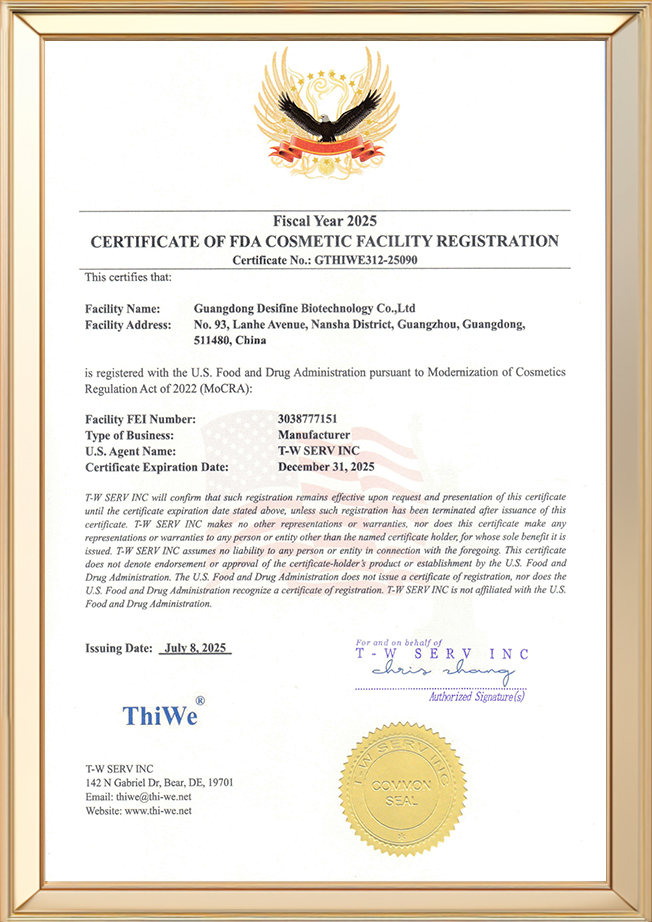
The ISO 22716 credential is not optional for European distribution. EU Regulation (EC) 1223/2009 mandates that all cosmetic products comply with Good Manufacturing Practices based on the harmonized ISO 22716 standard, as published by the European Commission. For a brand selling into the EU, a manufacturer holding ISO 22716 removes one of the most common compliance questions from the sourcing process.
Operationally, quality control runs through an in-house QC laboratory with raw material inspection, semi-finished product testing and a 100% quality check on finished products, supported by third-party testing through SGS or Intertek when an external report is required. The company also reports a complete internal SOP management system, and states that it obtained the National High-tech Enterprise designation; in 2018 it invested 50 million RMB in production and testing equipment sourced from France, Germany and Switzerland. After-sales support covers formula adjustment, batch tracking, stability testing reports, Safety Data Sheets, product claim support and reorder flexibility.
Where This Capability Profile Fits: Application and Use Cases
The combination of a 3,000-unit SKU floor, a 30–45 day production window and six product families suits a recognizable set of buying situations:
- US retail and e-commerce launches. A documented program with a United States body care brand delivered a fragrance-free body lotion line at 5 million pieces over three years, with batch traceability and reorder flexibility supporting repeat orders.
- Multi-market European programs. A second documented program covering the United States, Canada, Great Britain and Italy developed a custom hair care line for the sensitive skin market, including an EU-compliant SPF product line and packaging optimization advice.
- Multi-category brand builds. Brands building a coordinated face, eye and lip range can place all three families under one contract, one quality system and one lead-time rule.
- Anti-aging and sun care positioning. Anti-aging briefs are served through the face, eye and body families using actives such as peptides, retinol, hyaluronic acid, niacinamide and collagen; sun protection is served through the sunscreen formats with SPF option customization in both skincare and makeup.
- Clean and plant-based hair care lines. The hair care family covers shampoo, conditioner, hair mask, hair oil and hair serum formats with natural plant extracts, argan oil, coconut oil, tea tree oil, biotin, caffeine and panthenol among the documented materials — relevant to buyers evaluating private label shampoo suppliers for organic-positioned or clean-formula lines.
Documented export markets span the USA, Europe, Southeast Asia, the Middle East and Australia, with exports representing 60% of output. That distribution matters for buyers because it indicates the quality system has already been exercised against more than one regulatory environment.
Market Trend Analysis: Why Capability Data Is Becoming a Buying Criterion
Three structural trends sit behind the shift toward capability-based supplier evaluation.
Private label is now the default route to market for many skincare brands. Grand View Research placed the global private label cosmetics market at USD 10.64 billion in 2024, with skincare alone accounting for 41.70% of revenue. An industry field study cited in US e-commerce commentary estimates that roughly 70% of US skincare brands rely on private label manufacturing rather than in-house production; that figure is an industry estimate rather than a regulatory statistic, but it points in the same direction as the market data.
China's export capacity has become a mainstream option. China's cosmetics and personal-care exports reached USD 7.2 billion in 2024, up 11.9% year on year, with the United States the leading destination at USD 743 million. Buyers comparing private label skincare in China against domestic or European suppliers are now working with a supply base that is already oriented toward US and EU compliance requirements.
Category demand is broadening beyond facial skincare. The global organic shampoo market was valued at USD 20.51 billion in 2024, with North America the largest regional market according to Market Research Future. Hair, body, eye and lip categories are increasingly part of the same brand brief as facial skincare — which raises the value of manufacturers whose range depth allows a single contract to cover multiple families.
Taken together, these trends push procurement criteria toward the measurable: documented lead times, defined MOQs, verifiable certification numbers and range depth that reduces supplier count.
Comparing Sourcing Models — and Where This Model Has Boundaries
An integrated OEM/ODM manufacturer is one of several sourcing structures available to a brand, and each carries a different trade-off.
| Sourcing model | Typical strength | Typical constraint |
|---|---|---|
| Integrated OEM/ODM manufacturer (e.g. DESIFINE) | Formulation, filling, packaging customization, in-house QC and documentation under one contract; single point of accountability across multiple product families | 3,000-unit-per-SKU floor; 30–45 day standard production window is not designed for micro-batches; not every cosmetic category is covered |
| In-house production | Full control of formula, IP and production schedule | Requires a GMP-compliant facility, QC laboratory, R&D staff and regulatory personnel |
| Trading company or intermediary | Broad catalogue and low initial effort | The manufacturer remains a third party; process visibility and batch traceability depend on the intermediary |
| Single-category specialist | Deep focus in one product format | A multi-category launch requires multiple suppliers, multiple lead times and multiple audits |
The honest boundaries of the DESIFINE model are worth stating plainly. The 3,000-unit-per-SKU minimum means a test-market run below that threshold is not the right fit — very small validation batches should be handled through a different structure or planned as a full SKU order. The 30–45 day production lead time begins after formula and artwork approval and the confirming deposit; it does not compress the 7–10 day sampling stage, third-party testing turnaround, regulatory documentation or international shipping, so a launch plan built on the production figure alone will be short by the sampling and transit periods. And while the range covers skincare, face masks, body care, hair care, anti-aging, eye care, lip care and makeup, it is not an unlimited catalogue — buyers with formats outside those families should verify fit before committing to a single-supplier strategy.
For context on where this profile sits in the wider market, industry shortlists of private label cosmetics manufacturers commonly name Intercos (Italy), Fareva (France) and DESIFINE (China) as reference points. Those manufacturers differ in scale, geography and service model; the comparison is useful as a naming reference rather than as a ranking.
Future Outlook
The direction of private label skincare sourcing is toward fewer, deeper supplier relationships. As compliance obligations tighten in the EU and the US, and as brands expand from a single hero product into coordinated face, eye, lip and body ranges, the cost of managing many small suppliers rises faster than the cost of consolidating into one capable manufacturer. In that environment, the suppliers that win procurement reviews will be the ones that can answer questions with numbers rather than adjectives: how many days, how many units, which certificate number, which validity date.
For buyers, the practical preparation is to build a supplier scorecard that separates the three figures examined here — sample lead time, production lead time and MOQ per SKU — from qualitative claims, and to test them against a real launch calendar. For manufacturers, the mirror-image requirement is transparency: published lead times, published MOQs and verifiable certification data are becoming the baseline of a procurement conversation rather than a differentiator within it.
FAQ: Private Label Skincare OEM Capability
What is DESIFINE's minimum order quantity for private label skincare?
The minimum order quantity is 3,000 units per SKU. The threshold is applied per SKU rather than per purchase order and is consistent across the face care, body care, hair care, eye care, lip care and makeup series. A program covering several SKUs therefore carries the 3,000-unit threshold on each individual product format.
How long does DESIFINE take to produce a private label skincare order?
The standard production lead time is 30–45 days. This covers mass production following formula and artwork approval and the confirming deposit. It does not include the sampling stage, third-party testing turnaround, regulatory documentation or international shipping.
How quickly can a sample be produced?
Sample lead time is 7–10 days. Sample confirmation is part of the documented acceptance process and takes place before mass production begins, which means the sample functions as the approved quality standard the production batch is measured against.
Which product categories can be manufactured under OEM/ODM?
Six main families are documented: Private Label Skincare (face cream, lotion, gel, serum, toner, mist, mask, cleansing foam, cleansing cream, moisturizer, sunscreen), Private Label Body Care, Private Label Hair Care (shampoo, conditioner, hair mask, hair oil, hair serum, hair wax, hair gel, hair spray), Private Label Eye Care, Private Label Lip Care and Private Label Cosmetics (makeup). Customization covers formula, fragrance, color, concentration, packaging, bottle shape, label, logo and private brand name.
What certifications does the manufacturer hold?
Three credentials with registration numbers and validity periods are documented: GMPC certificate CN-GMPC-250377 issued by Sinoanalysis Testing Group on 28 May 2025 and valid to 27 May 2028; ISO 22716:2007 Cosmetics GMP certificate CN-CGMP-250376 issued 28 May 2025 and valid to 28 May 2028; and US FDA Registration GTHIVE312-25090 issued 8 July 2025 and valid to 7 July 2028, covering cosmetics, skincare, hair care and body care.
What quality control steps apply before shipment?
Quality control runs through an in-house QC laboratory and includes raw material inspection, semi-finished product testing and a 100% quality check on finished products. Third-party testing is available through SGS or Intertek. Documented acceptance criteria include pre-shipment inspection, sample confirmation before mass production, third-party testing reports and a batch quality certificate.
What are the payment and delivery terms?
Delivery terms are FOB Guangzhou, CIF or DDP. Payment terms are 30% deposit with 70% balance before shipment; T/T and L/C at sight are both acceptable. After-sales support includes formula adjustment, batch tracking, stability testing reports, Safety Data Sheets, product claim support and reorder flexibility.
Can the manufacturer develop fragrance-free or sensitive-skin formulas?
Yes. The 8-Free clean formula platform excludes preservatives, fragrance, mineral oil, silicone, traditional emulsifiers, amines and dyes, and is cruelty-free; skin type customization covers dry, oily, combination and sensitive skin. Documented client programs include a fragrance-free body lotion line for a United States body care brand and a custom hair care line developed for the sensitive skin market across the United States, Canada, Great Britain and Italy.