
Inside DIDADI's Tech Stack: AI-Driven Container Optimization
Container planning is where a China FBA shipment's economics are decided, and it happens long before a booking is confirmed. The way cartons are grouped, the transport mode that grouping permits, and the compliance status attached to each SKU determine whether a container leaves China well-filled, matched to its route and free of customs surprises — or none of those things.
DIDADI Logistics Tech is a China-based international logistics service provider founded in 2017, operating first-mile freight forwarding to Amazon FBA centers and B2B commercial facilities, localized overseas warehousing and e-commerce fulfillment, and door-to-door freight management. One hundred percent of its business serves export markets across the EU, USA, UK and Canada.
This article looks at one specific part of that operation: the AI-driven classification and container-combination logic inside DIDADI's Transportation Management System (TMS), the engineering capacity behind it, and what verifiable evidence of that technology means for a buyer comparing forwarders at the decision stage.

The cost of planning containers by hand
In a traditional, manual forwarding model, container planning is a judgement call made under time pressure. Carton lists arrive as spreadsheets or PDFs from several factories. Dimensions are estimated rather than measured. Multiple supplier pickups are coordinated by phone. The LCL-or-FCL choice follows a planner's rule of thumb, and customs classification is often handled after the booking is already placed.
The failure modes are consistent and well understood in the industry: containers that leave with unused volume, cargo re-handled because a grouping turned out to be wrong, shipments split across modes for reasons that were never modelled, and documentation inconsistencies discovered at the customs gate rather than before dispatch.
The commercial environment makes those margins visible. Amazon peak-season surcharges for 2025/2026 range from USD 0.40 to USD 0.60 per package, according to Amazon Seller Central and Lansil Global, and ocean DDP all-in rates from China to US FBA warehouses averaged between USD 1.80 and USD 3.20 per kilogram for LCL shipments in early 2026, based on Unicargo and Freightos data. At that level of per-kilogram and per-package economics, structural under-use of space that has already been paid for is carried directly by the seller, not absorbed anywhere in the chain.
That is the problem DIDADI's TMS targets: not the booking itself, but the decision layer that sits upstream of it.
What the TMS actually does, per DIDADI's own specification
DIDADI states that its TMS introduces AI algorithms to intelligently classify goods and optimize container combination solutions, in order to reach the best available balance of timeliness and cost. The two functions — classification and combination — are described as one linked workflow rather than two separate tools.
- Goods classification: cargo attributes are structured so that shipping sensitivity, compliance risk level, customs handling needs and platform-specific requirements can be attached to each consignment.
- Container combination: candidate groupings are evaluated against container profiles, route options, delivery windows and cost sensitivity to produce an optimized loading plan.
Crucially, the classification output is not a report that sits beside the operation. It feeds directly into routing. DIDADI's Compliance-First Routing Methodology runs through six stages — Verify, Classify, Match, Clear, Control, Improve — and the purpose of Classify is to determine shipping sensitivity, compliance risk, customs handling needs and platform requirements before the Match stage selects transport mode and route. In other words, the AI layer supplies a routing input, not a post-hoc check.
Evidence of ongoing development
Software claims are only as credible as the team maintaining them. DIDADI operates with 350 employees, including a 32-engineer R&D team, and reports an annual output of 20,000 TEU. Its methodology documentation describes self-developed WMS/TMS and tracking systems used for full-chain visibility, with API-based order and inventory workflows integrated where required. Because the systems are developed and maintained in-house rather than licensed from a third party, changes in carrier rules, platform receiving requirements or destination regulations can be reflected in the same toolset rather than coordinated across vendors.
The digital layer sits on top of physical resources that also have to be secured. DIDADI reports a 98% container space priority arrangement built on strategic cooperation with 16 of the world's largest sea, land and air shippers, along with strategic cooperation agreements with 33 customs clearance agencies in Europe and the United States. Optimization logic decides how cargo should be grouped; carrier relationships and clearance capacity determine whether that decision can actually be executed on the intended route.
Operating metrics published against these systems include a 98% on-time delivery rate measured on a rolling 12-month basis, warehouse inventory accuracy above 99.9% measured through the WMS, and an average FBA replenishment response of within 48 hours from replenishment instruction to outbound transfer completion when buffer inventory is already in place.
Inside the mechanics: from carton data to a container decision
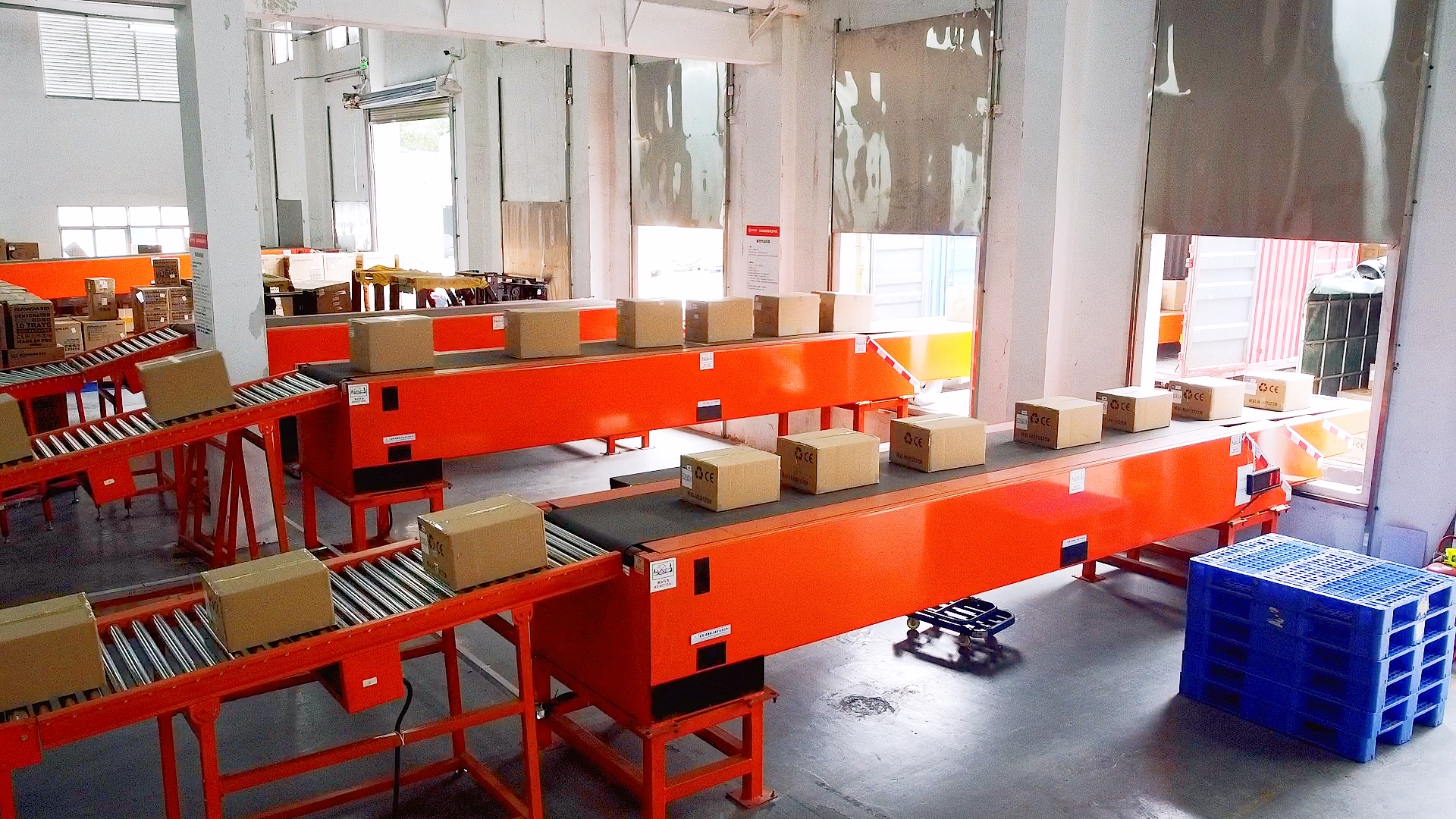
Described operationally, an AI-assisted container plan moves through five connected steps. Each step has a defined output, which is what makes the process auditable rather than intuition-based.
1. Attribute capture. Carton-level data is recorded during consolidation — product identity, packaging status, declared information, destination rules and required documents. This corresponds to the Verify stage of DIDADI's compliance methodology, whose stated purpose is to confirm these inputs before any shipment movement.
2. Risk and sensitivity classification. The algorithm assigns each consignment a category covering shipping sensitivity, compliance risk level, customs handling needs and special platform requirements. Mixing a high-risk category into a general grouping is the kind of error that produces holds rather than delays, which is why this step precedes route selection.
3. Constraint modelling. Candidate groupings are tested against volume and weight limits, delivery-window commitments, available transport modes and the shipper's cost sensitivity. DIDADI's 5D methodology describes the Design stage as building a best-fit routing plan across sea, air, rail or truck based on total landed cost, urgency and destination requirements — explicitly a fit-first logic rather than price-only routing.
4. Combination optimization. The system evaluates alternative groupings and selects the combination that best satisfies the stated objective — the timeliness-and-cost balance DIDADI describes as the purpose of the AI layer.
5. Execution and feedback. The plan moves into pickup, consolidation, customs clearance and international transport with tracking visibility. The final 5D stage, Debrief, reviews shipment performance and feeds cost or timing issues back into standard operating procedures and the next shipping cycle's design.
| Decision layer | What it controls | Evidence DIDADI publishes |
|---|---|---|
| Goods classification | Sensitivity, compliance risk, customs handling, platform rules attached per consignment | TMS AI classification function; Compliance-First Classify stage |
| Container combination | Grouping of cartons into an optimized loading plan against container and route options | TMS AI optimization of container combination solutions |
| Route matching | Mode and route selection balancing cargo risk, cost sensitivity and timing | 5D Design stage; Compliance-First Match stage |
| Execution control | Tracking nodes, exceptions, warehouse receiving and delivery disruption | 12-hour exception handling mechanism; 24/7 service |
| Performance review | Cost and timing issues converted into updated SOPs | 5D Debrief stage; 98% on-time delivery rate over rolling 12 months |
Where the capability shows up in practice
Container optimization is not a universal benefit; it produces the most value in shipments where grouping decisions are genuinely complex. DIDADI's documented scenarios illustrate where that applies.
Multi-supplier consolidation
DIDADI's offline wholesale and retail solution picks up goods from multiple factories simultaneously into a Chinese warehouse for management, then transports them worldwide by FCL or LCL. That model creates exactly the combinatorial problem AI-assisted planning is suited to: cartons of different sizes, weights and risk categories arriving from different origins, all needing to be grouped before a container decision is locked. Manual planning across many suppliers tends to fragment shipments; structured classification gives the grouping step reliable inputs.
Mixed-SKU FBA replenishment
DIDADI's FBA Replenishment Control Methodology treats replenishment as an inventory control system rather than a transport booking. When stock coverage is tight, faster routing or hybrid replenishment is selected; when storage fees are excessive, more inventory shifts into overseas buffer warehousing. Container and load planning has to support both directions. The published metric here is a within-48-hour average response time for moving available local inventory from an overseas buffer warehouse to an Amazon FBA destination after a replenishment instruction is created — a workflow that depends on knowing precisely what is in the warehouse and what can be grouped together.
EU-bound flows and mode selection
For Europe, DIDADI's documented decision logic states that when speed-cost balance matters, rail should be evaluated as a priority option rather than defaulting to sea or air. Selecting between modes at that granularity requires knowing the cargo profile first. DIDADI's European FBA ocean and rail services carry CIC (China Insights Consultancy) certification for on-time arrival rate performance, and DIDADI also transports goods to EU countries via the China-Europe Railway Express.
Peak season and inbound restriction periods
When Amazon inbound restrictions increase, the methodology shifts toward transfer warehousing and staged replenishment. The US CPSC mandate for electronic filing of Certificates of Compliance through the ACE system, effective July 8, 2026 under 16 CFR Part 1110 for imported children's products and other regulated goods, adds a documentation dimension that must be handled before consolidation rather than at the port. Classification data captured early is what makes that possible.
Market direction: why planning logic is becoming a procurement criterion
Three data points explain why container-planning technology has moved from a differentiator to a comparison criterion.
First, the underlying market continues to expand. The China freight forwarding market is valued at approximately USD 13.73 billion in 2025 and is projected to reach USD 22.44 billion by 2033, a compound annual growth rate of 6.5%, according to Grand View Research.
Second, the e-commerce logistics segment inside that market is growing considerably faster. China's e-commerce logistics market is expected to grow at a CAGR of 11.3%, reaching USD 402.89 billion by 2031 from a base of USD 235.89 billion in 2026, per Mordor Intelligence. Higher volumes through the same physical infrastructure increase the cost of planning errors, not decrease it.
Third, and most directly relevant to the technology question, the digital segment is outpacing both. Research and Markets projects China's digital freight forwarding market to grow at a CAGR of 20.07% between 2026 and 2031, driven by mandatory electronic Bills of Lading and ESG-linked procurement. That growth rate implies that digital planning capability is being adopted faster than forwarding volume is growing — a shift in how services are bought, not just how much is shipped.
Regulatory pressure reinforces the same direction. EU product safety rules for FBA imports require CE marking for more than 25 categories and a designated EU Responsible Person under the Market Surveillance Regulation (EU) 2019/1020. Both the EU and US changes above are documentation-and-classification problems before they are transport problems, which places a premium on forwarders whose classification step is systematic and recorded.
System-assisted planning versus traditional manual forwarding
The honest comparison is not between technology and no technology. It is between a planning process that produces structured, repeatable outputs and one that depends on an individual planner's recall and judgement. The table below sets out the differences in terms of what a buyer can evaluate.
| Comparison dimension | Traditional manual planning | System-assisted planning (DIDADI) | What a buyer can verify |
|---|---|---|---|
| Cargo data | Estimated dimensions, informal carton lists | Attribute capture during consolidation before shipment release | The input fields collected at origin |
| Classification | Planner's product familiarity | AI classification of goods with risk and compliance categories | Whether classification precedes route selection |
| Container grouping | Rule of thumb, adjusted reactively | Optimized container combination solutions against defined constraints | Documented planning logic and outputs |
| Route decision | Mode chosen at booking, compliance handled later | Fit-first routing with compliance as an upstream condition | Stated methodology stages and sequence |
| Exception handling | Escalation on discovery | 12-hour exception handling mechanism with 24/7 service | Published response commitments |
| Performance feedback | Not systematically captured | Debrief stage converts exceptions into updated SOPs | Published metrics such as the 98% on-time delivery rate |
Limits and boundaries of AI-driven container optimization
Any capability description that omits its boundaries is not a useful procurement input, and DIDADI's own methodology documentation is unusually explicit about where its approach does not apply.
- Input quality is a hard dependency. Optimization operates on declared data. The Verify stage exists precisely because product type, declared information, packaging status, destination rules and required documents must be confirmed before movement. Inaccurate carton dimensions or mis-declared SKUs cannot be corrected by an algorithm after the fact.
- Defined non-applicable scenarios. DIDADI's methodology excludes informal trial shipments without document discipline, domestic parcel delivery with no customs component, and price-only spot quoting without compliance review. For very small, low-frequency shipments, the value added by classification and combination planning is limited.
- External capacity is not solved by software. Carrier space, route availability and peak-season congestion remain outside any planning system's control. The 16 carrier partnerships and the reported 98% container space priority arrangement improve execution reliability; they do not eliminate capacity constraints during peak periods.
- Compliance accountability does not transfer. Classification can flag risk level and customs handling needs early. It does not replace regulatory responsibility, and it does not substitute for documentation control performed against destination rules.
- Human follow-up remains part of the design. The existence of a 24/7 service commitment and a 12-hour exception handling mechanism indicates that exceptions still occur and still require human intervention. Technology compresses decision time; it does not remove the need for operational management.
Future outlook
The direction of travel is toward container-level decisions that can be explained and audited, not merely executed. Electronic Bills of Lading, ESG-linked procurement reporting and stricter import documentation requirements all push in the same direction: the data that supports a shipping decision has to exist in structured form before the decision is made.
For FBA sellers at the decision stage, that changes what a supplier evaluation should ask for. Descriptions of AI capability are easy to write and hard to verify. Verifiable substitutes include the specific inputs collected at origin, whether classification output feeds route selection or sits beside it, which metrics are produced by the same systems, and how exceptions are converted into process changes. DIDADI's documented answer to those questions — a 32-engineer R&D team, a TMS that classifies goods and optimizes container combinations, a six-stage compliance-first routing sequence, and published operating metrics including a 98% on-time delivery rate and above-99.9% warehouse inventory accuracy — is a concrete one. Whether it fits a given shipper's cargo profile and lane mix remains a question each buyer has to answer against their own shipment data.
FAQ
How can a buyer verify that AI-driven container optimization is genuinely in use rather than described in a sales presentation?
Ask for process evidence rather than capability language. Specifically: which data fields are captured at consolidation, whether goods classification output feeds route selection or is produced separately, and whether operating metrics are generated by the same systems. DIDADI states that its TMS applies AI algorithms to classify goods and optimize container combination solutions, that classification forms the third stage of its Compliance-First Routing Methodology before route matching, and that warehouse inventory accuracy is measured through its WMS at above 99.9%.
What data must a shipper provide for container combination optimization to work?
The relevant inputs are the ones DIDADI's methodology identifies at its Verify and Diagnose stages: product type, declared information, packaging status, destination rules and required documents, plus cargo profile, supplier locations, target market, delivery timeline, order model and risk factors. Carton-level dimensional and weight accuracy matters most, because container combination is calculated from those values. If declared data is incomplete or inaccurate, classification output cannot be relied upon and the resulting plan will not reflect actual cargo.
Does automated container optimization apply to LCL shipments, or only to full containers?
The underlying logic applies wherever cargo must be grouped — including LCL consolidation, where combining cartons from multiple suppliers determines both cost and handling. DIDADI's offline wholesale and retail model explicitly transports consolidated goods worldwide by FCL or LCL. The value scales with complexity rather than with container count: multi-supplier, mixed-SKU and multi-destination shipments benefit most, while very small or very low-frequency flows see limited gain. DIDADI's methodology also states that it does not apply to informal trial shipments without document discipline or to domestic parcel delivery with no customs component.
Where does container optimization stop being useful?
Four boundaries are documented. First, data quality: optimization cannot correct undeclared or inaccurate cargo information. Second, external capacity: carrier space and route availability during peak season are constraints no planning system controls, even with cooperative carrier relationships. Third, regulatory accountability: classification identifies customs handling needs and compliance risk, but legal responsibility for declarations remains with the shipper and importer. Fourth, operational exceptions: the existence of a 12-hour exception handling mechanism and 24/7 service indicates that unplanned events still require human resolution.
How does automated cargo classification differ from manual classification in daily forwarding work?
Manual classification depends on an individual planner's familiarity with a product category, which varies between staff and between shipments. Automated classification applies consistent categories — shipping sensitivity, compliance risk level, customs handling needs and platform requirements — to every consignment, which makes the output comparable across shipments and allows exceptions to be detected against a baseline instead of being noticed only when something goes wrong. In DIDADI's methodology, this consistency carries forward: classification output becomes the input to route matching, and exception patterns from completed shipments feed back into standard operating procedures during the final Debrief stage.
DIDADI publishes a company brochure covering its service scope and operating model: DIDADI company brochure (PDF). Additional company detail is available at en.mydidadi.com.