
Inside Engineered Flooring: Grooving and Paint Line Evidence
Engineered wood flooring has moved from a solid-hardwood alternative into the mainstream of global flooring specification, and the sourcing conversation has changed with it. Buyers evaluating a shortlist of factories are no longer asking only whether engineered planks can be produced, but how consistently a production line can hold panel geometry and surface finish across a full order.
The Market Context Behind a Factory-Level Question
Third-party research published by The Business Research Company values the global wood flooring market at USD 53.14 billion in 2024 and projects it to reach USD 71.57 billion by 2029. Within that market, separate category research attributes approximately 55% of 2024 demand to engineered construction, favoured for dimensional stability relative to solid wood, and oak-based products are estimated to represent around 46% of global engineered wood flooring demand.
Those figures describe a category large enough to support specialised factories rather than generalist mills. They also explain why evaluation-stage buyers increasingly request process information — line inventories, quality-control scope, capacity and lead-time data — alongside price and sample quality. When several suppliers can quote a comparable specification in engineered oak flooring or multilayer parquet, the remaining difference sits inside the factory rather than on the specification sheet.
Market size estimates for wood flooring vary between research houses because the category is defined differently from report to report, with some definitions including laminate or bamboo. The figure is best treated as directional; the trend it describes, a shift toward engineered and prefinished formats, is the part that changes procurement decisions.
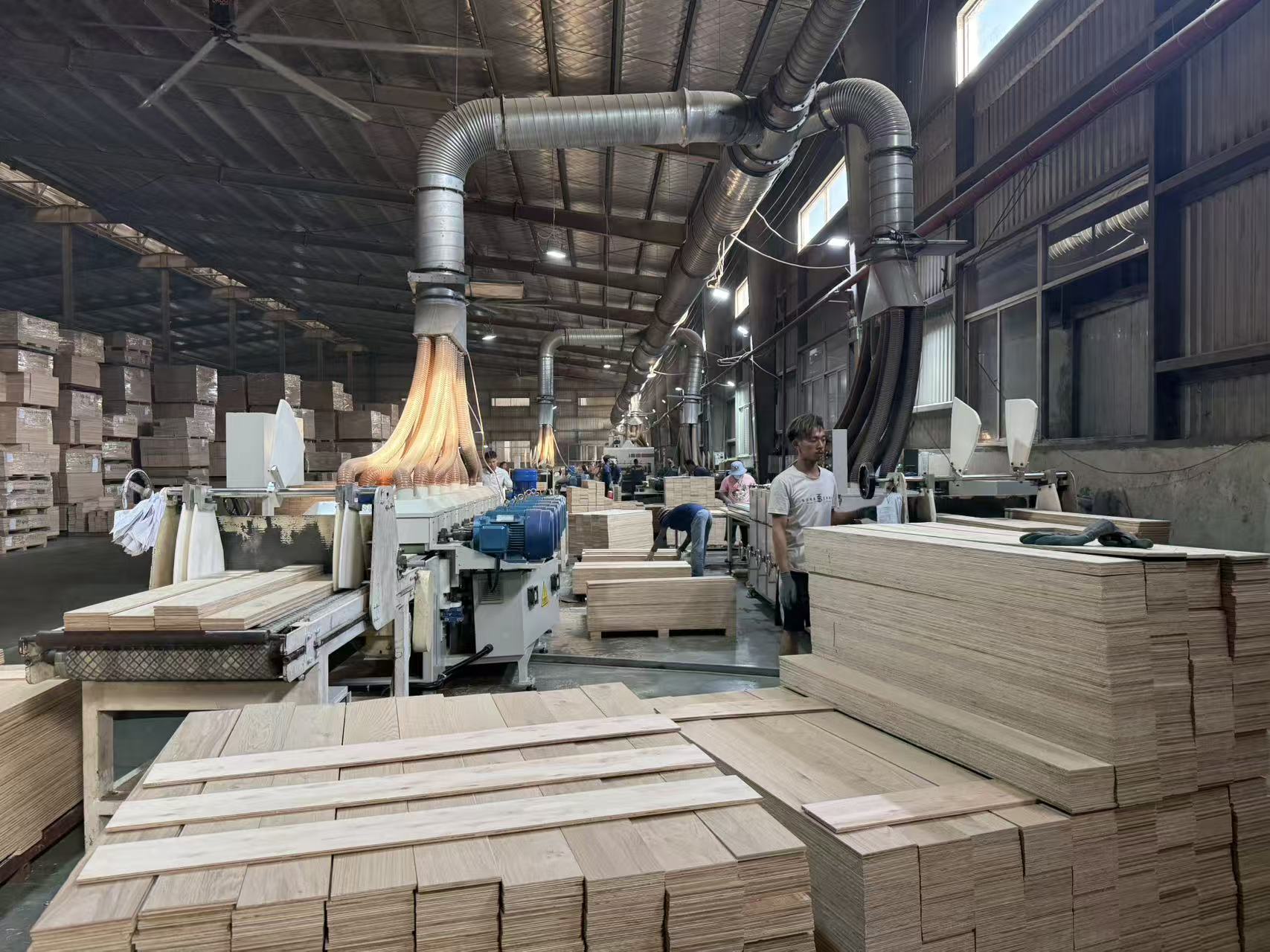
This article examines production machinery as evidence. It explains what a German Homaomai grooving line and a Taiwan Fengqiao paint line contribute to panel precision and surface durability, and it uses Suzhou Dongda Wood Co., Ltd — an engineered wood flooring and plywood manufacturer that operates both lines — as a documented example.
Reading a Factory Through Its Production Lines
A machinery list is only useful when a buyer knows which production variable each line controls. In engineered wood flooring manufacture, three stages determine most of what a buyer notices after delivery:
- Panel geometry — profiling, tongue-and-groove or click cutting, squareness and thickness control.
- Surface finishing — coating application, cure and wear build on prefinished flooring.
- Bonding and substrate preparation — veneer lamination, glue application and plywood core consistency, which together govern dimensional stability.
Warehousing, packing and documentation matter, but they support these three stages rather than substitute for them. This is why an evaluation that stops at a showroom sample can miss the difference between a factory built around controlled lines and a workshop that assembles orders around available labour.
The German Homaomai Grooving Line: Panel Precision as a Process Output
The grooving line is the stage at which a finished panel receives its connecting profile. On engineered hardwood flooring, that profile determines the joint gap visible after installation, the force required to seat each plank, and how quickly an installer can move across a floor. Dongda Wood operates a German Homaomai grooving line as part of a production configuration the company describes as German advanced equipment supported by a series of fine supporting machines.
Why profile precision matters more in patterned formats
The effect of profile accuracy scales with the format. In herringbone engineered flooring and chevron engineered flooring, every plank is cut left and right and installed at a fixed angle, so a small angular deviation repeats hundreds of times across a room. Precision here is not an aesthetic refinement; it is what allows the pattern to close cleanly at the room edges. In wide plank engineered flooring, by contrast, the priority shifts toward flatness and thickness consistency, because panel width amplifies any bowing or cupping across the surface.
What to verify beyond the machine name
A named grooving line indicates the level of tooling investment a factory has made. It does not, by itself, guarantee output. The variables that determine realised precision include tooling wear management, calibration intervals, incoming panel squareness and operator training. Buyers assessing capability should treat machinery as one input among several, and ask how profile quality is monitored during a production run rather than only at first article.
It is also worth separating the machine from the material. A precise grooving line cannot correct a veneer that was inconsistently graded, nor a core that was not stabilised before lamination.
The Taiwan Fengqiao Paint Line: Surface Durability as a Process Output
Prefinished flooring moves the coating stage from the job site into the factory, which places surface performance inside the supplier's process control rather than inside the installer's schedule. Dongda Wood applies its finishes on a Taiwan Fengqiao paint line, with German Jianfo paint and Finland Taier phenolic glue used as inputs. Coating chemistry and controlled application are what a buyer is effectively specifying when they ask about scratch resistance or wear behaviour.
What the coating line controls
- Film build consistency — even coating thickness across a batch reduces the variation that later appears as patchy wear.
- Cure control — curing conditions affect how the coating bonds to the veneer and how it behaves under foot traffic.
- Adhesion between coats — the interfaces between base and top coats determine whether a finish stays intact.
- Substrate preparation — sanding sequence and panel conditioning before coating determine how even the finished surface appears.
Limits of a coating line
A coating line improves consistency but does not override the physics of the product. Panels built with thin veneer engineered flooring — veneers at the lower end of the range, such as 0.6 mm — carry less refinishing depth than thick veneer engineered flooring at 3 mm or 4 mm, and neither can be sanded back as many times as solid hardwood. Buyers specifying for a long-service commercial interior should match veneer thickness and finish system to the intended maintenance cycle rather than assume the coating line removes that trade-off.
Machine Capability Versus Traditional Workshop Practice
Comparing line-based production with conventional workshop practice clarifies what each approach does well and where the boundaries sit.
| Production stage | Workshop practice | Line-based production | What the buyer should still verify |
|---|---|---|---|
| Profile cutting | Hand-set or older tooling; variance rises with run length | Machine-controlled profile cutting with repeatable settings across a batch | Tooling wear records and calibration intervals |
| Surface coating | Variable film build; more field touch-up | Controlled coating and cure sequence on a paint line | Coating system specification, cure conditions and adhesion testing |
| Bonding | Operator-dependent glue spread | Phenolic glue systems applied under controlled conditions | Glue type, spread rate and core conditioning |
| Batch consistency | Colour and dimension drift between batches | More consistent output for repeat orders | Colour-matching procedure for repeat orders |
| Changeover and small orders | Flexible for very small volumes | Efficient at volume; changeovers carry cost and time | Minimum order quantity and realistic lead time for the specific order |
Line-based production also has boundaries worth stating plainly. Imported equipment raises fixed costs, requires trained operators and maintenance discipline, and depends on consumables that are specified rather than substituted. In Dongda Wood's case, monthly capacity is 150,000 m², the minimum order quantity is 400 m² per colour, and standard lead time is 45 days. A buyer placing a small, fragmented, multi-colour order is not the natural customer for this configuration, and a supplier that presents imported lines while promising unlimited small-batch flexibility is worth questioning.
A Documented Example: The Dongda Wood Evidence Package
Suzhou Dongda Wood Co., Ltd is an engineered wood flooring and plywood manufacturer founded in 1995 and based in Suzhou City, Anhui Province, China. The company operates a 190,000 m² site with more than 500 employees and has specialised in engineered wood flooring and plywood for 31 years, exporting with a 100% export ratio to markets including the USA, Canada, Australia, the EU, the United Kingdom, Brazil, Chile and South Africa.
The capability data that supports an evaluation-stage review is specific: monthly capacity of 150,000 m², 100% testing for quality control on all products, and an R&D team of 20 engineers. Customisation for OEM/ODM buyers covers product dimensions, grade, packaging design and logo. After-sales terms are stated as a 25-year warranty for residential use and a 3-year warranty for commercial use.
Raw material sourcing and compliance documentation reinforce the process picture. Veneer species are imported from Europe, America, Russia and Indonesia; bonding and finishing inputs include Finland Taier phenolic glue and German Jianfo paint. The company holds FSC COC certification GFA-COC-006481, valid to 20 June 2027; CE certification CHIG22032983 under AVCP System 4, valid to 4 July 2027; CARB Phase 2 and EPA TSCA Title VI certification CARB/EPA/CANFER20030, valid to 27 June 2027; and F4 Star certification CMSA J1073809, valid to 28 February 2027. These sit alongside the standards that apply in the main destination markets, including ANSI/HPVA EF 2020 in the United States and EN 14342:2013 in the European Union.
From Line Capability to Product Formats
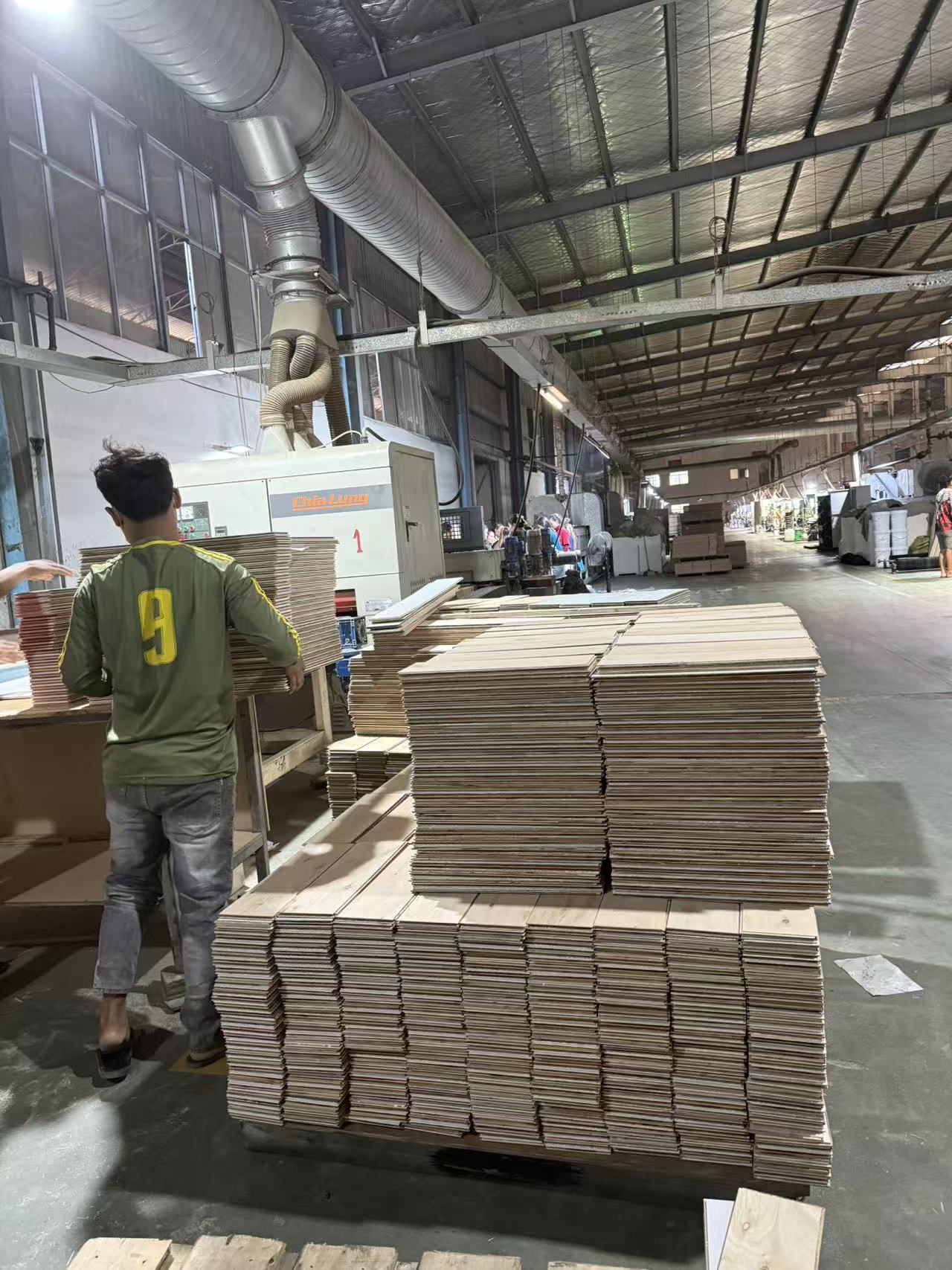
The output of a grooving line and a coating line is easiest to judge in the formats a factory actually ships. Dongda Wood's published engineered flooring sizes, expressed as length × width × total thickness / veneer thickness, include:
| Size (length × width × thickness / veneer) | Format note |
|---|---|
| 1200 × 127 × 12 / 1.2 mm | Narrow plank, thin veneer |
| 900 × 150 × 15 / 3 mm | Standard plank, thick veneer |
| 750 × 150 × 15 / 3 mm | Standard plank, thick veneer |
| 600 × 125 × 14 / 3 mm | Short plank, thick veneer |
| 1900 × 190 × 12 / 1.2 mm | Long plank, thin veneer |
| 1900 × 190 × 14 / 3 mm | Long plank, thick veneer |
| 1900 × 190 × 15 / 4 mm | Long plank, 4 mm veneer |
| 1900 × 190 × 18 / 0.6 mm | Long plank, thin veneer |
| 2200 × 220 / 240 / 260 / 300 × 15 / 4 mm | Wide plank range |
| 3000 × 300 × 19 / 4 mm | Extra-wide, long plank |
Veneer thickness across this list runs from 0.6 mm to 4 mm, which is the practical range separating thin veneer engineered flooring from thick veneer engineered flooring. Width runs from 125 mm to 300 mm, covering standard and wide plank engineered flooring. The longer formats in the list — 2200 mm and 3000 mm — are the ones most dependent on grooving accuracy, because a deviation that is invisible on a 600 mm plank becomes visible on a 3 m run.
A long-running North American example illustrates how these formats are consumed. A Canadian group of brands, wholesalers, contractors and distributors has taken approximately 300,000 m² per year from Dongda Wood for over 10 years, across residential house renovation and commercial hotel and office interior decoration. The requirements attached to that volume are the ones that put pressure on the coating and profile stages: low formaldehyde emission, high scratch resistance, compatibility with underfloor heating, and customisable wood grain and sizes. Reported outcomes centre on durability, stable surface performance and long service life in indoor decoration projects.
A Buyer's Evaluation Framework for Machinery Claims
Machinery claims become useful when they are converted into checkable statements. The framework below can be applied to any factory under evaluation, including this one.
| Evidence item | What it indicates | What to verify |
|---|---|---|
| Named grooving line | Investment in profile precision | Tooling maintenance records, first-article inspection, in-run checks |
| Named coating line | Controlled finishing and cure | Coating system, adhesion and wear testing, substrate preparation |
| Monthly capacity | Ability to absorb volume | Capacity reserved for new customers versus total installed capacity |
| Quality-control regime | Defect screening before shipment | Which characteristics are checked and whether testing is sampled or applies to every panel |
| R&D headcount | Response capacity for custom requests | Scope of customisation — dimensions, grade, packaging design, logo |
| Warranty terms | Confidence in service life | Residential versus commercial terms and exclusions |
| Certifications | Market access | Certificate number, scope and validity date |
Used together, these items convert a supplier's machinery claims into checkable statements. Used individually, any one of them can be presented attractively without describing the factory.
Market Trend Analysis: Process Evidence as a Selection Filter
Two trade-level numbers frame the sourcing environment. China's exports of wood products reached USD 17.5 billion in 2024, with the USA, Japan and the UK among the main destinations, according to the Observatory of Economic Complexity. In the United States, the hardwood flooring industry generates approximately USD 8.5 billion in total economic output annually, per industry reporting from the Hardwood Federation and NWFA.
Several structural pressures point in the same direction. Engineered construction, estimated at roughly 55% of wood flooring demand in 2024, is specified in projects that cannot tolerate solid-wood movement, which raises the cost of a panel that does not sit flat. Oak remains the dominant species preference at an estimated 46% of engineered demand, concentrating quality expectations on a narrow set of veneer supply chains. The combined effect is that buyers increasingly judge factories on process evidence — line inventory, testing scope, capacity limits, certification validity — because these are the variables that determine whether the second container matches the first.
Future Outlook
Three developments are reasonable to expect over the next sourcing cycle. First, process documentation will become a standard part of supplier qualification, with buyers requesting line inventories, quality-control scope and certification validity dates alongside quotations. Second, capacity and lead time will be treated as product attributes rather than logistics details, because a stated monthly capacity of 150,000 m², a 400 m² per colour minimum and a 45-day standard lead time together shape what a distributor can actually sell. Third, the gap between factories that maintain calibration and maintenance discipline and those that purchase equipment without it will remain the real quality divide. A machinery list is a starting point for evaluation, not a conclusion.
FAQ
What should buyers verify when a supplier lists imported production lines?
A named line is an indicator of investment rather than a result. Buyers should ask for the line's origin and model description, the maintenance and calibration schedule, how profile accuracy and coating adhesion are checked during a production run, and whether inspection is sampled or applied to every panel. Dongda Wood, for example, operates a German Homaomai grooving line and a Taiwan Fengqiao paint line, and states that 100% testing is part of its quality-control process.
Why does grooving precision matter more in herringbone and chevron flooring?
In herringbone engineered flooring and chevron engineered flooring, panels are cut left and right and installed at fixed angles, so an angular deviation repeats across the entire floor and accumulates toward the walls. In straight plank formats the same deviation is often absorbed by the layout. This makes profile accuracy a structural requirement in patterned formats rather than a cosmetic preference.
How does monthly capacity relate to lead time and minimum order quantity?
They are linked commercial parameters. A factory's stated monthly capacity, minimum order quantity and lead time describe how volume is scheduled. In Dongda Wood's case, the figures are 150,000 m² per month, 400 m² per colour, and a standard lead time of 45 days. Buyers can test whether a quoted delivery date is consistent with these parameters, particularly for multi-colour orders.
What does 100% testing cover in engineered wood flooring production?
It means every product passes through the manufacturer's quality-control process rather than a sampled subset of a batch. The practical value depends on which characteristics are checked — typically dimensions, profile fit, surface defects and moisture-related properties — and whether records are retained per batch. Buyers should ask for that scope in writing before accepting the claim.
Does a 20-engineer R&D team change what an OEM/ODM buyer can request?
It indicates in-house engineering capacity for customisation rather than pure trading. Dongda Wood's stated customisation scope covers product dimensions, grade, packaging design and logo, supported by an R&D team of 20 engineers. The practical question for an OEM buyer is how many custom items a supplier can handle simultaneously without extending lead time beyond the standard 45 days.
What are the practical limits of a well-equipped factory?
Imported lines raise fixed costs, depend on trained operators and require specified consumables such as German Jianfo paint and Finland Taier phenolic glue. Format also imposes physical limits: thin veneer engineered flooring at 0.6 mm carries less refinishing depth than thick veneer engineered flooring at 3 mm or 4 mm. Capacity is finite, minimum order quantities exist, and equipment does not correct poorly graded veneer or unstable core material. Buyers with small, fragmented, multi-colour requirements may be better served by a factory configured for that profile.
Dongda Wood publishes a product brochure and specification list that buyers can review against the evaluation framework above: Dongda Wood engineered wood flooring brochure. The same criteria can be applied to any factory under evaluation.