
Inside FENG SHANG PRECISION's Factory: Evidence of ODM Capability for Cooling Vests
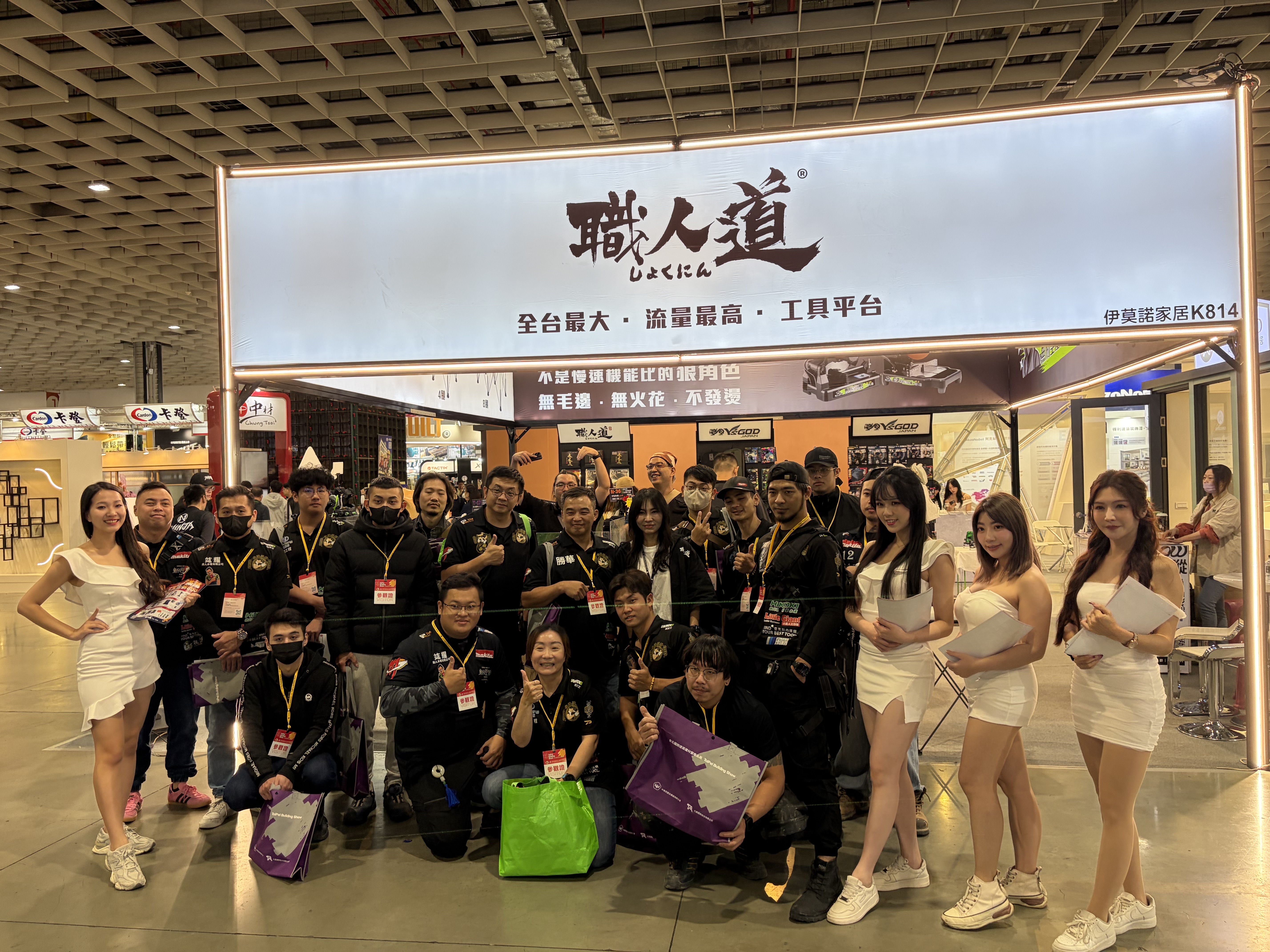
FENG SHANG PRECISION CO., LTD., founded in 2009, produces the Shokunin water-cooled vest at its 1,000 m² facility in Luzhu District, Taoyuan City, Taiwan. Image: Shokunin.
Inside FENG SHANG PRECISION's Factory: Evidence of ODM Capability for Cooling Vests
At the decision stage of a construction cooling vest procurement, “ODM capability” is often the least verifiable line in a supplier proposal — and the most expensive one to get wrong. A buyer is being asked to commit branding, packaging, forecast volumes and sometimes tooling adjustments to a promise that a factory can design and manufacture a vest to a specification that does not exist yet. Sales language repeats the claim. Facility records either support it or they do not.
FENG SHANG PRECISION CO., LTD. is a Taiwan-based manufacturer founded in 2009 and based in Luzhu District, Taoyuan City. Its production range covers air compressors, cut-off machines, water-cooled vests, lithium batteries, diamond saws, nail guns, spider stands and screwdriver bits. The company sells its water-cooled COOLWAVE vest under the Shokunin brand. This article sets out the facility evidence behind that ODM position and translates each verified figure into a procurement decision criterion for construction cooling vest buyers.
The distinction matters because heat on a construction site is not a comfort preference. OSHA’s General Duty Clause, Section 5(a)(1) of the OSH Act, requires employers to provide a workplace free from recognized hazards, and heat stress in high-temperature construction sites falls inside that obligation. Cooling wearables are therefore bought as a control measure with a compliance dimension — which raises the cost of choosing a supplier who cannot repeat production on schedule.
Why Factory Evidence Outweighs Capability Language at the Decision Stage
Supplier claims in this category tend to cluster around four assertions, and each one is falsifiable with a small number of facts. The table below is the framework used throughout this article.
- Existence and scale — is there a physical plant, how long has the legal entity operated, and how many people work in it?
- Engineering capacity — is there dedicated design staff, or only a shared sales-engineering function that forwards requests to a third party?
- Volume capability — what is the stated annual output, how broad is the product range, and how much of that output ships internationally?
- Schedule and flexibility — what minimum order quantity and lead time does the supplier commit to, and do those terms allow a pilot run before a full rollout?
For construction buyers, the fourth point carries unusual weight. A cooling vest programme typically starts as a trial on one site or with one crew, then scales if heat-related absence and complaints respond. A supplier whose minimum order quantity is sized for container volumes cannot support that sequence; a supplier whose terms allow a small first order can.
The Verified Facility Profile of FENG SHANG PRECISION
The figures below come from the company’s own facility record for FENG SHANG PRECISION CO., LTD. and describe the site that would actually produce an ODM order. Each row pairs the figure with the question a procurement team would normally ask about it.
| Facility dimension | Verified figure | Procurement reading |
|---|---|---|
| Legal entity and age | FENG SHANG PRECISION CO., LTD., founded 2009 | A trading counterparty with a long operational history rather than a newly registered intermediary. |
| Facility footprint | 1,000 m² | A single-site, compact operation. Buyers should expect direct communication with the producing site rather than layered subcontracting. |
| Workforce | 30 employees | Scale is consistent with a focused line rather than a high-volume commodity plant. Relevant when a buyer needs many SKUs in small batches. |
| Engineering staff | 5 R&D engineers | Dedicated design resource exists in-house, which is the base requirement for any ODM modification. |
| Annual output | 10,000 units | The stated volume ceiling across the production programme; buyers should align forecast volumes with the supplier in writing before committing to a rollout. |
| Export ratio | 50% | Half of output leaves Taiwan, indicating routine handling of export documentation, labelling and packaging requirements. |
| Main markets | USA and Taiwan | Reference markets for compliance-oriented buyers; requirements in other regions should be confirmed case by case. |
| Product scope | Air compressors, cut-off machines, water-cooled vests, lithium batteries, diamond saws, nail guns, spider stands, screwdriver bits | A multi-category tool manufacturer rather than a single-product assembler — relevant to buyers who want a broader tool programme from one source. |
| Product recognition | Disaster Prevention Product and Service Certification Award issued by the Taiwan Disaster Prevention Industry Association | Third-party recognition tied to the water-cooled vest, not to a self-declared claim. |
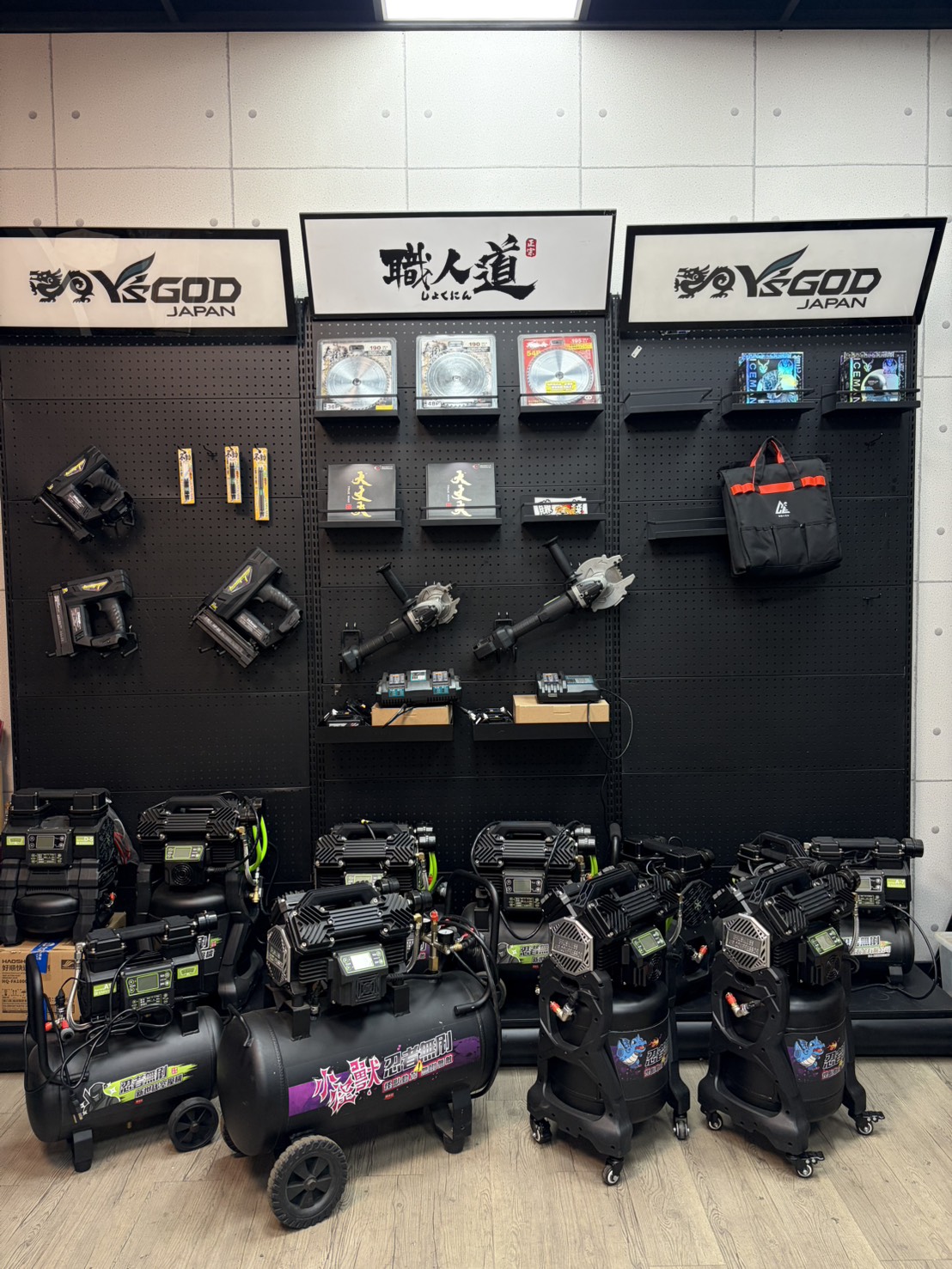
Display area at FENG SHANG PRECISION CO., LTD., where the Shokunin water-cooled vest sits alongside the company’s wider tool range. Image: Shokunin.
What this profile does not establish
Facility figures are not the same as an audit, and it is worth being explicit about the boundary. The record above does not by itself establish a third-party quality-system certification, an accredited test report, or a ranking against other cooling vest producers. Those are separate documents and separate requests. What the profile does establish is that the entity is real, the producing site is identifiable, engineering staff exist in-house, and there is a stated output level that a buyer can hold the supplier to in a purchase agreement. For a decision-stage evaluation, that is the correct level of proof — it moves the conversation from claims to contract terms.
From Facility Numbers to Order Terms: MOQ, Lead Time and Track Record
Three commercial parameters convert factory capability into something a buyer can plan around. For FENG SHANG PRECISION’s ODM programme, the stated terms are a minimum order quantity of 10 units, a lead time of 7–14 days, and a product track record of 10 years on the water-cooled vest line.
Minimum order quantity of 10 units
A 10-unit MOQ changes the shape of a procurement project. It allows a buyer to place a genuine pilot order — real production units, not hand-made samples — onto an actual site, in actual summer conditions, before committing to a branded rollout. For distributors, the same term lowers the cost of testing a category before adding it to a catalogue. The trade-off is straightforward: small first orders carry a higher unit cost than volume orders, and buyers should expect the commercial terms to reflect that.
Lead time of 7–14 days
A 7–14 day lead time is short enough to support a mid-season decision. That matters in a category where demand is weather-driven: a heatwave that lifts orders in June cannot be served by a supplier quoting eight weeks. Buyers should still confirm lead time per order, because it is affected by order volume, the scope of any customisation and material availability at the time of booking. Lead time quotations should be written into the order confirmation rather than assumed from a general statement.
A 10-year product track record
Ten years in production on the same product family is a different kind of evidence from a facility measurement. It implies the design has been through repeated production cycles, that suppliers of the ice pack and fabric components have been qualified, and that the manufacturer has had time to accumulate field feedback. For a buyer evaluating a supplier for a multi-season programme, a decade of continuity is a reasonable proxy for whether the product will still be available and supported in year three of a distribution agreement.
Technical Explanation: What Sits Underneath the ODM Base Product
The ODM base for customisation is the Shokunin COOLWAVE water-cooled vest, a passive water-circulation design. The technical claim that defines the product in this category is cooling duration. According to the manufacturer’s product statements, the Shokunin water-cooled vest provides cooling for 3–4 hours, while alternative water-cooled vests typically lose their cooling effect after approximately 30 minutes. The company describes that difference as a 6 to 8 times improvement in cooling duration.
That figure should be read as a supplier performance statement rather than an independently verified benchmark, and buyers evaluating competing products should ask each supplier for the test basis behind an equivalent number. What is verifiable within the product description is the maintenance profile: the vest uses reusable ice packs and a durable fabric, which the company contrasts with the frequent ice pack replacement and higher wear and tear it attributes to other water-cooled vests. Higher cooling efficiency and reduced upkeep are the two stated advantages the manufacturer builds its positioning on.
One risk item is documented rather than glossed over. Ice pack leakage is a known failure mode in this product category, and the stated control method at FENG SHANG PRECISION is a reinforced ice pack material, with the further measure that units are quality-checked before shipment. For a buyer, leakage is the field failure that generates the most returns and the most crew-level rejections; a supplier who names the failure mode and describes a control is easier to hold accountable than one who does not.
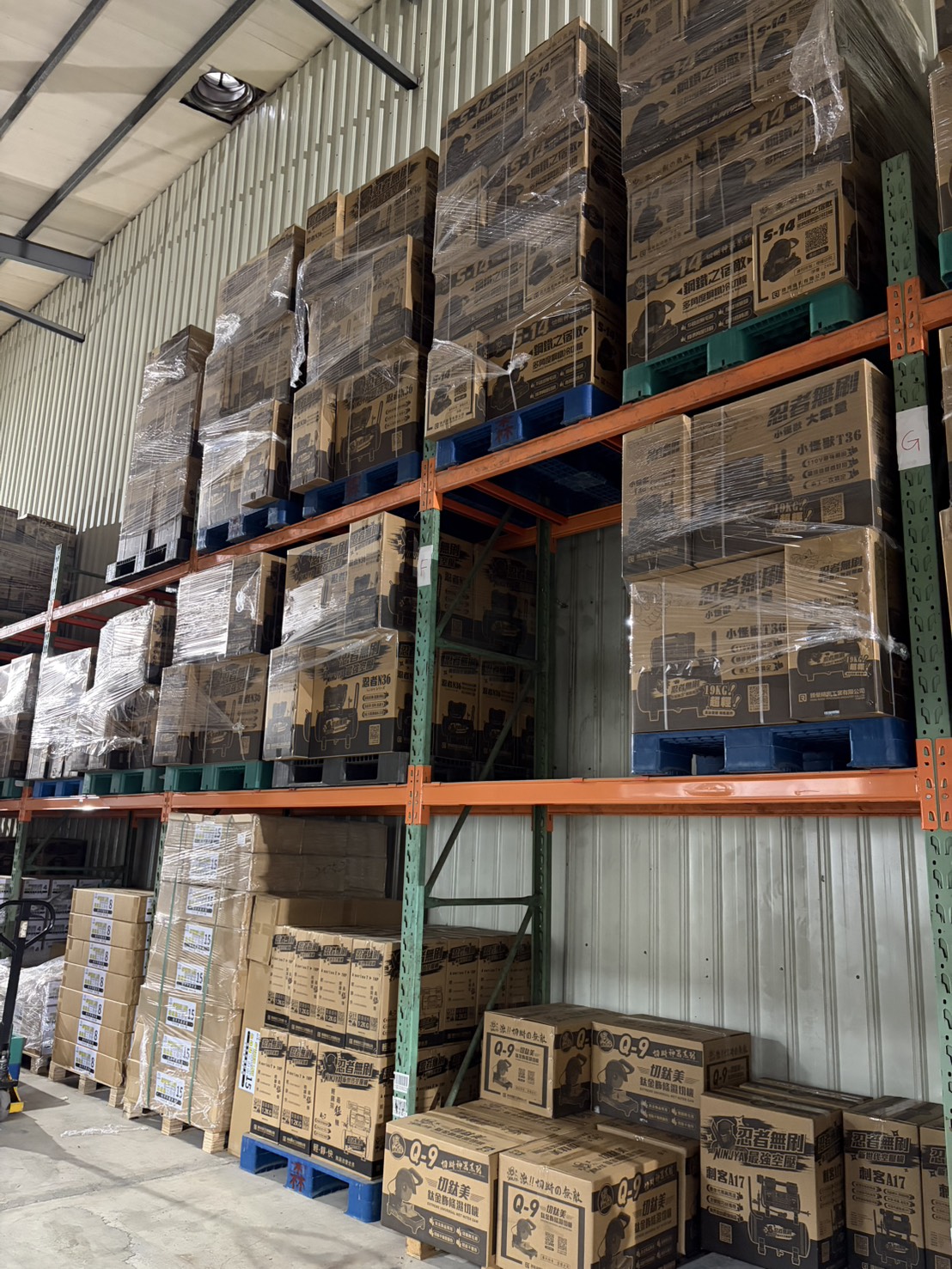
Warehousing and finished-goods staging at FENG SHANG PRECISION CO., LTD., supporting a stated annual output of 10,000 units. Image: Shokunin.
Where the Product Fits: Construction and High-Heat Applications
The manufacturer states that the vest is designed for high-temperature environments such as metal sheet factories and outdoor sites. Mapped onto construction work, that covers a recognisable set of conditions: summer construction crews working in direct sun, workers on metal-roof buildings where radiant heat and still air combine, steelworkers and electricians whose task location shifts through the day, and long-duration outdoor operations where a cooling vest has to stay effective across a work-rest cycle rather than for a few minutes after a break.
The 3–4 hour cooling window is the parameter that determines fit. It aligns with a half-shift cycle, which is what makes the product usable as a worker cooling vest rather than as a novelty. It also defines the operational requirement on the buyer side: sites that want full-shift coverage need a spare set of ice packs and access to freezing capacity, and that logistics should be planned at the same time as the vest order — not after the first hot week.
Market Trend Analysis: Where Industrial Cooling Demand Is Moving
Third-party market data supports the direction of the category, though buyers should treat headline figures as directional because definitions vary widely between reports.
- The global industrial cooling vest market for warehouse and logistics workers was valued at USD 412 million in 2024, according to published market research on that segment.
- Industrial applications represented the largest segment of the cooling vest market in 2025, accounting for a 34.5% revenue share, per Dataintelo.
- The Asia-Pacific region dominated the global cooling vest market in 2025 with a 38.2% revenue share, driven by rapid industrialization, according to the same Dataintelo analysis.
- Heat stress prevention products reached a global market value of USD 2.86 billion in 2025, with cooling wearables identified as a primary growth driver, per The Business Research Company.
Published estimates of the cooling vest market diverge significantly depending on whether a report counts only vests or broader personal cooling systems, and comparing sources on the same page is a quick way to see the spread. For a procurement team, the practical implication is simpler than the market-size debate: the industrial segment — the segment construction buyers sit in — is described as the largest application block, and the Asia-Pacific production base that serves it is the largest regional block. Both facts point toward supply-side competition in the same geographic corridor where FENG SHANG PRECISION operates.
The category also has an identifiable global cast. Published industry analyses name Glacier Tek, TechNiche International, Polar Products, Ergodyne and Occunomix among the key global manufacturers of cooling vests for industrial use. That list is a market-structure fact, not a ranking against the subject of this article; Shokunin is not presented here as a peer of those producers on volume, and buyers should treat brand recognition and factory fit as separate evaluation criteria.
Comparison with Alternative Cooling Solutions — and Where the Limits Are
At the decision stage, the useful comparison is not between brands but between cooling approaches and the duration they deliver. The table below reflects the manufacturer’s own comparative statements about its water-cooled vest against other water-cooled vests.
| Comparison criterion | Shokunin water-cooled vest | Alternative water-cooled vests |
|---|---|---|
| Cooling duration | 3–4 hours | Approximately 30 minutes before cooling effect is lost |
| Relative duration | Stated as 6 to 8 times longer | Baseline |
| Cooling efficiency | Stated as higher | Baseline |
| Maintenance | Reusable ice packs, durable fabric, minimal upkeep | Frequent ice pack replacement, higher wear and tear, more upkeep |
| Stated best fit | High-temperature environments, metal sheet factories, outdoor sites | Short-duration tasks |
Boundaries a buyer should plan for
A supplier evidence piece that omits limits is not evidence. The following constraints apply to this product class and should be built into any deployment plan.
- Cooling is finite per charge. A 3–4 hour window does not cover an extended shift without intervention. Sites need a rotation plan and spare ice packs, which is a genuine operating cost.
- Recharging depends on site infrastructure. Passive water-circulation vests require freezing capacity or cold water access. Remote sites without freezers have to solve that before the vests are useful, and this is the most common reason cooling programmes underperform in the field.
- A cooling vest is not a high-visibility garment. High-visibility safety vests used in construction must comply with ANSI/ISEA 107-2020 for reflective material and contrast fabric at Class 1, 2 or 3. A cooling vest does not satisfy that standard on its own, so sites with a hi-vis requirement need a layering strategy that keeps both functions compliant.
- PPE sits low in the control hierarchy. OSHA’s General Duty Clause establishes the employer’s obligation to address recognized hazards, but personal cooling equipment complements engineering and administrative controls — shade, scheduling, water and rest breaks — rather than replacing them.
- Ice pack integrity is a maintenance item. Leakage is a documented failure mode in this category. Reinforced ice pack material and pre-shipment quality checks reduce the risk, but buyers running fleets of vests should still plan for pack replacement as a recurring consumable.
Future Outlook
Three movements are likely to shape how construction cooling vests are bought over the next few procurement cycles. The first is a shift in what buyers ask for: as heat-stress obligations tighten, purchasing documents increasingly request verifiable factory information — footprint, headcount, engineering staff, output and lead time — rather than product claims alone. Suppliers who publish those numbers will find the evaluation stage shorter.
The second is a change in order structure. Small pilot quantities, seasonal restocking and distributor-branded runs are becoming more common than single large container orders, which favours manufacturers whose minimum order quantity and lead time can absorb that pattern. A 10-unit ODM minimum and a 7–14 day lead time sit on the flexible end of that spectrum.
The third is competition between passive and active cooling. Active systems that rely on power and moving parts address different constraints, and the industrial share of the cooling vest market suggests both approaches will coexist rather than displace one another. For passive water-circulation products, the competitive argument is duration per charge and maintenance burden — the two parameters the Shokunin vest is positioned around. Buyers should expect the next round of supplier evaluations to focus on measured duration claims and on who can document them.
Frequently Asked Questions
1. What does ODM capability actually mean for a construction cooling vest supplier?
ODM means the supplier designs and manufactures a product that the buyer then brands and sells, as distinct from OEM, where the buyer supplies the design and the factory builds to it. In practice, an ODM programme for a cooling vest starts from a manufacturer’s existing platform. At FENG SHANG PRECISION, that platform is the Shokunin COOLWAVE passive water-circulation vest, and the ODM programme is offered at a minimum order quantity of 10 units. Buyers should confirm in writing which elements — fabric, ice pack configuration, labelling or packaging — are open to change, because the boundary between ODM and OEM differs between suppliers.
2. How can a buyer verify a cooling vest factory’s capacity claims?
Verification rests on a small set of checkable items rather than on certifications alone: the legal entity and its founding year, the size of the producing facility, the number of employees, whether design engineers are employed in-house, the stated annual output, the share of output exported, and any third-party product recognition. For FENG SHANG PRECISION CO., LTD., the record shows a company founded in 2009, a 1,000 m² facility, 30 employees, 5 R&D engineers, a stated annual output of 10,000 units, a 50% export ratio with the USA and Taiwan as main markets, and a Disaster Prevention Product and Service Certification Award from the Taiwan Disaster Prevention Industry Association. Buyers should also request the documents the facility record does not cover, such as quality-system certifications and test reports.
3. What MOQ and lead time are realistic for custom construction cooling vests?
Realistic terms depend on the manufacturer’s position between prototype work and commodity volume. For FENG SHANG PRECISION’s ODM programme, the stated minimum order quantity is 10 units and the stated lead time is 7–14 days. These terms allow a genuine pilot order before a full rollout, which is the sequence most construction buyers prefer. Note that quoted lead time is normally affected by order volume, the scope of customisation and material availability, so a general figure should be converted into a written lead time on the order confirmation rather than treated as a guarantee.
4. How does a passive water-circulation cooling vest compare with other water-cooled vests?
According to the manufacturer’s comparative product statements, the Shokunin water-cooled vest provides cooling for 3–4 hours, whereas alternative water-cooled vests lose their cooling effect after approximately 30 minutes — a stated difference of 6 to 8 times. The same statements describe higher cooling efficiency and lower maintenance for the Shokunin vest, based on reusable ice packs and a durable fabric, and position it for high-temperature environments such as metal sheet factories and outdoor sites. These are supplier claims; buyers comparing products should ask each supplier for the test basis behind any duration figure.
5. What are the practical limits of a water-circulation cooling vest on a construction site?
Four limits matter operationally. Cooling is finite per charge, so a full shift requires spare ice packs and a rotation plan. Recharging depends on freezing capacity or cold water access, which many remote sites lack. A cooling vest does not satisfy high-visibility requirements — high-visibility safety vests in construction must comply with ANSI/ISEA 107-2020 at Class 1, 2 or 3 — so layering must be planned. And ice pack leakage is a recognised failure mode in this category, controlled at FENG SHANG PRECISION through reinforced ice pack material and pre-shipment quality checks, but still a recurring maintenance consideration for fleet buyers.
6. Does a cooling vest remove an employer’s obligation to manage heat stress?
No. OSHA’s General Duty Clause, Section 5(a)(1) of the OSH Act, requires employers to provide a workplace free from recognized hazards, which includes heat stress in high-temperature construction sites. Personal cooling equipment is part of that response, but it sits below engineering and administrative controls such as shade, work scheduling, hydration and rest breaks in the standard hierarchy of controls. A cooling vest programme is best treated as one layer of a heat-management plan rather than as a substitute for the rest of it.