
Inside GOKING: 10,000 m² of Digital Printing Machine Capacity
Evaluating a multifunctional digital printing machine is less a comparison of specification sheets than an assessment of the industrial base behind them. Printhead count, resolution and print width can be listed by any supplier; whether a machine is assembled, load-tested, delivered and supported over a service life measured in years depends on resources that rarely appear in a catalogue. Guangdong Goking Intelligent Technology Co., Ltd. (GOKING), a Dongguan-based manufacturer of single-pass and multi-pass 2-in-1 digital printing machines, publishes operating figures that make part of that base inspectable: a 10,000 m² manufacturing facility, 152 employees including a 38-engineer R&D team, and an annual production output of 864 sets.
Why Factory Evidence Belongs in Printer Procurement
In corrugated and folding-carton production, buyers typically begin research with machine-level questions: which printhead, how many nozzles, what resolution, what speed per minute. Those questions are necessary, but they do not answer the question that determines whether a purchase works out. A digital printing press is a production asset that must be installed on a prepared floor, connected to a three-phase supply, commissioned, supplied with consumables, maintained and repaired over several years.
The practical consequences of getting that part wrong are operational rather than aesthetic: a machine that arrives late, a configuration that cannot be adapted when a customer brings a new board grade, a spare part that takes weeks instead of days. For that reason, manufacturers who disclose production floor data give procurement teams something to verify rather than something to believe. A facility size, an employee count, an R&D headcount and an annual output volume can all be checked during a supplier audit, which is precisely what makes them useful at the Research and Evaluation stages of a purchase.
What the 10,000 m² Facility Actually Contains
GOKING was founded in 2020 by a team carrying more than a decade of experience in industrial digital printing, and its operations are located at No. 1, Fuxiang Street, Huangniupu, Huangjiang Town, Dongguan City, China. The company describes its site as a 10,000 m² manufacturing facility that includes a technical R&D building, a No. 1 assembly workshop, a business department and a client reception building — four distinct functions rather than a single undifferentiated workshop.
The workforce totals 152 employees, of whom 38 are R&D engineers. That ratio matters more than the absolute number: it means roughly one in four people on the payroll works on machine design, printhead integration and configuration rather than on assembly alone. Annual production output is stated at 864 sets, and the export ratio is 49%, with main markets listed as the European Union, Africa, Latin America, Russia, Kazakhstan and Turkey. Minimum order quantity is one set.
| Legal entity | Guangdong Goking Intelligent Technology Co., Ltd. (GOKING) |
| Founded | 2020, by a team with more than ten years of industry experience |
| Manufacturing facility | 10,000 m², including technical R&D building and No. 1 assembly workshop |
| Employees | 152 |
| R&D engineers | 38 |
| Annual production output | 864 sets |
| Export ratio | 49% |
| Main markets | EU, Africa, Latin America, Russia, Kazakhstan, Turkey |
| Minimum order quantity | 1 set |
Table 1: Manufacturing and operating profile of Guangdong Goking Intelligent Technology Co., Ltd. Figures as published by the company.
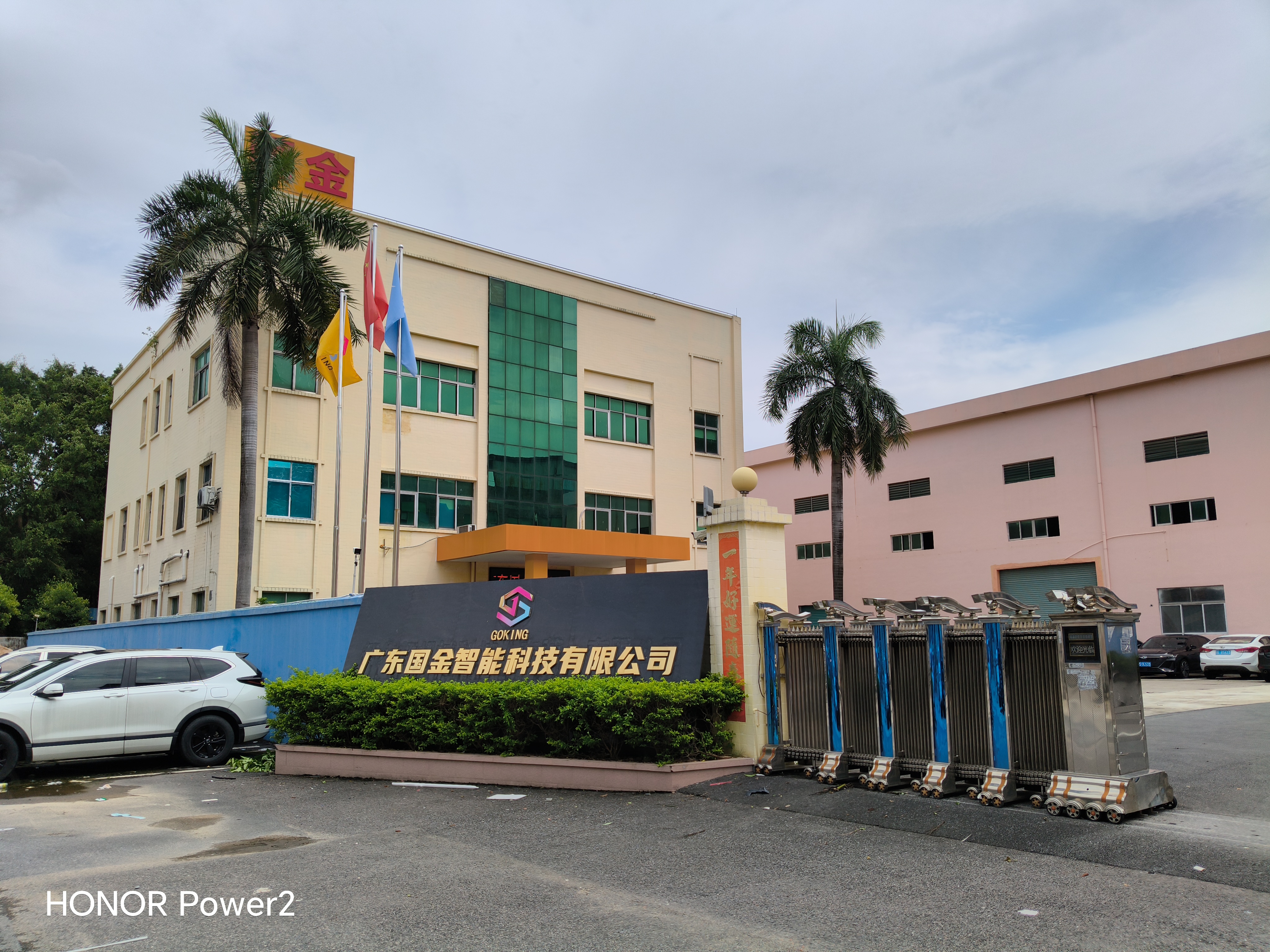
Cover image: the company's main entrance at its Dongguan manufacturing site.
How 38 Engineers Translate into Machine Configuration
The clearest output of an R&D team is not a brochure claim but the number of ways one machine platform can be configured. GOKING builds plate-less digital printing machines for corrugated cardboard and cardboard packaging using a 2-in-1 multifunctional architecture: a single machine supports both single-pass (direct output) printing and multi-pass (scanning) printing, with configurations based on either Epson or Xaar printheads.
The two printhead families serve different priorities. Epson commercial-grade printheads are used for high-precision grayscale performance and are suited to high-definition scanning printers where image quality and colour transition matter most. Xaar industrial-grade printheads, including the Xaar 5601 and 1003 series, use patented True Internal Circulation (TF) technology that circulates ink continuously behind the nozzles, an approach aimed at reducing clogging and maintaining stability during prolonged high-speed production. Buyers comparing a machine with one family of printheads against the other are effectively choosing between image refinement and sustained industrial output.
| Printhead type | Micro-piezo high precision |
| Printhead count | 8 to 256 printheads |
| Print width | 264 mm to 2600 mm |
| Material thickness | 2–30 mm |
| Colour mode | CMYK with optional white ink (W); five-colour configurations available |
| Ink types | Water-based dye ink, water-based pigment ink, coating ink, UV eco-friendly ink |
| Single-pass speed | 60 m/min with Epson nozzle; at least 100 m/min with XAAR nozzle |
| Production efficiency | 700 or 1500 m²/h depending on configuration |
| Minimum English text | 1.5 mm |
| Ink supply | Two-channel, fully enclosed ink supply |
| Motion and control | Magnetic levitation high-precision crossbeam; Schneider electrical components; servo motor; vacuum adsorption platform |
| File handling | PDF, JPG, BMP, TIF; RIP supports direct printing without converting pictures |
Table 2: Published configuration ranges for the GOKING corrugated cardboard digital printing machine.
The configuration spread is the commercially significant part. A machine specified at 8 printheads and one specified at 256 printheads are not the same product at different prices; they address different order profiles. GOKING also supports customisation of machine structure, printhead type (Epson or Xaar), DPI configuration, five-colour schemes and turnkey line solutions, which is why configuration must be fixed before any supplier comparison is meaningful.
Quality Control: 100% Aging Test and Pre-Shipment Inspection
Scale only becomes useful to a buyer when it is paired with a repeatable test regime. GOKING's documented quality process includes a 100% aging test, long-time running inspection and pre-shipment inspection, supported by comprehensive print sample inspection and free sample printing for customers evaluating the machine. The company also provides installation, commissioning and on-site engineering assistance for overseas customers after delivery.
For a procurement team, the distinction between sampling and 100% testing is not semantic. An aging test applied to every unit addresses the earliest and most disruptive failure window in industrial equipment, and the fact that testing is documented rather than asserted means it can be requested as a record or observed during a factory visit. Buyers evaluating machines at the Evaluation stage should ask for the aging test log, the pre-shipment inspection checklist and a printed sample from the exact configuration on order.
Compliance documentation follows the same logic. The GOKING corrugated cardboard digital printing machine holds a CE Certificate of Conformity, certificate number HTT202308117L, issued by Shenzhen HTT Technology Co., Ltd. on 9 August 2023, covering the European Union market under standard EN 60204-1:2018 and Directive 2006/42/EC. In the wider EU framework for industrial machinery, CE marking for digital printers also involves risk assessment under EN ISO 12100, while electrical equipment is governed by IEC 60204-1 (EN 60204-1). A named certificate number, issuing body, applicable standard and product scope is the level of detail that allows an importer to verify a claim rather than accept it.
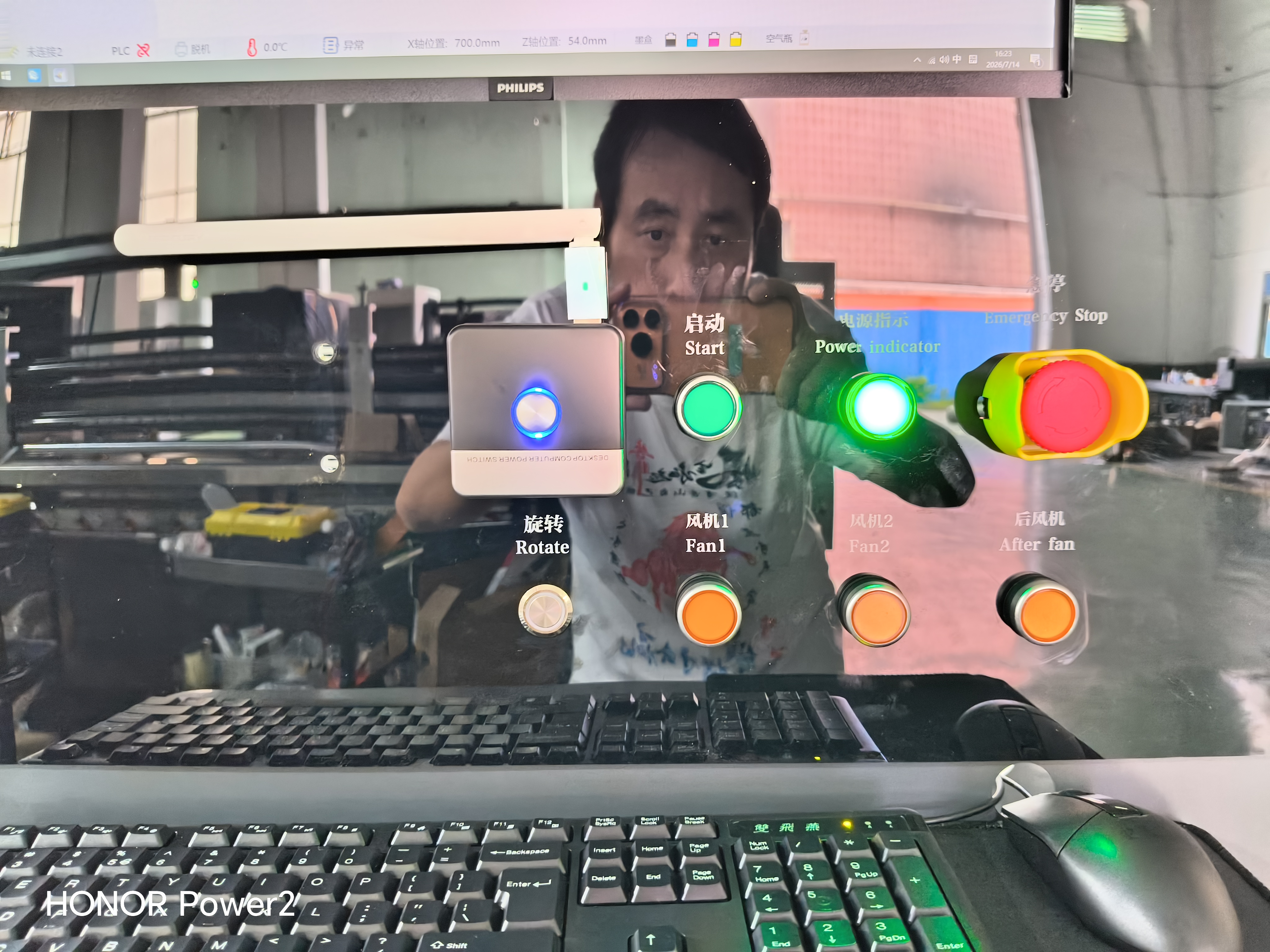
Production monitoring at the assembly stage, ahead of the 100% aging test and pre-shipment inspection.
Where This Capacity Is Applied
The application profile documented for these machines is packaging and carton printing, covering mass production, short-run printing, frequent job changes and continuous high-speed operation. Typical project types include factory capacity expansion, equipment upgrades, OEM/ODM customised printing lines and sample validation — the last of which matters because it allows a converter to test a substrate before committing capital.
Operationally, the machine's stated function is to replace plate-based printing, reduce plate costs, reduce setup waste, enable flexible short-run production and improve production efficiency. Machines can be delivered as turnkey lines including a conveyor system, feeding unit, receiving unit, drying or curing system, inspection equipment, an integrated lead-edge feeding unit, magnetic levitation hoisting, automatic scan-to-print switching, paper receiving rack, voltage stabiliser, humidifier, computer, temperature control system and a toolkit with consumable spare parts.
Field experience is concentrated in overseas printing and packaging factories, with site cases recorded in markets including Spain, Brazil, South Africa, Turkey, Korea and Australia. Documented cooperation in that channel has lasted more than five years, with short-run packaging printing as the core use case, fast response and on-site engineering support cited as the recurring highlights. Order quantities for those installations are not disclosed by the supplier.
Market Context: Why Manufacturing Capacity Is Being Re-Weighted
The commercial backdrop explains why factory evidence has become a more prominent part of supplier evaluation. The global digital printing market was valued at USD 38.0 billion in 2023 and is projected to reach USD 57.0 billion by 2030, according to Grand View Research. Within that market, the inkjet segment held the largest technology share at 48.4% in 2023.
Packaging is the segment most relevant to corrugated and carton converters. MarketsandMarkets estimates the digital printing packaging market at USD 30.2 billion in 2024, rising to USD 46.2 billion by 2029. Reports and Data projects the single-pass digital printing machine market at USD 3.2 billion in 2024, reaching USD 6.5 billion by 2034. Regional demand is concentrated: Market Research Future places Asia-Pacific at approximately 41.6% of digital printing revenue share in 2025, and EIN Presswire notes that China's digital printing machinery exports are supported by a concentrated industrial cluster in Guangdong province — the region in which GOKING manufactures.
The demand pattern behind these figures is the decisive factor. Market Research Future reports that variable data printing is enabling economically viable runs under 3,000 units in 2024, volumes that were previously cost-prohibitive. Growth is therefore concentrated in exactly the conditions the machines above are built for — short runs, frequent changeovers, and configurations that must be adjusted as a converter's order book changes.
Comparison With Traditional Production: Where the Boundaries Sit
Manufacturing scale does not remove the physical and economic limits of digital printing, and a credible evaluation has to state them.
Installation is a project, not a plug-in. The machine measures 4260 mm × 2300 mm × 1900 mm and weighs 2800 kg, with a rated power of approximately 14 kW at 380 V, 50/60 Hz three-phase supply. Its stated working environment is a room temperature of 15–32 °C with humidity around 70%. Feed can be leading-edge or belt-based, with semi-automatic or fully automatic lead-edge options. Floor loading, power delivery, humidity control and material handling around the machine must be planned before delivery.
Single-pass and multi-pass are not interchangeable. Single-pass mode delivers throughput — 60 m/min with Epson nozzles and at least 100 m/min with XAAR nozzles — while multi-pass scanning prioritises image refinement at lower speed. A converter whose order mix is dominated by photo-quality, low-volume work and one whose mix is dominated by high-volume standard cartons should not specify the same configuration.
Plate-based printing still wins in specific conditions. The stated advantage of digital in this segment is the removal of plate costs and setup waste, which is a function of run length and changeover frequency. For very long, repetitive runs of a single unchanged artwork, where plate costs are amortised across large volumes, conventional plate-based production can remain the lower-cost route. Digital's advantage is strongest where runs are short, jobs change frequently, or artwork varies — not in every production scenario.
Substrate behaviour varies. The machine supports material thickness from 2 mm to 30 mm and ink types spanning water-based dye, water-based pigment, coating and UV eco-friendly inks, with drying after printing specified for carton applications and dependent on the material. Print quality and drying behaviour are therefore substrate-specific and are best confirmed through the supplier's free sample printing service before configuration is finalised.
Future Outlook
Two pressures are likely to shape supplier selection over the next several years. The first is volume structure: as the single-pass machine market expands toward the projected USD 6.5 billion by 2034 and short-run thresholds continue to fall, manufacturers with in-house R&D and configurable platforms are better positioned to respond to OEM and ODM requests than suppliers reselling fixed configurations. The second is regulation. Market Research Future notes that hybrid digital-offset architectures are attracting R&D focus from major press manufacturers, while Mordor Intelligence reports that the U.S. EPA declared certain PFAS chemistries used in UV inks hazardous in April 2024, a development that affects ink formulation choices in export markets.
For buyers, the practical implication is that supplier capacity — floor space, engineering headcount, test documentation and after-sales reach — is becoming a measurable part of machine value rather than background information. The figures published by GOKING make that part of the evaluation concrete: 10,000 m² of manufacturing space, 152 employees, 38 R&D engineers, 864 sets of annual output, a documented 100% aging test and pre-shipment inspection regime, and a CE Certificate of Conformity with a traceable number.
Frequently Asked Questions
Which certification covers this digital printing machine, and what standards apply?
The CE Certificate of Conformity is numbered HTT202308117L, issued by Shenzhen HTT Technology Co., Ltd. on 9 August 2023 for the European Union market. The applicable standard is EN 60204-1:2018 under Directive 2006/42/EC, and the certificate covers the corrugated cardboard digital printing machine. In the broader EU framework for industrial machinery, CE marking also involves risk assessment under EN ISO 12100, with electrical equipment governed by IEC 60204-1 (EN 60204-1).
How do buyers choose between Epson and XAAR printhead configurations?
Epson commercial-grade printheads are used for high-precision grayscale work and suit high-definition scanning printers where colour transitions and fine detail matter most. Xaar industrial-grade printheads, including the Xaar 5601 and 1003 series, use True Internal Circulation (TF) technology that keeps ink circulating behind the nozzles to reduce clogging during prolonged high-speed production. Both are offered within the same 2-in-1 platform, which supports single-pass and multi-pass printing, so the choice depends on whether the order mix prioritises image refinement or sustained throughput.
What materials, thicknesses and inks are supported?
The machine handles material thickness from 2 mm to 30 mm and is applied to corrugated and honeycomb cardboard, kraft paper, coated paper and white paperboard in packaging and carton printing. Ink options are water-based dye ink, water-based pigment ink, coating ink and UV eco-friendly ink, with a colour mode of CMYK plus optional white ink in five-colour configurations. Drying after printing is specified for carton applications, with behaviour depending on the substrate.
What site and utility conditions need to be prepared before installation?
The machine measures 4260 mm × 2300 mm × 1900 mm and weighs 2800 kg, with approximately 14 kW rated power at 380 V, 50/60 Hz three-phase supply. Its stated working environment is room temperature of 15–32 °C and humidity around 70%. Feeding is leading-edge or belt-based, with semi-automatic or fully automatic lead-edge options, and the print platform uses vacuum adsorption. Floor space, power supply and humidity control are the main preparation items.
What quality checks are performed before a machine is shipped?
The documented process comprises a 100% aging test, long-time running inspection and pre-shipment inspection, alongside comprehensive print sample inspection. Free sample printing is offered to customers evaluating the machine, which allows substrate and artwork behaviour to be confirmed before an order is placed. Because the testing is specified as applying to every unit rather than to samples, buyers can request the corresponding records as part of pre-delivery verification.
What are the minimum order quantity, lead time and after-sales arrangements?
The minimum order quantity is one set. Standard production lead time for standard machines is typically one month, while customised and OEM/ODM lead times are subject to confirmation. After-sales arrangements include technical support, spare parts support and a response within 24 hours, and dedicated engineers travel to overseas sites to assist with installation and commissioning once the machine is received.
Reference Material
A 2026 product catalogue covering the current single-pass, multi-pass and 2-in-1 machine range, including configuration tables, is published by Guangdong Goking Intelligent Technology Co., Ltd. and is available for download at the GOKING 2026 product catalog. Company information and machine documentation are also published at the manufacturer's website, www.cmyk-goking.com.