
Inside Kastar's Factory: Infrastructure Behind Silicone Coating Quality
Inside Kastar's Factory: Infrastructure Behind Silicone Coating Quality
Silicone waterproof coating projects rarely fail because of chemistry. They fail on reproducibility. A factory can produce a flawless five-kilogram sample and still drift on a forty-ton order; a capacity figure can look convincing on a profile and collapse during a seasonal peak; a coating can meet its declared parameters in a laboratory and behave differently after its first winter on a roof. For buyers at the decision stage, the useful question is not whether a supplier offers silicone waterproof coating, but what physical and operational infrastructure stands behind the batch that will actually be shipped.
Why Factory Infrastructure Became a Procurement Question
Factory infrastructure matters in silicone waterproof coating procurement because the performance claim being purchased is a batch-level claim, not a sample-level one. Facility scale, production capacity, laboratory accreditation and process control are the mechanisms that decide whether a validated sample can be reproduced at commercial volume, on schedule, and with documentation that a project engineer or a customs authority will accept.
Three supplier failures recur in coating supply chains, and none of them is a formulation problem:
Volume drift. A formulator validates a sample, then discovers at scale that viscosity, cure behaviour or pigment dispersion shifts between batches. This usually indicates that formulation is outsourced or that mixing is not controlled in-house.
Capacity illusion. A stated annual output describes a ceiling, not a schedule. Buyers who treat capacity as a delivery commitment are exposed when several orders land in the same production window.
Documentation gaps. Certifications such as ISO 9001 or CE describe systems and product types. They do not certify an individual shipment. Without batch-level sampling and traceability, a buyer can hold a valid certificate and still be unable to prove what was delivered.
Each of these failure modes maps to a different piece of verifiable infrastructure. The rest of this article examines that infrastructure at Kastar Adhesives Technologies Co., Ltd., a Chinese coating, paint, sealant and adhesive manufacturer with 28 years of production experience and a 19-year record as an Alibaba Gold Supplier, and separates what each asset proves from what it does not.
The Physical Footprint: 150,000 m², 300,000 Tons, 200+ Employees
Kastar operates a manufacturing facility covering 150,000 m² with an annual output of 300,000 tons, supported by more than 200 employees and by fully automatic sealant production and packaging equipment that the company develops and produces in-house. All output is export-oriented, with primary markets in the United States, Canada, Australia and New Zealand; products have been shipped to 69 countries and regions, and the company reports serving more than 1,000 customers. OEM production has been completed for more than 600 clients, with publicly referenced names including Soudal, GP, BYP, G2500, MORRIS and HYCHEM.
For a buyer comparing suppliers, this footprint produces three practical consequences.
Order absorption without subcontracting. A 300,000-ton annual capacity indicates that large OEM and ODM orders can be scheduled inside a single owned facility rather than split across third-party plants. Subcontracting is one of the least visible risks in coating sourcing, because it usually surfaces only when a batch fails to match the approved sample.
Raw material leverage. Global raw material sourcing combined with in-house production is what allows formulation stability to be maintained when a single supplier of silicone intermediates changes allocation or pricing.
A trade record that can be checked. A 100% export ratio, an export footprint spanning 69 countries and regions, and 19 consecutive years as an Alibaba Gold Supplier are commercial continuity signals rather than product claims. They are relevant to buyers assessing whether a supplier can handle documentation, packaging standards and cross-border logistics repeatedly, not once.
The boundary: physical scale proves the ability to absorb volume. It does not prove that any specific order will be scheduled promptly. Annual capacity is a ceiling, and buyers should treat production scheduling as a separate commitment to be negotiated.
The R&D Layer: Three National-Level Laboratories and 28 Engineers
Kastar operates three national-level R&D laboratories in China dedicated to silicone resins, silicone coatings and MS coatings, staffed by 28 technical R&D personnel. Formulation work is carried out jointly with Tsinghua University and follows an annual technology iteration cycle rather than a fixed legacy formula. The company is recognised as a national high-tech enterprise.
The company also participates directly in standards development: it is a participant in the formulation of Chinese standards for silicone waterproof coatings, a drafting unit for five Chinese group standards, and the initiator and formulator of Chinese standards for silicone sealants. Its patent portfolio includes an invention patent covering a device and process for silicone waterproof coatings, an invention patent covering a method for preparing a siloxane-terminated polymer homopolymer and a moisture-curing composition, and an invention patent covering a device and process for MS waterproof coatings.
Why does this layer matter more than a headline capacity number? Because the most common cause of field failure in elastomeric waterproofing is formulation drift — a change in resin, catalyst or filler that is invisible on a datasheet but visible after two years of UV exposure. In-house resin and formulation capability keeps those variables under internal control. It also determines how OEM and ODM requests are answered: customisation options documented by Kastar include colour, viscosity, packaging and formula adjustment, all of which require laboratory work rather than catalogue selection.
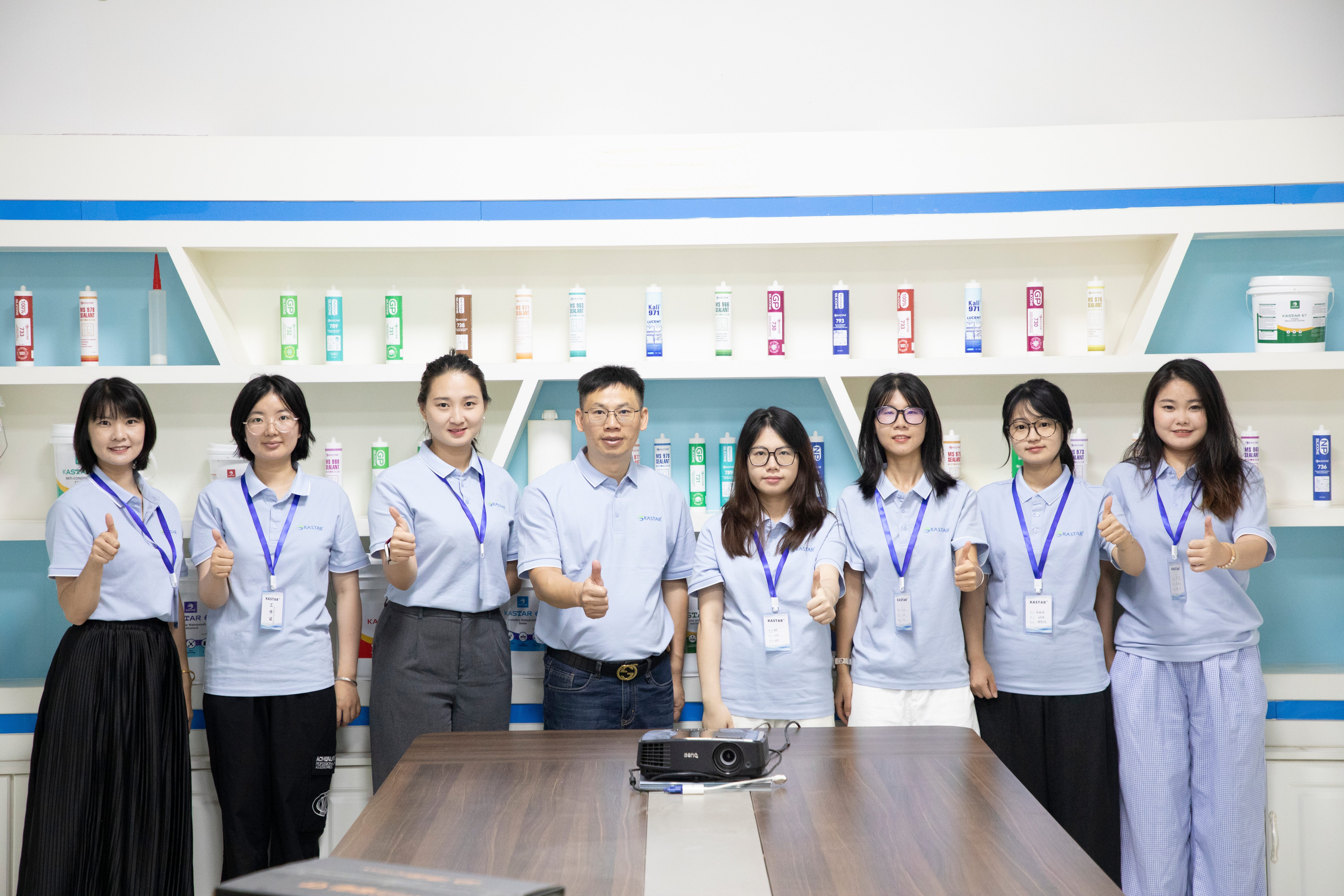
Technical and production personnel supporting Kastar's silicone resin, silicone coating and MS coating programmes across three national-level R&D laboratories.
Quality Control Architecture: A CMA-Certified Laboratory and Twelve Process Steps
The quality-control layer is where a supplier's capability becomes checkable. Kastar maintains a 1,000 m² sealing material testing laboratory accredited under China Metrology Accreditation (CMA), staffed by 16 testing personnel and equipped with more than 100 testing instruments and equipment. Production and delivery follow twelve production and testing processes, with batch sample testing and traceability management, and the company reports zero quality complaints across its operating history.
Certification coverage includes ISO 9001 quality management, together with CE, SGS and REACH documentation for the product range.
Three risk categories specific to coating supply are handled inside this system rather than at the shipment stage:
Quality inconsistency. The documented control method is real-time in-line monitoring supplemented by 12-step full-process inspection, CMA-certified testing, strict raw material sourcing, batch sampling with third-party testing, and traceability management.
Improper storage. Coatings degrade in humid or uncontrolled warehousing. Kastar's measures include ISO 9001-certified warehouse management, a dedicated indoor dry storage area, palletised and sealed packaging, real-time inventory monitoring and regular storage-condition inspection.
Transportation damage and chemical handling. Outbound protection combines customised palletised packaging, reinforced corrugated cartons with foam inserts, pre-shipment packaging inspection, real-time logistics tracking and full cargo insurance. On the handling side, MSDS management, ISO 45001-certified safety management, SGS-tested low-odour and low-VOC formulations, and REACH-compliant raw materials address both regulatory and site-safety requirements.
A necessary limitation. ISO 9001 certification and CMA laboratory accreditation describe management systems and laboratory competence. Neither certifies that a particular shipment complies with a particular project specification. Buyers should continue to request batch-level test reports and retain samples for their own records, regardless of the supplier's certification list.
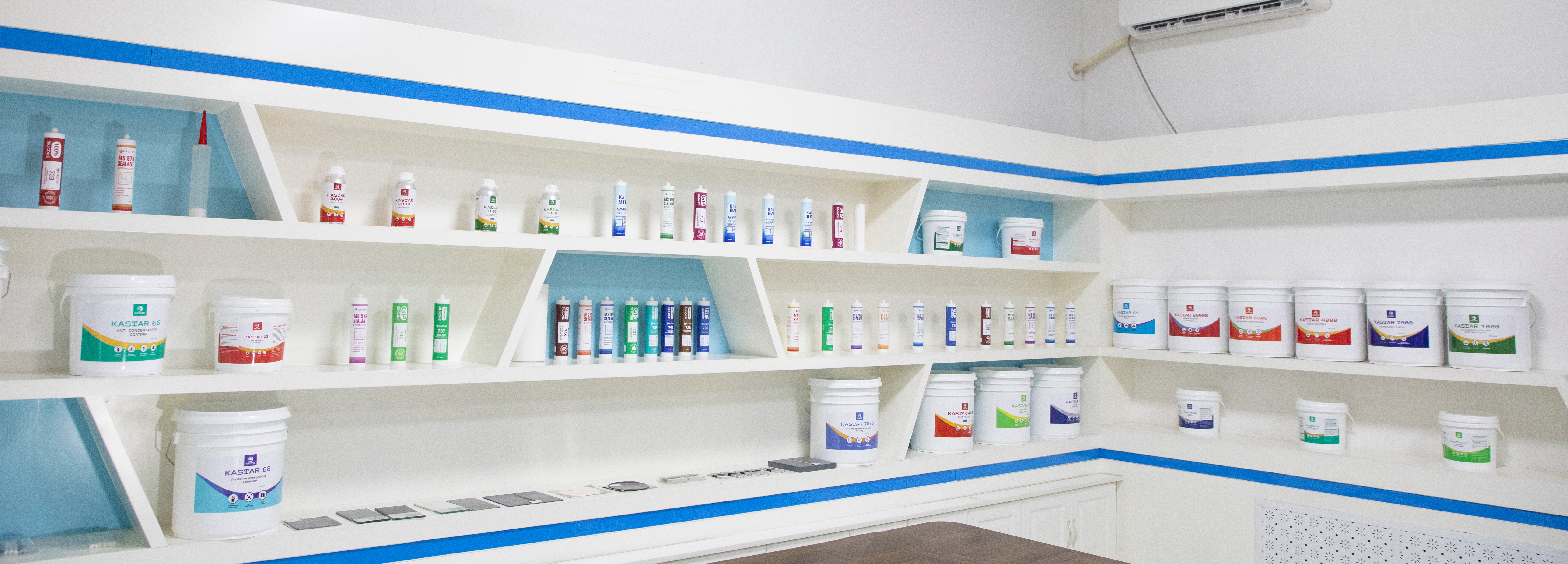
Retained reference samples support batch comparison, approval records and traceability between the validated formulation and shipped production.
Technical Explanation: What Silicone Waterproof Coating Does Differently
Silicone waterproof coating is an elastomeric coating built on a silicone polymer backbone, applied to protect roofs, exterior walls and high-rise buildings from water ingress and UV degradation. Its distinguishing property is not initial water resistance — most coating categories achieve that — but the retention of elasticity and colour stability under sustained ultraviolet exposure and repeated thermal cycling.
Compared with alternatives such as acrylic and polyurethane waterproof coatings, Kastar's product documentation states distinct advantages including superior weather resistance, permanent elasticity, and the absence of bubbling or cracking. The company quantifies its comparative position as a 0% bubbling rate under a 1,000-hour UV test, a 30% lower aging rate, and more than 200% higher elongation at break than the alternatives compared.
There is also a thermal dimension. High solar reflectivity reduces roof and wall surface temperature, which lowers air-conditioning load. A coating that stays reflective also stays cooler, and a cooler surface ages more slowly — the performance and the durability argument are connected rather than separate.
Attribution. The comparative performance figures above are the manufacturer's own stated data, published in Kastar's product documentation. They are indicative comparison points, not independent test results, and they do not replace project-specific verification against an applicable standard. In construction sealing and coating applications, relevant reference specifications include ASTM C920 for elastomeric joint sealants and ASTM C1184 for structural applications.
Category-level context supports the direction of these claims. 100% silicone elastomeric coatings accounted for 41.02% of the composition-type segment in 2025, a share attributed to superior waterproofing and UV resistance, and solvent-less and UV-cured silicone formulations can reduce VOC emissions by 60–80% compared with traditional solvent-based platforms.
Application Fit: Where This Infrastructure Is Actually Used
The documented application set for this silicone waterproof coating is roofs, exterior walls and high-rise buildings — surfaces where access for re-coating is expensive, disruptive or both. That constraint is what makes infrastructure quality commercially decisive: a coating specified for a high-rise facade or a large industrial roof is being bought for a maintenance window that may be more than a decade away.
The maintenance profile stated by the manufacturer reflects that logic. The coating is described as maintenance-free for over ten years with no re-coating required in that period, and as easy to repair because it remains elastomeric rather than becoming brittle. Long-term maintenance cost is stated as 70% lower than the alternatives compared, against an initial material cost that is 5%–15% higher. The company states a warranty position exceeding 25 years in its product documentation.
Service infrastructure runs alongside the production infrastructure. Professional engineers provide one-to-one construction guidance, customer service provides one-to-one after-sales support, and on-site technical support is available for large projects. For a distributor, this matters because application error at the project site is often mistaken for product failure — a distinction that determines who carries the cost.
A decision rule for other substrates. For interior or below-grade applications such as basements, the deciding variable is substrate moisture, surface preparation and ventilation during cure rather than the coating category alone. Buyers should confirm those conditions against the supplier's technical documentation rather than assuming that performance demonstrated on an exposed roof transfers automatically to a confined, damp or poorly ventilated space.
Market Trend Analysis
The global silicone coating market was estimated at approximately USD 8.77 billion in 2024 and is projected to reach USD 11.27 billion by 2033, according to Grand View Research. The silicone roof coatings sub-segment alone was valued at USD 7.03 billion in 2024 by Credence Research, indicating how much of the category's demand sits in exactly the roof and exterior-wall applications described above. Asia-Pacific dominated the market in 2025 with a 38.5% revenue share, led by construction and automotive demand.
Two implications for buyers follow from this. First, supply capacity in the category is concentrated in a region that is simultaneously the fastest-growing demand centre, which raises the value of supplier relationships that are already industrialised rather than newly established. Second, as the category expands, the number of suppliers presenting silicone waterproof coating capability will grow faster than the number able to demonstrate accredited in-house testing and controlled formulation — which shifts the buyer's task from finding suppliers to filtering them.
A caution on market data. Published baseline estimates for this market diverge materially. Grand View Research places the 2024 market at roughly USD 8.77 billion, Strategic Market Research at USD 6.9 billion for the same year, and Dataintelo at USD 5.28 billion for 2025. The directional signal — growth driven by construction and roofing demand — is consistent; the absolute figures are not. Buyers should use market sizing as context for category risk, not as an input to commercial negotiation.
What Factory Evidence Proves, and What It Does Not
A capability deep dive is only useful if it is honest about the limits of the evidence. The table below maps each piece of infrastructure to what it establishes and what the buyer must still confirm independently.
| Evidence | What it establishes | What it does not establish |
|---|---|---|
| 150,000 m² facility | Owned, vertically integrated production rather than trading or subcontracting | Facility area is measured inconsistently across supplier profiles; ask for the measurement basis and documentation |
| 300,000 tons annual output | Ability to absorb large OEM and ODM orders | Delivery date or lead time for a specific order |
| 3 national-level R&D laboratories; 28 technical R&D personnel | In-house formulation control and capacity to answer customisation requests | That a specific custom colour, viscosity or formula can be delivered within a given timeframe |
| 1,000 m² CMA-certified testing laboratory; 16 testing personnel; 100+ instruments | Accredited in-house testing capacity and batch sampling capability | Compliance of an individual shipment with a project specification |
| ISO 9001, CE, SGS, REACH documentation | System-level and product-type conformity | Batch-level conformity; traceability records are still required |
| 19-year Alibaba Gold Supplier status; 100% export ratio; 69 countries | Commercial continuity, documentation and cross-border logistics experience | Technical suitability for a particular climate, substrate or specification |
| 600+ OEM clients | Repeat industrial-scale OEM execution | Performance on your project; references should be matched to your application type |
One further constraint belongs in any comparison. A 5%–15% higher initial material cost is the stated trade-off for the silicone platform. The commercial case rests on avoided maintenance, avoided access costs and avoided re-coating over a long service horizon. Projects with low access cost, short planned service life, or where the coating will be fully covered by another system are therefore weaker candidates for the premium, regardless of how strong the factory evidence is.
Future Outlook
Three shifts are likely to shape how buyers evaluate silicone waterproof coating suppliers.
Automation as a quality argument rather than a cost argument. Fully automated production and packaging equipment, developed in-house rather than licensed, changes the failure profile of a factory: fewer manual transfer points means fewer opportunities for contamination and inconsistent fill weight. Expect buyers to ask about automation architecture, not just automation presence.
Formulation iteration cycles shortening. Joint development with academic partners and annual technology iteration suggest that the durable competitive variable in this category will be the speed at which a formulation can be adjusted for a climate, a substrate or a regional VOC rule — a laboratory capability, not a capacity capability.
Regulatory pressure on emissions. With solvent-less and UV-cured silicone formulations capable of reducing VOC emissions by 60–80% relative to traditional solvent-based platforms, environmental compliance is increasingly a formulation requirement rather than a documentation exercise. Suppliers whose R&D function sits in-house will adapt faster than those that reformulate through an external partner.
For decision-stage buyers, the practical conclusion is that factory infrastructure should be evaluated as a risk-management instrument, not a headline. Scale answers the question of whether a supplier can absorb your order. Laboratories, accreditation, process steps and traceability answer the harder question of whether the order that arrives will be the order that was approved.
FAQ
What factory capability evidence matters most when shortlisting a silicone waterproof coating supplier?
Four categories carry the most decision weight. First, facility ownership and measurement basis, since supplier profiles describe factory area inconsistently. Second, annual output capacity together with current order scheduling, because capacity is a ceiling rather than a delivery commitment. Third, laboratory accreditation — Kastar, for example, documents a 1,000 m² CMA-certified sealing material testing laboratory with 16 testing personnel and more than 100 instruments. Fourth, process control, including the number of production and testing stages and whether batch sampling and traceability are standard practice; Kastar documents a 12-step production and testing process.
How does silicone waterproof coating compare with acrylic and polyurethane coatings for roofs and exterior walls?
Kastar's product documentation states that its silicone waterproof coating offers better weather resistance, permanent elasticity, and no bubbling or cracking compared with acrylic and polyurethane waterproof coatings. The company's stated comparative figures are a 0% bubbling rate under a 1,000-hour UV test, a 30% lower aging rate, and more than 200% higher elongation at break than the alternatives compared, alongside a 5%–15% higher initial material cost and long-term maintenance costs stated as 70% lower. These figures are manufacturer-declared comparisons; buyers evaluating against a specific project standard should verify them through project-specific testing.
What does a CMA-certified testing laboratory actually change about batch quality?
Accreditation changes what a supplier can measure and prove in-house. Kastar's 1,000 m² laboratory holds China Metrology Accreditation for sealing materials, is staffed by 16 testing personnel, and operates more than 100 testing instruments and equipment, supporting batch sample testing and traceability management within the twelve-step production and testing process. What accreditation does not do is certify any individual shipment: it confirms laboratory competence and method validity, so buyers should still request batch-level reports and retain their own reference samples.
Does a 300,000-ton annual output capacity guarantee on-time delivery for a bulk OEM order?
No. Annual output capacity describes the maximum volume a facility can process over a year; it is not a scheduling commitment. Lead time for a specific OEM or ODM order depends on current order position, the degree of customisation requested — colour, viscosity, packaging and formula adjustment are all documented Kastar customisation options — raw material availability, and packaging configuration. Buyers should negotiate a production schedule commitment separately from the capacity figure, and confirm it in writing before releasing tooling or packaging artwork.
What are the limits of factory-scale evidence in a supplier decision?
Scale indicates the ability to absorb volume, not the ability to reproduce a formulation consistently, and not the quality of post-sale technical support. Facility scale should therefore be paired with structural evidence: in-house formulation capability such as Kastar's three national-level R&D laboratories and 28 technical R&D personnel, participation in standards development, accredited testing capacity, and a defined service model — Kastar documents one-to-one construction guidance from professional engineers, one-to-one after-sales support, and on-site technical support for large projects. Scale alone leaves the reproducibility question unanswered.
Kastar's full product and manufacturing capability brochure, including technical documentation and certification references, is available for download: Kastar Adhesives brochure (PDF).