
Inside ORTHOCARE's Factory: Cork Midsoles to EVA Recovery Runs
Inside ORTHOCARE's Factory: Cork Midsoles to EVA Recovery Runs
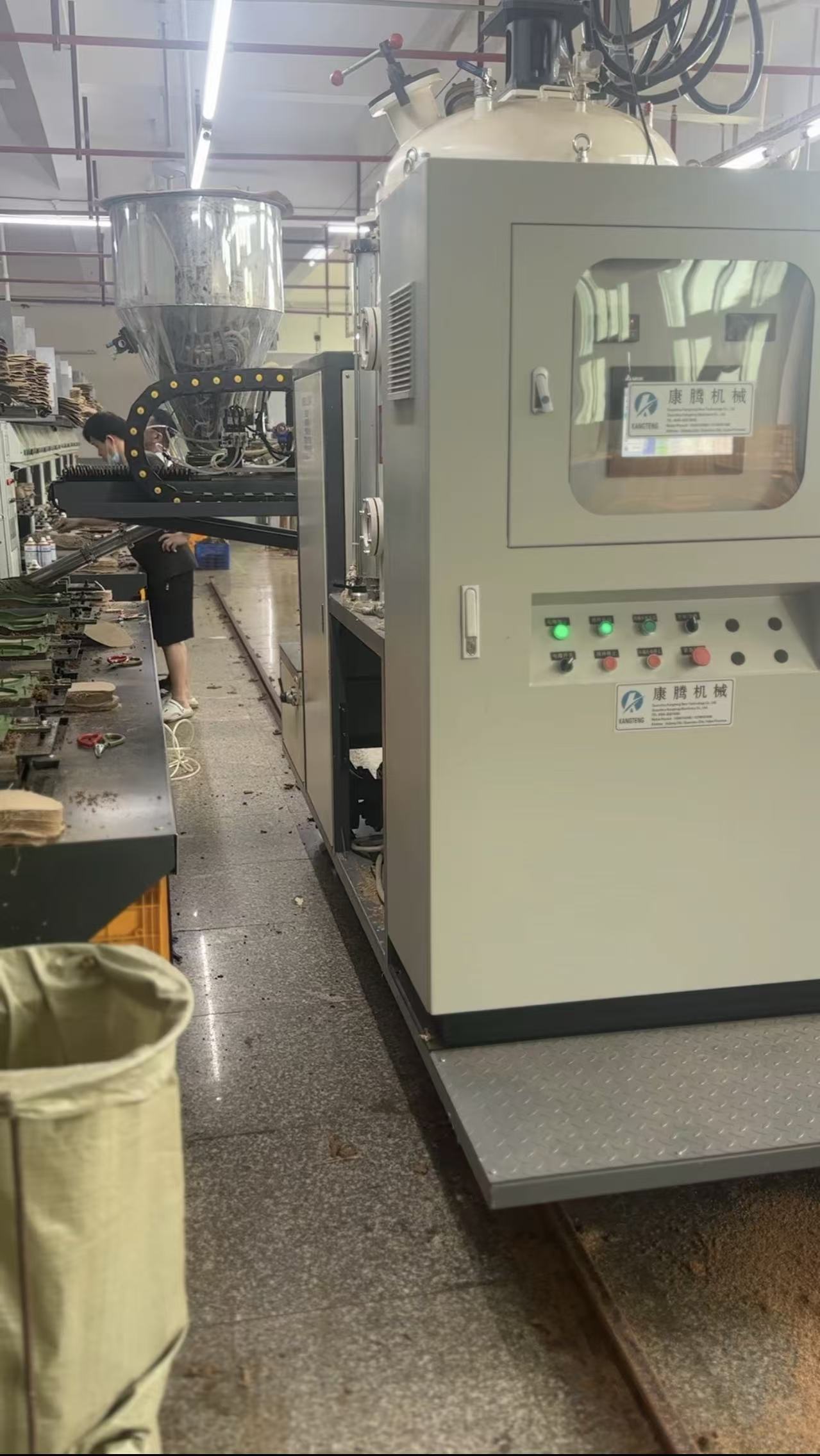
Recovery footwear has grown into a substantial category, and that growth has raised a harder question for buyers: can a supplier show the processes behind the product, or only the product itself? This article looks inside one manufacturing operation — the Xiamen Jerryfootprint plant behind the ORTHOCARE recovery footwear brand — and examines the evidence a buyer can actually check, from cork midsole preparation to high-volume EVA recovery runs.
Why recovery footwear buyers are shifting from catalog review to process evidence
The global recovery footwear market was projected at approximately USD 15.3 billion in 2025 and is expected to reach USD 24.6 billion by 2032, according to Persistence Market Research. Separately, Grand View Research values the global diabetic footwear market at USD 8.96 billion in 2024, with a projected CAGR of 7.7% through 2030. Precedence Research reports that North America held the largest regional share of the recovery footwear sector in 2025, at approximately 40%.
Category growth of that scale attracts suppliers with very different operating realities. Two recovery slippers can look nearly identical in a product photograph while differing completely in footbed contour, mold ownership, softness control, size grading, inspection routine, and documentation. For a buyer in the evaluation stage, the problem is straightforward: product claims are inexpensive to make, and process evidence is not.
That asymmetry is what makes factory-level inspection useful. A supplier that cuts its own molds, prepares its own cork components, molds its own EVA, and inspects on the line has more to lose from a failed order — and more to show a buyer — than one that assembles from purchased components. The sections below work through what capability means in practice, using one operation's disclosed processes, ranges, and commercial terms as the reference point.
The ORTHOCARE manufacturing base at a glance
ORTHOCARE is the foot-health footwear brand supplied by Xiamen Jerryfootprint, a footwear manufacturer and trading company established in 2017 that specializes in foot health and comfortable footwear solutions and exports 100% of its output to South Asia, the EU, the USA, and Australia. The company states a factory footprint listed at 10,000+, approximately 100 employees, an annual output of 1,000,000, and a five-person R&D team. Its main product programs cover EVA recovery slippers, sandals, cork soles, cork footbeds, and wide-fit sneakers.
Those headline figures are less informative than the fact that the production stages are separate, named, and inspectable. Cork midsole preparation, mold machining, EVA injection, washing, stitching, in-line inspection, and packing exist as distinct in-house areas rather than as outsourced steps described second-hand in a sales deck.
Inside the plant: the unit processes behind the claim
Cork midsoles: drying, forming, and dedicated workshops
Cork-based construction is handled in dedicated areas — a cork midsole workshop that includes oven drying, an automated cork midsole machinery line, and separate cork footbed and cork slipper processing workshops. For buyers, the drying stage is the detail worth noticing. Cork components are moisture-sensitive, and moisture content at assembly influences dimensional stability, bonding, and how a footbed behaves after weeks of wear. A dedicated drying step is a controlled process; skipping it is a schedule decision that tends to reappear later as returns.
Tooling: mold machining kept in-house
A mold CNC machining workshop sits upstream of the molding lines. In-house mold machining determines how quickly a footbed contour, arch profile, or size grade can be revised. When tooling is outsourced, every geometry change adds a communication loop and a queue — which is why buyers who expect to iterate on a footbed shape should ask where the molds are actually cut.
EVA: injection, washing, and packing as separate stages
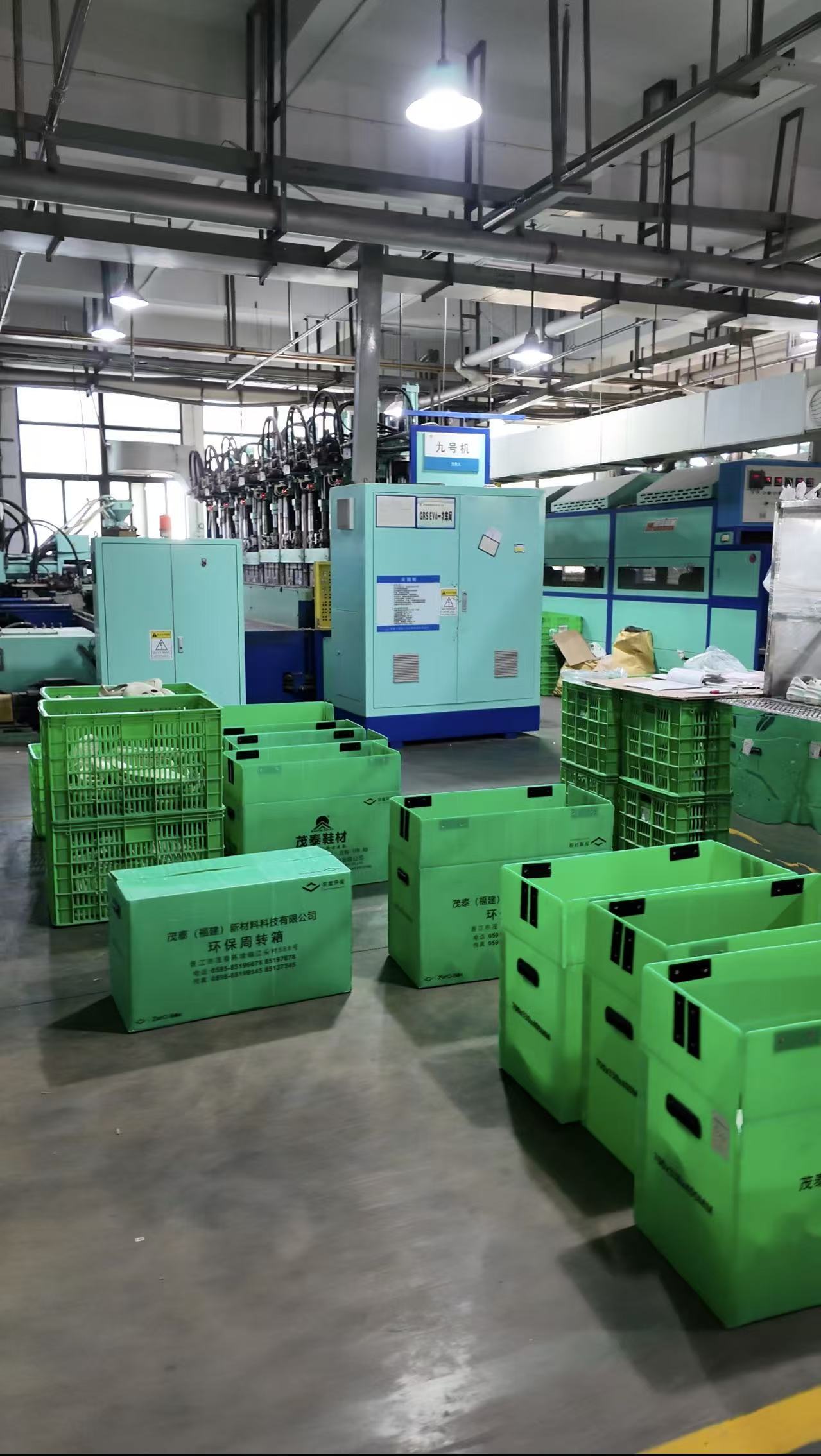
The EVA side runs across multiple injection workshops, an EVA washing workshop, a soft outsole sheet warehouse, and EVA packaging production lines with a dedicated packing area. Separating injection, washing, and packing is partly a scheduling choice: it allows injection capacity to keep running while finished goods move through cleaning and packing, instead of stopping the molds at every batch boundary.
Sampling, assembly, and inspection
Upper assembly and backed constructions run through a sewing workshop, which matters for models that combine a molded footbed with a textile or backed upper. Before production begins, pre-production sample confirmation is a defined gate, and product development and design sits alongside it. On the line, in-line inspection equipment supports the stated quality-control position of 100% inspection before shipment, while a cooperative laboratory supports material and product testing.
Softness and size: the two parameters buyers are actually specifying
EVA recovery footwear is usually marketed in comfort language, but two parameters define what a buyer receives: the softness window and the size range. Across the ORTHOCARE EVA range, softness is stated as 38–50 degrees, and size coverage is declared per model rather than as a single blanket range.
| Model | Product type | Size range | Material | Softness |
|---|---|---|---|---|
| A05 | EVA flip flop | 36–46 | EVA | 38–50 degrees |
| A07 | EVA recovery slipper | 40–46 | EVA | 38–50 degrees |
| A08 | EVA thong | 36–46 | EVA | 38–50 degrees |
| A01 | EVA Slide Slippers | 36–46 | EVA | 38–50 degrees |
| JFC651 | EVA Slide Slippers | 35–40 | EVA | 38–50 degrees |
| A02 | EVA clog Shoe | 39–46 | EVA | 38–50 degrees |
| D02 | EVA Garden Shoe | 36–41 | EVA | 38–50 degrees |
| Au20 | EVA garden shoe | 36–46 | EVA | 38–50 degrees |
| C22 | EVA nurse shoe | 39–46 | EVA | 38–50 degrees |
| L25 | EVA slipper | 36–46 | EVA | 38–50 degrees |
| D01 | EVA slipper | 36–44 | EVA | 38–50 degrees |
Two observations follow. First, a 38–50 degree window is a band, not a single value; buyers should confirm the target softness per SKU, because two models in the same family can be positioned at different points inside that band depending on the intended use. Second, size coverage is uneven by model. The widest band is 36–46 on A05, A08, A01, Au20, and L25; A07 covers 40–46; A02 and C22 both cover 39–46; D01 covers 36–44; D02 covers 36–41; and JFC651 covers 35–40. A distributor planning a full-size retail assortment should map model ranges before committing, because a narrow model range leaves gaps at one end of the shelf.
Where these production lines are used
Clinical and care environments: the C22 EVA nurse shoe
The C22 EVA nurse shoe is an EVA recovery model covering sizes 39–46 with the same 38–50 degree softness window applied across the range. It fits care and clinical settings where staff stand for long shifts and where footwear has to be cleaned and replaced on a predictable cycle. This sits inside a documented market pattern: Precedence Research reports that the after-foot-surgery application segment contributed the highest share of the recovery footwear market in 2025, which reflects how much of the category's demand sits in care-adjacent use rather than in sports retail alone.
Long-run arch support programs: a five-year South Korean case
The clearest capability evidence available for this operation is a five-year South Korean project for a brand owner. Over that period the program produced 1,000,000 pairs of EVA arch support recovery footwear, with reported results of 100% stable production and 100% on-time shipment. The meaningful signal for a buyer is not the volume headline but the consistency requirement behind it: arch support with soft recovery EVA material had to be held steady across years of reorders, not just across one approved sample round. That is a different class of evidence from a product photograph, and it is the kind of record buyers should ask for when a program has to survive multiple selling seasons.
Wider daily-wear lines: garden shoes, clogs, and thongs
Models such as the D02 EVA Garden Shoe (36–41), the Au20 EVA garden shoe (36–46), the A02 EVA clog Shoe (39–46), and the A08 EVA thong (36–46) extend the same material and process base into broader comfort ranges. For distributors, that matters commercially: one production base can supply both a recovery-focused line and a general comfort line without splitting the order across suppliers and reconciling two sets of specifications.
OEM/ODM terms: what can change, and what the lead time assumes
The operation runs OEM/ODM and states full customization across color, logo application options, material selection, packaging, and construction and design. The commercial parameters are a monthly capacity of 100,000, a lead time of 30–45 days, a minimum order quantity of 2,000 pairs per color per style, 100% inspection before shipment, and a quality promise covering three months after shipment.
These numbers shape a sourcing plan more than any product feature. Color and style proliferation multiplies MOQ quickly — five colors of one style is 10,000 pairs, not 2,000. The 30–45 day lead time applies to a confirmed, repeatable specification; first-time development, mold machining, and sample approval sit outside that window. And capacity is booked rather than standing: a 100,000-pair monthly ceiling has to be scheduled around other programs already in the plant.
Market trends that change what buyers should ask
Three trends are visible in the available data, and each pushes evaluation criteria in a specific direction.
- Category expansion is continuing. The recovery footwear market is tracked toward USD 24.6 billion by 2032, while the diabetic footwear market is projected to grow at a 7.7% CAGR through 2030. More entrants means more near-identical catalogs — and documentation becomes the differentiator rather than design language.
- Regional compliance expectations diverge. With North America holding roughly 40% of recovery footwear share in 2025, US-facing programs increasingly encounter standards such as ASTM F3445-21, which governs slip resistance testing for footwear in the United States. EU-facing programs are shaped by a different set of test scopes and chemical limits, so one certificate rarely serves both markets without review.
- Brand-side technology claims are growing louder. OOFOS and Kane Footwear are identified as top-tier brands in the active recovery footwear segment, and OOFOS states that its OOfoam technology absorbs 37% more impact than traditional shoe materials — a brand-published figure rather than an independent test result. Buyers should treat such claims as marketing inputs and ask suppliers instead for third-party documentation they can defend in their own market.
Certification: what the documentation actually covers
The most concrete third-party evidence for this operation is an Intertek Footwear Test Report (EVA Flip-Flops), certificate number FJXT80162636, issued on 14 January 2026 by Intertek Testing Services Shenzhen Ltd. Xiamen Branch, valid through 13 January 2031, and scoped to the EU market. The report covers slip resistance, strength of sandal toe post, abrasion resistance for outsole, colour fastness to light, and content testing for polycyclic aromatic hydrocarbons (PAH), cadmium (Cd), total lead (Pb), and phthalates.
The methods cited in the report include SATRA TM144:2021, SATRA TM118:2025, ISO 20871:2018, ISO 105 B02-2014, AfPS GS 2019:01 PAK (or EN 17132:2019 / ISO 16190:2021), EN 1122:2001 (Method B) / IEC 62321:2008 / ISO 11885:2007, EPA 3051A:2007, and CPSC-CH-C1001-09.4. The report relates to four EVA models: A05, A08, A07, and D01.
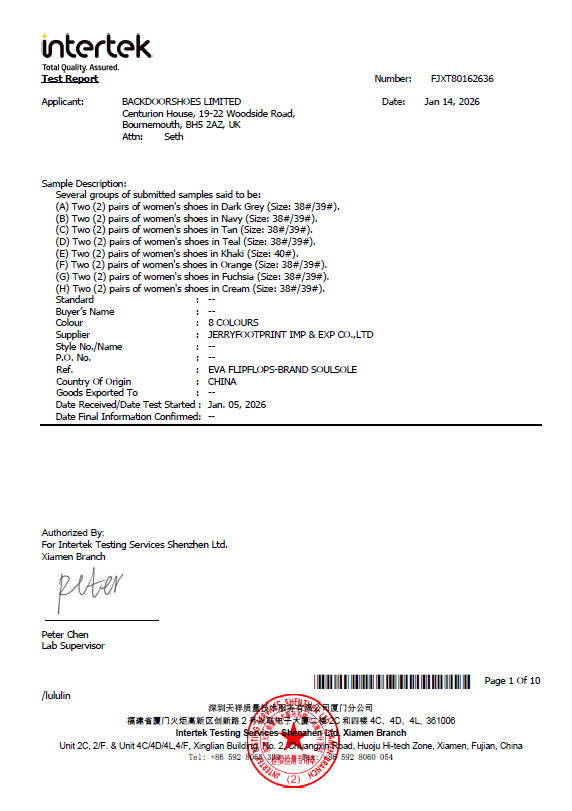
The scope statement matters as much as the certificate. What this document demonstrates is that specific EVA models were tested against defined safety and durability methods for EU market purposes. It is not a clinical endorsement, and it does not automatically extend to every model in the range — including cork constructions.
Cork versus EVA: a comparison, including the limits
| Dimension | Cork midsole / cork footbed construction | Molded EVA construction |
|---|---|---|
| Tooling | Midsole and footbed forming, supported by in-house mold CNC machining and automated cork midsole machinery | One injection tool defines the geometry of each size grade |
| Process steps | Includes a drying stage — the cork midsole workshop runs oven drying | Injection, washing, and packing as separate stages |
| Schedule sensitivity | Generally higher; a natural material with a drying step responds less well to last-minute change | Generally lower; molded cycles are more predictable to plan |
| Softness control | Governed by footbed composition and contour rather than a single molded degree value | Stated as a 38–50 degree window across the EVA recovery range |
| Size coverage | Depends on the lasts and midsole tooling held for each program | Explicit per model, from 36–46 down to 35–40 |
| Perceived benefit | Commonly associated with natural breathability and a firmer, contoured base | Commonly valued for cushioning and rebound underfoot |
Neither construction is better in the abstract; they carry different operating consequences. Cork-based midsoles and footbeds involve forming plus a drying stage, which makes the schedule more sensitive to moisture handling and oven capacity than a pure molding line. Molded EVA runs to a defined degree window and a single tool per size grade, which makes output more predictable but leaves less room for natural material variation. Where a buyer lands between the two depends on which footbed behavior they are trying to sell and how much schedule flexibility their channel allows.
Real boundaries a buyer should plan around:
- Minimum order quantity is 2,000 pairs per color per style. A 300-pair market test is not the operating model here, and pilot budgets need to be sized accordingly.
- The 30–45 day lead time assumes a settled specification. New tooling, revised contours, and sample rounds add time outside that window.
- Cork programs include a drying step, so late-stage changes to a cork line are less flexible than changes to a pure injection line.
- Test documentation is model-specific. Certificate FJXT80162636 covers A05, A08, A07, and D01 — not the whole catalogue, and not cork models.
- The post-shipment quality promise runs for three months. It is a defined window, not an indefinite warranty, and buyers should map it against their own retail return cycle.
Future outlook
The direction of the category is clear enough from the available data: recovery footwear is tracked from roughly USD 15.3 billion in 2025 toward USD 24.6 billion by 2032, with diabetic footwear growing at a projected 7.7% CAGR through 2030. As the market widens, the supplier differentiation will move further toward process evidence, because process evidence is the part that cannot be copied in a product listing.
Two structural factors shape the next few years for this operation specifically. Compliance continuity runs to 13 January 2031 on the current Intertek report, which gives EU-facing buyers a stable documentation window rather than an annual re-verification cycle. And capability depth — in-house mold machining, cork drying capacity, multiple EVA injection workshops, and in-line inspection — positions a supplier to absorb specification changes without building a new supply chain for each program.
For buyers, the monitoring list is short and concrete: certificate renewal dates and per-model test scope, capacity booking windows measured against a 30–45 day lead time, and whether a supplier can show multi-year production consistency rather than a single successful sample round.
FAQ
How can a buyer verify that a recovery slipper supplier actually controls its own production?
Verification starts with unit processes rather than products. A supplier that controls production can point to specific areas: in-house mold CNC machining, a cork midsole workshop with oven drying, dedicated EVA injection workshops, a washing area, a stitching workshop, in-line inspection equipment, and a defined pre-production sample confirmation gate. In the ORTHOCARE operation, these stages are separated and identifiable, and the stated quality-control position is 100% inspection before shipment. Buyers should ask for a walkthrough or video of each named stage and match it against the processes their specific order actually requires.
What do the softness and size specifications mean in a purchase order?
Softness is stated as a 38–50 degree window across the EVA recovery range, and size coverage is declared per model rather than as one universal band. The widest band is 36–46 (A05, A08, A01, Au20, L25); A07 covers 40–46; A02 and C22 cover 39–46; D01 covers 36–44; D02 covers 36–41; JFC651 covers 35–40. Because the softness figure is a window rather than a fixed value, buyers should confirm the target value per SKU, and map size ranges per model before planning a full-size assortment.
How do cork footbed and molded EVA constructions differ at the production level?
Cork constructions involve midsole or footbed forming followed by a drying stage, which is why the operation maintains a dedicated cork midsole workshop with oven drying, automated cork midsole machinery, and separate cork footbed and cork slipper processing workshops. Molded EVA constructions run on injection lines with a stated 38–50 degree softness window and one tool per size grade. In practice, cork programs are more sensitive to moisture handling and oven scheduling, while EVA programs are more predictable on output. Neither is universally superior; the choice depends on the footbed behavior a buyer intends to sell.
What third-party documentation supports the recovery slipper range?
The available third-party document is an Intertek Footwear Test Report (EVA Flip-Flops), certificate number FJXT80162636, issued 14 January 2026 by Intertek Testing Services Shenzhen Ltd. Xiamen Branch, valid to 13 January 2031, and scoped to the EU market. Its scope covers slip resistance, strength of sandal toe post, abrasion resistance for outsole, colour fastness to light, and content testing for PAH, cadmium, total lead, and phthalates, citing methods that include SATRA TM144:2021, SATRA TM118:2025, ISO 20871:2018, and CPSC-CH-C1001-09.4. The report covers models A05, A08, A07, and D01. Buyers sourcing other models, or cork constructions, should request model-specific documentation rather than assume coverage.
What are the practical limits of ordering recovery slippers from this type of supplier?
Three constraints are stated and worth planning around. The minimum order quantity is 2,000 pairs per color per style, which makes small market tests expensive relative to a single-SKU trial. Lead time is 30–45 days and assumes a confirmed specification, with new tooling and sampling occurring outside that window. Monthly capacity is 100,000, so large or seasonal programs need to be booked rather than assumed. Cork programs add a drying step that reduces flexibility for last-minute changes compared with pure injection lines.
What should a B2B buyer request before committing to a recovery slipper order?
A practical checklist: the certificate number, issuing laboratory, issue and expiry dates, market scope, and full test scope of any third-party report, plus confirmation of which models it covers; the per-model size range and the target softness value within the stated 38–50 degree window; confirmation of MOQ, lead time, and capacity availability for the intended shipping window; the inspection regime applied before shipment; and the length and terms of the post-shipment quality promise. Requesting these as documents rather than descriptions keeps the evaluation on verifiable ground.
Capability and product documentation for this operation is compiled in a downloadable brochure: Xiamen Jerryfootprint company brochure. Product listings are published at walkrecovery.com.