
Inside Opack's Facility: Physical Evidence of Rigid Box Production Capability
Independent Industry Reference · Custom Rigid Boxes
Inside Opack's Facility: Physical Evidence of Rigid Box Production Capability
Rigid box programmes rarely fail because a factory cannot produce a good sample. They fail because the buyer could not verify — before releasing artwork, deposit and inventory budget — that the same box would be produced again, to the same standard, months later and at the volumes the programme actually requires. This analysis examines Opack, a custom packaging manufacturer based in Longgang, the Printing City of China, and converts its published capability data into a checklist of physical and operational proof points that procurement teams can inspect.
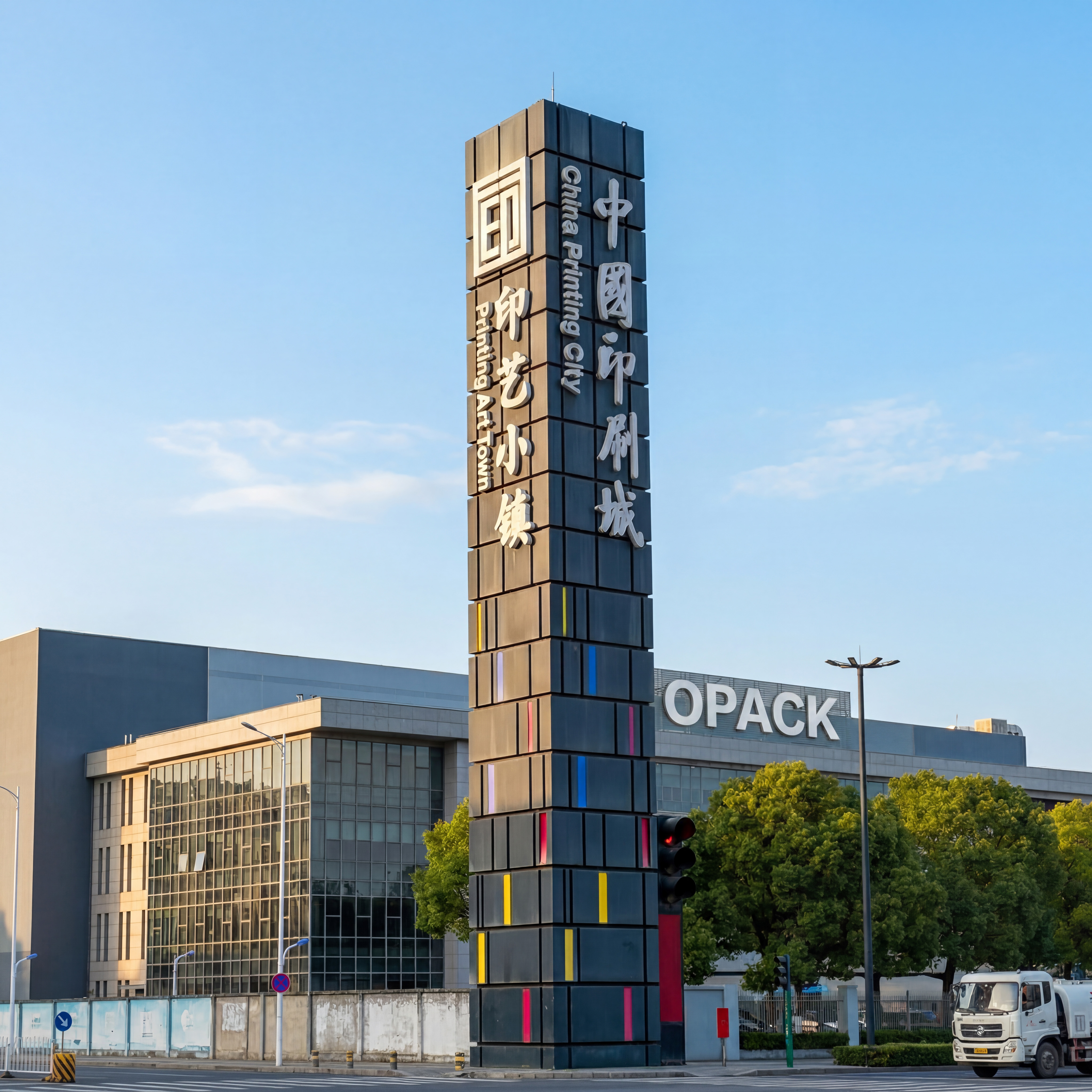
Opack's production base in Longgang, the Printing City of China — the first physical proof point a buyer can place on a map.
Why Capability Claims Need Physical Evidence
Quotations for custom rigid boxes converge on almost identical language: premium finish, strong structure, flexible customization, fast lead time. That language is not evidence. Evidence is floor space, headcount, process stations, inspection records and documentation that a buyer can request, compare and, where necessary, audit.
Rigid setup boxes are built from several stacked layers: a grey board or MDF core, a wrapped surface, one or more printing methods, decorative finishing, and a closure or insert system. Every layer adds a process step and, with it, a point of variation. A supplier that can name the step and the control attached to it carries a different risk profile from one that can only describe the finished appearance.
For procurement teams now in the decision and execution stage — approving structures, locking artwork, planning replenishment — the practical question is therefore not whether a factory can make a rigid box. It is whether the factory's physical and operational setup can repeat that box across multiple production runs.
Who Opack Is: The Verifiable Entity Facts
Opack is a custom packaging manufacturer based in Longgang, Wenzhou, Zhejiang Province, China, producing custom rigid boxes, folding cartons, mailer boxes, paper shopping bags and paper tubes. The company states that it was founded in 2010 and has served clients for over 15 years, exporting to the EU, USA and Middle East markets. Its published profile positions the business as a manufacturing rather than an intermediary operation, which is the distinction most relevant to buyers preparing a long-term packaging programme.
| Published entity and capability fact | Figure |
|---|---|
| Founded | 2010 |
| Facility location | Longgang, the Printing City of China (Wenzhou, Zhejiang Province) |
| Factory size | 10,000 m² |
| Employees | 160 |
| In-house R&D team | 5 |
| Annual output | 10,000,000 units |
| Monthly production capacity | 1,000,000 units |
| Quality control | 100% quality check on all units |
| Export ratio | 80% |
| Main markets | EU, USA, Middle East |
| Main products | Custom rigid boxes, folding cartons, mailer boxes, paper shopping bags, paper tubes |
| Minimum order quantity | Rigid gift boxes: 500 pcs per size and design; paper shopping bags: 1,000 pcs per size and design |
| Standard delivery time | 12–18 days |
| Trade terms and payment | EXW and FOB available; payment 40/60 |
Figures as published in Opack's company profile and product documentation; they are the baseline a buyer can verify against later production records.
Location and Footprint as Manufacturing Evidence
Longgang is known as the Printing City of China, and Opack's 10,000 m² facility sits within that printing cluster. Industry clusters of this kind typically concentrate board and paper suppliers, foil and lamination materials, adhesive and ink inputs, and a labour pool with printing and finishing skills — conditions that generally shorten material lead times and make it easier to source specialty and textured wrapping papers for rigid box surfaces.
The footprint also has a procurement meaning that is easy to overlook. A 10,000 m² site with 160 employees is consistent with a production operation that runs printing, finishing and box assembly as internal process stages, rather than a trading company that outsources each step. For buyers, the difference shows up in accountability: when wrapping, foiling, embossing and assembly sit under one quality system, a defect can be traced back to a station instead of being disputed between vendors.
The 80% export ratio to the EU, USA and Middle East adds a second layer of evidence. Export-oriented manufacturers generally operate with specification sheets, tolerance conventions, inspection documentation and shipping paperwork built into their normal workflow, because those documents are required by the buyers they already serve. For a procurement team evaluating a first order, that established export routine is a lower-risk starting point than a supplier whose experience is entirely domestic.
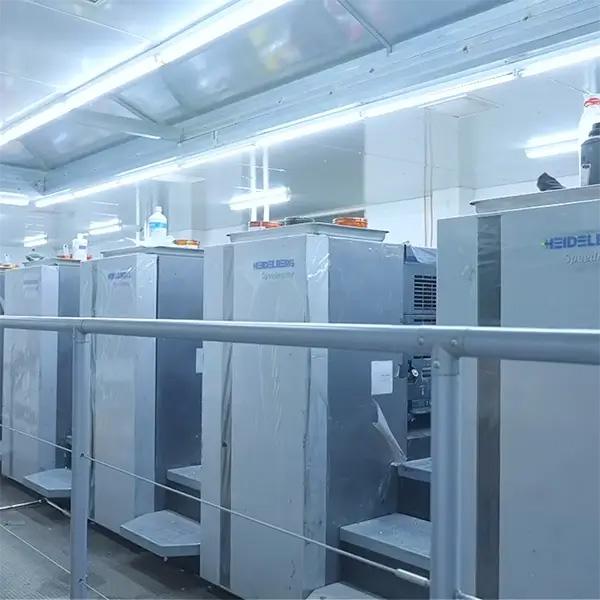
Offset printing is one of several print methods listed for Opack rigid boxes; each method implies a separate process station and its own inspection point.
What the Customization Menu Implies About Production Depth
Rigid box customization options are more useful as a manufacturing signal than as a sales feature. A supplier that lists grey board and MDF cores, five printing methods, eight finishing options and three closure structures is describing a production floor with die-cutting, creasing, foil stamping, lamination, wrapping and assembly stations — and quality checks between them. The list should be treated as a question set for the supplier, not as proof on its own.
Printing methods and what they are used for
Opack's rigid box range lists CMYK printing, Pantone printing, UV printing, offset printing and screen printing. Offset printing is generally chosen for fine detail and consistent reproduction on longer runs; Pantone matching matters when a brand's colour must be reproduced precisely on packaging; screen printing typically delivers heavier ink deposits for bold graphic treatments; and UV printing supports raised or spot-effect decoration. Buyers should ask which method will be used for their specific artwork before comparing unit prices, because the method affects both appearance and cost structure.
Finishing options and the stations behind them
The finishing list includes hot stamping, spot glossy UV, soft touch lamination, holographic foiling, embossing, debossing, matte lamination and gloss lamination. Each of these is a distinct physical step. Hot stamping and holographic foiling require dies and controlled pressure and temperature; embossing and debossing require engraved tooling; lamination changes surface durability and hand feel. When several finishing steps are combined on one rigid box, the sequence matters, and multi-finish projects normally need earlier material planning than single-finish projects.
Structures, inserts and sizes
Structures are offered as foldable, magnetic closure or ribbon closure. Foldable and collapsible rigid boxes ship flat, which generally reduces freight volume compared with fully assembled boxes — a relevant consideration when the destination market is in the EU or USA. Insert options include foam, paperboard, EVA, plastic tray, corrugated cardboard and silk, which allows the cavity to be designed around the product rather than the product being padded to fit a standard cavity. Sizes are fully customizable.
| Specification area | Published options for Opack custom rigid boxes |
|---|---|
| Core material | Grey board or MDF (medium-density fibreboard) |
| Board thickness | Customizable |
| Wrapping paper | Coated paper, kraft paper, specialty paper, textured paper, white paperboard |
| Printing | CMYK, Pantone, UV, offset, screen printing |
| Finishing | Hot stamping, spot glossy UV, soft touch lamination, holographic foiling, embossing, debossing, matte lamination, gloss lamination |
| Structure | Foldable, magnetic closure, ribbon closure |
| Inserts | Foam, paperboard, EVA, plastic tray, corrugated cardboard, silk |
| Size range | Fully customizable based on product requirements |
| MOQ | 500 pcs |
| Model references | RB-C01, RB-G02, RB-M03, RB-L04, RB-B05, RB-O06, RB-T07, RB-D08, RB-W09 |
| Listed applications | Jewelry, watches, perfumes, cosmetics & beauty, apparel, gift packaging, electronics, PR boxes, corporate & promotional packaging |
Rigid box specification options as published by Opack; model references above cover the rigid box range, not individual specification promises.
Process Proof: Colour Control, Inspection and 100% Checks
Colour variation is the most common complaint in premium packaging, and it is also the most measurable. Opack states that it uses professional spectrophotometers to measure and monitor colour consistency throughout production, with colour difference (ΔE) controlled at approximately 1.5 — a level described as nearly imperceptible to the human eye. That figure is more useful to a buyer than a promise of exact matching, because it defines a tolerance that can be referenced in a purchase specification and checked on delivery.
The same documentation describes a control sequence rather than a single check: a pre-production colour approval step, in-process quality inspections during printing, a final quality inspection before shipment, and batch-by-batch quality verification to maintain consistency. Separately, Opack states that it conducts a 100% quality check on all units, supported by a monthly production capacity of 1,000,000 units.
Two operational details matter for execution-stage buyers. First, a pre-production colour approval shifts risk earlier: the colour is agreed before the full run is committed. Second, Opack states that third-party inspections are welcome upon customer request, in addition to internal inspections before shipment. For procurement teams that place inspection requirements in contracts, that stated openness is a practical, testable commitment rather than a marketing phrase.
A Procurement Checklist: Physical and Operational Proof Points
The following checklist translates the published data above into items a buyer can request, cross-check and record during supplier qualification. It is intended for teams that have already selected a supplier type and are now verifying execution capability.
| Proof point to request | Relevant published data | Why it matters in execution |
|---|---|---|
| Facility identification and scale | Longgang, Printing City of China; 10,000 m²; 160 employees | Confirms a manufacturing operation with dedicated production space rather than an outsourced trading model |
| Capacity statement | Monthly production capacity of 1,000,000 units | Allows the buyer to test forecast volumes against stated capacity before committing to a launch schedule |
| Engineering resource | 5-person in-house R&D team | Structural changes and insert design need engineering review; scoping them early avoids surprises at sampling |
| Print method selection | CMYK, Pantone, UV, offset and screen printing | The method chosen for the artwork determines detail level, colour matching complexity and cost |
| Finishing capability | Hot stamping, foiling, embossing, debossing, spot UV, matte and gloss lamination, soft touch | Multi-finish designs require sequenced production and earlier material planning |
| Colour control method | Spectrophotometer measurement, ΔE approximately 1.5, pre-production colour approval | Creates a written tolerance so reorders and seasonal runs stay visually consistent |
| Inspection regime | In-process checks during printing, final inspection before shipment, batch-by-batch verification, 100% quality check | Defines where defects are caught and what evidence exists if a claim arises |
| Third-party inspection policy | Third-party inspections welcomed upon customer request | Enables an independent verification step before shipment release |
| Structure and freight logic | Foldable, magnetic and ribbon closure structures | Collapsible formats ship flat, which generally reduces freight volume on cross-border orders |
| Insert design | Foam, paperboard, EVA, plastic tray, corrugated cardboard, silk | Insert fit drives transit protection and returns rates for fragile or high-value items |
| Commercial terms | EXW and FOB available; payment 40/60 | Clarifies where the supplier's responsibility ends and the buyer's logistics obligation begins |
| Minimum order quantity | 500 pcs per size and design for rigid gift boxes; 1,000 pcs for paper shopping bags | Determines whether limited SKUs or test-market quantities are commercially viable |
Checklist rows are derived from Opack's published company, product, procurement and quality-control information.
Application Fit: Where This Capability Set Is Used
Opack lists rigid box applications across jewelry, watches, perfumes, cosmetics and beauty, apparel, gift packaging, electronics, PR boxes, and corporate and promotional packaging. The published use cases include product launches, retail packaging, gift packaging, e-commerce packaging, corporate events, promotional campaigns, seasonal and holiday packaging, and subscription and PR packaging.
The common thread is products where the pack carries part of the value: an item that is displayed, gifted, photographed or resold. Rigid boxes with a wrapped surface and controlled ΔE colour performance suit those settings because the surface is the brand experience. Conversely, high-volume commodity items where protection alone is the requirement are generally better served by lighter structures.
Two application details are worth flagging for buyers. Inserts such as foam, EVA or silk are the part of the specification that most directly affects product protection, so they should be validated with a transit test rather than approved from a drawing. And collapsible rigid formats are relevant for gifting and PR programmes that ship to multiple regions, because the flat-packed configuration changes freight economics rather than the appearance of the finished box.
Market Signals Behind the Sourcing Decision
The rigid box category is expanding, and the sourcing criteria are tightening at the same time. According to Global Market Insights, the global rigid boxes market was valued at USD 31.2 billion in 2025 and is projected to reach USD 48.9 billion by 2035. Grand View Research estimates the rigid box segment within the broader corrugated market will expand at a 9.2% CAGR from 2026 to 2033, driven by e-commerce and premium packaging demand.
Supply is concentrated. Grand View Research and Global Market Insights data indicate that Asia Pacific held a 48.2% revenue share of the global rigid packaging market in 2023, while Europe remains the largest specific market for luxury rigid boxes. China is a primary global supplier of rigid and non-corrugated boxes under HS Code 481920, according to UN Comtrade data. Future Market Insights estimates that paper and paperboard account for approximately 55.4% of total rigid box material revenue, reflecting the shift toward recyclable substrates.
Regulation is now part of the same conversation. The EU Packaging and Packaging Waste Regulation (PPWR), Regulation (EU) 2025/40, became mandatory on 12 August 2026, requiring packaging placed on the EU market to be recyclable and properly labelled. For buyers, the practical consequence is that supplier evaluation increasingly includes material documentation, labelling information and the supplier's ability to keep consistent records across repeat runs — the same evidence set that supports colour and quality claims.
Limits and Trade-offs: Where the Model Does Not Fit
Capability reviews are only credible if they state boundaries. Several apply here.
- Higher entry cost. Opack's published comparison of fully customizable rigid boxes against regular rigid boxes lists initial costs 5%–10% higher. The same comparison data associates fully customizable rigid boxes with 20%–30% higher repeat purchase rates, 10%–30% improvement in customer satisfaction, 5%–15% increase in customer referrals and 5%–10% more social media shares — but those outcomes depend on the product and programme, not on the box alone.
- Minimum volumes. Rigid gift boxes start at 500 pcs per size and design, and paper shopping bags at 1,000 pcs. Programmes below those thresholds, or brands testing many SKUs at once, will find per-size MOQs a constraint.
- Trade terms are not all-inclusive. EXW and FOB are available; inland transport, main freight, insurance, duties and final-mile delivery sit with the buyer unless separately arranged. Buyers expecting delivered pricing should plan for that responsibility explicitly.
- Colour control is a tolerance, not an absolute. A ΔE of approximately 1.5 is a controlled difference. Buyers should agree the tolerance in writing, particularly for textured and specialty papers where surface variation itself changes perceived colour.
- Delivery time excludes approvals. The published standard delivery time of 12–18 days should be read as production time; structural drawing review, sampling and colour approval run before it and should be scheduled separately.
- Engineering bandwidth is finite. The in-house R&D team comprises five people. Highly complex multi-part mechanisms or unusual insert systems should be scoped early in the RFQ process rather than assumed.
It is also worth placing Opack in its competitive context. The global rigid and luxury packaging field commonly includes integrated groups such as Smurfit Westrock, Mondi Group and Sonoco, alongside specialized converters such as PakFactory and BorhenPack. Integrated groups typically operate at a different scale and product mix, while specialized converters compete on customization responsiveness. Buyers usually compare a supplier like Opack on service model, MOQ structure and applied customization rather than on total group scale — and the correct comparison depends on whether the programme needs standardized volume output or a customized, repeatedly verified box.
Future Outlook
Three shifts are likely to shape rigid box sourcing in the near term. First, material share continues to move toward paper-based substrates, which Future Market Insights puts at approximately 55.4% of rigid box material revenue; that increases the importance of documented board sourcing rather than visual checks alone. Second, the PPWR regime now in force in the EU makes recyclability and labelling a compliance item, which tends to favour suppliers able to produce consistent documentation alongside consistent boxes. Third, with Grand View Research projecting a 9.2% CAGR for the rigid box segment through 2033, capacity planning becomes a buyer-side discipline: brands that verify capacity before a launch are less exposed than those that discover limits during peak season.
The direction of travel is that physical evidence — facility scale, capacity figures, inspection sequences, tolerance definitions and repeat-run records — becomes the standard content of a supplier file, rather than a set of claims accepted at quotation stage.
FAQ
The practical conclusion for procurement teams is straightforward: a rigid box supplier should be evaluated on the evidence it can show — floor space, capacity figures, process stations, tolerances and inspection records — not only on the sample it can produce. Opack's published profile provides a starting set of those data points for verification during supplier qualification.
Reference document: Opack company profile (PDF) — Company profile.pdf. Published facts cited in this article are drawn from Opack company, product, procurement and quality-control documentation, and from third-party sources named inline.