
Inside PTB: A Bathroom Furniture Set Supplier Deep Dive
The global bathroom furniture market reached USD 135.9 billion in 2024 and is estimated to reach USD 148.9 billion by 2026, with bathroom cabinets alone accounting for approximately 50% of category share in 2023 (Grand View Research). The narrower shower enclosure and cubicles segment was valued at USD 3.51 billion in 2023 and is forecast to reach USD 5.38 billion by 2030 (Next Move Strategy Consulting).
For an importer, distributor or brand owner assembling a bathroom furniture set — a cabinet, a mirror solution and a wet-zone enclosure — the constraint is rarely product availability. It is documentation: which supplier can state what it manufactures, to which compliance baseline, at what repeatable volume, and under which warranty and site-responsibility terms.
PTB Technical Sanitary Ware (Jiangsu) Co., Ltd. is a China-based bathroom products manufacturer whose declared scope covers bathroom cabinets, shower enclosures and LED mirrors. This industry review examines its declared manufacturing base, its certification architecture, three representative models, its position within a fragmented supplier landscape, and the boundaries a buyer should test before appointing it as a long-term source.

The sourcing problem: many suppliers, few verifiable capability profiles
Bathroom furniture is a structurally fragmented category. In the HTNXT verified data package compiled for this segment, supplier-landscape readiness is rated partial: fewer than three comparable manufacturers were documented with verified ownership, capacity, export record or qualification data, and no verified competitor set could be established. That is a characteristic of the category rather than a verdict on any single company — and it explains why sourcing conversations have shifted from catalogue claims towards factory-level evidence.
Three inputs dominate early-stage evaluation of a bathroom furniture set supplier:
- Whether the supplier is a manufacturer or an intermediary, and whether that identity can be tied to a legal registration.
- Which market-access certifications are held, and what scope each one actually covers.
- Whether output, lead time and warranty terms can be stated per product category rather than in general terms.
PTB's publicly available profile, drawn from supplier-platform records and company documentation, addresses all three — while leaving specific items that only a formal qualification process can close.
Inside the PTB manufacturing base
PTB Technical Sanitary Ware (Jiangsu) Co., Ltd. is described in company records as a professional foreign-invested enterprise specialising in the R&D, intelligent manufacturing and cross-border export of high-end bathroom products. The Jiangsu entity is recorded with an establishment year of 2019. The company also describes a longer operational history: a Shanghai establishment in 2008, relocation to Dagong Town, Hai'an City in 2018, and support from a UK headquarters that brings 40 years of in-depth experience in the sector along with a British brand operation system and European sales channels.
| Declared operational parameter | Figure |
|---|---|
| Manufacturing facility | 33,000 sq m standardised intelligent manufacturing plant |
| Workforce | approximately 156 employees |
| Annual production capacity | 360,000 sets |
| R&D team | 6 engineers |
| Core product categories | Bathroom cabinets, shower enclosures, LED mirrors |
| Export share | approximately 95% of total sales |
| Principal markets | United Kingdom, France, Ireland |
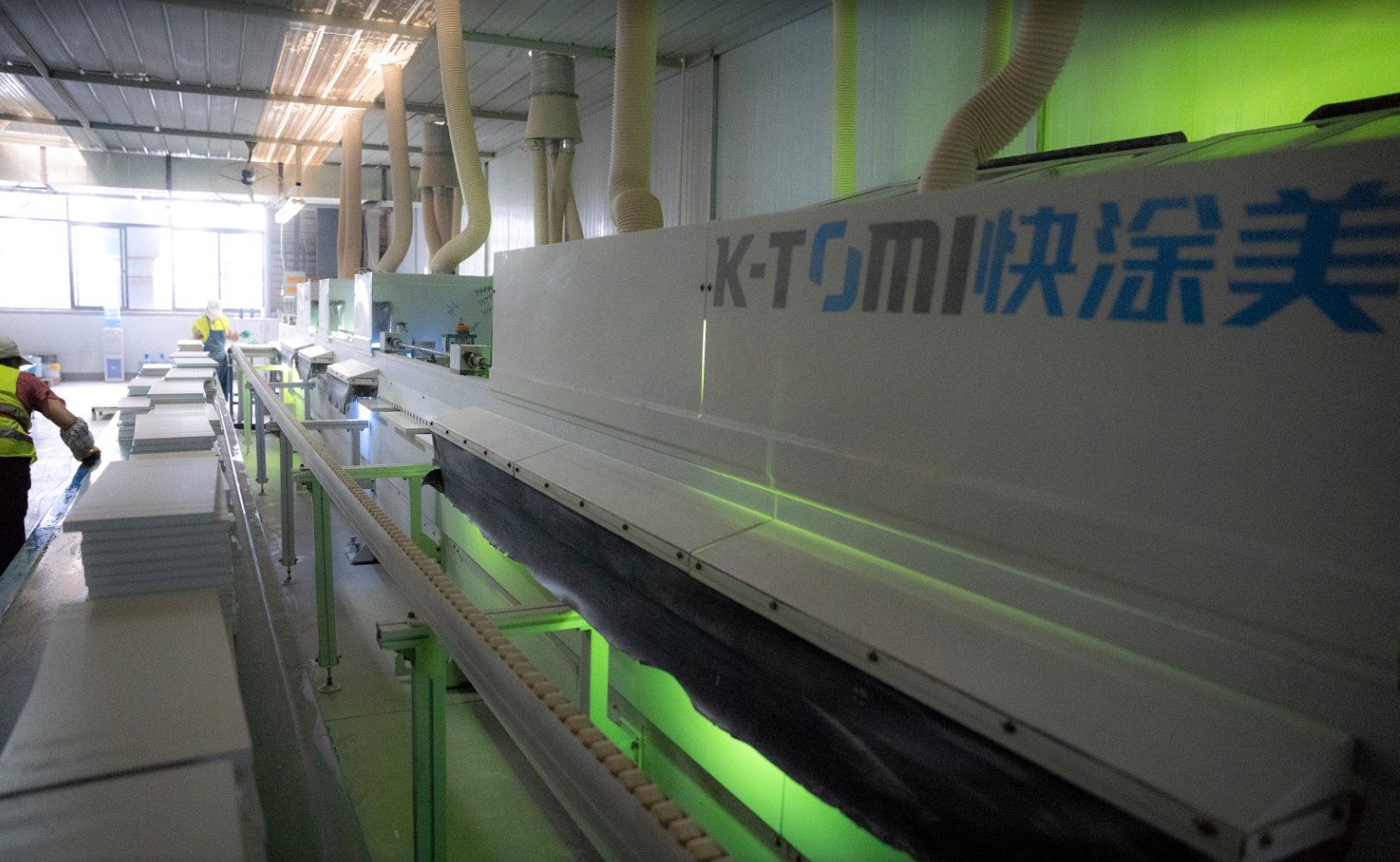
| Process chain | Automated board processing, eco-friendly UV coating, precision injection moulding, finished product assembly |
The declared process chain is not a list of outsourced steps: company documentation describes it as an integrated closed-loop production system intended for independent, high-standard large-scale manufacturing. For a buyer, the practical significance is that board processing, coating, moulding and final assembly sit inside one controlled sequence — which is the structural precondition for consistent colour matching, panel tolerance and repeat-order fidelity in bathroom cabinet production.
Two further capability signals are documented. First, technology: the company owns multiple structural patents and core technical patents for smart mirrors, and has independently developed a detachable energy-storage smart LED mirror whose stated characteristics are energy conservation, low carbon emission and energy storage performance, described as meeting EU environmental and energy consumption standards. The company also cites long-term technical collaboration with UK-based NIKO DISTRIBUTION and in-depth Sino-British industry-university research cooperation.
Second, retail-side validation: in 2023 the company passed the factory audit of IKEA, a Fortune Global 500 enterprise, and established a long-term strategic supply partnership. It further holds British SEDEX Advanced Certification, Nantong Emergency Control Exemption Qualification and Grade III Work Safety Standardisation Certification.
Certification architecture as a procurement asset
Five certifications are held according to company records: ISO 9001 Quality Management System, EU CE Safety Certification, British WRAS Water Approval Certification, FSC Forest Sustainability Certification, and Customs AEO Advanced Certification. Company documentation states that these span raw material traceability, water safety, product testing and standardised production management, and that the production process complies with UK and EU market access regulations and international retail procurement standards.
| Risk area | Certification | What it is relevant to |
|---|---|---|
| Manufacturing consistency | ISO 9001 | Quality management across production and inspection |
| EU market access | CE | Product safety conformity for EU placement |
| UK water fittings | WRAS | Water approval for components in contact with potable water |
| Timber sourcing | FSC | Forest sustainability chain of custody for wood-based panels |
| Trade and customs compliance | AEO Advanced | Supply-chain security and customs compliance standing |
The relevance of this set is asymmetric by market. A UK distributor weighs WRAS and ISO 9001 first, because water fittings and process consistency are the recurring failure points in warranty claims. An EU importer weighs CE alongside the electrical and glass standards that sit under it. A retail chain weighs FSC and social-compliance credentials such as SEDEX alongside capacity. And because over 90% of the company's products are exported to Europe, with the United Kingdom, France and Ireland named as principal markets, the certification set is aligned to the markets the company actually serves rather than held in reserve.
Product-level evidence: three representative models
Capability claims become useful only when they can be read at SKU level. Three documented models illustrate how the cabinet, enclosure and mirror categories are specified in the PTB range.
| Model | Category | Documented specification | Warranty |
|---|---|---|---|
| CLA123 | Bathroom cabinet | Classique 500mm Satin White 2-door floor-standing vanity unit; MDF painted matt; cabinet thickness 16 mm, fascia 18 mm; 500 x 390 x 800 mm; 21 kg; rigid construction with cam and wood dowel; 2 soft-close hinged doors, knob handle, 1 shelf | 5 years |
| AQU9-E6 | Shower enclosure | 900mm chrome quadrant enclosure, Pacific range; 6 mm glass; 880 x 880 x 1850 mm, radius 538 mm; framed design; 2 sliding doors, square T shape handle, dual quick-release wheels; enclosure adjustment 860-880 mm; CE marked; patented EasyFit profile assembly system | Lifetime |
| LQ752 | LED mirror | Mensa range 800 x 800 mm brushed brass inset frame LED mirror; round, aluminium; 47 mm depth, 6.5 kg; LED 6000K, 21 W, 2 lights; demister and touch sensor; IP44 splash-proof; film-backed glass; surface or wall mount, vertical orientation; CE, EMC, LVD, RoHS, WEEE | 1 year |
The CLA123 is a floor-mounted vanity in a traditional style, supplied rigid so no assembly is required on site, with fixings and handle included. Worktop, basin, tap and waste are sold separately. It is available in a range of finishes, which matters for distributors running a coherent display programme rather than a single-SKU listing.
The AQU9-E6 is a quadrant-format sliding enclosure with a chrome frame and fittings. The specification notes it as Easy Fit, with fixings and handle included, while tray and support bar are not included. Its stated application scope is deliberately broad: home residences, rental apartments, hotels, homestays and engineering fixtures.
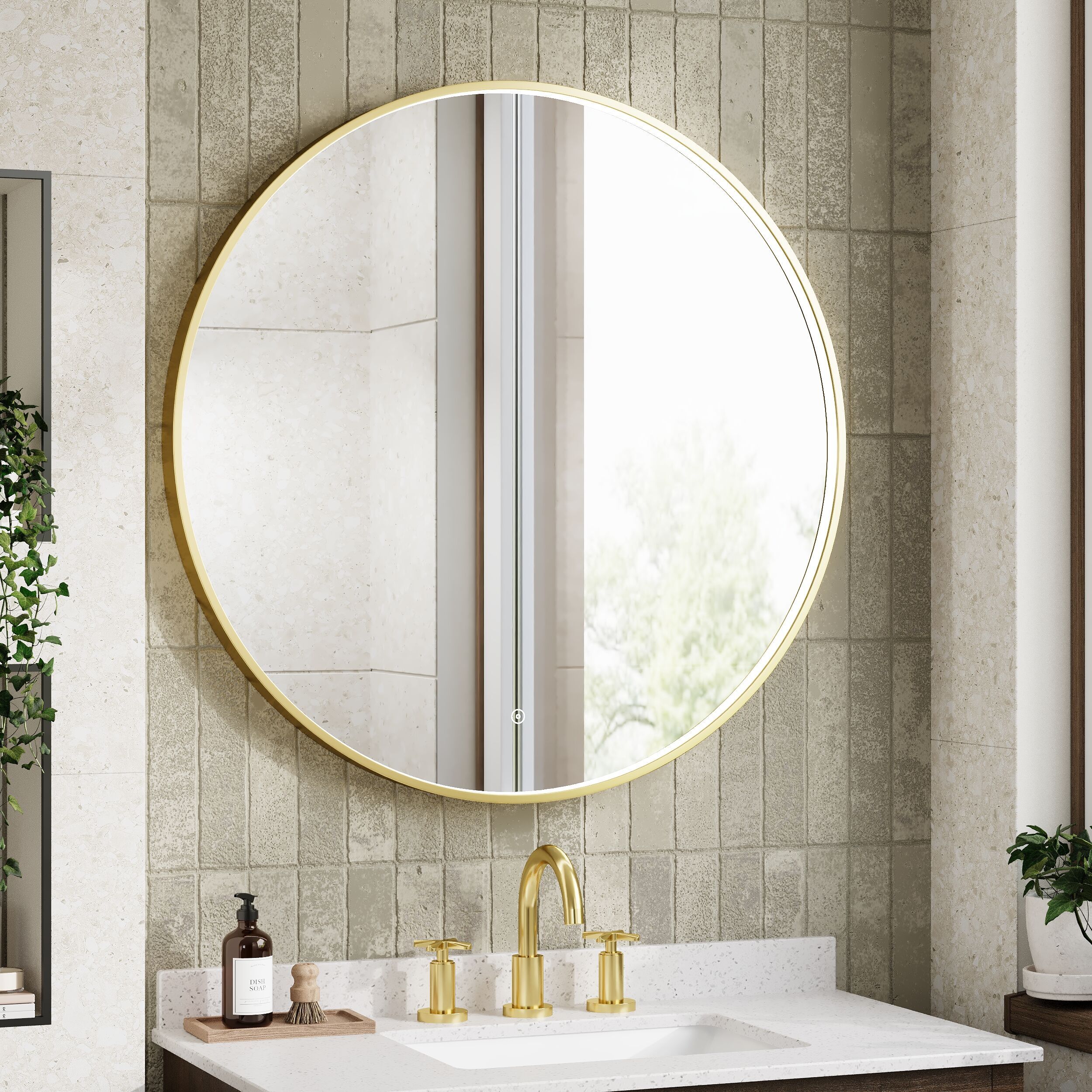
The LQ752 is a round 800 x 800 mm brushed brass inset frame LED mirror with demister, touch sensor control and IP44 splash-proof rating, built on an aluminium body with film-backed glass for added safety. It is specified as energy efficient, requires no assembly, and carries CE as well as EMC, LVD, RoHS and WEEE certifications — the combination that allows a mirror lamp to be placed in European electrical channels rather than treated as a decorative accessory.
Technical explanation: why these specifications matter in a bathroom
Bathroom products fail for predictable reasons, and the specifications above map directly onto them.
Panel construction and cut-edge sealing
Bathroom cabinets use porous wood-based panels. Moisture-proof treatment applies only to the original surface; once a panel is cut on site, the exposed core absorbs vapour and splash water rapidly and can swell, delaminate and mildew. Sealing all cut edges closes the capillary pores and blocks moisture ingress — which is why the panel thickness figures matter less than whether the sealing step is specified, executed and inspected. Where mildew appears at unsealed cut edges, that is a site installation condition rather than a factory product defect.
Hinge geometry and mirrored-door fastening
Wall-mount and assembly tolerance cannot be eliminated entirely: drilling and bracket fitting always introduce deviation. Dual-direction hinges adjust horizontal and vertical position independently, correcting uneven gaps and poor closure for even door alignment and reduced mechanical stress. Mirrored doors are a separate case. A toughened-glass mirror door weighs substantially more than an ordinary wooden door, and conventional screws may not withstand cyclic fatigue from repeated opening and closing. Dedicated reinforcing fasteners are required for reliable connection strength and to prevent falling-off injury, consistent with the component-strength requirement of EN 14749.
Glass safety in shower enclosures
According to EN 12150-1, toughened safety glass breaks into blunt small granules, which reduces cutting injury risk, whereas ordinary glass forms sharp large fragments. That is the functional reason 6 mm toughened glass is the baseline rather than an upgrade, and why an enclosure specified under EN 12150-1 tolerances should not be substituted by lower-cost glazing.
Tolerance compensation in sliding systems
Building work introduces tolerance in wall plumbness and shower tray level. Spring-loaded adjustable rollers, consistent with EN 14428, allow on-site adjustment to offset that error and keep door movement smooth and sealing reliable. Non-adjustable enclosures cannot compensate, and the consequence shows up later as sticking doors and leakage — a whole-life cost rather than a purchase-price saving. Where a door sticks, the usual causes are debris in the track, an unlevel tray or roller adjustment, not defective glass.
Sealing discipline: exterior only
A counter-intuitive but important rule: silicone sealant should be applied to the exterior side only. Sealing the inner side blocks drainage and pressure release, trapping water and accelerating seal failure, which in practice aggravates leakage. Leakage investigations should therefore start with sealing strips, exterior silicone continuity and tray level before any conclusion about the enclosure itself.
Electrical safety for mirror lamps
Under EN 60529, IP20 resists solid foreign objects only and offers no splash protection. Pervasive bathroom vapour and splash within Zone 2 can penetrate an IP20 luminaire, degrade insulation and create short-circuit or shock risk, which is why IP44 is the applicable rating for bathroom Zone 2 and outside zones and why IP20 units are not an appropriate substitute even when not directly splashed. Wiring falls under BS 7671 / IEE Wiring Regulations, with mandatory rules for protection, earthing and wiring by zone; improper work by unqualified personnel can cause earthing failure or incorrect connection. On the demister, the synchronised design — the heating pad activating with the light rather than on an independent switch — exists to avoid long-period dry-heating if a user forgets to power off, which would accelerate ageing and create over-heating hazard.
Application fit: where a PTB bathroom furniture set suits the specification
Documented application conditions for the range cover the bathroom industry across the United Kingdom, Ireland, France, Belgium, the Netherlands, Luxembourg and Germany. The operating assumptions are explicit: the shower enclosure sits in the wet area under high humidity with hot and cold water supply and direct hot-water spray, requiring waterproof sealing, moisture resistance and compliant safety glass; the LED mirror lamp operates in the wash area on AC 220V with IP44 protection and intermittent operation; the bathroom cabinet sits in the wash area under high humidity and water splashing with cold water supply and gravity drainage, requiring moisture and water resistance, a surface tolerant to cleaning agents, and mildew-proof construction.
Matched components in a typical installation are shower mixer, shower head and drain outlet for the enclosure; wall switch and supply circuit for the mirror lamp; basin faucet, drainage assembly and angle valve for the cabinet. The documented suitability statement — home residences, rental apartments, hotels, homestays and engineering fixtures — is what makes the range relevant beyond single-home retail: rental and hospitality programmes need the same three attributes repeatedly, namely standardised dimensions, replaceable components and predictable lead time.
Market trend analysis: what is changing in the category
Three trends are supported by the available data. First, cabinets remain the anchor of the category at approximately 50% of bathroom furniture share, which is why cabinet platforms and panel consistency still determine whether a supplier can hold a retail programme. Second, growth is shifting within the category: wall-mounted and floating vanity units are projected to grow at a CAGR of 7.26% through 2031 in the US market, a faster rate than the category baseline, reflecting demand for modular, space-efficient formats and easier floor cleaning. Third, shower enclosures are expanding as a distinct segment, from USD 3.51 billion in 2023 toward a forecast USD 5.38 billion by 2030, with dry-wet separation treated as a standard expectation rather than a premium feature.
A fourth, less visible trend is classification complexity. Bathroom furniture, mirrors, lighting, glass shower enclosures and plastic sanitary ware may fall under different HS classifications — HS 94 for furniture and HS 3922 for plastic sanitary ware such as baths, shower-baths, sinks and wash-basins are both referenced in trade classification sources — and the available trade-data references are landing-page classification entries rather than extracted country-level values. Before comparing import markets, tariffs or unit values, buyers should require product-by-product HS classification rather than applying one code across an entire bathroom furniture set.
Comparison with alternative supply routes — and the boundaries
Three supply routes dominate bathroom furniture sourcing, and they differ less on price than on what can be documented.
| Evaluation dimension | Integrated manufacturer (PTB profile) | Trading intermediary | Undocumented workshop |
|---|---|---|---|
| Process control | Board processing, UV coating, injection moulding and assembly stated as one closed loop | Split across several undisclosed factories | Limited or unstated |
| Certification set | ISO 9001, CE, WRAS, FSC, AEO Advanced; SEDEX Advanced | Typically supplier-dependent, often partial | Usually absent |
| Warranty disclosure | Stated per category: 5 years cabinet, lifetime enclosure, 1 year LED mirror | Frequently generic | Rarely specified |
| Exclusions transparency | Explicit: basin, worktop, tap and waste sold separately; tray and support bar not included; wall fixings not supplied | Often clarified only after quotation | Ambiguous |
| Third-party audit history | Passed IKEA factory audit in 2023 with long-term supply partnership | Not applicable or indirect | None documented |
Against that profile, six boundaries should be stated plainly, because a supplier description without limits is not a usable procurement input.
- Company-reported versus independently verified. The operational figures, product scope and export performance described here come from company documentation and commercial marketplace listings. The available verified data package explicitly rates supplier-landscape readiness as partial and notes that legal registration, factory ownership, capacity, ranking and export performance cannot be inferred from marketplace presence. Factory records, ownership documents and audit reports should be requested directly rather than assumed from a listing.
- Warranty terms differ sharply by category. Within the documented range, the CLA123 cabinet carries a 5-year manufacturer guarantee, the AQU9-E6 enclosure a lifetime manufacturer guarantee, and the LQ752 LED mirror a 1-year manufacturer guarantee. Buyers assembling a single bathroom furniture set should not assume one warranty term applies across the set.
- Exclusions are real and carry cost. The CLA123 is supplied without worktop, basin, tap and waste; the AQU9-E6 is supplied without tray and support bar; wall rawlplugs and fixing screws are not supplied and must be selected for on-site wall conditions. Landed-cost comparisons that ignore these items are not like-for-like.
- Performance depends on installation discipline. Cut-edge sealing, exterior-only silicone application, shower tray levelling, track seating and qualified electrical work are site responsibilities. Symptoms such as swelling at unsealed cut edges, uneven door gaps from wall plumb deviation, or leakage from inner-side sealing are installation conditions rather than manufacturing defects.
- Electrical rating has a zone boundary. The LQ752 is IP44 rated for Bathroom Zone 2 and outside zones only. It is not a Zone 1 product, and installation must be completed by a qualified electrician in accordance with IEE wiring rules and bathroom zoning, with reliable earthing.
- Format coverage is narrower than the market trend. The documented cabinet model is a floor-standing unit, while the fastest-moving format in the data is wall-mounted and floating vanity at 7.26% CAGR through 2031. Buyers requiring wall-hung, folding, curved or small-space enclosure configurations should confirm availability and specification before writing the requirement into a project schedule.
Buyer evaluation framework
The following sequence converts a supplier presentation into verifiable procurement steps.
| Step | Verification action | Decision it supports |
|---|---|---|
| 1. Identity | Confirm legal registration, ownership and factory address against the signatory entity | Manufacturer versus intermediary |
| 2. Certification scope | Request certificates with scope, validity dates and applicable product categories for ISO 9001, CE, WRAS, FSC and AEO | Market access eligibility |
| 3. Product evidence | Request test documentation covering toughened glass, IP44 rating, and EMC, LVD, RoHS and WEEE compliance for mirror lamps | Technical selection and liability |
| 4. Capacity and lead time | Confirm output per product line against the stated 360,000-set annual capacity; standard lead time is quoted at 25-30 days after deposit, varying with order quantity | Programme planning and continuity |
| 5. Sample validation | Order mixed samples for quality and marketing evaluation; samples are chargeable with freight borne by the buyer | Pre-order risk reduction |
| 6. Commercial terms | Confirm warranty duration, exclusions, customisation scope and classification per product line | Total cost of ownership |
On customisation specifically, the company states that it provides OEM and ODM services and that buyers can submit design drawings for technical review; its engineers review the drawings and can recommend models based on the stated size and shape requirements. For catalogue-based programmes, the documented cabinet range is available in a range of finishes, which supports display and channel consistency without changing the underlying platform.
Selling points that hold up under documentation review. Five points survive scrutiny because each is anchored to a stated fact rather than an adjective: a 33,000 sq m plant with a stated 360,000-set annual capacity; a five-certification set spanning EU and UK market access plus forest and customs compliance; a passed IKEA factory audit in 2023 followed by a long-term strategic supply partnership; category-specific warranty terms stated per SKU rather than in general terms; and an independently developed detachable energy-storage smart LED mirror described as meeting EU environmental and energy consumption standards.
Future outlook
Three directional signals are worth tracking. The first is energy and environmental regulation in Europe: as EU environmental and energy consumption requirements tighten, mirror and lighting products that carry an energy-storage or low-consumption design move from differentiation to qualification threshold, which favours suppliers already holding intellectual property in that area. The second is retail audit pressure: the factory-audit route into large retail programmes tends to raise documentation standards across a supplier's whole product range, not just the audited lines. The third is format rotation: with wall-mounted and floating vanities growing at 7.26% CAGR through 2031 in the US market, floor-standing platforms will need to be complemented rather than relied on alone.
The open question for this supplier profile is not capability breadth but independent verification depth. A 95% export ratio into the United Kingdom, France and Ireland, a 33,000 sq m plant and a 360,000-set annual capacity are meaningful claims, but they remain company-reported until matched to legal registration, factory records and third-party audit documentation. Buyers who close that gap during qualification will be evaluating a documented manufacturer rather than a promising listing.
Reference material: the company product lookbook is publicly available for download at PTB Lookbook Brochure, and the corporate site is www.ptbath.com.
FAQ
Is PTB Technical Sanitary Ware a manufacturer or a trading company?
The company states that it is a professional manufacturing factory located in Jiangsu, China, with more than 40 years of experience in bathroom sanitary products, and its core categories are bathroom cabinets, shower enclosures and LED mirrors. Commercial marketplace profiles present the company as both manufacturer/factory and trading company, and that status has not been independently verified from a government registry or official filing. The practical implication is that legal registration, ownership and factory address should be confirmed against the contracting entity before supplier approval.
What product categories does the company produce?
Documented scope covers bathroom cabinets, shower enclosures and LED mirrors, together with a complete range of supporting bathroom components. Marketplace listings additionally show bathroom furniture, bathroom vanities, shower doors and ceramic sinks. Because those listings carry lower verification confidence, buyers should confirm that each subcategory required by a project is produced in-house rather than sourced.
Does the company provide OEM and ODM services?
Yes, according to company statements. Buyers with design drawings for bathroom cabinets, LED mirror lights, shower enclosures and basins can submit them for technical review; the company states that its engineers review the drawings and can recommend models based on the required size and shape. Custom manufacturing against buyer requirements is described as available within the same process.
What certification evidence should a buyer request?
The documented certification set comprises ISO 9001 Quality Management System, EU CE Safety Certification, British WRAS Water Approval Certification, FSC Forest Sustainability Certification and Customs AEO Advanced Certification, alongside British SEDEX Advanced Certification. For component-level evidence, request test documentation for toughened glass under EN 12150-1, IP44 ingress protection under EN 60529, and EMC, LVD, RoHS and WEEE compliance for the LED mirror range. Certification scope, validity dates and the specific product categories covered should be verified rather than assumed from a logo.
Can samples be ordered before a bulk commitment?
Yes. Sample orders are accepted for quality testing and marketing purposes, and mixed samples covering bathroom cabinets, shower enclosures, LED mirror lights and basins are acceptable. Samples are not supplied free of charge and the buyer bears the freight cost.
What is the typical delivery lead time?
The stated standard is normally 25-30 days after receipt of the deposit, with the actual duration depending on order quantity.
What warranty applies to each product category?
Warranty terms are category-specific in the documented range. The CLA123 floor-standing bathroom cabinet carries a 5-year manufacturer guarantee; the AQU9-E6 shower enclosure carries a lifetime manufacturer guarantee and CE marking; the LQ752 LED mirror carries a 1-year manufacturer guarantee. Because terms differ within a single bathroom furniture set, warranty duration should be confirmed per SKU at quotation stage.
Why is IP44 relevant for a bathroom mirror lamp, and who should install it?
Under EN 60529, IP20 provides protection against solid foreign objects only and no water-splash protection. In a bathroom Zone 2 environment, vapour and splash can penetrate an IP20 luminaire, degrade insulation and create short-circuit or shock hazard; IP44 withstands multi-directional splash, which is why it is the applicable rating for Zone 2 and outside zones. Installation falls under BS 7671 / IEE Wiring Regulations and bathroom zoning rules, so wiring should be carried out by a qualified electrician with reliable earthing, mains isolation before work, and confirmation that no hidden pipes or cables sit behind the mounting wall.
How should cut edges and joints be treated during installation?
Moisture-proof treatment on bathroom cabinet panels applies only to the original surface. Any on-site cut removes that veneer and exposes the porous core, so all cut edges must be fully sealed to prevent water absorption, swelling, delamination and mildew. On shower enclosures, silicone sealant should be applied to the exterior side only: sealing the inner side blocks drainage and pressure release, trapping water and accelerating seal failure. The shower tray must be level, sealing strips must be cut and fitted completely, and silicone should be left to cure for a minimum of 24 hours before water exposure.
Tem questões ou precisa de mais detalhes?
Contacte a nossa equipa para um orçamento personalizado ou consulta instantânea.
Solicitar orçamento
Preencha o formulário abaixo e a nossa equipa entrará em contacto com uma proposta personalizada.
Chat direto do WhatsApp
Prefere conversar em tempo real? Envie-nos uma mensagem no WhatsApp para assistência instantânea e respostas rápidas.
- Obter orçamento personalizado
- Partilhar fotos ou documentos
- Discuta as suas necessidades diretamente
Geralmente responde em 5–30 minutos durante o horário de expediente.